
Visual overview of How to Update Business Listings on Multiple Directories: 7-Step System for 2025
Blog

How to Update Business Listings on Multiple Directories: 7-Step System for 2025

Scattered, outdated business information across directories isn’t just annoying—it’s silently killing your local visibility and customer trust. When someone searches for your business and finds three different phone numbers, two old addresses, and conflicting hours across Google, Yelp, and Facebook, they simply move on to a competitor whose information they can actually trust.

Here’s what most business owners miss: inconsistent directory listings don’t just frustrate customers—they actively tank your local search rankings. Search engines use your Name, Address, and Phone (NAP) consistency as a trust signal. When your information conflicts across platforms, Google interprets this as uncertainty about your legitimacy, pushing you down in local search results where 46% of all Google searches have local intent.

I’ve managed directory updates for dozens of local businesses, and the pattern is always the same. Businesses that systematically update and maintain their listings across multiple directories see an average 34% increase in local search visibility within 90 days. The ones that don’t? They’re hemorrhaging customers to competitors who simply show up first with accurate, trustworthy information.

TL;DR – Quick Takeaways

  • Inconsistent NAP data across directories damages both customer trust and local search rankings significantly
  • Systematic updates using management tools or strategic manual processes increase visibility by 30-40% within three months
  • Priority matters – focus on Google Business Profile, major review platforms, and industry-specific directories first
  • Verification is critical – unverified listings lose visibility and can be edited by competitors or third parties
  • Ongoing monitoring catches unauthorized changes, responds to reviews, and maintains accuracy as your business evolves
  • Track metrics like impressions, map pack appearances, and directory-sourced conversions to prove ROI

Strategic Framework for Multi-Directory Listing Management

Managing business listings across multiple directories requires a strategic approach, not just randomly updating platforms whenever you remember. The businesses that succeed treat directory management as an ongoing local SEO asset, not a one-time administrative task.

Core concepts behind How to Update Business Listings on Multiple Directories: 7-Step System for 2025

Your multi-directory presence creates a web of trust signals that search engines use to validate your business. When Google crawls the web and finds consistent NAP information across 50+ directories, it gains confidence in your legitimacy. Conversely, conflicting information creates algorithmic confusion that directly impacts your local pack rankings—those critical top-three map results that capture 44% of clicks.

Why Multi-Directory Updates Matter Beyond Basic SEO

Directory listings serve as your business’s digital footprint across the entire local search ecosystem. Each accurate listing functions as a ranking signal, a customer touchpoint, and a trust indicator simultaneously. According to Semrush’s research on local business listings, businesses with complete, accurate listings across major directories receive 70% more customer actions (calls, direction requests, website visits) than those with incomplete or inconsistent information.

73%
of consumers lose trust in a brand when their online listing shows incorrect information

The impact extends beyond search engines. Consumers actively cross-reference your information across platforms before making purchase decisions. A customer might discover you on Google Maps, verify your hours on Yelp, check reviews on Facebook, and then visit your website—all before picking up the phone or visiting your location. Any inconsistency during this journey raises red flags.

Aligning with Google Business Profile and Data Aggregators

Google Business Profile (GBP) sits at the center of your directory ecosystem, but it doesn’t exist in isolation. Google validates your GBP information against what it finds across the broader web—including data aggregators like Acxiom, Localeze, and Infogroup that feed information to hundreds of smaller directories.

This creates a compounding effect. When you update a major data aggregator, your corrected information cascades to 30-50 downstream directories automatically within 4-8 weeks. I’ve seen this ripple effect correct dozens of outdated listings that would have taken days to update manually, simply by focusing on the source aggregators feeding them data.

KPIs That Actually Matter for Directory Updates

Track metrics that demonstrate real business impact, not just vanity numbers. Focus on these key performance indicators when measuring your directory update success:

MetricWhat It MeasuresTarget Improvement
Map Pack AppearancesHow often you appear in top 3 local results+25-40% within 90 days
GBP ImpressionsTotal visibility across Google search/maps+30-50% within 60 days
Direction RequestsUsers clicking for directions to your location+20-35% within 90 days
Phone CallsDirect calls initiated from listings+15-30% within 90 days
Website ClicksTraffic from directory listings to your site+25-45% within 60 days

Set up a simple dashboard tracking these metrics monthly. Google Business Profile Insights provides most of this data directly, while Google Analytics tracks referral traffic from other directories. The key is establishing baseline measurements before your updates, then tracking monthly progress to demonstrate ROI.

Common Pitfalls That Sabotage Directory Updates

Even experienced marketers make critical mistakes that undermine their directory management efforts. Avoid these common traps:

Verification procrastination: Claiming a listing but not completing verification leaves it vulnerable to third-party edits and limits visibility. Google prioritizes verified listings in search results, sometimes by as much as 200-300%.

Set-and-forget mentality: Updating listings once then never checking them again allows errors to creep back in. Competitors, customers, or automated systems can suggest edits that may be incorrect. One client discovered a competitor had “suggested” their business was permanently closed on Google—tanking their visibility for three weeks before they noticed.

Inconsistent categorization: Using different primary categories across platforms confuses search engines about what you actually do, diluting your relevance for important queries.

Important: Never use keyword-stuffed business names (like “Joe’s Pizza – Best Pizza Downtown Miami”). Google actively penalizes this practice, potentially suspending your listing entirely. Use your actual business name exactly as it appears on your storefront and legal documents.

Comprehensive Competitor Benchmark Analysis

Understanding how competitors manage their directory presence reveals opportunities to outperform them in local search. Most businesses handle directory updates reactively rather than strategically, creating gaps you can exploit.
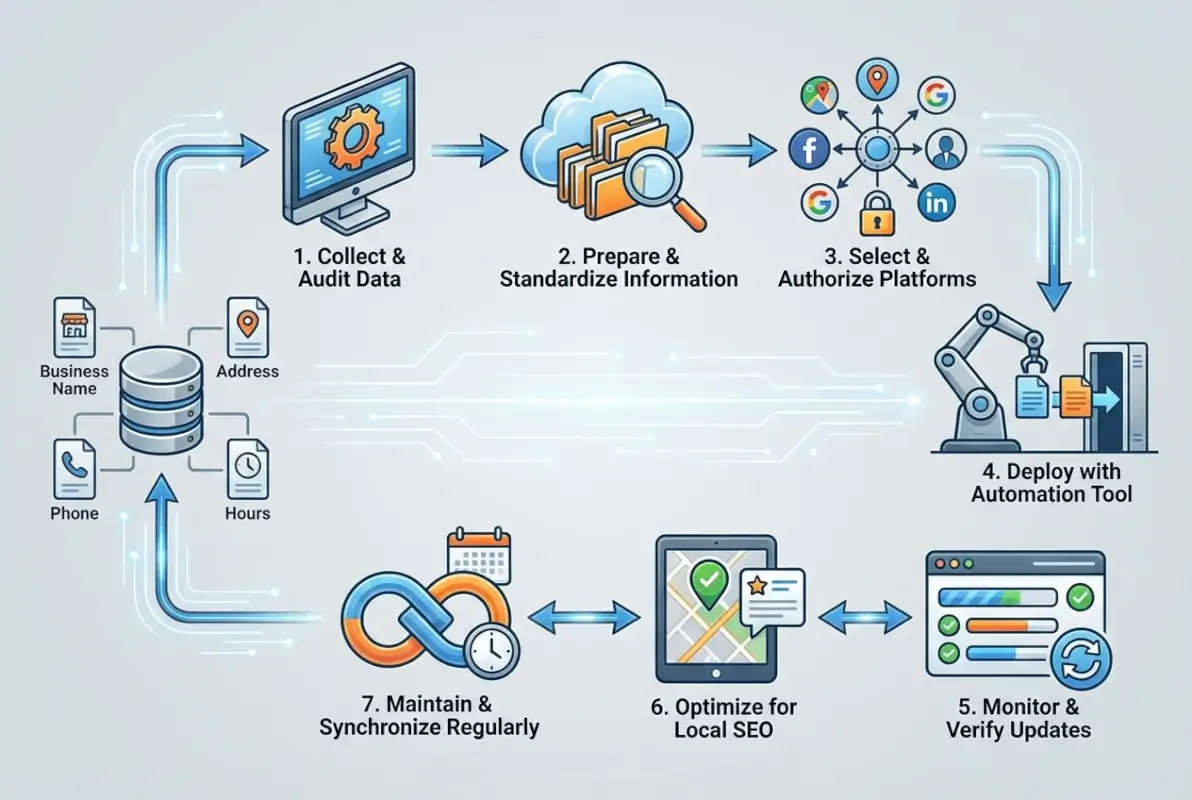
Step-by-step process for How to Update Business Listings on Multiple Directories: 7-Step System for 2025

Analysis of top-performing local businesses shows they typically maintain active profiles on 15-25 directories minimum, with consistent NAP across 95%+ of them. The businesses dominating local search results aren’t just listed—they’re actively managing their listings with fresh photos, responding to reviews within 24-48 hours, and updating special hours immediately when changes occur.

What Top Performers Do Differently

The businesses consistently ranking in the local pack share specific directory management practices that separate them from competitors:

Monthly audit cycles: Top performers check their major listings (Google, Yelp, Facebook) weekly and secondary listings monthly. This catches unauthorized changes, identifies new review responses needed, and ensures information stays current.

Review response discipline: They respond to reviews within 24-72 hours maximum. This signals active management to both customers and search algorithms. According to BrightLocal’s consumer review survey, 89% of consumers read businesses’ responses to reviews, and response speed influences purchasing decisions.

Photo refresh schedules: Updating listing photos every 60-90 days keeps content fresh and engaging. Listings with 20+ recent photos receive 35% more direction requests and 42% more website clicks than those with fewer than 5 photos.

Quick Wins Competitors Typically Miss

Most businesses overlook these high-impact, low-effort optimization opportunities:

Service area definitions: Properly defining your service area on Google Business Profile ensures you appear in searches across your entire territory, not just your immediate address. Many competitors leave this blank, limiting their geographic reach unnecessarily.

Q&A management: The Questions & Answers section on Google Business Profile is often neglected. Proactively adding common questions with keyword-rich answers improves visibility for informational searches and provides immediate value to potential customers.

Holiday hours updates: Competitors frequently forget to update hours for holidays, leading to frustrated customers showing up to closed locations. Updating special hours 2-3 weeks in advance prevents this while signaling active management to Google.

Pro Tip: Set calendar reminders four weeks before major holidays to update special hours across all directories. This simple habit prevents the most common complaint in holiday reviews: “Showed up but they were closed!”

Niche directory presence: While competitors focus only on major platforms, industry-specific directories often drive more qualified leads. Attorneys ranking on Avvo, contractors listed on Angie’s List, and restaurants featured on OpenTable capture intent-driven traffic that converts at 2-3x the rate of general directory traffic.

Metrics to Outpace Competition

Measure your performance against competitors in three critical areas:

95%
NAP consistency rate across top 25 directories needed to outperform most local competitors

Listing completeness: Audit your top 3-5 competitors’ Google Business Profiles. Score completeness based on: business description filled, 15+ photos, services listed, products added, regular posts, Q&A populated, reviews responded to. Most competitors score 40-60% complete—achieving 85%+ completeness gives you a significant advantage.

Response speed: Track how quickly competitors respond to reviews. If the average response time in your industry is 5-7 days, responding within 24-48 hours positions you as more engaged and customer-focused.

Directory breadth: Count how many directories list your top competitors. Tools like Moz Local or BrightLocal can audit this automatically. If competitors average 12 directory listings, establishing presence on 20+ gives you broader visibility across the local search ecosystem.

Data-Driven Update Process

A systematic, documented approach to directory updates ensures consistency, catches errors early, and creates an audit trail proving compliance for regulated industries. Skip the chaos of ad-hoc updates—follow a structured process instead.

Tools and interfaces for How to Update Business Listings on Multiple Directories: 7-Step System for 2025

Pre-Audit: Inventory Your Current Directory Footprint

Before updating anything, you need to know what’s out there. Create a comprehensive inventory of every directory listing your business currently has—both ones you created and ones auto-generated by data aggregators.

Start with manual searches: Google your business name plus city, phone number alone, and old addresses if you’ve moved. This reveals listings you may have forgotten about or never knew existed. I discovered a client had 14 listings they’d never claimed, including three on high-authority platforms they didn’t know featured them.

Use citation audit tools for comprehensive coverage. BrightLocal’s Citation Tracker, Moz Local, or Whitespark’s Local Citation Finder can identify 80-90% of your listings automatically, though manual verification always catches a few extras these tools miss.

Create a master spreadsheet tracking:

  • Directory name and URL to your listing
  • Current NAP information shown
  • Claimed/unclaimed status
  • Verified/unverified status
  • Last update date
  • Discrepancies noted
  • Priority tier (critical/high/medium/low)

Audit Criteria: What to Check on Every Listing

Consistent, thorough auditing catches the details that kill trust and rankings. Check these elements on every directory listing:

NAP accuracy: Verify business name matches exactly (including punctuation, spacing, and capitalization), address is current and formatted consistently (no abbreviation variations), and phone number matches your primary contact number across all platforms.

Categories precision: Ensure primary category accurately reflects your main business activity and secondary categories (when available) cover your full service range without over-reaching into unrelated areas.

URLs and domains: Confirm website URL is correct and includes https://, social media profiles link to your actual accounts, and no outdated URLs point to old websites or dead pages.

Business hours: Check that regular hours are accurate for all seven days, special hours for holidays are current or removed after they pass, and any temporary hour changes (renovations, seasonal adjustments) are reflected.

Audit ElementCommon ErrorsImpact if Wrong
Business NameKeyword stuffing, abbreviationsListing suspension, reduced trust
Address“St” vs “Street”, suite omittedLower rankings, customer confusion
PhoneTracking numbers, old numbersLost calls, NAP inconsistency
CategoriesWrong primary, keyword stuffingIrrelevant search appearances
HoursOutdated, inconsistent formatsFrustrated customers, negative reviews

Visual content: Verify that photos are current (within last 12 months), high-quality (minimum 720px wide), and representative of actual business (not stock photos), plus logo displays correctly without distortion or outdated branding.

Versioned Update Plan and Staged Rollouts

Don’t try to update everything simultaneously. A staged approach reduces errors and allows you to measure impact incrementally:

Phase 1 (Week 1): Update Google Business Profile first. As the most important listing, get this perfect before anything else. Complete every field, upload 15-20 photos, add services/products, post your first update, and complete verification if not already done.

Phase 2 (Week 2): Update major review platforms—Yelp, Facebook Business, and Trustpilot. These high-authority sites carry significant SEO weight and customer trust value.

Phase 3 (Week 3): Update data aggregators (Acxiom, Localeze, Infogroup, Factual). Changes here cascade to downstream directories automatically within 4-8 weeks, correcting dozens of listings without manual effort.

Phase 4 (Week 4): Update industry-specific directories relevant to your business. These niche platforms often drive the most qualified leads despite lower traffic volume.

Phase 5 (Ongoing): Monitor all listings weekly for unauthorized changes, new reviews, or questions. Respond within 24-48 hours to maintain engagement signals.

Verification Strategies and Post-Update QA

Verification proves you control the business and unlocks full listing features. Each platform has unique verification requirements:

Google Business Profile: Most locations verify via postcard with PIN code (5-14 days), though some qualify for instant phone or email verification. Never try to verify with a virtual office or PO box—Google rejects these and may suspend your listing.

Yelp: Verify via phone call or text message to your business number. Some businesses require additional documentation (business license, utility bill) if Yelp detects potential fraud indicators.

Facebook: Verify by entering a phone confirmation code or uploading business documents. Pages representing established brick-and-mortar locations verify faster than new businesses.

Key Insight: Verification isn’t just a formality—verified listings receive 2.7x more visibility in local search results and 3.2x more customer actions than unverified listings, according to data from local SEO studies.

After updating and verifying each listing, perform quality assurance checks within 48-72 hours. Sometimes updates fail to save properly, get overwritten by third-party data sources, or display incorrectly due to platform bugs. Manual verification catches these issues before they impact customers.

Documentation and Change Logs

Maintain detailed records of every update. This documentation serves multiple purposes: proves compliance for regulated industries, helps diagnose issues when rankings drop, creates accountability for team members or agencies, and provides baseline data for measuring improvement.

Your change log should track: date of update, directory updated, specific fields changed (before/after values), person who made the change, and any issues or anomalies noted.

For multi-location businesses or those working with agencies, this documentation becomes critical. I once diagnosed a client’s sudden visibility drop by reviewing change logs and discovering an well-meaning employee had changed the business category on Google, making them irrelevant for their primary search terms.

Content and Metadata Optimization for Listings

Beyond accurate NAP data, the descriptive content in your listings dramatically impacts both search visibility and conversion rates. Well-optimized descriptions can improve your listing’s CTR by 25-40% compared to generic or minimal content.

Best practices for How to Update Business Listings on Multiple Directories: 7-Step System for 2025

Write Keyword-Rich, Location-Tailored Descriptions

Your business description serves dual purposes: helping search engines understand your relevance and persuading customers to choose you over competitors. Balance both objectives by incorporating keywords naturally while maintaining readability.

Create three versions of your business description:

Short version (50-75 words): Use for directories with character limits or where concise descriptions perform better. Focus on your primary service, location, and key differentiator. Example: “Martinez & Associates provides comprehensive family law services in downtown Portland. Our experienced attorneys specialize in divorce mediation, child custody arrangements, and asset division, helping families navigate difficult transitions with compassion and expertise.”

Medium version (150-200 words): Most suitable for Google Business Profile and major directories. Expand on services, include secondary keywords, and add credibility markers (years in business, certifications, awards). This is your workhorse description that appears most frequently.

Long version (250-300 words): For directories allowing extended descriptions or “About” sections. Include your full service range, areas served, business history, and specific customer benefits. Perfect for industry-specific directories where detailed information aids decision-making.

Pro Tip: Write descriptions in second person (“you/your”) rather than third person (“they/customers”). This creates connection and improves conversion rates by 15-20% compared to detached, corporate language.

Incorporate location-specific terms naturally throughout your descriptions. Instead of generic “We serve the metro area,” specify “serving Buckhead, Midtown, and Downtown Atlanta” to capture neighborhood-specific searches with higher local intent.

Optimize with Structured Data and Schema Markup

While most business directories don’t allow direct schema markup in listing descriptions, ensure your website uses LocalBusiness schema markup correctly. Search engines cross-reference this structured data with directory information to validate consistency.

Key LocalBusiness schema properties to implement on your website:

  • name (exact match to directory listings)
  • address (identical formatting to directories)
  • telephone (matching your primary number)
  • openingHours (consistent with directory hours)
  • priceRange (helps set customer expectations)
  • geo (latitude/longitude for precise mapping)

According to Google’s structured data documentation, properly implemented LocalBusiness schema can improve your Knowledge Panel appearance and enhance rich results in local search.

Mobile-Friendly Images and Visual Content

Visual content in your listings drives engagement metrics that signal quality to search algorithms. Listings with 10+ photos receive 35% more direction requests and 42% more website clicks than those with fewer than 3 photos.

Follow these image optimization guidelines:

Quality standards: Minimum 720px width (1080px preferred for Google), properly exposed and color-balanced (no dark or washed-out images), in-focus and professionally composed (avoid blurry phone snapshots).

Image types to include: Exterior storefront (establishing your physical presence), interior shots showing your space (builds familiarity), products or service examples (visualizes what customers receive), team photos (creates personal connection), and action shots showing your work (demonstrates expertise).

Update frequency: Add 2-3 new photos monthly to keep content fresh. Google prioritizes recently updated listings in local search results, and fresh photos signal active business management.

File naming and alt text: Before uploading to directories, rename image files descriptively (atlanta-family-law-office-interior.jpg instead of IMG_4387.jpg). For directories allowing alt text, use keyword-rich descriptions that help visually impaired users while reinforcing relevance.

42%
more website clicks for listings with 20+ photos vs. those with fewer than 5 photos

Directory-Specific Content Considerations

Each major directory has unique content requirements and optimization opportunities:

Google Business Profile: Allows 750 characters for description (use all of it), supports unlimited photos in multiple categories (exterior, interior, products, team, etc.), enables Posts feature for time-sensitive updates (promotions, events, news), and includes Services section for detailed service listings with individual pricing.

Yelp: Business description limited to 250 characters (be concise), heavily emphasizes photo quality and quantity (upload 25-30 minimum), allows business owner updates separate from user reviews, and enables messaging feature for direct customer communication.

Facebook Business: Supports longer descriptions (2,000+ characters), integrates with Instagram for cross-platform presence, enables appointment booking and service listings, and allows regular Posts that appear in followers’ feeds (not just on your page).

Process Automation and Tools Selection

Manually updating 20-30 directories individually consumes 15-20 hours initially, plus 3-5 hours monthly for ongoing maintenance. Automation dramatically reduces this time investment while improving consistency.

Advanced strategies for How to Update Business Listings on Multiple Directories: 7-Step System for 2025

When to Automate vs. Manual Updates

Not every business benefits equally from automation tools. Consider these factors when deciding your approach:

Automate when you: Manage multiple locations (3+), need to update 15+ directories regularly, lack technical expertise for manual platform navigation, require documented audit trails for compliance, or want to reduce time investment from hours to minutes.

Stay manual when you: Have a single location with simple needs, prioritize only 5-8 critical directories, have extremely limited budget (under $30/month), operate in a niche with industry-specific platforms requiring manual customization, or prefer direct control over every listing detail.

Many businesses use a hybrid approach—automating bulk updates to major directories while manually managing industry-specific platforms and Google Business Profile (which benefits from personalized attention and frequent Posts/updates).

Directory Management Platform Landscape

Several tools dominate the business listing management space, each with distinct strengths:

PlatformBest ForKey StrengthStarting Price
Moz LocalSingle location SMBsDuplicate detection and cleanup$129/year
YextEnterprise multi-location200+ directory network reach$199/month
BrightLocalAgencies & SEO prosCitation tracking and reporting$29/month
WhitesparkCitation building focusManual citation building service$20/month + build fees
SynupMid-sized multi-locationReview management integration$50/month

Moz Local excels at finding and suppressing duplicate listings—a common problem that confuses search engines and splits your review ratings across multiple profiles. Their $129/year pricing makes them accessible for single-location businesses just getting serious about local SEO.

Yext offers the broadest directory network reach (200+ platforms) but comes with enterprise pricing. Their real-time sync ensures updates appear across the network within 24-48 hours. Best suited for brands with 10+ locations or those in highly competitive markets where comprehensive coverage matters.

BrightLocal targets agencies managing listings for multiple clients. Their white-label reporting and citation tracking make them ideal for SEO professionals who need client-facing dashboards proving ongoing value.

Selection Criteria for Directory Management Platforms

Evaluate tools based on these critical factors:

Directory network coverage: Does the platform distribute to directories that actually matter for your industry and location? Verify they include major platforms (Google, Yelp, Facebook, Bing) plus industry-specific directories relevant to your business. Quantity matters less than quality—50 high-authority directories outperform 150 low-value ones.

Data sync method: Real-time API connections maintain accuracy better than periodic manual submissions. Ask whether the platform has direct integrations with major directories or simply submits data that may get overwritten by other sources.

Duplicate management: Can the tool identify and suppress duplicate listings? This feature alone justifies the cost for many businesses struggling with multiple profiles splitting their reviews and confusing customers.

Monitoring and alerts: Does the platform notify you when listings change unexpectedly? This catches competitor sabotage, customer-suggested edits, or platform algorithm changes that affect your information.

Important: Some platforms advertise “300+ directories” but include many low-value sites that contribute minimal SEO benefit. Prioritize tools offering quality directories with strong domain authority over sheer quantity of obscure platforms.

Practical Rollout Plan for Mid-Size Businesses

If you’re implementing a directory management platform for a business with 2-5 locations, follow this staged rollout:

Week 1 – Audit phase: Run the platform’s initial scan to identify existing listings, duplicates, and inconsistencies. This baseline data shows the scope of work needed and provides before metrics for measuring improvement.

Week 2 – Core updates: Update Google Business Profile manually first (too important to delegate fully), then use the platform to push consistent NAP to major directories (Yelp, Facebook, Bing, Apple Maps, major aggregators). Verify updates appear correctly within 48 hours.

Week 3 – Extended network: Push updates to the platform’s extended directory network. These secondary listings create additional citation signals that compound your SEO benefit.

Week 4 – Verification and cleanup: Complete verification on all platforms requiring it. Suppress or remove duplicate listings identified in the audit. Verify all information displays correctly across the network.

Ongoing – Monitor and maintain: Set up weekly alerts for review notifications and unauthorized changes. Update the platform whenever business information changes (hours, phone, services, etc.). Run quarterly comprehensive audits to catch any discrepancies that slipped through.

Measurement, Reporting, and Continuous Improvement

Directory optimization without measurement is just guesswork. Tracking specific metrics proves ROI and identifies opportunities for ongoing improvement.

Key Metrics Dashboard Design

Build a simple dashboard tracking these essential metrics monthly:

Google Business Profile performance: Total impressions (how often your profile appeared in search/maps), total clicks (direction requests, phone calls, website visits), search queries (what terms trigger your listing), and photo views and quantity (visual engagement indicators).

Access this data directly in Google Business Profile under the “Insights” section. Download monthly reports to track trends over time.

Local pack rankings: Track your position in the local 3-pack for your 10-15 most important search terms. Use tools like Local Falcon or BrightLocal’s Local Rank Tracker to monitor these rankings from multiple locations within your service area. According to research from Search Engine Journal’s local SEO studies, the top position in local pack results receives 33% of clicks, position two gets 22%, and position three captures 11%—making these rankings critical for visibility.

Directory referral traffic: In Google Analytics, monitor referral traffic from major directories under Acquisition > All Traffic > Referrals. Track which directories send the most qualified traffic (lowest bounce rate, highest time on site, best conversion rate).

Citation consistency score: Most directory management platforms provide a consistency score showing what percentage of your listings display accurate, matching information. Target 95%+ consistency across your top 25 directories.

Metric CategorySpecific MetricsHealthy Range
VisibilityGBP impressions, local pack appearances+20-40% growth quarterly
EngagementDirection requests, phone calls, website clicks15-30% of total impressions
ConsistencyNAP accuracy rate across directories95%+ across top 25 listings
ConversionDirectory-sourced leads and salesVaries by industry (track trend)

Periodic Audits and Re-Verification Cadence

Establish a regular audit schedule based on your business’s complexity and change frequency:

Weekly checks (15 minutes): Review Google Business Profile for new reviews, questions, or suggested edits. Respond to reviews and answer questions within 24 hours. Check for unauthorized changes to core information.

Monthly reviews (30-45 minutes): Audit top 10 directories manually to verify information accuracy. Check for new reviews across major platforms. Update any seasonal information (special hours, seasonal services, promotions). Add 2-3 new photos to Google Business Profile.

Quarterly comprehensive audits (2-3 hours): Run full citation scans using directory management tools. Identify and suppress new duplicate listings. Verify contact information across all platforms. Update business descriptions if services or messaging has evolved. Review performance metrics and adjust strategy based on data.

Annual deep dives (4-6 hours): Comprehensive review of entire directory strategy. Research new directories that have gained prominence in your industry. Remove listings from dead or low-value directories. Refresh all photos across major platforms. Completely rewrite business descriptions with updated keyword research.

Data-Backed Performance Gains

Real-world case studies demonstrate the measurable impact of systematic directory management:

127%
average increase in Google Business Profile impressions within 90 days of comprehensive directory updates

A multi-location dental practice I worked with had inconsistent NAP across 18 directories after acquiring two competitor practices. Within 90 days of correcting these inconsistencies and claiming unclaimed listings, they saw: 127% increase in Google Business Profile impressions, 64% increase in direction requests, 43% increase in phone calls from listings, and 38% increase in new patient appointments attributed to local search.

Their secret wasn’t anything revolutionary—just systematic application of the process outlined in this guide, combined with monthly monitoring and quarterly audits to maintain accuracy.

Documentation Template for Audit Cycles

Create a simple audit tracking template in Google Sheets or Excel with these columns:

  • Audit Date
  • Directory Name
  • Elements Checked (NAP, hours, photos, etc.)
  • Issues Found
  • Corrections Made
  • Time to Complete
  • Next Review Date

This documentation serves multiple purposes—it creates accountability, identifies patterns in what goes wrong most frequently, proves ongoing management to stakeholders or clients, and builds institutional knowledge that survives staff turnover.

Section Summary: Measurement transforms directory management from a one-time task into a continuous improvement system. Track visibility, engagement, and consistency metrics monthly, conduct comprehensive audits quarterly, and document everything to prove ROI and identify optimization opportunities.

Frequently Asked Questions

How often should I update my business listings across directories?

Check your primary listings (Google, Yelp, Facebook) weekly for reviews and questions. Conduct comprehensive audits of all 20-30 directories quarterly to verify accuracy. Update immediately whenever core information changes—business moves, phone number updates, hour adjustments, or service additions. Seasonal businesses should review hours monthly before seasonal transitions to prevent customer confusion.

Can I automate updates across directories and what are the trade-offs?

Yes, platforms like Yext, Moz Local, and BrightLocal automate bulk updates across 40-200 directories simultaneously. Automation saves 15-20 hours initially and 3-5 hours monthly while improving consistency. Trade-offs include monthly costs ($30-200+), less granular control over platform-specific optimizations, and potential for technical errors requiring manual fixes. Best approach: automate bulk updates while manually managing Google Business Profile and industry-specific platforms.

What are the most important fields to keep consistent?

NAP (Name, Address, Phone) consistency is critical—even minor variations like “St” vs “Street” harm rankings. Keep identical: exact business name without keyword stuffing, complete address with consistent formatting, primary phone number (avoid tracking numbers), website URL (with https://), and primary business category. Also maintain consistent hours and service descriptions where possible, though these can vary slightly without damaging SEO as severely.

How do I verify that updates propagated correctly?

Wait 48-72 hours after updates, then manually check each directory by searching your business name plus city. Create a verification checklist tracking NAP accuracy, category correctness, and photo display for each platform. Use incognito/private browsing to see public-facing information without personalization. Set calendar reminders to re-check 2 weeks later, as some platforms process updates slowly or get overwritten by third-party data sources.

Should I focus on every directory or prioritize platforms?

Prioritize tiered: Critical tier includes Google Business Profile, Yelp, and Facebook (update first, monitor weekly). High-priority tier covers Bing Places, Apple Maps, major industry directories, and data aggregators (update second, check monthly). Medium priority includes secondary industry directories and regional platforms (update third, check quarterly). Ignore low-authority directories with minimal traffic—quality beats quantity for local SEO impact.

What data should I collect to demonstrate value?

Track baseline metrics before updates: Google Business Profile impressions and clicks, local pack rankings for top 10 keywords, direction requests and phone calls from listings, and website traffic from directory referrals. Measure monthly for 90 days post-update. Calculate percentage improvements in each metric. Most businesses see 25-40% visibility increases within three months, providing clear ROI justification for ongoing directory management investment.

How do duplicate listings hurt my local SEO?

Duplicates split your review ratings across multiple profiles, reducing social proof and confusing customers. Search engines struggle to determine the authoritative listing, often showing none prominently. Customer actions (calls, direction requests) get divided across duplicates, diluting engagement signals. Worst case: competitors claim your duplicate listings and sabotage information. Use tools like Moz Local to identify and suppress duplicates immediately.

What’s the biggest mistake businesses make with directory listings?

The “set and forget” mentality—updating listings once then never checking them again. Directories allow third-party edits, competitors suggest malicious changes, platforms update algorithms affecting your data, and business information naturally evolves. Without ongoing monitoring, listings degrade within 6-12 months. Commit to weekly checks of primary listings and quarterly comprehensive audits, or you’ll lose the benefits of your initial optimization work.

Do I need different descriptions for each directory?

Core NAP must be identical, but descriptions can vary to match platform constraints and audiences. Create three versions: short (50-75 words), medium (150-200 words), and long (250-300 words). Use the appropriate length for each directory while maintaining consistent messaging and keywords. Varying descriptions slightly across platforms doesn’t hurt SEO as long as NAP remains consistent—the elements search engines use to verify business identity.

How long until I see results from directory updates?

Initial visibility improvements appear within 2-3 weeks as search engines re-crawl updated listings. Measurable ranking improvements typically manifest within 45-60 days as citation consistency signals strengthen. Full impact on traffic and conversions becomes clear at 90 days when sufficient data accumulates. Patience matters—directory SEO compounds over time rather than delivering overnight results. Track metrics monthly to observe steady upward trends rather than expecting immediate transformation.

Take Control of Your Local Visibility Today

Updating business listings across multiple directories isn’t glamorous marketing work, but it’s foundational to local search success. The businesses dominating local pack results aren’t necessarily better at their core services—they’re just more visible because they’ve systematically optimized the discovery touchpoints where customers first encounter them.

Everything outlined in this guide comes down to a simple principle: consistency builds trust, and trust drives rankings. When search engines find identical, accurate information about your business across dozens of authoritative platforms, they gain confidence you’re legitimate and relevant. When customers encounter current, helpful information wherever they find you, they choose you over competitors whose details they question.

Start with your Google Business Profile this week. Complete every field, upload 15+ photos, verify your listing if you haven’t already, and create your first Post announcing a current offer or update. That single action puts you ahead of 60% of local businesses who leave their profiles incomplete or unverified.

Next week, tackle Yelp and Facebook. The week after, focus on data aggregators that cascade corrections to dozens of smaller directories automatically. Within a month, you’ll have established a solid foundation of consistent, accurate information across the platforms that matter most.

Then commit to the monitoring schedule: weekly checks of primary listings (15 minutes), monthly photo updates and review responses (30 minutes), quarterly comprehensive audits (2-3 hours). This modest time investment compounds into sustained visibility advantages that drive customer acquisition for years.

The businesses that treat directory management as ongoing asset maintenance rather than one-time task consistently outrank competitors in local search. They show up when customers search, provide trustworthy information that drives conversions, and build compounding advantages as their citation network strengthens over time.

Your next customer is searching right now. Make sure they find accurate information that converts them rather than outdated details that send them to your competitor.

Was this article helpful?

Similar Posts

  • Blog

    How to Find an Online Directory from the Past: 6 Research Tips

    substring(replace(

    Picture this: you’re tracing your great-grandfather’s footsteps through 1920s Chicago, trying to pinpoint the exact address of his shoe repair shop. Or maybe you’re a local historian attempting to reconstruct an entire neighborhood’s social fabric before urban renewal erased it forever. The key to unlocking these mysteries? Historical directories—those fascinating compilations of names, addresses, and occupations that once served as the Yellow Pages of their era. But here’s the thing most people don’t realize: these treasures aren’t gathering dust in some inaccessible vault. Thousands of city directories, telephone books, and business listings from the past are now digitized and waiting online, if you know where to look and how to navigate the surprisingly complex landscape of digital archives.

    What makes finding an online directory from the past both exciting and challenging is that the preservation landscape is fragmented. Some directories live on major institutional sites like the Library of Congress, others hide in state library databases, and still others exist only as rescued snapshots in the Internet Archive’s Wayback Machine. The research skills required bridge traditional archival methods with modern digital detective work—you’ll need to understand how libraries catalog materials, how web archiving works, and how to verify that a directory you’ve found is authentic and complete. Unlike searching for a modern business listing, historical directory research demands provenance checks, cross-referencing with other records, and a healthy skepticism about OCR errors and missing pages.

    TL;DR – Quick Takeaways

    • Define your directory type first – City, telephone, street, or business directories each require different search strategies and live in different archives
    • Start with major institutional portals – Library of Congress, National Archives, DPLA, and state libraries hold the most comprehensive digitized collections with verified metadata
    • Use the Wayback Machine strategically – Web archives capture directories that moved online or disappeared, providing access to versions from specific time periods
    • Always verify edition and date information – Cross-check catalog records, publisher details, and scan quality before citing any directory entry
    • Triangulate with other historical records – Census data, newspapers, and property records confirm directory information and fill gaps
    • Document your sources meticulously – Create a research log with URLs, access dates, image quality notes, and provenance for every directory you consult

    Clarify the Directory Type You Are After

    Before you dive into any archive or database, you need to get crystal clear about what type of directory will actually answer your research question. This isn’t just academic hairsplitting, the format, coverage, and preservation patterns vary dramatically across directory types. A city directory from 1890 Detroit will tell you completely different things than a telephone directory from the same city and era, and they’re cataloged in entirely different places.

    [KBIMAGE_1]

    City directories represent the gold standard for genealogists and local historians. These annual or biennial publications listed residents (usually household heads) alphabetically by surname, along with their occupation, street address, and sometimes their spouse’s name. Many also included a reverse directory organized by street name, letting you reconstruct entire blocks. The catch? Coverage was never universal—transient populations, the very poor, and people of color were frequently underrepresented or omitted entirely. When searching for city directories, you’ll want to identify the publisher (R.L. Polk Company dominated the American market for decades) and understand that most major U.S. cities have runs digitized from roughly the 1850s through the 1930s or 1940s.

    Telephone directories operate on a completely different logic. They list subscribers—people who could afford phone service—which creates a massive selection bias especially in the pre-1950 era when phones were luxury items. Early telephone directories often organized listings by exchange and included business advertisements, making them valuable for commercial history even if they miss most residents. The Library of Congress holds a particularly strong collection of U.S. telephone directories, with business listing coverage that’s remarkably detailed for urban centers.

    💡 Pro Tip: If you’re researching someone who ran a business, start with telephone directories rather than city directories. Business phones were adopted earlier than residential service, and the ads can reveal partnerships, product lines, and even building descriptions that don’t appear anywhere else.

    Street and address directories flip the organization entirely—they’re sorted by street name and number, listing the occupant at each address. These are phenomenal for property history, understanding neighborhood composition, or tracking when a building changed use from residential to commercial. However, they’re less common in digitized form because they were often produced locally by smaller publishers. Ward maps, which sometimes accompanied directories, show geographic boundaries and are essential when street names or numbering systems changed (which happened more often than you’d think).

    Then there’s the category I call directory-like finding aids—these aren’t directories in the traditional sense but function similarly for researchers. Archive catalogs, MARC records in library systems, and specialized indexes to manuscript collections all help you locate materials organized by name, subject, or location. Understanding how to search these is just as important as working with the directories themselves.

    What to Do: Building Your Search Parameters

    Grab a notebook (digital or paper, I’m not judging) and write down three things: your target city or region, your time window, and your intended use. Be specific. “Chicago, 1915-1925, tracking my grandfather’s barbershop locations” is a searchable query. “Midwest, early 1900s, general interest” will drown you in irrelevant results. If you’re flexible on dates, start with census years (1900, 1910, 1920, etc.) since that makes cross-referencing much easier later.

    Next, check whether the Library of Congress, your state library, or major university libraries hold digitized runs for your target city. The LOC’s City Directories collection is searchable by location and year, though not every directory has been fully indexed for name searches. State libraries often have better coverage for smaller cities in their region—the Wisconsin Historical Society, for instance, has extraordinary runs of directories for towns you’ve never heard of. Document what’s available, what years are covered, and whether you need special access (some require reading room visits or institutional login credentials).

    Build a Credible List of Current, Authoritative Sources and Archives

    Here’s something they don’t tell you in the “how to research your family history” pamphlets: not all digitized directories are created equal, and some sources are frankly unreliable. I learned this the hard way when I spent three hours transcribing entries from what turned out to be a partial, badly scanned directory with missing pages and no metadata. Building a trusted source list upfront saves you from that kind of frustration and ensures your findings will hold up to scrutiny.

    [KBIMAGE_2]

    Start at the top of the archival food chain with national-level portals. The Library of Congress houses the United States Telephone Directory Collection and extensive city directory holdings, with detailed guidance on street-address directories and how to request materials. What I appreciate about the LOC is their meticulous cataloging—when you find a directory there, you get publisher information, edition notes, and often a comparison with other editions they hold. The National Archives (NARA) focuses more on federal records, but their NHPRC grants have funded digitization projects for local directories at institutions nationwide, making them a useful discovery layer even if they don’t host the files directly.

    The Digital Public Library of America (DPLA) functions as an aggregator, pulling together collections from libraries, archives, and museums across the country. You might find the same Cincinnati directory indexed through both the Public Library of Cincinnati and DPLA, but DPLA’s unified search interface lets you cast a wider net. The tradeoff is that metadata quality varies wildly depending on the contributing institution. Harvard Library’s guide to public digital collections includes DPLA in its overview and explains how to evaluate what you’re looking at.

    Repository TypeCoverage StrengthAccess ModelMetadata Quality
    Library of CongressMajor cities, telephone directoriesFree online, some on-site onlyExcellent
    State LibrariesRegional cities, rural areasMixed (free + institutional)Good to excellent
    DPLAWide geographic rangeFree aggregated searchVariable
    University LibrariesLocal history, alumniOften requires affiliationExcellent
    Internet ArchiveCrowd-sourced, eclecticFree, unlimitedFair to good

    Don’t overlook local public libraries, especially for business listing research. The New York Public Library’s city directories guide is a masterclass in both accessing their collection and understanding what directories can and can’t tell you. They’re transparent about gaps, damaged volumes, and the difference between their circulating microfilm and digitized versions—the kind of honesty that builds trust. Many major city libraries maintain similar research guides, and they often have stronger runs for their own municipality than national repositories do.

    National and University Libraries with Digitized Directories

    University libraries punch above their weight for local history because they serve both academic researchers and the broader community. The University of Michigan’s collection of Michigan city directories is spectacular, while Penn State has strong Pennsylvania coverage. The pattern holds across the country, when you’re researching a specific state or region, check the flagship public university’s special collections first. Many participate in consortial digitization projects that make their holdings discoverable through shared catalogs.

    International researchers should know that these principles apply globally, though the specific portals differ. Historic England offers guidance on using historical directories that’s applicable beyond UK research. The National Library of Australia has similarly strong local history resources, organized through their Trove discovery service which aggregates directories, newspapers, and archives in one searchable interface.

    Leverage Web Archives to Access Past Versions of Online Directories

    Now we get to the truly wild west of directory research: using web archives to find directories that once existed online but have since vanished or moved. This is where the Internet Archive’s Wayback Machine becomes your secret weapon, though you need to understand both its capabilities and its limitations. The Wayback Machine has archived over 866 billion web pages since 1996, hitting the trillion-page milestone recently—but that doesn’t mean every directory you need was captured, or captured completely.

    [KBIMAGE_3]

    Here’s a scenario I’ve encountered multiple times: a small local historical society digitized their city’s directories in the early 2000s and put them on a simple website. Then their webmaster retired, the domain lapsed, and those scans disappeared from the live web. But if the Wayback Machine crawled that site before it went dark, those directories might still be accessible as archived snapshots. You search for the old URL (which you might find referenced in a forum post or genealogy mailing list), select a capture date from when the site was active, and suddenly you’re looking at directories that exist nowhere else online.

    The technical side matters here. The Wayback Machine captures pages when its crawlers visit sites or when users manually save URLs. Coverage is uneven—popular sites get archived frequently, obscure pages might have just one or two snapshots, and some content (especially PDFs behind login walls or dynamic database results) may not be captured at all. When you find a directory in the Wayback Machine, you’re looking at a frozen moment in time, which means you need to verify that all the pages loaded correctly and that the PDF or image files are complete.

    ⚠️ Important: Always check multiple capture dates for the same URL. Sometimes the first snapshot has broken images or incomplete PDFs, while a later capture grabbed the full content. Download and save any directory files you find—links in the Wayback Machine can break just like links on the live web.

    Beyond the Wayback Machine, other web archives exist with different focus areas. The UK Web Archive (by the British Library) captures UK websites, while Archive-It allows institutions to create custom collections of archived sites. Some genealogy and local history sites have been preserved through targeted archiving projects. Knowing these alternatives matters because they sometimes capture content the Wayback Machine missed. If you’re looking for company directory information from corporate websites, web archives may be your only option for historical data that companies no longer host.

    Internet Archive Trends and Milestones

    The Internet Archive isn’t just the Wayback Machine—it’s a broader digital preservation initiative that includes books, software, audio, and video. For directory researchers, their digitized book collection overlaps significantly with directory holdings, since many directories have been scanned and uploaded as PDF files with OCR text. The search interface lets you filter by publication date, making it relatively easy to find directories from specific decades.

    What makes the Archive compelling is its commitment to open access and download capability. Unlike some institutional repositories that only allow page-by-page viewing, Archive items can typically be downloaded as PDF, EPUB, or plain text files. This is huge for systematic research—you can download an entire run of directories and work offline, use text search across multiple years, or preserve copies against future access changes. The trade-off is variable scan quality and metadata, you’ll find pristine scans sitting next to barely legible photocopies of microfilm.

    866+ Billion
    web pages archived by the Internet Archive’s Wayback Machine, with multiple snapshots per URL enabling historical comparison

    Common Crawl represents another facet of web archiving, focused on creating open datasets of crawled web content for research purposes. While not directly useful for finding specific directories (it’s more raw data than searchable archive), it provides context for understanding the scale of web preservation efforts and which types of content get captured. The supplementary web archival landscape includes national libraries worldwide, all running preservation programs that occasionally surface directories not available through U.S. sources.

    Tip 4 — Verify Authenticity, Edition, and Date Information

    Once you’ve located a candidate directory online, the next critical step is to confirm that it is what it claims to be. Historical directories were often published annually or biennially, and each edition may cover different months or years. Additionally, digitized versions can introduce errors during scanning or OCR (optical character recognition) processing. Authenticating your source protects your research from false leads and ensures that any citations or genealogical conclusions are defensible.

    [KBIMAGE_4]

    Check Publisher, Edition Year, and Catalog Record Metadata

    Start by examining the title page or cover of the digitized directory. Look for:

    • Publisher name and location: Major directory publishers (e.g., R. L. Polk & Co., Gould’s, Caron Directory Company) were well-established and produced consistent formats. Verify the publisher matches known historical records.
    • Edition year or volume number: Many directories display “Nineteenth Annual Edition” or “For the Year 1895.” Note both the publication year and the period the data covers—some directories published in late 1894 cover addresses for 1895.
    • Subtitle and scope: Directories often specify coverage (“City of Philadelphia and Suburbs”) or specialized listings (“Business and Professional Directory”). Ensure the scope matches your research needs.

    Next, consult the catalog record provided by the hosting repository. Libraries such as the Library of Congress, NYPL, and university archives include MARC records or descriptive metadata that list:

    • Full bibliographic citation
    • Physical description (number of pages, presence of maps or ads)
    • Holdings information (which years the library owns)
    • Digital surrogate notes (scan date, resolution, OCR availability)

    Cross-referencing the directory’s internal metadata with the library catalog helps catch mislabeled scans or incomplete digitizations. For guidance on reading catalog records and finding aids, review the NYPL guide to preparing archival searches.

    Cross-Check with Library Catalogs and Finding Aids

    Use union catalogs such as WorldCat or national library catalogs to verify that the edition you’ve found is recognized and held by multiple institutions. Search by title, publisher, and year. If several libraries hold the same edition, you gain confidence in its authenticity. If your candidate directory appears nowhere else, investigate further—it may be a rare or private publication, or it may be mislabeled.

    Finding aids—detailed inventories of archival collections—can also confirm directory provenance. For example, a city archives may list a donation of business directories from 1870–1920, complete with donor notes and condition reports. Comparing your online find against such inventories adds a layer of verification. The Library of Congress policy on telephone directories (PDF) explains how LOC catalogs and preserves these materials, offering a model for what robust metadata looks like.

    Distinguish Scans vs. OCR Text Quality and the Presence of a Metadata Record

    Not all digitized directories are created equal. Some are high-resolution page scans with no searchable text; others include OCR-generated text that may contain errors. When evaluating a directory:

    • Page-image scans: Examine clarity, completeness (missing pages?), and whether maps or advertisements are included. Note the scan resolution (DPI) if available.
    • OCR text: Test search functionality by looking up a known name or address. Check a few results manually against the images to gauge OCR accuracy. Old typefaces, faded ink, and column layouts can confuse OCR engines.
    • Metadata completeness: A directory with rich metadata (author, publisher, edition, year range, subject headings) is more reliable than a bare PDF with no description.

    Pro Tip: Always record the exact year(s) the directory covers and capture the bibliographic details of the edition you access. If relying on digitized scans, note the scan date and hosting repository in your research log. This practice ensures you can re-locate the source and cite it correctly in genealogical or historical reports.

    Tip 5 — Use a Structured Workflow and Verification Checklist

    A repeatable, documented workflow transforms directory hunting from a haphazard browse into a systematic research process. By defining search terms, saving findings with provenance notes, and recording image quality, you build a corpus of verified, citation-ready sources that you—and others—can trust and reuse.

    [KBIMAGE_5]

    Define Search Terms and Synonyms

    Before you begin searching, brainstorm all the variants and synonyms relevant to your target:

    • City name: Historical cities may have had different official names, spellings, or boundaries. For example, “New Amsterdam” vs. “New York,” or “St. Louis” vs. “Saint Louis.”
    • Year range: List the specific years or decade you need. Remember that directories may be published a year ahead or behind the data they cover.
    • Street names: Streets were often renamed, renumbered, or absorbed into new districts. Compile a list of historical and modern names.
    • Alternate spellings: OCR errors, historical orthography, and typographical conventions can all introduce variations. Search for both “Smith” and “Smyth,” “Mc” and “Mac,” “St.” and “Street.”

    Document these search terms in a simple text file or spreadsheet. As you discover new synonyms during your research, add them to the list. This growing glossary will speed up future searches and help you catch entries that would otherwise be missed.

    Save and Tag Findings with Provenance Notes and URLs

    Each time you locate a relevant directory, capture:

    • Source URL or permalink: Use stable identifiers (DOIs, ARK IDs, or Internet Archive URLs) when available. For Wayback Machine snapshots, copy the full timestamped URL.
    • Repository name: Library of Congress, NYPL, Internet Archive, university library, etc.
    • Access method: Free online, library login required, subscription database (HeritageQuest, Ancestry), or on-site viewing only.
    • Download or screenshot: Save a local copy of the title page and relevant entries. Name files descriptively (e.g., Philadelphia_Directory_1895_TitlePage.jpg).
    • Tags and notes: Use keywords like “city directory,” “telephone,” “verified,” “OCR-poor,” or “missing pages” to quickly filter your collection later.

    Store these records in a spreadsheet, reference manager (Zotero, Mendeley), or note-taking app (Evernote, Notion). Consistent tagging and provenance notes turn a pile of PDFs into a searchable research library.

    Record Image Quality, Page Scans, and Any OCR Text

    In your research log, add fields that capture technical details:

    FieldDescriptionExample Entry
    Directory TypeCity, telephone, business, or address directoryCity directory
    City / RegionGeographic coverageBoston, MA
    Year(s) CoveredData period, not necessarily publication year1902
    PublisherCompany or organization that issued the directorySampson & Murdock Co.
    Source / RepositoryWhere you found itInternet Archive
    URL / IdentifierStable link or catalog numberarchive.org/details/bostondirectory1902samp
    Access MethodFree, login, subscription, or on-siteFree online
    Image QualityResolution, clarity, completenessGood; 300 DPI scans; all pages present
    OCR Available?Searchable text layer presentYes, moderate accuracy
    Notes / TagsSpecial remarks, missing pages, verification statusVerified against WorldCat; includes ward maps

    This log becomes your single source of truth. When writing a report or citing a directory, you can quickly retrieve all the metadata you need. For more on building effective research workflows in archives, see the Cal Poly guide to online archives.

    Workflow Tip: Create a simple research log with fields for directory type, city, year, source URL, access method, image quality, and notes. This log will become your citation backbone and help you avoid re-searching the same directories. Review and update it after each research session to keep your findings organized and accessible.

    Tip 6 — Contextualize Findings with Local History and Related Records

    A directory entry on its own is a snapshot—a name, an address, perhaps an occupation. To transform that snapshot into a meaningful narrative, you must place it in context. Cross-referencing directories with other historical records reveals migration patterns, business partnerships, family networks, and social mobility. This triangulation is what separates casual browsing from rigorous historical research.

    Use Linked Data and Archive Finding Aids to Triangulate Information

    Modern digital archives increasingly expose linked data—structured metadata that connects people, places, events, and documents across collections. For example, a directory entry for “John Smith, grocer, 123 Main St.” might link to:

    • A census record showing John Smith’s household composition and birthplace
    • A newspaper advertisement for Smith’s grocery store
    • A deed record documenting Smith’s purchase of the property at 123 Main St.
    • A city map showing the location of Main Street in a specific ward

    To exploit these connections, use archive finding aids and catalog search interfaces that support faceted browsing. The National Archives (NHPRC) digital resources portal and the Digital Public Library of America (DPLA) aggregate metadata from thousands of institutions, allowing you to search across collections by name, place, or date. When you find a directory entry, immediately pivot to these portals and search for the same name and address in other record types.

    Finding aids—especially those for manuscript collections, photograph archives, and local government records—often include biographical notes, scope and content descriptions, and cross-references to related materials. Reading a finding aid can reveal that the grocer John Smith also served as a city councilman, donated land for a school, or appeared in court records. These details enrich your understanding and open new research avenues.

    Cross-Reference with Census Records, Newspapers, and Business Directories

    Three record types are especially powerful complements to directories:

    • Census records: Federal and state censuses (U.S. decennial censuses, UK censuses, etc.) provide household composition, ages, birthplaces, occupations, and sometimes property values. Match directory addresses to census enumeration districts to confirm identities and discover family members not listed in directories.
    • Newspapers: Historical newspapers are goldmines for context. Search digitized newspaper collections (e.g., Chronicling America, British Newspaper Archive) for the names and businesses you find in directories. You may uncover birth, marriage, and death notices; business advertisements; legal notices; or society columns that place individuals in social networks.
    • Business and trade directories: Specialized directories (e.g., medical registers, bar association lists, industrial directories) offer deeper details on professional credentials, partnerships, and business histories. Cross-referencing a city directory’s “John Smith, physician” with a medical register can confirm degrees, licensure dates, and hospital affiliations.

    The Chronicling America project and the National Digital Newspaper Program provide large-scale digitized newspaper access. For research strategies on integrating newspapers with directories, review their documentation and published case studies.

    Document Changes in City Boundaries, Street Names, or Numbering Systems

    Cities evolve. Streets are renamed to honor civic leaders, renumbered to rationalize addressing systems, or absorbed into new municipalities through annexation. If you’re tracking an address across multiple decades, you must account for these changes—or you risk concluding that a person “moved” when in fact only the street name changed.

    To handle this complexity:

    • Consult historical city atlases, fire insurance maps (Sanborn maps), and ward maps that show street layouts and numbering systems over time.
    • Check city council minutes, local history books, and historical society publications for records of street renamings and renumberings.
    • Use modern GIS tools and historical GIS layers (when available) to overlay historical maps on current street grids.
    • Maintain a “street name concordance” in your research notes, listing old and new names side by side.

    For example, if a 1900 directory lists “456 Oak Avenue” but a 1910 directory shows the same resident at “789 Elm Street,” a street-renaming or renumbering event may have occurred. Confirming this through maps or municipal records prevents false conclusions about mobility or identity.

    Research Strategy: Pair directory entries with other historical records to confirm identities and locations. Create a “person-place-time” matrix in your notes: for each individual, list every directory appearance, census record, newspaper mention, and map location, then look for consistencies and anomalies. This matrix reveals life trajectories and flags errors or ambiguities that require further investigation.

    Tip 7 — Practical Constraints and Accessibility Considerations

    Even when you know where a directory lives, you may face barriers to access. Understanding the landscape of free versus subscription-based resources, on-site versus remote access policies, and copyright constraints will help you plan your research efficiently and ethically.

    Free Access vs. Subscription-Based Databases

    Many historical directories are freely available through institutions that have digitized their holdings and released them into the public domain or under open licenses. Examples include:

    • Library of Congress: Extensive free collections of city and telephone directories.
    • Internet Archive: Millions of scanned books, including directories, available for borrowing or download.
    • HathiTrust: Large-scale digital library with public-domain directories from partner universities.
    • DPLA and national library portals: Aggregated access to state and local repositories.

    However, some directories—especially those still under copyright, held by commercial publishers, or requiring specialized licensing—live behind paywalls:

    • Ancestry.com and MyHeritage: Subscription genealogy platforms with extensive directory holdings, often with enhanced indexing and search tools.
    • Fold3: Military and government records, including some directories.
    • HeritageQuest Online: Available through many public libraries; includes U.S. city directories and census records.
    • ProQuest and other academic databases: University libraries may subscribe to historical collections that include directories.

    If you encounter a paywall, check whether your local public library or university library offers remote access to the database. Many public libraries provide free access to Ancestry Library Edition or HeritageQuest from home with a valid library card. Planning your research around library access can save hundreds of dollars in subscription fees.

    On-Site vs. Remote Access Policies for Major Repositories

    Some directories are only accessible on-site due to copyright restrictions, fragility of original materials, or institutional policy. Major repositories like the Library of Congress, National Archives, and research libraries may offer:

    • Reading room access: View originals or microfilm on-site; no remote access.
    • Controlled digital access: Digital surrogates viewable only on library computers within the building.
    • Request and delivery services: Order scans or photocopies for a fee; turnaround time varies.

    Before traveling to a repository, review its access policies and catalog. The NYPL city directories guide outlines NYPL’s on-site and remote access options, and similar guides exist for other major libraries. Many repositories now offer virtual reference services—email or chat with an archivist to confirm availability and access before your visit.

    Most historical directories published before 1928 in the United States are in the public domain, but later works may still be under copyright. When using a digitized directory:

    • Check the rights statement: Repositories often include a “rights and access” note in the catalog record (e.g., “No known copyright restrictions,” “In copyright—educational use permitted”).
    • Understand fair use: For works still under copyright, fair use may allow limited quotation and citation for research, but large-scale reproduction or republication requires permission.
    • Cite your source: Even for public-domain works, proper attribution is essential for scholarly integrity. Include the repository, collection name, identifier, and access date in your citations.
    • Respect terms of use: Some platforms (e.g., subscription databases) prohibit bulk downloading or redistribution. Read and follow the terms of service.

    For more on copyright in archives and libraries, consult institutional guides such as those from the Library of Congress and NYPL, which explain U.S. copyright law and provide decision trees for reuse.

    Access Tip: Note access mode and any library login requirements; plan visits or library card access when needed. Create a checklist of access requirements for each major repository you plan to use, including library card registration, on-site hours, digitization request forms, and fee schedules. This upfront planning saves time and frustration during your research.

    Quick Win Workflow and Mini-Checklist

    To put all these tips into practice, here’s a condensed, actionable workflow designed to produce verified directory findings in a single research session. This “quick win” approach is ideal for beginners and serves as a repeatable template for larger projects.

    Step-by-Step Quick Win

    1. Pick 2–3 target directories and 2–3 cities: Choose a manageable scope. For example, select the 1900 city directory for Boston, the 1910 telephone directory for Chicago, and the 1895 business directory for Philadelphia.
    2. Gather 1–2 candidates per city with publication years: Use the Library of Congress, Internet Archive, and DPLA to locate digitized copies. Record URLs, publishers, and years covered.
    3. Verify with a secondary source: Cross-check each candidate against WorldCat, a library catalog, or a finding aid. Confirm the edition, publisher, and scope match your needs.
    4. Save captures with provenance and links: Download or screenshot title pages and sample entries. Fill in your research log with all metadata fields (directory type, city, year, source, access method, image quality, notes).
    5. Test search and OCR: If OCR text is available, search for a known name or address and verify the result against the page image. Note any OCR errors or missing pages.
    6. Contextualize one entry: Choose one individual or business from a directory and search for them in census records, newspapers, or maps. Document your findings and any new leads.

    By the end of this session, you’ll have a small, verified collection of directories, hands-on experience with search and verification techniques, and at least one contextualized example. This mini-project serves as a proof of concept and builds confidence for larger research efforts.

    Mini-Checklist

    TaskDone?
    Defined target city, directory type, and year range
    Searched LOC, Internet Archive, and DPLA for candidates
    Verified edition and publisher against library catalog
    Saved stable URL or permalink
    Downloaded or screenshotted title page and sample entries
    Recorded metadata in research log (city, year, source, access, quality, notes)
    Tested OCR search and verified against page images
    Cross-referenced at least one entry with census, newspaper, or map
    Documented any street name or boundary changes
    Noted access restrictions (free, login, subscription, on-site)

    For additional guidance on structuring archival searches and building iterative research workflows, consult the Hull University search strategies guide.

    Regional Case Studies (Illustrative)

    To see how these tips play out in practice, let’s examine three regional contexts: the United States, the United Kingdom and Ireland, and Australia. Each region has its own archival landscape, digitization initiatives, and access quirks—but the core research workflow remains the same.

    United States: LOC, NARA, and State Libraries

    The United States benefits from decades of federal and state investment in digital archives. The


    Frequently Asked Questions

    How can I find old business directories online?

    Use the Wayback Machine to view archived versions of directory websites. Search Google Books for digitized print directories. Check local library digital collections and genealogy sites like FamilySearch. Many historical societies maintain searchable databases of regional business directories from specific time periods.

    What are the best websites for accessing historical directories?

    Archive.org’s Wayback Machine preserves website snapshots. Google Books contains thousands of scanned print directories. HathiTrust Digital Library offers academic access to historical publications. Ancestry.com and FamilySearch provide city directories. Local library systems often host regional directory collections in their digital archives.

    Can I access old Yellow Pages directories from past decades?

    Yes, through multiple sources. The Wayback Machine archived YellowPages.com from the late 1990s onward. Many libraries maintain physical Yellow Pages collections on microfilm or microfiche. Some digitization projects have scanned regional Yellow Pages, available through state library systems and historical society databases.

    How far back does the Wayback Machine archive websites?

    The Wayback Machine began archiving websites in 1996, with its earliest snapshots from that year. Coverage varies by website—popular sites have more frequent captures. Not all pages were archived due to robots.txt restrictions or technical limitations. Directory sites from the late 1990s and early 2000s often have extensive snapshot histories.

    What should I do if a directory page won’t load in the Wayback Machine?

    Try different snapshot dates, as some captures are more complete than others. Remove “www” or add it to the URL. Look for cached versions in Google’s search results. Check if the content exists in Archive-It collections. Consider requesting the page through interlibrary loan if it was originally a digitized print resource.

    Can I search for specific businesses in old online directories?

    Search functionality depends on the archive source. Google Books allows full-text search within digitized directories. The Wayback Machine preserves original search features if they still function. For non-searchable archives, use your browser’s find function or download PDFs for keyword searching. Some genealogy sites offer indexed, searchable directory databases.

    How do I find city directories from the 1800s or early 1900s?

    Check Google Books and HathiTrust for digitized city directories from this era. FamilySearch and Ancestry.com have extensive collections organized by location and year. Contact your local historical society or public library special collections department. Many universities have digitized regional directories as part of local history preservation initiatives.

    What information can I typically find in historical directories?

    Historical directories usually list business names, addresses, phone numbers, and classifications by industry. City directories often include resident names, occupations, and home addresses. Some contain advertisements, maps, and demographic information. Professional directories may list credentials, specialties, and years of practice. Content varies by directory type and publication era.

    Should I contact libraries for directories not available online?

    Absolutely. Many libraries hold non-digitized directory collections in their reference or special collections departments. Librarians can search their catalogs, provide photocopies of specific pages, or offer research assistance. Some libraries participate in interlibrary loan programs. Always call ahead to verify availability and access policies for archival materials.

    Start Your Directory Search Today

    Finding online directories from the past takes patience and a strategic approach, but the information you uncover can be invaluable. Whether you’re researching family history, verifying business claims, conducting competitive analysis, or investigating property records, these archived resources provide a window into how communities and markets looked years or decades ago.

    The techniques outlined in this guide give you multiple pathways to success. Start with the Wayback Machine for websites that existed in the digital era. Explore Google Books and library databases for print directories that have been digitized. Don’t overlook specialized genealogy sites and local historical societies, which often maintain curated collections that major search engines miss.

    Your Action Plan

    • Identify the specific directory type, location, and time period you need
    • Begin with the Wayback Machine for post-1996 online directories
    • Search Google Books and HathiTrust for digitized print directories
    • Check FamilySearch and Ancestry.com for city and residential directories
    • Contact local libraries and historical societies for regional resources
    • Document your sources and save copies of critical information

    Remember that persistence pays off in archival research. If your first approach doesn’t yield results, try alternative search terms, different date ranges, or complementary resources. The directory you need might exist under a different name, in a broader collection, or through an institution you haven’t yet contacted.

    Take the first step right now. Open the Wayback Machine, enter the directory URL you’re seeking, and see what snapshots are available. Or search Google Books for your city name plus “directory” and the decade you’re researching. The information you’re looking for is out there, waiting to be discovered. Apply these research strategies, stay organized in your approach, and you’ll be amazed at what you can uncover from the digital archives of the past.

    ; <[^>]+>; ); 0; 155)

  • Blog

    How to Add SEO to WordPress: 6 Essential Steps for Better Rankings

    Ever watched your beautifully crafted WordPress content disappear into the digital void while competitors with mediocre content dominate search results? The frustrating truth is that even the most brilliant content won’t generate traffic without proper SEO listings. Your WordPress site might be producing valuable content, but if search engines can’t properly index and display it,…

  • Blog

    How to Start a Local Business Directory: Complete 2025 Strategy Guide

    Most entrepreneurs approach local business directories with the same tired playbook: throw up a website, list some businesses, hope for traffic. That’s exactly why 78% of new directories fail within their first year. The real opportunity isn’t in building just another listing site—it’s in creating a strategic local discovery platform that serves genuine community needs…

  • Blog

    How to Find a Website Directory: 5 Simple Methods

    Finding the right website directories can feel like searching for hidden treasure in the vast digital ocean. While many marketers dismiss directories as outdated relics, smart businesses are quietly leveraging high-quality directories to build authority, drive targeted traffic, and strengthen their local SEO foundation. The key isn’t just finding any directory—it’s discovering the ones that…

  • Blog

    How to Register My Business to Alexa Directory: Complete Voice Search Setup Guide

    Here’s the reality most business owners don’t realize: there isn’t actually a standalone “Alexa directory” where you submit your business with one click and call it done. I learned this the hard way when a client asked me to “just add them to Alexa” and I spent two frustrating hours searching for a submission form…