How to Start an Online Directory Business & Earn $5K/Month in 2026

Generating summary...
Most entrepreneurs chase complex business models when one of the simplest—and most profitable—opportunities sits right under their noses. An online directory business can generate consistent $5K monthly revenue by connecting local businesses with customers who are actively searching for them. Unlike e-commerce stores that require inventory management or SaaS products demanding constant development, directories thrive on a straightforward value exchange: businesses pay for visibility, users get curated recommendations, and you profit from the connection.
Here’s what almost nobody tells you: the best directory businesses don’t compete with Yelp or Google Maps. They win by going hyper-niche—serving specialty contractors in mid-sized cities, connecting eco-conscious consumers with sustainable brands, or listing certified professionals in highly regulated industries. The U.S. Small Business Administration reports that focused market research and niche targeting remain the top success factors for new online ventures, and directories exemplify this principle perfectly.
TL;DR – Quick Takeaways
- Niche specificity beats broad coverage – Target a defined vertical or locality rather than trying to list every business type
- Layered monetization drives $5K/month – Combine free basic listings, paid featured placements, and lead-generation fees
- Seed quality beats quantity early – Launch with 50-100 verified, high-value listings to establish credibility before scaling
- No-code platforms reduce launch risk – WordPress directory plugins and turnkey solutions let you validate demand before heavy investment
- Traffic + conversion = revenue – Focus equally on SEO-driven visitor acquisition and optimizing listing-to-payment conversion rates
Market Validation & Business Model
Before you write a single line of code or register a domain, you need to answer one question: will businesses in your chosen niche actually pay for listings? Too many directory founders skip this validation step and build elaborate platforms for markets that don’t exist. I’ve watched aspiring entrepreneurs spend months perfecting directory features for “artisanal candle makers in the Pacific Northwest” only to discover there are exactly 14 potential customers—and none willing to pay.
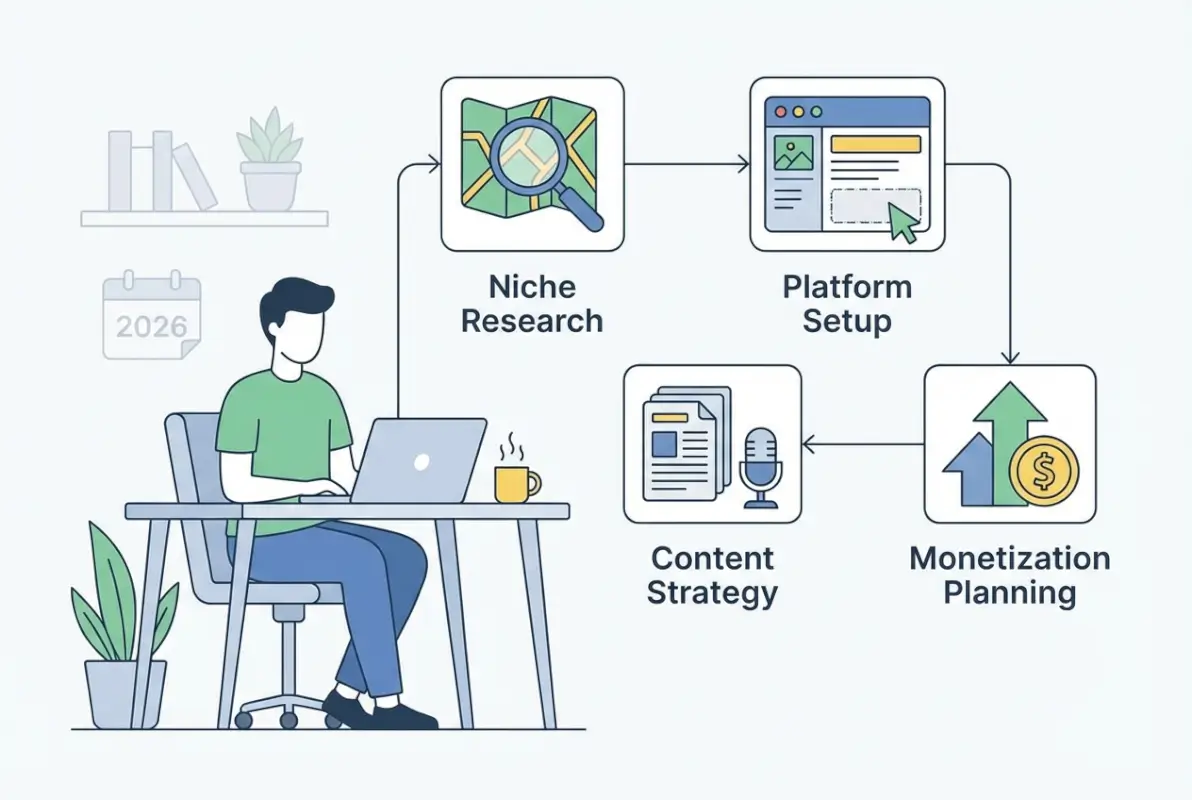
The smartest approach starts with reverse-engineering demand. Look for niches where businesses already spend money on lead generation but struggle with fragmented discovery options. Home service contractors, specialized medical practitioners, and B2B consultants typically fit this profile. According to data from the Interactive Advertising Bureau, digital advertising and online listings continue to grow as SMBs shift budgets toward measurable lead-generation channels, creating a natural tailwind for directory models.
Run focused competitive analysis using tools you already have (Google searches, LinkedIn prospecting, even Facebook groups). If you find 3-5 competitors already monetizing in your target niche, that’s validation, not a red flag. Competition proves the market exists and buyers have established purchasing behavior. Your job is differentiation—better user experience, tighter geographic focus, or superior vetting standards.
Market validation tactics
Smart validation doesn’t require expensive market research firms. Start by identifying 100 businesses in your target niche using free tools—Google Maps, industry associations, LinkedIn searches. Email 30 of them with a simple pitch: “I’m building a curated directory for [niche]. Would a featured listing that costs $X/month and generates Y qualified leads interest you?” Track response rates and objections. The U.S. Small Business Administration’s business planning resources emphasize this kind of primary research as the foundation for realistic revenue projections.
Interview at least 5 businesses that respond positively. Ask about their current marketing spend, how they generate leads today, and what frustrations they face with existing directories. These conversations reveal pricing tolerance, feature priorities, and competitive gaps. One founder I know discovered that wedding photographers in her city were paying $400/month for outdated association directories—validation that a modern, SEO-optimized alternative could command similar pricing.
Test demand with a lightweight MVP (minimum viable product) before committing to full development. A simple landing page with “Submit Your Business” and “Premium Listing Waitlist” CTAs can validate interest with zero coding. Run $100-200 in targeted Google or Facebook ads to drive traffic. If you can’t get 10 email signups from 1,000 visitors, your niche may be too narrow or your value proposition unclear.
Revenue streams & pricing
Most successful directories layer multiple revenue streams rather than relying on a single monetization method. The foundation is typically a freemium model: basic listings are free (to populate your directory quickly), while premium placements, enhanced profiles, or featured positioning command monthly or annual fees. This mirrors how profitable online business directories structure their monetization, balancing accessibility for new listings with premium options for established businesses.
Pricing should reflect the value you deliver, not arbitrary numbers. If your directory generates 3-5 qualified leads per month for a plumber, and each lead is worth $200-500 in potential revenue, a $99/month premium listing is rational. Use conservative projections initially—it’s easier to raise prices as you prove ROI than to discount your way into profitability. The directory profit calculators used by industry practitioners suggest targeting 15-20% conversion from free to paid listings once you exceed 200 total businesses.
Beyond core listings, consider lead-generation fees (pay-per-lead or commission-based), display advertising once you reach meaningful traffic, and affiliate partnerships with complementary service providers. A directory for fitness trainers might earn affiliate commissions from workout equipment retailers or nutrition supplement brands. Stack these incrementally rather than launching everything at once—complexity kills early-stage focus.
Competitive Landscape & Top Tactics
The directories that rank on page one of Google and generate sustainable revenue share specific structural patterns. After analyzing dozens of successful niche directories, from legal professional networks to local contractor listings, four elements appear consistently: laser-focused targeting, obsessive listing quality, user-first design, and transparent monetization that doesn’t compromise trust. Understanding these patterns lets you shortcut years of trial-and-error.
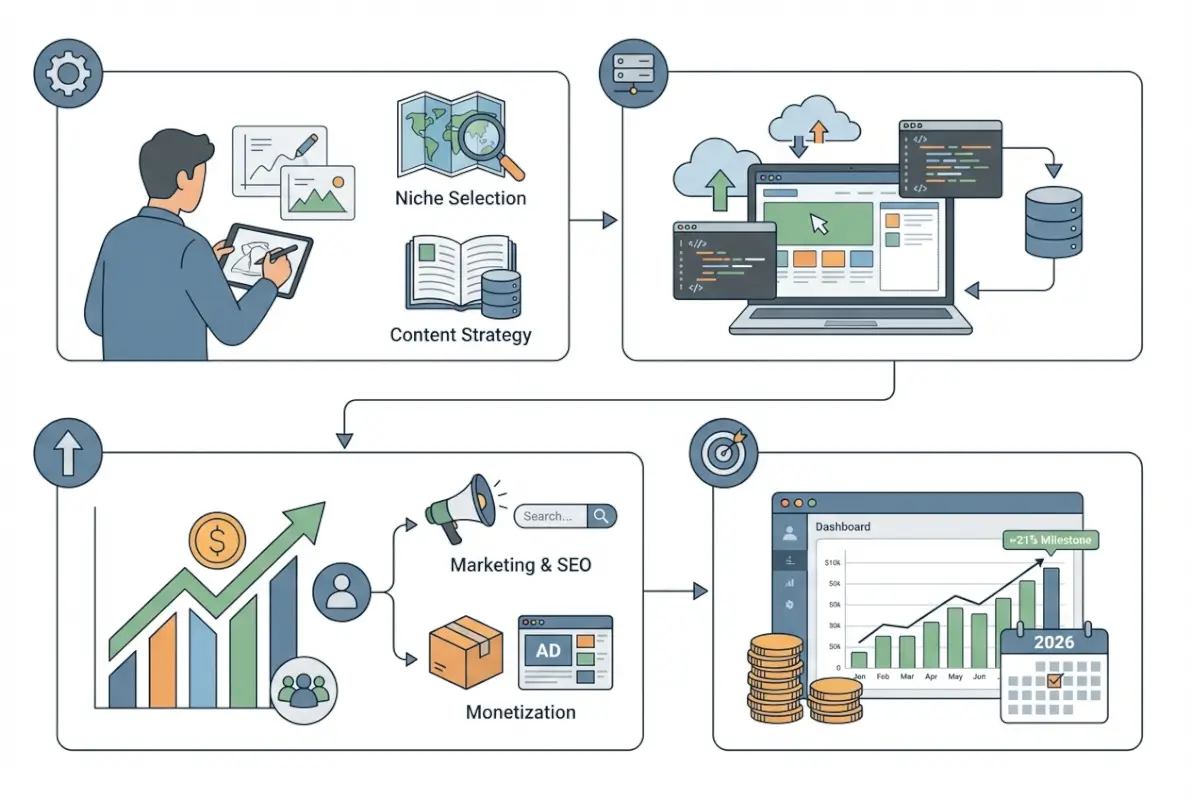
What separates winners from the thousands of abandoned directory projects cluttering the internet? Winners treat their directory as a product that solves a specific pain point, not just a database with a search function. A top-performing directory for sustainable fashion brands doesn’t just list companies—it verifies certifications, curates collections around user values, and provides transparent sourcing information. That curation creates value worth paying for, both for brands seeking visibility and consumers seeking trust.
The monetization approaches that work best avoid the “Yellow Pages trap” of charging for basic inclusion. Modern directories succeed by making basic listings free or very low-cost (to achieve critical mass), then charging premium fees for enhanced visibility, verification badges, lead-forwarding services, or promoted placements in search results. This model aligns incentives: businesses pay more as they get more value, and users benefit from a comprehensive, well-populated directory.
Common features of top-ranking articles
When you study the guides and tutorials that rank highly for “how to start a directory business,” you’ll notice they emphasize niche selection obsessively (often dedicating 20-30% of content to this topic alone). That’s because niche clarity determines everything downstream—your SEO strategy, content marketing approach, pricing model, and competitive positioning. Broad directories compete on resources you don’t have; niche directories compete on depth and relevance.
Top resources consistently stress listing quality over quantity in early stages. A directory with 50 meticulously vetted, complete business profiles outperforms one with 500 sparse, unverified entries. Quality creates trust, trust drives usage, and usage justifies premium pricing. This principle appears across successful directory playbooks because it’s been validated repeatedly in the market.
SEO and discoverability dominate these guides for good reason—directories live or die on organic traffic. The best-performing content emphasizes local SEO tactics (Google Business Profile integration, local keyword optimization, schema markup) and content strategies that answer long-tail queries. When someone searches “licensed electricians near me that offer emergency service,” your directory needs to surface relevant listings and helpful content.
Practical blueprint distilled from top resources
The proven build-seed-monetize sequence appears in virtually every successful directory case study. Start by building a focused, functional directory platform (no-code tools like TurnKey Directories, Directory software, or even structured WordPress themes work well initially). Focus your MVP on core features: searchable listings, filtering by location or attributes, and a simple submission process. Skip advanced features like user reviews, messaging systems, or complex analytics in version one.
Seed your directory manually with 50-100 high-quality listings before any public launch or marketing spend. This is tedious work—you’ll research businesses, verify details, sometimes call to confirm information—but it’s essential. A pre-populated directory looks credible and functional; an empty directory looks abandoned. Some successful founders have spent their first month doing nothing but curating initial listings, and that upfront investment paid dividends in early conversion rates.
Monetization starts after you’ve proven traction, not before. Aim for 200+ total listings and 500+ monthly unique visitors before introducing paid tiers. At that point, reach out to your most-viewed or most-engaged listings with a personalized pitch for premium placement. Early pricing should be conservative and flexible—you’re establishing the market, not maximizing immediate revenue. According to U.S. Census Bureau data on e-commerce growth, online discovery and lead-generation platforms see strongest adoption when they demonstrate clear ROI before requesting payment.
| Approach | Advantages | Best For |
|---|---|---|
| WordPress Plugin (TurnKey Directories) | Fast setup, proven monetization features, full control | Solo founders, service-based niches |
| No-Code Platform (Bubble, Webflow) | Custom design, no hosting management, flexible | Design-focused founders, unique UX needs |
| Custom Development | Unlimited customization, scalable architecture | Technical founders, complex feature requirements |
The “lean launch” philosophy dominates successful directory strategies because it minimizes wasted effort. Rather than spending six months building the perfect platform with every conceivable feature, launch a functional directory in 2-4 weeks, then iterate based on actual user feedback and business response. This aligns with the essential steps for setting up an online directory that prioritizes speed-to-market over feature completeness.
Setup, Build, and Launch
Technical build & no-code options
Choosing the right platform determines how quickly you can launch and iterate. No-code directory builders (like Brilliant Directories or WordPress plugins) let you go live in days, not months, and typically include listing forms, search filters, and basic payment integrations out of the box. If you prefer more control, a lightweight custom build on a headless CMS or static-site generator can work, but it adds complexity that most first-time directory operators don’t need.
Start with a manageable scope: core listing fields (name, category, location, contact, description), a simple search or filter by category and geography, and a submission form that feeds into a moderation queue. Avoid feature creep—advanced reviews, multi-tier membership dashboards, and map integrations can wait until you’ve validated that people will pay for listings. The goal at launch is proof of concept, not a feature-complete marketplace.
As traffic and revenue grow, plan incremental enhancements: add user reviews, integrate email automation for listing renewals, or build API connections to auto-populate data from public records or partner feeds. This phased approach minimizes upfront investment and lets you learn what users actually value before you commit engineering resources. The best directory platforms scale with you, so choose one that supports both rapid prototyping and long-term extensibility.
| Platform Type | Time to Launch | Best For | Typical Cost |
|---|---|---|---|
| No-code builder (e.g., Brilliant Directories) | 1–2 weeks | Non-technical founders, rapid validation | $50–$200/mo |
| WordPress + directory plugin | 2–4 weeks | Content-heavy sites, SEO-first approach | $20–$100/mo (hosting + plugin) |
| Custom build (headless CMS, static gen) | 4–8 weeks | Technical teams, unique UX requirements | Variable (dev time + hosting) |
Content, listings, and early seed strategy
A directory with zero listings has zero credibility, so your first job is to seed 50–100 high-quality entries in your niche. Hand-curate these initial listings by researching local chambers of commerce, industry associations, or public registries, then reach out to each business with a simple invitation to claim and expand their profile. This manual effort builds trust and gives you a baseline of accurate, complete listings that demonstrate value to both searchers and prospective paid customers.
Design a lightweight submission form that captures the essentials—business name, category, address, phone, website, and a brief description—then route submissions into a moderation queue. Approve listings within 24 hours to keep momentum high and signal that your directory is actively maintained. Early on, offer free basic listings to grow the database quickly, reserving paid tiers for featured placements, enhanced profiles, or lead-generation tools.
Community engagement and early partnerships accelerate acquisition. Reach out to trade groups, local business networks, or influencers in your niche and offer co-marketing: they promote the directory to their members in exchange for free featured listings or affiliate revenue share. This word-of-mouth flywheel is especially effective in tight-knit verticals where trust and referrals drive discovery. Track which acquisition channels deliver the highest-quality listings and double down on those as you scale.
Go-to-Market, Growth, & Monetization Roadmap
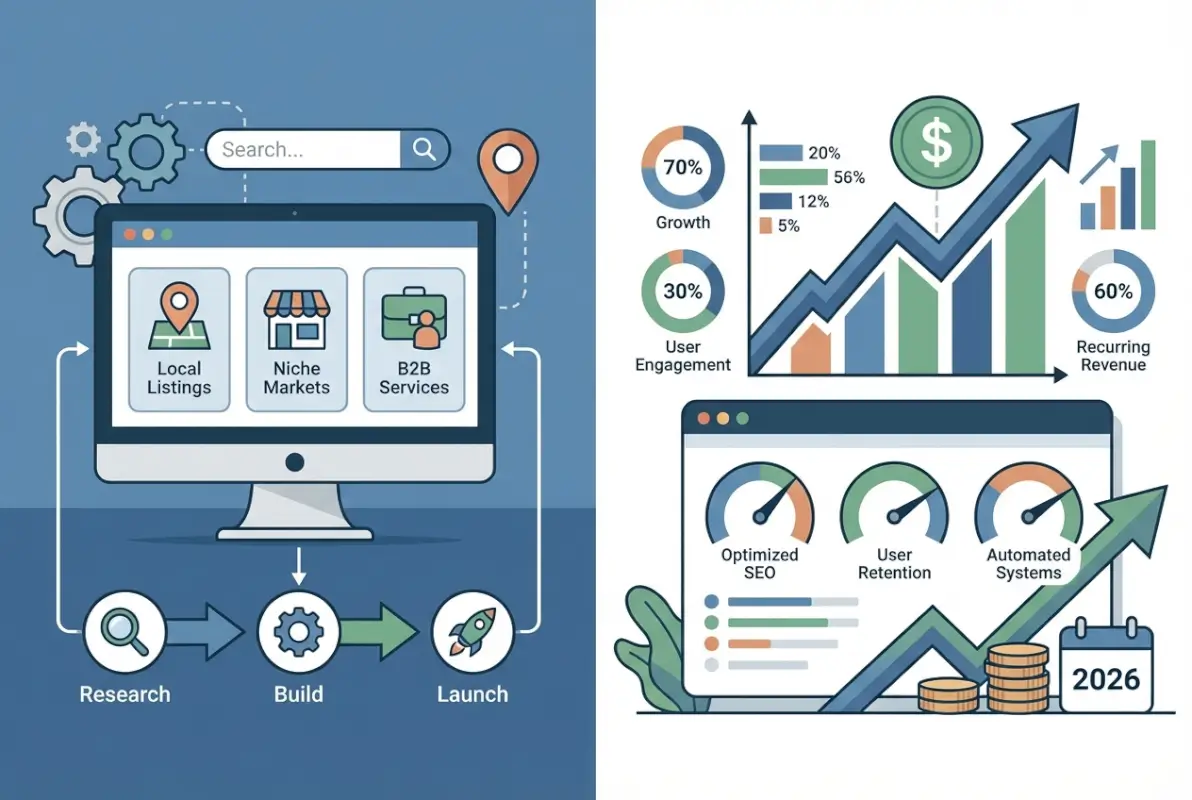
Reaching $5,000 in monthly recurring revenue requires a disciplined go-to-market plan that balances audience acquisition, conversion optimization, and phased monetization. The playbook is straightforward: drive targeted traffic through local and vertical SEO, convert free users into paid listings via clear value propositions, and layer in additional revenue streams (featured placements, lead generation, ads) as your authority and traffic grow. Most successful directories hit profitability within 6–12 months by executing this sequence methodically.
Traffic & audience acquisition
Local and vertical SEO are your primary traffic engines. Optimize each listing page with structured data (Schema.org LocalBusiness or Service markup), geo-targeted keywords, and rich content (business descriptions, categories, hours, contact info) so search engines can surface your directory for “near me” and category-specific queries. Create category landing pages (e.g., “/plumbers-in-austin”) and neighborhood guides to capture long-tail search intent. According to IAB’s 2025 digital economy report, online discovery and local search remain core drivers of SMB lead generation, making SEO-optimized directories a natural fit for this demand.
Supplement organic growth with strategic partnerships and community outreach. Guest-post on industry blogs, sponsor local events or trade shows, and collaborate with complementary services (e.g., a contractor directory partnering with a home-design blog). Paid experiments—Google Local Service Ads, Facebook geo-targeted campaigns, or sponsored posts in niche communities—can validate messaging and accelerate traffic, but keep acquisition cost per listing below your average revenue per user to maintain unit economics.
Content marketing extends your reach and establishes topical authority. Publish how-to guides, comparison articles, and local resource roundups that link back to relevant directory listings. This content ranks for informational queries, builds backlinks, and converts readers into directory users. Track referral sources, bounce rates, and listing page views in Google Analytics to identify which channels deliver engaged traffic, then iterate your content calendar and outreach plan accordingly.
Monetization milestones (from pilot to scale)
Start monetization conservatively: offer free basic listings to build the database, then introduce a paid “Featured” tier (e.g., $25–$75/month) that places businesses at the top of search results, adds premium badges, or unlocks analytics. This two-tier model is easy to explain and mirrors how directories like Yelp and Angi structure their revenue. Use a profit calculator to model different pricing scenarios and set realistic milestones: for example, 100 paid listings at $50/month = $5,000 MRR.
As traffic grows, layer in lead-generation monetization: charge businesses per qualified lead (phone call, form submission, or booking request) routed from your directory. This performance-based model aligns incentives—businesses pay only for results—and can command higher effective rates than flat listing fees. Test pricing in the $10–$50 per lead range depending on industry margins, and use tracking pixels or call-tracking numbers to attribute conversions accurately.
Additional revenue streams—display ads (Google AdSense, direct sponsorships), affiliate programs (tools, software, or services relevant to your niche), and premium content (industry reports, buyer guides)—become viable once you exceed 10,000 monthly visitors. Introduce these incrementally to avoid cluttering the user experience or diluting your core value proposition. The key is to balance revenue per visitor with user satisfaction; a directory that over-monetizes too early risks churn and poor word-of-mouth.
| Revenue Stream | Pricing Model | When to Introduce | Typical Contribution |
|---|---|---|---|
| Featured listings | $25–$75/month subscription | Month 1 (after 50 seed listings) | 60–80% of MRR |
| Lead generation | $10–$50 per qualified lead | Month 3–6 (traffic > 1,000/mo) | 15–30% of MRR |
| Display ads / sponsorships | CPM or flat monthly fee | Month 6–12 (traffic > 10,000/mo) | 5–15% of MRR |
| Affiliate programs | Commission per sale or sign-up | Month 6–12 (established authority) | 5–10% of MRR |
Risk Management, Compliance, and Long-Term Positioning

Building a sustainable directory means managing legal, operational, and market risks from day one. Neglecting compliance or user trust can derail traction faster than any competitive threat, so treat risk management as a core competency alongside product and marketing. The good news: most risks are preventable with straightforward planning and adherence to standard small-business best practices.
Legal, compliance, and best practices
Register your business entity (LLC or corporation) in your state to protect personal assets and establish credibility with customers and partners. The SBA’s 10-step startup guide walks through business structure, federal and state tax IDs (EIN), and basic licensing requirements. Most directories operate as simple service businesses and don’t require special permits, but check local regulations if you’re handling payments or sensitive user data.
Maintain listings accuracy and user privacy to build trust and avoid legal exposure. Publish clear terms of service and a privacy policy that disclose how you collect, store, and share business and user data; free templates from legal-tech providers or the SBA can get you 90% of the way there. Implement a straightforward process for businesses to claim, update, or remove their listings, and respond to disputes or inaccuracies within 48 hours. Proactive moderation and transparency reduce churn and negative reviews.
Stay current on data-protection regulations (GDPR if you serve EU users, CCPA in California) and payment-processing compliance (PCI-DSS if you handle credit cards directly). Most no-code platforms and payment gateways (Stripe, PayPal) handle PCI compliance for you, but verify that your setup meets requirements. Document your compliance efforts—privacy audits, terms updates, data-retention policies—so you can demonstrate good faith if questions arise.
Sustaining growth amid market shifts
E-commerce and digital discovery are growing, but consumer behaviors and platform algorithms evolve constantly. IAB’s 2025 digital economy report shows that online retail’s share of total retail continues to rise, supporting directory models as a traction channel for SMBs. Monitor these macro trends and be prepared to adapt your monetization mix—for example, if Google shifts to zero-click answers, invest more in lead-gen partnerships or direct-to-consumer content.
Diversify traffic sources to reduce platform risk. Relying solely on Google organic means one algorithm update can crater your revenue; balance SEO with email (build a subscriber list of businesses and searchers), social (community groups, LinkedIn, local Facebook pages), and partnerships (co-marketing with complementary services). This multi-channel strategy insulates you from single-point failures and gives you negotiating leverage as you scale.
Plan for competition and market saturation by deepening your niche moat. Invest in proprietary data (exclusive partnerships, verified reviews, industry benchmarks), superior UX (faster search, mobile-first design, better filters), and community engagement (events, forums, educational content). The directories that thrive long-term aren’t necessarily the first movers—they’re the ones that deliver the most value and adapt fastest to user needs.
Frequently Asked Questions
What is an online directory business?
An online directory is a platform that organizes and lists businesses or services within a specific niche or geographic area. It typically generates revenue through paid listings, featured placements, and lead-generation options. Directories help users discover services while offering businesses visibility and customer acquisition channels.
How much money can I make with a directory website?
Revenue depends on traffic, niche depth, and monetization strategy. Early-stage directories often earn $500–$2,000 monthly through basic paid listings. Mature directories with strong traffic can reach $5,000–$10,000 monthly by layering featured placements, lead generation, and advertising. Conservative pricing and gradual scaling are essential for sustainable growth.
Which monetization strategy works best for directories?
A tiered approach performs best: offer free basic listings to build inventory, then introduce paid featured placements for visibility. Add lead-generation monetization where businesses pay per inquiry or conversion. As traffic scales, layer in display advertising and affiliate programs to diversify revenue streams and reduce reliance on single channels.
How do I get my directory to rank in search engines?
Focus on niche relevance and high-quality listings with complete information. Optimize for local and long-tail keywords that match user search intent. Build content around common queries in your vertical, ensure fast page speeds, and encourage user reviews. Quality over quantity in listings improves domain authority and organic visibility.
What initial steps should I take to launch quickly?
Select a tightly defined niche and choose a no-code platform or directory plugin to minimize technical complexity. Seed 50–100 quality listings manually, set up a simple submission form, and define initial pricing for premium placements. Launch with core features only, then iterate based on early user feedback and conversion data.
Can a directory business be profitable in 2026?
Yes, directories remain profitable when focused on underserved niches with strong search demand. E-commerce growth and digital advertising trends support discovery platforms. Success requires disciplined niche selection, quality listings, strong SEO, and a clear monetization plan. Expect 6–12 months to reach meaningful revenue with consistent execution.
Should I offer free listings or charge from the start?
Offer free basic listings initially to build critical mass and credibility. Once you have 50–100 listings and steady traffic, introduce paid featured placements and premium tiers. This freemium model reduces friction for early adopters while creating clear upgrade paths. Monitor conversion rates closely to refine pricing strategy.
How long does it take to reach $5,000 per month with a directory?
Most directory businesses require 9–18 months of consistent effort to reach $5,000 monthly revenue. Timeline depends on niche competitiveness, SEO execution, listing acquisition speed, and monetization effectiveness. Accelerate growth by targeting low-competition niches, building strategic partnerships, and testing paid acquisition channels once organic traction validates product-market fit.
Your Path to a Profitable Directory Business Starts Now
Building a directory business that generates $5,000 monthly in 2026 is entirely achievable with the right approach. The opportunities are clear: e-commerce continues to expand, small businesses need discovery channels, and niche directories solve real problems for both users and service providers.
Success comes down to execution discipline. Choose a niche with proven demand but manageable competition. Build your directory on a platform that lets you launch quickly without technical complexity. Seed high-quality listings that establish credibility from day one. Layer monetization gradually, starting with featured placements and expanding to lead generation as traffic validates your model.
The market data supports this model. Digital commerce growth, rising online advertising spend, and sustained demand for local discovery all create tailwinds for well-executed directories. You don’t need to reinvent the wheel—you need to apply proven principles to an underserved vertical.
Your immediate action plan is straightforward. This week, define your niche and validate demand through keyword research and competitor analysis. Next week, choose your platform and begin seeding your first 25 listings. Within 30 days, launch with a simple submission process and initial pricing structure. Track metrics rigorously, iterate based on real user behavior, and scale what works.
Ready to Launch Your Directory?
Start with niche validation today. Define your target market, identify 50 potential listings, and map your monetization strategy. The businesses that will reach $5K/month in 2026 are the ones that start building now.
Leverage SBA resources for compliance, use industry data to validate your niche, and commit to consistent execution over the next 12 months. Your directory business is a series of small, disciplined decisions compounded over time.
The framework is proven. The tools are accessible. The market opportunity is real. What separates successful directory founders from those who never launch is simple: they start. Take the first step this week, commit to the process, and track your progress against clear milestones. Your $5,000-per-month directory business begins with the decision to build it.
Was this article helpful?