How to Improve Your Directory Listing: 6 SEO Best Practices

Generating summary...
Directory listings aren’t dead—they’ve just evolved into something far more sophisticated than the link farms of the early 2000s. While everyone’s chasing the latest algorithm update or social media trend, there’s a quietly powerful truth most businesses overlook: properly optimized directory listings still function as digital storefronts that Google trusts, customers rely on, and competitors frequently neglect. The real opportunity isn’t whether to use directories, it’s understanding that modern directory optimization is less about gaming search engines and more about creating coherent digital ecosystems where every piece of your business information reinforces the next. Think of each listing not as a backlink destination, but as a trust signal that validates your business exists in the physical and digital world simultaneously.
TL;DR – Quick Takeaways
- NAP consistency is non-negotiable – Inconsistent business information across directories confuses search engines and erodes customer trust, directly impacting local rankings
- Complete profiles outperform sparse ones – Fully filled listings with rich media generate significantly higher engagement and click-through rates than text-only entries
- Quality directories matter more than quantity – Five authoritative, relevant directory listings outweigh fifty low-quality submissions for both SEO value and referral traffic
- Reviews and reputation management are ranking factors – Active review profiles with thoughtful responses signal business legitimacy to both algorithms and potential customers
- Regular audits prevent decay – Directory information degrades over time; quarterly checks ensure accuracy and maintain SEO benefits
- Visual content drives measurable engagement – Listings with professional photos and videos generate up to three times more calls and clicks than text-only profiles
Ensure Consistent NAP Across Directory Listings
NAP consistency sounds deceptively simple until you’re managing listings across dozens of directories, each with slightly different formatting requirements and character limits. The fundamental principle remains straightforward: your business Name, Address, and Phone number should appear identically everywhere your business is listed online. Search engines use these data points as verification signals, essentially cross-referencing information to determine whether your business is legitimate and trustworthy.

Here’s what most guides won’t tell you—NAP inconsistencies don’t just hurt rankings through algorithmic penalties. They create real-world friction when potential customers can’t figure out if “Smith & Associates LLC” at one address is the same business as “Smith and Associates” at a slightly different address format. I’ve watched businesses lose customers who called an outdated phone number, got frustrated, and hired a competitor instead. The SEO impact matters, but the business consequences matter more.
Why NAP Consistency Signals Trust to Search Engines
Search algorithms, particularly for local results, operate on confidence scores. When Google crawls the web and finds your business mentioned with identical NAP information across multiple authoritative sources, it increases confidence that your business is real, stable, and accurately represented. Inconsistent information triggers uncertainty—the algorithm can’t confidently determine which version is correct, so it hedges by ranking you lower or showing less prominent information in search features.
The name field causes more problems than you’d expect. Some directories don’t allow special characters, others truncate long names, and legal entity suffixes (LLC, Inc., Ltd.) get handled inconsistionally. Your address might be formatted as “123 Main Street” on one directory and “123 Main St.” on another. Phone numbers appear with parentheses, dashes, spaces, or none at all. Each variation fragments the trust signal you’re trying to build.
Practical Steps to Achieve and Audit NAP Consistency
Start by documenting exactly how your business information appears on your most authoritative listings—your website, Google Business Profile, and any industry-specific directories that matter most to your sector. These become your canonical versions. For the business name, use your legal registered name unless you have compelling brand recognition reasons to use a DBA (doing business as) name. If you do use a DBA, use it consistently everywhere, never mixing the two.
Address formatting requires precision. Write out “Street” versus “St.” the same way every time, include or exclude suite numbers uniformly, and be consistent with abbreviations. For phone numbers, I recommend the format +1-555-123-4567 (country code, area code, number) because it works internationally and most directories accept it. Avoid vanity numbers in directory listings—they’re memorable for marketing but create tracking and consistency problems for SEO.
Setting up quarterly automated checks prevents drift. Business information changes—you relocate offices, update phone systems, rebrand slightly—and those changes need to propagate everywhere. Without scheduled audits, listings become increasingly inconsistent as the business evolves. Tools exist for citation monitoring (services like Moz Local, BrightLocal, or Whitespark), but even a simple spreadsheet listing your top 20 directories with last-checked dates works if you actually follow through with manual verification.
| NAP Element | Common Inconsistency | Best Practice |
|---|---|---|
| Business Name | Mixing legal name with DBA | Choose one version, use everywhere |
| Address | “Street” vs “St.” variations | Standardize all abbreviations |
| Phone | Different formatting styles | Use +1-555-123-4567 format |
| Suite Numbers | Sometimes included, sometimes not | Always include if you have one |
Tools and Metrics to Measure NAP Health
You can measure NAP consistency through several lenses. Direct citation tracking tools scan major directories and flag inconsistencies, providing a consistency score (typically 85% or higher is considered healthy). More revealing are the indirect signals: monitor your referral traffic from directory sources, track changes in local search rankings after cleaning up inconsistencies, and watch for patterns in customer confusion (wrong address visits, calls to old numbers).
The connection between NAP consistency and getting your business listing on the first page of Google isn’t always immediate, but it compounds over time. Clean, consistent data across quality directories builds cumulative trust that influences how confidently search engines display your business in local results.
Optimize Directory Profiles with Complete, Rich Listings
Incomplete directory profiles are digital equivalent of showing up to a networking event with a name tag but refusing to tell anyone what you do. Every blank field represents a missed opportunity—not just for SEO, but for giving potential customers the information they need to choose your business over competitors who bothered to fill out their profiles completely.
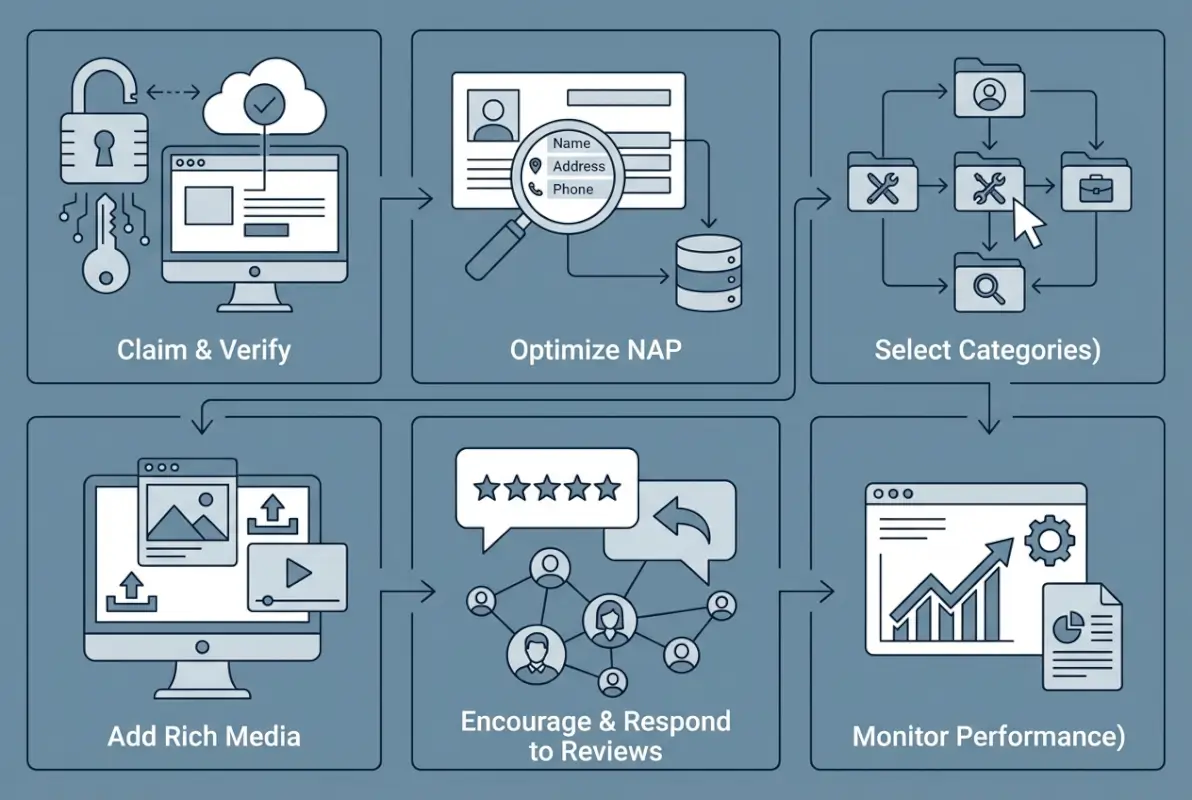
The difference between a minimal listing and a fully optimized one is measurable. Complete profiles generate higher engagement metrics across every dimension: more profile views, more website clicks, more phone calls, more direction requests. Search algorithms notice these engagement patterns, and they factor into ranking decisions for local searches. A half-finished profile signals low business investment and gets treated accordingly.
Write Comprehensive Business Descriptions
Business descriptions are where most directory submissions fall apart. People either leave them blank, copy-paste generic boilerplate from their website footer, or stuff them with awkward keyword repetitions that read like they were written by a malfunctioning robot. Your description should accomplish three things simultaneously: clearly explain what you do, incorporate relevant search terms naturally, and give readers a reason to choose you over competitors.
Think about the questions potential customers ask before they contact a business in your industry. What services do you provide? What areas do you serve? What makes your approach different? Who are your typical clients? Answer these questions in conversational language that sounds like a knowledgeable person explaining their business, not a marketing department optimizing for algorithms. The keywords will naturally appear when you describe your services accurately and thoroughly.
Here’s a practical approach: write three versions of your description in different lengths (50 words, 150 words, 300 words) so you’re prepared for directories with different character limits. The shortest version covers just the essential service and location. The medium version adds differentiators and key specialties. The longest version can include brief company history, credentials, or customer success elements. All three should sound authentic and informative.
Leverage Rich Media and Structured Data
Text-only listings are increasingly disadvantaged in directories that support photos, videos, and other media. Visual content serves multiple purposes: it makes your listing more visually prominent when users scroll through results, it provides social proof of your business quality and professionalism, and it gives search engines additional signals about your business category and legitimacy.
Upload your logo to establish brand consistency, add exterior photos that help customers recognize your location, include interior shots that showcase your facilities, and feature product or service photos that demonstrate your work quality. Many directories allow 5-10 images; use all available slots with different images that each tell part of your business story. Name your image files descriptively (business-name-service-location.jpg rather than IMG_1234.jpg) and add alt text where supported.
Video content, when directories support it, generates disproportionately high engagement. A 60-90 second overview video explaining your services, showing your team, or walking through your process makes your listing memorable and builds trust more effectively than text alone. Virtual tours work especially well for location-based businesses where customers need to feel comfortable with your physical space before visiting.
Include Complete Attributes and Structured Data
Business attributes—hours of operation, payment methods accepted, service areas, accessibility features, parking availability—seem like minor details until a customer needs that specific information to make a decision. Comprehensive attribute completion also helps directories and search engines categorize your business accurately, matching you with more relevant searches.
Many directories now support schema.org markup or have their own structured data formats (FAQ schema, LocalBusiness schema, service area markup). Take advantage of these when available, as they help search engines extract and display your information in rich results. Some directories automatically generate schema from your profile data; others require manual implementation. Either way, structured data makes your listing more machine-readable and increases chances of appearing in enhanced search features.
When considering how to get your business listed on directories, remember that the initial submission is just the starting point—the ongoing optimization of attributes and content determines actual performance.
Leverage Visuals and Rich Media
The engagement gap between media-rich listings and text-only entries is dramatic enough that it should fundamentally change how you approach directory submissions. Users scanning search results or directory categories are drawn to visual elements—photos, videos, logos—in ways that text blocks simply cannot match. This isn’t just about aesthetics, it’s about cognitive processing and trust-building in the seconds before someone decides whether to click or scroll past.

From a practical SEO perspective, images and videos provide additional ranking signals through file names, alt text, and the engagement metrics they generate. More importantly, they address the human decision-making process. When someone is comparing multiple businesses in a directory, the one with professional photos demonstrating quality and legitimacy has an immediate advantage over the one that couldn’t be bothered to upload a single image.
The Measurable Impact of Visual Content
Businesses with complete photo galleries in their directory listings consistently report higher click-through rates to their websites, more phone calls, and more direction requests compared to their own previous performance with text-only listings. The difference isn’t marginal—it’s often double or triple the engagement. Visual content works because it answers unspoken questions (What does this place look like? Does it seem professional? Is this the type of business I’m looking for?) before users even have to think through those questions consciously.
The type of images matters as much as their presence. Exterior shots help customers locate your business and verify they’re at the right place. Interior photos showcase your environment and set expectations. Action shots of your team at work or products being used demonstrate competence and build confidence. Before-and-after images work powerfully for services with visible transformations (remodeling, landscaping, restoration, cleaning). Each image type serves a different psychological function in the customer decision journey.
Optimize Media Within Directory Constraints
Different directories have different image requirements and limitations. Some accept only a single logo, others allow unlimited galleries. File size limits, dimension requirements, and acceptable formats vary. Rather than trying to optimize for each directory individually, create a master media kit with multiple versions of each asset: square logos, rectangular logos, horizontal and vertical photos in different aspect ratios, all exported at different resolutions to meet various requirements.
Image quality should be professional but not excessive. A 4000×3000 pixel photo might showcase amazing detail, but it creates unnecessarily large file sizes that slow directory page loads and may get rejected or automatically downsampled anyway. Export photos at appropriate web resolutions (typically 1200-1800 pixels on the longest side is plenty), compress them reasonably, and ensure they display well on mobile devices since most directory browsing happens on phones.
Name your files strategically: “chicago-plumber-emergency-service.jpg” provides more context to search engines than “DSC_8362.jpg” and makes your media library easier to manage. Add alt text whenever the directory platform supports it, describing what’s shown in the image naturally while incorporating relevant location and service terms when appropriate.
Track Visual Content Performance
You can’t improve what you don’t measure. Most business directories provide analytics showing how users interact with your listing—profile views, photo views, video plays, click-throughs to your website, phone calls initiated. Compare performance metrics before and after adding comprehensive media to understand the actual impact on your specific audience and industry.
Pay attention to which images get the most engagement. If your team photos get viewed more than your product shots, that tells you something about what your audience values (they want to know who they’ll be working with). If exterior photos get skipped but interior views hold attention, you’re probably in an industry where the environment matters more than the facade. Use these insights to refine your media strategy across all directories.
Proactively Manage Reviews and Reputation
Reviews transform directory listings from static business cards into dynamic reputation indicators that influence both search rankings and customer decisions. The challenge is that most businesses approach reviews reactively—waiting for feedback to appear and then scrambling to respond—rather than building systematic processes that generate consistent, authentic reviews while managing reputation proactively.

The SEO implications of reviews extend beyond simple volume. Search algorithms evaluate review recency (recent reviews signal an active business), response rates (businesses that engage with feedback appear more legitimate), sentiment patterns (overall positive trends matter more than perfect 5-star averages), and review detail (specific, substantive reviews carry more weight than generic praise). A strategic approach to reviews addresses all these factors simultaneously.
Why Review Volume and Quality Impact Rankings
Reviews function as third-party validation in ways that your own business descriptions never can. When dozens of people independently verify that your business provides the services you claim with quality that meets or exceeds expectations, search engines gain confidence in promoting your listings. This confidence translates into better visibility in local search results, more prominent placement in directory categories, and higher click-through rates from search features that display review ratings.
But not all reviews carry equal weight. Detailed reviews that mention specific services, locations, staff members, or experiences provide more value than simple “great service” comments. Reviews from verified customers (where the directory or platform can confirm an actual transaction occurred) count more heavily than unverified feedback. And patterns matter—a steady stream of reviews over time suggests genuine customer satisfaction, while sudden bursts of positive reviews trigger spam detection algorithms.
I remember working with a client who had 45 reviews across multiple directories—all posted within a three-week period, all extremely positive, all vague. Google’s algorithm correctly identified this as manipulation and actually penalized their rankings compared to a competitor with only 18 reviews spread over eight months but written with specific details about actual experiences. The lesson: authenticity beats volume, always.
Build a Sustainable Review Generation System
Systematic review generation isn’t about gaming the system, it’s about making it easy for satisfied customers to share their experiences while respecting their time and platform guidelines. The process starts with identifying the right moment to request feedback—typically right after a successful transaction or completed service when satisfaction is highest and the experience is fresh in the customer’s mind.
Create a simple workflow: follow up via email or text with a brief message thanking the customer for their business and including direct links to your most important directory profiles. Make the process as frictionless as possible—customers are far more likely to leave reviews when they can click a link that takes them directly to the review form rather than having to search for your business manually.
Respond Strategically to All Feedback
Response strategy matters almost as much as the reviews themselves. Responding to positive reviews shows appreciation and professionalism while giving you another opportunity to reinforce key messages about your services. Responding to negative reviews demonstrates that you take customer concerns seriously and provides public evidence of your customer service commitment—often more valuable than the negative review itself.
For positive reviews, keep responses brief but personalized. Mention something specific from their review to show you actually read it, thank them genuinely, and perhaps mention related services they might not know about. Avoid template responses that sound robotic or copy-pasted; customers and algorithms both notice when you’re just going through motions.
Negative reviews require more nuanced handling. Respond quickly (within 24-48 hours) to show you’re attentive. Acknowledge their experience without necessarily accepting blame for everything described. Offer to discuss the issue privately and work toward resolution. Never argue publicly or get defensive—potential customers watching these exchanges judge your professionalism more than they judge the complaint itself. Sometimes the best response is simply: “We’re sorry you had this experience. We’d like to learn more and make it right. Please contact us directly at [email/phone] so we can address your concerns personally.”
Strategic Directory Selection and Link Equity
The directory ecosystem has stratified dramatically over the past decade. At the top are major platforms like Google Business Profile, Apple Maps, and established industry-specific directories with genuine user bases and editorial standards. At the bottom are thousands of low-quality scraper sites that exist primarily to collect links and ad revenue. The difference in SEO value between these tiers isn’t just significant, it’s potentially negative—wrong directory choices can actually harm your rankings rather than help them.

Modern directory strategy requires selectivity. You’re building a portfolio of authoritative citations that collectively signal your business legitimacy and category relevance, not assembling as many backlinks as possible regardless of source quality. This means researching directories carefully, prioritizing those with real traffic and engagement, and avoiding bulk submission services that spray your information across hundreds of questionable sites.
Quality Indicators for Directory Vetting
Before submitting to any directory, evaluate several quality signals. First, check if the directory itself ranks well for relevant industry searches—if it has no Google visibility, it won’t drive traffic to you and may not pass meaningful link equity. Second, examine whether it has genuine user activity: recent listings from other businesses, current reviews, signs that people actually use the platform rather than just businesses submitting information into a void.
Look at the directory’s editorial standards. Does it accept every submission automatically, or does it review listings for quality and legitimacy? Selective directories carry more weight because inclusion implies some level of vetting and endorsement. Check the types of businesses already listed—if you’re a professional service provider and the directory is full of questionable entries for services that sound spammy, that’s not association you want.
Technical factors matter too. Is the directory properly indexed by search engines? Does it load quickly and work on mobile devices? Are individual business pages crawlable and followable by search bots, or are they buried behind JavaScript or search-only interfaces? Understanding how directories themselves rank on Google helps you prioritize the ones most likely to pass value to your listing.
| Directory Tier | Characteristics | Value Level |
|---|---|---|
| Premium Tier | Editorial review, high traffic, industry-specific authority | Highest SEO value, significant referral traffic |
| Mid-Tier | General directories with established presence, moderate traffic | Good for citation consistency, modest traffic |
| Low-Quality | Auto-accept all submissions, little or no traffic, spammy entries | Minimal to negative value, potential spam association |
Link Strategy and Anchor Text Considerations
When directories allow you to control anchor text for links back to your website, resist the urge to over-optimize with exact-match keywords. Natural link profiles include a mix of branded anchors (your business name), generic anchors (“website,” “visit us,” “learn more”), and some keyword-descriptive anchors. A pattern of identical keyword anchors across multiple directories looks manipulative to search algorithms and can trigger manual review or algorithmic penalties.
The actual mechanics of links matter too. Dofollow links pass more direct SEO value but may attract more scrutiny if the source isn’t highly reputable. Nofollow links still contribute to your overall citation profile and can drive referral traffic, just without direct link equity. Many quality directories now use nofollow by default, and that’s fine—the citation and traffic value justify the listing regardless of follow status.
Some directories offer tiered pricing with premium listings that include enhanced features or dofollow links. Evaluate these opportunities based on the directory’s actual authority and your specific needs. If it’s a major industry directory with significant user traffic, the premium tier might be worth the investment for visibility and features alone, regardless of link status. If it’s a marginal directory trying to monetize desperate businesses seeking backlinks, save your money.
Measuring Directory Performance Over Time
Track which directories actually drive results. Use UTM parameters or unique phone numbers to identify referral traffic sources. Monitor ranking changes for local keywords after adding quality citations. Watch for patterns: do certain industry-specific directories drive more qualified leads than general business directories? Does traffic from directories convert at rates comparable to other sources?
Domain authority metrics (like those from Moz or similar services) provide rough indicators of directory quality, but they’re not perfect. A directory with modest domain authority but highly relevant, engaged users in your specific industry may outperform a high-authority general directory where your listing gets lost among millions of others. Real traffic and conversion data beat theoretical authority metrics for practical decision-making.
Regular Audits and Maintenance for Longevity
Directory listings aren’t set-and-forget assets, they require ongoing attention to maintain accuracy and effectiveness. Business information changes—you update hours, add services, relocate offices, change phone systems—and without systematic maintenance, your directory presence gradually becomes outdated and misleading. Even worse, competitors may claim duplicate listings, directories may shut down or change ownership, and information can become corrupted through automated data scraping that propagates errors.
A quarterly audit cadence strikes the right balance for most businesses between staying current and not consuming excessive resources. Very dynamic businesses (frequently changing hours, seasonal services, multiple locations) might need monthly checks, while more stable operations can stretch to semi-annual reviews. The key is putting the audit on the calendar as a recurring task rather than waiting until someone notices problems.
Build a Systematic Audit Checklist
Your quarterly audit should cover several dimensions systematically. Start with NAP verification across your top 20-30 directories—confirm the name, address, and phone number are still correct and consistent. Check business hours, especially if they change seasonally or you’ve adjusted operating schedules. Verify that your business categories and service descriptions still accurately reflect your current offerings (many businesses evolve their services but forget to update directory listings).
Review your visual content. Are the photos still current and representative? If you’ve remodeled, rebranded, or updated equipment and facilities, your images should reflect those changes. Check that links to your website still work and point to relevant landing pages (not broken pages or generic home pages when specific service pages would be more appropriate). Test your phone numbers by actually calling them to ensure they connect properly and don’t hit dead lines or full voicemail boxes.
Scan your reviews and ratings. Respond to any new feedback you missed. Look for patterns in complaints or praise that might inform service improvements or marketing messaging. Check if any competitors have left fake reviews or if you’ve been targeted by review spam—unfortunately, this happens and requires prompt action to request removal through proper channels.
Update and Refresh Content Strategically
Beyond correcting outdated information, use your audit cycle to proactively improve listings. Rewrite descriptions to highlight new services or updated value propositions. Add recent photos showcasing new facilities, team members, or successful projects. Update any promotional content or special offers (and remove expired promotions—nothing looks worse than highlighting a “Summer 2022 Special” in your active listing).
Look for opportunities to expand your presence in directories you’ve been underutilizing. Maybe you submitted a minimal listing a year ago; now fill out all the optional fields, add comprehensive media, and leverage any new features the directory has introduced. Platforms evolve constantly, adding new capabilities, and your old listings won’t automatically inherit these features—you need to manually update to take advantage.
Some directories penalize dormant listings in their internal rankings or search results. Regular updates signal active business presence, which directories reward with better visibility. Even minor updates—adding a new photo, refreshing your description slightly, updating your hours for a holiday schedule—can reset recency signals that boost your listing within the directory’s ecosystem.
Watch for Compliance Issues and Risks
Part of your audit should involve checking that your listings comply with each directory’s current terms of service and that you’re not inadvertently creating problems. Look for duplicate listings (often created when businesses change names or someone submits your business without authorization). Duplicate listings fragment your reviews and engagement signals across multiple profiles, diluting the value of each.
Check that you haven’t been listed in inappropriate categories, either through your own error or directory mistakes. Being categorized incorrectly can show your business to the wrong audience and signal confusion to search engines about your actual services. Monitor for potential data scraping issues—some low-quality sites automatically pull information from other sources and may have created outdated or inaccurate listings for your business without your knowledge or permission.
Cybersecurity matters too. Ensure you still have access to all your directory accounts (test your logins periodically) and that contact email addresses are current. If a key directory needs to contact you about a policy change or suspicious activity on your listing, you want to receive that message, not have it bounce to a defunct email address. Just as you need to know how to recover listings when access problems occur, preventing access issues through regular maintenance is far easier than recovering after lockouts.
Frequently Asked Questions
Do directory listings improve SEO in 2026?
Yes, quality directory listings still contribute to SEO by providing citation signals that validate business legitimacy, generating referral traffic that search engines monitor, and creating backlinks from authoritative sources. The key is focusing on reputable, relevant directories rather than pursuing quantity indiscriminately. Modern algorithms heavily discount low-quality directories while valuing citations from established platforms.
Should I focus on premium directory listings or free listings?
Prioritize free listings on all major and relevant directories first, then selectively upgrade to premium tiers where the directory has genuine traffic and the enhanced features provide clear value—better placement, additional media slots, analytics, or lead generation tools. Premium listings on low-traffic directories rarely justify their cost regardless of SEO claims.
How often should I update directory listings?
Conduct comprehensive audits quarterly to verify accuracy and make strategic updates. Update immediately when core business information changes (address, phone, hours, major service additions). Minor refreshes every few months—new photos, slight description updates, responding to new reviews—help maintain active status signals that directories reward.
How important is NAP consistency across directories for local SEO?
NAP consistency is critical for local SEO because search engines cross-reference business information across multiple sources to build confidence in data accuracy. Inconsistent information reduces this confidence, resulting in lower rankings and less prominent display in local search features. Even small variations create fragmentation that dilutes trust signals.
What are best practices to standardize business name, address, and phone formatting?
Create a master reference document with your exact legal business name, complete address with standardized abbreviations, and phone number formatted consistently with country code. Use this exact formatting everywhere unless technical limitations prevent it, in which case document approved variations. Avoid mixing legal names with DBAs or using different address formats across platforms.
Do images and videos in directory listings boost rankings?
Images and videos primarily boost engagement metrics—click-through rates, time on listing, calls initiated—which indirectly influence rankings through user behavior signals. Additionally, optimized image file names and alt text provide supplementary keyword signals. The ranking impact is less direct than citation consistency but measurable through improved visibility and conversion rates.
Should I optimize descriptions for keywords in directory listings?
Yes, but prioritize natural, helpful descriptions over keyword density. Incorporate relevant search terms by accurately describing your services, locations, and specialties in conversational language. Modern algorithms penalize obvious keyword stuffing and reward genuinely informative content that answers user questions and helps them determine if your business meets their needs.
How should I respond to reviews on directory listings?
Respond to all reviews within 24-48 hours when possible. For positive reviews, thank the customer briefly and mention something specific from their feedback. For negative reviews, acknowledge their experience without arguing, apologize if appropriate, and offer to resolve the issue privately. Keep responses professional and concise—you’re addressing both the reviewer and future customers reading the exchange.
Do reviews from directories impact local rankings?
Yes, reviews influence local rankings through multiple factors: total review volume, review recency, average rating, review detail and authenticity, and your response rate. Search algorithms treat reviews as third-party validation of business quality and legitimacy. Reviews also impact click-through rates from search results, which creates secondary ranking signals through user behavior.
How can I measure the impact of directory listings on referral traffic?
Use UTM parameters on website links in directory profiles to track referral traffic sources in Google Analytics. Implement unique phone numbers for different directories to measure call volume by source. Monitor directory-provided analytics dashboards for profile views, clicks, and other engagement metrics. Compare performance before and after optimizing listings to isolate the impact of your improvements.
What metrics indicate directory listings are helping my SEO?
Track several indicators: increased referral traffic from directory sources, improved rankings for local keywords containing your city or service area, more frequent appearance in local map packs and local search features, higher click-through rates from search results to your website, and increased call volume and direction requests. Growth across multiple metrics indicates healthy directory strategy performance.
Are industry-specific directories more valuable than general business directories?
Industry-specific directories typically provide higher-quality traffic and leads because users are already qualified by category interest, though general directories like Google Business Profile have vastly larger audiences. Ideal strategy includes both: major general directories for maximum visibility and top industry directories for qualified, high-intent traffic. Relevance often matters more than authority for conversion outcomes.
Putting Your Directory Strategy Into Action
Directory optimization works precisely because most businesses ignore it or execute it poorly. While your competitors are chasing the latest social media trend or obsessing over minor algorithm changes, you can build durable competitive advantages through systematic directory management that compounds over time. The six practices outlined here—NAP consistency, complete profiles, rich media, review management, selective directory choice, and regular audits—aren’t individually revolutionary, but together they create a directory presence that functions as genuine business infrastructure rather than neglected marketing afterthought.
Start with a focused audit of your current directory presence across your 10-15 most important platforms. Document inconsistencies, identify incomplete profiles, and create your master NAP reference document. This baseline assessment typically reveals more problems than businesses expect, but that’s actually good news, it means you have clear, actionable opportunities for improvement that competitors have probably also neglected.
Approach optimization systematically rather than trying to fix everything simultaneously. Month one: clean up NAP consistency and establish your master documentation. Month two: complete all profile fields and upload rich media to your top directories. Month three: implement review generation systems and respond to existing feedback. Month four: evaluate your directory portfolio and prune low-quality listings while researching new quality opportunities. By quarter’s end, you’ll have transformed your directory presence from liability to asset.
- Create your master NAP document and verify consistency across your top 5 directories this week
- Schedule recurring quarterly audits on your calendar now, before you forget
- Choose one directory to fully optimize—complete profile, add media, encourage reviews—as your template for others
- Set up tracking mechanisms (UTM parameters, unique numbers) to measure actual impact
The businesses that excel at directory optimization share a common characteristic: they treat it as an ongoing discipline rather than a one-time project. Your directory presence reflects your business across dozens of platforms where potential customers make decisions, and that presence deserves the same attention you give to your website or major marketing initiatives. The competitive opportunity exists precisely because most businesses won’t do this work consistently—which means the ones who do capture disproportionate value from an often-overlooked channel that still delivers tangible results.
Whether you’re establishing your first directory listings or optimizing an existing presence that’s accumulated years of neglect and inconsistency, the principles remain the same: accuracy builds trust, completeness drives engagement, quality beats quantity, and systematic maintenance preserves value over time. Your directory strategy might not generate overnight transformation, but executed consistently over quarters and years, it creates compounding advantages that become increasingly difficult for competitors to match. In fact, understanding how specialized platforms feature listings can inform broader directory strategies across multiple platforms.
Directory listings represent one of the few remaining SEO tactics where significant opportunities still exist for businesses willing to execute fundamentals exceptionally well. While others debate the latest ranking factor speculation or chase diminishing returns from saturated channels, the practical, unglamorous work of maintaining accurate, comprehensive directory profiles continues delivering measurable results. That’s the opportunity—not in discovering some secret tactic, but in consistently executing known best practices that most businesses acknowledge but few actually implement systematically.
Was this article helpful?