Best Business Listing Websites Free & Paid: Boost Your Online Presence in 2025

Generating summary...
Finding customers online isn’t optional anymore – it’s survival. When 97% of consumers search online before making local purchases, your business needs to appear where they’re looking. That means claiming your spot on the right business listing websites, from free platforms to strategic paid options that actually drive traffic.
I’ve watched countless small businesses struggle with visibility until they finally optimized their online listings. One contractor I worked with went from sporadic calls to consistent, qualified leads within eight weeks – no expensive ads, just smart placement on the right free business listing websites and one strategic paid listing. The difference wasn’t magic; it was methodical.
- Google Business Profile is non-negotiable – it’s the foundation of local visibility and costs nothing
- Free listings deliver real ROI when you prioritize quality directories and complete every profile field
- Consistency matters more than quantity – accurate NAP (Name, Address, Phone) across platforms beats having 50 incomplete listings
- Reviews drive local pack rankings – actively request and respond to customer feedback on listing platforms
- Track what works – monitor GBP insights and referral traffic to identify which listings actually convert
Why Business Listing Websites Matter in 2025: Visibility, Trust, and Local Intent
Business listing websites function as digital storefronts that exist independent of your website. They’re where consumers conduct research, compare options, and make purchase decisions. According to Google’s consumer insights research, “near me” searches have grown exponentially, with 76% of people who search for something nearby visiting a business within 24 hours.
The mechanics are straightforward: search engines aggregate information from multiple sources to validate business legitimacy. When your company appears consistently across authoritative directories – from free business listing websites to industry-specific platforms – Google interprets this as a trust signal. That validation directly influences whether you appear in the local pack (those three map-based results at the top of local searches).

Here’s what actually moves the needle: proximity to the searcher, relevance of your business to their query, and prominence (which includes review quantity, review recency, and citation consistency). A complete profile on Google Business Profile combined with accurate listings on 5-10 quality directories typically outperforms 50 half-completed profiles scattered across random platforms.
The Local Pack and What Actually Ranks
The local pack remains critical real estate. Research from Whitespark’s 2024 Local Search Ranking Factors survey shows that Google Business Profile signals account for approximately 36% of local pack ranking factors, followed by review signals at 16%, and on-page website signals at 14%.
What’s changed? AI-assisted signals are emerging as ranking factors. Google increasingly uses machine learning to assess business legitimacy through patterns in review authenticity, response behaviors, and information consistency. The algorithmic shift means that businesses maintaining active, responsive profiles with genuine customer interactions gain advantage over those treating listings as “set and forget” assets.
How Company Listings Complement Your Website SEO
Business listings don’t replace website optimization – they amplify it. Each quality listing creates a citation (mention of your NAP data) that reinforces your geographic and category relevance. Think of listings as outposts that guide customers back to your primary digital property.
The practical balance for most local businesses: allocate 60-70% of local SEO effort toward Google Business Profile optimization and quality directory listings, with 30-40% toward traditional on-page website SEO. Why? Because according to Google’s own Business Profile documentation, GBP directly influences Maps visibility and local search results – often delivering faster ROI than website optimization alone.
That doesn’t mean neglecting your website. It means recognizing that for location-based searches, your GBP listing often becomes the first impression. Your website then serves to convert that initial interest into action.
Core Business Listing Websites to Claim and Optimize
Not all listing platforms deliver equal value. The strategic approach: claim Google Business Profile immediately, then add high-authority directories that actually send traffic. Skip the temptation to list everywhere – inconsistent information across dozens of platforms hurts more than it helps.
Start with these priorities: Google Business Profile (non-negotiable), Apple Maps (for iOS users), Bing Places (underutilized but valuable), and 2-3 industry-specific directories where your target customers actually search. For businesses seeking to build their own directory platform, TurnKey Directories offers WordPress-based solutions that simplify launching professional business listing websites.
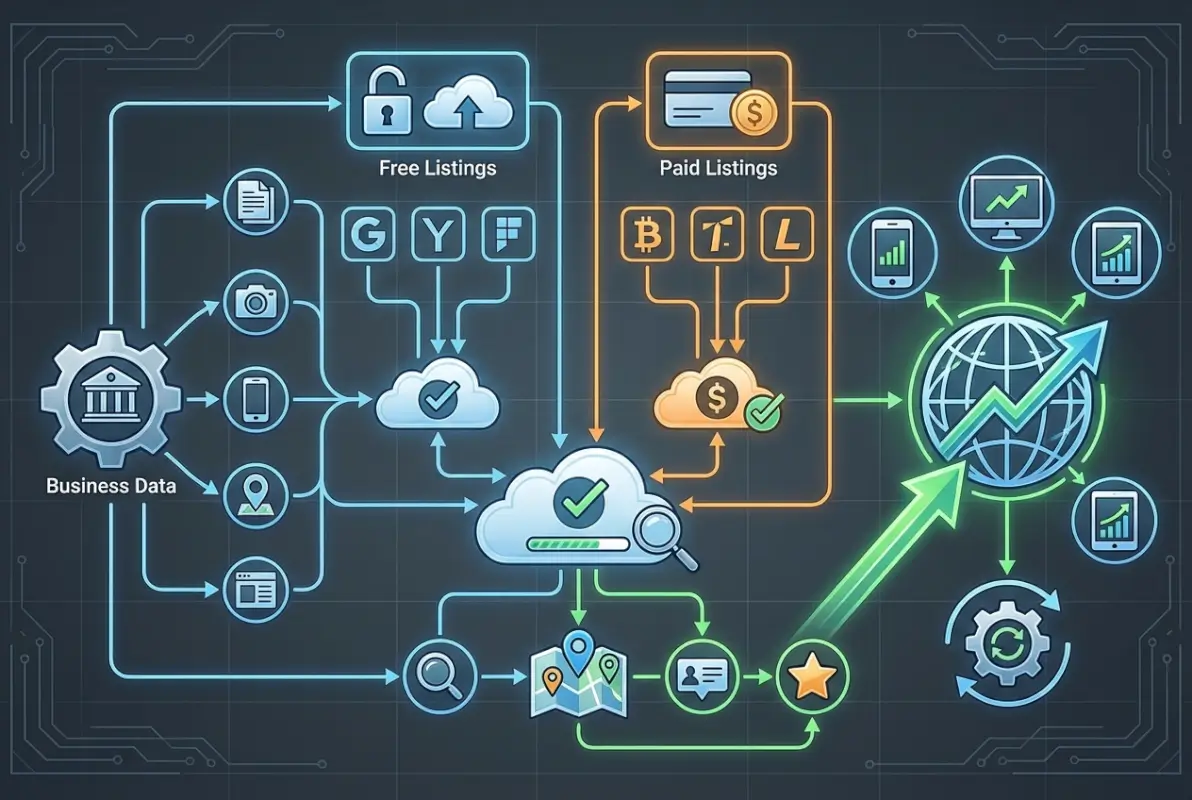
Google Business Profile as the Foundation
Google Business Profile (formerly Google My Business) functions as your primary local search asset. It’s free, directly controls your Google Maps presence, and influences local pack rankings more than any other single factor.
Critical optimization steps:
- Verify your business using the method Google provides (usually postcard, sometimes phone or email)
- Complete every profile section: business name, address, phone, website, hours, services, attributes, and business description
- Select the most specific primary category for your business type
- Add 10+ high-quality photos showing exterior, interior, products, and team
- Enable messaging so customers can contact you directly through the listing
- Post weekly updates about offers, events, or relevant business news
- Monitor and respond to Q&A section questions within 24 hours
According to Google’s Business Profile Help Center, businesses with complete information are twice as likely to be considered reputable by consumers. The metrics Google provides – calls, direction requests, website clicks, and booking actions – let you measure exactly how the listing performs.
Common mistake: claiming the profile but leaving optional fields blank. Google’s algorithm favors completeness. A business with all attributes selected, services listed, and regular posts typically outranks competitors with bare-minimum profiles, even when other ranking factors are similar.
Essential Free Business Listing Websites and Citations
Beyond Google, focus on directories with strong domain authority and relevance to your business type. These free business listing websites deliver the best ROI for time invested:
General directories (claim these first):
- Yelp – dominant for restaurants, retail, and service businesses; strong mobile usage
- Bing Places – often overlooked but serves Microsoft ecosystem users
- Apple Maps – critical for iOS users searching on devices
- Facebook Business Page – technically social media but functions as a business directory
Industry-specific platforms (select 2-3 relevant to your business):
- Healthgrades, Zocdoc (healthcare providers)
- Avvo, FindLaw (legal services)
- Houzz, Porch (home improvement)
- TripAdvisor, OpenTable (hospitality, restaurants)
- Angie’s List, HomeAdvisor (home services)
The strategy: ensure NAP consistency across all platforms. Your business name, address, and phone number must match exactly – down to abbreviations (use “Street” or “St.” consistently, not both). Search engines cross-reference this information to validate legitimacy.
Optimize for Local Intent: Near Me Searches, Mobile, and Reviews
Local search behavior centers on immediacy and proximity. When someone searches “coffee shop near me” or “emergency plumber,” they want results now, and they want them close. Your business listing websites need to signal both availability and relevance to capture this high-intent traffic.
The mobile component is crucial – 76% of people who search on their smartphone for something nearby visit a business within a day, and 28% of those searches result in a purchase, according to Think with Google research. Your listings must load fast, display accurate hours, and provide click-to-call functionality.

Local Search Signals That Matter in 2025
Proximity remains the dominant factor you can’t control – if a searcher is five blocks from a competitor, that competitor has an inherent advantage. What you can control: relevance (does your listing match what they’re searching for?) and prominence (does Google trust your business enough to show it?).
Prominence breaks down into several components: review quantity and quality, citation consistency, website authority, and behavioral signals (are people clicking your listing? Are they calling? Requesting directions?). The shift toward AI-assisted ranking means Google increasingly evaluates whether users find what they’re looking for when they click your listing.
Practical optimization: select your most specific primary category in Google Business Profile. If you’re a “wedding photographer,” choose that rather than the generic “photographer.” Add secondary categories sparingly – only services you genuinely offer. Google’s algorithm correlates category selection with search query relevance.
Reviews and Social Signals: Growing Impact on Local Visibility
Review signals account for approximately 16% of local pack ranking factors according to Whitespark’s research. But reviews impact more than just rankings – they directly influence click-through rates and conversion.
Effective review strategy:
- Request reviews from satisfied customers within 24-48 hours of service completion
- Make the process simple – send a direct link to your Google review page
- Respond to every review within 24-48 hours, positive or negative
- Use negative reviews as opportunities to demonstrate customer service
- Never offer incentives for reviews (violates Google’s policies)
- Monitor review velocity – sudden spikes in reviews can trigger spam filters
Recent reviews matter more than old ones. A business with 50 reviews, 20 of them from the past 60 days, typically outranks a competitor with 100 reviews where the most recent is six months old. Recency signals active customer engagement.
Response rate and quality also factor in. Businesses that respond thoughtfully to reviews – acknowledging specific details customers mentioned rather than generic “thanks for the review” responses – tend to build stronger trust signals. I’ve seen this firsthand: a local restaurant that started responding personally to each review saw their average rating climb from 4.1 to 4.6 within four months, with review volume increasing 40%.
Data-Driven Profile Enrichment: Content That Converts
Complete profiles consistently outperform sparse ones. Google’s algorithm specifically favors businesses that provide comprehensive information, because complete profiles better serve user intent. A listing with all fields filled, multiple photos, services listed, and attributes selected typically ranks higher than an identical business with minimal information.
The conversion impact matters even more than rankings. A potential customer viewing two similar businesses – one with 15 photos, detailed services, recent posts, and answered Q&A, versus another with just a name and address – will choose the complete profile nearly every time. Completeness signals professionalism and legitimacy.

Complete Every Profile Field
Treat each section of your business listing as an opportunity to match search queries and answer customer questions before they ask. Here’s what “complete” actually means:
Business description (750 characters max on GBP):
- Open with what makes you different, not generic industry description
- Include your primary keyword naturally in the first sentence
- Mention specific services, products, or specializations
- Reference your location and service area if relevant
- End with a benefit or reason to choose your business
Services section:
- List every distinct service you offer (GBP allows 300+ services)
- Use specific names customers would search for
- Add descriptions to individual services when the platform allows
- Include pricing where appropriate and competitive
Attributes:
- Select all accurate attributes (wheelchair accessible, Wi-Fi, outdoor seating, etc.)
- These filter search results and appear in listings
- Accuracy matters – false attributes damage trust
Photos and videos:
- Upload minimum 10 photos; optimal is 30+
- Include exterior, interior, products, services in action, team
- Update with new photos quarterly to signal active management
- Use high-resolution images (minimum 720px on shortest side)
- Add short videos (30-60 seconds) showing your business in action
For businesses creating their own directory platforms, understanding how to organize active directory for business environment helps structure listings that serve both users and search algorithms effectively.
Structured Data and AI-Ready Content
Search engines increasingly use structured data to understand business information. While most listing platforms handle this automatically, ensure your own website includes proper LocalBusiness schema markup. This helps search engines connect your website to your various business listings.
AI-assisted ranking factors mean Google analyzes not just keywords but context and user satisfaction. Write your business description for humans first – explain clearly what you do, who you serve, and why customers choose you. The algorithmic understanding will follow.
Consistency in naming is critical for AI interpretation. If your legal business name is “Smith Plumbing LLC,” but you brand yourself as “Smith Plumbing” in most places, choose one version and use it everywhere. Mixed naming confuses entity recognition algorithms and dilutes your citation value.
Measuring Impact: How to Track Business Listing Performance
Creating listings without measuring their impact is like advertising with no idea if anyone responds. The right metrics tell you which platforms drive actual business and which waste your time. Most businesses never check this data – which explains why they keep investing in listings that generate zero return.
Google Business Profile provides the most comprehensive free analytics through its Insights dashboard. You’ll see exactly how customers found your listing (direct search vs. discovery search), what actions they took (called, visited website, requested directions), and how many people viewed your photos. This data typically reveals that 2-3 specific search terms drive 70% of your visibility.

KPIs and Tools to Use
Google Business Profile Insights (check monthly):
- Search queries used to find your listing (identifies what you’re actually ranking for)
- Total searches (branded vs. non-branded)
- Customer actions (website clicks, direction requests, phone calls)
- Photo views and comparison to competitors
- Where customers view your profile (Search vs. Maps)
Google Analytics (track referral traffic):
- Set up goal tracking for conversions from directory referrals
- Check Acquisition > All Traffic > Referrals to see which listing sites send traffic
- Compare conversion rates across different directory sources
- Monitor bounce rate from directory traffic (high bounce suggests mismatch between listing and website)
Call tracking (for phone-driven businesses):
- Use unique phone numbers for different listings if budget allows
- Track which directories generate actual phone inquiries
- Record call quality and conversion rate by source
The practical approach: review GBP Insights monthly, run a full analytics audit quarterly. Look for patterns – which listings drive traffic during which seasons? Do certain directories send higher-quality leads? I worked with a contractor who discovered 80% of his qualified leads came from just two directories (Google and Angie’s List), while six others generated zero business. He stopped maintaining the low-performers and invested that time in getting more reviews on the platforms that mattered.
When to Add or Remove Listings
Add a new listing when you identify a platform where your target customers actively search and your competitors appear but you don’t. Industry-specific directories often fall into this category – they won’t drive massive volume, but they send highly qualified leads.
Remove or deprioritize listings that generate zero engagement after 6-12 months. But here’s the nuance: even a listing that sends minimal traffic may still provide SEO value through citation consistency. The decision matrix: if it’s easy to maintain (information syncs automatically), keep it. If it requires manual updates and sends no measurable traffic, eliminate it.
Warning sign that listings aren’t working: you’re appearing in search results but getting zero clicks. This typically means your profile lacks compelling information, quality photos, or recent reviews compared to competitors. Fix the content rather than abandoning the platform.
Exploring key steps run successful directory website business can help you understand which features make certain listing platforms more effective than others.
| Metric | How to Track | What Success Looks Like |
|---|---|---|
| Profile views | GBP Insights dashboard | Steady monthly increase; 100+ views/month for local businesses |
| Direction requests | GBP customer actions | 5-10% of profile views for retail/restaurants |
| Website clicks | GBP + Google Analytics | 10-15% of profile views |
| Phone calls | GBP + call tracking | 8-12% of views for service businesses |
| Referral traffic | Google Analytics referrals | Top 3 directories should drive 70%+ of directory traffic |
What are the best free business listing websites to start with?
Google Business Profile is essential and should be your first priority. Follow with Yelp, Bing Places, Apple Maps, and Facebook Business Page. These five platforms are free, have high authority, and drive the majority of directory traffic for most local businesses. Complete your GBP profile fully before expanding to other directories.
How many business listing websites should I be listed on?
Focus on quality over quantity. Start with 5-7 high-authority directories that your target customers actually use. Google Business Profile, Yelp, industry-specific directories, and a few general directories like Bing Places typically provide 90% of the value. Managing too many listings leads to inconsistent information, which hurts your SEO more than it helps.
Do business listing websites actually improve search rankings?
Yes, business listings improve local search rankings through citation consistency and trust signals. When search engines find consistent NAP information across multiple authoritative directories, they validate your business legitimacy. Google Business Profile directly influences local pack rankings, while other quality listings provide supporting citations that strengthen your overall local SEO presence.
How should I respond to negative reviews on listing sites?
Respond within 24-48 hours with a professional, empathetic reply that acknowledges the concern and offers to resolve it offline. Never argue or make excuses publicly. According to research, 45% of consumers are more likely to visit a business that responds to negative reviews, as it demonstrates you value customer feedback and service quality.
Can I use different phone numbers on different listing websites?
While technically possible for call tracking, using different phone numbers across listings creates NAP inconsistency that can harm your local SEO. If you need call tracking, use a consistent primary number across all listings and implement tracking at the website level instead. Consistency in name, address, and phone number is critical for search engine validation.
How long does it take to see results from business listings?
Most businesses see increased profile views and website traffic within 2-4 weeks of creating optimized listings on major platforms. Full local SEO benefits typically manifest within 3-6 months as search engines index your citations and validate consistency. Reviews and engagement accumulate over time, continually improving visibility and conversion rates.
Should I pay for premium listings on business directory websites?
Start with free listings and track performance for 3-6 months. Upgrade to paid listings only on platforms where you’re already seeing significant engagement and the premium features directly address a gap (like removing competitor ads or getting priority placement). Many businesses get excellent results from free listings alone when profiles are fully optimized.
What information should I include in my business listing profiles?
Include complete NAP data, accurate hours, website URL, business description with relevant keywords, all applicable categories, services offered, attributes, 10+ high-quality photos, and responses to customer questions. The more complete your profile, the better you rank and the higher your conversion rate when potential customers view your listing.
Take Action on Your Online Visibility Today
The businesses winning local search aren’t doing anything complicated – they’re claiming the right business listing websites, completing every profile field, and actively managing reviews. That’s it. No secret tricks, no expensive tools, just consistent execution on fundamentals.
Start with Google Business Profile this week. Block two hours to complete every section, upload quality photos, and verify your listing. Then add Yelp and Bing Places. Within a month, you’ll likely see measurable increases in calls, direction requests, and website traffic.
The competitive advantage isn’t temporary. Most businesses claim listings but never optimize them. They leave fields blank, ignore reviews, and forget the profiles exist. That sustained neglect creates opportunity for businesses willing to invest minimal time in maintaining accurate, complete, engaging listings.
Your potential customers are searching right now – on their phones, looking for businesses near them. Make sure they find you first, with complete information and compelling reasons to choose your business over alternatives. The visibility you build through strategic business listing websites compounds over time, turning into a reliable source of qualified leads.
Your Next Steps
Claim your Google Business Profile today. Complete your Yelp listing this week. Add Bing Places and Apple Maps by month-end. Request your first five reviews within 30 days.
Those four actions will drive more local visibility than months of complex SEO tactics. Start now.
Was this article helpful?