Business Directory ID: What It Is & Why You Need One for Local SEO Success
Opens a Google-translated copy of this article in a new tab.
Here’s something most business owners discover too late: you can have a beautiful website, an active social media presence, and great products—but if your Business Directory ID isn’t properly managed across platforms, you’re essentially invisible to local customers searching for exactly what you offer. I learned this the hard way when consulting for a thriving bakery that couldn’t understand why they weren’t showing up in Google Maps despite having hundreds of five-star reviews. The culprit? Their business name appeared differently across fifteen directories, creating what search engines saw as fifteen different businesses.
In the evolving landscape of local search—where Google Business Profile signals now account for approximately 32% of local pack ranking factors—your Business Directory ID serves as the canonical identifier that ties together your entire digital presence. It’s not just about having a listing; it’s about creating a unified, consistent identity that search engines can trust and customers can find reliably. Whether you’re managing a single storefront or multiple locations, understanding how to leverage your Directory ID effectively could be the difference between dominating local search results and languishing on page three.
TL;DR – Quick Takeaways
- Unified Identity Matters – A Business Directory ID is your consistent identifier across all platforms, connecting your GBP, website, and directory listings into one trusted entity
- GBP Signals Dominate – Google Business Profile optimization accounts for roughly 32% of local pack ranking factors in 2026, making it your top priority
- Consistency Drives Rankings – Standardized NAP (Name, Address, Phone) information across all touchpoints significantly improves local search visibility
- On-Page Content Equals Organic Visibility – Approximately 33% of local organic rankings depend on service pages, schema markup, and localized content
- AI-Ready Format Required – Structured data and clear formatting help your business appear in AI-powered search results from ChatGPT, Gemini, and other platforms
- Reviews Impact Everything – Customer reviews influence not just trust, but also ranking algorithms across traditional and AI search platforms
What Is a Business Directory ID and Why Does It Matter?
A Business Directory ID represents your unique, persistent identifier used across business directories, maps platforms, Google Business Profile, and citation sources to unify your business identity. Think of it as your business’s social security number in the digital world—every platform assigns some form of identifier when you create or claim a listing, but the real power comes from ensuring the information tied to these IDs remains absolutely consistent across every touchpoint.
When you register on Google Business Profile, you receive a Customer ID (CID)—a unique number that identifies your specific business within Google’s ecosystem. Yelp assigns its own business ID, Facebook has another, and industry-specific directories each maintain their own systems. While these technical IDs differ, what matters most is that the core business information—your name, address, phone number, website, hours, and service offerings—remains identical across all of them.
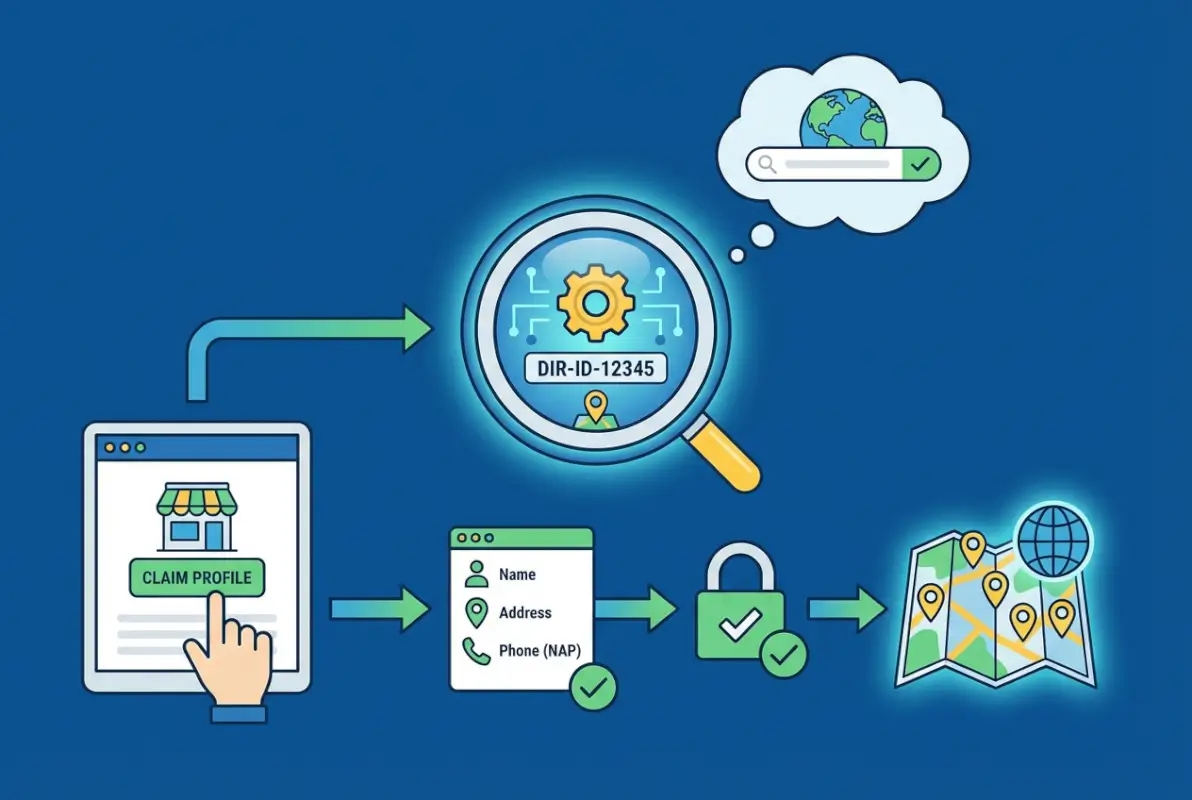
This consistency isn’t just about being organized (though that helps). Search engines rely on these unified signals to validate your business’s legitimacy and determine your relevance for local searches. When Google’s algorithms crawl the web and find your business name spelled three different ways, listed at two different addresses, and showing conflicting phone numbers, they can’t confidently present you in local search results. You’re essentially telling search engines that you might be three separate businesses, or worse, an unreliable source of information.
According to research examining local information seeking trends, the majority of consumers now begin their search for local businesses online, making this digital consistency more critical than ever. Your Directory ID serves as the connecting thread that transforms scattered online mentions into a cohesive, authoritative presence that both search engines and customers can trust.
The Technical Side: How Directory IDs Connect Your Digital Footprint
Behind the scenes, search engines use sophisticated algorithms to match and attribute business information across the web. When your NAP information appears identically across multiple authoritative sources, these algorithms create what’s essentially a confidence score. High confidence means better rankings; fragmented information means lower confidence and reduced visibility.
This process involves several data points beyond just your basic contact information. Search engines also look at business categories, service descriptions, operating hours, payment methods accepted, and even the photos associated with your listings. Each consistent data point reinforces the others, creating a compound effect that significantly impacts your local search performance.
The real value emerges when all these elements work together. Your Google Business Profile links to your website. Your website displays the same NAP information found in your GBP. Industry directories echo this information. Review platforms reflect identical details. Suddenly, search engines see an established, legitimate business with a strong local presence—exactly what they want to show people searching for your services.
The 2026 Local SEO Landscape: Where Directory IDs Fit In
Local SEO has undergone significant evolution, and understanding the current ranking factor landscape helps you prioritize your Directory ID optimization efforts effectively. The latest industry analyses reveal that local search rankings depend on three distinct result types, each weighted differently: local pack results (the map listings), local organic results (standard search results with local intent), and AI-powered search results (responses from ChatGPT, Gemini, and similar tools).
For local pack rankings—those coveted map listings appearing at the top of search results—Google Business Profile signals carry approximately 32% of the ranking weight. This represents the single largest factor category, making GBP optimization your top priority. Review signals account for about 16%, link signals around 11%, and behavioral signals (how users interact with your listing) approximately 9%. On-page signals from your website contribute roughly 8% to local pack rankings.

The picture shifts somewhat for local organic results, where on-page content becomes more dominant at approximately 33% of ranking factors. Link signals increase to around 18%, while GBP signals still matter significantly at roughly 16%. This distribution explains why you need both a strong Google Business Profile and well-optimized service pages with local content to truly dominate local search.
AI-powered search results present a newer challenge and opportunity. These results depend heavily on structured data, clear content formatting, and consistent information across sources. When ChatGPT or Google’s Gemini pulls business information to answer a query, it’s drawing from the same pools of data that traditional search uses—your Directory IDs, citations, and website content. Businesses with well-structured, consistent information across platforms are more likely to be featured in these AI responses.
What does this mean for your Directory ID strategy? First, recognize that consistency across platforms doesn’t just help one ranking factor—it supports all of them. Second, prioritize your time based on these weights: GBP optimization comes first, followed by on-page content development, then review generation, and finally broader citation building and link acquisition.
The Mobile-First Reality of Local Search
Understanding that 76% of local searches result in business visits within a day underscores why your Directory ID accuracy matters so much. When someone searches “coffee shop near me” while driving through your neighborhood, they’re making a decision within minutes. If your hours are wrong on Google Maps, your address doesn’t match between Yelp and your website, or your phone number reaches a disconnected line, that potential customer simply moves to the next result.
I remember consulting with a home services company that couldn’t understand why their call volume dropped every winter. We discovered their summer hours were still showing on three major directories in December, making customers think they were closed. Twenty minutes of updating Directory IDs across platforms restored their typical call volume within a week.
Creating Your Unified Directory ID Strategy
Establishing a consistent Business Directory ID requires methodical implementation across three phases: standardization, normalization, and ongoing maintenance. This isn’t exciting work, but it’s foundational to everything else you’ll do in local SEO, and fortunately, it doesn’t require technical expertise—just attention to detail and consistency.
Start with standardization by documenting your canonical business information. Open a spreadsheet or document and record these elements exactly as they should appear everywhere:

- Legal Business Name: Match your official registration (avoid adding keywords here)
- Address Format: Choose one format for street abbreviations and stick to it
- Phone Number Format: Decide on (555) 123-4567 or 555-123-4567, not both
- Website URL: Include or exclude “www” consistently (preferably match your primary domain)
- Business Categories: List primary and secondary categories in priority order
- Business Description: Create one master description (not keyword-stuffed, just clear)
- Hours of Operation: Document standard hours and create a schedule for updating seasonal changes
- Service Area: Define whether you serve customers at your location, travel to them, or both
This document becomes your single source of truth. Whenever anyone on your team creates or updates a directory listing, they reference this document to ensure perfect consistency. I keep mine in a shared document with view-only access for employees and edit access for the owner and one designated marketing person.
| Priority Level | Platforms | Update Frequency | Impact |
|---|---|---|---|
| Essential | Google Business Profile, Website | Within 24 hours of any change | Direct ranking & customer experience |
| High | Yelp, Facebook, Bing Places, Apple Maps | Within 1 week | Citation consistency & customer reach |
| Medium | Industry directories, Yellow Pages, Better Business Bureau | Monthly audit | Citation building & niche visibility |
| Low | General directories, aggregators | Quarterly audit | Long-tail citation building |
The Normalization Process: Bringing Everything Into Alignment
With your standardized information documented, begin the normalization phase by auditing your current directory presence. Search for your business name in Google, along with your address and phone number separately. You’ll likely discover listings you didn’t create—directories often generate automated profiles from publicly available data.
For each listing you find, determine whether you need to claim it (if it’s unclaimed), update it (if information is incorrect), or merge duplicates (if multiple listings exist for your single business on one platform). This process takes time—budget several hours for a thorough initial audit—but you only need to do it once if you maintain consistency afterward.
When claiming listings, platforms typically require verification to prove you’re the legitimate business owner. Google usually sends a postcard with a verification code to your physical address (this takes 5-14 days, so start early). Other platforms might call your business phone, send an email, or offer instant verification if your website domain matches your business email domain.
As you update each listing, copy information directly from your standardization document to ensure perfect consistency. This isn’t the time to “improve” your business name by adding keywords or to “clarify” your address with additional details. Exact consistency is what matters.
Google Business Profile: The Foundation of Your Directory ID
Google Business Profile deserves special attention because it’s both the most impactful directory for local rankings and the most feature-rich platform for engaging customers. According to recent Google Business Profile optimization guidelines, proper setup and ongoing management of your GBP can dramatically impact your visibility in both Maps and organic search results.
Start with complete category selection. Your primary category should precisely describe your main business activity—this significantly influences which searches you appear for. Google allows additional categories, which you should use strategically to cover secondary services without diluting your primary focus. A restaurant might use “Italian Restaurant” as primary, then add “Pizza Restaurant” and “Wine Bar” as secondary categories if those accurately represent distinct offerings.

Your business description, limited to 750 characters, should clearly explain what you do, who you serve, and what makes you different. Write for humans first—this appears prominently in your profile and influences customer decisions—but naturally incorporate relevant keywords that describe your services. Avoid keyword stuffing; Google’s algorithms penalize overly optimized descriptions, and more importantly, customers find them off-putting.
Hours, Attributes, and the “Open Now” Advantage
Business hours deserve meticulous attention because they directly impact both rankings and customer experience. Google has confirmed that business openness functions as a local ranking factor, meaning businesses showing as “open now” receive preferential treatment in searches happening during their operating hours.
Enter your regular hours accurately, then religiously update special hours for holidays, seasonal changes, or temporary closures. Set calendar reminders for upcoming holidays to update hours a week in advance. I’ve seen businesses lose significant revenue because they forgot to update holiday hours and appeared closed when they were actually open.
Google Business Profile attributes allow you to highlight specific features: women-led business, wheelchair accessibility, outdoor seating, free Wi-Fi, and dozens of others depending on your category. Select every attribute that accurately applies to your business. These attributes influence search filtering and help customers find businesses that meet their specific needs.
Photos, Posts, and Active Engagement
Visual content significantly impacts customer engagement with your GBP listing. Upload high-quality photos in these categories: exterior, interior, products, services, team, and at work. Google recommends adding new photos regularly—at least monthly—to show your business is active and current.
Google Posts allow you to share updates, offers, events, and new products directly in your Business Profile. These appear prominently when customers view your listing and signal to Google that you’re actively managing your presence. Create posts weekly if possible, at minimum monthly. Posts expire after seven days (or on the date you specify for events and offers), so maintaining a consistent posting schedule keeps fresh content visible.
The Q&A section often gets neglected, but it’s valuable for two reasons: you can preemptively answer common questions, and you can ensure accurate information appears when customers ask. Review your Q&A section monthly and consider adding your own questions with answers for topics customers frequently ask about. This prevents misinformation from appearing if a customer posts an answer before you can.
Building Your On-Page Content Foundation
While your Google Business Profile and directory listings create your external presence, your website’s on-page content provides the foundation for local organic rankings and AI search visibility. The distinction matters: GBP primarily affects map pack results, while website content drives organic search rankings—and you need both to dominate local search completely.
Service pages represent your most important on-page content for local SEO. If you’re implementing key steps launch successful business directory strategies, dedicated, detailed service pages for each offering help search engines understand exactly what you provide and match you with relevant searches.

Each service page should include the service name in the H1 tag, a comprehensive description of what the service entails, the problems it solves, what customers can expect, and pricing information (if you’re comfortable sharing it). Incorporate location references naturally throughout the content—mention the cities, neighborhoods, or regions you serve, but do so in context rather than simply listing them.
For businesses serving multiple locations, create separate location pages for each area. These pages should include unique content about that specific location: the full address, local phone number if you have one, hours for that location, driving directions, parking information, nearby landmarks, and a description of what makes that location special or how it serves that particular community.
Schema Markup: Speaking Search Engines’ Language
Schema markup provides structured data that helps search engines understand your content more accurately. For local businesses, LocalBusiness schema (and more specific types like Restaurant, MedicalClinic, or AutoRepair) tells search engines exactly what information represents your business name, address, phone, hours, and other key details.
Implementing schema isn’t particularly difficult, especially with WordPress plugins that generate it automatically, but it requires accuracy. Your schema markup should reflect the same NAP information as your Google Business Profile and directory listings—this is another place where inconsistency can undermine your Directory ID strategy.
Beyond basic LocalBusiness schema, consider implementing FAQ schema for common questions, Review schema for testimonials on your site, and Service schema to describe your offerings. Each type of structured data provides additional context that search engines can use to understand and categorize your content.
Content That Answers Local Intent
Beyond service and location pages, create content that addresses local questions and needs. This might include blog posts about topics relevant to your local community, guides to choosing services like yours in your area, comparisons of different approaches or options in your industry, or local expertise demonstrating your connection to the community.
This content serves multiple purposes: it provides opportunities to naturally incorporate local keywords, demonstrates expertise to both users and search engines, creates pages that can rank for informational queries that eventually lead to commercial intent, and provides content worth linking to from other local sources.
When creating this local content, focus on genuine value rather than keyword density. Write for the people in your community who are trying to solve problems or answer questions related to your business. The keywords will naturally appear when you’re addressing real local intent.
Citations, Reviews, and Reputation Signals
Citations—mentions of your business name, address, and phone number on other websites—function as votes of confidence in your business’s legitimacy. Each consistent citation reinforces your Directory ID and strengthens your local search presence. For those working to proven tactics grow business directory visibility, strategic citation building provides compounding returns over time.
Not all citations carry equal weight. Focus first on authoritative general directories: Google Business Profile (obviously), Yelp, Facebook, Bing Places, Apple Maps, Yellow Pages, and Better Business Bureau. These platforms carry significant authority and appear in nearly every citation audit as high-priority targets.
After covering general directories, identify industry-specific directories relevant to your business. Restaurants should be on TripAdvisor, OpenTable, and local dining guides. Medical practices belong on Healthgrades, Vitals, and insurance provider directories. Home service businesses should claim profiles on HomeAdvisor, Angi, and Houzz. These niche directories often convert better than general directories because users have specific intent when visiting them.
Review Generation and Response Strategy
Customer reviews have evolved from nice-to-have social proof to essential ranking signals that influence visibility across traditional search, maps results, and AI-powered responses. Review signals account for approximately 16% of local pack ranking factors, making them one of the most impactful elements you can actively influence.
Develop a systematic approach to generating reviews. The most effective method remains simply asking satisfied customers at the moment they’re happiest with your service. This might be immediately after completing a project, when serving a delighted customer at checkout, or in a follow-up email after delivery. Make the process easy by providing a direct link to your Google Business Profile review form.
Review velocity matters as much as review volume. A business with 200 old reviews looks less active than one with 50 recent reviews. Aim for a steady stream of new reviews rather than campaigns that generate bursts followed by months of silence. If you want to create thriving local business directory presence, consistency in review generation signals ongoing customer satisfaction and business activity.
Respond to every review, positive or negative. Thank customers for positive reviews and address any concerns mentioned in negative ones. Your responses show potential customers how you handle feedback and signal to review platforms that you’re actively engaged with your listing. Response rate and response speed both factor into how platforms evaluate and display your business.
| Review Type | Response Timeline | Response Approach |
|---|---|---|
| 5-star positive | Within 48 hours | Thank them, mention specifics they referenced |
| 3-4 star mixed | Within 24 hours | Thank them, address concerns, invite offline discussion |
| 1-2 star negative | Within 12 hours | Apologize, explain (briefly), offer resolution privately |
| Suspicious/fake | Immediately | Report to platform, respond professionally stating facts |
Preparing for AI-Powered Search Results
AI-powered search through ChatGPT, Google’s Gemini, Microsoft’s Copilot, and similar tools represents a growing portion of how consumers discover businesses. These platforms pull information from the same data sources that traditional search uses—your website, directory listings, reviews, and citations—but they prioritize differently and present information in conversational formats rather than lists of blue links.
Structured content matters enormously for AI visibility. When someone asks ChatGPT “What’s the best Italian restaurant in downtown Austin?”, the AI needs to identify, evaluate, and present relevant businesses from its training data and real-time web searches. Businesses with clear, consistently formatted information across multiple authoritative sources are more likely to be included in those responses.
Your Directory ID consistency directly impacts AI search performance. When your business name, address, phone, and service descriptions match exactly across your website, Google Business Profile, Yelp, and industry directories, AI models can confidently aggregate that information and present it as a unified business entity. Inconsistent information creates ambiguity that reduces the likelihood of inclusion.
Formatting Content for Machine Readability
AI models parse content more effectively when it follows clear organizational patterns. Use descriptive headings that accurately label the content beneath them. Structure information in logical hierarchies with H2 and H3 tags. Present service descriptions, pricing, and key details in consistent formats that machines can easily identify and extract.
Lists work particularly well for AI parsing. When describing your services, locations served, or business attributes, consider using bulleted or numbered lists rather than prose paragraphs. This doesn’t mean sacrificing readability for humans—well-formatted lists improve the experience for both human readers and AI processors.
Keep critical business information highly visible on your website. Your NAP details, hours, service areas, and contact options should appear prominently, ideally in your header or footer so they’re present on every page. This consistent, visible placement helps both users and AI quickly locate essential information.
Implementation: Your 90-Day Directory ID Optimization Plan
Transforming your Directory ID from fragmented to unified requires systematic effort, but you don’t need to do everything simultaneously. This phased approach spreads the work across three months while prioritizing high-impact activities first.
Days 1-30: Foundation Phase
- Create your standardization document with canonical business information
- Claim and verify your Google Business Profile (if not already done)
- Complete every field in your GBP: categories, description, attributes, hours, photos
- Audit your website to ensure NAP matches your GBP exactly
- Implement LocalBusiness schema markup on your site
- Claim or create listings on Yelp, Facebook, Bing Places, and Apple Maps
- Set up review request process and begin asking satisfied customers
Days 31-60: Expansion Phase
- Identify and claim 10-15 industry-specific directory listings
- Audit existing citations for inconsistencies and submit corrections
- Create or optimize service pages with local keywords and content
- Implement FAQ schema for common customer questions
- Develop location pages if you serve multiple areas
- Create content calendar for monthly GBP posts
- Begin weekly review monitoring and response routine
Days 61-90: Optimization Phase
- Analyze Google Search Console data for local search performance
- Create local content addressing community-specific topics
- Expand citation building to 20-30 total quality directories
- Optimize underperforming service pages based on data
- Implement additional schema types (FAQ, Service, Review)
- Document maintenance schedule for ongoing management
- Assess results and adjust strategy based on performance data
Measuring and Maintaining Your Directory ID Performance
Like any marketing investment, your Directory ID optimization should be measured and refined based on performance data. Several metrics indicate whether your efforts are improving your local search visibility and customer acquisition.
Google Business Profile Insights provides valuable data about how customers find and interact with your listing: how many people viewed your profile, where they came from (search vs. maps), what actions they took (website visits, phone calls, direction requests), and how many photos were viewed. Track these metrics monthly and look for trends rather than daily fluctuations.
Google Search Console offers detailed data about your organic search performance, including impressions, clicks, average position, and CTR for specific queries. Filter by queries containing your city or “near me” to isolate local search performance. For businesses working to proven strategies monetize business directory listings, this data directly connects optimization efforts to measurable results.
Establish a quarterly audit process to maintain your Directory ID over time. Check that your NAP information remains consistent across all platforms, verify that no duplicate listings have appeared, confirm your hours are current (especially around holidays), ensure photos and posts are fresh, respond to any new reviews, and assess whether your service offerings or categories need updating.
Real business changes require Directory ID updates. When you move locations, change phone numbers, modify hours, add or remove services, or rebrand, update all your directory listings within 24-48 hours. The longer inconsistent information persists, the more it undermines your local search performance.
Frequently Asked Questions
What exactly is a Business Directory ID and why should I care?
A Business Directory ID is the unique identifier assigned to your business across various online directories and platforms. It matters because consistent information tied to these IDs helps search engines verify your legitimacy, improve your local rankings, and ensure customers find accurate details about your business. Think of it as creating a unified digital identity across the entire web.
How do I find out if my business already has directory listings I don’t know about?
Search for your exact business name in quotes on Google, then search for your phone number, and finally your address. You’ll discover both claimed and unclaimed listings across various platforms. Many directories auto-generate basic listings from public data sources, which is why businesses often find profiles they never created. Claim these rather than creating new ones to avoid duplicates.
Can incorrect business hours actually hurt my local search rankings?
Yes, significantly. Google has confirmed that business openness functions as a ranking factor, meaning businesses showing as “open now” during their actual operating hours receive preferential treatment in search results. Beyond rankings, incorrect hours frustrate potential customers and lead to lost business when people think you’re closed when you’re actually open, or vice versa.
Should service-area businesses that work at customer locations show their address on Google Business Profile?
It depends on whether you also serve customers at your location. If you only travel to customers (plumbers, mobile pet groomers, house cleaners), you should hide your address and instead specify your service areas. If customers can visit your location (you have a showroom, office for consultations, etc.), display your address even if you also travel to customer sites. Google’s guidelines specifically address this distinction.
How often should I update my directory listings?
Update immediately when core information changes (address, phone, hours). Beyond that, add new photos monthly, create Google Posts weekly if possible, and conduct full audits of all listings quarterly. Consistent, ongoing attention signals to both search engines and customers that your business is active and information is current. Set calendar reminders to make this routine rather than reactive.
What’s more important for local SEO: Google Business Profile or my website?
Both are essential and serve different purposes. Google Business Profile primarily affects local pack rankings (the map results), accounting for roughly 32% of ranking factors there. Your website’s on-page content drives local organic rankings at approximately 33% of factors. You need both optimized to dominate local search completely—GBP for map visibility and website content for organic results below the map.
How do I handle duplicate listings for my business on the same platform?
Never create a new listing if duplicates exist—this makes the problem worse. Instead, claim the listing with the most reviews and complete information, then report the others as duplicates through the platform’s process. For Google, suggest an edit on the duplicate listing and mark it as a duplicate location. Contact customer support for platforms without self-service duplicate resolution. Consolidating duplicates unifies your reviews and prevents customer confusion.
Do I need to pay for premium directory listings to improve my SEO?
Premium or paid directory listings typically don’t provide better SEO value than free listings—the citation and backlink value remains the same. Paid features mainly provide enhanced visibility within that specific directory (featured placement, additional photos, removing competitors from your profile). Prioritize claiming and optimizing free listings on authoritative directories before considering paid enhancements anywhere. Focus resources on platforms where your customers actually search.
How long does it take to see results from Directory ID optimization?
Most businesses begin seeing improved visibility within 4-8 weeks after establishing consistent Directory IDs across major platforms. Full SEO benefits typically accumulate over 3-6 months as search engines validate your consistent information. Quick wins include immediate appearance in directory search results and customers finding correct contact information. Ranking improvements follow as search engines process and trust your unified signals.
Will Directory ID consistency help my business appear in ChatGPT or AI search results?
Yes, increasingly so. AI models pull business information from the same sources traditional search uses—your website, Google Business Profile, reviews, and citations. Consistent, structured information across multiple authoritative sources makes it easier for AI to confidently identify and present your business in response to relevant queries. As AI-powered search grows, Directory ID consistency becomes even more valuable for visibility.
Taking Control of Your Local Search Presence
Your Business Directory ID might not be the most glamorous aspect of digital marketing, but its impact on local search visibility is undeniable and measurable. The businesses dominating local search results aren’t necessarily those with the biggest marketing budgets—they’re the ones that have established unified, consistent identities across every platform where customers search for their services.
The beauty of Directory ID optimization is its accessibility. You don’t need technical expertise, expensive tools, or an agency to implement these strategies effectively. What you need is attention to detail, consistency, and commitment to maintaining accurate information across platforms. The investment is primarily time rather than money, and the returns compound over months and years as your local authority grows.
Start today by creating your standardization document—the single source of truth for your business information. Then claim and optimize your Google Business Profile completely. Those two actions alone will deliver measurable improvements in local visibility within weeks. From there, expand systematically to other directories, always maintaining perfect consistency with your canonical information.
Your Local Search Advantage Starts Now
Block two hours this week to audit your current directory presence and create your standardization document. Then spend thirty minutes daily for the next month claiming and optimizing your listings on the essential platforms. Your future customers are searching for businesses like yours right now—make sure they find accurate, consistent information that leads them directly to your door. The competitive advantage goes to businesses that execute consistently, not perfectly.
Was this article helpful?