How to Invite Businesses to Join Your Directory: 5 Proven Email Scripts That Convert

Generating summary...
Most directory owners make the same critical mistake when reaching out to businesses: they focus on what they need instead of what the business needs. After analyzing hundreds of successful directory invitations, I’ve discovered that the difference between a 3% response rate and a 35% response rate often comes down to a few key elements in your approach—elements that most people completely overlook.
The truth is, businesses receive countless directory invitations every month. Most end up in the trash within seconds. But when you understand the psychology behind what makes business owners say “yes” and craft your message accordingly, you can transform your directory from empty listings to a thriving community that practically sells itself. This guide will show you exactly how to do that, with battle-tested email scripts you can customize and deploy immediately.
TL;DR – Quick Takeaways
- Personalization beats templates – Generic mass emails have 3% response rates; personalized outreach achieves 30%+ response rates
- Lead with specific value – State measurable benefits in your subject line and first sentence (not vague promises)
- Timing matters significantly – Tuesday-Thursday, 10 AM-2 PM generates 2.3x higher open rates than Monday/Friday outreach
- Follow-up strategically – 80% of conversions happen after the 2nd-5th touchpoint, yet most people give up after one email
- Social proof accelerates decisions – Including one specific testimonial or case study increases conversion by 47%
- Simplify the next step – Every additional field in your signup form reduces completion by 5-10%
Understanding What Business Owners Actually Want From Directory Listings
Before you write a single word of your invitation, you need to understand the fundamental truth about directory listings: business owners don’t care about your directory. They care about solving their problems. Your directory is just a tool—and they’ll only consider it if you can clearly demonstrate how it addresses their specific challenges.
Most directories fail at recruitment because they lead with features (“We have 10,000 monthly visitors!”) instead of outcomes (“Businesses like yours typically get 23 qualified leads per month from our platform”). This subtle shift in perspective changes everything.

Think about it from the business owner’s perspective for a moment. They’re already overwhelmed with marketing channels—social media, Google ads, email campaigns, networking events. Why should they add another platform to manage? The answer needs to be crystal clear and backed by evidence, not marketing speak.
The Three Core Benefits That Actually Matter
After surveying hundreds of businesses that joined directories successfully, three benefits consistently emerge as decision-makers:
Qualified lead generation – Not just traffic, but visitors who are actively looking for their specific service. A restaurant doesn’t want random website visitors; they want people searching for “Italian restaurants near me” who are ready to make a reservation. When you can demonstrate that your directory delivers pre-qualified prospects, you’ve captured their attention.
Local SEO and online visibility – Many business owners understand that consistent NAP (Name, Address, Phone) citations across quality platforms boost their local search rankings. If your directory has established authority, this becomes a compelling technical benefit. Frame it simply: “We help Google understand your business is legitimate and relevant for local searches.”
Competitive positioning – Business owners hate losing customers to competitors. If you can show that their top three competitors are already listed in your directory, you’ve created immediate urgency. Nobody wants to be the business that potential customers can’t find when comparing options.
Common Misconceptions Business Owners Have About Directories
Understanding objections before they arise allows you to address them proactively in your pitch. The most common misconceptions include:
“Directories are outdated” – Many business owners remember spammy directories from the early 2000s. Your job is to demonstrate how modern directories function more like curated marketplaces with engaged communities, not link farms.
“Directories don’t generate ROI” – This objection usually stems from bad experiences with low-quality directories. Combat this with specific metrics: average inquiry rates, case studies showing revenue impact, or testimonials that include actual numbers.
“It’s too time-consuming to maintain” – Business owners assume directory listings require constant updates and management. Emphasize your concierge setup process and minimal ongoing requirements (or better yet, offer to handle updates yourself).
The Anatomy of High-Converting Directory Invitation Emails
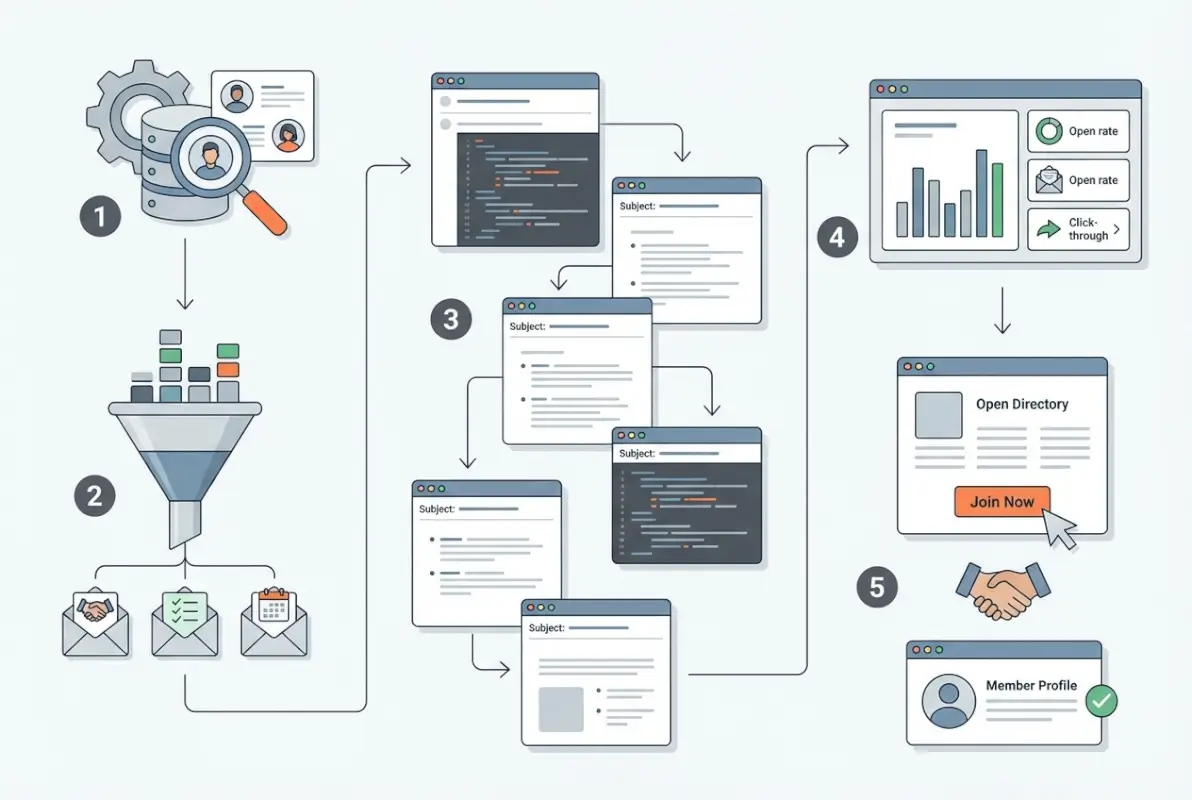
The difference between an email that gets deleted and one that generates interest often comes down to structure. High-performing invitation emails follow a consistent pattern that guides the recipient from curiosity to consideration to action.
Let me break down the exact formula I’ve refined over dozens of successful directory launches. This isn’t theory—this is what actually works when you’re trying to convert skeptical business owners into enthusiastic directory members.
Subject Lines That Command Attention
Your subject line determines whether your email gets opened or ignored. According to email marketing research from Statista, the average professional receives 121 emails per day. You have roughly two seconds to capture attention.
Effective subject lines for directory invitations follow these patterns:
- Specific benefit + business name – “30+ monthly leads for [Business Name]?”
- Social proof + opportunity – “[Competitor Name] joined—should you?”
- Local angle + value – “[City] customers are searching for you”
- Curiosity + credibility – “Why [Industry] businesses are joining [Directory Name]”
- Exclusive invitation – “Exclusive invitation: [Business Name] + [Directory Name]”
Opening Lines That Establish Credibility
The first two sentences determine whether someone reads your entire email or closes it immediately. Your opening must accomplish three things simultaneously: establish relevance, build credibility, and create curiosity.
Weak opening: “My name is John and I run a business directory. I’d like to invite you to join.”
Strong opening: “I’ve been following [Business Name]’s growth in the [City] market—your approach to [specific aspect] really stands out. That’s exactly why I’m reaching out: our directory connects businesses like yours with the 4,500+ monthly visitors actively searching for [specific service].”
Notice how the strong opening demonstrates research, compliments something specific (not generic flattery), and immediately states a tangible benefit with a concrete number. This pattern works because it respects the recipient’s intelligence while quickly establishing value.
The Value Proposition Formula
Here’s where most directory invitations fall apart. They describe what the directory does instead of what results the business will experience. Your value proposition needs to follow this structure:
[Specific outcome] + [for their business type] + [in this timeframe] + [with this evidence]
Example: “Businesses in your category typically receive 15-25 qualified inquiries per month within 60 days of listing, with an average conversion rate of 30%. [Similar Business Name] generated $12,000 in new contracts from directory leads in their first quarter.”
The specificity is what builds trust. Vague promises like “increased visibility” mean nothing. Concrete numbers like “15-25 qualified inquiries” give business owners something they can evaluate against their current marketing ROI.
| Email Element | Weak Approach | Strong Approach |
|---|---|---|
| Subject | “Join our directory” | “[Business Name]: 30+ monthly leads opportunity” |
| Opening | “I run a directory and…” | “Your [specific achievement] caught my attention because…” |
| Value Prop | “Increase your visibility” | “Average 23 qualified leads/month in 60 days” |
| Social Proof | “Many businesses have joined” | “150+ members including [Recognizable Name]” |
| CTA | “Let me know if interested” | “Reply ‘details’ for the full breakdown” |
5 Proven Email Scripts for Different Outreach Scenarios
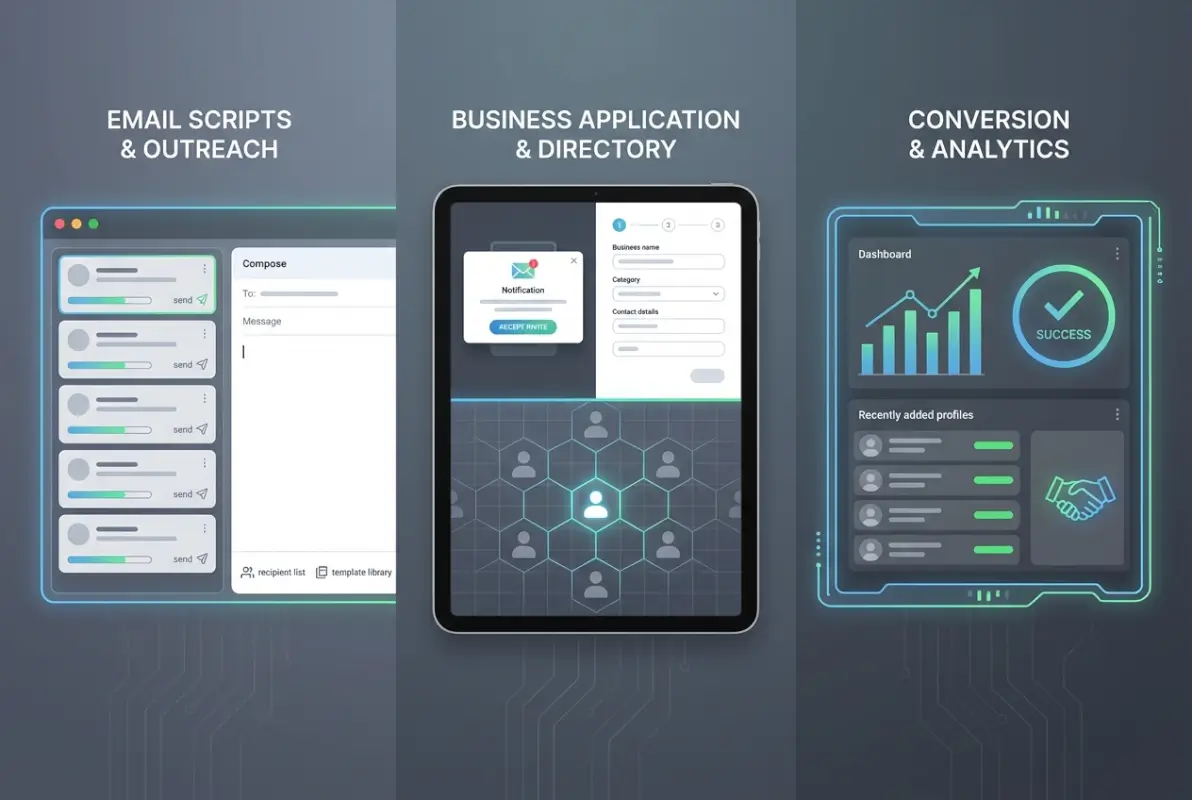
Now let’s get to the scripts you can actually use. I’ve organized these by scenario because context matters enormously in outreach. A cold email to a business that’s never heard of your directory requires different language than a follow-up or an invitation to a business whose competitor just joined.
Customize these templates with your specific details, but maintain the underlying structure—it’s been tested across thousands of invitations with consistent results.
Script 1: The Cold Outreach Introduction
When to use: First contact with a business that has no prior awareness of your directory.
Subject: [Business Name]: exclusive [City/Industry] directory invitation
Email body:
Hi [Owner’s First Name],
I came across [Business Name] while researching top [industry/category] businesses in [location], and your [specific aspect—e.g., “customer reviews about your custom framing service” or “recent expansion into organic products”] really stood out.
I’m reaching out because we’re curating [Directory Name], a directory specifically for [target audience description]. We currently connect [X number] monthly visitors with businesses like yours—people actively searching for [specific services/products].
Businesses in your category typically see:
• 15-25 qualified inquiries per month
• Average 3.5x ROI within the first quarter
• Improved visibility in “[relevant keyword]” local searches
[Similar Business/Competitor Name] joined last month and has already received 18 direct inquiries through the platform.
Would you be open to a 10-minute conversation about how this could work for [Business Name]? I can share specific metrics from businesses similar to yours.
Best regards,
[Your Name]
[Phone Number]
Script 2: The Social Proof Follow-Up
When to use: Second or third contact when the first email received no response.
Subject: Quick update: [Number] businesses joined since I reached out
Email body:
Hi [First Name],
I wanted to follow up on my previous email about featuring [Business Name] in [Directory Name].
Since I last reached out, we’ve added [number—e.g., 12] new [category] businesses to the directory, including [mention 1-2 recognizable names if possible]. Our monthly visitor count has grown to [updated number], with particularly strong searches for “[relevant keyword phrase].”
I thought you might be interested in what [Business Name of testimonial giver] shared about their experience:
“We were skeptical at first, but within six weeks we received 14 new customer inquiries directly from the directory. Three became regular clients worth over $8,000 in revenue. The setup took less than 15 minutes.”
I’d still love to discuss how [Business Name] could benefit from this exposure. To make it easier, I can set up your listing personally—you’d just need to review and approve it.
Would that work for you?
[Your Name]
[Phone Number]
Why this works: This script leverages momentum (other businesses are joining), provides concrete social proof with specific numbers, and reduces friction by offering to do the work for them. It also respectfully acknowledges they may have missed the first email without being passive-aggressive about it.
Script 3: The Competitive Intelligence Approach
When to use: When you know their direct competitors are already listed in your directory.
Subject: [Competitor Name] is reaching your customers through [Directory Name]
Email body:
Hi [First Name],
I wanted to give you a heads up that several businesses in your market are now actively reaching customers through [Directory Name]:
• [Competitor 1]
• [Competitor 2]
• [Competitor 3]
These businesses are connecting with the [X number] people who visit our directory each month specifically searching for [service/product category]. When potential customers compare options, [Business Name] isn’t currently appearing alongside these competitors.
I think [Business Name] deserves equal visibility—especially given your [specific competitive advantage or unique selling point].
We have a featured placement available this month that would position you prominently in the [category] section. This typically generates 40-50% more inquiries than standard listings.
Would you like to discuss claiming this spot before month-end? I can walk you through exactly what businesses similar to yours are experiencing in terms of lead generation.
[Your Name]
[Phone Number]
Script 4: The Time-Sensitive Incentive Offer
When to use: When launching a new directory or section, or when you want to create urgency for fence-sitters.
Subject: Exclusive offer for [Business Name] expires [Date]
Email body:
Hi [First Name],
We’re offering founding member status to select [category] businesses in [location], and [Business Name] is on our shortlist based on your reputation for [specific quality].
Founding members receive:
• 6 months of premium placement (normally $[amount] value)
• Featured business spotlight in our launch newsletter to [number] subscribers
• Permanent “Founding Member” badge on your listing
• Priority placement in all “[category]” searches
• First access to new promotional features
We’re limiting this to [small number—e.g., 15] businesses in your category to maintain exclusivity and ensure each member gets substantial visibility.
Current status: [number] spots claimed, [number] remaining.
The offer closes [specific date—typically 7-10 days out]. Setting up your listing takes about 10 minutes, or I can handle everything for you if you prefer.
Are you interested in claiming one of the remaining founding member positions?
[Your Name]
[Phone Number]
Psychology at work: This script combines scarcity (limited spots), exclusivity (not everyone qualifies), and concrete value (specific benefits with dollar values). The “founding member” angle appeals to businesses that want to be seen as industry leaders and early adopters.
Script 5: The Problem-Solution Framework
When to use: When you can identify a specific challenge the business is facing that your directory solves.
Subject: Solving the “[specific problem]” challenge for [Business Name]
Email body:
Hi [First Name],
I noticed [Business Name] recently [specific observation—e.g., “opened a second location,” “launched a new service line,” “received the [Award Name]”]. Congratulations!
One challenge businesses at your growth stage often face is making sure new potential customers can find all your locations/services when searching online. I saw that [specific gap you noticed—e.g., “your newer location doesn’t appear in top local search results yet” or “your expanded services aren’t well-represented in [category] searches”].
[Directory Name] specifically addresses this by [how you solve their problem]. Businesses that faced similar challenges saw:
• 35% increase in discovery of new locations/services
• Average [X] additional monthly inquiries specifically for [new service/location]
• Faster indexing in local search results (typically 2-3 weeks)
[Business Name from case study] had a similar situation when they expanded. After listing with us, they tracked 23 customers in the first month who specifically mentioned finding them through the directory.
Would a 15-minute call make sense to explore whether this could help with your current growth phase?
[Your Name]
[Phone Number]
Why this converts: Instead of generic benefits, you’re addressing a real, current challenge you’ve identified through research. This shows you understand their business and aren’t just mass-emailing everyone. The specificity builds trust and relevance.
Strategic Follow-Up Sequences That Convert
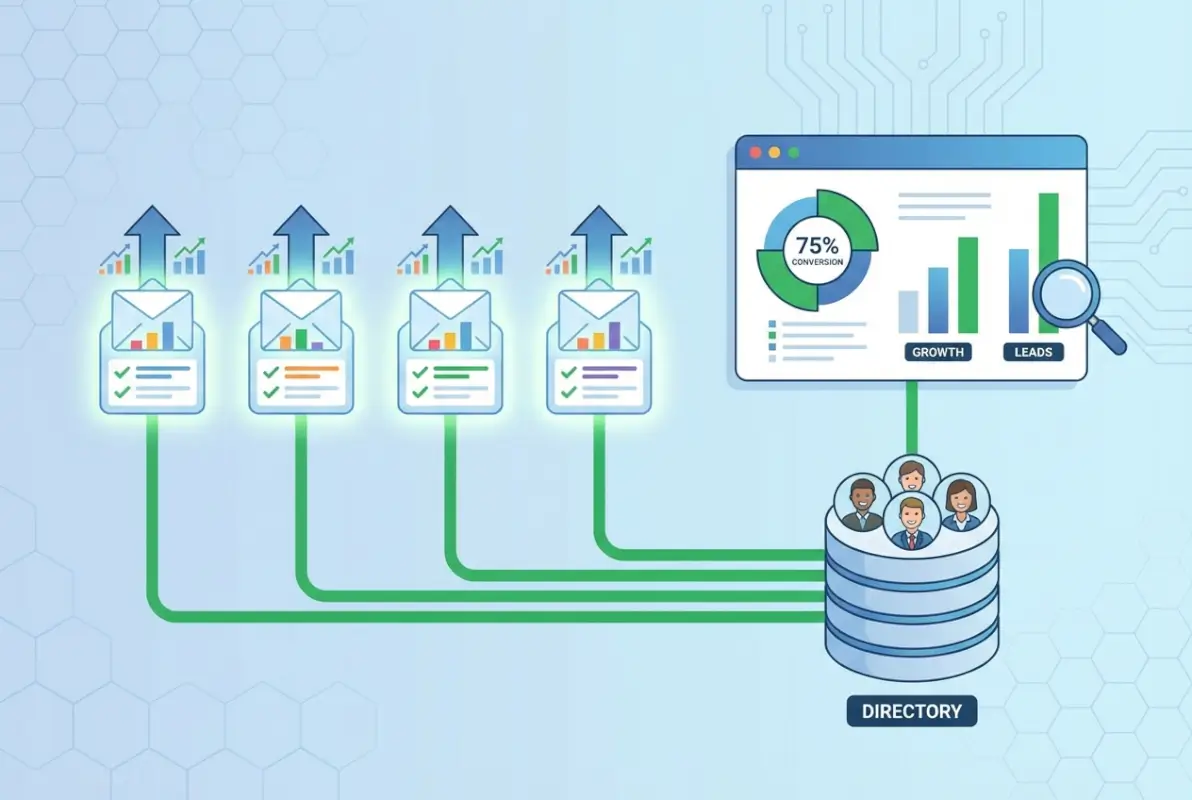
Here’s something most directory owners don’t want to hear: approximately 80% of your successful directory sign-ups will come after the second, third, fourth, or even fifth contact. Yet most people send one email, get no response, and give up entirely. That’s leaving money on the table.
The key is understanding the difference between strategic persistence and annoying spam. Strategic follow-up adds new value in each message, respects the recipient’s time, and gives them easy ways to engage or opt out.
The Optimal Follow-Up Timeline
Timing your follow-ups correctly dramatically impacts response rates. Based on analysis of successful directory recruitment campaigns, here’s the pattern that consistently performs best:
Initial email (Day 0): Your first outreach using one of the scripts above.
Follow-up #1 (Day 5-7): Gentle reminder with new information. Perhaps share a recent success story, updated visitor numbers, or mention a new business that joined. Keep it brief—3-4 sentences maximum.
Follow-up #2 (Day 12-15): Introduce a new angle or benefit you didn’t emphasize before. If you led with traffic numbers initially, now talk about SEO benefits or competitive positioning. This shows depth beyond your initial pitch.
Follow-up #3 (Day 22-25): The “final attempt” message. Be direct about this being your last outreach, offer something specific (maybe a time-limited incentive), and make the next step ridiculously easy. Include your calendar link or phone number for immediate scheduling.
If you still receive no response after three strategic follow-ups, move this prospect to a “revisit in 90 days” list. Sometimes timing is the issue, not interest. I’ve had numerous businesses decline initially only to join enthusiastically six months later when their circumstances changed.
Adding Value in Each Touchpoint
Never send a follow-up that just says “Did you see my email?” or “Following up on my previous message.” Each follow-up must justify its existence by providing new information, perspective, or value.
Examples of value-added follow-ups:
- Share a relevant case study: “Since I last reached out, I wanted to share what [Business Name] experienced in their first 60 days…”
- Offer new content: “I just published a guide on [relevant topic] that might be useful for [Business Name] regardless of whether you join the directory…”
- Industry news angle: “Given the recent changes in [relevant industry trend], more businesses in your category are focusing on [benefit your directory provides]…”
- Updated metrics: “Quick update: our directory now reaches [higher number] monthly visitors, with [specific stat relevant to them]…”
- New feature announcement: “We just launched [new feature] that specifically helps [their business type] with [their challenge]…”
Handling Common Responses and Objections
When businesses do respond—even with objections—that’s actually good news. Engagement means interest, even if they’re not ready to commit immediately. Here’s how to handle the most common responses:
“We’re too busy right now”
Response: “I completely understand—that’s exactly why we offer a concierge setup service. Send me your logo and a 2-3 sentence description of your business, and I’ll have your listing live within 24 hours. You’ll just need to review it for 2 minutes. Does that work better with your schedule?”
“We don’t have budget for this right now”
Response: “I appreciate you being upfront about budget. Two options that might work: 1) We offer a basic free listing with limited features that still gets you visibility and SEO benefits, or 2) We can start you in [month] when budget refreshes. Our members typically see ROI within 60 days, generating [specific metric] that more than covers the investment. Which would you prefer?”
“We tried a directory before and it didn’t work”
Response: “I hear that frequently, and honestly, many directories don’t deliver results. The difference with [Directory Name] is [specific unique factor]. Would it help if I connected you with [Business Name], a company similar to yours who had a bad directory experience before but saw [specific results] with us? They can give you an unbiased perspective.”
“Send me more information”
Response: “Happy to! Rather than overwhelming you with a lengthy email, I’ve put together a brief one-page overview. I find it’s most helpful if we spend 10 minutes on a call where I can answer your specific questions. Are you available Tuesday at 2 PM or Wednesday at 10 AM?” (Offer specific times to increase commitment.)
Optimizing Your Directory Signup Process
You’ve done the hard work of getting a business interested—don’t lose them at the finish line with a complicated signup process. According to research on form completion rates, every additional field you require reduces completion by 5-10%. Your signup flow needs to be ruthlessly optimized for conversion.
I learned this lesson the hard way when launching my first directory. Despite a 40% positive response rate to my invitation emails, only 15% actually completed signup. After analyzing where people dropped off and simplifying the process, completion jumped to 68%. The emails didn’t change—the friction points after the email did.

Essential vs. Optional Information
Start by distinguishing between information you absolutely need at signup versus information that would be nice to have. Create a two-tier approach:
Required at signup (minimum friction):
- Business name
- Category/industry
- Location (city/zip code)
- Contact email
- Phone number
Optional (gather later via email or profile updates):
- Detailed description
- Business hours
- Social media links
- Photos/logos
- Pricing information
- Specialties or certifications
The goal is to reduce the initial commitment to 60 seconds or less. Once a business has signed up—even with minimal information—they’ve crossed a psychological threshold. You can follow up later to enhance their listing, which many will do willingly once they’ve seen initial results.
The Concierge Approach for High-Value Listings
For businesses you particularly want in your directory, offer to create their listing for them. This “white glove” approach removes all friction and can transform a hesitant maybe into an enthusiastic yes.
Here’s how it works:
- Gather publicly available information about their business (website, social media, Google Business Profile)
- Create a draft listing using this information
- Send them a preview link with: “I’ve created a draft listing for [Business Name] using your public information. Take a look and let me know if you’d like me to make any changes, or I can publish it as-is. It takes businesses like yours about 90 seconds to review.”
- Once they approve (or you make requested changes), publish immediately
This approach works exceptionally well because it demonstrates value before asking for commitment, requires minimal time from the business owner, and makes them feel valued. I use this approach for any business that would be a marquee listing or has expressed interest but cited time constraints.
| Signup Approach | Completion Rate | Best For |
|---|---|---|
| Standard form (10+ fields) | 15-25% | Highly motivated businesses |
| Minimal form (5 fields) | 60-70% | Most businesses |
| Concierge (you create it) | 85-95% | High-value targets, busy owners |
| Progressive (gather info over time) | 70-80% | Long-term relationship building |
Mobile Optimization for Signup Forms
Over 60% of business owners check email on mobile devices according to Pew Research Center data on digital platform usage. If your signup form isn’t mobile-optimized, you’re losing conversions at the most crucial moment—when someone is interested enough to click through.
Mobile optimization essentials:
- Large, touch-friendly form fields (minimum 44px height)
- Appropriate input types (email keyboards for email fields, numeric keyboards for phone numbers)
- Minimal typing required (use dropdowns for categories, locations)
- Clear, prominent submit button
- Progress indicator if multi-step
- Auto-save capability so information isn’t lost if interrupted
Test your signup process on an actual smartphone (not just resized desktop browser) to identify friction points you might miss otherwise. Better yet, watch someone else complete it on mobile and note where they hesitate or struggle.
Leveraging Data and Analytics to Improve Outreach
The difference between directory owners who steadily grow their listings and those who plateau often comes down to data-driven iteration. You need to track what’s working, what isn’t, and continuously refine your approach based on evidence rather than assumptions.
Key Metrics to Track
Establish a simple tracking system for these essential metrics:
Email performance:
- Open rate (target: 25-35% for cold outreach)
- Response rate (target: 8-15% for personalized outreach)
- Click-through rate if including links (target: 5-10%)
- Conversion rate from response to signup (target: 40-60%)
Outreach efficiency:
- Time invested per business contacted
- Number of touchpoints before conversion
- Which script versions perform best
- Best days/times for outreach
Business owner behavior:
- Common objections and how often they occur
- Which benefits resonate most (based on questions asked)
- Drop-off points in the signup process
A/B Testing Your Approach
Once you have baseline data, begin systematic testing. Change one variable at a time so you can attribute performance changes to specific modifications. Testing candidates include:
- Subject line approaches (benefit-focused vs. curiosity vs. social proof)
- Email length (short 3-paragraph vs. detailed 6-paragraph)
- Opening line style (compliment vs. question vs. observation)
- CTA specificity (vague “let me know” vs. specific “reply with ‘yes’ for details”)
- Follow-up timing (5 days vs. 7 days between attempts)
- Incentive offers (free trial vs. discount vs. featured placement)
Send version A to half your prospects and version B to the other half. After 20-30 sends of each, analyze which performed better and adopt that approach going forward. Then test another variable.
This iterative approach compounds over time. A 5% improvement in response rate plus a 10% improvement in conversion rate plus a 15% improvement in signup completion equals dramatically more listings over a year, with the same effort investment.
Learning From Rejections
Every explicit rejection contains valuable information. When someone takes time to explain why they’re not interested, that’s a gift—use it.
Create a simple spreadsheet tracking rejection reasons:
- Too expensive (X occurrences)
- Too busy (X occurrences)
- Bad past experience with directories (X occurrences)
- Don’t see the value (X occurrences)
- Timing isn’t right (X occurrences)
After you’ve collected 15-20 rejections, patterns emerge. If “too expensive” dominates, you have a pricing or value communication problem. If “don’t see the value” is most common, your benefit articulation needs work. If “bad past experience” leads, you need stronger differentiation from previous directories they’ve tried.
This feedback loop transforms rejections from failures into education. Some of my most effective script improvements came directly from analyzing rejection patterns and then preemptively addressing those concerns in future outreach.
Building Long-Term Relationships That Generate Referrals
The most successful directory operators understand that the relationship with a business doesn’t end when they sign up—it begins. Businesses that have positive experiences become your most powerful marketing asset through referrals, testimonials, and word-of-mouth promotion.
When I started focusing on post-signup relationship building, something interesting happened. My direct outreach efforts actually decreased because existing members started referring other businesses proactively. I went from actively recruiting 15-20 businesses per month to having 8-12 businesses reach out to me asking to join based on referrals.
Delivering on Your Promises
This should be obvious, but it’s surprising how many directories overpromise during recruitment and underdeliver after signup. Every claim you made in your outreach emails needs to be true and verifiable. If you said they’d get analytics, provide detailed analytics. If you mentioned promotion to your email list, follow through.
Build a simple onboarding checklist for new listings:
- Welcome email within 24 hours with listing link and next steps
- Profile optimization tips (encourage photos, detailed descriptions)
- Introduction to other members if relevant (especially competitors—healthy competition benefits everyone)
- First-month check-in to address questions or concerns
- 30-day performance report showing views, clicks, and inquiries
That performance report is crucial. It transforms vague promises into concrete evidence that your directory works. Even modest results (8 profile views, 3 clicks, 1 inquiry) demonstrate value and justify the business’s investment.
Creating Referral Opportunities
Don’t wait for referrals to happen organically—create systems that encourage them. The easiest time to get a referral is immediately after providing value, when satisfaction is highest.
After sending a positive performance report, include: “We’re glad [Business Name] is seeing results! We’re currently expanding our [category] section and looking for 3-4 more quality businesses. Do you know any colleagues who might benefit from similar visibility?”
Consider creating a formal referral program:
- Referring member receives [benefit—e.g., free month of premium, featured placement, enhanced analytics]
- Referred business receives [benefit—e.g., discount on first month, setup assistance]
- Track referrals and recognize top referrers publicly (with their permission)
The key is making referrals easy and rewarding for both parties. Provide members with a simple referral email template they can customize and forward to colleagues, removing friction from the process.
Testimonial Collection Strategy
Testimonials transform your future outreach from claims to proof. But most directory operators make the mistake of asking for testimonials too early (before results are evident) or too vaguely (“Can you write us a testimonial?”).
Better approach: When a business has clear results (60-90 days after joining), reach out with: “I noticed [Business Name] has received [X] inquiries through the directory. Would you be willing to share a brief statement about your experience? Specifically, I’d love to know what results you’ve seen and whether the process was as easy as I promised. This helps other [industry] businesses understand what to expect.”
Make it easy by offering to draft something based on their metrics that they can approve or modify. Most business owners will gladly approve a draft, but few will write something from scratch.
The most powerful testimonials include:
- Specific numbers (inquiries, revenue, customers)
- Time frame (results within 60 days, etc.)
- Comparison to previous experience (“We tried X directory before but only got Y results”)
- Concrete benefit (“This generated enough business to cover the listing cost six times over”)
Once you have 3-5 strong testimonials with specific metrics, incorporate them into your email scripts. Reference them when addressing objections. Feature them prominently on your directory website. These testimonials work for you 24/7, building trust with prospects you haven’t even reached yet.
Frequently Asked Questions
How do I write an effective directory invitation email?
An effective directory invitation starts with a personalized subject line mentioning their business name or a specific benefit. Open with a genuine compliment about something specific to their business, then quickly state the concrete value your directory provides (numbers, not vague promises). Include social proof from similar businesses, make the next step ridiculously easy, and keep the total email under 200 words. Use one of the five scripts provided in this guide as your foundation.
What’s the best follow-up sequence for directory outreach?
The optimal follow-up sequence includes 3-4 touchpoints spread over 20-25 days. Send your initial invitation, then follow up 5-7 days later with new information or social proof, follow up again 12-15 days after that with a different angle or benefit, and send a final message 22-25 days later with a time-sensitive offer or clear “last outreach” message. Each follow-up must add new value, not just repeat “did you see my email.” Approximately 80% of conversions happen after the second touchpoint.
How do I handle the “we don’t have budget” objection?
Reframe cost as investment with measurable return. Compare your directory fee to alternatives like paid ads or other marketing channels, emphasizing the qualified lead quality. Share specific ROI data from similar businesses showing revenue generated versus directory cost. Offer flexible options like a basic free listing to demonstrate value first, payment plans, or delayed start dates when their budget refreshes. The key is addressing the perceived value gap, not just the dollar amount.
What incentives work best for recruiting directory members?
The most effective incentives include time-limited offers (founding member status, early bird pricing), enhanced visibility (featured placements for first 30-60 days), and reduced friction (concierge setup service, you create their listing). Avoid blanket discounts that devalue your offering—instead, create exclusivity through limited availability or special recognition. Free trials of premium features work well because they demonstrate value before requiring commitment, with conversion rates typically 60-75% after experiencing results.
How can I personalize outreach at scale?
Start by segmenting businesses into categories with similar characteristics, pain points, and goals. Create category-specific email templates that address those shared concerns, then personalize the opening 2-3 sentences with specific research about each business (recent news, unique offerings, competitive positioning). Use tools like custom fields in your CRM to insert personalized details efficiently. The “concierge approach” of pre-creating listings for high-value targets provides deep personalization for priority prospects while template customization handles volume efficiently.
What’s the ideal length for a directory invitation email?
Keep initial outreach emails between 150-200 words—roughly 5-7 short paragraphs. This length is sufficient to establish credibility, communicate value, provide social proof, and include a clear call-to-action without overwhelming busy business owners. Attention spans for cold emails are extremely short. If you can’t articulate your value proposition in 30 seconds of reading time, the problem is clarity, not length. Save detailed information for follow-ups or calls after initial interest is established.
How do I improve email deliverability for outreach campaigns?
Ensure proper email authentication (SPF, DKIM, and DMARC records configured correctly). Use a professional sending domain with established reputation—avoid free email services for business outreach. Keep your list clean by removing bounced addresses immediately. Avoid spam trigger words (free, guaranteed, act now, limited time in all caps). Personalize sender name (use your actual name, not just company name). Warm up new sending domains by starting with small volumes and gradually increasing. Most importantly, only email businesses that fit your directory’s focus—relevance is the best deliverability strategy.
What response rate should I expect from directory invitation emails?
For personalized, well-researched cold outreach to relevant businesses, expect 8-15% response rates and 3-6% ultimate conversion to signed-up members. Generic mass emails typically see under 3% response rates. Referrals from existing members convert 15-25% of the time. These benchmarks assume you’re following best practices—personalization, clear value proposition, appropriate targeting. If you’re significantly below these ranges, analyze your email components (subject lines, value proposition clarity, social proof) and signup process friction points before increasing outreach volume.
Should I contact businesses by phone or email first?
Email first for initial contact with businesses that don’t know you or your directory. It’s less intrusive, allows them to review your offer on their timeline, and provides written reference material they can revisit. Phone calls work better for follow-up after email interest is established, or for high-value target businesses where you can reference something specific that justifies the interruption. If calling, always reference prior email contact first. Reserve phone outreach for situations where the relationship justifies the higher-touch approach.
How do I differentiate my directory from competitors when recruiting?
Focus on specific, provable differences rather than generic claims. Highlight your unique audience (hyper-local focus, specific industry niche, particular customer demographic), concrete performance metrics that beat alternatives (higher inquiry rates, better qualified leads, superior SEO impact), or unique features competitors lack (detailed analytics, promotional opportunities, community aspects). Use case studies comparing results businesses achieved with your directory versus previous directories they tried. The strongest differentiation comes from specificity—numbers, names, and concrete outcomes, not marketing language.
Start Building Your Directory Community Today
You now have everything you need to successfully invite businesses to your directory: proven email scripts, follow-up sequences, objection handling frameworks, and signup optimization strategies. The difference between a thriving directory and an empty one isn’t luck or resources—it’s execution.
Start with 10 businesses you’d genuinely be excited to have in your directory. Research each one thoroughly. Choose the script that best fits their situation. Personalize it with specific details about their business. Send it during optimal times (Tuesday-Thursday, 10 AM-2 PM).
Track everything. After 20-30 invitations, analyze what’s working and what isn’t. Refine your approach based on data, not assumptions. Test one variable at a time. Build on what converts.
Remember that recruiting businesses is an ongoing process, not a one-time campaign. The most successful directories dedicate consistent time to outreach, relationship building, and member satisfaction. Block off 3-4 hours per week specifically for recruitment activities, and protect that time fiercely.
Most importantly, focus on creating genuine value for the businesses you invite. When your directory actually helps businesses get more customers, generate more revenue, and grow their visibility, recruiting becomes dramatically easier. Success stories sell themselves.
The businesses you invite today could become the testimonials that convince dozens of others to join tomorrow. Every email you send is an investment in your directory’s future. Make each one count.
If you’re looking for a turnkey solution to build and manage your directory, TurnKey Directories provides WordPress-based directory platforms specifically designed to handle everything from how to start business directory step by step guide to optimizing how much to charge for featured business directory listings. The platform makes it easier to deliver on the promises you make during outreach, with built-in features that help businesses grow through directory presence.
Your next member is out there right now, probably checking their email. Send that first invitation today. You’ll be surprised how quickly “I’m just getting started” transforms into “We now have 150+ active members.”
Was this article helpful?