How to Start a Profitable Business Directory in 7 Steps (2025 Guide)

Generating summary...
The business directory model remains one of the most underrated pathways to building a sustainable online business. While everyone chases the next viral app or cryptocurrency trend, smart entrepreneurs are quietly building six-figure directory businesses that generate revenue while they sleep. I’ve watched this happen more times than I can count—someone identifies an underserved niche, builds a solid directory platform, and within 18 months they’re generating $5,000 to $25,000 monthly from listing fees, featured placements, and advertising.
What makes directories particularly attractive in 2025 is the convergence of local search prominence, Google Business Profile optimization, and the growing complexity businesses face in being discovered online. Small businesses desperately need visibility but lack the resources to compete with enterprise SEO budgets. Your directory becomes the bridge—connecting searchers with specialized providers while generating multiple revenue streams for you.
TL;DR – Quick Takeaways
- Niche focus beats broad competition – Target specific industries where businesses actively seek visibility and customers search for specialized services
- Multiple revenue streams create stability – Combine subscription listings, featured placements, advertising, and affiliate partnerships for sustainable income
- Platform choice impacts scalability – WordPress with directory plugins offers the best balance of cost, flexibility, and control for most entrepreneurs
- GBP optimization drives visibility – Local search signals and Google Business Profile factors determine whether your directory gets found
- Data quality builds trust – Verified listings with accurate NAP (Name, Address, Phone) information outperform unverified competitors
- Launch lean, scale strategically – Start with 50-100 quality listings and expand based on actual user behavior and business feedback
- Community creates retention – Directories with active user engagement see renewal rates 20-30% higher than transactional-only platforms
Step 1: Validate Your Directory Niche and Business Model
Before writing a single line of code or purchasing any platform, you need absolute clarity on who you’re serving and why they’ll choose your directory over alternatives. This isn’t about gut feelings—it’s about data-driven validation that your chosen niche can support a profitable business.
The biggest mistake I see aspiring directory owners make? Trying to compete with Yelp, Google My Business, or established industry giants. You’re not going to out-resource them. Instead, you win by going narrow and deep into underserved markets where your specialized focus provides disproportionate value.

Identify Your Target Niche and Geographic Scope
Start by mapping the intersection of market opportunity and your unique advantages. The most successful directories I’ve encountered occupy spaces where:
- 500-5,000 businesses exist in the addressable market (enough to build critical mass, not so many that competition is overwhelming)
- Businesses allocate $500-2,000 monthly for marketing and lead generation
- Current solutions are outdated, poorly designed, or missing key features users actually want
- The industry is growing 10%+ annually rather than declining
- You possess domain expertise or existing relationships that provide competitive advantages
Consider vertical-specific niches like holistic healthcare practitioners, sustainable construction contractors, specialized pet services, or remote work consultants. Geographic focus matters too—sometimes dominating a city or region in a broader category beats trying to serve a niche nationally.
Conduct Competitive Landscape Analysis
Identify 5-7 existing directories or lead generation platforms in your target space. For each competitor, document:
- Feature set and user experience quality (outdated interfaces signal opportunity)
- Pricing structure and monetization methods they employ
- Estimated traffic volume using tools like SimilarWeb or Ahrefs
- User complaints in reviews (these reveal unmet needs)
- Geographic or category gaps in their coverage
- Content quality and update frequency (stale content indicates vulnerability)
Competition isn’t necessarily bad—it validates demand. What you’re looking for is exploitable weaknesses: poor mobile experience, confusing navigation, lack of verification processes, or pricing that doesn’t match market willingness to pay.
Define Your Value Proposition and Revenue Model
Your value proposition must be crystal clear for both sides of the marketplace. For businesses: “Get qualified leads from customers specifically searching for your specialty.” For searchers: “Find vetted, specialized providers without wading through irrelevant results.”
Revenue model decisions shape everything that follows. The most sustainable directories in 2025 typically combine:
| Revenue Stream | Typical Pricing | % of Total Revenue |
|---|---|---|
| Subscription Listings | $29-149/month | 50-65% |
| Featured Placements | $99-299/month | 15-25% |
| Display Advertising | $200-800/month | 10-20% |
| Affiliate Partnerships | Varies | 5-15% |
Subscription models create predictable recurring revenue, but require ongoing value delivery to maintain retention. One-time listing fees are easier to sell initially but limit long-term revenue potential. Most successful operators start with a freemium approach—basic listings free to build critical mass, then premium tiers with enhanced visibility, analytics, and features.
Step 2: Choose Your Platform and Build Core Infrastructure
Your technology stack determines everything from initial costs to scalability limits to ongoing maintenance burden. This decision is difficult to reverse later, so getting it right from the start saves enormous headaches (and expense) down the road.
I’ve watched entrepreneurs waste $15,000 on custom development before validating market demand, and others choose SaaS platforms that locked them into vendor roadmaps that didn’t align with their vision. The right choice depends on your technical skills, budget, timeline, and long-term ambitions.

WordPress with Directory Plugins vs. SaaS Platforms
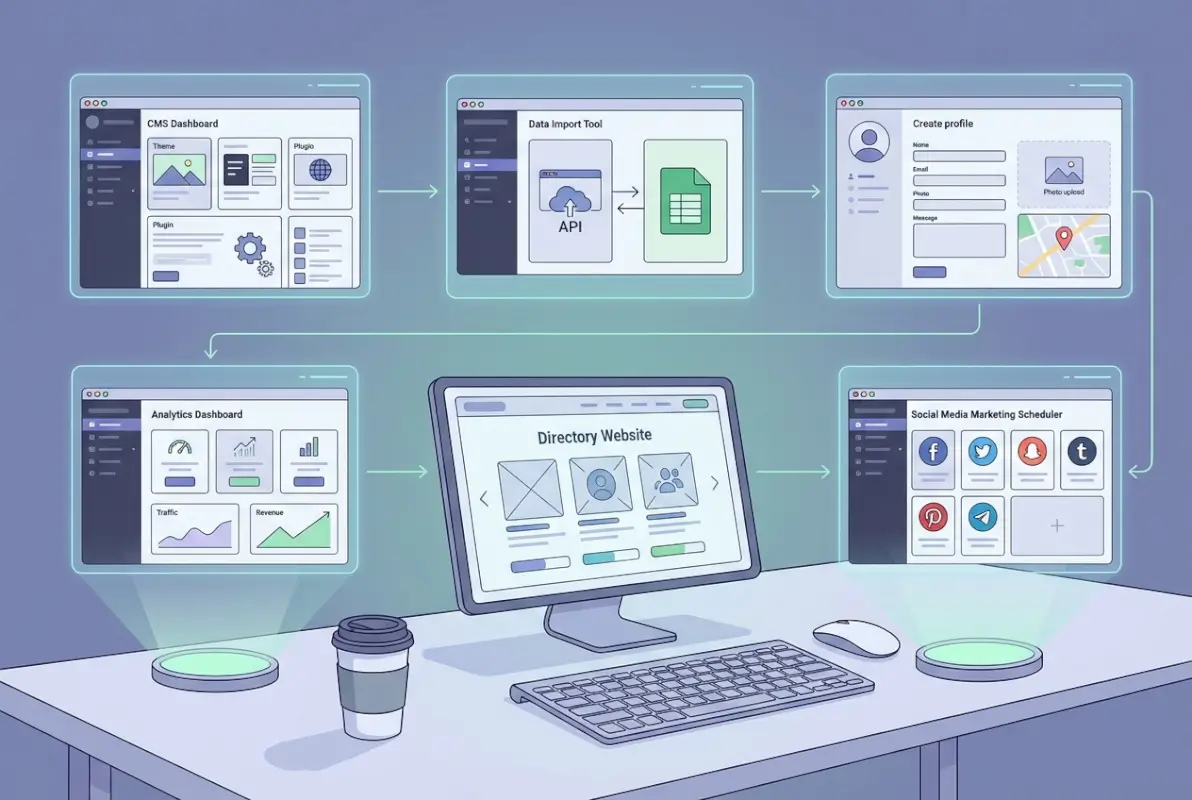
For most directory entrepreneurs starting out, WordPress paired with a specialized directory plugin offers the optimal balance. You get professional functionality without enterprise costs, flexibility to customize as you learn what users want, and ownership of your platform and data.
Popular WordPress directory solutions include Directories Pro ($149-249 one-time), Business Directory Plugin (free core, $99-299 for bundles), and themes like ListingPro ($69). Combined with quality hosting ($20-80/month), you’re operational for under $500 initial investment plus manageable monthly costs.
SaaS platforms like Brilliant Directories ($67-497/month) or eDirectory ($149-249/month) provide faster setup with less technical knowledge required. Everything’s managed—hosting, updates, security—but you sacrifice customization flexibility and pay ongoing fees regardless of revenue. For non-technical founders who want to launch quickly and test demand, this trade-off often makes sense.
Custom development ($10,000-50,000+) only makes sense when you’ve validated demand and have specific requirements that off-the-shelf solutions can’t address. Start lean, prove the model, then invest in custom features once revenue justifies the expense.
Essential Features for 2025 Directory Success
Regardless of platform, your directory must include these core capabilities:
- Advanced search with multiple filters – location radius, categories, attributes, ratings, availability
- Mobile-responsive design – 68% of directory searches happen on mobile devices
- Streamlined submission workflow – multi-step forms with progress indicators and auto-save
- Verification and moderation tools – prevent spam while maintaining listing quality
- Review and rating system – builds trust and provides fresh user-generated content
- Payment processing integration – Stripe or PayPal for subscription and one-time payments
- Analytics dashboards – for both directory owners and individual business listings
- Schema markup for local business data – critical for SEO and rich results
- Email automation – welcome sequences, renewal reminders, notification systems
- Claim listing functionality – lets businesses take ownership of existing profiles
According to W3C web accessibility guidelines, ensuring your directory is usable by people with disabilities isn’t just ethical—it expands your addressable market and often improves overall user experience.
Data Quality Standards and Verification Processes
Trust is everything in directories. One experience with outdated information or a closed business destroys user confidence. Implement verification processes from day one:
- Email verification for all submissions (minimum barrier)
- Phone verification for premium listings (call or SMS verification)
- Business documentation review for specialized industries (licenses, certifications)
- Periodic re-verification reminders (quarterly or semi-annually)
- User reporting mechanisms for incorrect information
NAP consistency—ensuring Name, Address, and Phone number match across your directory and other online presences—directly impacts local search visibility. Research on local SEO ranking factors consistently shows citation accuracy among the top signals Google uses to determine local search rankings.
Step 3: Optimize for Local Search and Google Business Profile Integration
Your directory’s visibility depends almost entirely on how well you perform in local search results and how effectively you leverage Google Business Profile signals. This isn’t optional—it’s the primary channel through which both businesses and searchers will discover your platform.
The local search landscape in 2025 revolves around three core signals: relevance (how well listings match search intent), proximity (geographic closeness to the searcher), and prominence (how well-known and authoritative a business appears). Your directory must excel at all three.
Implementing Schema Markup for Directory Listings
Structured data tells search engines exactly what your content represents. For directories, implementing LocalBusiness schema (or more specific subtypes like Restaurant, MedicalBusiness, or ProfessionalService) dramatically improves how your listings appear in search results.
Each listing should include schema markup with:
- Name, address, and phone number (NAP)
- Business category and subcategories
- Operating hours and special hours
- Geographic coordinates
- Aggregate rating information
- Price range indicators
- Images with proper alt text
- Services or products offered
Most modern directory plugins handle basic schema automatically, but review the output with Google’s Rich Results Test to ensure proper implementation. This technical foundation enables enhanced search appearances that drive significantly higher click-through rates.
Creating Location-Specific Landing Pages
Generic category pages don’t cut it anymore. Search queries like “holistic dentist Austin” or “sustainable landscaper Portland” demand pages specifically addressing that city + service combination.
Build location-based landing pages for every city or neighborhood in your coverage area, each optimized for “[Service] in [Location]” queries. Include:
- Unique introductory content (not duplicate boilerplate)
- Listings filtered to that specific location
- Local statistics or market insights when available
- Maps with pinned business locations
- Local customer testimonials or reviews
- Area-specific FAQ content
One directory owner I worked with saw organic traffic increase 340% within six months after implementing city-specific pages for his top 50 markets. The key was making each page genuinely valuable rather than thin, auto-generated content that Google increasingly penalizes.
Review Strategy and Reputation Management
Reviews serve dual purposes: they provide social proof that influences user decisions, and they create fresh, unique content that search engines reward. Your directory should make leaving reviews effortless while implementing safeguards against fake or malicious submissions.
- Send automated review requests 5-7 days after service (optimal timing for positive sentiment)
- Make the review process mobile-friendly and fast (under 60 seconds to complete)
- Display aggregate ratings prominently in search results and listing pages
- Implement review verification (confirmed purchases or service interactions)
- Moderate reviews for policy violations while respecting free expression
- Allow business responses to reviews (demonstrates engagement)
According to consumer behavior research, listings with 40+ reviews see conversion rates nearly double compared to those with fewer than 10 reviews. Your platform should actively encourage and facilitate review generation.
Step 4: Build Content That Drives Discovery and Authority
Listings alone don’t drive traffic—you need content that answers questions, solves problems, and establishes your directory as the authoritative resource in your niche. This content strategy serves multiple purposes: attracting organic traffic, building backlinks, demonstrating expertise, and providing value that keeps users returning.
The most successful directories I’ve analyzed publish consistent, high-quality content that targets both informational queries (users researching options) and transactional queries (users ready to hire or purchase). This dual approach captures users throughout their decision journey.

Strategic Content Planning for Directory Growth
Start with comprehensive keyword research to identify what your target audiences are actually searching for. Tools like Ahrefs, SEMrush, or even Google’s autocomplete and “People Also Ask” features reveal the questions and pain points you should address.
Content categories that perform well for directories include:
- How-to guides – “How to choose a [service provider]” or “What to look for in [professional]”
- Comparison articles – Side-by-side evaluations of different approaches or service types
- Local market guides – Comprehensive overviews of industries within specific cities
- Expert interviews – Featuring businesses from your directory (adds value, builds relationships)
- Industry trends and reports – Data-driven analysis of your niche market
- Checklists and templates – Practical resources users can download and apply
- Case studies – Success stories from businesses and customers in your directory
Publishing cadence matters. Consistency beats volume—two quality articles monthly published reliably outperform eight mediocre pieces published sporadically. Establish a sustainable rhythm you can maintain for 12+ months.
On-Page SEO Optimization for Directory Content
Every content page should be optimized following current SEO best practices:
- Primary keyword in title tag, H1, first paragraph, and naturally throughout content
- Semantic variations and related terms (LSI keywords) distributed naturally
- Descriptive, keyword-rich meta descriptions (under 155 characters)
- Internal links to relevant listings and other content pages
- External links to authoritative sources (builds trust, demonstrates research)
- Images with descriptive file names and alt text
- Clear heading hierarchy (H2s and H3s that outline content structure)
- Sufficient content depth (1,500+ words for competitive topics)
According to Google’s SEO Starter Guide, focusing on user experience and valuable content delivery produces better long-term results than technical optimization tricks.
Building Authority Through Outreach and Partnerships
Content on your own site is necessary but not sufficient. You need external signals—backlinks from authoritative sources—to build domain authority and ranking power.
Effective link-building strategies for directories include:
- Industry association partnerships – Many associations will link to quality directories as member resources
- Guest posting on industry blogs – Contribute valuable content with natural links back to your directory
- Data-driven PR – Publish original research or surveys that journalists reference
- Local chamber of commerce relationships – Especially valuable for location-based directories
- Sponsor relevant events or podcasts – Generates both links and brand awareness
- Resource page outreach – Many sites maintain curated lists of industry resources
One directory owner generated 120+ quality backlinks within eight months by publishing an annual industry salary survey. The research required 40 hours of work but produced link value worth thousands in SEO benefit.
Step 5: Launch with Strategic Business Acquisition
Your directory’s value proposition depends entirely on having quality listings. But businesses won’t join until you have traffic, and you won’t get traffic without listings—the classic chicken-and-egg problem. Breaking this cycle requires strategic thinking about your launch sequence.
The most successful directory launches I’ve observed follow a specific pattern: they seed the platform with 50-100 quality listings before any public announcement, then use that critical mass to attract both additional businesses and user traffic simultaneously.

Pre-Launch Listing Acquisition Strategies
Before going public, manually curate your initial listings. This foundational work establishes quality standards and gives early visitors a reason to bookmark and return.
- Manual business research – Identify top providers in your niche and create basic listings with publicly available information
- Outreach with claim incentives – Contact businesses explaining you’ve created a profile they can claim for free
- Partnership with industry associations – Some will help you reach members with special offers
- Import from public databases – Where legally permissible, bootstrap from government licensing databases
- Beta tester recruitment – Offer founding member benefits in exchange for early adoption
The claiming approach works particularly well. Businesses are naturally curious when they discover someone has already listed them, and claiming their profile provides immediate value while requiring minimal initial commitment from them.
Structured Launch Timeline and Milestones
A phased launch approach reduces risk while building momentum:
Days 1-30: Foundation Phase
- Platform setup and testing completed
- Initial 30-50 listings manually created
- Core content pages published (about, how it works, FAQs)
- Analytics and conversion tracking implemented
Days 31-60: Soft Launch
- Beta testers invited with special incentives
- Feedback collected and critical issues resolved
- Reach 75-100 total listings
- First content marketing pieces published
- Social media channels activated
Days 61-90: Public Launch
- Press release distributed to industry publications
- Paid advertising campaigns initiated
- Email outreach to remaining target businesses
- Goal: 150-200 listings, 500+ monthly unique visitors
Days 91-180: Growth Phase
- Convert 5-10% of free listings to paid tiers
- Expand geographic or category coverage based on demand signals
- Implement community features (reviews, Q&A, events)
- Goal: 300-500 listings, 2,000+ monthly visitors
Conversion Optimization for Listing Sign-Ups
Getting businesses to actually complete the listing process requires removing friction and clearly communicating value at every step.
- Multi-step forms with progress indicators (feels less overwhelming than single long form)
- Auto-save functionality so users don’t lose work
- Clear value propositions on landing pages (“Get found by customers searching for [your service]”)
- Social proof (testimonials from existing listers, usage statistics)
- Limited-time founding member benefits (reduced pricing, enhanced features)
- Immediate preview of how their listing will appear
- Multiple entry points (claim existing listing vs create new listing)
A/B testing different approaches reveals what resonates with your specific audience. One directory increased sign-up conversion 47% simply by adding a “See what your listing will look like” preview before requiring account creation.
Step 6: Implement Diversified Monetization Strategies
The most resilient directory businesses don’t depend on a single revenue source. They combine multiple monetization methods that together create stability—if one channel underperforms, others compensate. This diversification also allows you to test different approaches and optimize based on what your specific market responds to.
I’ve seen directories generate anywhere from $3,000 to $40,000 monthly using the same basic platform and similar listing counts. The difference? Strategic monetization that aligns pricing with value delivery and customer willingness to pay.
Subscription Tier Design and Pricing Strategy
Tiered subscription models typically outperform both completely free and single-price approaches. They accommodate different business sizes and needs while creating natural upgrade paths.
| Tier | Monthly Price | Key Features | Target Customer |
|---|---|---|---|
| Basic | Free | Standard listing, 3 photos, basic info | New businesses, test users |
| Professional | $49-79 | Enhanced listing, unlimited photos, analytics, category feature | Established small businesses |
| Premium | $129-179 | Featured placement, video, priority support, newsletter inclusion | Growth-focused businesses |
Pricing should reflect the value businesses receive, which correlates directly with how much traffic and qualified leads your directory generates. Early on, pricing conservatively ($29-49 for paid tiers) reduces resistance and helps you build critical mass. As traffic grows and you demonstrate ROI, gradually increase prices for new subscribers while grandfathering existing customers.
Annual payment options with 15-20% discounts dramatically improve cash flow and retention. Businesses paying annually have 70%+ renewal rates compared to 55-60% for monthly subscribers—the larger commitment creates stickiness.
Featured Placement and Advertising Revenue
Beyond subscription tiers, additional revenue comes from businesses seeking enhanced visibility:
- Featured listings – Premium placement in category pages and search results ($99-299/month)
- Homepage spotlights – Rotating featured businesses on your homepage ($199-499/month)
- Category sponsorships – Exclusive branding for specific categories ($299-799/month)
- Banner advertising – Display ads in sidebar, header, or content areas ($200-600/month)
- Newsletter sponsorships – Featured placement in email newsletters ($150-400 per send)
- Promoted search results – Pay-per-click model within directory search
Keep advertising tasteful and relevant—excessive ads degrade user experience and ultimately harm the traffic that makes your directory valuable to advertisers in the first place. A good rule of thumb: advertising should never constitute more than 25-30% of total revenue.
Affiliate Partnerships and Complementary Services
Your directory audience represents a valuable, qualified market for relevant tools and services. Strategic affiliate relationships can generate 15-25% of total revenue without creating friction for users.
High-performing affiliate categories for directories include:
- Industry-specific software and tools (CRM, scheduling, payment processing)
- Business insurance and financial services
- Marketing and advertising platforms
- Professional education and certification programs
- Industry conferences and events
The key is genuine relevance and value. One directory owner generates $4,000+ monthly by promoting a specialized insurance provider to his health and wellness directory—businesses in that niche genuinely need liability coverage, so the recommendation provides real value while generating commissions.
Step 7: Scale Through Community and Continuous Improvement
The work doesn’t stop at launch—successful directories continuously evolve based on user feedback, market changes, and competitive dynamics. The platforms that dominate their niches five years after launch are those that treat their directory as a living product requiring ongoing attention and improvement.
What separates thriving directories from those that plateau? It’s not usually the initial concept or even the platform choice, it’s the commitment to iterative enhancement and community building that creates compounding value over time.
Data-Driven Feature Development and Optimization
Let user behavior guide your development priorities. Analytics reveal what’s working and what’s creating friction:
- Which search filters get used most frequently? (Prioritize making them prominent)
- Where do users drop off in the listing submission process? (Reduce friction at those points)
- Which listing features correlate with higher engagement? (Encourage more businesses to complete those fields)
- What content topics drive the most organic traffic? (Create more content in those areas)
- Which acquisition channels have the best LTV:CAC ratios? (Allocate budget accordingly)
Implement regular user testing—watching real people navigate your directory reveals issues no amount of analytics can surface. Even 5-6 user sessions quarterly provides invaluable insights for improvement.
Building Engaged Community and Reducing Churn
Transactional relationships create price sensitivity and high churn. Community creates loyalty that survives competitive pressure and economic downturns.
Community-building tactics that work for directories:
- Virtual networking events – Monthly meetups for listed businesses to connect and collaborate
- Educational webinars – Industry experts sharing insights and best practices
- Member forums or groups – Private spaces for peer support and knowledge sharing
- Recognition programs – Awards, spotlight features, “provider of the month” designations
- Exclusive resources – Templates, guides, and tools available only to directory members
- In-person events – Annual conferences or regional meetups (for directories with sufficient scale)
Directories with active communities see renewal rates 20-30 percentage points higher than purely transactional platforms. When businesses form meaningful connections through your platform, they won’t leave even if a competitor offers marginally lower pricing.
Strategic Expansion and Scaling Decisions
Once you’ve established success in your initial niche, strategic expansion can accelerate growth. The key word is strategic—unfocused expansion dilutes your brand and spreads resources too thin.
Successful expansion approaches include:
- Geographic expansion – Replicate success in additional cities or regions
- Adjacent categories – Add complementary service types that share your core audience
- Specialized subdirectories – Create focused sections for specific subspecialties
- Acquisition of competitors – Buy smaller directories and integrate their listings
- White-label or franchise models – License your platform for others to operate in different markets
- Vertical integration – Add booking, payments, or other services beyond pure directory functionality
The right expansion path depends on your resources and goals. One directory owner I know bought three smaller competing directories over 18 months, integrated their listings, redirected their domains, and effectively tripled his addressable market while eliminating competition.
Frequently Asked Questions
What makes a business directory profitable in 2025?
Profitable directories in 2025 combine specific niche focus with multiple revenue streams including subscription listings, featured placements, and advertising. Success requires 300+ quality listings, strong local SEO optimization, verified business data, and demonstrated ROI for listed businesses through qualified lead generation. Most profitable directories generate $5,000-25,000 monthly within 18-24 months of launch.
How much does it cost to start a business directory?
Initial costs range from $500-1,500 for WordPress-based directories (hosting, domain, premium plugins, theme) or $0-200 upfront for SaaS platforms with $50-300 monthly fees. Budget an additional $500-1,500 for initial marketing and content creation. Custom development starts around $10,000 but is rarely necessary for initial launch and market validation.
What platform is best for building a directory website?
WordPress paired with specialized directory plugins (Directories Pro, Business Directory Plugin, ListingPro) offers the best balance of cost, flexibility, and control for most entrepreneurs. SaaS platforms like Brilliant Directories work well for non-technical founders prioritizing speed over customization. Custom development only makes sense after validating demand with a proven revenue model.
How long does it take to make money from a business directory?
Most directories reach break-even between 8-14 months after launch, with profitable operations beginning months 12-18. Timeline depends on niche selection, initial investment, marketing effectiveness, and pricing strategy. Directories focusing on recurring subscription revenue typically take longer to reach profitability but build more sustainable business models than one-time listing fees.
How do I get businesses to list on my directory?
Effective listing acquisition combines pre-seeding with quality listings created from public information, outreach with claim incentives, partnerships with industry associations, beta tester programs with founding member benefits, and content marketing that demonstrates traffic and lead generation potential. Start with 50-100 listings manually before public launch to establish critical mass.
What are the most important features for a business directory?
Essential features include advanced search with location and category filters, mobile-responsive design, streamlined submission workflows, verification and moderation tools, review and rating systems, secure payment processing, analytics dashboards, schema markup for SEO, email automation, and claim listing functionality. User experience and data quality matter more than feature quantity.
How important is local SEO for directory success?
Local SEO is critical—46% of Google searches have local intent. Successful directories implement schema markup for local business data, create location-specific landing pages for city-service combinations, optimize for Google Business Profile integration, maintain NAP consistency across listings, and encourage review generation. Local search signals (relevance, proximity, prominence) determine visibility and traffic.
What pricing model works best for business directories?
Tiered subscription models combining free basic listings with paid premium tiers ($49-179/month) typically outperform single-price or completely free approaches. This structure accommodates different business sizes, creates upgrade paths, and generates recurring revenue. Annual payment options with 15-20% discounts improve cash flow and retention. Supplement with featured placements and advertising for additional revenue streams.
How do I prevent spam and maintain listing quality?
Implement multi-level verification including email verification (minimum), phone verification for premium listings, business documentation review for regulated industries, periodic re-verification reminders, and user reporting mechanisms. Manual moderation during early growth establishes quality standards. Verified listings generate 3x higher user engagement and significantly better conversion rates than unverified submissions.
Can a business directory be sold or acquired?
Yes, successful directories represent attractive acquisition targets for private equity, larger directory platforms, or industry participants seeking customer access. Directories typically sell for 2-4x annual revenue depending on growth trajectory, market position, and revenue diversity. Maintain clean data, documented processes, and diversified traffic sources to maximize acquisition value and marketability.
Your Directory Journey Starts Now
Building a profitable business directory isn’t about luck or timing—it’s about strategic execution across niche selection, platform choice, local SEO optimization, content strategy, business acquisition, monetization, and community building. The entrepreneurs succeeding in this space share a common approach: they start focused, validate demand early, and scale based on actual user behavior rather than assumptions.
The opportunity in 2025 remains substantial. Small businesses desperately need better ways to be discovered, and consumers want curated, specialized resources beyond the generic mega-platforms. Your directory can bridge that gap while generating sustainable income—if you’re willing to do the strategic work upfront and commit to continuous improvement.
Start by identifying your niche today. Research the competitive landscape, validate demand through conversations with potential users, and take that first step toward building your directory business. The best time to start was yesterday; the second-best time is now.
Was this article helpful?