How to Login to GoDaddy Pro: A Step-by-Step Tutorial

If you manage websites for clients—whether you’re a freelance designer, agency owner, or WordPress developer juggling multiple projects—you’ve probably felt the chaos of logging into dozens of separate GoDaddy accounts. Passwords scattered across your browser, client credentials mixed up, and that sinking feeling when you need urgent access but can’t remember which email was tied to which domain. Here’s what most people don’t realize: GoDaddy Pro wasn’t built as just another hosting dashboard, it’s actually a complete mindset shift for how professionals handle client work. Instead of being a guest in your clients’ accounts (which creates security headaches and handoff nightmares), you become the central hub where everything connects through your single login. This isn’t just convenient—it fundamentally changes how you scale your business.
The real genius of GoDaddy Pro’s login system lies in what happens after you sign in. While competitors force you to toggle between accounts or use clunky account-switching dropdowns, The Hub gives you a bird’s-eye view of every client site, domain renewal, security alert, and maintenance task in one unified interface. I remember when a client’s site went down at 2 AM, and instead of fumbling through email threads to find their login details, I accessed their hosting through my Pro account in under 30 seconds. That’s the difference between panic and professionalism.
TL;DR – Quick Takeaways
- Single Login Power – One GoDaddy Pro account grants access to unlimited client sites, domains, and products without switching credentials
- The Hub Difference – Not just a dashboard, but a complete client management system with monitoring, backups, and maintenance tools built in
- Security First – Pro accounts support 2FA and eliminate the risky practice of sharing client passwords with your team
- Priority Support – 24/7 dedicated Pro support team that actually understands agency workflows and client management challenges
- Streamlined Workflow – Add client sites in minutes, monitor uptime across your entire portfolio, and handle billing from one central location
What GoDaddy Pro Is and Why It Matters
GoDaddy Pro isn’t a premium version of regular GoDaddy hosting—it’s an entirely separate platform designed specifically for professionals who manage websites for others. At its core, Pro combines three powerful components: The Hub (your command center for all client sites), Pro Connect (automated client site monitoring and management), and a suite of business tools that handle everything from invoicing to maintenance scheduling. While a standard GoDaddy customer logs in to manage their own domains and hosting, Pro members access a multi-tenant environment where dozens or even hundreds of client projects live under one umbrella.

The target audience for GoDaddy Pro skews heavily toward web designers, WordPress developers, digital agencies, and IT consultants who bill multiple clients monthly. If you’ve ever found yourself explaining to a client why they need to give you their GoDaddy password (and felt uncomfortable about it), you’re exactly who this platform serves. Pro membership is free, which surprises many people—GoDaddy makes their revenue when you purchase client hosting, domains, or security products through the platform, not from membership fees. This business model aligns your success with theirs, since the more clients you bring on, the more products get sold.
The fundamental difference between a standard GoDaddy login and a GoDaddy Pro login comes down to perspective. A regular account is customer-focused: “Here are MY domains, MY websites, MY products.” A Pro account is manager-focused: “Here are ALL my client sites, organized by project, with centralized billing and monitoring.” When you log into Pro, you’re not accessing a single account—you’re accessing your entire business infrastructure. This distinction matters because it affects everything from how permissions work to how support representatives handle your tickets.
One aspect that doesn’t get enough attention is how GoDaddy Pro integrates with the broader GoDaddy ecosystem. Your Pro login gives you access to The Hub, but it also seamlessly connects to GoDaddy Payments, Email Marketing, and even Microsoft 365 admin centers when you manage client email. This interoperability means fewer separate logins overall, not just for GoDaddy products. In practice, I’ve reduced my active password manager entries by about 40% since consolidating client work into Pro—that’s significant when you’re already managing credentials for hosting panels, FTP, databases, and third-party tools. For more insights on managing multiple business tools effectively, check out resources on top business directory software solutions that can help streamline your workflow.
Preparing to Log In
Before you attempt your first GoDaddy Pro login, you need to verify that you actually have a Pro-eligible account. Here’s where it gets slightly confusing: any GoDaddy account can become a Pro account by enrolling in the program, but not every account starts as Pro. If you already have a personal GoDaddy account with your own domains, you can convert it to Pro, or you can create a completely new account specifically for your professional work (which I recommend for clean separation between personal and business assets). The enrollment process is straightforward and free—you simply visit the GoDaddy Pro homepage and click “Join Now,” then follow the prompts to either upgrade an existing account or create a new one.

The credential structure for Pro accounts follows standard GoDaddy authentication: your username is typically the email address you used during registration, and your password must meet their security requirements (minimum eight characters, at least one number and one special character). However, here’s what catches people: if you have multiple GoDaddy accounts under different email addresses, you need to be crystal clear about which one you enrolled in Pro. I’ve seen colleagues waste 20 minutes trying to log into Pro with their personal account email when they actually created a separate work account for Pro membership. Write it down, store it in your password manager, and triple-check before your first login attempt.
Security preparations deserve serious attention before you start managing client assets. At minimum, you should enable two-step verification (2FA) on your GoDaddy Pro account—this typically involves receiving a code via SMS or using an authenticator app like Google Authenticator or Authy. GoDaddy supports both methods, and I strongly advocate for authenticator apps because they work without cell service and can’t be hijacked through SIM-swapping attacks. The setup process happens in your account security settings, and yes, it adds 10 seconds to each login, but that’s a trivial price for protecting dozens of client websites.
Password strength matters more for Pro accounts than for personal accounts because the blast radius of a compromise is exponentially larger. If someone gains access to your personal GoDaddy account, they can mess with your blog; if they breach your Pro account, they can take down your entire client portfolio and potentially access billing information for multiple businesses. Use a password manager to generate and store a unique, complex password of at least 16 characters. I use a passphrase system (four random words plus numbers and symbols) which gives me both security and memorability for that rare moment when my password manager isn’t accessible. Exploring robust business directory services for growth can also provide additional layers of security for your business infrastructure.
One final preparation step that often gets overlooked: clear your browser cache and cookies if you’ve been logged into standard GoDaddy recently. Mixed sessions can cause bizarre behavior where you think you’re accessing Pro but you’re actually in a regular account view, or vice versa. Starting with a clean slate—especially for your first Pro login—eliminates this variable and gives you a clear picture of what the actual Pro experience looks like.
Step-by-Step: How to Log In to GoDaddy Pro
The actual login process for GoDaddy Pro starts at godaddy.com/pro or directly at the Hub dashboard URL. When you land on the Pro homepage (assuming you’re not already logged in), you’ll see a prominent “Sign In” button in the top navigation. Clicking this triggers the standard GoDaddy authentication flow—you’re not signing into a separate system, you’re signing into your GoDaddy account which happens to have Pro features enabled. This is important to understand because it explains why the login page looks identical to regular GoDaddy: the differentiation happens after authentication, not during it.
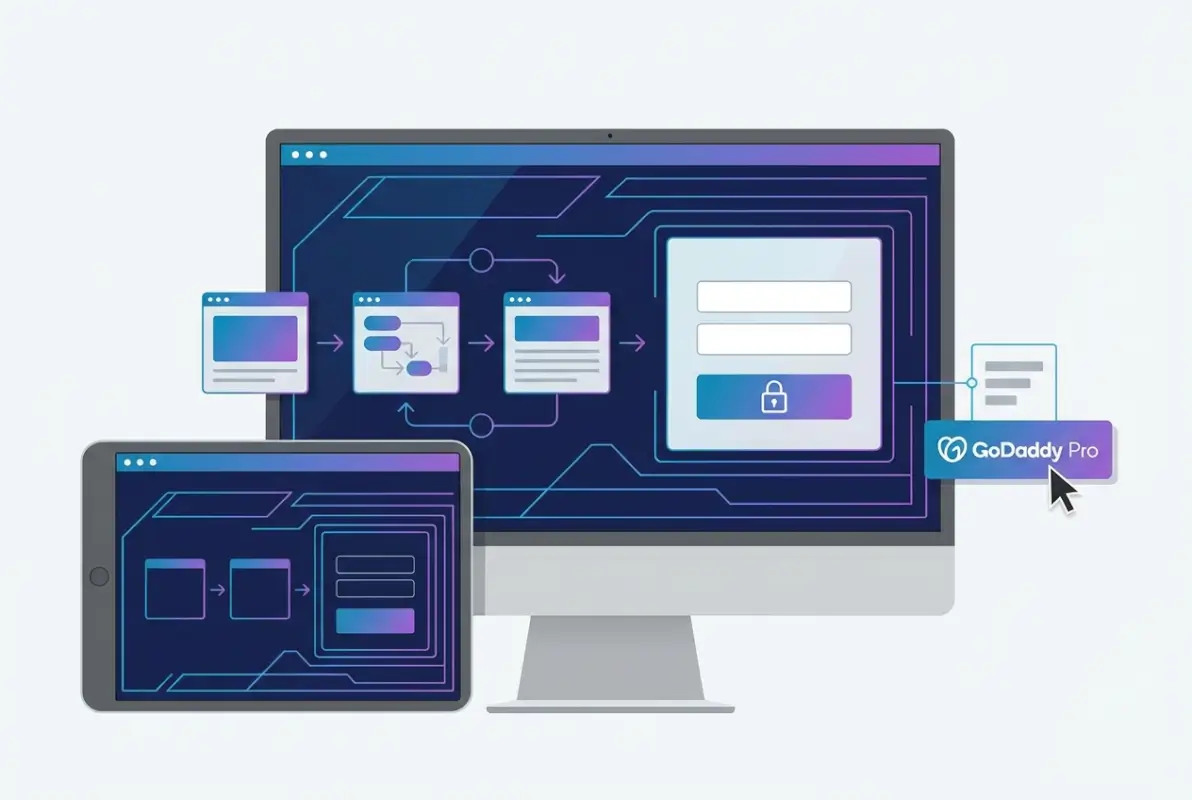
Enter your Pro account email address in the username field, then your password. If you’ve enabled two-step verification (and you should have), you’ll see a secondary prompt asking for your authentication code. Retrieve this from your authenticator app or SMS, enter the six-digit code, and proceed. Some users see a “Trust this device” checkbox—checking this means you won’t need to enter 2FA codes on this specific computer/browser combination for 30 days, which is convenient for your primary work machine but should never be enabled on shared or public computers.
| Login Step | What You’ll See | Common Issues |
|---|---|---|
| Initial Page | GoDaddy Pro homepage with “Sign In” button | Wrong URL bookmarked, lands on standard GoDaddy |
| Credentials Entry | Email/password fields identical to regular login | Using wrong email (personal vs. Pro account) |
| Two-Factor Auth | Code entry prompt (if 2FA enabled) | Lost access to authenticator app or phone |
| Hub Dashboard | Client list, site overview, navigation sidebar | Redirected to regular account page instead |
After successful authentication, GoDaddy’s system detects your Pro membership and automatically redirects you to The Hub dashboard. This is your command center—visually, it looks nothing like the standard GoDaddy product page. Instead of seeing “My Products” with a list of your own domains, you’ll see “Sites” with a list of all client websites you’ve added to your Hub. The left navigation includes sections for Sites, Clients, Monitoring, and Tools, giving you quick access to the entire Pro feature set.
Navigating to a specific client or site within The Hub follows an intuitive hierarchy. Click “Sites” in the left navigation to see your full portfolio, then click any individual site card to drill into that site’s details. From there, you can access hosting control panels, manage domains, view analytics, run backups, and more—all without leaving The Hub interface. The single-login magic happens here: when you click to manage a client’s hosting, The Hub passes your authenticated session to the hosting control panel (usually cPanel for shared hosting) without requiring you to log in again. You’re essentially acting as the account administrator for that client’s products, but through your own credentials.
If you’re already logged into a standard GoDaddy product (say, your personal domain management page) when you attempt to access Pro, the behavior depends on whether that account has Pro enabled. If your personal account is your Pro account, you’ll seamlessly transition to The Hub. If you’re logged into a different account, you’ll typically see a prompt to switch accounts or you’ll need to log out first. This is one reason many pros create entirely separate Pro accounts using a work email address rather than converting their personal accounts—it eliminates this session conflict entirely. Understanding how to efficiently manage these platforms can be enhanced by exploring business directory search engines to boost visibility in your professional endeavors.
Alternative Login Scenarios and Troubleshooting
Password resets for GoDaddy Pro accounts follow the same recovery flow as standard GoDaddy accounts because, again, they’re using the same authentication system. If you can’t remember your password, click “Forgot Password” on the login screen, enter your Pro account email, and follow the reset link sent to your inbox. The email typically arrives within 60 seconds, but I’ve occasionally seen delays of 5-10 minutes (check your spam folder). Once you create a new password, you can immediately log back into Pro—there’s no waiting period or admin approval needed.
Browser compatibility issues occasionally surface, particularly with older versions of Internet Explorer or Safari. GoDaddy Pro is built on modern web standards and works best in current versions of Chrome, Firefox, Edge, or Safari. If you’re experiencing strange behavior—buttons that don’t respond, pages that won’t load, or forms that won’t submit—your first troubleshooting step should be trying a different browser. I keep Chrome as my primary browser and Firefox as a backup specifically for this reason; if something breaks in one, the other almost always works.
One scenario that genuinely confuses people is when they successfully log in but land on a page that doesn’t look like The Hub. This usually happens when you’ve bookmarked a specific GoDaddy page (like “My Products”) and your browser auto-logged you in. Even though you’re authenticated with your Pro account, you’re viewing the standard customer interface. The solution: manually navigate to godaddy.com/pro or use the Hub-specific URL. To verify you’re actually in The Hub versus the legacy interface, check for these visual cues: the left navigation should say “Sites” and “Clients” (Hub) rather than “My Products” (standard), and the top banner should reference “The Hub by GoDaddy Pro.”
SSO (single sign-on) redirects occasionally cause head-scratching moments, especially if you manage client sites on other platforms like WordPress.com or third-party hosting that integrates with GoDaddy. When you click to manage a site, you might bounce through two or three redirects before landing on the actual management interface. This is normal—The Hub is coordinating your authenticated session across different systems. However, if you get stuck in a redirect loop (same page keeps reloading), clear your cookies for godaddy.com and try again. Nine times out of ten, this resolves it.
A less common but frustrating issue: account lockout after too many failed login attempts. GoDaddy implements this security measure to prevent brute-force attacks, and it’s typically a 30-60 minute lockout. If you (or someone trying to access your account) enters the wrong password five times in a row, you’ll see a message saying the account is temporarily locked. You can’t bypass this by resetting your password, you actually have to wait it out or contact support to manually unlock. This is another reason I’m religious about using a password manager—no more failed attempts from mistyping.
Managing via The Hub: Post-Login Essentials
Once you’re successfully logged into The Hub, your first order of business is typically adding client sites and organizing them logically. Click “Add Site” in the Hub interface, and you’ll be prompted to enter either an existing GoDaddy product (if the client already has hosting/domains with GoDaddy) or to create a new site from scratch. For existing sites, you’ll need either delegated access (the client grants permission through their account) or you’ll need to transfer ownership of products to your Pro account. For new sites, you can purchase hosting, domains, and SSL certificates directly through The Hub, and they’ll automatically associate with the correct client.

Client organization within The Hub uses a two-tier system: Clients (the people or businesses you serve) and Sites (the actual websites or projects under each client). One client might have three sites, or you might manage 15 single-site clients—The Hub accommodates both scenarios. When you add a new client, you enter their contact information, billing details, and any notes you want to track. This metadata isn’t just cosmetic, it powers features like automated client reporting and makes it easy to filter your site list when you’re managing dozens of projects. I use the notes field religiously to track contract end dates, special billing arrangements, and technical quirks specific to each client.
The maintenance tools built into The Hub go far beyond basic hosting management. Under the “Monitoring” section, you can set up uptime tracking that pings your client sites every few minutes and alerts you if anything goes down. This has saved me more times than I can count—I’ve gotten downtime alerts before clients even noticed their sites were offline, which makes you look incredibly proactive. The backup system lets you schedule automatic backups (daily, weekly, or monthly) and store them either on GoDaddy’s servers or export them to your own storage. For WordPress sites specifically, The Hub includes one-click staging environments and plugin/theme update management across your entire portfolio.
Security features within The Hub deserve their own discussion because they’re genuinely comprehensive. Each site gets a security dashboard showing malware scan results, SSL certificate status, and any detected vulnerabilities. For WordPress sites, you can enable automatic security patches, and The Hub will apply critical updates as soon as they’re released (with automatic rollback if something breaks). The firewall settings let you whitelist or blacklist IP addresses across all client sites simultaneously, which is incredibly useful if you’re dealing with a coordinated attack or if you have a team that needs access from specific office IPs. Implementing solid security practices can be complemented by understanding how to log into GoDaddy Pro guide principles for comprehensive protection.
Billing and invoicing through The Hub is where the platform really shows its business-focused design. You can generate invoices for clients directly within the interface, mark products as “bill to client” or “bill to agency,” and track payment status all in one place. If you’re purchasing hosting on behalf of clients, you can set up pass-through billing where the client pays GoDaddy directly but you maintain administrative control. Alternatively, you can pay GoDaddy yourself and invoice clients through The Hub’s built-in invoicing (or export to your accounting software). This flexibility accommodates different business models—whether you’re a freelancer billing hourly, an agency with retainer clients, or a reseller marking up hosting costs.
Security Best Practices for GoDaddy Pro
Password hygiene for your GoDaddy Pro account extends beyond just the login password—you need to think about the entire credential ecosystem. Your Pro password should be unique (not reused from any other service), complex (at least 16 characters with mixed case, numbers, and symbols), and stored in a reputable password manager like 1Password, Bitwarden, or LastPass. I rotate my Pro password every six months as a precautionary measure, even though there’s no evidence of compromise. This might seem paranoid, but when a single account controls access to 50+ client websites, paranoia is appropriate.
Two-factor authentication (2FA) setup on GoDaddy Pro accounts supports both SMS and authenticator apps. Go to your account security settings (accessible from the profile menu in the top-right of The Hub), find the two-step verification section, and choose your preferred method. I advocate strongly for authenticator apps (Google Authenticator, Authy, Microsoft Authenticator) over SMS because they’re resistant to SIM-swapping attacks and work without cell coverage. The setup process involves scanning a QR code with your authenticator app, which then generates rolling six-digit codes every 30 seconds. Save the backup codes GoDaddy provides during setup in a secure location (your password manager’s secure notes section is perfect)—these are your fallback if you lose access to your authenticator device.
| Security Measure | Implementation | Risk Mitigated |
|---|---|---|
| Unique Password | 16+ characters, password manager generated | Credential stuffing, brute force attacks |
| 2FA Authenticator | App-based codes, not SMS | SIM swapping, password theft |
| Delegated Access | Hub team features vs. sharing passwords | Exposed credentials, unauthorized access |
| Activity Monitoring | Regular review of login history | Undetected account compromise |
Sharing access with team members represents one of the biggest security challenges for agencies, and GoDaddy Pro has a specific solution: team member features within The Hub. Instead of giving your employees or contractors your master Pro login (which grants full access to everything), you can add them as team members with granular permissions. One person might get access only to WordPress management for specific sites, while another can handle billing across all clients. This role-based access control eliminates the security nightmare of shared passwords and lets you revoke access instantly when someone leaves your team. The setup happens in The Hub’s team management section, where you invite members via email and assign their permission levels.
Session management is another security dimension that deserves attention. By default, GoDaddy keeps you logged in for extended periods (weeks, potentially) unless you explicitly log out. For your primary work computer, this is convenient and relatively safe if you use disk encryption and lock your screen when away. However, if you ever log into Pro from a shared computer, conference center kiosk, or any untrusted device, you must manually log out when finished. Additionally, don’t check the “Trust this device” box for 2FA on anything except your personal, secured machines. I made this mistake once at a coworking space and spent a nervous weekend changing passwords and checking audit logs (fortunately, nothing bad happened, but lesson learned).
Monitoring login activity gives you visibility into who’s accessing your Pro account and from where. GoDaddy maintains a login history showing timestamps, IP addresses, and device information for recent sessions. Check this periodically (I review mine monthly) and look for anything suspicious: logins from geographic locations you didn’t visit, unfamiliar devices, or access times that don’t match your work patterns. If you spot something concerning, immediately change your password, revoke all active sessions (there’s typically a “sign out everywhere” option), and contact GoDaddy Pro support to report potential unauthorized access.
Tips for Agencies and Power Users
Client onboarding becomes dramatically more efficient when you develop a standardized workflow through The Hub. Create a checklist: (1) Add new client to Hub with billing contact information, (2) Either connect existing GoDaddy products or purchase new hosting/domains, (3) Apply your standard security configuration template, (4) Set up monitoring and backups, (5) Add client to your billing cycle, (6) Send automated welcome email with access details. With practice, this entire sequence takes under 15 minutes per client. I batch new client setups on Monday mornings, which gives me a clear week to complete any technical configuration before sites go live.
Invoicing through The Hub can integrate with external accounting systems, though the built-in invoicing is actually quite robust. You can create line items for hosting, development hours, maintenance contracts, and one-off services all on a single invoice. The system supports multiple currencies, tax calculations (with regional variations), and payment tracking. For agencies running on retainer models, you can set up recurring invoices that generate automatically each month, saving countless admin hours. One feature I love: the ability to send invoices directly to clients via email from within The Hub, with payment links that go straight to your merchant account or PayPal.
Managing multiple accounts from a single login truly shines when you’re handling emergency situations across your portfolio. Let’s say a plugin vulnerability gets announced and you need to update 40 WordPress sites within the next few hours. From The Hub, you can filter to show only WordPress sites, view which ones have the vulnerable plugin installed (monitoring detects this), and push the update to all affected sites with a few clicks. Compare this to the old method: logging into 40 separate hosting accounts, finding the WordPress admin for each, clicking through to plugins, and manually updating. The time savings are measured in hours, not minutes.
Scaling your business with Pro tools means leveraging the automation features that most people underutilize. Set up smart alerts that notify you when client domains are 30 days from expiration (preventing embarrassing outages), configure automatic SSL renewals so certificates never lapse, and enable maintenance mode toggles that you can flip globally before doing risky updates. The monitoring system can even track site performance metrics and alert you when page load times exceed thresholds, letting you proactively address slowdowns before clients complain. These automations transform you from reactive firefighter to proactive manager. For additional strategies to grow your business, exploring best business directory sites list can provide valuable networking opportunities.
Reporting and analytics within The Hub provide the data you need to demonstrate value to clients. Generate monthly reports showing uptime percentage, security scans completed, backups created, and any incidents resolved. Some agencies turn these automated reports into upsell opportunities—highlighting that a site needed three malware cleanings in a month might justify an upgrade to premium security monitoring. The data is already being collected, you’re just packaging it in a way that reinforces your value proposition and keeps clients engaged with your service.
What to Do If You’re Locked Out or Lose Access
Complete account lockout (can’t remember email, password forgotten, no access to 2FA device) requires a multi-step recovery process. Start at the GoDaddy login page and use the “Forgot Password” link, but if you can’t remember which email you used for your Pro account, you’ll need to contact support directly. GoDaddy’s phone support (available 24/7) can look up your account based on other identifying information: domain names you manage, your business name, or the last four digits of the credit card on file. This verification process exists to prevent unauthorized account recovery, so be prepared to answer security questions and potentially provide documentation proving you own the business.
If you’ve lost access to your two-factor authentication device (phone stolen, authenticator app deleted, etc.), use one of the backup codes you (hopefully) saved during 2FA setup. Each backup code is single-use and bypasses the normal 2FA requirement, letting you log in and reconfigure your authentication settings. If you didn’t save backup codes (most people don’t, unfortunately), you’ll need to go through GoDaddy’s account recovery process, which involves identity verification via phone support. This can take 30 minutes to several hours depending on how quickly you can provide the requested verification documents.
Temporary lockouts due to too many failed login attempts typically resolve themselves after 30-60 minutes, but you can accelerate this by contacting GoDaddy Pro support directly. Explain the situation (usually “forgot password, tried several times, now locked out”) and they can manually reset the lockout timer after verifying your identity. The support number for GoDaddy Pro is different from standard support—look for the Pro-specific contact information in your welcome email or on the official GoDaddy Pro help page, since Pro members get priority routing to specialized agents.
Delegated access issues (you can log into Pro but can’t access a specific client’s products) usually stem from permission problems rather than authentication failures. Verify that the client actually granted you access through their GoDaddy account, or confirm that product ownership has been transferred to your Pro account. The Hub has a troubleshooting section under each client that shows the access status for their various products—if something shows “Access Denied” or “Pending Authorization,” you know exactly where the problem lies. Reach out to the client to complete the delegation, or contact Pro support if you believe the permissions are correctly configured but still not working.
For situations where your entire business is at stake (you’re locked out during a client emergency, sites are down, and you can’t get in), escalate immediately to GoDaddy Pro’s priority support line and clearly communicate the urgency. In my experience, Pro support is genuinely responsive to legitimate emergencies and can often resolve access issues in under 30 minutes when critical sites are affected. Document your situation clearly, have your account information ready, and be prepared for stringent identity verification—they take security seriously, which is ultimately protecting you.
Frequently Asked Questions
What is GoDaddy Pro, and how is it different from a standard GoDaddy account?
GoDaddy Pro is a free membership platform designed for web professionals who manage multiple client sites. Unlike standard accounts that manage personal domains and hosting, Pro provides a centralized Hub where you access all client websites through a single login, with tools for monitoring, maintenance, billing, and team collaboration—essentially transforming how agencies and developers handle client work at scale.
How do I log in to GoDaddy Pro Hub?
Navigate to godaddy.com/pro or the Hub dashboard URL, click “Sign In,” and enter your Pro account credentials (email and password). After two-factor authentication if enabled, you’ll automatically redirect to The Hub interface. The login uses standard GoDaddy authentication, but Pro membership determines whether you access The Hub or standard account pages post-login.
Can I access multiple client sites with one GoDaddy Pro login?
Yes, that’s the core value of GoDaddy Pro. Your single Pro login grants access to unlimited client sites added to your Hub. You don’t need separate credentials for each client—The Hub acts as an authentication broker, translating your Pro permissions into appropriate access for each client’s hosting, domains, and other products you manage on their behalf.
What should I do if I can’t log in due to password issues, redirects, or browser problems?
For password issues, use the “Forgot Password” recovery link on the login page. For redirect loops or browser problems, try clearing cookies/cache or switching to a different browser (Chrome or Firefox work best). If you’re seeing standard GoDaddy pages instead of The Hub, verify you’re using the correct Pro account email and navigate directly to godaddy.com/pro after login.
How does GoDaddy Pro handle support and what is The Hub’s role?
GoDaddy Pro members receive 24/7 priority support from specialized Pro agents who understand agency workflows and multi-client management. The Hub serves as your central command interface where you can access support resources, submit tickets with context about specific client sites, and track resolution—Pro support is notably more responsive and knowledgeable than standard GoDaddy support for professional use cases.
How do I add a client or site to The Hub?
Click “Add Client” or “Add Site” in The Hub navigation, then enter the client’s information and either connect existing GoDaddy products through delegated access or purchase new hosting/domains that automatically associate with that client. The process takes 5-10 minutes and includes setting up monitoring, backups, and security configurations you want applied to the new site from day one.
What security measures should I enable when using GoDaddy Pro?
Enable two-factor authentication using an authenticator app (not SMS), create a unique 16+ character password stored in a password manager, use team member features instead of sharing your login credentials, regularly review login history for suspicious activity, and never check “Trust this device” on shared or public computers—Pro accounts control multiple client sites, so security failures have exponential consequences.
Can I manage WordPress sites specifically through GoDaddy Pro?
Absolutely. The Hub includes WordPress-specific tools like one-click staging environments, bulk plugin and theme updates across multiple sites, security patch automation with automatic rollback, and performance monitoring. You can manage WordPress sites hosted anywhere (not just GoDaddy) by connecting them through the Pro Connect plugin, making it genuinely useful even if clients use third-party hosting.
Does GoDaddy Pro cost money, or is there a subscription fee?
GoDaddy Pro membership is completely free with no monthly subscription fees. GoDaddy’s revenue model relies on you purchasing client hosting, domains, SSL certificates, and other products through the platform. You often get discounted Pro pricing on these products compared to standard retail prices, creating a win-win where you can mark up services while still saving clients money versus direct purchase.
What happens to client sites if I stop using GoDaddy Pro or close my account?
Client products you purchased through Pro are tied to your account as delegated administrator, not outright owner (unless you specifically transferred ownership). If you close your Pro account without transferring products back to clients or to another Pro account, clients maintain ownership and access through their own GoDaddy accounts. Always coordinate handoff properly before closing Pro to avoid disrupting client access.
Ready to Transform Your Client Management?
Logging into GoDaddy Pro is just the beginning—the real power emerges when you start leveraging The Hub’s centralized monitoring, automated maintenance, and streamlined billing to scale your web business beyond what scattered individual logins could ever support. Your next step: enroll in GoDaddy Pro if you haven’t already, add your first three client sites to The Hub, and experience the difference between managing accounts and managing a portfolio. Don’t let password chaos and account-switching friction hold your business back from the growth it deserves.