How to Monetize a Directory Website: 6 Proven Revenue Strategies That Actually Work

If you’re running a business directory that isn’t generating revenue, you’re essentially maintaining an expensive hobby. Most directory owners struggle with the same challenge—they’ve built a valuable platform but haven’t figured out how to make money with a business directory website. The reality? Your directory sits at the intersection of business needs and consumer intent, creating multiple opportunities for strategic monetization that can transform your platform into a profitable venture.

After working with directory owners across various niches—from local service platforms to specialized industry databases—I’ve seen firsthand which monetization strategies for directory websites actually deliver results. The successful ones don’t rely on a single revenue stream. They build diversified income through a combination of advertising, premium features, and value-added services that benefit both businesses and users.
TL;DR – Quick Takeaways
- Multiple revenue streams win: Successful directories combine 3-4 monetization methods rather than relying on just one
- Premium listings convert: Tiered pricing models generate 2.8x more revenue per listing than flat fees
- Start strategic: Focus on building listing density and traffic before aggressive monetization
- Ads need balance: Display advertising works when properly targeted—poor placement drives users away
- Lead generation pays: Pay-per-lead models align your success with business outcomes
- Data has value: Anonymized insights and market reports create additional revenue from existing information
Whether you’re launching a new directory or optimizing an existing platform, understanding how to monetize a directory website requires matching the right strategies to your audience, niche, and growth stage. Let’s explore six proven methods that generate sustainable revenue while maintaining genuine value for your users.
1. Premium Listings and Tiered Membership Models
Premium listings create the foundation for how to monetize directory website platforms effectively. The concept is straightforward—businesses pay for enhanced visibility and features that help them stand out from competitors. What makes this approach powerful is the clear value exchange: businesses get more inquiries, and you generate predictable recurring revenue.

The key to successful premium listings lies in creating obvious visual and functional differentiation. When someone browses your directory, premium listings should immediately catch their attention through strategic placement, enhanced visuals, or special badges. According to recent industry data, premium listings typically generate 4-6 times more clicks than standard entries, justifying their higher price point.
Designing Effective Pricing Tiers
Most successful directories implement a four-tier structure: Free (basic listing), Professional ($29-79/month), Premium ($99-199/month), and Enterprise ($299+/month). Each tier should offer progressively more valuable features that justify the price increase.
Common premium features that businesses actually pay for include multiple images and videos, priority placement in search results, advanced analytics showing profile views and user interactions, direct inquiry forms with email notifications, social media integration, and verified business badges. The trick is bundling features in a way that makes the middle tier feel like the obvious choice—a psychological principle called the “compromise effect.”
| Feature | Free | Professional | Premium |
|---|---|---|---|
| Basic listing | ✓ | ✓ | ✓ |
| Photos/videos | 1 photo | 5 photos + video | Unlimited |
| Search priority | Standard | Elevated | Top placement |
| Analytics | — | Basic | Advanced |
| Lead forms | — | ✓ | ✓ + CRM integration |
One directory owner I worked with initially offered only free and one paid tier at $50/month. Conversion rates were disappointing—less than 3%. After restructuring into three paid tiers ($29, $79, $149), the middle tier became the most popular option, and overall conversion jumped to 11%. The lesson? Give businesses choices, but make the path clear.
Demonstrating ROI to Convert Free Listings
The biggest barrier to premium upgrades is business owners not understanding the value. Combat this by providing transparent analytics that show exactly what premium features deliver. Create dashboards showing search appearances, profile views, click-through rates, and inquiry volume. When businesses see concrete numbers—”Your listing appeared in 847 searches last month but only received 23 views”—the value of premium placement becomes obvious.
Include success stories and testimonials from businesses that upgraded. Video testimonials work particularly well, showing actual business owners discussing tangible results like increased bookings or qualified leads. Social proof removes doubt and accelerates decision-making.
2. Display Advertising and Sponsored Content
Display advertising remains one of the most immediate ways to monetize directory website platforms, particularly once you’ve established steady traffic. The challenge isn’t whether to include ads—it’s how to implement them without degrading user experience or eroding trust.

Modern directory advertising has evolved beyond simple banner placements. The most successful approaches combine contextual relevance with strategic positioning. When someone searches for “Italian restaurants in Chicago,” showing targeted ads for premium dining experiences or food delivery services in that city makes sense. Random ads for unrelated products? That’s how you drive users away.
Strategic Ad Placement and Formats
Effective ad placement follows the natural user flow without disrupting the core directory experience. High-performing positions include header sections on category pages, sidebar placements on listing detail pages, and native ad units within search results (clearly labeled as “Sponsored”). Average click-through rates for well-targeted directory ads range from 0.45-0.65%—significantly higher than general website averages.
You have several advertising implementation options. Ad networks like Google AdSense provide hands-off revenue but typically generate lower CPMs ($1-5). Direct ad sales to businesses in your niche command much higher rates ($15-50 CPM) but require active sales effort and relationship management.
The hybrid approach often works best: use ad networks to monetize unsold inventory while building direct relationships with high-value advertisers in your core categories. Create advertising packages that combine display placements with sponsored content and featured listings for maximum advertiser value.
Sponsored Content and Native Advertising
Sponsored content—articles, guides, or business profiles created in partnership with paying businesses—generates higher engagement than traditional display ads when done properly. The key word is “properly.” Low-quality sponsored content that reads like blatant advertising damages your credibility and drives users away.
Set clear quality standards for sponsored content. It should provide genuine value to your audience while naturally showcasing the sponsor. For example, a “Complete Guide to Planning Outdoor Weddings” sponsored by a wedding venue works well. A thinly-veiled sales pitch disguised as content doesn’t (I’ve seen this mistake torpedo otherwise solid directories).
Always clearly label sponsored content with tags like “Sponsored,” “Partner Content,” or “Paid Promotion.” Transparency builds trust. The FTC requires clear disclosure of paid relationships, and users appreciate honesty about commercial relationships.
3. Lead Generation and Pay-Per-Lead Models
Lead generation represents a sophisticated approach to directory monetization that aligns your success directly with business outcomes. Instead of simply listing businesses, you actively facilitate connections between potential customers and service providers—then charge for those qualified leads.
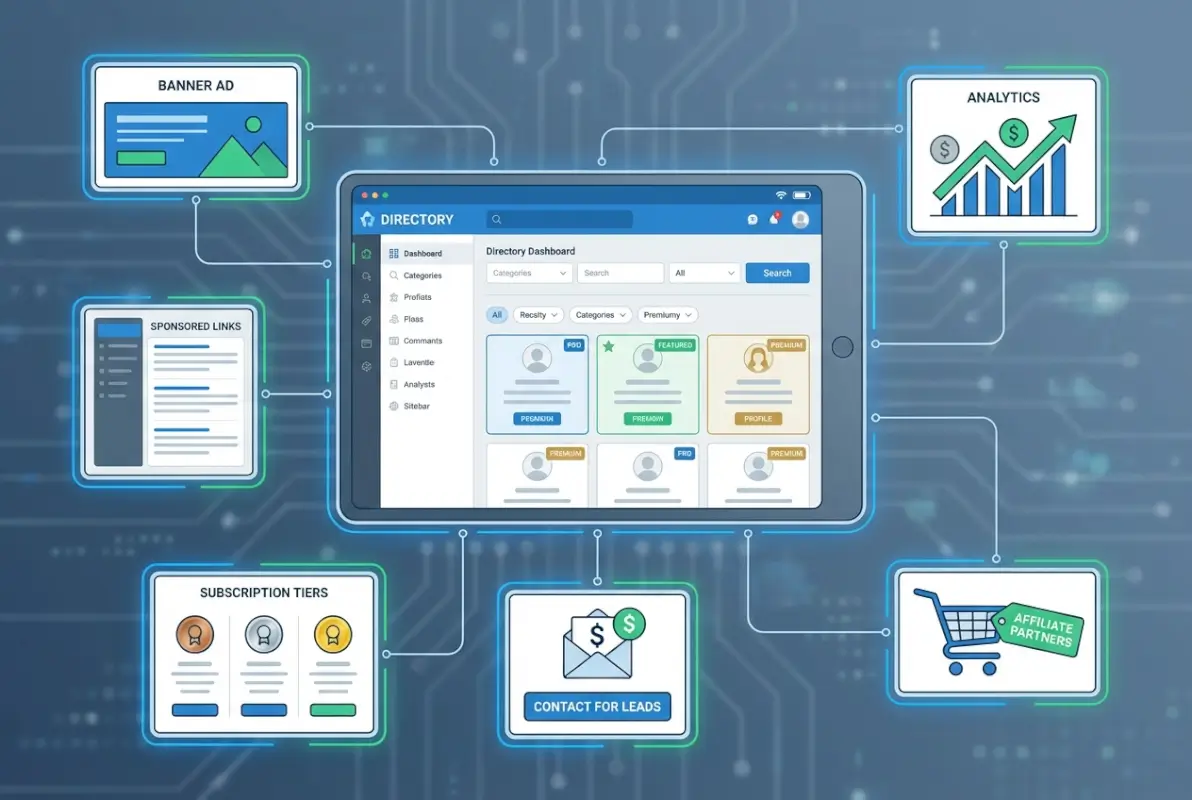
This model works particularly well for high-value service directories where customer lifetime value justifies higher acquisition costs. Home improvement contractors, legal services, wedding vendors, and B2B service providers routinely pay $25-150+ per qualified lead, making this one of the most lucrative monetization strategies for directory websites serving these niches.
Implementing Effective Lead Capture
The foundation of lead generation is capturing user intent at the right moment. When someone shows strong interest in a specific business—viewing their full profile, checking pricing, or reading reviews—that’s the perfect time to facilitate a connection through an inquiry form, quote request, or appointment booking.
Lead qualification matters enormously. Businesses will pay premium prices for qualified leads but will quickly abandon your platform if they receive low-quality inquiries or spam. Implement screening questions that filter genuine interest from casual browsing. For a contractor directory, asking about project scope, timeline, and budget filters serious prospects from tire-kickers.
Several lead distribution models work well for directories. You can charge per lead delivered (businesses pay $X for each inquiry), implement a credit system (businesses purchase credits to respond to quote requests), or take a percentage commission on completed transactions if you facilitate bookings or sales.
Tracking and Attribution
Transparent tracking builds trust with paying businesses. Provide dashboards showing lead volume, response times, and conversion metrics. When businesses can see exactly what they’re paying for and measure ROI, they’re more likely to continue and increase their investment.
Consider implementing lead scoring that adjusts pricing based on quality indicators. A lead with detailed project requirements and contact information might cost more than a basic “I’m interested” inquiry. This creates fairness and incentivizes users to provide detailed information that helps businesses respond effectively.
4. Affiliate Partnerships and Strategic Integrations
Affiliate marketing creates passive income streams without requiring additional content creation or active sales effort. The principle is simple: refer your directory users to relevant products or services and earn commissions on resulting sales or signups.

The effectiveness of affiliate marketing in directories comes from contextual relevance. You’re not randomly promoting products—you’re recommending solutions that genuinely help businesses listed in your directory or users searching for services. When done thoughtfully, affiliate partnerships enhance rather than detract from the user experience.
Selecting Profitable Affiliate Partnerships
The most successful directory affiliate strategies focus on tools and services businesses in your niche actually need. For a restaurant directory, affiliates might include reservation systems, point-of-sale platforms, or food delivery integrations. For a professional services directory, CRM software, appointment scheduling tools, or payment processing solutions make sense.
Look for affiliate programs offering recurring commissions rather than one-time payments. Software-as-a-service (SaaS) tools typically provide monthly commissions for the lifetime of the customer you refer. A single referral generating $20/month in commissions becomes $240 in annual recurring revenue—far more valuable than a $50 one-time payment.
| Partnership Type | Commission Structure | Best For |
|---|---|---|
| SaaS tools | 20-30% recurring monthly | Business software, CRMs |
| Service marketplaces | $5-50 per lead/booking | Appointments, reservations |
| E-commerce products | 5-15% per sale | Supplies, equipment |
| Financial services | $100-500 per signup | Business loans, insurance |
Integration and API Monetization
Beyond traditional affiliate links, consider strategic integrations that embed partner services directly into your directory. For example, integrating a booking system that allows users to schedule appointments directly from business listings creates value for all parties—users get convenient booking, businesses get qualified appointments, and you earn commission on transactions.
Some directories monetize their data through API partnerships, allowing third-party applications to access directory listings, reviews, or analytics in exchange for usage fees or revenue sharing. This B2B approach requires technical implementation but can generate substantial recurring revenue from each integration partner.
5. Events, Webinars, and Educational Content
Leveraging your directory’s audience for events and educational content creates high-margin revenue opportunities while positioning your platform as an industry authority. This approach works particularly well once you’ve established a community around your niche.

The beauty of event-based monetization is multiple revenue streams from a single initiative. You can charge for tickets, secure event sponsorships from listed businesses, offer premium exhibitor packages, and create recorded content for ongoing passive income. A single well-executed event can generate $5,000-50,000+ depending on scale and pricing.
Virtual Events and Webinar Programs
Virtual events have become particularly profitable because of low overhead costs and global reach. Monthly networking events for businesses in your directory can generate steady recurring revenue—charging $29-99 per ticket to 30-100 attendees creates $900-9,900 monthly income with minimal production costs.
Webinar series addressing industry challenges or best practices provide value while generating revenue. Record sessions and offer them as on-demand content to extend value and create evergreen income. Bundle webinar access into premium memberships to increase perceived value and justify higher subscription prices.
Educational Content and Certification Programs
Creating courses related to your directory’s industry establishes authority while generating additional revenue. These might include online courses teaching industry best practices, certification programs businesses can display on their profiles, or mentorship programs connecting established and emerging businesses.
Digital courses benefit from high margins—once created, they generate passive income with minimal ongoing costs. Successful directory-based courses typically generate $5,000-50,000 monthly depending on pricing, quality, and audience size. Price courses at $99-499 for self-paced content or $999-2,499 for interactive cohort-based programs with direct instruction.
6. Data Products and Market Intelligence
Your directory collects valuable data about search patterns, industry trends, and market demand. While maintaining appropriate privacy standards and compliance, this anonymized data can be packaged into market intelligence products that industry professionals and businesses pay for.
Market research firms, industry associations, investors, and businesses themselves often seek data that helps them understand search trends, geographic demand distribution, seasonal patterns, competitive landscapes, and emerging market opportunities. Your directory sits on a goldmine of this information.
Creating Sellable Data Products
Package insights into quarterly or annual industry reports, custom data dashboards for premium members, or on-demand market analysis. Price these products between $149-799 depending on depth, exclusivity, and customization level. Businesses making strategic decisions about market entry, expansion, or positioning will pay for reliable data.
One directory owner I advised initially gave away market insights for free in blog posts. After repackaging similar data into a quarterly “State of the Industry” report priced at $299, they generated $15,000+ in the first quarter while maintaining goodwill by offering a free executive summary. The detailed data became a revenue generator rather than a marketing expense.
Business Intelligence Dashboards
Offer premium subscribers access to competitive intelligence showing how their listing performs compared to category averages, trending searches in their industry, geographic demand patterns, and user behavior insights. These dashboards help businesses optimize their presence while creating recurring revenue from data you’re already collecting.
Implementation Strategy: Matching Methods to Your Directory Stage
Knowing these monetization methods is valuable, but implementing them effectively requires matching strategies to your directory’s maturity and audience size. Trying to monetize too aggressively before establishing value will backfire, while waiting too long leaves money on the table.
Phase 1: Foundation Building (0-6 Months)
Focus first on building listing density and attracting users. Offer free basic listings to populate your directory quickly—businesses won’t pay to join an empty platform. Implement simple affiliate partnerships requiring minimal setup and consider one premium listing tier with obvious value differentiation. Prioritize growth over immediate monetization during this phase.
Phase 2: Revenue Activation (6-18 Months)
Once you have consistent traffic (5,000+ monthly visitors) and solid listing base (200+ businesses), activate primary monetization. Introduce tiered subscription models, implement lead generation where appropriate, add strategic display advertising, and launch featured listing positions. This phase is where most directories achieve profitability.
Phase 3: Diversification (18+ Months)
With established revenue streams, expand into higher-margin opportunities like educational content and events, consulting services, data products, and API partnerships. This transforms your directory from a listing service into a comprehensive industry platform with significantly increased value and defensibility.
Frequently Asked Questions
How do online directories make money?
Online directories generate revenue through multiple streams including premium business listings with enhanced features, display advertising and sponsored content, lead generation fees when connecting users with businesses, affiliate commissions from partner services, event ticketing and sponsorships, data products and market intelligence reports, and subscription memberships offering exclusive benefits. Most successful directories combine 3-4 methods rather than relying on a single approach.
What is the best monetization strategy for a niche directory?
Niche directories monetize most effectively through premium listings combined with targeted lead generation. Start with free basic listings to build density, then introduce tiered paid options with clear value differentiation. Add lead generation once you have steady traffic, as niche audiences typically have strong commercial intent. Consider industry-specific affiliate partnerships and eventually expand to educational content and events as your community grows and trusts your authority.
How much revenue can a directory website generate?
Revenue potential varies dramatically by niche, traffic, and implementation quality. Small local directories typically generate $500-3,000 monthly, while established niche directories can earn $10,000-50,000+ monthly. High-value niches like legal services, home improvement, or B2B directories command higher prices per listing and lead. Most directories reach break-even profitability within 12-24 months and achieve significant income after 18-36 months of consistent effort.
Should I charge for listings from the beginning?
No, offering free basic listings initially helps build directory population and attract users quickly. Businesses won’t pay to join an empty platform with no traffic. Once you’ve established traffic and demonstrated value through analytics showing views and inquiries, approximately 5-15% of free listings typically convert to paid premium options when properly incentivized. Build value first, monetize second.
How do I price premium directory listings competitively?
Research what businesses in your niche pay for advertising, leads, or listings on competitive platforms. Consider your traffic levels—directories with higher engagement can charge more. Start with monthly pricing between $29-99 for basic premium upgrades, $100-199 for mid-tier packages, and $200-500+ for comprehensive packages with priority placement and lead generation. Test different price points and adjust based on conversion rates and business feedback.
Can I monetize without hurting user experience?
Absolutely—the best monetization enhances user experience rather than degrading it. Premium listings help users discover quality businesses, sponsored content provides valuable information, and lead generation connects users with providers efficiently. The key is maintaining relevance and avoiding intrusive tactics like excessive pop-ups, misleading sponsored content, or ad overload. If users find value, they’ll appreciate monetization that supports the platform.
What are effective ways to monetize a wedding directory?
Wedding directories monetize effectively through premium vendor listings with photo galleries and reviews, lead generation connecting couples with vendors ($15-50 per qualified lead), affiliate partnerships with planning tools and registries, sponsored content like planning guides and checklists, advertising from wedding-related businesses, and ticketing for wedding expos or planning workshops. The high transaction values in the wedding industry support premium pricing across all these methods.
How long until a directory becomes profitable?
Most directories reach break-even profitability within 12-24 months with proper execution. Significant income typically requires 18-36 months of consistent effort building listings, traffic, and authority. Directories in established niches with existing demand monetize faster than those requiring market education. Success depends on niche selection, execution quality, marketing effectiveness, and sustained effort through the initial growth phase before monetization scales.
Should I use multiple monetization methods or focus on one?
Start with one or two complementary methods, perfect their implementation, then gradually add others. For example, begin with premium listings and strategic affiliate partnerships, then add lead generation once you have steady traffic. Multiple revenue streams provide stability and growth potential, but only if each is implemented well. Excellent execution of fewer strategies generates more revenue than mediocre implementation of many.
What tools help implement directory monetization?
Choose directory software supporting multiple listing tiers, built-in payment processing, subscription management, analytics dashboards, lead generation forms, and advertising space management. WordPress-based solutions like TurnKey Directories provide these features out of the box. For payments, Stripe or PayPal handle subscriptions reliably. Google Analytics tracks performance effectively, while CRM integrations help manage leads and business relationships professionally.
Building Your Profitable Directory: Next Steps
Understanding how to monetize a directory listing website is just the beginning—implementation separates successful directories from abandoned projects. The strategies outlined here have generated substantial revenue for directory owners who applied them consistently and thoughtfully, adapting methods to their specific niche and audience.
The most successful approach isn’t implementing every possible revenue stream immediately. It’s understanding your audience deeply, providing genuine value first, and strategically introducing monetization methods that enhance rather than detract from the user experience. Start with one or two methods that align with your directory’s maturity stage, perfect their execution, and gradually expand your revenue mix as you grow.
Your directory has potential to become both a valuable resource for your community and a profitable business rewarding your investment. Choose your first monetization strategy today, commit to excellent implementation, and begin building the sustainable revenue streams that will support your directory’s long-term growth and success.