7 Reasons Why Your Business Listing Isn’t Showing Up (+ How to Fix It)

Generating summary...
You’ve spent hours setting up your business listing. You’ve filled in every field, uploaded photos, and double-checked your information. Yet when you search for your own business, it’s nowhere to be found. Meanwhile, your competitors seem to dominate the local search results effortlessly.
Here’s what most business owners don’t realize: appearing in local search results isn’t about simply having a listing—it’s about sending the right signals to search engines at the right time. Google processes over 8.5 billion searches daily, and local intent drives nearly half of those queries. The difference between businesses that appear prominently and those that remain invisible often comes down to a handful of fixable issues that most owners overlook completely.
- Verification is non-negotiable – Unverified listings simply won’t appear in competitive searches
- NAP consistency matters more than ever – Even minor variations confuse Google’s trust algorithms
- Reviews drive visibility – Businesses with 40+ reviews rank significantly higher than those with fewer
- Category selection is critical – Generic categories dilute your relevance for specific searches
- Technical issues kill rankings – Indexing problems and slow sites undermine everything else
- Citations build authority – Quality directory listings validate your business existence
- Fresh content signals activity – Regular updates tell Google your business is currently operational
1. Your Google Business Profile Isn’t Fully Verified
The single most common reason businesses don’t appear in local search is surprisingly simple: their Google Business Profile remains unverified. I’ve consulted with dozens of frustrated business owners who couldn’t understand their invisibility, only to discover they never completed the verification process that Google sent them months earlier.
Verification isn’t a formality—it’s the gateway to local search visibility. Google requires verification to prevent spam, ensure accuracy, and protect consumers from fraudulent listings. Without that verified badge, your listing exists in a kind of digital limbo where it might appear occasionally but will never compete with verified businesses for prominent placement.

The verification process has evolved significantly. Google now offers multiple verification methods depending on your business type: postcard verification (the traditional method), phone verification, email verification, video verification for certain categories, and instant verification if you’ve already verified your business through Google Search Console. Each method has specific requirements and timelines.
Recent changes to Google Local Services ads have made verification even more critical. Businesses that fail to maintain verified status now lose eligibility for both organic local pack placement and paid advertising opportunities. The verification requirement has become a fundamental gatekeeper for all forms of local visibility.
Once verified, your profile completeness becomes the next critical factor. According to comprehensive local SEO research, profiles that are 100% complete receive 7x more clicks than partially completed profiles. This means filling every available field: business description, hours (including special hours), attributes, services, products, and a robust photo gallery showing your team, facility, and offerings.
2. NAP Data Inconsistencies Across the Web
Your business name, address, and phone number—collectively called NAP data—must appear identically across every online platform where your business is listed. This sounds straightforward until you realize how many places your business information exists: your website, Google Business Profile, Facebook, Yelp, Apple Maps, industry directories, chamber of commerce listings, and dozens of data aggregators you’ve never heard of.
Google’s algorithm cross-references these citations to build confidence in your business information. When it finds conflicting data—”Johnson & Sons Plumbing” in one place and “Johnson and Sons” in another, or different phone numbers across platforms—it reduces your trust score. In competitive local markets, this inconsistency alone can drop you from position 3 to position 15 or worse.
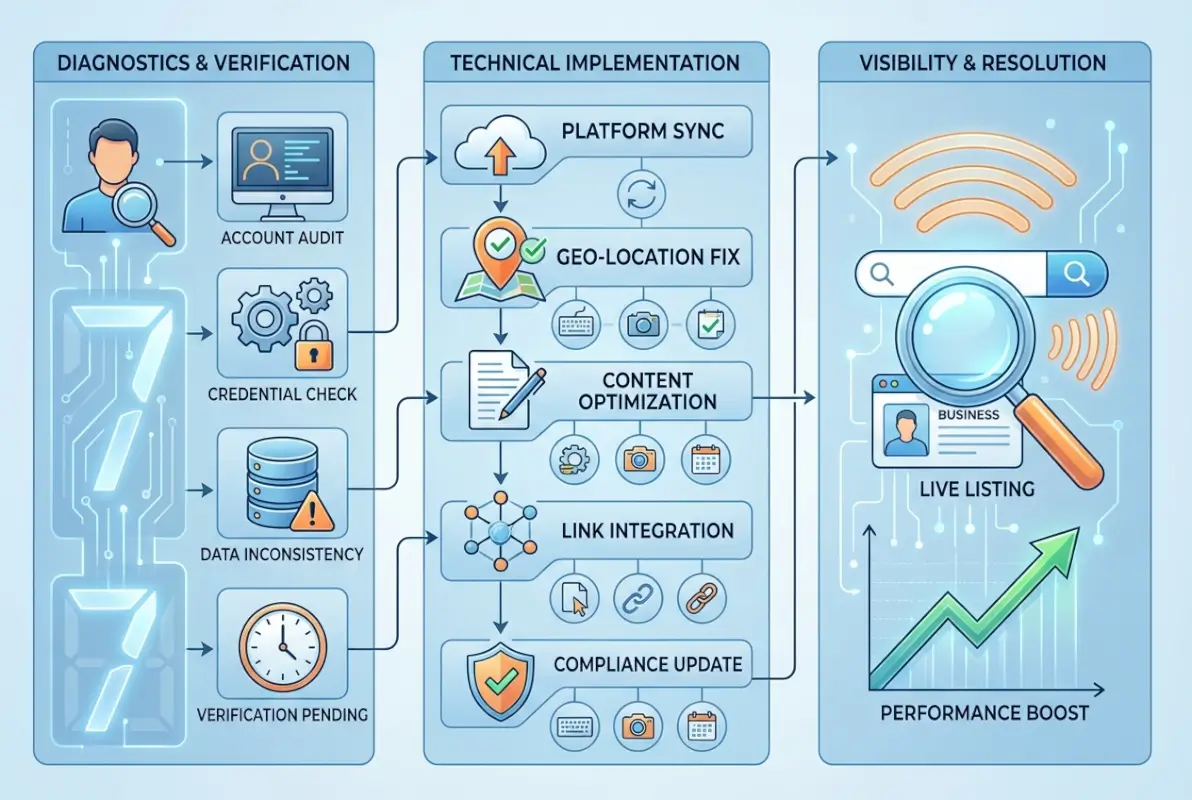
| Element | Correct Format | Common Mistake | Impact |
|---|---|---|---|
| Business Name | Exact legal name | Adding keywords or city names | High |
| Address | 123 Main Street, Suite 5 | 123 Main St., 123 Main St #5 | High |
| Phone | (555) 123-4567 | Different numbers per platform | Critical |
| Website URL | https://www.example.com | HTTP vs HTTPS variations | Medium |
I worked with a dental practice that had been struggling with local visibility for eight months. During our audit, we discovered their phone number appeared in 14 different formats across various platforms—some with parentheses, some with dashes, some with dots, and two completely different numbers from a previous location they’d closed three years earlier. Within six weeks of standardizing everything, they jumped from position 12 to position 2 in local pack results.
The fix requires systematic work. Create a master NAP document with your exact, canonical business information. Then audit every platform where your business appears—use tools or manual searches for your business name plus variations. Update each listing to match your master document precisely, paying attention to seemingly minor details like “Street” versus “St.” or whether you include a suite number.
3. Insufficient Review Quantity and Quality
Reviews function as social proof for potential customers and ranking signals for search engines. If your competitors average 47 reviews while you have 5, Google interprets this as evidence that their businesses are more established, trustworthy, and relevant to searchers. The algorithm doesn’t just count reviews—it evaluates recency, response rate, star rating distribution, and review content depth.
Research consistently shows a correlation between review count and local pack placement. Businesses in the top three local results typically have at least 40 reviews, with an average rating of 4.3 stars or higher. But here’s what catches most business owners off guard: a handful of recent reviews outperforms a larger number of old reviews. Google wants to see current customer validation, not just historical popularity.

The challenge is generating reviews systematically without violating platform policies (which prohibit incentivizing or gate-keeping reviews). The most successful approach I’ve seen involves building review requests into your customer journey at natural touchpoints. A plumbing company I advised sends a text message 24 hours after completing a job with a simple message: “Thanks for choosing us! If you were happy with our service, we’d appreciate if you’d share your experience” followed by a direct link to their Google review page.
Responding to reviews matters almost as much as getting them. Response rate signals to both Google and potential customers that you’re actively engaged with feedback. Respond to every review—positive and negative—within 48 hours. Keep responses professional, specific to the reviewer’s comments, and use them as an opportunity to naturally mention relevant keywords (though don’t force it).
4. Wrong or Too-Generic Category Selection
Your Google Business Profile category selection directly determines which search queries trigger your listing. Choose “Food” as your primary category and you’re competing with every restaurant, grocery store, and food truck in your area. Choose “Bakery” and you’ve immediately narrowed your competition while dramatically increasing your relevance for bakery-specific searches.
Google allows one primary category and up to nine additional categories. The primary category carries the most weight in ranking algorithms, so this single choice can make or break your visibility. Yet I regularly encounter businesses that have selected categories that are either too broad (reducing relevance) or inaccurate (showing up for irrelevant searches that don’t convert).
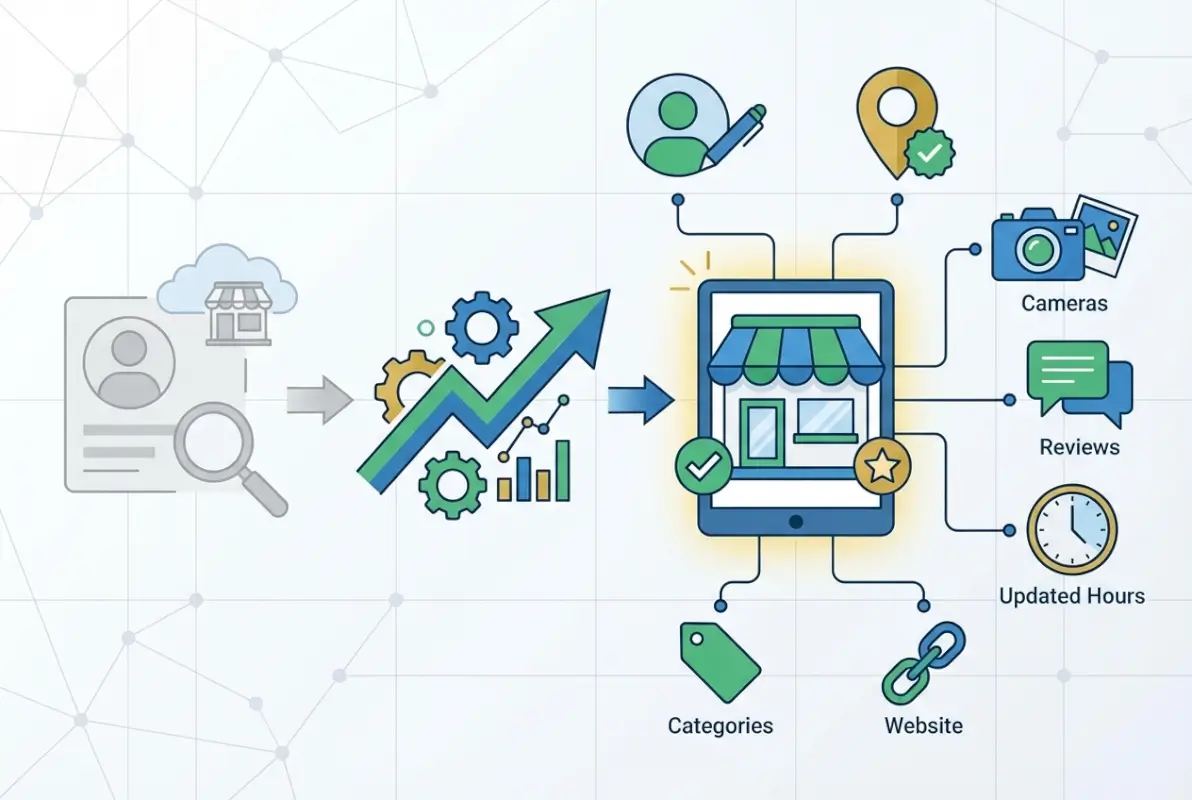
Categories have gotten more specific and nuanced over time. Where Google once offered just “Lawyer,” they now have “Criminal Defense Attorney,” “Family Law Attorney,” “Personal Injury Attorney,” and dozens more specializations. Using these specific categories signals exactly what you do, which helps Google match you to precise search intent.
| Business Type | Generic Category | Specific Category | Visibility Gain |
|---|---|---|---|
| Italian Restaurant | Restaurant | Italian Restaurant | 3.2x |
| Divorce Lawyer | Lawyer | Divorce Lawyer | 4.1x |
| Auto Body Shop | Auto Repair | Auto Body Shop | 2.8x |
Secondary categories should represent legitimate services you offer, not wishful thinking about ranking for additional terms. Google’s algorithm has gotten sophisticated at detecting category stuffing—when businesses select marginally related categories just to appear in more searches. This can actually harm your rankings by diluting your core relevance signals.
Audit your categories quarterly because Google regularly adds new, more specific options. What wasn’t available six months ago might now perfectly describe your specialty, offering a competitive advantage if you adopt it early while competitors still use older, broader categories.
5. Technical Website Issues Blocking Visibility
Your Google Business Profile doesn’t exist in isolation—it’s connected to your website, and technical problems on your site can undermine your entire local search presence. Google cross-references information between your profile and website to validate accuracy and gauge legitimacy. If your website is slow, not mobile-friendly, or has indexing issues, it drags down your business listing visibility.
Page speed has become increasingly critical, particularly on mobile devices where most local searches happen. According to Google’s PageSpeed research, sites loading in under 2 seconds see conversion rates 15% higher than those taking 5 seconds. But speed isn’t just about conversions—it’s a direct ranking factor. A slow website tells Google your business provides a poor user experience.

Schema markup—structured data that helps search engines understand your content—remains underutilized by local businesses. Implementing LocalBusiness schema on your website provides explicit signals about your business type, location, hours, contact information, and services. This structured data reinforces the information in your Google Business Profile and can enable rich results that make your listing more prominent.
SSL certificates (HTTPS) are no longer optional. Google has explicitly stated that HTTPS is a ranking signal, and browsers now display warnings for non-secure sites. Beyond rankings, many potential customers will abandon your site if they see security warnings, killing your conversion rate even if you do achieve visibility.
Mobile responsiveness deserves special attention since Google uses mobile-first indexing. Your desktop site might be beautiful, but if the mobile version is difficult to navigate or has broken elements, Google ranks you based on that inferior experience. Test your site on actual mobile devices—not just desktop browser simulators—to identify navigation issues, tiny text, or buttons too close together.
6. Missing or Low-Quality Citations
Citations—mentions of your business name, address, and phone number on other websites—function as digital references that validate your business exists where you claim. Think of them as the online equivalent of word-of-mouth recommendations. Each quality citation tells Google “yes, this business is real and operates at this location.”
The relationship between citations and rankings isn’t as simple as “more is better.” Quality matters significantly more than quantity. A citation from the Better Business Bureau or your local chamber of commerce carries far more weight than listings on dozens of obscure directories nobody uses. Google evaluates the authority and relevance of the source when determining how much trust to assign each citation.
Strategic citation building starts with the major platforms everyone uses: Yelp, Yellow Pages, Facebook, Apple Maps, and Bing Places. These high-authority citations provide the foundation of your citation profile. Then move to industry-specific directories relevant to your business—Healthgrades for doctors, Avvo for lawyers, OpenTable for restaurants. These niche citations demonstrate category relevance alongside geographic relevance.
Don’t neglect data aggregators—these are companies like Neustar, Factual, Foursquare, and Localeze that supply business information to hundreds of downstream platforms. Getting your information correct at the aggregator level can automatically populate dozens of citations across the web, though you still need to verify accuracy as data flows through these systems.
Understanding businesses sign up directory processes helps you build citations more efficiently. Many directory sites have specific submission requirements or verification steps. Following their guidelines precisely increases approval rates and speeds up the process.
7. Competitive Markets Without Differentiation
In saturated local markets—think dentists in major cities, personal injury lawyers in metropolitan areas, or restaurants in tourist districts—simply having a complete, accurate listing isn’t enough. You’re competing against dozens or hundreds of businesses that have also optimized their profiles. Without clear differentiation, you’ll struggle to break into the top results regardless of your technical optimization.
Differentiation in local search means identifying and emphasizing what makes your business uniquely valuable for specific searcher intents. A general contractor competing against 200 others faces impossible odds. But a contractor specializing in “historic home restoration” or “eco-friendly remodeling” suddenly competes in a much smaller, more targeted market where their specialized expertise becomes the deciding factor.
Your business description on Google Business Profile offers 750 characters to communicate your unique value proposition. Most businesses waste this space with generic statements like “we provide quality service” that could apply to anyone. Instead, highlight specific specializations, unique methodologies, certifications, awards, or the particular customer problems you solve better than competitors.
Google Posts provide another differentiation opportunity that most businesses ignore. These are short updates that appear in your business profile, similar to social media posts. Businesses that publish weekly Google Posts signal active operation and current relevance to Google’s algorithm. Use Posts to highlight special offers, recent projects, community involvement, or seasonal services—anything that shows you’re actively engaged with your market.
For businesses in business park directory locations, emphasizing your specific location within the park can help you capture searches from other businesses or clients visiting the area. This hyper-local targeting reduces competition while increasing relevance for nearby searchers.
Content marketing amplifies differentiation. A law firm that publishes weekly blog posts about recent changes in their practice area builds authority signals that generic competitors lack. This content doesn’t just help your website rank—it provides signals to Google that you’re an active, engaged expert in your field, which reinforces your business listing credibility.
Creating a Systematic Visibility Improvement Plan
Fixing business listing visibility isn’t about randomly trying tactics—it requires a systematic approach that addresses issues in priority order. Start with verification and NAP consistency since these are prerequisite for everything else. Without verification, nothing else matters. With inconsistent NAP data, you’re actively undermining your own efforts.
Next, optimize your Google Business Profile completion percentage and category selection. These foundational elements directly influence which searches trigger your listing. Then move to building your review profile and citation foundation—these signal trust and authority that take time to accumulate, so starting early matters.
Technical website optimization and content creation work in parallel with your listing optimization. Fix critical issues like page speed, mobile responsiveness, and HTTPS immediately. Then develop a content calendar that demonstrates ongoing expertise and activity in your market.
Implementing directory software solutions can help manage multiple listings efficiently if your business operates in multiple locations or you’re managing listings for multiple businesses. These tools help maintain consistency and alert you to changes or issues across platforms.
Track your progress using Google Business Profile Insights to monitor how your visibility metrics change: search impressions, map views, website clicks, and direction requests. These metrics provide concrete evidence of improvement and help identify which optimizations delivered the biggest impact for your specific situation.
For guidance on building comprehensive directory presence, explore tips for businesses in fslocal directory tips which provide practical strategies for maximizing visibility across multiple platforms simultaneously.
Frequently Asked Questions
How long does it take for a business listing to show up after verification?
Most verified Google Business Profiles appear in search results within 3-7 days after verification completes. However, achieving competitive visibility in local pack results typically takes 8-12 weeks of consistent optimization including reviews, citations, and engagement signals. Highly competitive markets may require 4-6 months of systematic effort.
Can I rank in local search without a physical address?
Service-area businesses without storefronts can absolutely rank for local searches. You’ll hide your address in your Google Business Profile and instead define service areas. Focus on city-specific landing pages on your website, reviews mentioning served locations, and citations in regional directories to build geographic relevance.
Why did my business listing suddenly disappear from results?
Sudden disappearances typically indicate suspension (guideline violations), verification expiration, or major algorithm updates. Check your Google Business Profile dashboard for suspension notices. Verify your listing status hasn’t changed. Review recent edits that might have triggered automated flags. Suspensions can often be appealed if resolved quickly.
Should I create separate listings for multiple services I offer?
No—creating multiple listings for the same physical location violates Google’s guidelines and risks getting all listings removed. Instead, use your primary and secondary categories strategically, create service-specific pages on your website, and use your business description to highlight multiple specializations while maintaining one verified profile per location.
How many reviews do I need to compete in local search?
Review count requirements vary by market competitiveness. Research your top 3 local competitors and aim to match their review count as a baseline. Most competitive markets require 40+ reviews, but quality and recency matter as much as quantity. Focus on generating 2-4 new reviews monthly rather than bulk acquisition.
Do social media profiles count as citations for local SEO?
Yes, social profiles with complete NAP information function as citations. Facebook, LinkedIn, Instagram, Twitter, and YouTube all contribute to your citation profile when business information is consistent and complete. Ensure your NAP data matches exactly across all social platforms and your primary business listings.
What should I do if competitors have fake reviews?
Report suspicious reviews through Google’s flagging system, but focus primarily on building authentic reviews from real customers. Google’s algorithms detect review patterns and regularly removes violating content. Building a strong genuine review foundation provides more sustainable results than trying to police competitors.
How important is my website for business listing visibility?
Your website significantly impacts local listing rankings. Google cross-references listing data with website information to validate accuracy. Sites with proper schema markup, fast loading speeds, mobile optimization, and location-specific content reinforce business profile signals and improve overall local search visibility.
Can I improve visibility by frequently updating my listing?
Regular updates signal active business operation to Google’s algorithm. Adding photos weekly, publishing Google Posts, responding to reviews promptly, and keeping hours current all contribute to engagement signals that influence rankings. Businesses with regularly updated profiles typically outrank competitors with stagnant listings.
Why does my competitor rank higher despite having fewer reviews?
Local rankings consider 200+ factors beyond review count. Your competitor likely excels in other areas: NAP consistency, citation quality, website authority, category relevance, proximity to searcher, or engagement metrics like click-through rate. Conduct a comprehensive competitive analysis to identify their specific advantages.
Take Control of Your Local Visibility Today
Business listing visibility isn’t mysterious—it’s systematic. Each factor we’ve covered builds on the others to create compound effects. Verification enables optimization, optimization attracts reviews, reviews build authority, authority drives rankings, and rankings generate customers who leave more reviews, continuing the cycle.
Start with the quick wins: verify your profile, fix NAP inconsistencies, and optimize your category selection this week. Then build momentum with systematic review requests, citation building, and regular content updates. The businesses dominating local search aren’t necessarily better at what they do—they’re just more intentional about managing their digital presence. You can join them with consistent, strategic effort applied to the right factors in the right order.
Moving Forward With Confidence
Understanding why your business listing isn’t showing up removes the mystery and frustration from local search visibility. These seven factors—verification status, NAP consistency, review profile, category selection, technical website health, citation quality, and competitive differentiation—account for the vast majority of ranking variations between businesses.
None of these factors requires expensive tools or expert-level technical knowledge. What they require is systematic attention and consistent effort over time. Local search visibility accumulates through dozens of small signals that compound into significant competitive advantages.
The businesses that struggle with visibility are usually those that treat their online presence as a one-time setup task rather than an ongoing operational responsibility. Those that succeed treat listing optimization the same way they treat customer service or quality control—as a continuous process that requires regular attention and adaptation to changing conditions.
For businesses looking to establish comprehensive visibility, learning key steps run successful directory website business strategies provides broader context for how directory ecosystems work and how to leverage them effectively.
Which of these seven factors will you address first? Start with verification and NAP consistency—they’re prerequisites for everything else. Then systematically work through the remaining factors, tracking your progress through Google Business Profile Insights. You’ll likely see meaningful improvement within the first 30 days, with compounding benefits emerging over the following months as your signals strengthen and your authority builds.
Was this article helpful?