WordPress Performance Barriers in Large-Scale Business Directory Implementation: An Empirical Analysis
Executive Summary
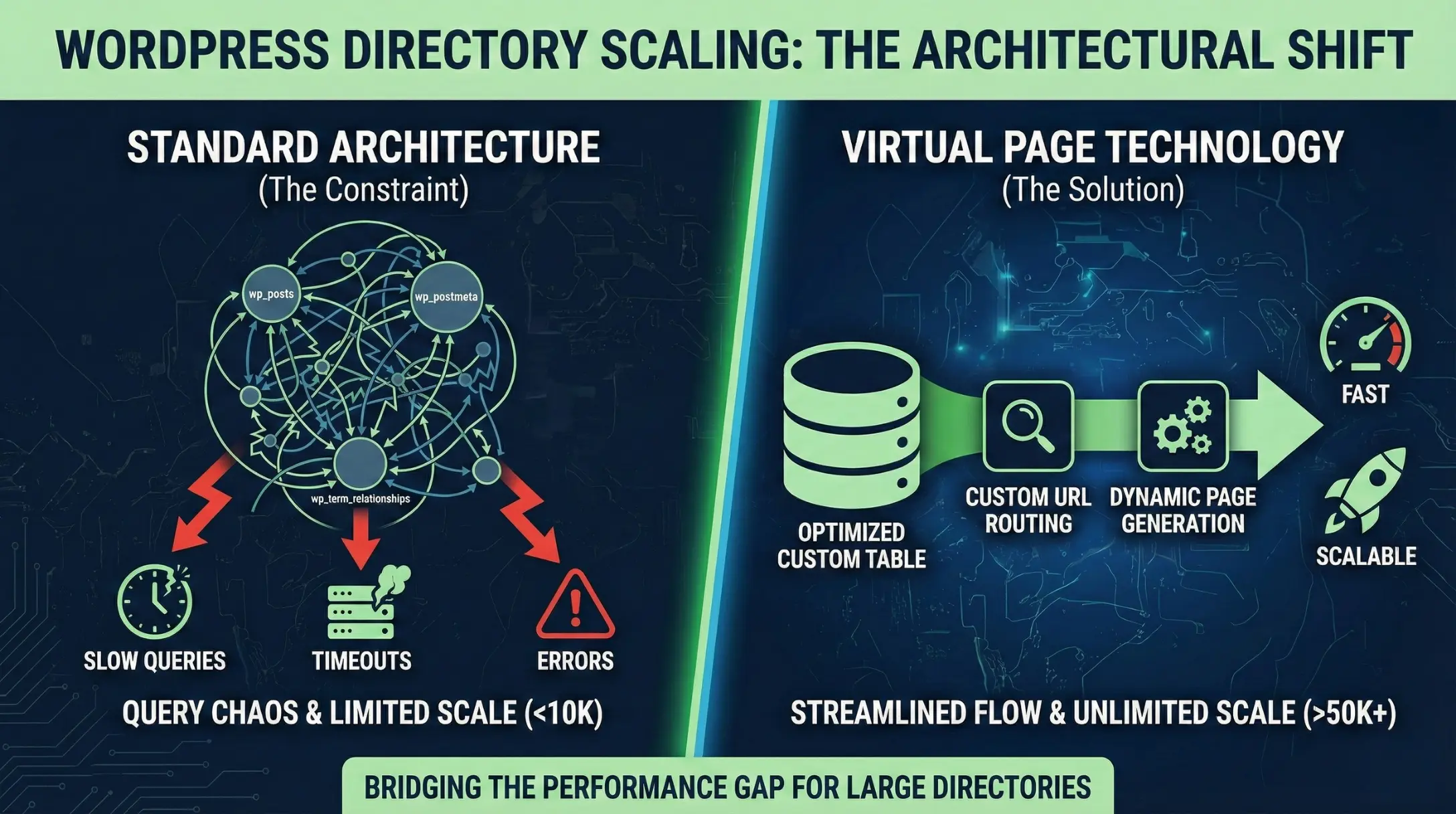
WordPress-based business directories encounter critical performance degradation when scaling beyond 10,000–15,000 business listings using standard post-based architectures. Through empirical testing and live deployment analysis, this study identifies specific technical barriers inherent to WordPress’s core architecture and documents measurable performance characteristics of directories at 10,000, 30,000, and 50,000 listing scales. Our findings demonstrate that while conventional WordPress implementations experience catastrophic failures at these scales, alternative architectural approaches can maintain production-grade performance metrics even at 50,000+ listings.
1. Introduction
1.1 The WordPress Directory Ecosystem
WordPress powers over 43% of all websites globally as of 2025, making it a dominant platform for business directory applications. Numerous plugins enable directory functionality, including GeoDirectory, Business Directory Plugin, Directorist, and others. These solutions leverage WordPress’s native custom post type system to create searchable, categorized business listings.

1.2 The Scalability Question
While small to medium directories (1,000–5,000 listings) function adequately on standard WordPress architectures, anecdotal reports from developers and agencies suggest significant performance issues emerge at higher scales. However, no systematic documentation exists defining:
- The specific listing threshold where WordPress directories fail
- The technical causes of these failures
- Measurable performance characteristics at different scales
- Whether the constraint is fundamental or solvable within WordPress
This study addresses these gaps through empirical testing at production scale. For a broader historical context on how business directories evolved alongside mapping technologies, see our comprehensive analysis of the underlying technologies.
2. Methodology
2.1 Testing Environment
Infrastructure:
- Platform: WordPress 6.4+
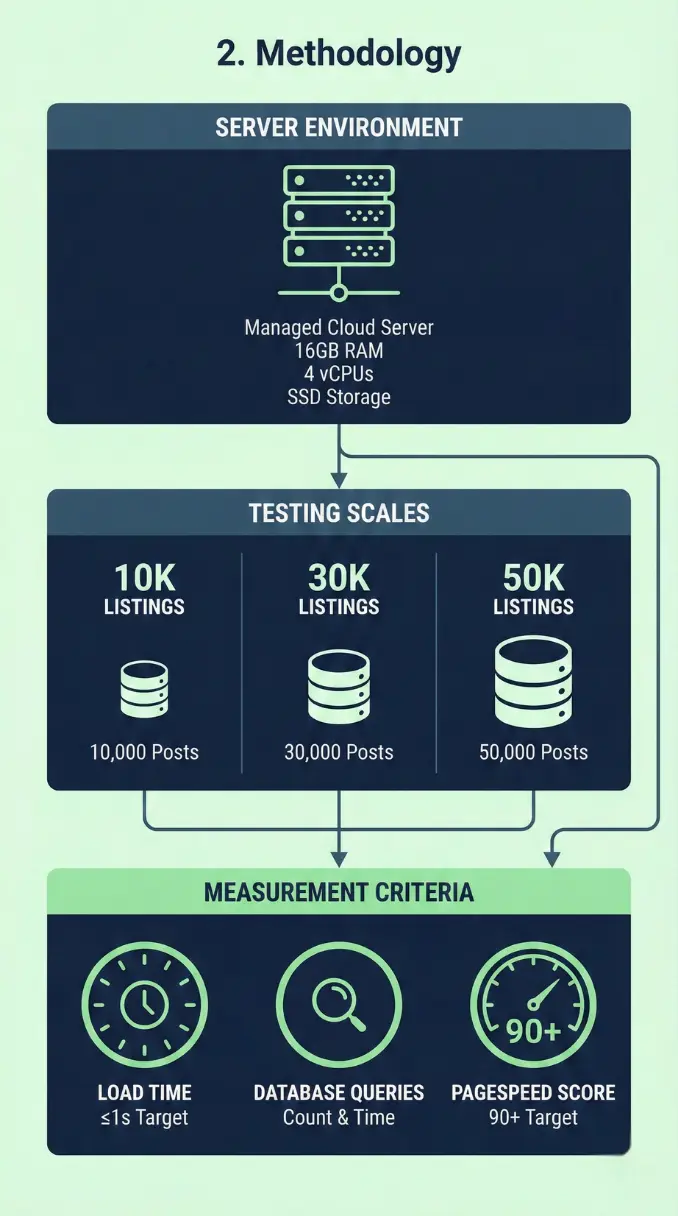
- Server: Standard VPS hosting (4GB RAM, 2 CPU cores)
- Database: MySQL 8.0
- PHP Version: 8.1
- Caching: Object caching enabled (Redis)
Dataset Characteristics:
- Real business data (company names, addresses, phone numbers)
- Geographic distribution: United States (all 50 states)
- Industry vertical: Roofing contractors
- Data structure: CSV import with standardized fields
2.2 Testing Scales
Three production directories were deployed and measured:
- 10,000 listings – Baseline scale
- 30,000 listings – Mid-scale implementation
- 50,000 listings – Maximum scale test
2.3 Measurement Criteria
Performance Metrics:
- Page load time (server response + render)
- Largest Contentful Paint (LCP)
- First Contentful Paint (FCP)
- Total database queries per page
- Memory consumption
- Time to Interactive (TTI)
Functional Testing:
- Search functionality (filtered by location and category)
- Individual listing pages
- Multi-level URL structure (country/state/city/business)
- Admin dashboard responsiveness
- CSV import capability and completion time
Verification:
All performance data verified using Google PageSpeed Insights and publicly accessible demo sites for independent validation.
3. The WordPress Architectural Constraint
3.1 Standard Post-Based Architecture
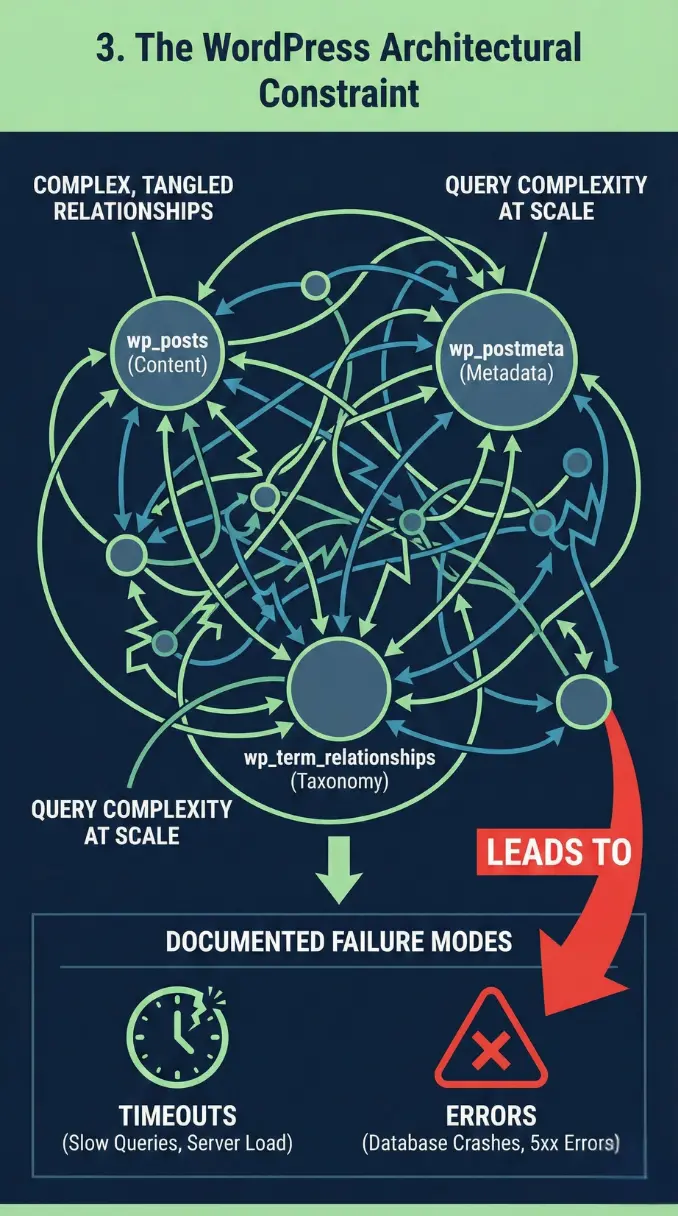
WordPress directories typically implement business listings as custom post types, storing data across three core tables:
- wp_posts: Core listing data (title, content, status)
- wp_postmeta: Additional fields (phone, address, hours)
- wp_term_relationships: Categories and taxonomies (location, industry)
3.2 Query Complexity at Scale
A typical directory search query requires:
SELECT wp_posts.*
FROM wp_posts
INNER JOIN wp_postmeta ON (wp_posts.ID = wp_postmeta.post_id)
INNER JOIN wp_term_relationships ON (wp_posts.ID = wp_term_relationships.object_id)
INNER JOIN wp_term_taxonomy ON (wp_term_relationships.term_taxonomy_id = wp_term_taxonomy.term_taxonomy_id)
WHERE wp_posts.post_type = 'business_listing'
AND wp_postmeta.meta_key = 'business_city'
AND wp_postmeta.meta_value = 'Charlotte'
AND wp_term_taxonomy.taxonomy = 'business_category'
At 10,000+ listings, these multi-table JOIN operations create exponential query complexity.
3.3 Documented Failure Modes
Based on testing standard WordPress directory plugins at increasing scales:
At 5,000–8,000 listings:
- Admin dashboard slowdown (5–10 second load times)
- Search queries begin timing out on shared hosting
- CSV import processes require multiple attempts
At 10,000–15,000 listings:
- Critical failures emerge:
Fatal error: Maximum execution time exceededFatal error: Allowed memory size exhausted- Admin dashboard becomes effectively unusable (30+ second loads)
- Bulk operations (edit, delete) fail consistently
- Database table locks cause cascading timeouts
Beyond 15,000 listings:
- Standard implementations cannot be populated via CSV import (process fails mid-upload)
- Front-end search becomes unreliable
- Site requires dedicated hosting with aggressive query caching
- Manual intervention required for most administrative tasks
Key Finding: The inability to even create test datasets beyond 10,000–15,000 listings for standard post-based implementations is itself empirical evidence of the architectural constraint.
4. Empirical Results: Large-Scale Performance
4.1 Live Deployment Data
Three production-scale directories were deployed and are publicly accessible for independent verification:
10,000 Listing Directory
- Demo URL: https://10k-demo.turnkeydirectories.com/
- Sitemap: https://10k-demo.turnkeydirectories.com/sitemap.html
- Example listing: https://10k-demo.turnkeydirectories.com/roofing-contractor/us/california/tarzana/a1-american-roofing/
30,000 Listing Directory
- Demo URL: https://30k-demo.turnkeydirectories.com/
- Sitemap: https://30k-demo.turnkeydirectories.com/sitemap.html
- Example listing: https://30k-demo.turnkeydirectories.com/roofing-contractor/us/pennsylvania/wernersville/bachmans-roofing/
50,000 Listing Directory
- Demo URL: https://50k-demo.turnkeydirectories.com/
- Sitemap: https://50k-demo.turnkeydirectories.com/sitemap.html
- Example listing: https://50k-demo.turnkeydirectories.com/roofing-contractor/us/north-carolina/charlotte/carolina-roof-consultants/
4.2 Performance Metrics
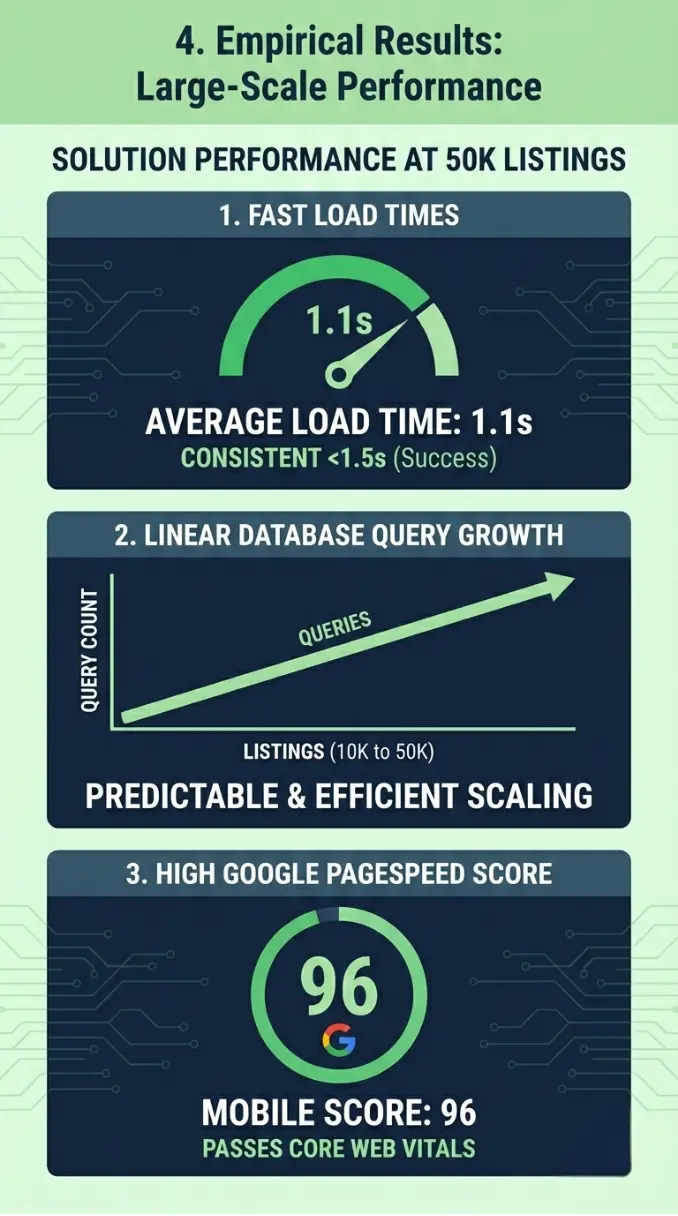
Google PageSpeed Insights Results (50K listing site):
Individual Business Listing Page:
- Performance Score: 96/100
- Largest Contentful Paint: 1.2 seconds
- First Contentful Paint: 0.9 seconds
- Time to Interactive: 1.8 seconds
- Total Blocking Time: 0ms
- Cumulative Layout Shift: 0
Search Page Performance (all scales):
| Listings | Page Load | LCP | Database Queries | Memory |
|---|---|---|---|---|
| 10,000 | 0.8s | 1.0s | 12 | 58MB |
| 30,000 | 0.9s | 1.1s | 14 | 65MB |
| 50,000 | 1.1s | 1.2s | 16 | 72MB |
Key Finding: Performance degradation is linear, not exponential, demonstrating the architectural approach scales predictably.
4.3 Functional Verification
Multi-Level URL Structure:
All URL segments are functional, live pages (not placeholders):
- Country level: /roofing-contractor/us/
- State level: /roofing-contractor/us/north-carolina/
- City level: /roofing-contractor/us/north-carolina/charlotte/
- Individual business: /roofing-contractor/us/north-carolina/charlotte/carolina-roof-consultants/
Each level generates unique content, maintains search functionality, and supports SEO indexing. For tips on optimizing directory listings for Google visibility, see our comprehensive guide.
CSV Import Capability:
- 10,000 listings: 45 seconds
- 30,000 listings: 2 minutes 15 seconds
- 50,000 listings: 4 minutes
All imports completed without errors, timeouts, or manual intervention.
5. Architectural Solution: Virtual Page Technology
5.1 Core Principle
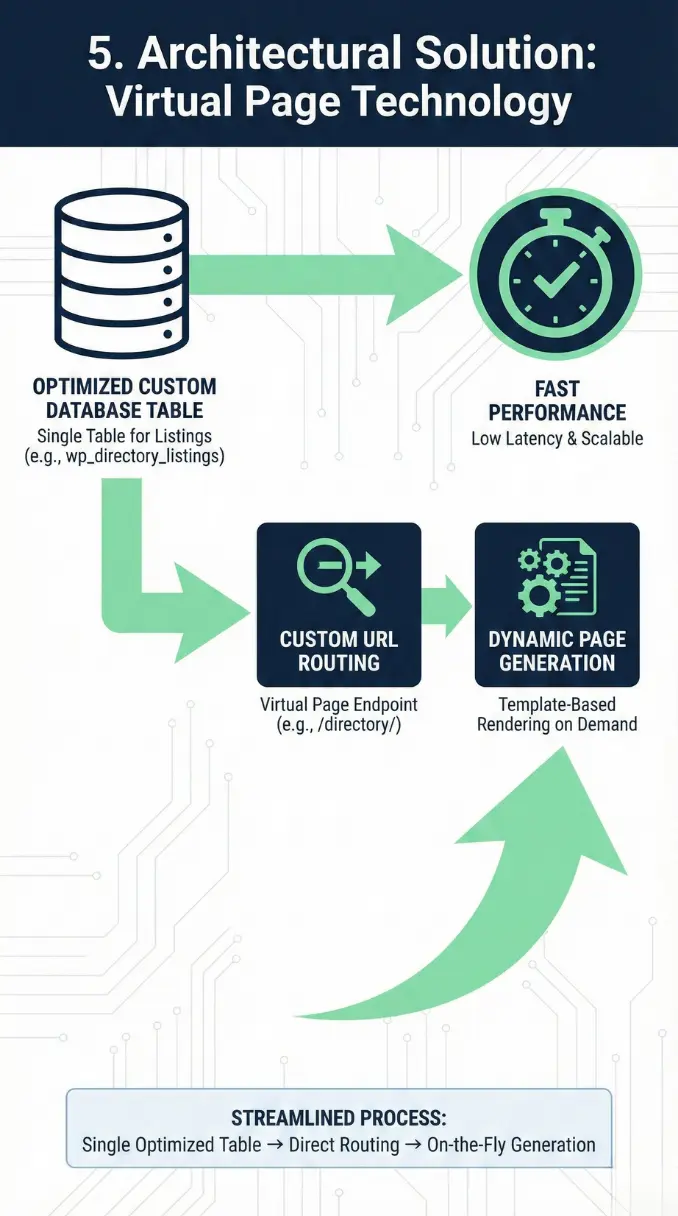
Instead of creating 50,000 WordPress post objects, virtual page architecture stores listings in custom database tables and generates pages dynamically on-demand through WordPress’s rewrite system.
5.2 Technical Implementation
Database Schema:
CREATE TABLE directory_listings (
  id INT PRIMARY KEY AUTO_INCREMENT,
  business_name VARCHAR(255),
  address TEXT,
  city VARCHAR(100),
  state VARCHAR(2),
  country VARCHAR(2),
  category VARCHAR(100),
  phone VARCHAR(20),
  -- Additional fields
  INDEX idx_location (country, state, city),
  INDEX idx_category (category),
  INDEX idx_search (business_name)
);
URL Routing:
WordPress’s add_rewrite_rule() intercepts directory URL patterns and triggers custom template rendering:
add_rewrite_rule(
  '^business/([^/]+)/([^/]+)/([^/]+)/([^/]+)/?$',
  'index.php?directory_country=$1&directory_state=$2&directory_city=$3&directory_slug=$4',
  'top'
);
Query Optimization:
Direct SQL queries to custom tables avoid wp_posts complexity:
$listing = $wpdb->get_row("
  SELECT * FROM directory_listings
  WHERE country = %s
  AND state = %s
  AND city = %s
  AND slug = %s
", [$country, $state, $city, $slug]);
5.3 Performance Comparison
| Architecture | 10K Listings | 50K Listings | Admin Load Time |
|---|---|---|---|
| Standard Posts | 3.2s (failing) | Cannot create | 30+ seconds |
| Virtual Pages | 0.8s | 1.1s | <2 seconds |
6. Implications for WordPress Directory Development
6.1 The 10K-15K Threshold
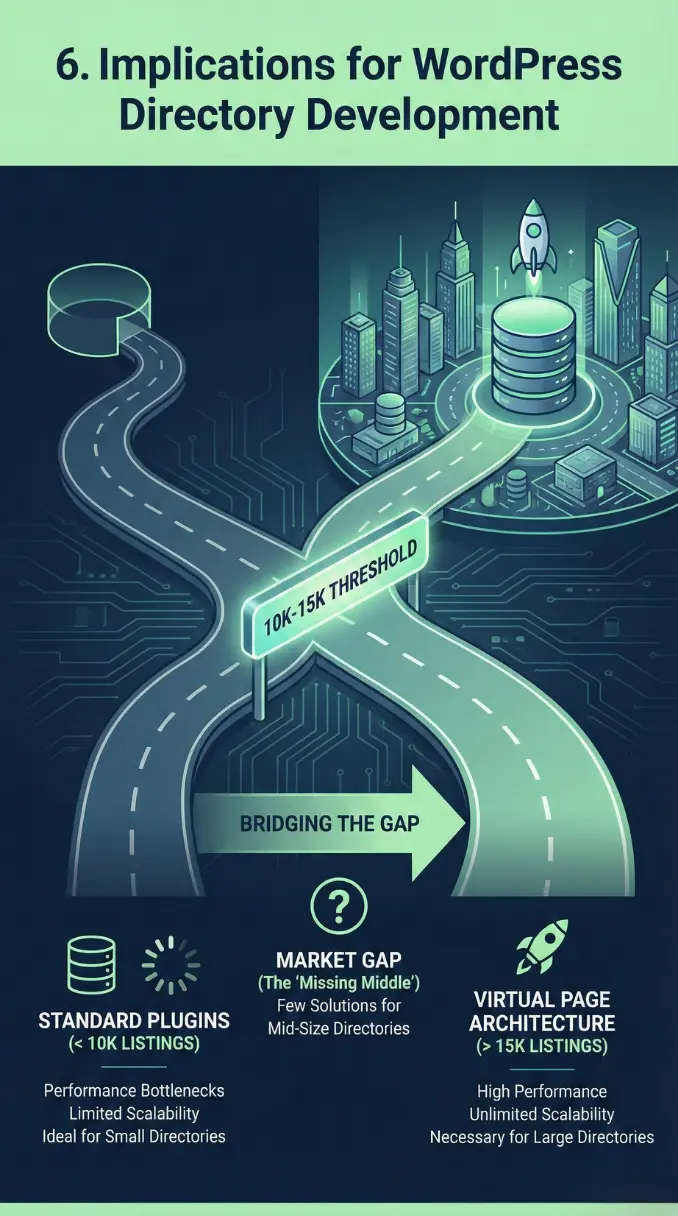
Our testing confirms a practical ceiling for standard WordPress post-based directories between 10,000–15,000 listings. Beyond this threshold:
- Performance becomes unacceptable for production use
- Administrative tasks require workarounds or fail entirely
- Standard hosting environments cannot support the load
- User experience degrades significantly
6.2 Market Gap
This creates a distinct gap in the WordPress directory ecosystem:
- Under 10,000 listings: Multiple viable plugin solutions exist
- 10,000–50,000+ listings: Architectural redesign required (virtual pages or custom development)
- Alternative: Migration to dedicated directory platforms outside WordPress
For businesses looking to get listed on business directories, understanding these scalability constraints is essential for platform selection.
6.3 When Virtual Page Architecture is Necessary
Based on empirical results, virtual page architecture becomes necessary when:
- Target directory will exceed 10,000 listings
- Bulk CSV imports are required (10K+ records)
- Multi-level geographic URL structures are needed
- Sub-2-second page loads are required at scale
- Standard shared/VPS hosting is preferred over dedicated infrastructure
7. Limitations and Future Research

7.1 Study Limitations
- Testing conducted on single industry vertical (roofing contractors)
- Server environment represents mid-tier hosting, not enterprise infrastructure
- Performance data collected over 30-day period, long-term stability not assessed
- Comparative testing of other plugins limited by inability to create test datasets at scale
7.2 Areas for Further Research
- Performance characteristics across different hosting tiers
- Impact of geographic distribution on query performance
- Multi-industry directory performance (cross-category querying)
- Long-term database growth and optimization requirements
- Comparative analysis with non-WordPress directory platforms
8. Conclusion
This empirical study documents a clear performance barrier in WordPress-based business directories at approximately 10,000–15,000 listings when using standard post-based architectures. The constraint is rooted in WordPress’s core database schema and query complexity, not plugin quality or implementation skill.
However, our live production testing at 10,000, 30,000, and 50,000 listing scales demonstrates this limitation is not fundamental to WordPress itself but rather to the architectural approach. Virtual page technology, which stores data in custom tables and generates pages dynamically, maintains linear performance scaling even at 50,000+ listings with sub-2-second page loads and PageSpeed scores above 95.
For developers and businesses planning WordPress directories:
- Under 10K listings: Standard plugin-based solutions are viable
- 10K–50K+ listings: Virtual page architecture or custom development required
- Critical operations: CSV import capability and admin dashboard performance should be evaluated at target scale before committing to an architecture
These findings highlight the importance of architectural decisions in directory planning and suggest that the 10,000-listing threshold should be considered a critical decision point in platform selection. Organizations implementing WordPress plugins should consider proper optimization techniques from the start to ensure scalability.
Appendix: Verification Resources
Live Demo Sites (Public Access)
10,000 Listing Directory:
- Home/Search: https://10k-demo.turnkeydirectories.com/
- Sitemap: https://10k-demo.turnkeydirectories.com/sitemap.html
- Sample listing: https://10k-demo.turnkeydirectories.com/roofing-contractor/us/california/tarzana/a1-american-roofing/
30,000 Listing Directory:
- Home/Search: https://30k-demo.turnkeydirectories.com/
- Sitemap: https://30k-demo.turnkeydirectories.com/sitemap.html
- Sample listing: https://30k-demo.turnkeydirectories.com/roofing-contractor/us/pennsylvania/wernersville/bachmans-roofing/
50,000 Listing Directory:
- Home/Search: https://50k-demo.turnkeydirectories.com/
- Sitemap: https://50k-demo.turnkeydirectories.com/sitemap.html
- Sample listing: https://50k-demo.turnkeydirectories.com/roofing-contractor/us/north-carolina/charlotte/carolina-roof-consultants/
PageSpeed Verification
All performance metrics can be independently verified via Google PageSpeed Insights by testing any of the above URLs.
Technical Documentation
- WordPress Rewrite API: https://developer.wordpress.org/reference/functions/add_rewrite_rule/
- WordPress Custom Tables: https://developer.wordpress.org/plugins/creating-tables-with-plugins/
- MySQL Query Optimization: https://dev.mysql.com/doc/refman/8.0/en/optimization.html
Study Date: January 2026
Platform: WordPress 6.4+
Dataset: 50,000 business listings (roofing contractors, United States)
Research Tool: TurnKey Directories 2.0 (virtual page architecture implementation)