Do Online Directory Services Pay Taxes on Membership Fees?

Generating summary...
TL;DR – Quick Takeaways
- Tax on membership fees depends on what you’re selling – If your online directory provides pure access to information, different tax rules apply than if you’re transferring goods or bundled services
- Jurisdiction is everything – California treats memberships differently than New York, and VAT countries have entirely separate frameworks from US states
- Component-based analysis is critical – Break down exactly what members receive (data access, discounts, physical items) and tax each piece appropriately
- Documentation protects you – Clear invoicing and itemization aren’t just best practices—they’re your defense during tax audits
- No universal answer exists – What works for one directory in one location may create tax liability in another
Running an online directory service can feel straightforward until you hit the tax question. Are membership fees taxable? The answer isn’t as clean as anyone would like it to be, and that’s precisely why so many directory operators find themselves scrambling when tax season arrives or when they expand into new markets. The complexity isn’t just academic—it impacts your pricing, your compliance costs, and ultimately your bottom line.
Here’s something most articles won’t tell you upfront: the traditional framework for sales tax was built around physical goods changing hands at a cash register. Online directories exist in a gray zone that tax authorities are still figuring out, which means you need to understand the underlying principles rather than just following a checklist. The question of whether online directory services pay taxes on membership fees depends on three core variables: what exactly the membership includes, where your business and your members are located, and how your local tax authority interprets the intersection of services and digital access.
What Counts as a Membership Fee in Online Directories?
Before we can discuss tax treatment, we need to establish what we’re actually talking about. Membership fees in online directories come in more flavors than most people realize, and the structure you choose has direct tax implications.

Definitions and Typical Structures
A membership fee is any recurring or one-time payment that grants access to your directory’s features or benefits. The most common models include flat annual fees (pay once, access everything for a year), tiered access structures (bronze/silver/gold levels with escalating benefits), and modular approaches where members pay for a base package plus optional add-ons.
What makes this complicated is that tax authorities don’t care about your marketing terminology. Whether you call it a “membership,” “subscription,” “listing fee,” or “access charge” matters less than what the member actually receives in exchange for payment. I’ve seen directory operators get tripped up because they marketed their offering as a “membership” when tax authorities viewed it as selling advertising space—two very different tax treatments in many jurisdictions.
Examples of What’s Included with Memberships
Typical membership benefits span a wide range: basic directory listings, enhanced profile visibility, access to member-only data feeds or APIs, networking event invitations, printed directories or materials, discounts on other products or services, and priority customer support. Each of these components can carry different tax implications.
Consider a professional association directory that charges $300 annually. That fee might include a searchable online listing, quarterly printed directory mailed to the member’s office, 20% discount on conference tickets, and access to a members-only job board. From a tax perspective, you potentially have: a service (online listing), tangible personal property (printed directory), a discount mechanism (conference tickets), and information access (job board). Depending on your jurisdiction, each piece might face different tax treatment.
Distinguishing Fees for Services vs. Fees for Access to Tangible Goods
This distinction matters more than almost anything else in determining taxability. Tax authorities across multiple jurisdictions emphasize whether you’re transferring tangible property (something physical) versus providing a service (something intangible) versus granting access to information (which may be treated as neither or both, depending on local rules).
Pure access to a searchable database typically falls into the service or information category. But the moment you add a printed directory, promotional materials, or physical membership cards, you’ve introduced tangible property that many jurisdictions will tax differently. The California Department of Tax and Fee Administration specifically notes that charges for services generally aren’t subject to sales tax unless they’re specifically enumerated as taxable—but charges for tangible personal property usually are.
Taxability by Jurisdiction: A Patchwork of Rules
If you’re hoping for a simple, universal answer, I have bad news. Tax treatment of membership fees varies dramatically based on where you operate and where your members are located. The regulatory landscape resembles a patchwork quilt more than a unified framework.
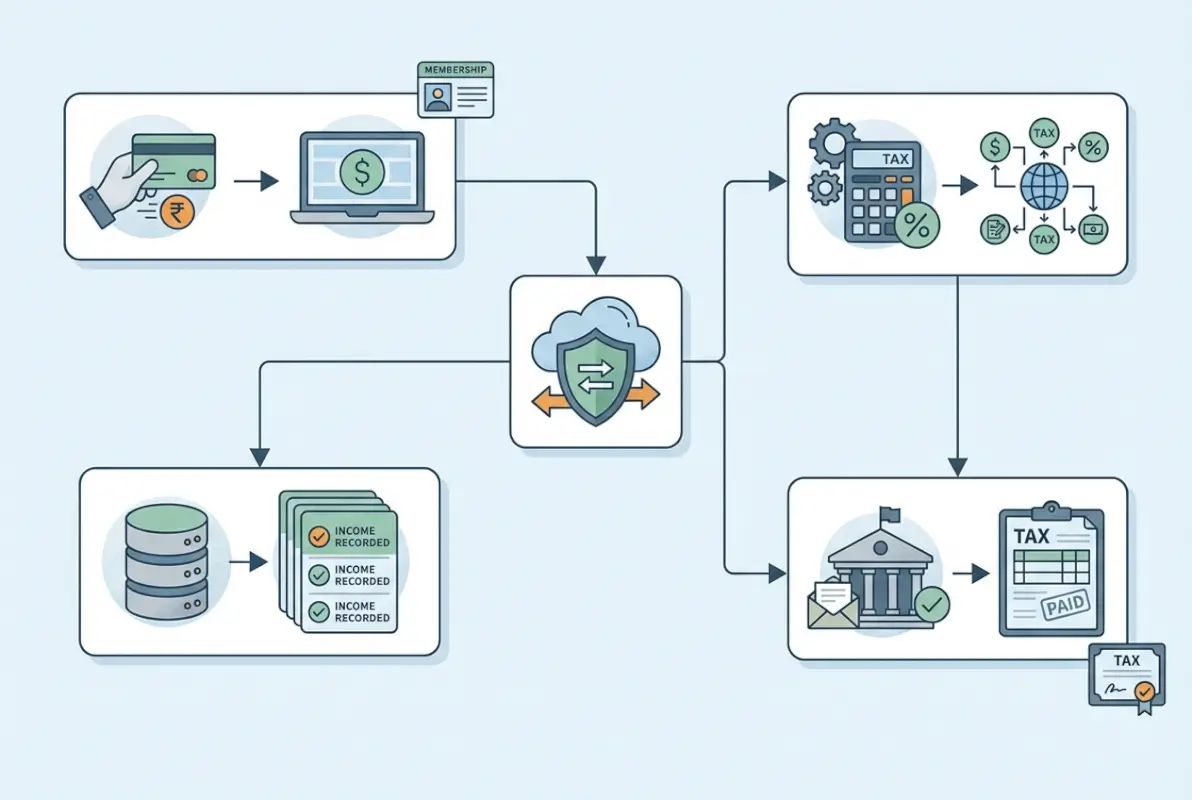
United States — State-Level Sales and Use Tax Considerations
In the US, sales tax operates at the state level (and sometimes county or city level), creating 50+ different sets of rules. There’s no federal sales tax, which means you can’t apply one standard approach across the country.
When Memberships Are Taxable as a Service vs. Non-Taxable
Most states distinguish between taxable services and non-taxable services, but they don’t all agree on which category memberships fall into. Some states tax very few services, treating membership fees as non-taxable unless they involve transfer of tangible goods. Others have expanded their tax base to include various digital services and information access.
The general pattern: if your membership fee is purely for access to online information or directory listings with no physical goods transferred, many states won’t impose sales tax. But if members receive anything tangible—printed materials, promotional items, physical badges—that portion becomes taxable in most jurisdictions.
Examples from California: Context-Specific Guidance
California provides some of the most detailed public guidance on these questions. According to the California Department of Tax and Fee Administration, charges for memberships that provide only the right to purchase other goods or services (like warehouse clubs) may not be taxable, while charges that include transfer of tangible personal property generally are taxable to the extent they cover that property.
Here’s where it gets nuanced: California emphasizes transaction context. If your online directory membership includes access to downloadable reports or data files, is that tangible personal property? California has historically said yes to certain digital products, though the rules continue to evolve. The key takeaway is that you can’t just assume “it’s all digital, so it’s all exempt.”
| State Approach | Pure Digital Access | Digital + Physical Goods | Service-Only Model |
|---|---|---|---|
| California | Generally not taxed | Physical portion taxed | Not taxed unless enumerated |
| Texas | May be taxable if “data processing” | Both portions potentially taxed | Information services often taxed |
| New York | Not taxed unless information service | Tangible portion taxed | Most services exempt |
| Washington | Generally taxable under B&O | Both portions taxed | Service/other activities tax applies |
International Guidance: VAT and GST Considerations
Outside the US, Value Added Tax (VAT) and Goods and Services Tax (GST) systems operate on fundamentally different principles than American sales tax. These consumption taxes apply at each stage of production and distribution, with businesses generally able to reclaim tax paid on inputs.
VAT/GST Treatment of Membership Fees
In VAT jurisdictions (EU, UK, and many other countries), the question centers on whether the membership constitutes a supply of services, goods, or is exempt. Most online directory memberships would be treated as supply of services, which are generally taxable at the standard VAT rate unless specifically exempted.
The South African Revenue Service guidance illustrates this approach. Entertainment, accommodation, and membership-related transactions face scrutiny about whether they constitute taxable supplies. The default position in most VAT systems is that if you’re supplying something for consideration (payment), it’s taxable unless it falls into a specific exemption category.
One critical difference from US sales tax: in VAT systems, the location of the customer (not just the supplier) determines tax obligations. If your online directory serves EU customers, you may need to charge VAT based on where each customer is located—a compliance nightmare that’s led to various simplified schemes for small suppliers.
Other Tax Perspectives and Industry Notes
Professional Associations and Membership Structures
Professional associations face unique considerations. In the UK, professional subscription fees that enable someone to practice their profession may qualify for tax relief on the employee’s personal income tax return. This doesn’t mean the association doesn’t charge VAT—it means the member might be able to deduct the cost.
The Association of Taxation Technicians notes that professional subscriptions can be claimed as tax relief if the membership is relevant to the employee’s job and is on HMRC’s approved list. This creates an interesting dynamic where the tax treatment on both ends matters—what the association charges and what the member can deduct.
Key Factors That Determine Taxability
Understanding the underlying factors that drive tax decisions helps you navigate situations where specific guidance doesn’t exist. Tax authorities apply consistent principles even when their conclusions differ.

Transfer of Tangible Property vs. Purely Digital or Informational Access
This factor appears repeatedly across jurisdictions because it reflects traditional tax concepts. Physical goods have always been easier to tax—you can see them, track them, and measure their value. Services and information access exist in a murkier zone.
When you’re creating an online directory on WordPress, the platform itself doesn’t determine tax treatment. What matters is whether members receive physical deliverables alongside their digital access. A membership that includes only searchable online listings faces different scrutiny than one that also ships printed directories quarterly.
Some states have expanded their definitions of “tangible personal property” to include certain digital goods, but this expansion isn’t uniform. Downloaded software might be taxable in one state but not in another. Access to a database that you never download might face yet different treatment.
Relationship Between the Membership Fee and Subsequent Purchases or Services
Warehouse clubs like Costco charge membership fees that only grant you the right to shop at their stores—you still pay separately for items. This fee structure often receives different tax treatment than memberships that bundle goods or services into the fee itself.
If your directory membership works like this—members pay for access but then purchase individual listings or features separately—you may have an easier argument for non-taxability of the membership fee itself. The subsequent purchases would then be evaluated on their own merits.
But if the membership fee is all-inclusive (members get everything for one price), tax authorities are more likely to scrutinize what “everything” includes and allocate the fee across taxable and non-taxable components.
Location of Seller vs. Location of Purchaser
Origin-based tax systems (less common) tax based on where the seller is located. Destination-based systems (more common, especially post-Wayfair in the US) tax based on where the buyer receives the benefit.
For online directories, this creates complexity because your service is delivered digitally—where does the buyer “receive” it? Their billing address? Their IP address? Where they access the directory most frequently? Different jurisdictions have different rules, and this ambiguity is one reason many directory operators consult tax professionals before expanding geographically.
Whether the Payer is an End Consumer vs. a Business
B2B (business-to-business) transactions often face different rules than B2C (business-to-consumer) transactions. In VAT systems, registered businesses can typically reclaim VAT paid, so the tax becomes less of a burden even though it’s charged. In sales tax jurisdictions, resale certificates can exempt certain business purchases.
If your directory primarily serves businesses getting listed (not consumers browsing listings), this distinction matters. Business members might provide exemption certificates or VAT registration numbers that change how you handle their payments.
Nonprofit and Association Considerations
Not all online directories are for-profit ventures. Professional associations, industry groups, and nonprofit organizations often operate directories as member benefits, and tax treatment in these contexts follows additional nuances.

Dues vs. Charges for Goods and Services Delivered
Membership dues paid to nonprofits are often not subject to sales tax when they’re considered true dues—payments that support the organization’s mission without a direct quid pro quo exchange of goods or services. But this exemption erodes quickly when members receive specific, tangible benefits.
If your nonprofit association directory provides members with online access plus monthly printed publications, event admission, and professional development resources, tax authorities may view portions of the “dues” as actually payment for taxable goods and services. The key question: is there a clear exchange of value, or is the payment primarily to support the organization’s mission?
I remember working with a professional association that was shocked to discover their “membership dues” were partially taxable because members received substantial tangible benefits including printed directories, promotional items, and event tickets. They had assumed nonprofit status shielded them completely, but that’s not how it works in most jurisdictions.
Membership Fees That Fund Programs but Also Deliver Goods/Services
Many associations use a hybrid model where membership dues fund general operations and programs, but members also receive specific deliverables. Tax treatment requires unbundling: what portion of the fee corresponds to actual goods/services versus general support?
Some jurisdictions require you to allocate the membership fee proportionally. If 30% of your costs go toward producing and shipping printed directories to members, then 30% of the membership fee might be treated as a taxable sale of tangible property. The remaining 70% supporting non-tangible programs might be exempt.
This allocation exercise isn’t arbitrary—you need supportable documentation showing how you calculated the split. Many associations establish separate fee categories to make this cleaner: a base membership fee for general support plus optional add-on fees for publications or events.
Reimbursements and Tax Relief for Employees/Members
In jurisdictions that allow professional subscription tax relief, the employer-employee dynamic creates another layer. An employer might pay for an employee’s professional association membership, or the employee might pay and claim reimbursement or tax relief.
The UK system illustrates this well. Employers can pay for professional subscriptions without creating a taxable benefit for the employee if the membership is relevant to the employee’s duties. Alternatively, employees can claim tax relief for subscriptions they pay personally. According to guidance from professional tax bodies, this relief reduces the employee’s tax burden even though the association charged VAT on the membership.
Practical Guidance for Online Directory Operators
Theory matters less than application, so let’s talk about concrete steps you can take to get tax treatment right (or at least defensible) for your online directory’s membership fees.

Catalog the Components of Your Membership
Start by creating a comprehensive list of everything members receive. Be granular: online profile listing, enhanced search visibility, monthly newsletter (digital), quarterly magazine (printed), member badge, directory API access, discount codes for partners, invitations to networking events, dedicated support line.
For each component, categorize it as tangible property (something physical), digital property (downloadable or streamable), service (something done for the member), or access/rights (permission to use or view something). This taxonomy isn’t just academic—it’s how tax authorities will analyze your offering.
When you’re figuring out how to get businesses listed in your city directory, you’ll naturally highlight these benefits. Use the same detailed breakdown for tax analysis.
Map Each Component to Tax Rules in Your Primary Selling Jurisdiction(s)
Once you’ve cataloged components, research how your jurisdiction treats each category. This is where jurisdiction-specific guidance becomes essential. California’s treatment of digital goods differs from Texas’s approach, and both differ dramatically from UK VAT rules.
For multi-state or international operations, prioritize jurisdictions that represent the largest revenue or the highest compliance risk. It’s impractical to research all 50 US states immediately if 80% of your members are in five states.
Maintain Documentation to Support Tax Treatment
Tax auditors love documentation. Maintain clear records showing: what each membership tier includes, how you calculated any allocation between taxable and non-taxable components, invoices that clearly itemize charges, and the reasoning behind your tax treatment decisions.
If you decide certain components are non-taxable, document why. Reference specific statutes, regulations, or published guidance. “We didn’t think we needed to charge tax” won’t fly in an audit. “We relied on California Regulation 1595 which addresses information services and determined our directory access fits the exemption criteria” stands a much better chance.
Consider Consulting a Tax Professional
I’ll be honest: this article gives you framework and questions to ask, but it’s not a substitute for jurisdiction-specific advice from someone who practices in your area. Tax professionals who specialize in sales tax or VAT stay current with regulatory changes, have relationships with tax authorities, and can often negotiate better outcomes if issues arise.
The cost of a tax consultation is usually far less than the penalties and interest from getting it wrong. If your directory generates significant revenue or operates across multiple jurisdictions, professional guidance should be in your budget alongside essential plugins for your WordPress directory.
Comparative Snapshots and Patterns Observed
Looking across multiple jurisdictions and types of analysis, certain patterns emerge that help predict how untested scenarios might be treated.
Common Themes Across Guidance and Top Coverage
Nearly every authoritative source emphasizes the tangible-vs-intangible distinction. Whether it’s California’s sales tax annotations, South African VAT guides, or UK membership tax relief discussions, the question “what are you actually transferring?” dominates the analysis.
Second, jurisdictional boundaries matter intensely. There’s no international standard, no universal framework. What works in one market creates compliance headaches in another, which is why many operators start locally and expand cautiously rather than launching globally from day one.
Third, bundling creates complications. Simple, single-component offerings are easier to evaluate than complex memberships that bundle multiple benefits. If you can separate components into distinct fee categories, you often get cleaner tax treatment (though this might complicate your pricing strategy).
Notable Gaps Often Observed
Most public guidance focuses on traditional scenarios—physical retail, straightforward services, conventional professional associations. Online directory memberships blend multiple elements in ways that don’t fit neatly into existing categories, and many tax authorities haven’t published specific guidance for this hybrid model.
Multi-jurisdiction guidance remains sparse. You’ll find detailed California guidance, detailed UK VAT guidance, but very little comparative analysis helping you understand how to comply simultaneously across markets. This gap forces operators to piece together compliance programs from multiple sources.
Practical checklists and decision trees are rare. Most guidance is narrative, requiring you to extract principles and apply them yourself. That’s part of why we’ve structured this article around actionable frameworks rather than just summarizing rules.
Data and Statistics: The Evolving Landscape
Tax policy around digital services and memberships continues to evolve rapidly, and understanding current trends helps you anticipate future changes.
Tax Collection Trends for Membership-Based Services
The expansion of sales tax to services and digital goods represents one of the biggest trends in state taxation. States facing budget pressures increasingly view untaxed services as revenue opportunities. Membership fees, subscription services, and digital access charges are all in the crosshairs.
Several states have expanded their tax base explicitly to include “digital products” or “information services,” categories that can encompass online directory memberships depending on how they’re structured. This trend shows no signs of reversing—if anything, it’s accelerating as states see successful implementations elsewhere.
State-Level Variances and Notable Changes
California continues to update its annotations and guidance on services and digital goods. Recent years have seen clarification (though not always simplification) of how various online services are treated. The CDTFA publishes regular updates to its guidance that directory operators should monitor.
Post-pandemic, many states reassessed their tax codes as remote work and digital services exploded. Some states that previously didn’t tax many services began expanding their tax base. Others clarified existing rules to address digital transactions more explicitly. Following state revenue department announcements helps you stay ahead of changes rather than discovering them during an audit.
Implications for Online Directory Operators
Increased enforcement is coming. States are investing in technology and personnel to identify remote sellers who should be collecting tax but aren’t. Marketplaces and platforms face increasing pressure to facilitate tax collection, and payment processors are being enlisted as compliance checkpoints.
For directory operators, this means compliance costs are rising. You may need sales tax automation software, multi-state tax registration, periodic audits of your tax treatment, and professional advice to navigate the complexity. These aren’t optional expenses if you’re operating at scale—they’re cost of doing business.
Best Practices for Compliance and Disclosures
Getting tax right isn’t just about calculation—it’s about transparency, documentation, and proactive management of your obligations.
Clear Invoicing and Itemization of Membership Components
Your invoices should clearly break down what members are paying for. “Annual Membership: $500” is opaque. “Annual Membership: $500 (Directory Listing: $200, Quarterly Magazine: $100, Event Access: $150, General Support: $50)” gives both you and the member clarity.
This itemization serves multiple purposes. It supports your tax allocation decisions, helps members understand what they’re getting (improving your tactics to get businesses to join your directory), and facilitates their own accounting and deduction claims.
If you charge tax on some components but not others, show this clearly: “Directory Listing: $200 (non-taxable); Quarterly Magazine: $100 + $8 sales tax; Event Access: $150 (non-taxable).” Transparency reduces confusion and disputes.
Transparent Terms of Service and Tax Statements on Checkout
Your checkout process should tell members whether tax will be added before they complete payment. “Total: $500” that becomes “$540 with tax” at the last step creates friction and abandoned carts.
Include a brief statement explaining why tax is or isn’t charged: “Sales tax is calculated based on your location and the taxable components of your membership” or “This membership fee is not subject to sales tax as it provides access to exempt information services.” You don’t need to write a treatise, but a sentence of explanation helps.
Your terms of service should address tax: “Prices shown do not include applicable taxes. Sales tax, VAT, or other transaction taxes will be added where required by law based on your location and the components of your membership.”
Proactive Monitoring of Jurisdictional Updates
Tax law changes constantly. Subscribe to updates from tax authorities in your key markets. The California CDTFA, for instance, publishes tax guides, annotations, and updates that affect online sellers. Most state revenue departments have similar resources.
Professional associations like the Sales Tax Institute provide updates and analysis on multi-state developments. Trade publications covering your industry often report on tax changes affecting your sector. Building time into your quarter for tax monitoring isn’t glamorous, but it prevents expensive surprises.
Frequently Asked Questions
Are membership fees for online directory services taxable?
It depends on your jurisdiction and what the membership includes. Pure information access fees are often not taxable, but memberships that include physical goods, certain digital products, or taxable services may trigger sales tax or VAT obligations. Always check your specific jurisdiction’s rules and consider the component breakdown of your offering.
What determines whether a membership fee is taxed as a service vs. a sale of goods?
Tax authorities examine what’s being transferred. If members receive tangible personal property (printed directories, physical items), that’s typically treated as a sale of goods. If they receive only access to online information or services with no physical transfer, it’s more likely treated as a service. The distinction matters because goods are almost always taxable while services often aren’t, depending on jurisdiction.
How should I price or invoice memberships to reflect tax treatment accurately?
Itemize the components of your membership fee on invoices, breaking down charges for different elements (online access, printed materials, event tickets, etc.). Apply appropriate tax rates to taxable components and clearly show the calculation. This transparency helps members understand charges, supports your tax treatment decisions, and provides documentation if audited.
Do nonprofit or professional associations face the same tax rules as for-profit online directories?
Not always. Nonprofit status can provide exemptions for certain dues or membership fees, but only when payments are truly dues supporting the mission rather than payment for specific goods or services. When nonprofits deliver tangible benefits to members, those portions may be taxable even if the organization has tax-exempt status. Rules vary significantly by jurisdiction.
Where can I find authoritative jurisdiction-specific guidance on membership taxes?
Start with your state or country’s revenue or tax authority website. In the US, each state’s department of revenue publishes sales tax guides and bulletins. For VAT questions, consult HMRC (UK), Revenue (Ireland), or the equivalent authority in your country. Professional tax organizations and practitioners can also interpret guidance for your specific situation.
Do all countries tax digital or online-only memberships the same way?
No. VAT/GST countries generally tax most supplies of services including digital access, while US states vary widely with some taxing digital services and others exempting them. Even within similar tax systems (like EU VAT), implementation details differ. Digital services face evolving rules in most jurisdictions, so current official guidance is essential.
Can I get in trouble for not charging tax on membership fees?
Yes, if your jurisdiction requires it. Tax authorities can assess back taxes, penalties, and interest if they determine you should have collected tax but didn’t. The good news is that many jurisdictions offer voluntary disclosure programs allowing you to come into compliance with reduced penalties if you self-report before being audited.
What’s the difference between origin-based and destination-based sales tax for memberships?
Origin-based tax means you collect based on where your business is located. Destination-based means you collect based on where the member is located. Most US states now use destination-based rules for remote sales after the Wayfair decision, meaning you potentially owe tax in every state where you have members above certain thresholds—not just your home state.
Should I charge different tax rates for different membership tiers?
Only if the tiers include different components with different tax treatment. If your basic tier is pure online access (non-taxable) but your premium tier includes printed magazines (taxable), then yes, different tiers might have different tax implications. The tax follows the substance of what’s delivered, not your pricing tiers.
How do I handle tax when members are located in multiple states or countries?
This is complex. You’ll need to register for tax collection in jurisdictions where you exceed economic nexus thresholds, collect appropriate tax based on each member’s location, and file returns in each jurisdiction. Many operators use sales tax automation software to manage this. For international operations, VAT rules on cross-border services add additional complexity requiring professional guidance.
Moving Forward with Confidence
Tax compliance for online directory membership fees won’t ever be simple, but it doesn’t have to be paralyzing either. The key insight is that taxability flows from what you’re actually providing to members—not from how you label it, not from your business structure, and not from what you’d prefer the answer to be.
Start by getting crystal clear on your offering. Break it into components, understand which pieces are tangible and which aren’t, and then methodically research how your primary jurisdictions treat each category. Document your reasoning, implement transparent invoicing, and build relationships with tax professionals who can guide you through ambiguous situations.
As your directory grows and you expand into new markets, revisit your tax treatment regularly. What worked when you had 100 members in one state may not suffice when you have 10,000 members across 30 states or multiple countries. Compliance scales with your business—plan for it rather than treating it as an afterthought.
Your Next Step: Catalog the components of your current membership offerings. For each component, note whether it’s tangible property, digital access, or a service. Then research how your primary selling jurisdiction treats each category. This exercise alone will clarify 80% of your tax questions and highlight the 20% where you need professional guidance.
The regulatory environment will continue evolving. States will expand their tax bases, international tax cooperation will increase, and enforcement will become more sophisticated. But operators who understand the underlying principles, maintain good documentation, and stay proactive about monitoring changes will navigate these shifts successfully. Your directory provides value to members—make sure your tax compliance supports that value rather than creating unnecessary risk or friction.
Was this article helpful?