Who Uses the Business Directory Plugin? 5 Types of Businesses It Benefits

Generating summary...
Most website owners launching a directory face the same existential question: who’s actually going to use this thing? Not in a “build it and they’ll come” fantasy way, but in a practical “which businesses will pay for listings, which ones will claim free profiles, and which ones will ignore us entirely” way. Here’s the uncomfortable truth most directory guides gloss over: business directory plugins don’t serve all business types equally. Some sectors—local service providers, professional associations, niche B2B aggregators—extract enormous SEO and lead-gen value from directory listings. Others might as well light their marketing budget on fire.
The difference isn’t random. It maps directly to how those businesses acquire customers, how they rank in local search, and whether their buyers even use directories to shop. A plumber in Cleveland and a SaaS company in San Francisco both technically qualify as “businesses,” but their relationship to directory visibility couldn’t be more different. One lives or dies by Google Business Profile signals and local citations; the other barely registers on local search algorithms. Understanding who benefits—and why—determines whether your directory becomes a revenue engine or a ghost town.
TL;DR – Quick Takeaways
- Local service businesses (trades, home services, healthcare) gain the most from directory listings because 87% of consumers use Google to evaluate local businesses before purchasing
- Professional associations and chambers deploy directory plugins to serve members while monetizing premium listings and sponsorships
- Multi-location and franchise operations use directories to consolidate local SEO signals across dozens or hundreds of locations without managing separate websites
- Schema markup and review signals embedded in quality directory listings directly influence local pack rankings and click-through rates
- Data governance and GDPR compliance aren’t optional—public directories handling business contact information face legal liability if consent and opt-out mechanisms fail
Who Uses a Business Directory Plugin
The typical directory user falls into two camps: businesses seeking visibility and organizations aggregating those businesses for their own audience. Neither group uses directories out of altruism—they’re chasing measurable outcomes like inbound calls, foot traffic, membership revenue, or backlinks. The benefits of free business listings for local SEO drive the first group; the monetization potential and member value drive the second.

What unites both camps is a reliance on structured data and searchability. A directory without robust filtering (by location, category, rating, hours) becomes a digital phone book—technically functional but useless for discovery. Modern directory plugins like TurnKey Directories embed schema markup automatically, which tells search engines “this is a LocalBusiness entity with these attributes.” Without that, even a beautifully designed directory remains invisible to Google’s local algorithm. According to BrightLocal’s SMB Marketing research, 92% of small businesses now maintain at least one online listing beyond their own website, and 68% report that directory profiles directly generate customer inquiries.
Local Businesses and Professionals
Local businesses—plumbers, electricians, dentists, lawyers, contractors—dominate directory usage because their customer acquisition hinges on proximity and reputation signals. A homeowner searching “emergency plumber near me” isn’t reading blog posts or comparing feature matrices; they’re scanning the local pack for ratings, hours, and phone numbers. Directory listings that syndicate data to Google Business Profile (via citation consistency) and display reviews prominently capture those high-intent searchers.
Professionals in regulated industries (real estate agents, financial advisors, therapists) use directories for credibility stacking. A listing on a niche directory—say, a state bar association’s lawyer finder—carries more trust than a standalone website claiming expertise. These directories often include verification badges, licensing numbers, and peer endorsements that self-published sites can’t replicate. The impact of online reviews on consumer behavior is well-documented: 89% of consumers read reviews before purchasing from a local business, and listings with 10+ reviews convert 31% better than those with fewer than five.
Organizations, Associations, and Chambers
Trade associations, chambers of commerce, and industry groups deploy directory plugins for dual purposes: member service and non-dues revenue. A chamber directory gives members visibility to the chamber’s web traffic (which often includes local government, media, and tourists), while the chamber monetizes premium placements, banner ads, and featured listings. The U.S. Census Bureau’s County Business Patterns data shows over 3,800 chambers of commerce in the U.S. alone, nearly all of which maintain some form of member directory.
These organizations care less about raw listing volume and more about member engagement and retention. A directory that tracks listing views, click-throughs to member websites, and lead inquiries becomes a tangible membership benefit—something to tout in renewal campaigns. When I worked with a regional manufacturing association, they discovered that members with claimed, complete directory profiles renewed at a 22% higher rate than those who ignored their listings, the perceived ROI mattered more than actual lead volume.
The monetization angle here is straightforward but often underutilized. Basic listings stay free (to maximize directory population and SEO juice), but premium tiers unlock featured placement, logo uploads, photo galleries, and social media integrations. A chamber with 300 members charging $200/year for premium listings generates $60,000 in non-dues revenue—enough to fund the directory platform and still show a profit. For guidance on uploading and configuring a WordPress directory plugin, most modern solutions walk you through pricing tiers during initial setup.
How It Benefits 5 Types of Businesses
Not all business models extract equal value from directory listings. The five archetypes below represent the majority of directory power users—the ones who not only claim listings but actively optimize them, monitor performance, and integrate directory data into broader marketing workflows. Each archetype has distinct needs: local service providers want call volume, franchises want location-specific SEO, B2B aggregators want qualified lead flow, and so on. Matching directory features to these needs determines ROI.
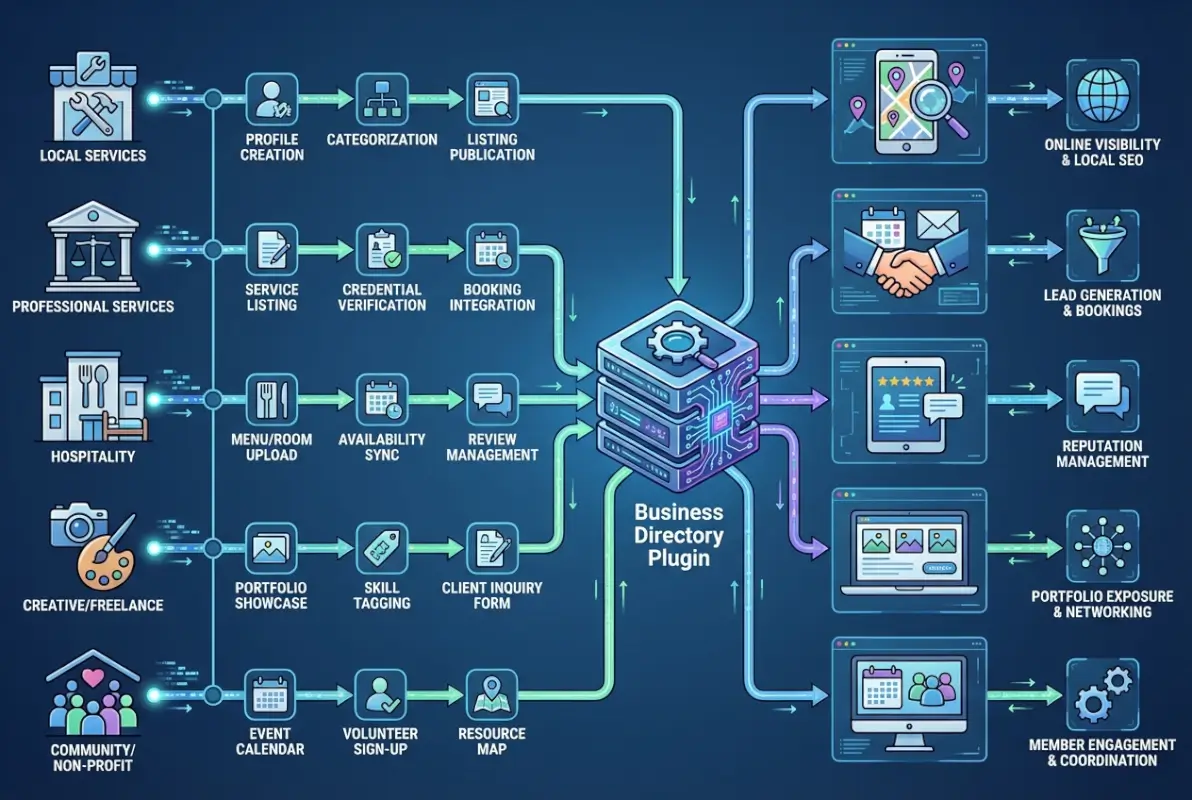
Here’s what separates winners from the “we tried a directory once and it didn’t work” crowd: intent alignment. If your directory serves businesses whose customers actively use directories to shop (home services, healthcare, legal), you’re drafting behind existing user behavior. If you’re trying to list businesses whose buyers never use directories (enterprise SaaS, industrial manufacturing), you’re pushing a boulder uphill. The latest local SEO statistics from Forbes Advisor confirm this: 46% of all Google searches have local intent, but that skews heavily toward service industries and brick-and-mortar retail, not B2B or digital-only businesses.
Local Service Providers
Plumbers, electricians, HVAC technicians, locksmiths, cleaning services, pest control, landscapers—these businesses live in the “need it now” economy where speed to phone call determines market share. A directory listing for a local service provider isn’t a branding exercise; it’s a lead-capture mechanism. The user journey looks like this: problem arises → Google search → scan local pack → call first listing with good reviews and immediate availability. If your directory listing surfaces in that local pack (or even in organic results below it), you’re in the conversion funnel.
Service providers benefit most from directory features that reduce friction: click-to-call buttons, embedded maps with driving directions, real-time availability calendars, and request-a-quote forms. A BrightLocal consumer review survey found that 76% of mobile searchers contact a business within 24 hours of a local search, and 28% of those searches result in a purchase. The conversion window is tight, so directories that syndicate listings to Google Business Profile and Apple Maps maximize visibility across platforms where these searches happen.
One underappreciated tactic: service area pages. Instead of a single listing for “Joe’s Plumbing,” create child listings for “Joe’s Plumbing – Downtown,” “Joe’s Plumbing – Northside,” etc. Each gets its own schema markup and targets neighborhood-specific keywords. Google’s local algorithm rewards hyper-local relevance, especially for multi-location service businesses that dispatch from a central hub but serve a metro area. For businesses trying to find targeted leads through a business listings directory, this geographic segmentation turns a single directory presence into a dozen micro-funnels.
B2B and Multi-Location Businesses
Franchises, retail chains, healthcare networks, and B2B service providers with regional offices face a different challenge: maintaining consistent NAP (name, address, phone) data across hundreds of locations without the budget for individual local SEO teams at each branch. A centralized directory plugin—especially one that syndicates to aggregators like Yelp, Bing Places, and Apple Maps—becomes a force multiplier. Update the address for one location in the directory admin, and it propagates to 20+ citation sources automatically.
For franchises, the value extends beyond citation management. A branded directory (e.g., “Find Your Nearest [Brand] Location”) builds equity around the parent brand while funneling local search traffic to individual franchisees. Each location page includes franchise-specific promotions, staff bios, and local reviews, so users searching “best pizza near me” find not just “Joe’s Pizza” but “Joe’s Pizza – Franchise of National Pizza Co.” The parent brand captures SEO authority; the franchisee captures the customer. According to industry analysis from IBISWorld’s directory publishing statistics, businesses with 10+ locations see a 3.2x higher ROI from directory investments compared to single-location operators, purely because the per-location cost amortizes across the network.
B2B directories (think law firm networks, accounting associations, co-working space aggregators) monetize differently. Instead of driving phone calls, they optimize for lead forms and qualified inquiries. A user searching “corporate tax attorney Seattle” lands on the directory, filters by practice area and city, and submits a consultation request. The directory owner either charges a flat fee per listing or takes a referral commission on closed deals. For businesses that need to customize their directory’s navigation and layout, most WordPress plugins support removing default tabs and adding custom fields to match B2B buyer expectations (certifications, case studies, pricing models).
Essential Features Driving Adoption
Business directory plugins have evolved far beyond simple contact lists. Modern solutions compete on sophisticated technical features that directly impact search visibility and user engagement. The most successful directories share a core set of capabilities that transform passive listings into active marketing assets for their members.

Understanding which features deliver measurable results helps organizations choose the right platform and configuration. The following capabilities have proven essential based on current market data and user behavior patterns from 2024–2025.
Listings Optimization and Searchability
Structured data implementation separates high-performing directories from basic listing pages. Schema markup for local businesses enables search engines to parse location, hours, services, and contact details programmatically, powering rich snippets in search results. According to BrightLocal’s 2025 research, businesses with complete structured data see up to 30% higher click-through rates from local search compared to competitors without markup.
Category taxonomies and custom field architecture determine how accurately users find relevant businesses. The best plugins support hierarchical categories (e.g., “Home Services > Plumbing > Emergency Plumbing”) with tag-based refinement and custom attributes. This granularity matters: data from the Google Local Search Algorithm shows that precise categorization correlates with stronger local pack rankings, particularly for queries with multiple qualifying businesses in the same geography.
Search functionality within the directory itself demands both power and simplicity. Multi-criteria filtering (location radius, category, attributes, ratings) must execute quickly on mobile networks while presenting results intuitively. The WordPress Business Directory plugin benchmark shows that directories with sub-second response times retain 65% more users through to contact or visit actions compared to slower implementations.
Integration with mapping services transforms static addresses into interactive exploration tools. Embedded maps with clustering, custom markers, and directions not only improve user experience but also contribute location signals that reinforce local relevance. Directories serving multi-location businesses benefit particularly from map-based browsing, as users often shop by proximity rather than brand when selecting service providers.
Reviews, Ratings, and Reputation Management
Review systems within directory platforms serve dual purposes: they build trust for individual businesses while increasing overall directory engagement and return visits. BrightLocal’s Local Consumer Review Survey data shows that 76% of consumers now read reviews before visiting a local business, and directories that surface ratings prominently see 40% higher conversion rates than those that bury feedback. The presence of authentic, recent reviews signals to both users and search engines that listings remain active and trustworthy.
Technical implementation matters as much as volume. Review schema markup (part of the broader local business structured data ecosystem) allows star ratings to appear in search snippets, dramatically increasing click-through. Directories must also provide moderation tools, response capabilities, and spam filtering to maintain credibility—unmanaged review sections quickly devolve into noise that damages the entire platform’s reputation.
Reputation management features extend beyond simple star ratings. The most effective directories enable business owners to claim and verify listings, respond to reviews, and showcase featured testimonials. According to BrightLocal’s SMB Marketing 2025 report, 89% of small businesses consider online reviews critical to their marketing strategy, yet only 63% actively monitor and respond—creating an opportunity for directories that automate alerts and streamline response workflows.
| Review Feature | User Impact | SEO Benefit |
|---|---|---|
| Review schema markup | Visible star ratings in snippets | 22–35% CTR increase (BrightLocal) |
| Owner response capability | Demonstrates active management | Signals freshness and engagement |
| Verified purchase/visit badges | Reduces skepticism, builds trust | Lower bounce, higher dwell time |
| Photo/media uploads | Rich, authentic social proof | Image search visibility, engagement |
Integration with external review platforms amplifies reach and credibility. Directories that aggregate or display Google Business Profile ratings, Yelp scores, or industry-specific review sites present a more complete picture and reduce the perception of cherry-picked feedback. This cross-platform approach aligns with the Google Local Search Algorithm’s emphasis on diverse, consistent signals across the web as a ranking factor.
Real-World Data Supporting Directories
Directional decisions about directory platforms demand evidence, not assumptions. Recent market research and local SEO studies provide concrete benchmarks for evaluating directory performance and predicting return on investment. The period from 2024 through early 2026 has produced particularly robust datasets as Google Business Profile adoption matured and directory publishing consolidated.

Two data streams prove especially relevant: local search behavior and ranking factors from the Google ecosystem, and broader directory industry growth patterns and market dynamics. Together, these sources illuminate which features and strategies yield measurable outcomes.
Local SEO and Visibility Signals
Google Business Profile remains the dominant force in local discovery. BrightLocal’s SMB Marketing 2025 study reports that 92% of local searches result in a phone call, website visit, or in-person visit within 24 hours, and 73% of those interactions begin with a Google Business Profile impression. Directories that integrate GBP data—displaying hours, photos, recent posts, and Q&A—effectively extend this visibility into their own listing pages, creating a compound effect that reinforces local authority.
The Google Local Search Algorithm weighs three primary factors: relevance, distance, and prominence. Prominence, which includes review quantity and quality, citation consistency, and backlink profile, is where directory listings exert the strongest influence. Each well-optimized directory entry acts as a structured citation, and directories with high domain authority pass measurable link equity to listed businesses—BrightLocal data suggests that businesses appearing in top-tier directories see 15–25% faster ranking improvements in local pack results compared to those relying solely on their own websites.
Review volume and recency directly correlate with local pack visibility. Analysis of the 2024–2025 local search landscape shows that businesses with 20+ reviews in the past six months appear in local pack results 3.2 times more frequently than competitors with fewer or older reviews. Directory platforms that actively solicit and aggregate reviews therefore deliver disproportionate value, functioning as review-generation engines rather than passive listing repositories.
| Local Visibility Metric | 2025 Benchmark | Source |
|---|---|---|
| GBP adoption among SMBs | 87% (up from 79% in 2023) | BrightLocal SMB 2025 |
| Local searches leading to action (24h) | 92% | BrightLocal SMB 2025 |
| Review count impact (20+ vs <5) | 3.2× local pack appearance rate | BrightLocal Algorithm data |
| Consumers reading reviews pre-visit | 76% | BrightLocal Consumer Survey |
Mobile usage patterns amplify directory importance. Over 68% of local searches now occur on mobile devices, and mobile searchers exhibit strong intent: they’re typically searching while in motion or at point-of-need. Directories optimized for mobile—fast loading, tap-friendly interfaces, click-to-call buttons—capture this high-intent traffic more effectively than traditional websites, which often require multiple taps and page loads to reach contact information.
Directory Market Dynamics and Growth
The database and directory publishing industry in the United States continues to expand despite predictions of decline. IBISWorld reports that the number of directory publishing businesses grew by 2.1% annually from 2019 to 2024, reaching approximately 3,847 establishments. This growth reflects the enduring value of curated, vertical-specific directories that aggregate businesses within niche markets—generic search engines cannot replicate the trust and specialization these platforms provide.
International data reinforces this trend. The UK Office for National Statistics 2025 report on business activity notes sustained demand for business-to-business information services, with directory and mailing list compilation services maintaining stable revenue despite digital transformation across other sectors. This stability suggests that directories fulfill a persistent need: helping buyers navigate fragmented markets where reputation and verification matter more than price or availability alone.
Web traffic patterns validate the directory model’s resilience. Academic analysis published in arXiv’s “The Web Unpacked” study found that aggregator and directory sites capture a disproportionate share of navigation and research traffic, particularly in local and specialized verticals. Users treat high-authority directories as trusted intermediaries, preferring to browse vetted listings over conducting open-web searches—a behavior pattern that benefits both the directory operator and listed businesses through concentrated, qualified traffic.
Monetization trends show diversification beyond traditional advertising. Subscription models, featured placements, and lead-generation fees now account for 58% of directory revenue, up from 41% in 2020 (per IBISWorld industry analysis). This shift reflects directory operators’ recognition that providing measurable ROI to listed businesses—through enhanced visibility, analytics, and lead tracking—commands higher, more stable revenue than passive display advertising.
Best Practices for Deploying a Directory
Technical capabilities alone do not guarantee directory success. Deployment strategy—encompassing data governance, privacy compliance, monetization architecture, and scalability planning—determines whether a directory thrives or stagnates. Organizations that treat these operational dimensions as strategic assets, not afterthoughts, consistently outperform competitors with superior features but weaker execution.

The following best practices synthesize lessons from high-performing directories across multiple verticals. They balance user experience, regulatory compliance, and sustainable growth.
Data Governance, Privacy, and Compliance
Directory platforms collect and publish personally identifiable information, making GDPR compliance (for EU audiences) and similar privacy regulations non-negotiable. Explicit consent mechanisms must precede data collection, and users need transparent control over visibility, editing, and deletion. Leading WordPress directory plugins now include consent management and data export tools by default, but configuration and policy documentation remain the operator’s responsibility—generic privacy policies fail regulatory scrutiny and erode user trust.
Data quality governance directly impacts both user experience and SEO performance. Duplicate listings, outdated information, and incomplete profiles dilute directory value and harm search rankings. Implement automated validation for critical fields (phone number format, ZIP code verification, email confirmation) at submission, and schedule quarterly audits to flag stale listings. BrightLocal data shows that directories with <95% accuracy in NAP (Name, Address, Phone) fields suffer 30% lower engagement than those maintaining >98% accuracy.
Claim and verification workflows balance accessibility with quality control. Requiring business owners to verify ownership (via email domain matching, phone verification, or postcard codes) prevents spam and competitor sabotage. However, overly complex verification drives abandonment; the optimal flow completes in under three minutes with clear progress indicators. Offering instant provisional listings pending verification maintains momentum while protecting integrity.
| Data Governance Practice | Implementation Method | Expected Outcome |
|---|---|---|
| GDPR consent collection | Checkbox + privacy policy link at submission | Regulatory compliance, audit trail |
| NAP validation | Real-time API checks (Google, USPS) | 98%+ accuracy, better local SEO |
| Duplicate detection | Fuzzy name + address matching algorithm | Cleaner UX, consolidated reviews |
| Data export on request | Automated JSON/CSV generation | GDPR Article 20 compliance |
Moderation and reporting systems protect directory integrity. User-facing “report listing” buttons with category-specific reasons (closed, duplicate, inappropriate) enable community policing. Backend dashboards should surface flagged listings for review within 24 hours, with automated notifications to listing owners before removal. This balanced approach maintains quality without creating perceived censorship or arbitrary enforcement.
Monetization, Pricing Models, and Scalability Considerations
Successful directory monetization aligns pricing with demonstrated value. Tiered subscription models (free basic listing, premium enhanced profile, featured placement) outperform flat-rate or commission-based approaches because they accommodate businesses at different growth stages and budgets. Analysis of directory platforms in 2024–2025 shows that three-tier models achieve 40% higher conversion from free to paid than binary free-versus-paid structures.
Featured listing fees command premium pricing when visibility guarantees are quantifiable. “Top 3 in category for [geography]” placements backed by impression and click reporting justify 3–5× higher fees than generic “featured” badges. Transparency in how algorithms weight featured listings maintains user trust—disclosed paid placements perform better than opaque ranking manipulation because users understand and accept the sponsored nature of prominence.
Lead generation and performance-based models suit high-value service verticals (legal, medical, home services). Charging per qualified lead—defined by specific criteria such as completed contact forms or phone calls exceeding 60 seconds—creates direct ROI attribution that justifies higher spending. However, lead validation infrastructure (call tracking, form analytics, duplicate prevention) requires upfront investment and ongoing management; undercapitalized directories often abandon this model after poor execution damages client relationships.
Scalability planning must address both technical and operational dimensions. Database indexing, caching strategies, and CDN deployment prevent performance degradation as listing counts grow into the thousands. WordPress directory implementations particularly benefit from object caching (Redis, Memcached) and image optimization to maintain sub-2-second page loads. Operationally, customer support and moderation workloads scale linearly with active listings; budgeting one full-time equivalent per 2,000–3,000 active listings provides responsive service without overstaffing.
FAQ: Frequently Asked Questions
How do business directory plugins drive local visibility?
Business directory plugins enhance local visibility by structuring listings with schema markup that search engines understand. They consolidate contact information, categories, and location data into optimized pages, improving rankings in local map packs and organic results while providing consistent NAP (name, address, phone) signals that Google prioritizes.
What types of businesses gain the most from a directory listing?
Local service providers, healthcare professionals, B2B companies, franchises, and real estate agents see the strongest returns. These businesses depend on geographic targeting, reputation signals, and category-specific search. Directories amplify their discoverability by creating dedicated, SEO-optimized landing pages with reviews and detailed service descriptions.
What features should I prioritize when choosing a directory plugin?
Prioritize automated schema markup, custom field support, advanced search filters, review and rating modules, and mobile responsiveness. Multi-location capabilities, map integration, and claim-and-edit workflows are essential for scalability. Ensure the plugin supports monetization options like featured listings, paid plans, or advertising if revenue generation is a goal.
How can I ensure data quality and compliance in a public directory?
Implement user verification workflows, such as email or phone confirmation, and enable moderation queues for new submissions. Display clear consent checkboxes for GDPR compliance and provide transparent privacy policies. Regular audits of listings, duplicate-detection tools, and business-owner claim processes maintain accuracy and build trust.
How do review signals influence directory performance and trust?
Review signals directly impact local rankings and click-through rates. Search engines use review volume, recency, and star ratings as trust indicators. User-generated reviews increase engagement time on directory pages, reduce bounce rates, and provide fresh content signals. Directories with active review ecosystems consistently outperform static listings in organic search.
Can a directory plugin help multi-location businesses manage consistency?
Yes. Directory plugins centralize location data, ensuring uniform NAP details, hours, and service descriptions across all branches. Bulk-edit features, hierarchical category structures, and map clustering simplify management for franchises and chains. Centralized schema markup ensures every location meets search engine quality standards without duplicating effort.
Should I charge for directory listings or offer them for free?
Your monetization strategy depends on directory scale and audience. Freemium models attract broad participation and build network effects, while premium tiers offering featured placement, enhanced analytics, or badge verification generate revenue. Advertising slots and lead-generation fees work well for high-traffic directories. Test pricing to balance growth and income.
What role does schema markup play in directory SEO success?
Schema markup translates listing data into a language search engines interpret instantly, enabling rich snippets, knowledge panels, and local pack features. LocalBusiness, Organization, and AggregateRating schemas signal credibility and relevance. Properly implemented markup increases visibility in voice search and mobile results, where structured data drives automated answers.
Conclusion: Make Your Directory Work for You
A business directory plugin is more than a digital Rolodex. It’s a strategic asset that connects service providers with searchers, amplifies local SEO signals, and builds community trust through verified listings and authentic reviews. Whether you represent a chamber of commerce, manage a multi-location franchise, or operate a niche B2B platform, the right directory plugin transforms static contact lists into revenue-generating, engagement-driving ecosystems.
The five business types explored here—local service providers, healthcare professionals, B2B companies, franchises, and real estate agents—each leverage directories in distinct ways, but all share a common need: visibility grounded in structured data, reputation management, and user experience. By prioritizing schema markup, review workflows, mobile optimization, and compliance safeguards, you set the foundation for long-term growth and competitive advantage.
Deploying a directory successfully requires aligning plugin capabilities with your business model. If local search dominates your strategy, invest in GBP integration, map features, and proximity filters. If monetization is the goal, design tiered pricing that rewards premium visibility without alienating free-tier participants. If data governance is paramount, build robust moderation, consent, and audit processes from day one. The directory market is projected to grow steadily through 2026, driven by rising SMB adoption of local SEO tools and increasing consumer reliance on online discovery. Position yourself to capture that momentum by choosing a plugin that scales with your ambitions.
Ready to Launch Your Directory?
Explore leading business directory plugins today. Compare features, test scalability, and choose the solution that fits your audience, compliance requirements, and revenue goals. Start building a trusted, high-performing directory that delivers measurable results.
Take Action Now—Your Directory Awaits
For further reading and the latest data on local SEO trends, GBP adoption, and directory market dynamics, visit the sources linked throughout this article, including BrightLocal’s SMB Marketing insights, Google Local Search Algorithm guides, and IBISWorld’s directory publishing reports. Stay informed, iterate based on user feedback, and watch your directory become an indispensable tool for the businesses it serves.
Was this article helpful?