Business Directory Website: How to Create One That Drives Revenue

Generating summary...
Building a business directory website isn’t just about collecting listings—it’s about architecting a platform that turns verified data into recurring revenue. While most directory owners chase thousands of free listings and hope advertisers will follow, the smartest operators flip that model: they build tight, high-intent niches where businesses compete for visibility, then layer multiple revenue streams on top. The difference between a stagnant directory and one generating six figures annually often comes down to understanding which market signals predict buyer intent, how to structure pricing tiers that capture maximum lifetime value, and which compliance guardrails protect long-term monetization.
TL;DR – Quick Takeaways
- Niche validation beats scale – directories targeting high-margin verticals (legal, healthcare, B2B) with proven search demand outperform broad local listings by 3-5x in ARPU
- Revenue architecture matters more than traffic – premium upgrades, sponsored placements, and API licensing can monetize 1,000 quality listings better than 50,000 unverified ones
- Data hygiene is your moat – real-time validation and business verification create trust signals that justify premium pricing and reduce churn
- Freemium funnels drive conversion – free basic listings build inventory while tiered upsells (featured placements, review management, analytics) convert 8-15% to paid
- Compliance protects monetization – clear data usage policies, API terms, and opt-in mechanisms keep revenue streams defensible as privacy regulations tighten
How Do You Choose a Profitable Niche for Your Directory?
The biggest mistake new directory builders make is chasing volume instead of value. A broad “all businesses in my city” directory competes with Google Maps, Yelp, and a dozen established players who’ve spent years building domain authority. Instead, look for verticals where businesses actively pay for visibility because customer lifetime value justifies the spend—think niche professional services (estate planning attorneys, pediatric dentists), specialized B2B suppliers (commercial HVAC, industrial packaging), or regulated industries (licensed contractors, certified financial advisors) where credibility signals matter.

Start by cross-referencing search volume data (Google Keyword Planner, Ahrefs) with commercial intent signals. If searchers are typing “best [service] near me” or “[industry] directory,” they’re already in buying mode, which makes those keywords worth targeting. According to the U.S. Small Business Administration, nearly 33.2 million small businesses operate across diverse sectors—but only a fraction compete in high-margin niches where directory placement drives measurable ROI. Your job is to identify where demand outpaces quality supply.
Competition analysis reveals gaps faster than opportunity hunting. Pull the top 10 ranking directories in your target niche and audit their listing quality, update frequency, and monetization tactics. If incumbents have stale data, no verification process, or rely solely on banner ads, you’ve found an opening. Build a directory that solves the trust problem (verified credentials, real reviews, current contact info) and businesses will pay to be featured because you deliver qualified leads, not just eyeballs.
Assess Demand and Competition Using Market Data
Quantify demand by mapping search volume to business density. If “commercial roofing contractors” gets 18,000 monthly searches in your metro area but only three directories exist (with outdated listings), that’s a green light. Use Census Bureau business pattern data and local chamber of commerce records to estimate how many qualified businesses could list—if the addressable market is under 200 businesses, you’ll need high ARPU or adjacent revenue streams to hit scale. Aim for niches with 500+ potential listings and average customer acquisition costs below $150 per business.
Competitive moats in directories come from data advantages, not SEO alone. The 2024 Census Small Business Profiles show new business formation spiking in sectors like professional services and healthcare—these are high-trust categories where verification (licenses, certifications, insurance) becomes a premium feature. If you can automate credential checks or partner with licensing boards, you create a barrier competitors can’t easily replicate, because building that data pipeline takes time and relationships.
Aligning Listings with Buyer Intent and High-Margin Services
Buyer intent signals determine whether visitors convert or bounce. A searcher typing “emergency plumber near me” has different urgency than someone browsing “local plumbers,” so your directory should tag listings by service type, response time, and availability. High-margin services—think estate law, cosmetic dentistry, executive coaching—support premium pricing because businesses earn enough per client to justify $50-$200/month for featured placement. According to research from the U.S. Chamber of Commerce, small businesses in professional services allocate 7-12% of revenue to marketing, which means they’ll pay for listings that deliver qualified leads.
Design your taxonomy around the questions buyers actually ask. Instead of generic categories like “Home Services,” drill down to “Basement Waterproofing” or “Whole-House Generator Installation.” Specificity improves SEO and matches buyer intent, which boosts conversion rates for both visitors (who find exactly what they need) and listers (who get higher-quality inquiries). Tag each listing with attributes like “free estimates,” “same-day service,” or “financing available”—these filters let users self-qualify and reduce friction in the decision path.
Defining a Compelling Value Proposition for Listings and Users
Your value proposition needs to answer two questions simultaneously: why should businesses pay to list here, and why should users trust this directory over Google? For listers, the promise is simple—qualified leads at a predictable cost. For users, it’s credibility and comprehensiveness: verified information, transparent reviews, and filtering tools that surface the right provider in seconds. If you can’t articulate both sides in one sentence, your positioning is too vague to support premium pricing or organic growth.
Differentiation in directories comes from solving the “freshness problem” that plagues older platforms. According to industry benchmarks, roughly 20-30% of business contact info goes stale annually (closures, relocations, phone changes), so directories that auto-verify listings via API integrations (Google Business Profile, public records, phone validation services) can charge more because users know the data is current. Real-time validation isn’t just a nice-to-have, it’s a revenue lever—businesses will pay a premium to appear in a directory that users actually trust, and users return when they don’t waste time calling disconnected numbers.
Trust signals multiply when you layer verification, reviews, and editorial oversight. A WordPress business directory plugin like TurnKey Directories can automate credential checks, flag duplicate submissions, and integrate third-party review platforms (Google Reviews, Trustpilot) to surface social proof directly on listing pages. This matters because 72% of consumers say positive reviews make them trust a local business more (according to BrightLocal data), and directories that aggregate those signals become the go-to resource instead of a static phone book.
What Makes Listings Trustworthy and Searchable
Trustworthy listings start with structured data and end with proof of legitimacy. Require business license numbers, insurance certificates, or professional accreditations during submission—then spot-check a sample each month. Public-facing badges like “Verified License” or “Background Checked” signal to users that you’ve done diligence, which reduces bounce rates and increases time-on-site. Searchability depends on clean metadata: accurate NAP (name, address, phone), service area tags, hours of operation, and keyword-rich descriptions that match how people search.
Schema markup transforms listings into rich results. Mark up each business with LocalBusiness or ProfessionalService schema so search engines can display star ratings, hours, and contact info directly in SERPs. This not only boosts click-through rates but also positions your directory as a structured data source, which can lead to API licensing opportunities down the road (more on that in the next section). A well-structured listing is machine-readable and human-friendly, which means it ranks higher and converts better.
Differentiators: Data Freshness, Verification, Reviews, and API Access
Data freshness is your competitive moat if you automate it. Integrate with services like Clearbit, Hunter.io, or Melissa Data to periodically ping listings and flag outdated contact info. Charge businesses a small annual fee ($25-$50) to maintain “verified” status, which funds the validation infrastructure and creates a recurring revenue stream. Directories that let listings go stale lose user trust fast, while those that update in near-real-time become indispensable reference tools that businesses fight to be featured in.
Review aggregation and moderation policies set premium directories apart from spam-filled clones. Allow users to submit reviews, but require email verification and flag suspicious patterns (multiple reviews from the same IP, overly generic praise). Surface both positive and negative feedback with business responses to show transparency—this builds trust and gives listers an incentive to engage (and pay for premium placement to offset any negative signals). According to data from Statista, 93% of consumers read online reviews before making a purchase decision, so your review system is effectively your conversion engine.
API access opens B2B revenue channels that scale independently of listing volume. Once you have a clean, verified dataset, package it as an API product for software platforms, CRM providers, or industry associations that need bulk business data. For instance, if you’ve built a directory of licensed contractors, a home warranty company might pay $500-$2,000/month for real-time API access to pull contractor info into their dispatch system. This revenue stream compounds as your data quality improves, because you’re selling the same asset (your database) to multiple customers without incremental acquisition costs. Offering business directory services beyond simple listings—like data feeds, white-label widgets, or partner integrations—can double your monetization surface area.
Platform Foundations that Drive Growth
A directory’s long-term revenue depends on platform reliability, data quality, and user trust. Start with real-time validation during submission: check business names against public databases, verify addresses through geocoding APIs, and flag duplicate or suspicious entries before they reach the live index. Automated checks reduce moderation overhead and ensure that each listing meets minimum standards for accuracy and completeness.

Implement a multi-stage moderation workflow that combines automated filters with human review for edge cases. Flag listings that lack contact details, use generic email domains, or contain promotional language in free fields. Schedule periodic re-verification—send email confirmations or SMS codes to listed contacts every six to twelve months, and archive unresponsive entries into a “pending verification” queue. This cycle keeps your database fresh and signals to users that listings are actively maintained.
Data hygiene extends beyond initial submission: syndicate verified listings to partner platforms and local-search aggregators to build inbound citations and cross-validate accuracy. Use schema markup (LocalBusiness, Organization) on every listing page to help search engines parse hours, reviews, and contact information. Consistent NAP (name, address, phone) across the directory and syndication partners strengthens local SEO and reduces confusion for both users and crawlers.
On the user side, design a submission flow that requests only essential fields up front—business name, category, location, contact—and prompts for enrichment (hours, photos, description) in a second step. Progress indicators and inline validation reduce abandonment and improve data completeness. Offer a preview mode before final publication, and send a dashboard link via email so owners can update details post-launch without re-submitting.
Real-time Validation, Business Verification, and Spam Prevention
Deploy API integrations with address validation services (USPS, Google Geocoding) to catch typos and normalize formatting at submission time. Cross-reference business names and phone numbers against known spam databases or public blacklists to prevent SEO farms and fake storefronts from polluting your index. Set rate limits on IP addresses and email domains to block bulk submission scripts, and require CAPTCHA or reCAPTCHA for free-tier submissions.
Introduce identity verification for premium listings: require a business email domain match, tax ID confirmation, or upload of a government-issued license. This added friction deters low-quality actors and boosts credibility for upgraded profiles. Display a “Verified” badge on listings that pass all checks, and highlight verification status in search results and category pages to reward compliant businesses with higher visibility.
Monitor user-reported flags and disputes through an internal ticketing system. Allow visitors to flag outdated hours, closed locations, or duplicate entries, and route those reports to your moderation queue. Acknowledge reporters via automated email and update listings within 48 hours; this feedback loop improves data accuracy and builds community trust. Publish a transparency report annually that summarizes verification rates, spam blocks, and resolution times to demonstrate ongoing platform governance.
Data Syndication and Consistency Across Partner Networks
Partner with local-search aggregators, industry-specific portals, and map platforms to distribute verified listings beyond your site. Use automated feeds (CSV, JSON, or XML) that push updates nightly, ensuring that changes to hours, contact details, or services propagate to all syndication endpoints within 24 hours. Track inbound citations and monitor for discrepancies; when a partner displays outdated information, alert them or revoke syndication access until they commit to refresh cycles.
Offer businesses a “manage everywhere” dashboard that displays syndication status and flags inconsistencies across partner sites. This feature becomes a premium upsell: free listings appear only on your directory, while paid tiers unlock distribution to five or ten partner networks. Surface analytics—impressions, clicks, and conversions per channel—so business owners see the ROI of syndication and renew annual plans.
Maintain a public API that lets third-party developers and research firms query your data under license. Require attribution and enforce rate limits to prevent scraping; charge API access fees based on query volume or data freshness tiers. API licensing generates recurring B2B revenue and positions your directory as the authoritative source for niche business data, expanding reach without diluting on-site traffic.
User Experience, Search Relevance, and Conversion
Design your homepage and category pages to surface high-intent searches in one or two clicks. Place a prominent search bar at the top with auto-complete suggestions drawn from business names, categories, and locations. Below the search, display popular categories as large tiles with icons and listing counts; users should understand your directory’s breadth without scrolling. Add a geolocation prompt to default the search radius to the visitor’s city, reducing friction for mobile users seeking nearby businesses.

Implement faceted filters on search-results pages: location radius, category tags, price range, customer ratings, and availability (open now, accepts appointments). Persist filter state in the URL query string so users can bookmark or share refined searches. Display results in a grid or list view with thumbnail images, star ratings, distance from the user, and a snippet of the description. Each result card should include a clear call-to-action—”View Details,” “Get Directions,” or “Request Quote”—that drives engagement and tracks conversion intent.
Optimize individual listing pages for local SEO and user trust. Embed a Google Map or OpenStreetMap iframe showing the business location, and include structured data (LocalBusiness schema) with opening hours, price range, and aggregate review rating. Display user reviews prominently above the fold, sorted by recency and helpfulness votes. Encourage businesses to respond to reviews directly on your platform; active engagement signals credibility to both users and search engines.
Add trust signals throughout the user journey: SSL certificates, privacy-policy links in the footer, and “Verified Listing” badges on profiles that have completed identity checks. Surface recent activity—”Updated 3 days ago,” “Responded to 5 reviews this month”—to show that listings are active and monitored. Use breadcrumb navigation (Home > State > City > Category > Business) to aid crawlers and help users backtrack through category hierarchies without hitting the browser’s back button.
Intuitive Submission Flow and Robust Search Filters
Break the submission form into a three-step wizard: basic info (name, category, location), contact and hours (phone, email, website, schedule), and enrichment (photos, description, services). Show a progress bar at the top and allow users to save drafts if they need to gather additional details. Inline validation catches errors immediately—invalid email formats, missing required fields—so users fix issues before clicking “Submit.” After submission, redirect to a confirmation page that explains the review timeline and offers a link to claim and edit the listing later.
For search filters, expose only the most relevant dimensions on the initial results page—location radius, category, and rating—and hide advanced filters (price, amenities, certifications) behind an “Advanced Filters” toggle. This progressive disclosure keeps the interface clean for casual browsers while empowering power users to narrow results. Provide filter counts (“3 results match your criteria”) and a “Clear All” button to reset the search without reloading the page.
Track filter usage in your analytics platform to identify which dimensions drive the most engagement. If “Open Now” is frequently selected, promote it to a primary filter or add a “Currently Open” badge to relevant listings. Use heatmaps and session recordings to spot friction points—users repeatedly toggling the same filter, or abandoning after zero results—and adjust filter logic or seed additional listings in underserved categories.
Local SEO Considerations, Reviews, and Trust Signals
Target long-tail local keywords by creating dedicated landing pages for each city-category pair (e.g., “Plumbers in Austin” or “Veterinarians in Brooklyn”). Populate these pages with a curated list of top-rated businesses, a brief editorial introduction, and links to related categories. Update landing pages quarterly with fresh content—seasonal tips, new business highlights—to signal ongoing relevance to search engines. Use city and category names in page titles, H1 headings, and meta descriptions, and interlink aggressively between regional and category hubs.
Encourage review submission by sending automated emails to users after they interact with a listing—clicked “Get Directions,” visited the website, or requested a quote. Offer a simple five-star rating with an optional text field, and moderate submissions for profanity or spam before publishing. Display aggregate ratings (e.g., “4.3 stars from 27 reviews”) in search snippets and social-share previews; rich snippets in Google results can boost click-through rates by 20–30% according to industry benchmarks.
Build trust through transparency: publish a “How We Verify Listings” page that explains your moderation process, and link to it from the footer and submission-confirmation emails. Add a “Report an Issue” button on every listing page, routing complaints to your support queue. Display a “Last Verified” timestamp on each profile, and archive listings that fail re-verification into a separate “Unverified” section with reduced visibility. These signals reassure users that your directory is actively curated and reduce the risk of outdated or fraudulent information damaging your reputation.
| Trust Signal | Placement | Impact on Conversion |
|---|---|---|
| Verified badge | Search cards, listing header | +15–25% click-through |
| Aggregate star rating | Snippets, share previews | +20–30% organic CTR |
| Last verified timestamp | Listing sidebar | Reduces bounce by ~10% |
| Business response to reviews | Review section | +12–18% trust score |
| SSL lock icon in browser | Global (HTTPS) | Baseline expectation |
Traffic Acquisition and Content Engine
Organic search drives the majority of directory traffic, so prioritize local and vertical SEO from day one. Claim and optimize your directory’s own Google Business Profile, and ensure every listing page is crawlable with clean URL slugs, descriptive titles, and meta descriptions. Build topical authority by publishing category guides—”How to Choose a Plumber,” “Top 10 Questions for Veterinarians”—that rank for informational queries and link back to relevant listing pages. These guides attract top-of-funnel visitors who later convert into directory users or paid listers.

Invest in content partnerships with local bloggers, industry associations, and community newsletters. Offer to sponsor a “Best Of” roundup or contribute expert insights in exchange for a backlink and co-branded promotion. These partnerships generate referral traffic, build domain authority, and introduce your directory to niche audiences that trust the partner’s endorsement. Track referral sources in Google Analytics and double down on channels that deliver high-intent users with low bounce rates.
Leverage social media and community-building tactics to amplify reach. Create a LinkedIn company page and share success stories from featured businesses, tagging them to encourage reshares. Launch a Facebook group or subreddit for your niche, where business owners and consumers exchange tips and referrals; moderate lightly and use the community to surface trending needs or underserved categories. Paid social ads (Facebook, Instagram, LinkedIn) can jump-start traffic, but focus on retargeting visitors who viewed listings without submitting or upgrading, rather than cold acquisition, to maximize return on ad spend.
Public relations and influencer collaborations extend your brand beyond owned channels. Issue press releases when you hit milestones—1,000 verified listings, a new city launch, or a major partnership—and pitch them to local business reporters and trade publications. Identify micro-influencers in your vertical (YouTube reviewers, Instagram business coaches) and offer free premium listings or co-marketing campaigns in exchange for mentions. Track earned media in a spreadsheet and measure impact through referral spikes and branded search volume.
Local and Vertical SEO, Content Marketing, and Partnerships
Map out a content calendar that aligns with seasonal trends and local events. Publish “Spring Home Maintenance” guides in March, “Holiday Gift Ideas from Local Artisans” in November, and “New Year Fitness Resources” in January. Each seasonal piece should link to relevant listings and categories, driving traffic during peak search periods. Use Google Trends and keyword-research tools to identify rising queries in your niche, and create content that captures those searches before competitors do.
Develop strategic partnerships with complementary directories and local chambers of commerce. Offer reciprocal listing exchanges—your plumbers appear in their home-services directory, their members get discounted premium listings on your platform. Co-host webinars or virtual networking events that bring together business owners and potential customers, positioning your directory as the central hub for industry connections. Document partnership performance in a dashboard that tracks referral traffic, new listings, and revenue attributed to each partner.
Implement schema markup for Article, HowTo, and FAQPage on all editorial content to increase eligibility for rich snippets and featured positions in search results. Embed relevant listing cards within guides—e.g., a “Top-Rated Electricians” carousel in your electrical-safety article—to drive internal traffic and improve session depth. Regularly audit your content for broken links, outdated statistics, and low-performing pages; update or consolidate underperformers to maintain domain quality and crawl efficiency.
Social, PR, and Community-Building Tactics
Launch a weekly or biweekly newsletter that highlights new listings, industry news, and user success stories. Segment your list by location and category so subscribers receive relevant updates—New York-based contractors get NYC-focused content, while pet-service providers see pet-industry trends. Include a “Featured Business” spotlight in each issue, rewarding premium members with additional exposure and incentivizing free listers to upgrade. Track open rates, click-through rates, and conversions from newsletter traffic to measure engagement and refine subject lines and content mix.
Host or sponsor local events—networking breakfasts, trade-show booths, or community workshops—where you can demo your directory and collect business cards for follow-up outreach. Print QR-code flyers that link directly to your submission form, and offer on-the-spot premium upgrades at a discounted event rate. Events build personal relationships with business owners, generate word-of-mouth referrals, and provide content opportunities (photos, testimonials) for social media and blog posts.
Engage with online communities where your target users congregate: Reddit, Facebook groups, Slack channels, and industry forums. Answer questions, share relevant listings, and provide value without overt self-promotion; moderators and members will notice your expertise and visit your directory organically. Set Google Alerts for your niche keywords and city names to catch new discussion threads, and respond promptly with helpful insights. This grassroots engagement compounds over time, building brand recognition and trust within tight-knit professional communities.
Content Strategy and Data-Driven Engagement
Develop a library of listing optimization guides that educate business owners on maximizing their profile’s visibility and conversion. Cover topics like “Writing a Compelling Business Description,” “Choosing the Right Category Tags,” and “Using Photos to Increase Click-Through Rates.” Publish these guides on your blog and link to them from the submission-confirmation email and user dashboard. Well-optimized listings improve overall directory quality and reduce moderation workload, creating a virtuous cycle of better data and higher user satisfaction.
Create category hub pages that aggregate editorial content, top listings, and user-generated reviews for each major vertical. For example, a “Home Services” hub might include guides on hiring contractors, seasonal maintenance checklists, and a curated list of verified plumbers, electricians, and HVAC technicians. Hubs serve as pillar content that ranks for broad keywords and funnels visitors into specific subcategories. Update hubs quarterly with new content, trending listings, and seasonal calls-to-action to maintain freshness and search relevance.
Partner with industry influencers and thought leaders to co-create content: guest blog posts, video interviews, or podcast episodes that explore best practices in your niche. Feature these collaborations prominently on your homepage and share them across social channels, tagging the influencer to amplify reach. Influencer endorsements lend credibility to your directory and introduce your platform to their established audiences, driving high-quality traffic and potential premium upgrades.
Offer value-added data insights through dashboards and reports. Provide premium members with monthly analytics—impressions, clicks, competitor benchmarks—and aggregate anonymized data into public trend reports (e.g., “Q3 2025 Local Services Demand Index”). These reports generate media coverage, backlinks, and social shares, positioning your directory as an authoritative data source. Publish a quarterly State of the Industry report that highlights growth trends, regional hotspots, and emerging categories, and promote it through press releases and email campaigns.
Listing Optimization Guides, Category Hubs, and Influencer Collaborations
Build a resource center within your directory that houses all optimization guides, video tutorials, and FAQs. Organize content by user journey stage—getting started, enhancing your profile, promoting your listing—and use clear navigation so business owners can self-serve. Embed short video walkthroughs (2–3 minutes) that demonstrate how to upload photos, respond to reviews, and interpret dashboard analytics. Videos reduce support tickets and improve listing quality by making best practices accessible to non-technical users.
Establish a formal influencer partnership program: identify bloggers, YouTubers, and podcasters with audiences that overlap your target market, and offer them free premium listings, affiliate commissions, or co-branded content opportunities. Provide partners with ready-made social assets—branded graphics, sample posts, trackable referral links—to simplify promotion. Track partner performance through UTM parameters and affiliate dashboards, and renew or expand partnerships based on measurable traffic and conversion contributions.
Curate “Best Of” collections that spotlight exceptional businesses in each category: “Top 10 Eco-Friendly Contractors,” “Most Responsive IT Support Providers,” or
Frequently Asked Questions
How do I start a business directory website with revenue potential?
Begin by validating a profitable niche with measurable demand and buyer intent. Choose a flexible platform, design tiered pricing for premium listings, and launch with a content strategy that drives organic traffic. Prioritize data quality and verification to differentiate from generic directories.
What are the best monetization models for directory sites in 2024–2026?
Premium listing upgrades, sponsored placements, and featured profiles form the core. Layer in B2B data licensing, API access for developers, and partnership integrations. Freemium entry with automated upsell funnels maximizes conversion while scaling annual commitments and volume discounts drive recurring revenue.
How can I ensure high-quality listings and credible reviews?
Implement real-time validation during submission, verify business credentials against public registries, and moderate reviews for authenticity. Use spam filters, duplicate detection, and data syndication to maintain consistency. Display trust signals like verification badges, response rates, and third-party ratings prominently.
Which pricing strategy works best for premium listings and sponsorships?
Tiered pricing with clear feature differentiation performs best. Offer monthly trials to reduce friction, then incentivize annual commitments with discounts. Use volume pricing for multi-location businesses and introduce sponsorship slots in high-traffic categories. Test dynamic pricing based on search volume and competition.
What legal or privacy considerations should I plan for directory data?
Draft clear data usage policies explaining how you collect, store, and share business information. Secure opt-ins for marketing communications, comply with regional privacy laws, and implement standard security measures. Include API terms for data licensing partners and transparent opt-out mechanisms for listed businesses.
How can I scale a directory to thousands of listings while maintaining performance?
Use scalable cloud infrastructure with caching, CDN delivery, and database indexing. Automate moderation with rule-based filters and periodic audits. Batch-import verified listings from reputable sources, and syndicate updates across partner networks. Monitor page speed and search responsiveness as your listing count grows.
What are common pitfalls when launching a niche directory?
Choosing a niche that’s too broad or lacks buyer intent, neglecting data quality from day one, and launching without a clear monetization plan. Other traps include over-relying on paid ads before organic traction, underestimating moderation costs, and failing to track unit economics early.
How can API licensing contribute to revenue?
Offer structured data feeds to developers, analytics platforms, and partner services via paid API tiers. Price by request volume or monthly access caps, and package premium endpoints with enriched metadata. API licensing creates high-margin recurring revenue and expands your directory’s reach beyond the web interface.
How long does it take to achieve profitability in a directory business?
Timelines vary by niche and traffic strategy, but expect 12–24 months to reach breakeven if you build organic traction and convert free listings to premium tiers. Faster paths involve partnership seeding, pre-launch commitments, or licensing deals that offset initial development and content costs.
What metrics matter most for a directory’s financial health?
Track average revenue per user (ARPU), churn rate, and customer lifetime value. Monitor funnel metrics including visits-to-listings conversion, free-to-premium upgrade rate, and renewal percentage. Calculate unit economics by comparing customer acquisition cost to LTV, and segment revenue mix across premium listings, sponsorships, and licensing.
Bring Your Directory Vision to Life
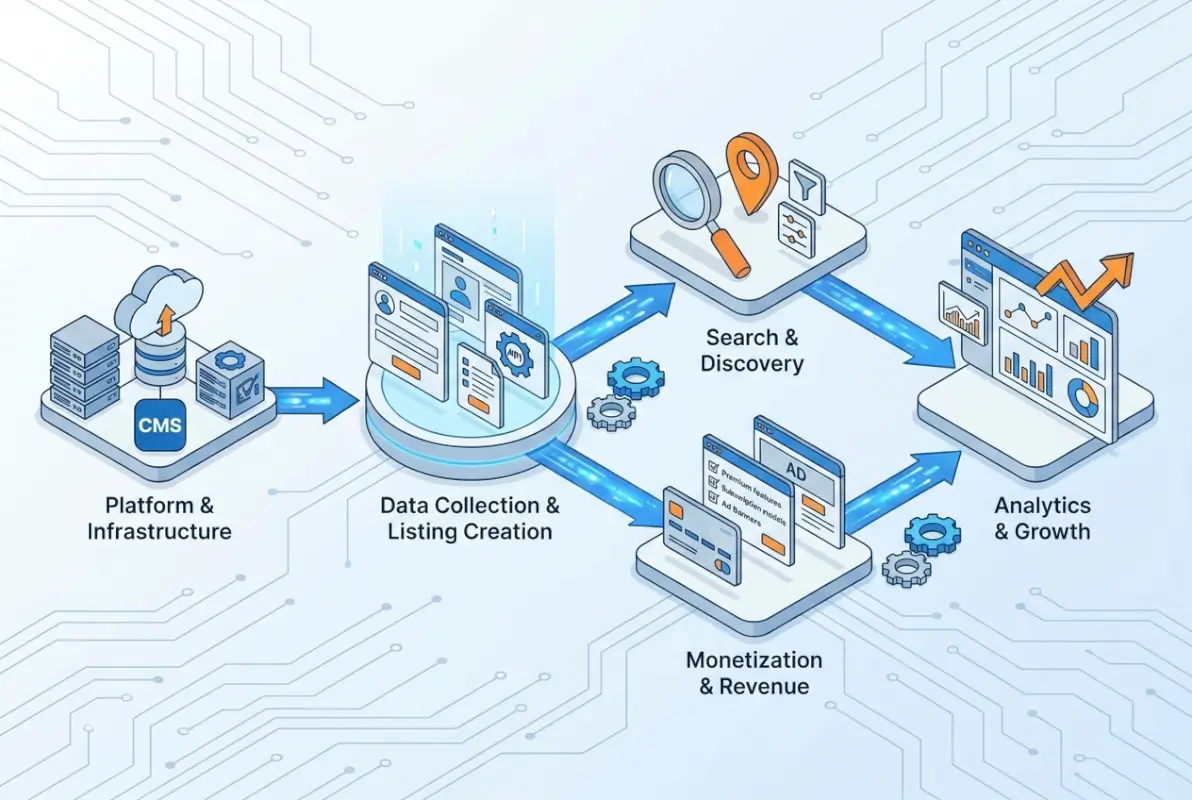
You now have a comprehensive blueprint for building a business directory that generates sustainable revenue. The five-section framework equips you to choose a market-validated niche, architect multiple revenue streams, deliver high-quality listings, attract targeted traffic, and measure performance with discipline. Each decision—from tiered pricing to data verification—compounds into competitive advantage.
Execution milestones matter more than perfection. Launch with a focused niche and a minimum viable set of premium features. Track your funnel from the first week: visits, submissions, upgrades, and renewals. Measure ARPU and churn monthly, and iterate pricing based on real customer behavior. Use public data from the U.S. Small Business Administration, Census Bureau, and industry benchmarks to validate market size and refine your positioning as you scale.
Remember that directory businesses thrive on network effects and data quality. Every verified listing, every authentic review, and every upsell conversation builds a moat that generic aggregators cannot replicate. Consistency in moderation, transparency in pricing, and relentless focus on user trust will differentiate your platform and unlock long-term growth.
Ready to Launch Your Revenue-Driven Directory?
Map your niche, design your pricing tiers, and start validating listings today. Apply the strategies in this guide to build a directory that attracts buyers, rewards quality businesses, and scales profitably.
Start small, measure obsessively, and grow with confidence.
The directory landscape rewards operators who combine sharp niche selection, transparent monetization, and reliable data. Use the tactics, metrics, and frameworks outlined here to carve out your position, deliver real value to users and businesses, and build a platform that drives revenue from day one. Your next step is clear: define your niche, set up your infrastructure, and ship your first hundred listings.
Was this article helpful?