Business Directory Services: 5 Offerings to Monetize Your Site

Generating summary...
You’ve built a business directory and brought in traffic—congratulations. But now comes the critical question: how do you turn that traffic into consistent revenue without alienating users or cluttering the experience? Most directory owners start with simple listing fees, only to discover they’ve left thousands of dollars on the table by ignoring complementary revenue streams. The truth? A well-monetized directory operates more like a media company than a phonebook—layering subscriptions, data products, lead routing, and advertising into a diversified engine that scales with your audience. Here’s what almost no one tells you upfront: the directories making serious money aren’t picking one model; they’re orchestrating four or five revenue streams in a way that feels seamless to both vendors and buyers.
TL;DR – Quick Takeaways
- Paid listings are foundational – but tiered pricing and featured placements drive 2-3x higher revenue per vendor
- Data products unlock enterprise revenue – API access and analytics reports convert directory content into recurring B2B subscriptions
- Lead-gen models align incentives – pay-per-lead and inquiry routing tie your revenue directly to vendor ROI, making renewals easier
- Sponsored placements scale with traffic – once you hit 10,000+ monthly visitors, category sponsorships and display ads become significant income
- Combine multiple streams early – directories that launch with 3-5 revenue methods see 40% faster profitability than single-model sites
Core Listing Revenue Models
Paid listings are the bedrock of directory monetization because they’re simple to explain and easy to sell. A vendor pays to appear in your directory—either as a one-time fee, an annual subscription, or a monthly recurring charge. The beauty of this model is its predictability: once you have 100 paying vendors at $200/year, you’ve locked in $20,000 in annual revenue. But the weakness is that flat-rate listings leave money on the table when vendors have wildly different budgets and expectations.
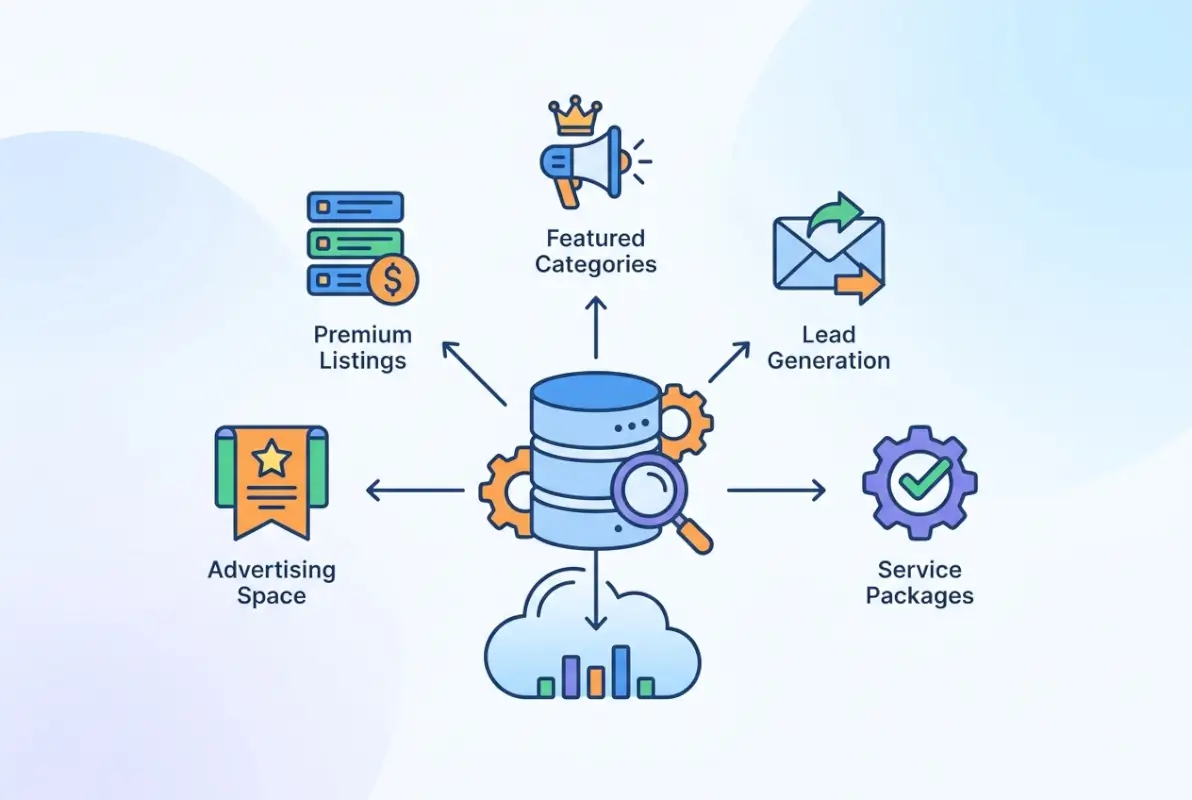
That’s where tiered pricing enters the picture, you create Bronze, Silver, and Gold packages (or Free, Plus, Pro) that bundle incremental value—more photos, video embeds, priority placement in search results, social media badges. I’ve seen directories double their average revenue per user simply by introducing a $49/month tier above their existing $25/month plan. Vendors who are serious about leads will pay for visibility, and those who aren’t can stay on a free or low-cost tier that still populates your directory.
Featured placements take tiering one step further. Instead of bundling features, you auction or sell premium real estate—top-of-category slots, homepage carousels, “Verified” badges. These placements command premium pricing because they’re scarce. If you have 500 plumbers in a city but only five featured spots, the market sets the price. Some directories run these as fixed monthly fees, others use a bidding system similar to Google Ads. Either way, featured placements convert browsing vendors into paying customers faster than any other upgrade.
If you’re using WordPress, tools like TurnKey Directories make it trivial to configure tiered packages and featured-listing logic without custom code. The plugin handles recurring billing, tier-based permissions, and frontend badges automatically. That means you can test pricing models in hours, not weeks—critical when you’re finding product-market fit.
Value-Added Subscriptions and Access
Here’s where most directories miss a huge opportunity: charging buyers, not just vendors. If your directory has valuable search filters, comparison tools, saved-search alerts, or proprietary data (ratings, compliance scores, verified reviews), you can gate that behind a user subscription. Think of it like LinkedIn Premium or Yelp’s business-owner dashboard—users who need more than casual browsing will pay for better tools. Access subscriptions typically range from $10 to $50/month depending on the niche, and they compound over time because churn is lower when users integrate your directory into their workflow.

Data-as-a-service is the next frontier. Once your directory accumulates thousands of listings with structured metadata (hours, certifications, pricing ranges, service areas), that database becomes a product in itself. Third-party apps, market researchers, and even competing platforms will pay for API access or bulk CSV exports. I know a niche healthcare directory that generates $3,000/month licensing its provider database to telehealth startups—revenue that required zero incremental work once the API was built. According to Statista, the data-as-a-service market is projected to exceed $30 billion globally, and even micro-niches can carve out five-figure licensing deals.
To make this work, you need clean, structured data from day one. That means enforcing schema validation on listing submissions—require vendors to fill in every field (address, phone, category tags, hours) rather than accepting free-text bios. The more machine-readable your directory, the more valuable it becomes to API customers. Tools like OWASP provide guidelines for securing API endpoints so you can offer tiered access (read-only for $99/month, full CRUD for $499/month) without exposing your entire dataset.
A hybrid approach works well: offer a free tier with rate limits (100 API calls/day) to attract developers, then upsell to paid tiers when their usage grows. SaaS companies call this “usage-based pricing,” and it aligns incentives perfectly—customers who extract more value from your data pay more, while hobbyists and testers stay free. If you’re curious about business directories still being profitable, data licensing is one of the clearest proof points that directories can scale beyond listing fees.
Lead Generation and Lead-Based Monetization
Lead generation transforms your directory from a passive listing platform into an active matchmaker between buyers and vendors. Instead of charging a flat listing fee, you capture inquiry forms, quote requests, or RFP submissions from users and route qualified leads to businesses willing to pay for them. This model works especially well in niches where the lifetime value of a customer is high—home services, B2B software, professional services, or industrial supplies—because vendors will pay $10 to $200+ per qualified lead.
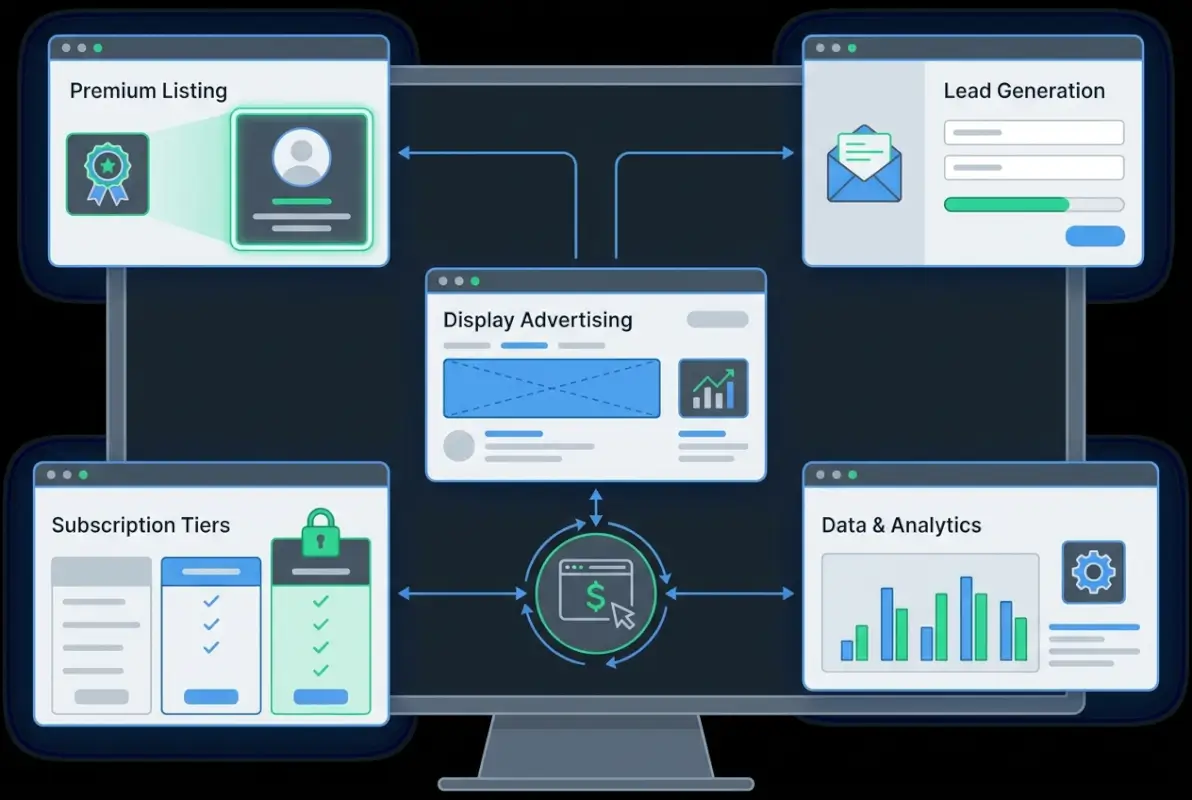
Pay-per-lead (PPL) pricing is straightforward: each time a user submits a contact form or phone number, the receiving business pays a fixed fee or a percentage of the transaction. Pay-per-qualified-lead (PPQL) adds a validation layer—your team or an automated workflow scores leads by completeness, intent signals (budget mentioned, timeline specified), or even a quick phone screen. By filtering out tire-kickers, you command a higher price per lead and reduce churn among your vendor customers.
Beyond raw leads, consider lead-nurturing services: automated email sequences that warm up prospects before handing them off, appointment-setting calls, or CRM integrations that sync inquiries directly into vendor pipelines. These workflow enhancements justify recurring service fees or revenue-share arrangements. Some directories bundle lead validation, drip campaigns, and monthly performance reports into a $199–$999/month “Lead Manager” subscription tier, making the value proposition clear and sticky.
To operationalize lead-gen monetization, start with a prominent “Request a Quote” or “Get Free Estimates” button on every listing and category page. Track conversion rates religiously—aim for 2–5% of visitors submitting an inquiry—and A/B test form length, trust badges, and follow-up messaging. Use a lightweight CRM or a Zapier workflow to distribute leads round-robin or by category preference, and invoice vendors weekly or monthly based on delivered volume.
| Lead Type | Typical Price Range | Qualification Method | Best-Fit Niches |
|---|---|---|---|
| Raw Inquiry | $5–$20 | None (name + email only) | Low-ticket services, events |
| Qualified Lead | $25–$100 | Budget + timeline + phone | Home services, contractors, B2B |
| Hot Transfer / Appointment | $100–$300 | Live call or booked calendar slot | Legal, financial, medical, SaaS |
| Exclusive Enterprise Lead | $300+ | Multi-touch validation + intent scoring | Industrial, wholesale, high-value contracts |
Sponsored Content, Advertising, and Co-Marketing
Sponsored placements let businesses buy their way to the top of search results, category pages, or homepage carousels, offering instant visibility without waiting for organic discovery. A “Sponsored” or “Featured” badge—often in a contrasting color or with a subtle icon—signals the promotion while maintaining editorial integrity. Pricing can be a flat monthly fee ($50–$500 per category), cost-per-impression (CPM), or even cost-per-click if you have robust analytics; many directories find monthly sponsorships easiest to sell and forecast.
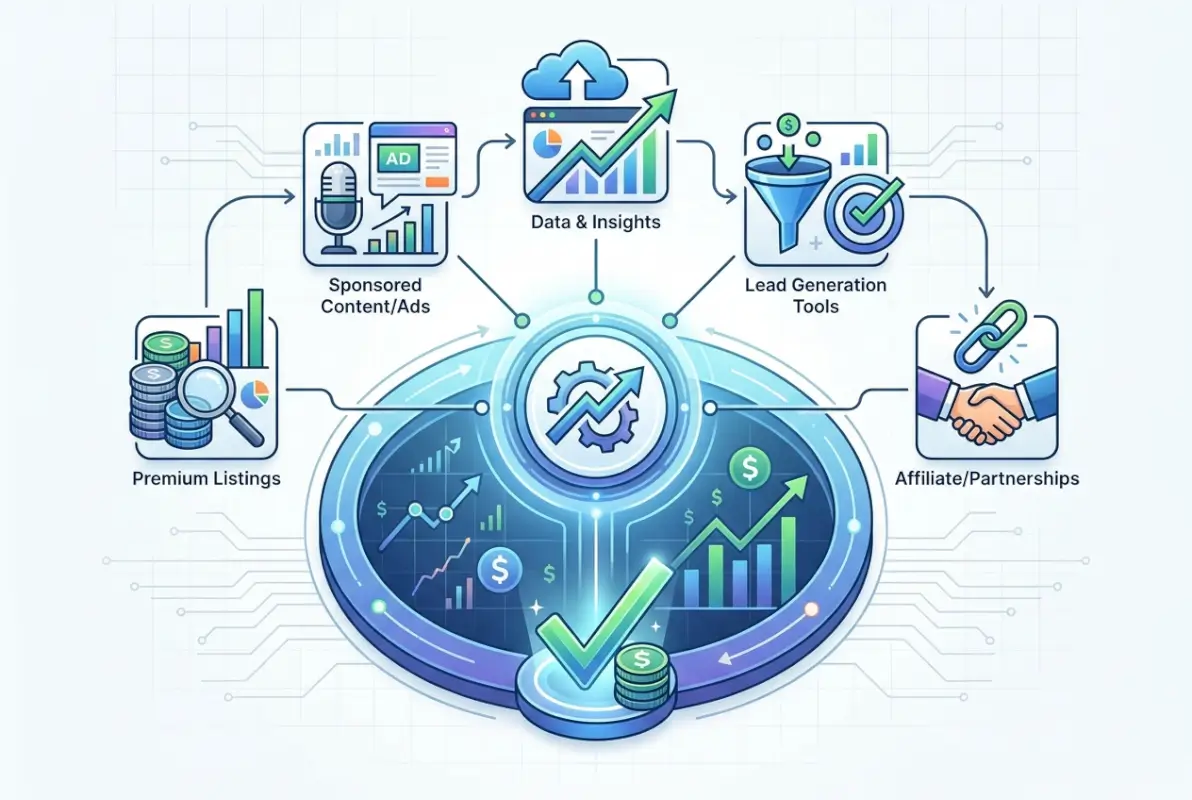
Sponsored posts and advertorials extend the model into content marketing: a vendor pays $200–$2,000 to publish a case study, how-to guide, or industry insight under a “Partner Content” label. These pieces live in your blog or resources section, drive SEO value for both parties, and give sponsors a platform to demonstrate expertise rather than just a listing. Combine sponsored posts with co-branded email blasts or social-media promotion to justify premium pricing and deliver measurable reach.
Display advertising—banner slots, sidebar widgets, or interstitials—remains viable if your directory attracts significant traffic (10,000+ monthly visits). Use Google AdSense or a direct-sales approach for category-specific banners; for example, a plumbing-supply vendor sponsors the entire “Plumbers” category for $300/month, locking out competitors. Newsletter sponsorships are another high-margin play: charge $100–$500 per issue for a logo, 50-word blurb, and call-to-action link in your weekly or monthly digest.
To maximize sponsor revenue, create a media kit that shows traffic by category, user demographics, average session duration, and past sponsor case studies. Offer tiered packages—Bronze (sidebar banner), Silver (category sponsorship + newsletter mention), Gold (homepage hero + sponsored post + email feature)—and bundle a three- or six-month commitment at a 10–20% discount. Track click-through rates and conversions in a shared dashboard so sponsors see ROI and renew automatically.
| Sponsored Product | Format | Monthly Price Range | Ideal Traffic Threshold |
|---|---|---|---|
| Featured Listing Badge | Top-of-results + icon | $50–$500 | 1,000+ visits/mo |
| Category Sponsorship | Banner + header branding | $200–$1,000 | 5,000+ visits/mo |
| Sponsored Post / Advertorial | 1,000–1,500 word article + byline | $200–$2,000 (one-time or recurring) | 3,000+ visits/mo |
| Newsletter Sponsor Slot | Logo + 50-word blurb + CTA | $100–$500 | 2,500+ email subscribers |
| Homepage Hero / Takeover | Full-width banner or video | $1,000–$5,000 | 25,000+ visits/mo |
Data Value, Partnerships, and Ancillary Offerings
Your directory’s structured, categorized business data is itself a product. Market-research firms, software vendors, and enterprise buyers will pay for CSV exports, API access, or white-label versions of your dataset to power their own applications, dashboards, or competitive intelligence. Pricing depends on data freshness, coverage, and exclusivity: a one-time CSV dump might fetch $500–$5,000, while ongoing API access with real-time updates can command $200–$2,000/month per enterprise client.

Beyond raw data licensing, package insights and analytics as premium reports. For instance, compile quarterly benchmarks—average listing views by category, trending search terms, geographic hotspots—and sell them to vendors for $49–$299 per report. Offer tiered subscriptions: $99/month for monthly dashboards, $499/month for custom segmentation and competitor analysis. These products leverage data you already collect, requiring minimal marginal cost while positioning your directory as an industry authority.
Affiliate and partnership programs extend monetization into adjacent services. Embed affiliate links for point-of-sale systems, marketing tools, or business insurance in relevant listing pages; earn 5–30% commission on sign-ups. White-label partnerships let franchisors, trade associations, or regional chambers deploy a branded version of your directory; charge an upfront setup fee ($2,000–$10,000) plus annual licensing ($500–$5,000). Co-marketing agreements—where complementary SaaS platforms integrate your directory data and share revenue—can add $500–$3,000/month in passive income.
To unlock these ancillary streams, invest in clean data architecture: unique business IDs, standardized address formats, verified contact details, and robust category taxonomies. Document your API endpoints and rate limits in a public developer portal, even if you start with just a handful of enterprise prospects. Create sample reports and data dictionaries to share with potential licensees, and consider freemium API tiers (100 requests/day free, $200/month for 10,000 requests) to attract integrators who later convert to paid plans.
| Data/Partnership Offering | Delivery Format | Pricing Model | Buyer Persona |
|---|---|---|---|
| CSV Data Export | Spreadsheet download | $500–$5,000 one-time | Market researchers, sales teams |
| API Access (standard tier) | REST API with JSON responses | $200–$2,000/month | SaaS platforms, app developers |
| Market Insights Reports | PDF or dashboard subscription | $49–$299 per report or $99–$499/month | Vendors, industry analysts |
| White-Label Directory License | Branded subdomain or plugin | $2,000–$10,000 setup + $500–$5,000/year | Trade associations, franchisors, chambers |
| Affiliate / Co-Marketing Revenue | Embedded links or integration | 5–30% commission or $500–$3,000/month rev-share | Complementary SaaS, service providers |
Frequently Asked Questions
What are the most common monetization models for a business directory?
The most common models include paid listings (subscription or one-time fees), freemium tiers with premium placements, pay-per-lead generation, sponsored content and advertising, and data licensing or API access. Most successful directories combine two or three of these streams to diversify revenue and maximize average revenue per user.
How much can a directory realistically earn per month?
Monthly earnings vary widely based on niche, traffic, and monetization mix. Small niche directories often earn $500–$2,000 monthly from basic listings and ads. Mid-tier directories with quality data and lead-gen can reach $5,000–$15,000, while established platforms commanding enterprise partnerships and API licenses may exceed $50,000 monthly.
Do buyers pay for listings, or is it mainly advertisers?
In most directories, businesses being listed (vendors or service providers) pay for premium placements or enhanced profiles. Advertisers—brands seeking visibility—contribute through display ads or sponsorships. Increasingly, some directories also charge buyers or end-users for access to premium search features, analytics, or exclusive content, creating a dual-sided revenue model.
Is data licensing viable for directories, and what are typical price ranges?
Data licensing is viable once your directory achieves strong data quality and coverage. Typical API or bulk-data licenses range from $200 to $2,000 per month per client, depending on data volume, exclusivity, and freshness. Enterprise contracts or white-label partnerships can command significantly higher fees, often $5,000 to $20,000 monthly.
How do I choose the right mix of monetization methods for my niche directory?
Start by identifying your audience’s buying behavior and competition. If businesses compete for visibility, prioritize paid and featured listings. If lead quality matters, implement pay-per-lead. For high-trust niches with valuable data, add subscriptions or API access. Test one or two streams early, measure conversion, then layer additional models as traffic and authority grow.
Can I monetize a directory without charging businesses for listings?
Yes. You can offer free basic listings and monetize entirely through advertising, sponsored placements, affiliate partnerships, or charging end-users for premium access and analytics. This freemium approach builds volume quickly and works well when your traffic or data attracts sponsors and partners willing to pay for exposure or intelligence.
What is the best way to package directory services for recurring revenue?
Package services into tiered monthly or annual subscriptions. For example, offer Basic (free listing), Pro (featured placement and analytics), and Enterprise (priority support, API access, and lead routing). Clear tier naming, transparent feature lists, and annual-discount incentives drive predictable recurring revenue and improve lifetime customer value.
Should I add lead generation immediately or wait until my directory has traffic?
Wait until you have consistent monthly traffic and a critical mass of quality listings. Lead generation requires trust and volume; buyers will not submit inquiries if your directory looks sparse. Build foundational traffic with free listings and SEO, then introduce lead-gen forms and pay-per-lead pricing once you can demonstrate inquiry quality to vendors.
Ready to Turn Your Directory Into a Revenue Engine
Building a profitable business directory is no longer about choosing a single monetization path. The most successful operators layer multiple streams—paid and featured listings for immediate cash flow, subscriptions for predictable recurring revenue, lead generation to align with vendor ROI, sponsored content to tap brand budgets, and data products or API access to unlock enterprise deals. Each model complements the others, letting you diversify risk and capture value at every stage of the user journey.
Start by selecting one or two foundational offerings that align with your niche and audience behavior. If your directory serves competitive local markets, premium listings and featured placements will deliver quick wins. If you operate in a high-trust vertical with deep data, prioritize subscriptions and lead-gen. As you gain traction, test additional revenue streams in parallel, measure conversion rates, and double down on what works. The five core service categories outlined in this guide give you a proven framework to build, test, and scale without guesswork.
Remember, monetization is not a one-time decision. Your revenue mix will evolve as your traffic grows, your data improves, and your understanding of customer willingness-to-pay deepens. Keep pricing tiers simple and transparent, invest in data quality and user experience, and communicate value clearly at every touchpoint. Whether you’re just launching or looking to diversify an established directory, the strategies in this post provide a roadmap to sustainable, scalable income.
Take Action Today
Choose one monetization stream from this guide and implement it this week. Map out your pricing tiers, draft your feature list, and set up the infrastructure to capture payments or leads. The sooner you start testing, the sooner you’ll unlock real revenue and validate your directory’s earning potential.
Need more guidance? Explore the linked resources throughout this article for in-depth case studies, pricing benchmarks, and technical implementation tips. Your directory’s next revenue milestone is one offering away.
Was this article helpful?