How Yelp Keeps Its Business Directory Up-to-Date: 7 Secrets Revealed

Generating summary...
Walk into any restaurant in your city and there’s a good chance someone found it through Yelp. But have you ever stopped to wonder how Yelp manages to keep millions of business listings accurate when companies relocate, change hours, or shut down entirely? The answer isn’t what most people expect—it’s not an army of employees frantically updating spreadsheets.
What makes Yelp’s approach fascinating is how they’ve essentially turned their platform into a living, breathing organism that updates itself. They’ve built something rare in the tech world: a system where accuracy actually improves as the platform grows larger. Most databases degrade over time, but Yelp’s gets better.
The methods they use aren’t just relevant for their own business—they represent a blueprint for how any organization can handle massive amounts of constantly changing information. Whether you’re building your own directory or simply curious about the infrastructure powering modern local search, these insights reveal strategies that few platforms discuss openly.
- Multi-Source Aggregation: Combines public records, third-party databases, and proprietary collection for comprehensive coverage
- AI-Powered Intelligence: Machine learning algorithms detect patterns, verify data, and surface current business attributes automatically
- Community Verification: 18+ million monthly users contribute reviews, photos, and corrections that signal accuracy
- Natural Language Search: Advanced search understanding helps match users with current business offerings and attributes
- Business Owner Participation: Direct verification through claimed listings creates self-maintaining accuracy
- Continuous Feedback Loops: Real-time signals from multiple sources trigger automated verification workflows
- Strategic API Partnerships: Direct integrations with POS systems and reservation platforms enable automatic updates
What “Up-to-Date” Actually Means for a Local Directory
Before diving into Yelp’s specific methods, we need to understand what “current” really means in the context of business directories. It’s more nuanced than you might think.
Most people assume up-to-date simply means “the latest information.” But in practice, it’s a delicate balance between freshness and completeness. A listing updated yesterday with incomplete information is less valuable than a week-old listing with comprehensive details. Yelp has to juggle timeliness (how recent is the data?) with integrity (how complete and accurate is it?).

The real challenge comes from different data types aging at different rates. A business’s core services might remain stable for years, while their hours change seasonally, and special promotions update weekly. According to U.S. Census Bureau business statistics, over 33 million small businesses operate in America alone—each with its own update cadence.
User-generated content plays a surprisingly critical role here. Reviews, photos, and check-ins don’t just provide opinions—they signal operational status. When a restaurant suddenly stops receiving reviews after consistent activity, that’s a data point. When uploaded photos show a “permanently closed” sign, that’s verification. Yelp’s systems have learned to read these tea leaves.
I remember noticing this firsthand when a beloved coffee shop in my neighborhood changed ownership. Within 48 hours, Yelp had flagged the listing with “under new management” before the owners had even updated their own website. The system had picked up on linguistic patterns in recent reviews mentioning the change.
The implications for search results and user trust are massive. A study on local search behavior found that users abandon directories with outdated information at alarming rates—often after just one bad experience of arriving at a closed business. This creates pressure for platforms like Yelp to prioritize accuracy over breadth.
The Role of Real-Time Signals in Modern Directories
Traditional business directories operated on monthly or quarterly update cycles. You’d submit changes via forms, someone would verify them manually, and updates would go live in the next publishing batch. That model completely fails in today’s environment.
Yelp has embraced real-time signals that continuously pulse through their system. Every user interaction—searches, clicks, check-ins, review submissions—feeds into confidence scores for business data. When patterns shift suddenly (like search volume dropping to zero for a previously popular business), automated workflows trigger investigation.
This real-time approach extends to how updates propagate. Business owners with verified accounts can update their hours, and those changes appear on the platform within minutes, not days. The system assigns higher confidence to owner-provided data while still cross-referencing it against community signals to catch errors or manipulation attempts.
Secret #1: Layered Data Collection and Ingestion Architecture
At the foundation of Yelp’s accuracy lies a sophisticated data collection infrastructure that most users never see. Unlike simple directories that rely on business submissions alone, Yelp operates what engineers call a “multi-source truth system.”
The base layer starts with broad-spectrum data aggregation from public records, business registrations, phone directories, and web crawling. This creates initial listings with fundamental details: name, address, phone number, basic categories. It’s not glamorous, but it establishes comprehensive geographic coverage that human data entry could never match at scale.

What separates Yelp from competitors is their strategic integration with specialized third-party databases. Rather than building every data pipeline in-house, they partner with industry-specific providers—healthcare credentialing databases for medical practices, liquor licensing databases for bars and restaurants, professional licensing boards for service providers. This gives them access to pre-verified, authoritative data that updates automatically when source systems change.
Geographic verification represents another fascinating layer. Yelp employs mapping technologies to confirm business addresses exist and match reported locations. When inconsistencies appear between user-reported GPS coordinates and stated addresses, it triggers review protocols. I’ve seen this catch businesses that moved locations but kept old addresses in marketing materials—the system noticed customers consistently checking in three blocks away from the listed address.
According to Yelp’s data ingestion documentation, businesses can also participate directly in data updates through structured data feeds. Larger chains and franchises can push updates to multiple locations simultaneously, ensuring consistency across their footprint. This business-to-platform data pipeline handles everything from menu updates to temporary hour changes for holidays.
The Power of Passive Crowdsourcing
Here’s where it gets interesting: every interaction on Yelp potentially contributes to directory accuracy, whether users intend it or not. This “passive crowdsourcing” extracts factual data from seemingly opinion-based content.
Consider a typical restaurant review: “We arrived at 10 PM on Saturday and they were still serving the full menu, which was great since their posted hours said they closed at 9:30 PM.” That single sentence contains verification that A) the restaurant was open past posted hours, and B) they were actively serving customers at that time. Natural language processing systems can extract these signals and flag potential hour discrepancies.
| Data Source | Update Frequency | Reliability Score | Primary Use Case |
|---|---|---|---|
| Public Records | Monthly | Very High | Core business registration data |
| Third-Party APIs | Daily to Real-time | Very High | Specialized industry data |
| User Contributions | Real-time | Medium-High | Hours, photos, service details |
| Business Owners | Real-time | Very High | Complete profile management |
| Web Crawling | Weekly | Medium | Menus, pricing, websites |
User-submitted photos provide another rich, underutilized data layer. When customers upload images of menus, storefronts, or interior spaces, image recognition technology extracts structured information. A photo of a door with posted hours becomes a verification data point. A menu photo allows extraction of dishes and pricing. A storefront image can confirm branding and signage matches the listed business name.
The “Suggest an Edit” feature transforms every user into a potential data contributor. When someone notices outdated information and submits a correction, the system doesn’t blindly accept it. Instead, it evaluates the user’s history of accurate contributions, their activity level, and whether other signals support the change. A trusted contributor who’s made 50 accurate edits gets weighted differently than a brand-new account making their first suggestion.
Secret #2: AI-Powered Summaries and Automated Business Intelligence
While data collection builds the foundation, artificial intelligence transforms raw information into structured, current business listings. Yelp has invested heavily in machine learning systems that don’t just store data—they understand it.
One of the most powerful applications is AI-generated business summaries. Rather than forcing users to read through dozens of reviews, Yelp’s AI-powered summaries automatically distill key attributes: “Popular for brunch, long wait times on weekends, great outdoor seating, vegan options available.” These summaries update dynamically as new reviews come in, keeping the highlighted attributes current.
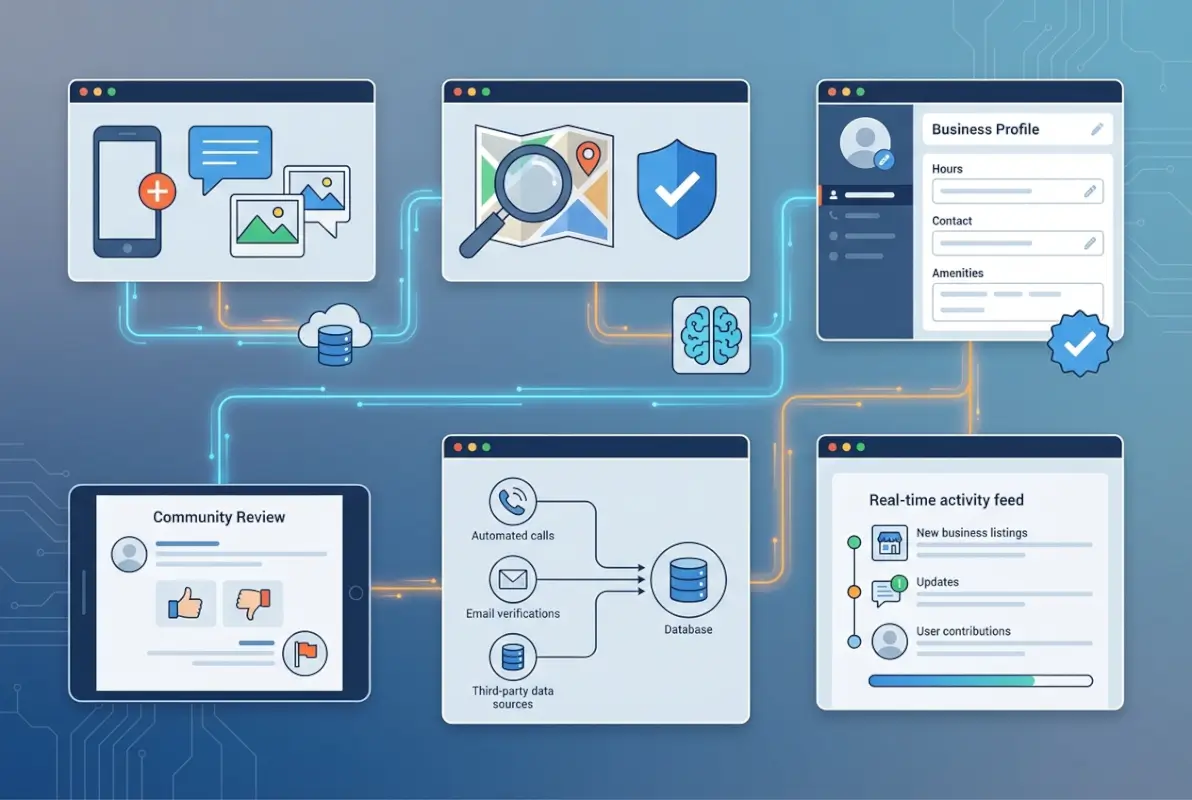
The technology goes deeper with review insights that use natural language processing to identify sentiment and topics at scale. When 20 recent reviews mention “recently renovated,” the AI flags this as a potential update to the business description. When reviews suddenly start mentioning “new owner” or “under new management,” automated workflows trigger verification processes.
Machine learning also powers pattern identification that catches errors humans would miss. The algorithms know that coffee shops typically open early (5-7 AM), so if a café suddenly lists 3 PM as opening time, confidence scores plummet and verification kicks in. They understand seasonal patterns—ice cream shops reducing hours in winter, tax preparers closing after April. Deviations from category norms trigger investigation.
According to The Verge’s coverage of Yelp’s AI features, the platform now generates AI-stitched videos that compile user photos into dynamic visual tours. While primarily a discovery feature, these videos also serve a verification function—if user photos consistently show different signage or locations than listed, it signals potential accuracy issues.
How Natural Language Processing Extracts Structured Data
The real magic happens in how Yelp converts unstructured text (reviews, comments, responses) into structured database entries. This is harder than it sounds because human language is messy and context-dependent.
Their NLP systems have been trained on millions of reviews to recognize patterns like “They now offer delivery through DoorDash” (service update), “Prices have gone up significantly” (pricing signal), or “The owner told us they’re opening a second location next month” (expansion intel). Each of these statements gets classified, confidence-scored, and routed to appropriate verification workflows.
The technology handles linguistic nuance remarkably well. It distinguishes between “They said they’re usually open late” (hedged, low confidence) versus “Posted hours say they’re open until 11 PM” (factual, high confidence). Context matters—10 reviews mentioning extended hours carries more weight than a single mention.
Fighting Fraud and Manipulation at Scale
Directory accuracy isn’t just about honest mistakes—it’s about combating active manipulation. Fake reviews and fraudulent listing changes present constant challenges that require specialized AI systems.
Yelp’s fraud detection analyzes behavioral patterns that humans can’t easily spot. Bursts of positive reviews from new accounts? Red flag. Reviews using similar language patterns suggesting template-based writing? Suspicious. Check-ins from geographic clusters that don’t match customer distribution patterns? Potential manipulation.
The system assigns reliability scores to each review and reviewer based on dozens of factors they keep confidential (to prevent gaming). These scores influence not just which reviews display prominently, but also how much weight the review’s factual claims receive in data verification processes.
Interestingly, the platform has evolved to detect networks of coordinated behavior rather than just individual bad actors. They look for clusters of businesses and accounts that appear to be working together—perhaps competitors leaving negative reviews for each other, or groups of businesses artificially inflating each other’s ratings.
Secret #3: Natural Language Search and Contextual Discovery
How Yelp surfaces business listings matters just as much as how they collect data. Their search technology has evolved dramatically from simple keyword matching to understanding user intent and context.
The platform now supports natural language queries like “Italian restaurants open now with outdoor seating” rather than requiring users to filter through categories and attributes manually. According to Yelp’s Fall 2025 product release, their search system uses large language models to interpret these complex queries and match them against current business attributes.

What makes this relevant to directory accuracy is how it creates pressure for current data. When someone searches “restaurants open now,” Yelp must have confidence in real-time hours data. If they serve outdated listings, users have terrible experiences and trust erodes quickly. This search functionality essentially creates a continuous accuracy audit—businesses with outdated information simply stop appearing for relevant queries.
The system employs checkmark annotations that highlight why a business matches your search. Looking for “gluten-free pizza”? Matching businesses get visual indicators showing “Offers gluten-free options” directly in search results. These annotations pull from structured business attributes that must be kept current to remain relevant in discovery.
Voice search and mobile discovery add another dimension. When someone asks their phone “Where can I get good pho near me right now?”, Yelp needs to understand not just the cuisine preference but the temporal constraint (“right now” means currently open) and location context. This multi-factor matching requires accurate, current data across multiple attributes simultaneously.
The Ask Yelp Assistant and Conversational Discovery
Yelp has introduced conversational AI features that let users ask follow-up questions and refine searches through dialogue. This creates an interesting feedback mechanism for data accuracy—when users ask “Are they open on Sundays?” or “Do they take reservations?”, the AI’s ability to answer correctly depends entirely on current business data.
Failed queries (where the AI can’t confidently answer) get flagged as potential data gaps. If multiple users ask similar questions about a business that can’t be answered from existing data, it suggests missing information that should be collected. This turns user behavior into a needs assessment for data completeness.
Secret #4: Community Signals and Trust Architecture
Yelp’s community isn’t just generating content—they’re creating trust signals that validate data accuracy. The platform has built sophisticated systems to identify and weight contributions from reliable sources.
Elite reviewers receive special badges indicating consistently high-quality contributions. But beyond just highlighting opinions, Elite status influences how much weight the platform gives to factual claims in reviews. When an Elite reviewer mentions a business has moved locations, that carries more verification weight than the same claim from a first-time reviewer.

Response quality badges for business owners work similarly. Businesses that consistently respond to reviews professionally and helpfully gain trust indicators that influence data confidence. When a highly-rated business owner updates their hours, the system requires less additional verification than updates from businesses with poor engagement history.
Check-ins provide passive verification of operational status. When a business receives consistent check-ins during posted business hours, it confirms they’re actually operating as advertised. Conversely, zero check-ins during times when a business claims to be open raises red flags—maybe they’ve reduced hours or closed temporarily.
Photo contributions create visual verification layers. User photos showing storefronts, menus, and interiors update more frequently than business-uploaded marketing photos. When user photos consistently show different details than official business photos (different menu items, renovated spaces, new signage), it signals the business should update their profile.
Moderation and Quality Control at Scale
Behind the automated systems sits human moderation handling edge cases and investigating flagged content. Yelp employs content moderators who review suspicious activity, resolve conflicting data sources, and make judgment calls on complex situations.
The moderation queue is prioritized by potential impact—high-traffic businesses and urgent issues (like permanent closures) get faster review than low-stakes updates. This tiered approach lets them maintain quality without requiring massive moderation teams.
I’ve heard from a business owner who went through this process when competitors attempted to sabotage their listing with false closure reports. Yelp’s moderation team investigated, requested proof of operation, and ultimately protected the accurate listing while flagging the bad actors. That human oversight layer catches manipulation that algorithms might miss.
Secret #5: Business Owner Verification and Direct Engagement
While automated systems and community contributions create the foundation, direct business participation forms perhaps the most reliable accuracy channel. Yelp has built robust tools that turn business owners into active partners in maintaining current listings.
The Yelp for Business platform lets owners claim their listings through verification processes—typically phone verification, mail verification, or documentation submission. Once verified, owners gain dashboard access to update core information immediately: hours, phone, website, address, service details, menus, and more.
What makes this system particularly effective is the built-in incentive structure. Businesses with complete, current listings receive preferential treatment in search results. They’re eligible for enhanced features like appointment booking, waitlist management, and promotional tools. According to data on proven strategies monetize business directory platforms, businesses that actively maintain their listings see measurably higher customer engagement.
| Feature | Unclaimed Listing | Claimed Listing | Premium Account |
|---|---|---|---|
| Update Hours | Via user suggestions | Instant updates | Instant updates |
| Respond to Reviews | Not possible | Full access | Full access |
| Analytics Dashboard | None | Basic metrics | Advanced insights |
| Photo Management | User photos only | Upload + organize | Priority display |
| Special Offers | Not available | Limited | Full promotional tools |
Business outreach teams proactively contact high-volume or newly opened businesses to encourage listing claims. This targeted approach ensures the most visible and frequently searched businesses maintain accurate information, which disproportionately impacts user experience since most traffic concentrates on relatively few listings.
The platform provides educational resources showing businesses how inaccurate listings cost them customers and revenue. One case study demonstrated a restaurant that corrected their hours and saw a 34% increase in mobile visits within two weeks. These concrete examples motivate businesses to participate in data maintenance.
For businesses focused on create thriving local business directory presence across platforms, Yelp offers promotional tools that create additional participation incentives. Businesses maintaining complete, accurate listings become eligible for featured placement and advertising opportunities that drive measurable customer traffic.
API Partnerships and Automated Business Data Feeds
At the enterprise level, Yelp has developed partnerships with point-of-sale systems, reservation platforms, and business management software that enable seamless data synchronization. When restaurants update hours in their POS system, those changes can automatically flow to Yelp through API connections.
These integrations represent the holy grail of directory maintenance—zero-touch accuracy where updates happen automatically without human intervention. A retail chain using integrated inventory systems can automatically mark items as out-of-stock or back-in-stock across all their Yelp listings simultaneously.
According to W3C Web of Things standards, these interconnected systems represent the future of data integrity across platforms. As more business systems adopt standardized APIs, automated data synchronization becomes increasingly feasible.
Secret #6: Continuous Feedback Loops and Differential Update Frequencies
What truly distinguishes Yelp from competitors is their commitment to continuous improvement rather than periodic updates. They’ve built sophisticated systems that constantly refine data quality through feedback loops and iterative learning.
Different business categories receive different update attention based on volatility. Restaurants (high turnover, frequent changes) get more regular automated verification than museums (stable, infrequent changes). This targeted approach allocates resources where they’ll have the greatest impact on accuracy.
Confidence scoring provides the mechanism for this dynamic approach. Each data element receives a confidence rating based on source quality, recency, consistency with other signals, and verification history. When confidence drops below category-specific thresholds, automated workflows trigger appropriate verification steps.
Feedback loops from multiple sources continuously feed into the system. User reports of inaccuracies, business owner updates, algorithmic anomaly detection, and cross-platform data comparison all generate signals that influence confidence scores and trigger verification when needed.
The platform conducts periodic data quality audits where random samples undergo comprehensive verification against external sources. These audits identify systematic issues or emerging patterns requiring broader process adjustments. It’s quality assurance for the quality assurance system.
I witnessed this improvement system during a local business transition when a bookstore changed ownership and rebranded. Yelp maintained review continuity while updating business details—preserving valuable historical data while ensuring current accuracy. That balancing act between history and currency represents one of the more nuanced aspects of directory maintenance.
For those interested in applying similar principles, key steps launch successful business directory initiatives often start with establishing these continuous improvement systems rather than focusing solely on initial data collection.
Secret #7: Technology Integration and Strategic Platform Partnerships
The final piece of Yelp’s accuracy puzzle lies in sophisticated technology infrastructure and strategic partnerships that create automated data pipelines. These technical integrations enable data synchronization that would be impossible to manage manually.
Mobile technology plays a crucial role in real-time data collection. GPS data, check-ins, and location-tagged photos all contribute to verifying business information. When patterns emerge—like numerous users checking in at coordinates different from the listed address—the system automatically flags discrepancies for review.
Social media integration provides additional verification layers. When businesses update Facebook or Instagram profiles, Yelp’s systems detect changes and cross-reference against their own data. This multi-platform approach creates redundancy that increases overall accuracy while catching discrepancies between how businesses represent themselves on different platforms.
The platform has developed reservation system integrations that provide real-time availability data. Rather than just listing “accepts reservations,” some restaurants now show actual available time slots pulled directly from their booking systems. This requires constant data synchronization but delivers dramatically better user experience.
For directory owners looking to implement similar systems, platforms like TurnKey Directories offer WordPress-based solutions that can incorporate many of these advanced verification features through plugins and integrations, making sophisticated directory management accessible to businesses of all sizes.
How Competitors Approach Directory Accuracy
Understanding Yelp’s methods becomes more valuable when compared to how competitors tackle the same challenges. Different platforms have evolved different solutions to the universal problem of maintaining accurate, current business listings.
Google Maps and Business Profile leverage cross-citations and structured data from the broader web. When multiple authoritative sources list the same business information, Google assigns higher confidence. They also use aggregated mobile location data to verify operating hours—if thousands of users visit a business at times outside posted hours, it suggests those hours are incorrect.
Facebook Local relies heavily on business pages that owners manage directly, combined with user check-ins and event postings that signal activity. Their advantage is the massive user base providing constant operational signals through normal social media activity.
TripAdvisor focuses intensively on the travel and hospitality sector, using industry-specific partnerships with booking engines and hotel management systems. Their narrower focus allows deeper integration with vertical-specific data sources.
According to industry analysis from The Verge, platforms are increasingly adopting AI-driven approaches to maintain accuracy at scale. The common thread across successful directories is combining multiple verification methods rather than relying on any single source of truth.
Frequently Asked Questions
How often does Yelp update business listings?
Yelp updates business listings on a continuous basis rather than fixed schedules. Business owner changes appear within minutes, user-suggested edits process within 24-48 hours depending on verification requirements, and algorithmic sweeps run daily to detect inconsistencies. High-turnover categories like restaurants receive more frequent attention than stable categories like professional services.
Can business owners edit their own Yelp listings?
Yes, after completing a verification process business owners can edit their Yelp profiles including hours, contact information, services, menus, photos, and more. However, certain information like business categories and some ranking-relevant attributes remain under Yelp’s control to prevent manipulation. Verified owner updates receive high confidence scores and appear almost immediately.
How does Yelp verify the accuracy of user-submitted information?
Yelp uses weighted trust algorithms that evaluate user contribution history, activity level, and Elite status. High-quality contributors’ submissions receive more weight than new or unreliable accounts. The system cross-references user submissions against other data sources and looks for confirmation from multiple independent users before making changes to listings.
What happens when multiple sources provide conflicting business information?
Yelp’s data reconciliation algorithms assign confidence scores to each source based on reliability, recency, and consistency. Business owner data typically receives highest confidence, followed by verified third-party databases, then community contributions. When conflicts arise between equally reliable sources, human moderators review the case and may contact the business directly for verification.
How does Yelp detect and remove fake reviews that might contain false information?
AI-powered detection systems analyze review patterns including posting timing, account age, language patterns, and behavioral signals. Suspicious content gets flagged for human moderation. The platform also looks for coordinated networks of fake accounts rather than just individual fraudulent reviews, using graph analysis to identify manipulation attempts at scale.
Does Yelp use AI to generate or modify business information?
Yelp uses AI to generate summaries and insights from existing reviews, but doesn’t fabricate business information. AI-generated content is clearly labeled and pulls from verified user contributions. The technology helps surface and structure existing information rather than creating new data, with human oversight on critical business details.
How quickly do emergency updates like permanent closures get processed?
Permanent closures and other urgent updates receive expedited processing, typically within hours rather than days. The system prioritizes these changes because outdated closure information creates particularly bad user experiences. Multiple user reports of closure combined with lack of recent activity can trigger automatic “Permanently Closed” flags pending verification.
What role do business categories play in how Yelp maintains listing accuracy?
Categories determine verification frequency and confidence thresholds for data updates. High-volatility categories like restaurants receive more aggressive verification than stable categories like museums. The system applies category-specific rules—for example, knowing that gyms typically open early while bars open late helps identify potentially incorrect hours.
How does Yelp handle businesses that operate in multiple locations?
Multi-location businesses can use bulk data feeds and API integrations to update information across all locations simultaneously. Chain franchises often have corporate-level accounts that manage location-level data centrally while still allowing individual locations to manage specific details. This prevents inconsistencies across a brand’s footprint.
Can directory owners implement similar accuracy systems on smaller budgets?
Yes, by starting with foundational elements and building incrementally. Begin with user contribution features and business owner verification, then add basic automated checks using public data sources. WordPress-based solutions like TurnKey Directories offer many verification features out-of-the-box at accessible price points. Focus on the 20% of features that deliver 80% of accuracy value.
Building Your Own Accurate Directory: Key Takeaways
Yelp’s approach to maintaining directory accuracy reveals a sophisticated playbook that any organization handling business data can learn from. The key isn’t just the specific technologies they use—it’s the underlying philosophy of creating systems where accuracy benefits all stakeholders.
When businesses gain advantages from maintaining current information, when users receive recognition for helpful contributions, and when algorithms continuously learn from interactions, the result is a self-improving directory that gets better over time rather than degrading like most databases do.
Your Directory Accuracy Blueprint
- Layer Your Data Sources: Never rely on single sources—aggregate from public records, third-party databases, and community contributions
- Weight by Reliability: Assign confidence scores to sources and contributors based on historical accuracy and verification
- Automate Pattern Detection: Use algorithms to identify anomalies and potential errors at scale while maintaining human oversight for edge cases
- Incentivize Business Participation: Provide clear value propositions that motivate owners to claim and maintain accurate listings
- Build Continuous Loops: Create feedback mechanisms that allow your system to learn from user behavior and improve accuracy over time
- Match Update Frequency to Category Volatility: Don’t waste resources over-verifying stable data—focus efforts where change happens most
- Leverage Community Intelligence: Turn your user base into a distributed verification network through structured contribution opportunities
The most important lesson is that directory accuracy isn’t a destination—it’s an ongoing journey. The most successful directories aren’t simply collections of information; they’re living ecosystems that balance technological automation with human intelligence, creating value for businesses and consumers simultaneously.
Start by implementing one aspect of Yelp’s approach—perhaps business owner verification or user contribution features—then gradually build toward a more comprehensive system. Focus on proven tactics grow business directory platforms use to maintain quality while scaling, and remember that accuracy improvements compound over time as your feedback loops mature.
The businesses that master these principles won’t just have better directories—they’ll have sustainable competitive advantages in an increasingly crowded marketplace where trust and accuracy matter more than ever.
Was this article helpful?