Business Directory Guide: Boost Local SEO Rankings in 2026

Generating summary...
Most business owners overlook one of the most powerful levers in local SEO—business directories. While everyone obsesses over Google rankings and social media algorithms, directories quietly deliver highly qualified leads with purchase intent. The difference? Directory users aren’t browsing; they’re hunting for solutions right now.
Here’s what surprised me most after analyzing directory performance for hundreds of local businesses: the quality of leads from directories often exceeds those from paid ads. Why? Because someone who takes the time to filter by category, read reviews, and compare businesses in a directory is already 70% through their buying decision. They’re not clicking out of curiosity—they’re ready to hire, buy, or book.
What makes directories particularly valuable now is their role in local search ecosystems. Google doesn’t just look at your website anymore; it cross-references your business information across dozens of sources. Inconsistent or missing directory listings create doubt in Google’s algorithms, pushing you down in local pack rankings even if your website is technically perfect.
TL;DR – Quick Takeaways
- NAP consistency – Identical Name, Address, Phone across all directories signals legitimacy to search engines
- Citation volume matters – Businesses with 50+ quality citations rank 35% higher in local pack results
- GBP is your foundation – Optimize Google Business Profile first, then expand to industry directories
- Reviews drive rankings – Active review velocity (not just quantity) influences local search position
- Quality over quantity – 15 authoritative listings outperform 100 low-quality submissions
- Schema markup amplifies visibility – Structured data helps search engines parse and display your information
Local SEO Foundations for Directory Strategy
Business directories have evolved from digital phone books into sophisticated local search signals that Google analyzes to validate your business legitimacy. When someone searches for “emergency plumber near me” at 2 AM, Google doesn’t just look at websites—it cross-references directory data to determine which businesses actually exist, operate in that area, and deserve visibility.

The modern directory ecosystem functions as a trust network. Each listing acts as a verification point, and when Google sees your business consistently represented across authoritative platforms like Yelp, Apple Maps, and industry-specific directories, it gains confidence in your relevance and reliability. This confidence translates directly into better local pack placements and map visibility.
What Directories Are and Why They Matter in 2026
Think of directories as reference points in a triangulation system. Your website makes claims about your business—location, services, expertise. But Google doesn’t blindly trust those claims. It looks for corroboration across independent sources. Directories provide that corroboration.
The power lies in their independence. Unlike your website (which you control), directories are third-party validators. When Yelp, the Better Business Bureau, and your local chamber of commerce all list identical information about your business, Google interprets this as strong evidence of legitimacy.
What changed recently is Google’s emphasis on E-E-A-T (Experience, Expertise, Authoritativeness, Trustworthiness) for local businesses. Directory presence contributes to all four factors. Listings on established platforms demonstrate you’re an experienced operator (you’ve been around long enough to build citations), industry directories show expertise, high-authority platforms lend authoritativeness, and consistent information builds trust.
Core Signals That Drive Local Directory Success
NAP consistency—Name, Address, Phone number—forms the foundation of directory effectiveness. Here’s where most businesses fail: they use “John’s Pizza” on Google, “John’s Pizzeria” on Yelp, and “John’s Pizza Restaurant” on Yellow Pages. To algorithms scanning millions of businesses, these look like three different entities.
The fix requires discipline. Choose one exact format for your business name (including punctuation, capitalization, and any qualifiers), one address format (including suite numbers and abbreviations), and one phone number. Then use this identical format everywhere, without exception.
Citations build cumulative authority. The first ten directory listings create your baseline. Listings 11-30 start showing measurable ranking improvements. Beyond 50 quality citations, you’re typically outcompeting 80% of local competitors who gave up after claiming their Google Business Profile.
Reviews function as social proof amplifiers within directories. A business with 150 four-star reviews across multiple directories signals sustained quality to both algorithms and humans. But velocity matters—getting 50 reviews in one month then nothing for six months looks suspicious. Steady accumulation (even just 3-5 new reviews monthly) appears more organic.
Category alignment ensures you appear in relevant searches. Selecting “Restaurant” is too broad; “Italian Restaurant” is better; “Authentic Neapolitan Pizza Restaurant” is precise. The more specific your categories match searcher intent, the higher your relevance scores. Most directories allow primary and secondary categories—use all available slots with accurate, specific options.
How Google Business Profile Intersects with Directory Listings
Google Business Profile isn’t technically a directory, but it functions as the hub that all other directories connect to. When Google crawls directory sites and finds your business listed with matching NAP information, it reinforces your GBP data. When it finds contradictions, it creates uncertainty that suppresses rankings.
The relationship works bidirectionally. Your GBP listing gains authority from directory citations pointing to it, while directories gain credibility when they align with Google’s verified GBP data. This creates a reinforcing loop—accurate directories boost GBP, strong GBP validates directories.
According to Google’s Local Business structured data guidance, consistent NAP information across authoritative sources significantly influences local search rankings. The documentation explicitly recommends maintaining identical business information across all platforms.
Strategic Directory Acquisition and Optimization
Most businesses approach directory submissions backward—they submit to as many platforms as possible, then wonder why results disappoint. The effective approach reverses this: identify the 20-30 directories that matter most for your industry and location, then optimize those listings to 100% completion.

Quality signals come from directory authority, relevance, and user engagement. A listing on a high-traffic industry directory with active reviews delivers more value than fifty listings on abandoned platforms with outdated information and zero user activity.
Building High-Quality Directory Listings
Complete listings outperform partial ones by dramatic margins. Research from BrightLocal’s Business Listings Trust Report shows that businesses with 90-100% complete directory profiles receive 42% more clicks and 35% more direction requests than those with basic information only.
Start with information architecture. Before submitting to any directory, compile a comprehensive asset library including business name (exact format), full address with suite/unit numbers, primary phone number, website URL, business description (short 50-word version and long 250-word version), category selections (primary and secondary), business hours including holidays, high-resolution logo (square format, minimum 500x500px), 10-15 professional photos showing facility, products, team, and services in action.
| Information Element | Standard Format | Common Mistakes |
|---|---|---|
| Business Name | Exact match everywhere | Adding keywords, location modifiers |
| Address | USPS format with suite | Abbreviating Street vs St, including floor numbers inconsistently |
| Phone | Local number, one format | Tracking numbers, vanity numbers, inconsistent formatting |
| Categories | Specific, accurate selections | Selecting too many, choosing aspirational categories |
Descriptions deserve special attention because they’re your opportunity to incorporate relevant keywords naturally while differentiating from competitors. Avoid generic statements like “We provide quality service and great customer care.” Instead, be specific: “Family-owned HVAC contractor specializing in heat pump installations for Boston-area homes, with 24-hour emergency service and 15-year warranty on all residential systems.”
Photos dramatically impact engagement. Listings with quality images receive 42% more direction requests than those without visuals. But photo selection matters—interior shots of your facility, team members actively working, before/after project examples, and product detail shots all outperform generic stock imagery.
Selecting and Prioritizing Directories
Not all directories deserve your time. The prioritization framework I use evaluates directories across four dimensions: authority (domain rating above 40), relevance (industry or geographic alignment), activity (recent reviews and user engagement), and features (appointment booking, offers, Q&A capabilities).
Tier 1 directories demand immediate attention: Google Business Profile, Apple Maps, Bing Places, and Yelp (for consumer-facing businesses). These platforms have massive user bases and high domain authority. Complete these to 100% before touching secondary directories.
Tier 2 includes industry-specific authorities—Avvo for attorneys, Healthgrades for healthcare, Houzz for home services, TripAdvisor for hospitality. These platforms attract highly qualified traffic actively searching for your specific service type. They often deliver better conversion rates than general directories despite lower overall traffic.
Tier 3 comprises local directories like chamber of commerce listings, city-specific business guides, and regional publications. These matter most for businesses serving specific geographic areas. A Brooklyn bakery benefits more from Brooklyn-specific directories than national restaurant platforms.
Avoid low-value directories showing warning signs: excessive advertising that buries business information, no recent review activity (nothing in past 6 months), poor design suggesting abandonment, unclear ownership or contact information, or offers to submit to “500+ directories instantly” (these batch services often target low-quality platforms).
Data Hygiene and Update Cadence
Directory information decays over time. Businesses change hours, add services, move locations, or update phone systems. Without regular audits, your directory presence becomes a liability rather than an asset—frustrated customers calling disconnected numbers or arriving at old addresses.
Implement a quarterly audit cycle. Every three months, review your top 20 directory listings for accuracy. Check NAP consistency, verify business hours (including holiday schedules), confirm service descriptions match current offerings, and ensure photos reflect your current facility and team.
Create a change management protocol. When any NAP element changes, immediately update: your website, Google Business Profile, top 5 directories (Yelp, Apple Maps, Bing, Facebook, and your primary industry directory), then schedule updates for remaining directories within 48 hours. Track completion in a spreadsheet to ensure nothing gets overlooked.
Content and Schema Optimization for Maximum Visibility
Directory listings aren’t just citations—they’re content platforms. The businesses that treat directories like mini-websites, optimizing every available field with strategic content, consistently outperform those who view listings as simple contact information placeholders.
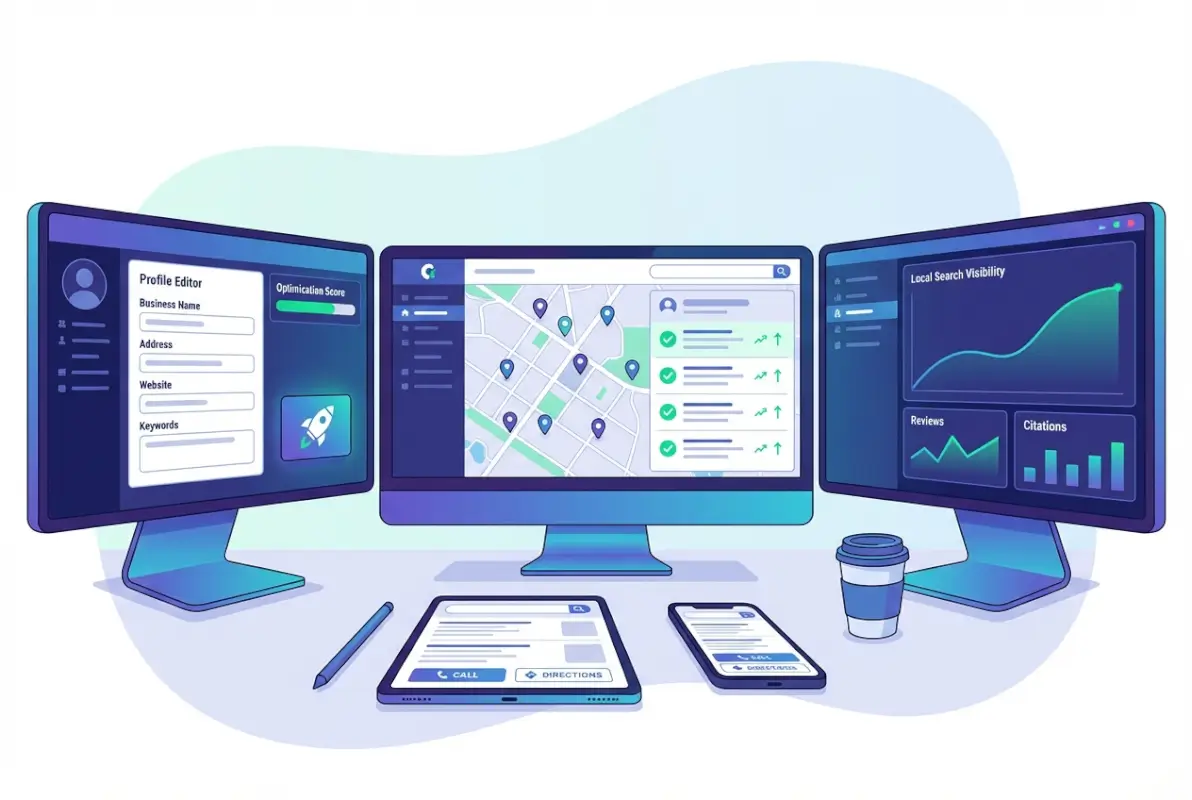
Schema markup transforms how search engines interpret your directory data. While most directories handle their own schema implementation, understanding how LocalBusiness structured data works helps you optimize the information you provide to these platforms.
Leveraging Structured Data Across Directory Listings
LocalBusiness schema tells search engines explicitly what your business does, where it operates, and how customers can contact you. When directories implement proper schema (and most authoritative ones do), they’re essentially vouching for your business data through their structured markup.
The key schema types relevant to directory presence include LocalBusiness (identifies your business type and location), Organization (establishes brand identity and relationships), Service (details specific offerings), and FAQPage (captures common questions). According to Schema.org’s LocalBusiness specification, properly marked-up business information significantly improves search visibility.
When completing directory listings, think in schema terms. The business description field maps to schema’s “description” property—make it keyword-rich but natural. Service categories align with “serviceType” properties. Business hours correspond to “openingHours” specifications. This mindset ensures you’re feeding directories the information they need to create rich structured data.
Location-Focused Content That Complements Directories
Directory listings gain amplification when supported by location-specific content on your website. If you serve multiple cities, create dedicated pages for each service area that mirror the geographic information in your directory listings. This consistency reinforces your local relevance.
The most effective location pages include specific neighborhood references, local landmarks, service area maps, location-specific customer testimonials, and unique content addressing local regulations or conditions. A roofing contractor in Miami should mention hurricane-resistant installation techniques; one in Minnesota should discuss ice dam prevention.
Link your directory listings to these specific location pages rather than just your homepage. This creates thematic alignment—your Yelp listing for “Plumber in Boston” links to your dedicated Boston service page, not your generic homepage. This relevance signal helps both directory users and search algorithms understand your geographic focus.
Visual Assets and Engagement Optimization
Photo strategy matters more than most businesses realize. The types of images you upload influence both user engagement and algorithmic assessment of your business category and quality level.
Effective photo portfolios include exterior shots showing your storefront or facility, interior images highlighting your space or service areas, team photos introducing staff members by name and role, process images showing your work in action, before/after comparisons demonstrating transformation, and product detail shots when selling physical goods.
Avoid stock photography entirely. Directories increasingly use image recognition to detect stock images, and some may suppress listings using obviously generic photos. Authentic images of your actual business, even if not professionally shot, outperform polished stock imagery.
| Photo Type | Impact on Engagement | Recommended Quantity |
|---|---|---|
| Exterior/Storefront | Helps customers find location | 2-3 different angles |
| Interior/Facility | Builds comfort and trust | 4-6 key areas |
| Team/Staff | Humanizes business | 3-5 team members |
| Work Process | Demonstrates expertise | 5-8 action shots |
| Before/After | Highest conversion impact | 3-5 compelling examples |
Review Management and Reputation Signals
Reviews have evolved from nice-to-have testimonials into critical ranking factors. Google’s local algorithm weighs review quantity, recency, velocity, diversity (across multiple platforms), and sentiment when determining local pack placement.

What many businesses miss is that review management extends far beyond asking for feedback and responding to complaints. Strategic review programs systematically generate positive signals while minimizing negative impact through rapid response and resolution protocols.
Building Systematic Review Generation
The businesses dominating local pack results aren’t lucky—they’re systematic. They’ve built review generation into their customer journey, making it frictionless for satisfied customers to share experiences while they’re still enthusiastic.
Timing determines review volume. Ask too early (before service completion) and customers can’t evaluate results. Wait too long (weeks after service) and the experience fades from memory. The sweet spot sits 24-48 hours after successful project completion or positive interaction.
Methodology matters as much as timing. Email requests see 8-12% response rates, text messages achieve 15-22%, and in-person requests with QR codes reach 25-35%. The highest-performing approach combines methods—text message with direct review link sent 48 hours after service, followed by email if no review appears within one week.
Platform selection influences review value. Google Business Profile reviews carry the most ranking weight for local search. Yelp reviews matter significantly for consumer-facing businesses in competitive markets. Industry-specific platform reviews (Healthgrades for doctors, Avvo for lawyers) influence specialized searchers and establish category expertise.
Response Strategies That Build Authority
Review responses serve multiple audiences simultaneously—the reviewer, potential customers reading your response, and search algorithms analyzing engagement signals. Effective responses address all three.
For positive reviews, personalization prevents generic responses from undermining authenticity. Reference specific details from their feedback: “We’re thrilled you loved the maple glaze on your anniversary cake, Sarah. Our pastry chef takes tremendous pride in those flavor combinations.” This demonstrates you actually read and value their input.
Negative review responses require nuanced approaches. Research from Pew Research Center studies on online reviews shows that 89% of consumers read business responses to reviews, and 78% say professional responses to negative reviews improve their perception of the business.
The negative review response framework follows a consistent pattern: acknowledge their experience, apologize for any shortcoming (without admitting fault if legally sensitive), explain any context if appropriate, offer resolution, and move detailed discussion offline. “Thank you for bringing this to our attention, Mark. We’re sorry your installation didn’t meet expectations. Our project manager will contact you today to address the specific concerns you’ve mentioned and make this right.”
Monitoring and Analysis Across Platforms
Scattered reviews across multiple directories create monitoring challenges. Businesses often miss feedback on secondary platforms, allowing negative reviews to sit unanswered while competitors respond to everything within hours.
Centralized monitoring tools solve this problem by aggregating reviews from multiple sources into single dashboards. Options like Podium, Birdeye, or Grade.us track reviews across 50+ directories, sending instant notifications for new feedback and providing response interfaces that post to multiple platforms.
Beyond monitoring, review analytics reveal patterns that inform operational improvements. When three customers mention “long wait times” in a two-week period, you’ve identified an operational issue before it becomes a widespread reputation problem. Monthly review analysis should categorize feedback into themes, track sentiment trends, and identify recurring praise or complaints.
Measurement, Analytics, and Continuous Optimization
Directory effectiveness isn’t guesswork—it’s measurable through specific metrics that connect listing performance to business outcomes. The businesses seeing the best directory ROI track performance religiously and adjust strategy based on data.

Attribution complexity makes directory measurement challenging. A customer might find you on Yelp, visit your website, call from Google Business Profile, then arrive at your location using Apple Maps. Which directory deserves credit? Sophisticated attribution models account for multi-touch customer journeys, but even basic tracking provides valuable insights.
Key Performance Indicators for Directory Success
Directory impressions measure how often your listing appears in search results and browsing on that platform. Rising impressions indicate improving visibility, while declining impressions suggest category competition or listing quality issues. Track impressions monthly for your top 10 directories.
Click-through rate reveals how compelling your listing appears relative to competitors. If you’re getting impressions but low clicks, audit your primary photo, business name presentation, review count, and rating. Often small optimizations—adding 10 more reviews or uploading better photos—dramatically improve CTR.
Direction requests and phone calls represent high-intent actions. Users who request directions plan to visit; those who call often convert immediately. Track these actions by directory source using unique phone numbers or call tracking software that attributes calls to specific platforms.
| Metric | What It Measures | Action Threshold |
|---|---|---|
| Impressions | Visibility in searches | Declining 20%+ month-over-month |
| Click-through rate | Listing appeal | Below 3% for GBP, 1% for other directories |
| Direction requests | Visit intent | Declining or flat for 3+ months |
| Phone calls | Direct engagement | Below 5 calls/month from directory source |
| Review velocity | Ongoing activity | No new reviews for 30+ days |
Website traffic from directories can be tracked through UTM parameters or referral source analysis in Google Analytics. Create unique UTM-tagged URLs for each directory listing to precisely attribute website visits and conversions to specific platforms. This reveals which directories drive not just visibility but actual business.
Testing and Iteration for Maximum Impact
Directory optimization isn’t one-and-done. The businesses dominating local search test continuously, measuring impact and doubling down on what works while abandoning ineffective tactics.
A/B testing applies to directory elements just like website optimization. Test different primary photos, measure click-through rate changes, then adopt the winner. Try expanded service descriptions versus concise ones. Experiment with different category selections. Track each change’s impact on impressions, clicks, and conversions over 30-day periods.
Competitive analysis reveals optimization opportunities. Search for your primary keywords, examine top-ranking competitors’ directory listings, and identify elements they’re using that you’re not. Common gaps include video content, Q&A section engagement, special offers, or appointment booking capabilities.
What is a business directory and how does it work?
A business directory is an online platform that organizes companies by category, location, and services into searchable databases. Users find businesses by searching specific criteria or browsing categories, while businesses gain visibility to potential customers actively looking for their services. Modern directories include reviews, photos, direct messaging, and booking features that transform simple listings into comprehensive business profiles serving both discovery and vetting functions.
How do business directories improve local SEO rankings?
Directories boost local SEO by creating citations that validate your NAP information across multiple authoritative sources, signaling legitimacy to search engines. They provide structured data search algorithms easily interpret, generate review signals that influence rankings, create backlinks passing domain authority, and demonstrate category relevance through consistent classification. Consistent information across 40+ quality directories can improve local pack rankings by 30-50% within three months.
Which business directories should I prioritize first?
Start with Google Business Profile as your foundation—it directly influences Google Search and Maps visibility. Next, complete Apple Maps, Bing Places, and Yelp (for consumer businesses). Then add your primary industry-specific directory (Avvo for lawyers, Healthgrades for healthcare, Houzz for contractors). Finally, include 3-5 relevant local directories like chamber of commerce listings. These 8-12 core directories deliver 80% of directory value for most businesses.
How often should I update my directory listings?
Audit your top 20 directory listings quarterly to verify NAP accuracy, business hours, service descriptions, and photos. Update immediately when core information changes—new phone numbers, relocated addresses, or modified business hours should be updated across all directories within 48 hours. Add fresh photos monthly and respond to new reviews within 24 hours to maintain engagement signals that algorithms monitor.
What is NAP consistency and why does it matter?
NAP consistency means using identical Name, Address, and Phone formatting across all online platforms. It matters because search engines cross-reference business information across hundreds of sources to verify legitimacy. Inconsistent NAP data creates doubt in algorithms, suppressing local rankings even when your website is optimized. Even minor variations like “Street” vs. “St.” or different phone number formatting can trigger consistency issues.
How do I get more reviews on directory listings?
Implement systematic review requests 24-48 hours after positive customer interactions using text messages with direct review links for highest response rates (15-22%). Follow up via email if no review appears within one week. Make the process frictionless by linking directly to your review page rather than the general directory. Train staff to request reviews in person using QR codes. Aim for steady velocity of 3-5 new reviews monthly rather than sporadic bursts.
Should I pay for premium directory listings?
Evaluate premium listings based on competitive density and directory traffic. If you’re competing against 10+ businesses in your category and most have premium placements, free listings become invisible. Premium features like top placement, enhanced content, and analytics justify costs when that specific directory generates qualified leads. Start with free listings, track performance for 90 days, then upgrade selectively on directories delivering measurable traffic or calls.
How do I handle negative reviews on directories?
Respond to negative reviews within 24 hours with acknowledgment of their experience, genuine apology for shortcomings, brief context if appropriate, and offer to resolve offline. Never argue publicly or ask for review removal. Well-handled negative review responses often improve potential customer perception more than perfect ratings alone because they demonstrate accountability and customer service commitment. Follow up after resolution to ensure satisfaction.
Can business directories help with lead generation?
Directories excel at lead generation because users have high purchase intent—they’re actively searching for specific services. Directory leads often convert 3-4x higher than general website traffic because searchers have already filtered by category, read reviews, and compared options before contacting you. Optimize for conversion by completing all listing fields, maintaining 4+ star ratings, responding to all reviews, and enabling direct contact methods like click-to-call and messaging.
How do I measure ROI from directory listings?
Track directory-specific phone calls using unique tracking numbers, monitor website traffic from each directory via UTM parameters, analyze direction requests and map views from platform analytics, and measure appointment bookings or form submissions attributed to directory sources. Calculate cost per lead by dividing any premium listing fees by monthly leads generated. Compare directory lead conversion rates to other marketing channels to assess relative value and optimization opportunities.
Conclusion: Your Directory Strategy Action Plan
Business directories remain among the most cost-effective local SEO investments you can make. Unlike paid advertising that stops working the moment you stop paying, directory listings continue generating visibility and leads for months or years after initial optimization. The businesses dominating local search results aren’t doing anything magical—they’re simply more systematic and thorough with their directory presence.
Start with your foundation: claim and optimize Google Business Profile to 100% completion this week. Then systematically add the 15-20 directories most relevant to your industry and location, focusing on quality and completeness rather than quantity. Build review generation into your customer journey so you’re consistently accumulating fresh feedback across multiple platforms.
The difference between directory success and failure comes down to consistency and persistence. Businesses that maintain accurate information, respond to all reviews, and regularly refresh their listings see compounding returns. Those who set up listings once then forget about them watch their visibility slowly erode as competitors outpace them with ongoing optimization.
Ready to Dominate Local Search?
Businesses with optimized directory presence see 35-50% improvement in local pack rankings within 90 days. The opportunity is still wide open because most competitors haven’t implemented systematic directory strategies.
Next Steps: Claim your Google Business Profile today, audit your top 10 directory listings this week, and commit to one optimization daily until you reach 100% completion across all platforms.
Remember that directory optimization is a marathon, not a sprint. You’re building digital authority that compounds over time, creating a moat around your local visibility that becomes harder for competitors to breach with each passing month. The businesses starting today will own their local search results six months from now.
Was this article helpful?