Business Directory Submission Services: Proven Local SEO Strategy for 2025

Generating summary...
Most business owners throw away hundreds of dollars on directory submissions that don’t move the needle. Here’s what nobody tells you: the directory submission game fundamentally changed in the past two years, and the old “submit everywhere” playbook now does more harm than good.
I learned this the hard way when a client paid $800 for “500+ directory submissions” and saw their local rankings actually drop. The service had spammed low-quality directories with inconsistent business information, confusing Google’s algorithms and diluting their local SEO signals. That failure taught me something valuable—directory submissions still work in 2025, but only when executed as a strategic citation-building campaign rather than a bulk link dump.
The fundamental truth about business directory submission services is this: they boost local SEO through citation consistency and authoritative backlinks, but quality trumps quantity every single time. A well-chosen portfolio of 30-50 relevant directories will outperform 500 random listings by a landslide.
TL;DR – Quick Takeaways
- Directory submissions remain effective for local SEO when focused on quality, industry-relevant platforms with proper NAP consistency
- Citation signals complement Google Business Profile and are among the top local ranking factors in 2025
- Results require 6-12 weeks as search engines discover, index, and process new citations across the web
- Automated tools help scale but must be paired with manual QA to prevent inconsistent or spammy listings
- Measure what matters by tracking NAP consistency, indexed citations, local pack visibility, and downstream actions like calls and direction requests
The Current State of Directory Submissions in Local SEO (2025 Reality Check)
Local search ranking factors evolved significantly between 2023 and 2025. Google’s algorithms now place heavier weight on Google Business Profile signals, citation consistency across trusted sources, and user engagement metrics. Directory submissions fit into this ecosystem as citation builders—digital confirmations that your business exists at a specific location.
According to research from BrightLocal’s annual local consumer surveys, citation signals remain in the top five local ranking factors. However, the way these citations impact rankings has become more nuanced. Search engines now evaluate citation quality based on directory authority, relevance to your industry, and consistency with other online mentions of your business.

What changed? Google got smarter at identifying spammy citation patterns. Bulk submissions to hundreds of generic directories now trigger quality filters rather than boosting rankings. The algorithm looks for natural citation patterns—mentions on directories that real humans actually use to find businesses.
When Directory Submissions Help (and When They Don’t)
Directory submissions deliver the strongest ROI when your business operates in competitive local markets where multiple competitors vie for the same keywords. They work particularly well for service businesses (plumbers, electricians, lawyers), brick-and-mortar retail, restaurants, and healthcare providers.
Here’s where they fall flat: if your business already dominates local search with minimal competition, directory submissions offer diminishing returns. Similarly, purely online businesses without physical locations see limited benefit from traditional local directories—though they may benefit from industry-specific platforms.
The strategy matters more than the tactic. Focus on directories that align with your industry, serve your geographic area, and maintain active user bases. A listing on a industry-specific directory visited by 10,000 monthly users in your target market beats 50 listings on abandoned general directories with outdated interfaces.
2025 Success Checklist for Directory Submissions
Successful directory campaigns in 2025 require attention to these foundational elements:
- NAP Consistency: Your business Name, Address, and Phone number must be identical across every directory. Use “Street” consistently, not “St.” on some and “Street” on others.
- Complete Profiles: Fill every available field—business hours, services offered, payment methods, photos, service areas. Incomplete listings signal low-quality to both search engines and users.
- Category Alignment: Select the most specific, relevant categories available on each platform. Broad categories dilute your relevance signals.
- Ongoing Monitoring: Business information changes. Set quarterly calendar reminders to audit and update your directory portfolio.
- Quality Over Quantity: Aim for 30-75 high-authority, relevant directories rather than 300+ random submissions.
Understanding Modern Directory Submission Services
Professional directory submission services have evolved from simple data entry operations into strategic citation management platforms. The best services in 2025 combine technology with human oversight—automated distribution systems backed by manual quality checks.
These services typically offer tiered packages. Basic packages cover 20-40 essential general directories (Google Business Profile, Bing Places, Facebook, major data aggregators). Mid-tier packages add 30-50 industry-specific and local directories relevant to your business type and location. Premium packages include 75-100+ directories with ongoing monitoring, duplicate suppression, and quarterly updates.
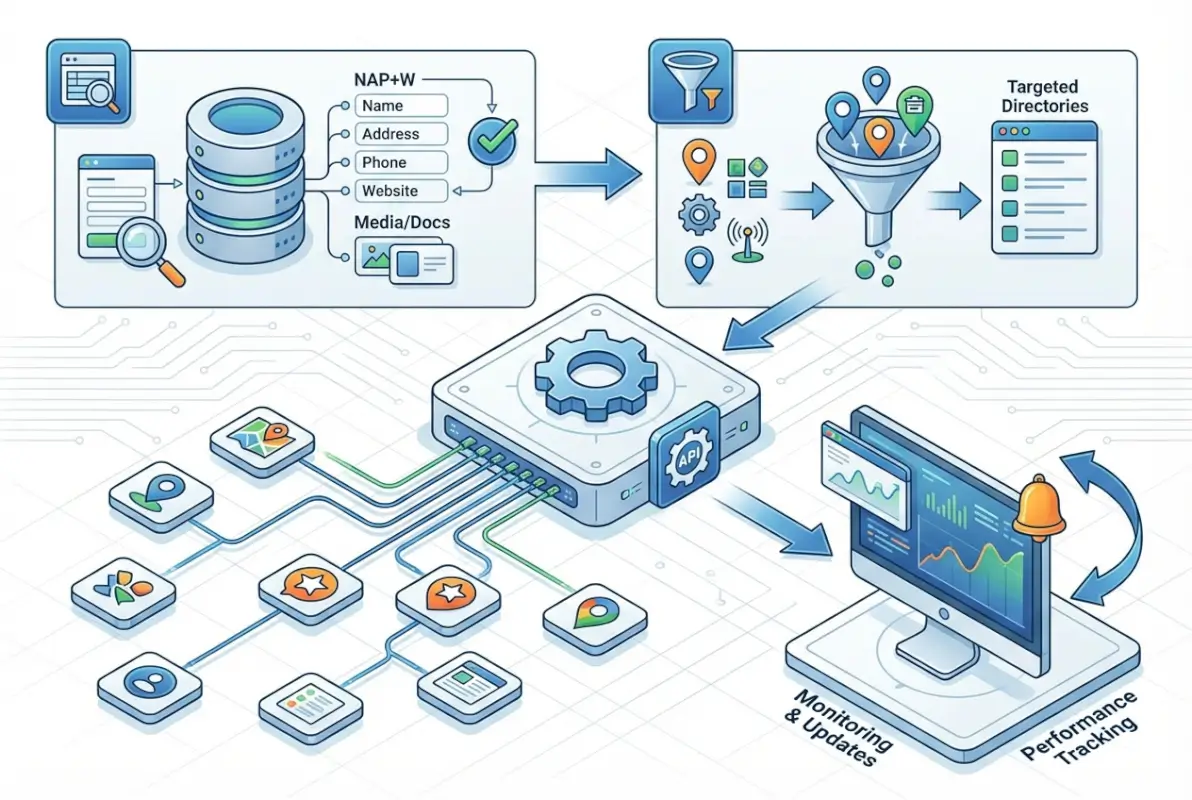
What you’re really paying for isn’t just data entry—it’s expertise in directory selection, experience with verification processes, and systems to maintain consistency across platforms. A quality service knows which directories matter for your specific industry and which ones waste your money.
| Package Level | Directory Count | Manual QA | Typical Cost |
|---|---|---|---|
| Basic | 20-40 | Limited | $200-$400 |
| Professional | 50-75 | Yes | $500-$800 |
| Premium | 100+ | Complete | $1,000-$2,000 |
How to Evaluate Directory Submission Providers
Red flags to watch for: providers promising “guaranteed #1 rankings” (no ethical SEO service can guarantee specific positions), unwillingness to share their directory list, prices that seem too good to be true (under $150 for comprehensive submissions), and purely automated processes with zero human verification.
Quality indicators include: transparent reporting showing exactly which directories received your listing, manual verification of submissions, willingness to customize directory selection for your industry, case studies with measurable results, and clear communication about timelines and expectations.
Ask prospective services these questions: Which specific directories will you submit to? How do you handle verification processes? What happens if my business information changes? Do you provide ongoing monitoring or just one-time submissions? Can you show examples of improved local pack visibility for previous clients?
Building Your Directory Submission Strategy That Actually Works
The most effective directory campaigns start with clear goals and success metrics. What are you actually trying to achieve? Most businesses pursue one or more of these objectives: improved Google Map Pack visibility for target keywords, increased direct traffic from directory sites, stronger domain authority signals, better NAP consistency across the web, or enhanced brand presence in local search results.
Once you’ve defined goals, select directories strategically rather than randomly. Start with the four essential categories mentioned in listed in business directory key benefits for your business: major general directories (Google Business Profile, Bing Places, Facebook), industry-specific platforms relevant to your sector, local directories for your geographic area, and niche directories for your specific business category.

For example, a dental practice should prioritize health directories like Healthgrades, Zocdoc, and RateMDs alongside general platforms. A restaurant needs Yelp, TripAdvisor, OpenTable, and local dining guides. A home service contractor benefits from HomeAdvisor, Angi, Thumbtack, and local chamber listings.
Profile Optimization Guidelines
Creating optimized directory profiles requires more than copying and pasting your business name and address. Each listing should present complete, compelling information that encourages both search engines and humans to engage.
Your business description should incorporate target keywords naturally while remaining readable and persuasive. Write two versions—a comprehensive 200-300 word version for directories that allow detailed descriptions, and a concise 50-75 word version for platforms with character limits.
Photos dramatically improve listing performance. Include your logo, storefront or office exterior, interior shots showing your workspace, team photos, and images of your products or completed work. High-quality visuals increase click-through rates from directory pages by 40-60% according to industry benchmarks.
- Use your legal business name consistently—avoid abbreviations or alternate versions
- Format your address identically everywhere, including Suite/Unit designations
- Use a consistent phone number (preferably a local number, not toll-free)
- List comprehensive business hours, including special hours for holidays
- Select the most specific category available on each platform
- Include service areas for businesses that travel to customers
- List payment methods, parking information, and accessibility features when applicable
Manual Submissions vs. Automated Tools
The manual versus automated debate doesn’t have a universal answer—the best approach depends on your budget, time constraints, and business needs. Manual submissions offer superior customization, allowing you to tailor descriptions for each platform, select platform-specific categories, upload optimized photos, and respond immediately to unique verification requirements.
Automated distribution through platforms like Yext, Moz Local, or similar aggregators saves substantial time by pushing your information to dozens of directories simultaneously. These systems excel at maintaining perfect NAP consistency and can update information across all platforms when your business details change.
My recommended hybrid approach: manually submit to the 10-15 highest-impact directories for your industry and location, giving these premium listings your full attention and customization. Use automation tools for the remaining 30-50 listings where basic information suffices. This balances time efficiency with quality optimization.
Measuring Directory Submission ROI and Performance
You can’t improve what you don’t measure. Effective directory campaigns require tracking specific metrics that demonstrate whether your investment is paying off. The challenge is that directory submissions contribute to local SEO indirectly through citation signals and backlinks rather than generating immediate, obvious traffic spikes.
Start by establishing baseline measurements before launching your campaign. Document your current rankings for 10-15 important local keywords, your Google Business Profile insights (views, clicks, calls, direction requests), your citation consistency score from a tool like Moz Local, and your current monthly organic traffic from local searches.

Track these metrics on a consistent schedule—weekly for the first month, then monthly thereafter:
| Metric Category | What to Track | Tools | Expected Timeline |
|---|---|---|---|
| Citation Health | NAP consistency, duplicate listings | Moz Local, BrightLocal | 4-8 weeks |
| Local Rankings | Position for target keywords | Local rank trackers | 6-12 weeks |
| Map Pack Visibility | Appearances in top 3 local results | Grid My Business, Local Falcon | 8-12 weeks |
| Traffic Sources | Referral traffic from directories | Google Analytics | 2-6 weeks |
| Conversion Actions | Calls, forms, direction requests | Call tracking, CRM | 6-10 weeks |
Understanding Attribution and Setting Realistic Expectations
Here’s something most directory service providers won’t tell you upfront: isolating the specific impact of directory submissions from other SEO activities is extremely difficult. Directory citations work synergistically with your Google Business Profile optimization, on-page SEO, review generation, and other local search factors.
That said, you can track directional improvements. If your citation consistency score improves from 62% to 94% over three months while your local pack visibility for target keywords increases by 35%, there’s a strong correlation suggesting the directory work contributed meaningfully to the improvement.
Set realistic timelines. Most directory submissions show measurable impact within 6-12 weeks as search engines discover and index new citations. Significant improvements in local rankings typically require 3-6 months as citation signals accumulate and strengthen your overall local authority profile.
Critical Mistakes That Sabotage Directory Campaigns
Even well-intentioned directory submission efforts can backfire when businesses make common tactical errors. Understanding these pitfalls helps you avoid wasting money and potentially harming your local SEO.
The single biggest mistake? Submitting to low-quality, spammy directories just to inflate your citation count. These platforms typically have weak domain authority, minimal organic traffic, poor user experience, and lax listing standards. Not only do they provide negligible SEO value, but association with spammy directories can actually harm your site’s reputation in Google’s eyes.

How do you identify low-quality directories? Warning signs include: excessive advertising that overwhelms content, predominantly SEO-focused language rather than user-focused information, minimal editorial oversight allowing obvious spam listings, outdated design and broken functionality, and domain authority scores below 20 (check using tools from Moz’s domain analysis platform).
NAP Inconsistency: The Silent Ranking Killer
Inconsistent NAP information across directories represents one of the most damaging yet easily preventable mistakes. When search engines encounter different versions of your business information—”Johnson Plumbing Services, Inc.” on some platforms and “Johnson Plumbing” on others—they struggle to confidently consolidate these signals.
The result? Your ranking power gets diluted across multiple entity interpretations rather than consolidated into one strong signal. Research suggests businesses with significant NAP inconsistencies can lose 15-25% of their potential local ranking power.
Create a master document with your exact NAP formatting and share it with anyone who might create listings on your behalf. This simple step prevents well-meaning employees or contractors from introducing variations that undermine your citation consistency.
- Don’t mix “Street” and “St.” in your address formatting
- Use the same Suite/Unit designation format everywhere
- Stick with one phone number format (parentheses vs. hyphens)
- Use your legal business name, not shortened versions or DBA variations
- If you change your phone number or address, systematically update ALL directory listings
The “Set It and Forget It” Trap
Business information changes over time—phone numbers get updated, hours shift seasonally, services expand, even addresses change when businesses relocate. Treating directory submissions as a one-time project rather than an ongoing maintenance task inevitably leads to outdated information across the web.
Outdated directory listings frustrate potential customers (imagine driving to a business based on published hours only to find it closed), damage your credibility with search engines (inconsistent information signals unreliability), and waste the initial investment in creating those listings.
Establish a quarterly review calendar to audit your directory portfolio. Check that your information remains accurate, look for duplicate listings that may have appeared, and verify that your listings are still active on important directories. Many businesses discover that directory platforms periodically purge inactive or unverified listings.
For businesses focusing on local visibility, resources like business directory boosts local marketing can provide additional context for maximizing your directory presence as part of a comprehensive local marketing strategy.
Frequently Asked Questions About Business Directory Submissions
Do directory submissions still help with local SEO in 2025?
Yes, directory submissions remain effective for local SEO when focused on quality, relevant platforms. They work as citation signals that complement your Google Business Profile and contribute to local ranking factors. The key difference in 2025 is that strategic, targeted submissions to 30-75 authoritative directories outperform bulk submissions to hundreds of low-quality sites.
How many directory submissions should I do for noticeable results?
Focus on 30-75 high-quality, industry-relevant directories rather than chasing a specific number. Quality trumps quantity—one listing on an authoritative industry directory visited by your target customers provides more value than ten listings on abandoned generic platforms. Start with the essential 20-30 major directories, then expand into niche and local platforms relevant to your business.
What metrics should I track for directory submission campaigns?
Track NAP consistency scores across the web, number of indexed citations, changes in local pack visibility for target keywords, referral traffic from directory sites, and downstream conversion actions like phone calls and direction requests. Use tools like Google Analytics, Google Business Profile Insights, and citation monitoring platforms to measure these metrics monthly.
Should I use automation tools for directory submissions?
A hybrid approach works best—use automation for distributing basic information to 30-50 secondary directories while manually creating detailed, customized listings on the 10-15 most important platforms for your industry. Automation saves time and ensures consistency, but manual submissions allow better optimization of photos, descriptions, and platform-specific features that improve engagement.
Which directories are most valuable for local service businesses?
Start with Google Business Profile, Bing Places, and Facebook as foundational platforms. Add industry-specific directories relevant to your service type (HomeAdvisor and Thumbtack for contractors, Healthgrades for medical practices, Avvo for lawyers). Include local directories like your Chamber of Commerce and regional business associations. Finally, target niche directories where your specific customer base searches for services.
How does directory submission interact with Google Business Profile?
Directory citations complement and reinforce your Google Business Profile by providing consistent business information across multiple trusted sources. When Google sees your NAP information verified across numerous authoritative directories, it gains confidence in your GBP data, potentially improving your visibility in the Local Pack and Maps results. Think of directories as supporting evidence for your GBP claims.
How long does it take to see SEO results from directory submissions?
Expect 6-12 weeks for initial measurable results as search engines discover and index new citations. Citation consistency improvements may show within 4-8 weeks. More substantial improvements in local rankings and Map Pack visibility typically appear over 3-6 months as citation signals accumulate and strengthen your local authority profile.
Can directory submissions hurt my SEO if done incorrectly?
Yes, directory submissions can harm your SEO if you submit to spammy low-quality directories, create inconsistent NAP citations across platforms, or violate directory guidelines with keyword stuffing. However, a strategic campaign focused on authoritative, relevant directories with accurate, consistent information will positively impact your local search performance.
What’s the difference between free and paid directory listings?
Free listings allow basic business information without charge but typically offer limited features, slower verification, and less prominent placement. Paid listings provide enhanced profiles with photos, detailed descriptions, premium placement, priority support, and additional features like customer messaging. For your most important directories, paid enhanced listings often justify the investment through improved visibility and engagement.
How often should I audit my directory listings?
Conduct comprehensive directory audits quarterly to catch NAP inconsistencies, duplicate listings, and outdated information. Set up monthly quick-checks of your 10-15 most important listings to ensure they remain active and accurate. When your business information changes (new phone number, moved location, expanded hours), update all directory listings systematically within 2-4 weeks.
Transform Your Local Visibility Starting Today
Directory submissions remain one of the most cost-effective local SEO tactics when executed strategically. The businesses winning local search in 2025 aren’t the ones with the most directory listings—they’re the ones with the right listings, perfect NAP consistency, and complete, compelling profiles that convert searchers into customers.
Start by auditing your current directory presence to identify gaps and inconsistencies. Then build a targeted submission plan focused on the 30-75 directories that actually matter for your industry and location. Monitor your progress monthly, and adjust your strategy based on what the data tells you. The investment you make in directory submissions today will compound into stronger local visibility, more customer trust, and improved search rankings for years to come.
Was this article helpful?