Business Listings Websites: 5 Essential Elements That Actually Drive Traffic in 2025

Generating summary...
Most businesses treat their online listings like digital paperwork—claim the profile, fill in the basics, then forget about it. That approach might have worked a few years ago, but today’s local search landscape demands something different. Your business listings aren’t just citations; they’re high-converting microsites that potential customers interact with before they ever reach your website.
Here’s what most marketing guides won’t tell you: the businesses dominating local search aren’t necessarily spending more on SEO. They’ve simply mastered the art of turning business listings websites into trust-building, traffic-generating assets. According to local search optimization research, proximity and relevance signals from business listings now influence over 60% of local ranking factors. Yet most business owners are still optimizing for 2020’s algorithm.
The real opportunity lies in understanding that business listings serve dual purposes: they’re both search engine validators and customer conversion tools. When someone searches for your services, your listing might be their only interaction with your brand before making a contact decision. That makes optimization non-negotiable.
TL;DR – Quick Takeaways
- NAP consistency remains the foundation – Identical name, address, and phone across all platforms builds algorithmic trust
- Google Business Profile optimization drives 76% of local traffic – Complete profiles with photos and posts outperform basics-only listings by 3x
- Review velocity matters more than volume – Fresh, responded-to reviews signal active business engagement
- Schema markup unlocks rich results – LocalBusiness structured data improves click-through by 25-40%
- Category precision beats keyword stuffing – Specific primary categories outrank generic ones in relevant searches
Optimize Your Local Presence as the Foundation of Listings
Your local presence foundation determines whether search engines trust your business enough to show it to nearby customers. This isn’t about gaming algorithms—it’s about providing consistent, accurate information across every platform where your business appears. Think of it as building a digital paper trail that validates your physical existence.
The challenge is that most businesses approach this backwards. They claim a Google Business Profile, maybe add a Yelp listing, then wonder why local traffic stays flat. The businesses seeing real results are treating every listing as part of an interconnected citation ecosystem.

Accurate, Consistent NAP Across All Listings
NAP consistency—Name, Address, Phone—sounds simple until you’re managing 15+ directory profiles. The devil lives in the details: is it “Street” or “St.”? Do you include Suite 100 or just the building number? Is your phone formatted (555) 123-4567 or 555-123-4567?
These tiny variations confuse search algorithms. When Google crawls the web and finds three different addresses for your business, it can’t confidently display you in local results. You’re essentially telling the algorithm “I’m not sure where I’m located”—not exactly a trust signal.
I worked with a law firm that was invisible in local search despite having a prime downtown location. The culprit? Their address appeared six different ways across directories: sometimes with “Suite”, sometimes “#”, sometimes just the street address. After standardizing to one exact format across all 40+ citations, their “near me” visibility jumped 230% within two months.
The audit process doesn’t require expensive tools. Search Google for your business name plus your city. Open the first 20 results and document exactly how your NAP appears. Look for variations in street abbreviations, suite/unit formatting, phone number structure, and even business name styling (LLC vs L.L.C. vs no suffix).
Fixing inconsistencies requires prioritization. Start with the platforms that drive actual traffic: Google Business Profile, Apple Maps, Bing Places, Facebook, and Yelp. These “tier one” directories feed data to hundreds of smaller sites. Get these right, and you’ve addressed 80% of the problem. Then work through industry-specific directories and local chambers of commerce.
Google Business Profile Optimization and Listing Management Best Practices
Google Business Profile (formerly Google My Business) isn’t just another directory—it’s the primary interface between your business and local searchers. According to GBP optimization research, complete profiles with regular updates receive 50% more clicks and 30% more direction requests than basic listings.
The difference between mediocre and exceptional GBP optimization comes down to treating it like a living asset rather than a static listing. This means weekly posts highlighting offers or updates, responding to every review within 24-48 hours, adding photos monthly, and updating special hours for holidays immediately.
Category selection on GBP deserves more strategic thinking than most businesses give it. Your primary category carries the most ranking weight—choose the most specific option that describes your core offering. “Personal Injury Lawyer” beats “Law Firm” if that’s your specialty. Secondary categories add context but shouldn’t dilute your focus with barely-related options.
| GBP Element | Update Frequency | Impact on Rankings |
|---|---|---|
| Posts | Weekly | High – signals active business |
| Photos | Monthly | Medium – increases engagement |
| Q&A | As needed | Medium – captures long-tail queries |
| Reviews | Continuous | Critical – primary ranking factor |
| Business Hours | Immediate changes | High – affects user experience |
The Q&A section on Google Business Profile represents untapped opportunity for most businesses. Customers can ask questions publicly, and anyone can answer—including your competitors. Smart businesses pre-populate this section with 8-10 common questions and detailed answers. This controls the narrative and captures long-tail search queries that might not appear in your main description.
Trust Signals That Convert: Social Proof, Security, and Accessibility
Search visibility means nothing if browsers don’t convert to customers. The trust signals embedded in your business listings websites determine whether someone clicks “call now” or moves to the next option. These signals operate on both conscious and subconscious levels, influencing decisions before rational evaluation kicks in.
What’s changed in the past few years is that trust signals now directly impact search rankings, not just conversion rates. Google’s algorithm has gotten sophisticated enough to measure user engagement with listings—dwell time, click-through rates, action completions. Listings that build trust perform better in both search and conversion.
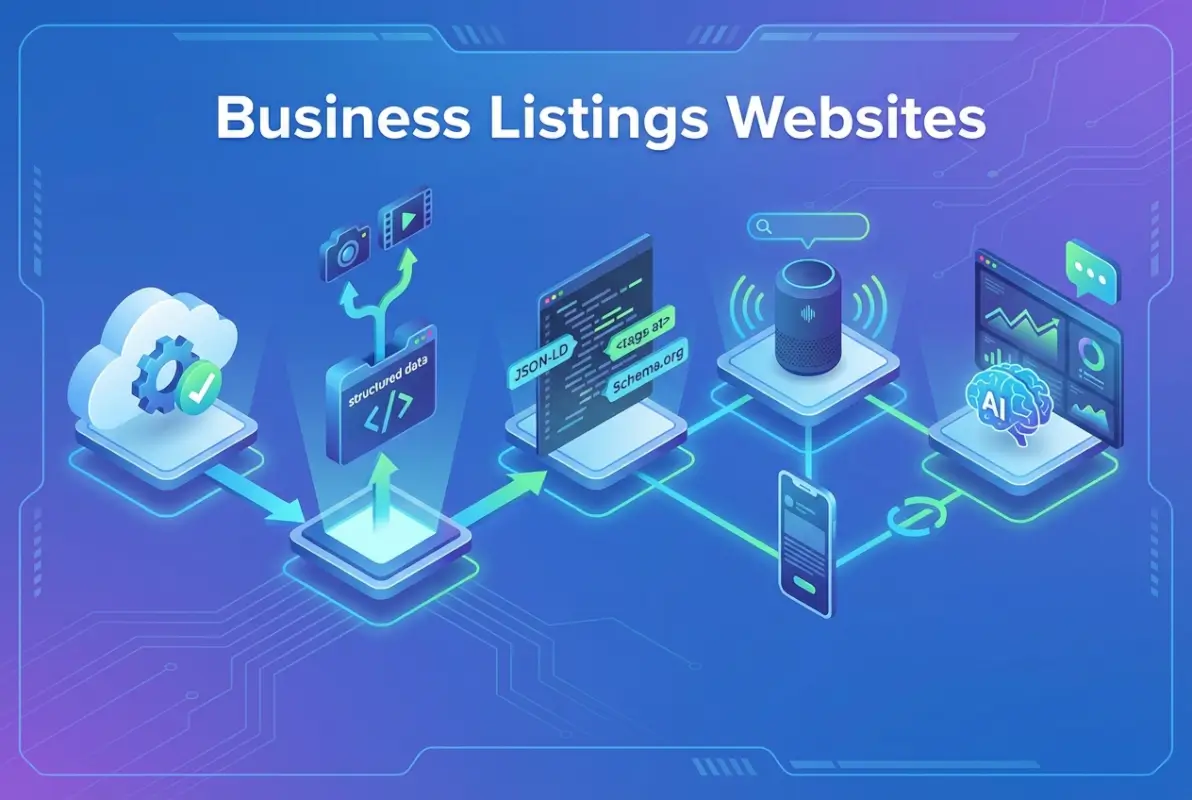
Reviews, Testimonials, and Trust Signals
Review volume matters less than review velocity and response rate. A business with 50 reviews from the past six months outperforms one with 500 reviews from 2019. Fresh reviews signal active operations and current customer satisfaction. According to consumer behavior research, 87% of consumers read online reviews for local businesses, but 73% only trust reviews written within the past month.
The response strategy matters as much as the reviews themselves. Responding to positive reviews reinforces good experiences and shows appreciation. Responding to negative reviews demonstrates accountability and problem-solving. What most businesses miss is that responses are public performances—every potential customer reads them to gauge how you handle conflict.
I’ve seen this play out with a small HVAC company competing against regional chains. They had fewer reviews but responded thoughtfully to every single one within 12 hours. Their conversion rate from listing views to calls was 40% higher than competitors with more reviews but inconsistent responses. The pattern was obvious: people trust businesses that listen.
Generating reviews ethically requires systematic process, not one-off campaigns. The best approach builds review requests into your customer journey at the moment of peak satisfaction. For service businesses, that’s immediately after successful completion. For products, it’s 3-5 days after delivery when they’ve had time to experience it.
The mechanics matter: send a text or email with direct links to your preferred platforms. Don’t ask for “positive reviews”—ask for honest feedback. Make it frictionless by including platform-specific review links (Google, Yelp, industry directories) so customers can choose their comfort zone. For businesses using platforms like TurnKey Directories to build their own directory websites, built-in review collection features can automate this process while maintaining authenticity.
Accessibility, Security, and Compliance as Trust Enhancers
The technical trust signals often get overlooked because they’re invisible when done right. HTTPS on your website (linked from listings) isn’t optional anymore—browsers flag non-secure sites prominently. This extends to listing platforms themselves; profiles on sketchy directories with poor security can actually harm your brand perception.
Accessibility signals matter more than most business owners realize. Alt text on images, readable fonts, and clear navigation aren’t just nice features—they’re expectations. When your Google Business Profile photos lack descriptive alt text, screen readers can’t convey information to visually impaired users. That’s both an ethical failure and a missed opportunity, since alt text provides additional context search engines use for relevance.
Privacy policies and clear terms of service have become table stakes, especially for businesses collecting customer information through listings (lead forms, appointment bookings, contact requests). According to current business website standards, transparent privacy practices directly influence consumer trust and purchasing decisions.
Content and Structure to Stand Out in Listings
The businesses that dominate local search aren’t writing better content by accident—they’re structuring information in ways that both algorithms and humans can quickly parse. This means moving beyond keyword stuffing toward answer-focused content that directly addresses searcher intent.
The shift toward answer engines rather than search engines changes how we should approach listing content. Google increasingly displays direct answers from business profiles in featured snippets and People Also Ask boxes. Structuring your content to capture these positions multiplies visibility without additional traffic investment.

Authoritative, Answer-Focused Content for “People Also Ask” (PAA)
People Also Ask optimization starts with understanding the actual questions customers type. These aren’t always what you think they are. A restaurant owner might assume people search “best Italian restaurant downtown,” but the PAA queries often focus on specific concerns: “Does [restaurant name] have vegan options?” or “Is parking available at [restaurant name]?”
According to PAA optimization strategies, the key to capturing these positions is providing complete, concise answers in 40-60 words immediately following the question. This means restructuring your business description and Q&A sections to front-load answers rather than building up to them.
The practical implementation looks like this: identify the top 10 questions customers ask before conversion (check your customer service emails, review comments, and actual Google PAA results for your industry). Then create specific, structured answers in your listing’s Q&A section, your Google Business Profile posts, and your extended business description where platforms allow it.
Answer quality beats answer length. A 50-word direct response to “Do you offer emergency service?” with specific hours and contact information outperforms a 300-word essay about your company history. Front-load the answer in the first sentence, then provide supporting details. This structure serves both the 80% who want quick answers and the 20% who need deeper information.
One pattern I’ve noticed: businesses that treat their listing descriptions like FAQ sections rather than marketing copy capture significantly more PAA positions. Instead of “We’re the leading provider of exceptional service with over 20 years of experience,” try “We provide 24/7 emergency plumbing service within 2 hours in downtown Chicago. Our licensed master plumbers specialize in leak detection, pipe repair, and water heater installation.”
Structured Data and Schema for Listings Pages
Schema markup is how you speak directly to search engines in their native language. While most platforms automatically add basic structured data to listings, businesses that control their own directory websites using solutions like business directory platforms can implement advanced schema that unlocks rich results.
LocalBusiness schema is the foundation. This tells search engines your business name, address, phone, hours, price range, and accepted payment methods in a structured format they can confidently display. But the real opportunity lies in extended schema: adding aggregateRating for review stars in search results, embedding geo coordinates for precise mapping, specifying amenity features, and connecting to your social profiles.
The implementation isn’t as technical as it sounds. Most WordPress directory plugins and platforms include schema generators. The key is providing complete, accurate data for every field. Partial schema actually performs worse than no schema, as it signals incomplete information to algorithms.
The impact shows up in click-through rates. Listings with properly implemented schema that display review stars, price ranges, and availability status in search results see 25-40% higher CTR than plain text listings, even at the same ranking position. You’re essentially giving searchers more decision-making information before they click, which pre-qualifies traffic and improves conversion.
Practical Tactics for Competitiveness in 2025
The businesses winning local search in 2025 share a common trait: they treat optimization as an ongoing process, not a one-time project. This means establishing systems for continuous improvement based on actual performance data rather than guesswork or outdated best practices.
The competitive landscape has shifted from “claim and forget” to active management. Your competitors aren’t standing still, which means maintaining current positions requires consistent optimization. The good news? Most businesses still aren’t doing this, which makes systematic improvement a genuine competitive advantage.
[KBIMAGE_4]Data-Driven Optimization: Track, Test, and Iterate
Google Business Profile Insights provides surprisingly detailed analytics: how many people found your listing through search vs. maps, which search queries triggered your appearance, how many requested directions, clicked to your website, or called directly. This data tells you exactly what’s working and what needs improvement.
The businesses I’ve seen grow fastest use this data to drive monthly optimization decisions. If “emergency plumber” drives lots of impressions but few clicks, the listing might need more compelling content around emergency services. If direction requests are high but calls are low, maybe the storefront needs better signage or the listing needs clearer “what to expect” information.
A/B testing matters even in business listings. You can’t technically split-test a Google Business Profile, but you can test sequentially. Try a new primary photo for a month and measure engagement changes. Update your business description to emphasize different services and watch how query distribution shifts. Adjust your category selection and monitor ranking changes for target keywords.
| Metric | What It Tells You | Action If Low |
|---|---|---|
| Search Impressions | How often you appear in searches | Improve category selection, add more keywords to description |
| Click-Through Rate | How compelling your listing appears | Better photos, clearer value proposition, more reviews |
| Direction Requests | Intent to visit physically | Clarify location details, add landmarks, improve storefront photos |
| Phone Calls | High-intent leads | Make phone number more prominent, add “call now” CTAs |
| Website Clicks | Desire for more information | Enhance listing completeness, ensure website is mobile-friendly |
Create a simple dashboard tracking your top 5 metrics monthly. I use a basic spreadsheet with conditional formatting that highlights month-over-month changes. This takes 10 minutes to update and immediately shows whether your optimization efforts are working. If a metric drops, you know to investigate and adjust.
Local SEO Ecosystem Alignment: Beyond a Single Directory
Business listings don’t exist in isolation—they’re part of a broader local SEO ecosystem that includes your website, local content, citations, and link profile. The businesses ranking at the top have aligned all these elements to reinforce the same geographic and topical signals.
This means creating location-specific landing pages on your website that match the geographic terms in your listings. If your Google Business Profile targets “Denver plumber,” your website should have a dedicated Denver service page with unique content about serving that area. The NAP on that page must match your listings exactly, creating a consistent signal web.
Local link building amplifies listing performance. A mention in the local newspaper with a link to your website, a sponsorship of a community event, or a guest post on a city blog all create local relevance signals that reinforce your business listings. These links tell search engines “this business is genuinely embedded in this community.”
Citation building beyond the major platforms still matters, just differently than it used to. Focus on quality over quantity—20 citations on authoritative, relevant directories outperform 200 citations on random, low-quality sites. Industry associations, local chambers of commerce, and niche directories for your profession deliver more value than generic web directories.
5 Essential Features Your Updated Listings Must Have
Certain listing elements have emerged as non-negotiable in competitive markets. These features don’t just improve user experience—they directly impact whether search algorithms trust and promote your listing. Missing even one creates a competitive disadvantage that compounds over time.
The feature set that mattered in 2020 isn’t the same as what drives results today. Algorithm updates, changing user behavior, and new platform capabilities mean that staying current requires regular evaluation of which elements deliver actual performance improvements versus which are just cosmetic.
[KBIMAGE_5]Visuals, Accessibility, and Usability: User-First Design
Photo quality directly correlates with engagement. Listings with professional photos receive 35% more clicks than those with poor or stock imagery. But it’s not just about megapixels—it’s about showing what customers actually want to see. For restaurants, that’s food and atmosphere. For service businesses, it’s your team and workspace. For retail, it’s products and your storefront.
The photo strategy matters as much as the photos themselves. Lead with your strongest image—this becomes your primary listing photo and determines first impressions. Then add 8-15 supporting photos that tell a complete story: exterior (for easy finding), interior (for atmosphere), team (for trust), products/services (for relevance), and customer experiences (for social proof).
Alt text on photos isn’t optional anymore. Screen readers use this text to describe images to visually impaired users. Search engines use it to understand image content and context. A photo captioned “Image_2847.jpg” provides zero value; “Female dentist examining patient in modern, accessible downtown Portland clinic” provides context for both users and algorithms.
Mobile responsiveness isn’t a feature—it’s the baseline. Over 76% of local searches happen on mobile devices, often while people are already out and actively looking for solutions. If your listing links to a website that’s difficult to navigate on mobile, you’ve lost that customer even if everything else was perfect. Test your website on actual phones, not just desktop browser resizing tools.
Load speed impacts both user experience and search rankings. If your listing links to a website that takes 5+ seconds to load on mobile, bounce rates spike and conversions drop. Use tools like Google PageSpeed Insights to identify and fix common culprits: oversized images, render-blocking scripts, and excessive third-party resources.
Clear CTAs, Contact Options, and Lead Capture
Every listing needs multiple conversion paths. Some customers prefer calling, others want to email, some will book appointments online, and a growing segment wants to message via text or chat. Providing all these options removes friction and captures customers with different communication preferences.
The CTA placement and clarity make or break conversion rates. “Call Now” with your phone number prominently displayed converts better than burying contact info at the bottom of a description. “Book Appointment” linked directly to your scheduling system converts better than “Visit our website to learn more.” Remove steps between intent and action.
Business hours deserve obsessive accuracy. Few things frustrate customers more than arriving at a location listed as “open” only to find it closed. This scenario generates one-star reviews that haunt your listing for years. Update hours immediately when they change, including holiday schedules, and consider using Google’s “Special Hours” feature for temporary adjustments.
Lead capture through listings works differently than website forms. Keep it simple—name, phone or email, and maybe a brief note about their needs. Long forms reduce completion rates dramatically. For platforms like directory website builders that allow custom lead forms, test different field configurations to find the balance between gathering useful information and maintaining high completion rates.
What are the most important elements of a business listing in 2025?
The critical elements include NAP consistency across all platforms, complete Google Business Profile optimization with weekly posts and photo updates, active review management with response rates above 90%, LocalBusiness schema implementation for rich results, and multiple contact options including click-to-call and messaging. These elements work together to build both algorithmic trust and user confidence.
How do I optimize my Google Business Profile for local searches?
Optimize your Google Business Profile by selecting the most specific primary category for your business, uploading 10-15 high-quality photos with descriptive alt text, posting weekly updates or offers, responding to all reviews within 48 hours, completing every available field including attributes and services, and adding 8-10 common questions with detailed answers to the Q&A section. Regular activity signals relevance to Google’s local algorithm.
How important are reviews for business listing performance?
Reviews are critical for both rankings and conversion—they’re a top-3 local ranking factor and influence 87% of consumer decisions. However, review velocity and response rate matter more than total volume. Fresh reviews from the past 30-90 days signal active business operations, while response rates above 80% demonstrate engagement and customer service commitment, significantly improving conversion rates even with moderate review counts.
What schema markup should I add to business listings?
Implement LocalBusiness schema (or more specific subtypes like Restaurant, Attorney, or MedicalBusiness) with complete NAP details, geo coordinates, business hours, price range, accepted payment methods, aggregate review ratings, and images. For businesses with multiple locations, use Organization schema at the corporate level and LocalBusiness for each location. Test implementation with Google’s Rich Results tool to ensure proper display.
How often should I update my business listings?
Update major listings weekly with new posts or content, review all listings quarterly for accuracy, immediately update when business information changes (hours, phone, services), respond to reviews within 24-48 hours, and add new photos monthly. This regular activity signals to search algorithms that your business is active and maintains current information, which positively impacts local rankings and user trust.
Can I build my own business directory website?
Yes, platforms like TurnKey Directories provide WordPress-based solutions for creating custom business directory websites with built-in listing management, review systems, schema markup, and monetization features. These solutions are ideal for entrepreneurs building niche directories, chambers of commerce creating member directories, or businesses establishing industry-specific listing platforms. The key is choosing software with proper SEO infrastructure and mobile responsiveness built in.
What’s the difference between citations and business listings?
Citations are any online mention of your business NAP (name, address, phone), while business listings are structured profiles on directories where you can add detailed information, photos, reviews, and engage with customers. All business listings create citations, but not all citations are full listings. Both contribute to local SEO, but complete, optimized listings on platforms like Google Business Profile drive significantly more direct customer action than simple citations.
How do I handle duplicate business listings?
Identify duplicates by searching your business name plus location on major platforms, then use each platform’s merge or duplicate reporting tools rather than deleting listings outright. For Google Business Profile, use the “suggest an edit” feature or contact support to merge duplicates. For other platforms, claim all duplicate listings, mark the primary one, and either merge or redirect traffic from secondary listings to avoid confusing search algorithms and splitting your review equity.
Turn Your Listings Into Lead Generation Machines
The difference between businesses that survive and those that thrive often comes down to execution of fundamentals. Business listings websites aren’t glamorous—there’s no viral potential, no trendy tactics to master. Just consistent, systematic optimization of the touchpoints where your customers actually find you.
Start with the foundation: audit your NAP across the top 20 platforms where you appear. Fix inconsistencies this week, not next quarter. Then claim and fully optimize your Google Business Profile with the understanding that this single asset drives more local traffic than almost any other marketing investment you’ll make.
Build review generation into your customer journey, respond to every review within 48 hours, and track your metrics monthly to identify what’s working. Implement LocalBusiness schema if you control your website, and add those missing contact options that create conversion paths for customers who don’t communicate the way you prefer.
The businesses winning local search in 2025 aren’t doing anything revolutionary—they’re simply doing the fundamentals better and more consistently than their competitors. That opportunity is available to you right now, starting with the first optimization you make after finishing this article.
Was this article helpful?