
How to Find the Best Dentist Near You: Complete 2026 Guide
Opens a Google-translated copy of this article in a new tab.
- Start with verified directories – Use ADA Find-a-Dentist and state dental boards to confirm credentials before considering reviews
- Prioritize practical fit – Location within 15 minutes, evening/weekend hours, and insurance acceptance matter as much as clinical skill
- Verify credentials directly – Check state dental board websites for licenses, disciplinary actions, and specializations
- Read reviews strategically – Look for patterns across multiple platforms, not isolated comments
- Schedule a consultation – The first visit reveals communication style, office cleanliness, and whether the practice matches your needs
Your choice of dentist affects more than just your smile. According to the CDC’s 2024 Oral Health Surveillance Report, nearly half of adults over 30 show signs of gum disease, yet many avoid regular dental care due to bad experiences with providers or difficulty finding accessible practices. The right dentist can be the difference between proactive oral health management and emergency room visits for preventable dental crises.
Finding a dentist near you who accepts your insurance, offers convenient hours, and provides quality care doesn’t need to feel overwhelming. I spent three months searching after moving cities, visiting four different practices before finding one that didn’t rush through appointments or push unnecessary treatments. That experience taught me which factors actually matter and which ones just look good in marketing materials.
This guide walks through the exact process that works: starting with credible data sources, filtering for your specific needs, verifying credentials independently, and making smart comparisons before committing to a provider.
How to Identify the Best Dentist Near You: Criteria That Matter
The “best” dentist isn’t the same for everyone. A practice that excels at pediatric care might not be ideal for complex restorative work. Before searching directories or reading reviews, define what matters most for your situation—whether that’s specialized treatment capabilities, anxiety management, or simply finding someone who explains procedures clearly.

Start by understanding the baseline qualifications every licensed dentist should have, then layer on the factors specific to your needs. This two-part evaluation prevents you from either settling for inadequate care or getting distracted by impressive-sounding credentials that don’t address your actual requirements.
Clinical Quality Signals to Check
Board certification matters more than most patients realize. While all dentists hold either a DDS (Doctor of Dental Surgery) or DMD (Doctor of Dental Medicine) degree—which are functionally identical—specialists complete 2-6 additional years of focused training. If you need periodontal work, orthodontics, or oral surgery, verify the provider has completed an accredited residency program in that specialty.
Check continuing education records through your state dental board website. Most states require 20-50 hours of continuing education annually, but dentists committed to staying current often exceed these minimums. Look for participation in study clubs, advanced training certifications (like CEREC for same-day crowns or Invisalign certification), and memberships in specialty organizations.
Infection control standards became front-page news recently, but they’ve always been critical. The American Dental Association’s 2025 guidance reinforces strict sterilization protocols. During your first visit, observe whether staff wear fresh gloves for each patient, use disposable barriers on equipment, and maintain organized sterilization areas visible to patients.
Accessibility and Convenience Factors
The most skilled dentist in your city won’t help if you can’t actually get appointments. Proximity matters—practices within 15 minutes of home or work see higher patient compliance with preventive care schedules. You’re more likely to keep that 7 AM cleaning appointment if it doesn’t require a 45-minute commute.
Office hours determine whether dental care fits into your life or constantly conflicts with it. Look for practices offering at least some early morning (before 8 AM), evening (after 5 PM), or weekend slots. Some dental groups rotate coverage so at least one location stays open extended hours throughout the week.
Emergency availability often gets overlooked until you need it. Ask how after-hours emergencies are handled—some practices provide dentist cell numbers to established patients, others contract with emergency dental services, and some simply refer you to the ER. A cracked tooth at 10 PM on Saturday reveals which approach actually works.
Telehealth options expanded significantly in recent years. Virtual consultations work well for post-procedure check-ins, second opinions on treatment plans, or initial assessments before scheduling in-person visits. They’re particularly valuable if you’re evaluating specialists located further from your home.
How to Evaluate Dentists Using Reliable Data and Local Context
Online reviews and marketing materials tell one story, but objective data sources reveal a more complete picture. The gap between what dental practices advertise and what they actually deliver becomes obvious when you cross-reference multiple information sources—and surprisingly, the most reliable data is freely accessible if you know where to look.
I once nearly chose a practice with 4.8 stars and slick website design, until checking their state dental board record revealed two disciplinary actions in three years. Those actions never appeared in online reviews or Google listings. This kind of critical information requires going beyond consumer-facing platforms to official regulatory databases.
Leverage National Health Data to Interpret Local Need and Outcomes
Understanding regional oral health trends helps set realistic expectations. The NIDCR’s data and statistics portal breaks down cavity prevalence, tooth retention rates, and access to care by state and demographic group. If you live in an area with limited access to fluoridated water, prioritize dentists who emphasize preventive fluoride treatments and discuss home care more thoroughly.
Local demographics influence what services practices prioritize. Areas with aging populations typically have more dentists specializing in dentures, implants, and periodontal care. Neighborhoods with young families attract pediatric specialists and family practices offering broader age ranges. Match the practice’s focus to your likely needs over the next 5-10 years.
Insurance acceptance patterns vary by region too. In areas dominated by a single large employer, most practices accept that company’s dental plan. In diverse urban areas, you’ll find wider insurance acceptance but also more cash-only or membership-model practices. Check the dentist’s website for accepted insurance lists, but always verify directly by phone—those lists update slowly.
Interpreting Reviews and Patient Experiences Ethically
Read reviews across at least three platforms—Google, Healthgrades, and Yelp—to get past selective curation. Practices sometimes suppress negative Google reviews through takedown requests, but they can’t control every platform simultaneously. Consistent themes across multiple sites reveal genuine patterns.
Look for specific details rather than generic praise. “Dr. Smith explained exactly why I needed the root canal and showed me the x-ray highlighting the infection” tells you more than “Great dentist!” Similarly, detailed complaints about billing surprises or rushed appointments matter more than vague negativity.
Review timing matters. A cluster of negative reviews from the same month often indicates a temporary problem—maybe a popular hygienist left, or the office dealt with a billing system change. Negative reviews spread evenly over years suggest ongoing issues.
According to Time’s analysis of dentist visit frequency, patients who feel heard by their providers maintain better preventive care schedules. Reviews mentioning “took time to listen” or “never felt rushed” indicate practices that prioritize communication—often more valuable than technical skill alone.
The Step-by-Step Process: From “Find” to “Book”
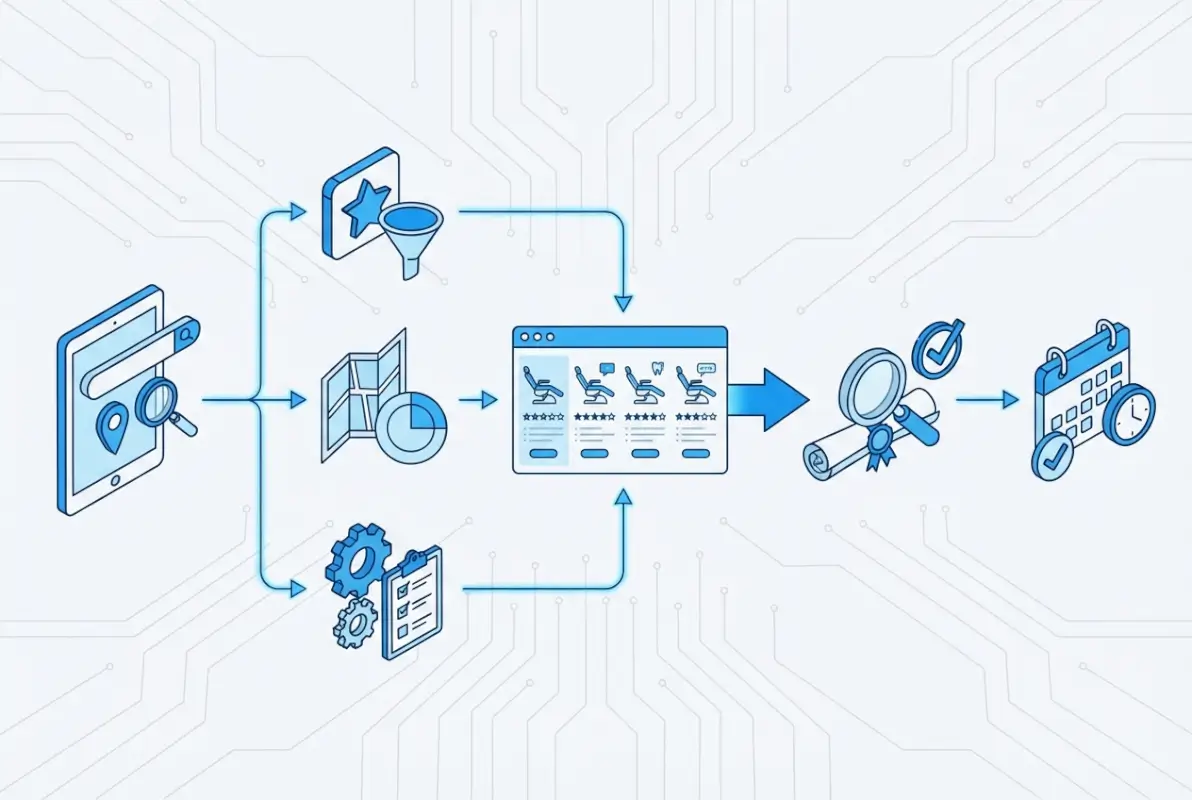
The most effective dentist search follows a specific sequence. Starting with broad searches wastes time sifting through hundreds of options. Starting too narrow (like asking neighbors for recommendations first) limits your pool before you’ve established your own criteria. This systematic approach balances efficiency with thoroughness.

Most people do this backward—they pick a dentist based on location or reviews, then discover that practice doesn’t take their insurance or offer the services they actually need. Defining requirements first, then filtering options, then verifying quality produces better matches with less frustration.
Start with Reputable Directories and Official Care Resources
Begin your search at the ADA Find-a-Dentist tool, which includes only licensed, credentialed practitioners. This eliminates unlicensed providers and practices with serious disciplinary issues. Filter by your zip code, insurance accepted, and any specialty needs.
If you need a specialist, go directly to specialty organization directories. The American Association of Orthodontists, American Academy of Periodontology, and similar groups maintain searchable databases of board-certified specialists. These directories verify completion of accredited residency programs, not just general dental degrees.
State dental association websites often provide more detailed information than national directories, including dentists’ years in practice, languages spoken, and specific services offered. Many states also list disciplinary actions more prominently than national databases do.
For building your own local directory of verified dentists, platforms like TurnKey Directories offer WordPress-based solutions that let you create searchable, map-integrated listings with custom fields for insurance, specialties, and patient reviews. This works particularly well for local health organizations or community groups wanting to maintain curated provider lists.
| Directory Source | Best For | Credential Verification | Limitation |
|---|---|---|---|
| ADA Find-a-Dentist | Initial broad search | Complete license verification | Limited patient reviews |
| State Dental Board | Verifying credentials and history | Official records, disciplinary actions | No convenience details (hours, insurance) |
| Healthgrades | Detailed patient reviews | Basic credential check | Reviews skew to extremes |
| Zocdoc | Quick online booking | Partial verification | Limited to participating practices |
| Insurance Provider Directory | Finding in-network options | None (relies on practice claims) | Often outdated, verify by phone |
Make Smart Inquiries and Trial Visits
Once you’ve narrowed to 3-5 candidates, call each office directly. Front desk interactions reveal a lot about practice culture. Are they friendly? Do they answer insurance questions clearly, or do they seem evasive? Can they schedule a new patient appointment within two weeks?
Ask these specific questions during your call: “What’s included in a new patient exam?” (should include comprehensive exam, x-rays, and cleaning unless periodontal issues are found), “How do you handle after-hours emergencies?” (get specific—a phone number, an on-call service, or ER referral), “What’s your cancellation policy?” (reasonable is 24-48 hours notice), and “Can you provide a cost estimate before treatment?” (good practices do this routinely).
Request a cost estimate for a standard cleaning and exam before your first visit. Most insurance covers preventive care at 100%, but if you’re paying out of pocket or have a high deductible, prices vary significantly—anywhere from $150 to $400 for the same service. Practices that hesitate to discuss costs upfront often surprise you with bills later.
Schedule new patient appointments at different practices before committing to treatment. Many people choose their dentist based on the first appointment, then discover issues only after starting a multi-visit treatment plan. A consultation visit costs $75-200 but can save thousands if it helps you avoid the wrong provider.
Practical Considerations: Cost, Insurance, and Special Circumstances
Clinical excellence doesn’t matter if you can’t afford the care or if the practice can’t accommodate your specific needs. Financial transparency and accessibility features often separate practices that work long-term from those that look good initially but become frustrating within months.

I learned this the expensive way when a dentist quoted $800 for a crown, my insurance approved the procedure, then I received a bill for $1,100 because they used a “premium material” that wasn’t covered. The practice wasn’t wrong, exactly—but they also didn’t explain the cost difference before proceeding. Now I ask for itemized estimates with insurance breakdown before any procedure over $200.
Understanding Costs and Insurance Coverage
Dental insurance operates differently from medical insurance. Most plans follow a 100-80-50 structure: 100% coverage for preventive care (cleanings, exams, x-rays twice yearly), 80% for basic procedures (fillings, simple extractions), and 50% for major work (crowns, bridges, root canals, dentures). Annual maximums cap total insurance payments at $1,000-$2,000, regardless of your needs.
In-network versus out-of-network makes a substantial difference. In-network dentists accept pre-negotiated fees from insurance companies. An in-network crown might cost you $400-500 out of pocket (your 50% share), while the same procedure out-of-network could run $800-1,200 because those dentists set their own fees and insurance reimburses a smaller percentage.
Pre-treatment estimates (also called pre-determinations or pre-authorizations) let you know exactly what insurance will cover before starting work. Request these for any procedure expected to cost over $300. The dentist submits the treatment plan to your insurance, which responds with an exact coverage breakdown. This process takes 5-10 business days but prevents billing surprises.
For patients without insurance, dental savings plans offer an alternative. You pay an annual fee ($100-300) for discounted rates at participating dentists—typically 20-40% off standard fees. These work well if you need more than basic preventive care but don’t have access to employer-sponsored insurance. CareCredit and similar healthcare credit cards provide 6-24 month interest-free financing for larger procedures.
Special Needs, Age, and Comfort Considerations
Dental anxiety affects roughly 36% of the population to some degree, with 12% experiencing severe anxiety that prevents regular care. Practices specializing in anxious patients offer sedation options ranging from nitrous oxide (laughing gas) to oral sedation to IV sedation. Ask specifically about their experience with anxious patients and what calming techniques they use beyond medication.
Pediatric dentists complete 2-3 years of additional training focused on child development, behavior management, and treating growing mouths. They understand how to communicate with children, manage dental anxiety in kids, and track proper tooth development from infancy through adolescence. If you have young children, a pediatric specialist typically provides better experiences than a general dentist, even if the general dentist “sees children.”
Elderly patients and those with mobility limitations need to verify physical accessibility. Ask about parking proximity to the entrance, whether there are stairs or if there’s elevator access, and if treatment chairs can accommodate wheelchairs or patients who can’t easily transfer. Some practices offer house calls for homebound patients or those in assisted living facilities.
Patients with complex medical conditions—diabetes, heart disease, blood disorders, or those taking medications like blood thinners—should seek dentists experienced in treating medically compromised patients. These dentists coordinate care with your physicians, modify treatment protocols to prevent complications, and understand how dental procedures interact with your overall health management.
Using Dentist Directories Effectively and Building Local Resources
Modern dentist directories do more than list contact information. Well-structured platforms integrate real-time availability, verified credentials, patient education resources, and comparison tools that make finding quality care faster and more reliable than ever—but only if you know which features actually matter versus which ones just look impressive.

For healthcare organizations, community groups, or local municipalities wanting to maintain curated dentist directories for their regions, the structure and information quality of your directory directly impacts whether residents actually use it. According to Statista’s oral health and dental care statistics, 77% of patients start their provider search online, but fragmented or outdated information sends them to commercial platforms instead of trusted local resources.
How Readers Benefit from Well-Documented Practice Information
Complete, consistent NAP data (Name, Address, Phone) seems basic, but inconsistencies across listings hurt both patients and practices. When a dentist’s office shows one address on Google, a different one on Healthgrades, and a third on insurance directories, patients end up at closed locations or wrong buildings. Verify NAP accuracy across all major platforms before adding practices to any directory.
Service menus should be specific, not generic. “General Dentistry” tells patients almost nothing. “Preventive care (cleanings, exams, fluoride treatments, sealants), Restorative care (fillings, crowns, bridges), Cosmetic services (whitening, veneers), Emergency services (same-day appointments for pain, broken teeth)” helps patients immediately identify whether the practice handles their needs.
Credential transparency builds trust faster than any marketing copy. Display education (where and when they earned their degree), specialty certifications (including year obtained), professional memberships (ADA, state associations, specialty organizations), and years in practice. Practices confident in their credentials showcase them prominently; those hiding this information raise red flags.
Patient education links integrated into directory listings provide value beyond basic contact info. A periodontist’s listing that includes links to articles explaining gum disease stages, treatment options, and what to expect during deep cleaning procedures helps patients make informed decisions before calling to schedule.
Structuring Directory Entries for Better Local Visibility
For those building or maintaining local dentist directories, structure impacts both user experience and search visibility. WordPress-based directory solutions like TurnKey Directories make it straightforward to create searchable, mobile-responsive listings with custom fields for insurance accepted, services offered, hours, languages spoken, and accessibility features.
Essential fields for effective dentist directory entries include: practice name and DBA (doing business as) if different, complete address with suite/floor numbers, primary phone and after-hours emergency contact, website URL and online booking link if available, accepted insurance plans (be specific—list carriers, not just “most major insurance”), services offered (broken into preventive, restorative, cosmetic, specialty categories), office hours including weekend/evening availability, languages spoken by dentists and staff, accessibility features (wheelchair access, parking, public transit options), and credentials (education, specializations, years in practice).
Map integration is non-negotiable for local directories. Patients want to visualize proximity to home or work, and map-based searching often reveals convenient options they wouldn’t find through text search alone. Embed interactive maps showing all listed practices with filtering by insurance, services, and current availability.
Review systems add social proof but require moderation to stay useful. Allow patients to rate specific aspects (communication, wait times, billing transparency, comfort of office) rather than just overall stars. Require review verification through email or phone number to reduce fake reviews while keeping the process easy enough that real patients will participate.
How do I verify a dentist’s license and check for disciplinary actions?
Visit your state dental board website and search their licensee lookup tool using the dentist’s name. The database shows current license status, education credentials, specializations, and any disciplinary actions or complaints filed. This verification takes about five minutes and reveals information that never appears in practice marketing materials or online reviews.
What questions should I ask when calling a dental office for the first time?
Ask what’s included in a new patient exam, how they handle after-hours emergencies, their cancellation policy, whether they provide cost estimates before treatment, which insurance plans they accept, and how quickly they can schedule new patients. Request a price quote for a standard cleaning and exam to compare costs across practices before committing to your first appointment.
How often should I visit the dentist if I have no current dental problems?
Most dentists recommend cleanings and exams every six months for patients with healthy teeth and gums. However, your specific interval should be based on your oral health history, cavity risk factors, and gum health. Patients with gum disease or frequent cavities often need visits every 3-4 months, while those with excellent oral health might extend to annual visits after consulting their dentist.
What should I do if my dentist recommends expensive treatment I didn’t expect?
Request a detailed written treatment plan with itemized costs and ask the dentist to explain why each procedure is necessary. Get a second opinion before proceeding with any treatment over $1,000 or involving major procedures like crowns, root canals, or extractions. Submit a pre-treatment estimate to your insurance to know exact out-of-pocket costs before beginning work.
Can I find a good dentist without dental insurance?
Yes—look for practices offering dental savings plans, which provide 20-40% discounts for an annual membership fee, or in-house membership programs that include preventive care and treatment discounts. Community health centers and dental schools offer reduced-cost care. Many dentists also provide payment plans or accept healthcare credit cards like CareCredit with interest-free periods for qualifying amounts.
How can I tell if online reviews for a dentist are trustworthy?
Read reviews across multiple platforms like Google, Healthgrades, and Yelp rather than relying on one source. Look for specific details about experiences rather than vague comments, check if reviews are spread over time or clustered suspiciously, and pay attention to how practices respond to criticism. Patterns across many reviews reveal more than individual extremely positive or negative outliers.
What makes a dentist good for patients with dental anxiety?
Look for practices explicitly mentioning sedation options like nitrous oxide, oral sedation, or IV sedation on their website. Read reviews mentioning how the practice handles nervous patients. During your consultation, observe whether the dentist explains procedures thoroughly, allows breaks during treatment, and creates a calm environment. Some practices specialize in treating anxious patients with specific training in anxiety management techniques.
Should I choose a general dentist or a specialist for specific dental problems?
Start with a general dentist for routine care, cleanings, fillings, and basic procedures. Seek specialists when you need advanced procedures: orthodontists for braces and alignment, periodontists for gum disease and implants, endodontists for complex root canals, or oral surgeons for extractions and jaw surgery. General dentists often refer complex cases to appropriate specialists when needed.
Take the Next Step Toward Better Dental Care
Finding the right dentist doesn’t happen by accident—it requires a systematic approach that combines verified credentials, practical considerations, and honest assessment of your specific needs. Start with official directories to identify licensed, credentialed practitioners in your area. Verify those credentials through state dental boards. Filter by insurance, location, and services that match your requirements.
Then comes the most important step: schedule consultation visits with your top 2-3 choices. One appointment reveals more about communication style, office professionalism, and whether you’ll feel comfortable returning for ongoing care than hours of online research. Your oral health deserves this investment of time upfront—because the dentist you choose today could be your partner in dental health for the next twenty years.
Don’t settle for the first acceptable option or let urgency force you into a poor choice. Take control of the process, ask the tough questions about costs and credentials, and trust your instincts about whether a practice truly prioritizes patient care over transaction volume. Your smile—and your wallet—will thank you.
Was this article helpful?