
Directory Subscription: 5 Advantages of Recurring Revenue Models
Opens a Google-translated copy of this article in a new tab.
The subscription economy has fundamentally transformed how businesses monetize their platforms—and directory businesses are no exception. Directory subscription models convert one-time transactions into predictable, recurring revenue streams that compound over time. Whether you’re running a local business directory, professional association listings, or niche industry portal, recurring revenue doesn’t just stabilize cash flow—it multiplies customer lifetime value and creates a foundation for sustainable growth. The shift from pay-per-listing to membership-based monetization represents one of the most impactful strategic pivots available to directory operators today.
Most directory owners underestimate the difference between recurring and transactional revenue models. A single annual subscriber paying $300 represents far more value than three one-time $100 listings; that subscriber becomes a predictable data point in your financial projections, reducing acquisition pressure and funding continuous platform improvements. The challenge lies in structuring subscription tiers, reducing churn, and demonstrating ongoing value—elements we’ll explore in detail throughout this guide.
TL;DR – Quick Takeaways
- Recurring revenue creates predictability – Subscription models deliver steady cash flow that supports long-term planning and platform investment
- Higher lifetime value per customer – Subscribers typically generate 3-5x more revenue than one-time buyers through renewals and upsells
- Reduced acquisition costs – Stable subscriber base lowers pressure to constantly acquire new customers at high CAC
- Tiered pricing drives ARPU growth – Strategic packaging with monthly, annual, and premium tiers maximizes revenue per user
- Churn management is critical – Retention tactics and value delivery directly impact subscription business sustainability
Why a Directory Should Adopt a Recurring Revenue Model
The fundamental economics of directory businesses change dramatically when you transition from transactional to subscription-based monetization. Traditional directories charge once for a listing submission or annual renewal, creating unpredictable revenue spikes and troughs. Recurring revenue smooths these fluctuations into a steady baseline that compounds as your subscriber count grows. For directory operators planning feature development, hiring, or marketing investments, this predictability eliminates guesswork from financial forecasting.
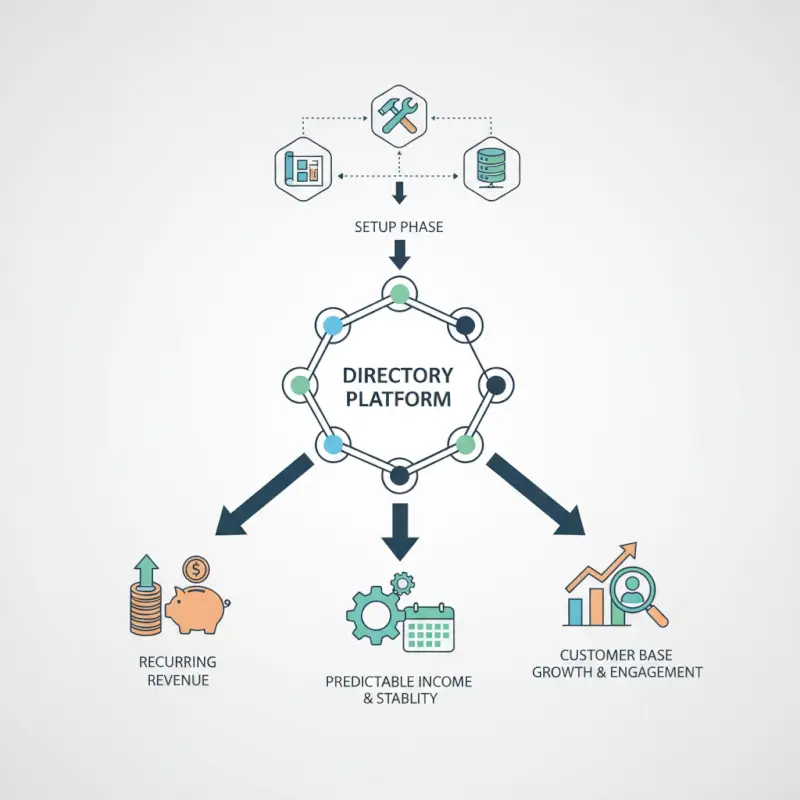
The mechanics are straightforward but powerful. Assume your directory has 200 business listings paying $150 annually. Under a one-time model, you collect $30,000 once and hope for renewals. Under a monthly subscription at $15/month, those same customers generate $36,000 annually with monthly touchpoints that reinforce value. More importantly, you gain 12 opportunities per year to demonstrate platform improvements rather than a single annual interaction, which has been shown to improve retention rates significantly according to research from Chargebee’s subscription growth analysis.
Predictability and Cash-Flow Stability
Cash-flow volatility kills directory businesses. When revenue arrives in unpredictable bursts—concentrated around renewal periods or seasonal listing surges—you can’t confidently invest in platform enhancements or marketing experiments. Recurring revenue solves this by creating a growing baseline of Monthly Recurring Revenue (MRR) that you can forecast with reasonable accuracy. This stability allows you to budget for enhanced listing features, analytics dashboards, and API integrations without worrying whether next quarter’s revenue will cover costs.
The directory revenue model strategies you choose directly impact this stability. Consider annual prepaid subscriptions versus month-to-month commitments; annual plans provide immediate cash injection while monthly plans offer lower friction but require tighter churn management. Most successful directories blend both options, offering a discount for annual commitment (typically 15-20% savings) while maintaining monthly flexibility for smaller businesses or individual professionals testing the platform.
Beyond forecasting, recurring revenue creates operational breathing room. You’re no longer scrambling to replace churned listings with new acquisitions at the same rate; instead, you focus on net subscriber growth where even modest monthly gains compound. If you add 20 new subscribers monthly while losing 5, that 15-net gain accumulates to 180 additional subscribers annually—representing significant ARR growth without proportional increases in marketing spend.
Higher Customer Lifetime Value and Retention Opportunities
Customer Lifetime Value (CLV or LTV) represents the total revenue a single subscriber generates over their entire relationship with your directory. In transactional models, LTV equals the average purchase value times purchase frequency—often resulting in low multiples. Subscription models flip this equation, turning a $150 one-time buyer into a $1,800+ customer over just one year of monthly payments at $15/month, assuming minimal churn.
The retention component matters most here. Every month a subscriber remains active adds incremental revenue with minimal additional acquisition cost. According to Digital Applied’s subscription commerce research, increasing customer retention by just 5% can boost profits by 25-95% because retained customers cost significantly less to serve than new acquisitions. For directories, this manifests through improved listing quality over time—long-term subscribers tend to maintain accurate information, upload photos, and respond to reviews, creating network effects that attract more users.
Subscription economics also unlock cross-sell and upsell opportunities that one-time transactions can’t support. A basic subscriber paying $20/month represents an expansion revenue opportunity; you can introduce premium features like enhanced visibility, lead tracking analytics, or featured placement that command additional $10-30/month premiums. Research from Forbes on subscription management shows that upsell revenue typically contributes 10-30% of total recurring revenue in mature subscription businesses, which explains why tiered pricing strategies prove so effective.
Core Benefits and Metrics for Directories
Transitioning to subscription-based monetization requires tracking different success metrics than transactional directories use. Annual Recurring Revenue (ARR), Monthly Recurring Revenue (MRR), churn rate, and LTV:CAC ratio become your operational dashboard, replacing simple listing count or transaction volume. These metrics provide early warning signals when subscriber health deteriorates and highlight growth levers that deserve additional investment. Understanding how to interpret and act on these numbers separates successful recurring revenue directories from those that struggle with high churn.

The shift in measurement philosophy reflects a deeper business model change. You’re no longer optimizing for maximum listings or highest transaction volume; you’re building a subscriber base that renews predictably and expands over time. This requires balancing acquisition (adding new subscribers) with retention (keeping existing ones) and expansion (increasing revenue per subscriber through upsells). The directory monetization strategies that work best integrate all three growth vectors rather than focusing narrowly on new customer acquisition.
Predictable Monetization and Margin Growth
ARR represents your annualized committed revenue from all active subscriptions, normalized to yearly values regardless of billing frequency. If you have 100 monthly subscribers at $25/month and 50 annual subscribers at $250/year, your ARR equals $42,500 (100 × $25 × 12 + 50 × $250). This metric becomes your north star for valuation; subscription businesses typically command 5-10x ARR multiples in acquisition scenarios, far exceeding transactional directory valuations of 2-3x annual earnings.
Churn management directly impacts ARR sustainability. Your monthly churn rate—the percentage of subscribers who cancel each month—must stay below revenue growth rate to ensure net positive expansion. For directories, acceptable monthly churn ranges from 2-5% depending on subscriber type; B2B professional directories typically see lower churn (2-3%) while consumer-focused local directories may experience 4-6%. Every percentage point of churn reduction compounds dramatically over time, which explains why Chargebee’s recurring revenue research emphasizes retention as the highest-leverage growth activity.
The WordPress plugins you choose for subscription management must support detailed MRR tracking, cohort analysis, and churn reporting. Basic payment processors like PayPal won’t provide the analytical depth needed to optimize subscription performance. Instead, directory operators should implement subscription-specific billing platforms that track voluntary versus involuntary churn (failed payments), expansion MRR from upgrades, and contraction MRR from downgrades. These granular metrics reveal whether you’re losing subscribers due to insufficient value delivery or simply payment method failures you can recover through retry logic.
Lower Customer Acquisition Pressure via Long-Term Commitments
Customer Acquisition Cost (CAC) represents the total sales and marketing expense required to land a single new subscriber. For directories, this includes advertising spend, sales personnel compensation, promotional discounts, and platform onboarding costs. Transactional models require constant high-volume acquisition because each customer generates limited one-time revenue. Subscription models allow you to amortize CAC over many months of recurring payments, fundamentally changing acquisition economics.
The LTV:CAC ratio quantifies this advantage. A healthy subscription business maintains a 3:1 ratio or higher, meaning each subscriber generates at least three times their acquisition cost over their lifetime. If your CAC equals $75 through paid advertising and onboarding, that subscriber must generate at least $225 in total recurring revenue before churning. At $25/month, this requires a 9-month minimum retention period—achievable for most directories with reasonable onboarding and value delivery. According to Statista’s e-commerce analysis, subscription businesses typically recover CAC within 5-12 months, after which all revenue flows to margin.
This economic structure lets you experiment with higher-touch acquisition channels that transactional directories can’t justify. A $200 CAC would be prohibitive if you’re selling $150 one-time listings, you’d lose money on each customer. But if that $200 CAC yields a subscriber paying $30/month who remains active for 18 months on average, your LTV reaches $540 with a 2.7:1 ratio—approaching healthy benchmarks. This opens opportunities for content marketing, partnerships, and even limited inside sales that drive qualified, higher-intent subscribers rather than volume listing buyers.
The technical infrastructure of your directory platform must support frictionless subscription signup to minimize CAC. Every additional form field or verification step reduces conversion rates; every delay in payment processing creates abandonment opportunities. Best-in-class directory subscription experiences complete signup in under 90 seconds with immediate access to basic features, encouraging activation before buyer’s remorse sets in. Then your onboarding sequence—email drips, tutorial videos, success manager outreach for premium tiers—drives early value realization that cements retention.
Growth Levers for Directory Subscriptions
Once a directory establishes recurring revenue as its foundation, the next challenge is maximizing growth through strategic pricing, packaging, and retention. Unlike one-time fees that optimize for conversion alone, subscription models offer multiple levers to increase both acquisition and lifetime value. Directories can experiment with tiered membership plans, annual versus monthly billing, and add-on features such as priority placement, analytics dashboards, or enhanced profile customization.

Pricing strategy is the most direct growth lever. Industry analysis from Chargebee highlights that well-designed pricing tiers can increase average revenue per user (ARPU) by 20–30% compared to single-plan models. For directories, this might mean offering a basic listing tier at low cost, a professional tier with enhanced visibility and multimedia support, and a premium tier with lead-generation tools and priority search ranking. Annual billing typically reduces churn and improves cash flow, as customers who commit for a full year have lower early-stage attrition and often receive a discount incentive (e.g., 15–20% off monthly rates).
Packaging is equally important. Directories should bundle features that drive measurable value for subscribers—such as traffic analytics, customer inquiries, or social-media integrations—and reserve the highest-value capabilities for upper tiers. This creates natural upgrade paths and encourages existing subscribers to expand their spend. Add-ons (e.g., verified badges, featured placements, or extended geographic coverage) can further boost revenue without forcing users into higher tiers prematurely.
Retention tactics are the second critical lever. Subscription growth guides consistently emphasize that reducing churn by even 5 percentage points can increase customer lifetime value by 25% or more. Directories should monitor early-warning signals—low login frequency, declining profile updates, or unanswered inquiries—and trigger proactive outreach, personalized onboarding sequences, or limited-time feature unlocks. Delivering quick wins during the first 30 days (e.g., “Your listing received 50 views this week”) reinforces value and builds habit formation.
| Growth Lever | Tactic | Typical Impact |
|---|---|---|
| Tiered Pricing | Basic / Professional / Premium plans with progressive feature unlocks | +20–30% ARPU |
| Annual Billing | 15–20% discount vs. monthly; upfront cash collection | −5–10% churn; improved cash flow |
| Feature Add-Ons | Verified badges, featured placement, extended geo coverage | +10–15% incremental revenue per subscriber |
| Proactive Churn Prevention | Low-engagement alerts, personalized onboarding, quick-win dashboards | −5% monthly churn; +25% LTV |
Operational Considerations for Implementing Directory Subscriptions
Launching a directory subscription model requires robust infrastructure to handle renewals, invoicing, proration, upgrades, downgrades, and cancellations without manual intervention. A modern billing platform should automate dunning (retry logic for failed payments), generate compliant invoices, support multiple payment gateways, and provide self-service account management for subscribers. Subscription operations guides emphasize that operational friction—such as clunky upgrade flows or opaque billing cycles—directly increases churn and support burden.

Technology selection should prioritize integration and flexibility. The billing system must connect to your directory’s user database, content-management platform, and analytics stack to trigger feature access, log usage events, and reconcile revenue recognition. Many directories use platforms like Stripe Billing, Chargebee, or Recurly to abstract payment orchestration, subscription lifecycle management, and revenue reporting. Self-service portals are essential: subscribers expect to view invoices, update payment methods, change plans, and cancel subscriptions without contacting support.
Onboarding workflows deserve special attention. New subscribers should receive automated welcome emails, guided tours of premium features, and milestone-based tips (e.g., “Complete your profile to boost visibility by 40%”). Recurring revenue research shows that users who complete core actions in the first week have 50% lower churn than those who do not. Directories can embed onboarding checklists, offer live or recorded demos, and send usage-based nudges to accelerate time-to-value.
Compliance and risk management are non-negotiable. Recurring billing introduces regulatory obligations around clear disclosure, cancellation rights, and data privacy. In the United States, the Federal Trade Commission scrutinizes “negative option” plans—subscriptions that auto-renew unless canceled—requiring conspicuous consent, easy cancellation mechanisms, and timely renewal notifications. Regulatory commentary from the Competitive Enterprise Institute underscores the importance of transparent terms and frictionless opt-out processes. Directories must also comply with GDPR (for European subscribers), CCPA (for California residents), and PCI DSS standards for payment data security.
Practical Case Considerations for Directory Niches
Directory subscription strategies vary significantly between B2B and B2C contexts. B2B directories—such as vendor marketplaces, professional association rosters, or industry supplier databases—typically command higher price points and emphasize lead quality, advanced search filters, and integration with CRM or procurement systems. Subscribers in B2B niches often value exclusive access, certified vendor badges, and detailed analytics on profile views and inquiries. Annual contracts and tiered sponsorship packages are common, reflecting higher willingness to pay and longer sales cycles.

B2C directories—local business listings, consumer service providers, or hobbyist communities—rely on volume, frequency, and ancillary monetization (e.g., promoted listings, banner ads, or booking integrations). Monthly subscriptions and lower entry prices reduce friction for individual service providers and small businesses. Cross-industry subscription insights indicate that B2C models benefit from freemium tiers to drive initial adoption, then upsell based on usage (e.g., “You’ve reached your monthly inquiry limit—upgrade to respond to more customers”). Both segments achieve predictable revenue, but packaging, pricing, and retention tactics must align with buyer psychology and value perception.
Market signals from 2024–2026 provide directional benchmarks. Industry reports show that mature SaaS and subscription businesses maintain median gross churn rates of 5–7% monthly for B2C and 1–2% monthly for B2B. ARPU growth in successful subscription businesses averages 10–15% year-over-year through pricing optimization, upsells, and cross-sells. Directories launching recurring models should target similar trajectories, tracking cohort retention curves and expansion revenue to diagnose health early.
Niche-specific features can differentiate directory subscriptions. A professional directory might offer continuing-education credits, peer endorsements, or event access as part of premium tiers. A local business directory could bundle reputation-management tools, appointment scheduling, or online-review response templates. By tailoring value propositions to the unique needs of each niche, directories transform subscriptions from commoditized listings into essential business tools that justify recurring fees and resist commoditization.
| Directory Type | Typical Subscriber | Price Point | Core Value Drivers |
|---|---|---|---|
| B2B Vendor Directory | Enterprise suppliers, solution providers | $200–$2,000/month | Lead generation, RFP alerts, CRM integration, certified badges |
| Professional Association Directory | Individual members, practices, consultancies | $50–$500/year | Credentialing, referrals, continuing education, peer endorsements |
| Local Business Directory | Small businesses, service providers | $10–$100/month | Visibility, customer inquiries, review management, appointment booking |
| Hobbyist/Community Directory | Enthusiasts, clubs, freelancers | $5–$25/month | Community access, event listings, marketplace privileges, featured profiles |
Frequently Asked Questions
How does a directory subscription differ from a one-time listing fee?
A directory subscription charges customers recurring fees (monthly or annually) for ongoing access to enhanced listings, analytics, and priority placement, while one-time listing fees grant limited-term or basic visibility. Subscriptions generate predictable revenue and foster deeper engagement, whereas one-time fees require continuous new customer acquisition to sustain cash flow.
What are the most effective pricing models for directory subscriptions?
Tiered monthly and annual plans work best for directories. Offer a basic tier for visibility, mid-tier with analytics and premium placement, and enterprise tier with API access or unlimited listings. Annual billing reduces churn and improves cash flow, while monthly plans lower entry barriers and attract smaller businesses testing your platform.
How can a directory reduce churn and boost retention with recurring revenue?
Reduce churn by demonstrating tangible value early through onboarding tutorials, regular usage reports, and performance analytics showing lead generation or traffic gains. Implement proactive outreach when engagement drops, offer flexible plan downgrades instead of cancellations, and continuously add features like review management or SEO tools that increase stickiness.
What metrics should a directory track to gauge subscription health?
Track monthly recurring revenue (MRR), annual recurring revenue (ARR), customer churn rate, revenue churn, customer lifetime value (CLV), customer acquisition cost (CAC), and average revenue per user (ARPU). Monitor expansion revenue from upsells and cross-sells. These metrics reveal growth trajectory, retention strength, and profitability of your subscription base.
Are there successful examples of directory businesses using subscription models?
Yes. Professional directories like Houzz Pro and industry-specific platforms such as ThomasNet offer tiered subscriptions for enhanced visibility and lead generation. Local business directories including Yelp and Angi provide subscription packages for analytics, advertising credits, and priority placement. These models demonstrate the viability of recurring revenue in directory contexts.
What are common pitfalls when launching a directory subscription program?
Common pitfalls include unclear value propositions, overly complex pricing tiers, poor onboarding that delays time-to-value, and inadequate billing infrastructure causing payment failures. Neglecting churn signals, failing to communicate renewal terms transparently, and underinvesting in customer success can also erode retention and damage reputation.
Should a directory offer both free and paid subscription tiers?
A freemium model can drive user acquisition and build network effects by populating your directory with free listings, then converting power users to paid plans for premium features. However, ensure free tiers are feature-limited enough to incentivize upgrades without diluting value or creating support burdens that outweigh conversion revenue.
How long does it take for a directory subscription model to become profitable?
Profitability timelines vary by niche and acquisition cost. Directories with low CAC and high-value niches can break even within 6–12 months as recurring revenue accumulates. High-growth directories investing heavily in marketing may require 18–24 months. Focus on reducing payback period by improving onboarding, retention, and pricing efficiency to accelerate profitability.
Ready to Transform Your Directory into a Revenue Engine?
Directory subscriptions are not just a billing tactic—they’re a strategic shift that aligns your business model with sustainable, scalable growth. By replacing sporadic one-off listing fees with predictable recurring revenue, you gain the financial stability to invest in product enhancements, customer success, and long-term competitive differentiation. The five advantages we’ve covered—cash-flow predictability, higher lifetime value, efficient acquisition dynamics, retention-focused operations, and growth optionality—work together to create a compounding flywheel: happier, stickier customers generate more revenue, funding better features that attract and retain even more subscribers.
Implementation requires deliberate planning. Start by segmenting your audience and mapping their willingness to pay against the value you deliver—analytics dashboards, premium placement, lead tracking, or API integrations. Design tiered pricing that balances accessibility and profitability, then build an operational stack capable of handling renewals, prorations, and self-serve upgrades without friction. Invest early in onboarding and customer success to shorten time-to-value and reduce churn, and establish dashboards that surface MRR, ARR, churn, CLV, and expansion metrics at a glance.
Most importantly, remember that subscription success is iterative. Monitor cohort retention curves, run pricing experiments, gather qualitative feedback from churned and loyal subscribers, and continuously refine your value proposition. The directories that thrive in a subscription economy aren’t those with the fanciest features—they’re the ones that relentlessly focus on delivering measurable outcomes, communicate transparently about pricing and renewals, and treat every renewal as an opportunity to prove ongoing value.
Your Next Steps
Define your target segments, prototype three pricing tiers, and map out a 90-day onboarding journey that demonstrates ROI within the first renewal cycle. Set up a simple metrics dashboard tracking MRR, monthly churn, and customer acquisition payback period. Then launch a pilot cohort, gather feedback, and iterate. The sooner you start, the sooner you’ll build a revenue base that funds innovation and insulates your directory from market volatility.
Ready to unlock predictable growth? Build your subscription model today.
The transition from transactional to recurring revenue is a journey, not a flip of a switch. But directories that commit to this path unlock compounding advantages: stronger customer relationships, more predictable forecasting, higher valuations, and the operational leverage to outpace competitors still chasing one-time deals. Whether you run a local business directory, a B2B industry platform, or a niche professional network, the principles are the same—align pricing with value, obsess over retention, and let recurring revenue become the engine that powers every strategic initiative. The opportunity is here. The tools and insights are available. Now it’s your turn to act.
Was this article helpful?