7 Essential Tips to Run a Profitable Online Business Directory in 2026

Generating summary...
Building a profitable online business directory isn’t about throwing up a list of local companies and hoping for the best. The directories that win in today’s market combine trusted listings, scalable monetization, rock-solid SEO, and smart automation—while staying lean enough to actually turn a profit. Most founders stumble because they focus on breadth (every business in town!) rather than building something users genuinely trust and return to. The real opportunity? Directories that solve a specific problem for a narrow audience, monetize from day one, and use data quality as a competitive moat.
TL;DR – Quick Takeaways
- Market positioning beats scale – Niche directories with verified listings outperform generic local directories
- Monetize early – Premium listings, lead gen, and API access create diverse revenue faster than ads alone
- Trust signals convert – Reviews, verification badges, and data freshness drive user engagement and paid upgrades
- SEO fuels growth – Structured data, location pages, and niche content capture organic traffic without ad spend
- Automation is profit – Self-serve onboarding and automated validation reduce costs while scaling listings
Market Landscape and Competitive Positioning
What the Market Looks Like Right Now
The online business directory space is split between massive generic platforms and specialized niche players—and the niche players are winning. According to IMARC Group research, the digital marketing ecosystem continues to expand with directory services capturing a growing share as consumers search for verified, specialized listings. Small businesses rely on directory websites to build local visibility, while consumers demand accuracy and trust signals before they click.
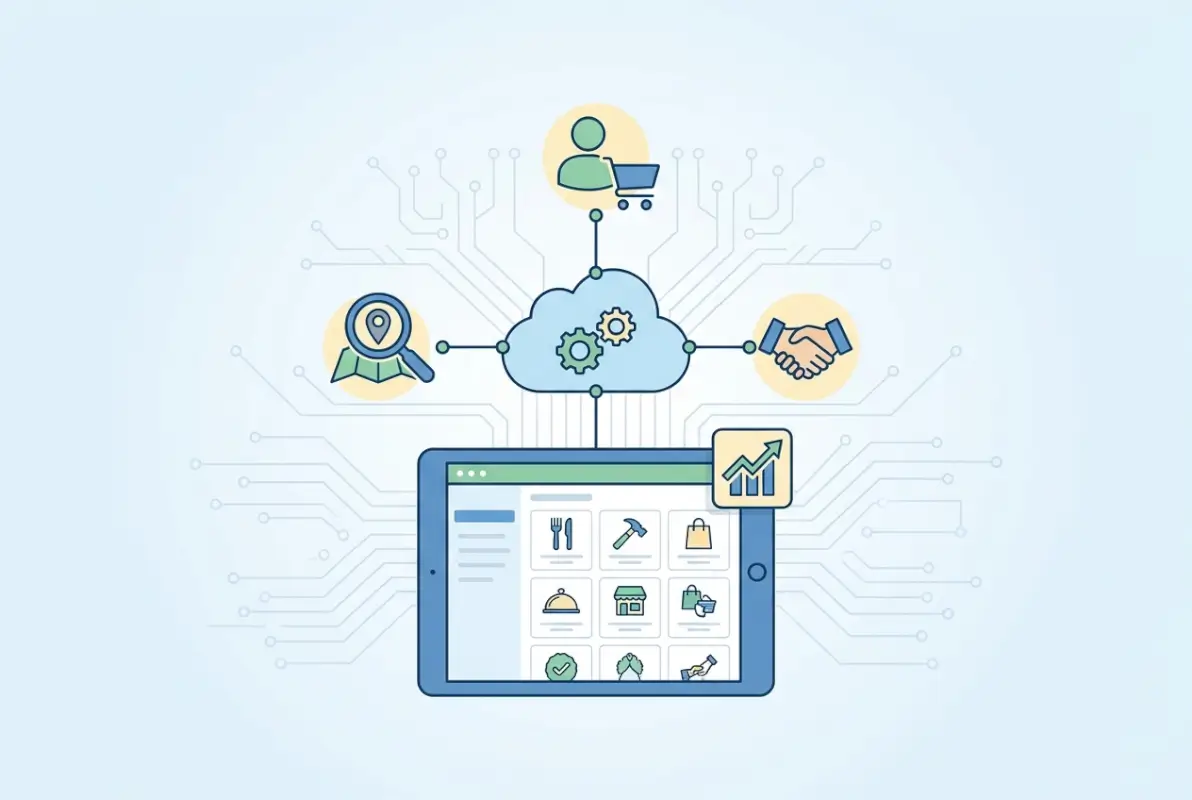
The real shift is toward micro-niche directories—think “plumbers who specialize in historic homes” rather than “all contractors.” These focused directories command higher listing fees because they connect businesses with qualified leads, not just browsers. Data from the U.S. Small Business Administration shows small business formation continues strong, creating fresh demand for targeted discovery platforms that help them stand out from generic search results.
Consumer trust in listings hinges on three factors: recency (when was this listing last updated?), verification (is this business real and open?), and social proof (what do other customers say?). Directories that nail these three beat broader platforms every time, because users know they’re not wasting time on dead links or questionable operators.
Benchmarking Top Competitors and What Works
Leading directory players share a playbook: they blend free basic listings with premium upgrades, layer in advertising revenue, and license their data to third parties. Platforms like doctor directories excel by offering detailed profiles, patient reviews, and insurance filters—features users can’t get from a simple Google search. The monetization mix matters more than traffic volume; a focused directory with 10,000 monthly users can outperform a generic one with 100,000 if those users have high intent.
Trust signals separate winners from also-rans. Top directories display verification badges (we called this business and confirmed their hours), show last-updated timestamps, and surface genuine reviews prominently. They integrate with local SEO by claiming and syncing Google Business Profile data, ensuring their listings match what users see on Maps. This consistency builds credibility and reduces bounce rates.
The best platforms also maintain data freshness through a mix of automation (scraping public records, API integrations with business registries) and crowdsourcing (prompting users to flag outdated info). According to Statista internet usage data, users abandon directories quickly if they encounter even a few stale or incorrect listings, so quality control isn’t optional—it’s the core product.
Monetization and Profit Accumulation Framework
Core Revenue Streams That Scale
Premium listings remain the workhorse revenue model: businesses pay monthly or annually for enhanced profiles with photos, extended descriptions, and priority placement in search results. This works because the ROI is clear—a plumber who gets three extra leads per month from a featured spot will pay $50–$200/month without hesitation. Business directory advertising options add a second layer, letting non-listed companies buy banner or sponsored slots to reach your audience.

Lead generation partnerships create higher-value revenue streams. Instead of just listing a business, you capture inquiry forms (quote requests, appointment bookings) and charge per qualified lead delivered. This model works best in high-ticket categories—home services, legal, medical—where a single conversion is worth hundreds or thousands of dollars. Affiliate partnerships (linking to booking platforms, review sites, or SaaS tools businesses use) add incremental income without extra overhead.
API and data licensing often fly under the radar but can generate significant recurring revenue. Other platforms, apps, or research firms will pay for structured access to your verified business data, especially if you’ve built a rich dataset in a specialized niche. The margins are excellent because you’re selling the same data multiple times with minimal additional cost.
| Revenue Stream | Best For | Typical Margin |
|---|---|---|
| Premium Listings | All directory types | 70-85% |
| Display Advertising | High-traffic directories | 60-75% |
| Lead Generation | High-ticket services | 40-60% |
| API/Data Licensing | Niche B2B directories | 80-95% |
Cost Structure and Efficiency Levers
Directory costs cluster around listing acquisition, validation, customer support, hosting, and content moderation. Acquisition costs drop dramatically when you let businesses self-onboard through a free tier, then upsell premium features via automated email sequences. Validation can be partially automated using public data sources (business registries, Google Business Profile APIs) and flagging systems where users report issues.
Support costs scale with complexity—if you offer custom features or manual verification, headcount grows with listings. The fix is tiered pricing with clear self-service documentation for free and basic tiers, reserving human support for premium customers who pay enough to justify it. Performance-based incentives (sales commissions on upgrades, bonuses for reducing churn) align your team with profitability metrics.
Hosting and infrastructure scale more predictably; modern platforms like TurnKey Directories run on WordPress and can handle thousands of listings on modest hosting plans. The real efficiency lever is automation—automated listing imports, review moderation using keyword filters, and scheduled re-verification prompts to businesses keep data fresh without manual busywork.
Data Quality, Trust, and Compliance for Growth
Trust is the currency of any directory business, and in 2026 consumers expect verification, transparency, and accuracy before clicking or converting. A directory that displays stale contact details, unverified reviews, or missing business hours loses credibility fast—often to a competitor who invests in data quality. To build trust at scale, deploy visible signals such as verification badges, “last updated” timestamps, and user-generated review counts on every listing page. These elements reassure visitors that your platform actively curates its data rather than scraping outdated information from third-party sources.

Data quality starts with automated validation workflows that flag inconsistencies—duplicate listings, mismatched phone numbers, or broken URLs—before they go live. Implement periodic re-verification prompts for business owners, offering a simple dashboard where they can update hours, services, and photos in seconds. Incentivize participation by showing analytics (profile views, click-throughs) to paid subscribers; businesses that see tangible traffic will maintain their listings more diligently. Where automation cannot reach, lean on community moderation: allow users to suggest edits and reward accurate contributions with badges or loyalty points.
Trust Signals that Drive Conversion
Conversion hinges on three trust pillars: social proof, authority markers, and transparency. Social proof comes from authentic reviews—prioritize star ratings with review counts prominently displayed, and surface recent testimonials above older ones to demonstrate ongoing engagement. Authority markers include industry certifications, years in business, and editorial endorsements (e.g., “Featured Listing” or “Top Rated”); these labels work best when criteria are clearly explained to users, preventing any perception of pay-to-play bias. Transparency means showing exactly when a listing was last verified, who verified it (owner-claimed or platform-validated), and disclosing any commercial relationship (sponsored tag) when premium placement is purchased.
Leverage schema markup—specifically LocalBusiness and AggregateRating schemas—to push trust signals directly into search snippets, increasing click-through from Google and Bing. Add rich media (photos, videos, virtual tours) to premium tiers; listings with high-quality images convert two to three times better than text-only entries. Finally, consider third-party integrations: sync verified reviews from Google Business Profile or Trustpilot to aggregate credibility, and display API-sourced certifications (Better Business Bureau accreditation, professional licenses) when available.
Compliance, Privacy, and Data Quality
Regulatory frameworks around data privacy—GDPR in the EU, CCPA in California, and emerging state laws across the U.S.—require explicit consent before processing personal information and straightforward opt-out mechanisms. If your directory collects business owner emails, phone numbers, or customer IP addresses for analytics, publish a transparent privacy policy that details what you collect, how you use it, and third parties you share with. Implement cookie consent banners for European visitors and honor “Do Not Sell” requests under CCPA by maintaining a suppression list that your email automation respects.
Data governance extends beyond legal compliance to operational hygiene: maintain an audit log of listing changes, enforce role-based access controls for your team, and schedule regular exports to a secure backup. For directories serving regulated industries—healthcare, legal, financial—verify professional credentials through primary sources (state licensing boards, certification agencies) and document the verification date. Compliance failures not only invite fines but erode the trust foundation your entire monetization model depends on, so treat data quality and regulatory adherence as non-negotiable inputs to profitability.
SEO, Content, and Growth Engine for 2026
Organic search remains the primary acquisition channel for directories because high-intent queries—”best contractors near me,” “verified accountants in Austin”—map directly to directory value propositions. In 2026, winning SEO means structured data excellence, location-page depth, and content that matches People Also Ask clusters. Start by implementing LocalBusiness, BreadcrumbList, and SearchAction schemas on every listing; these markup types surface rich snippets (star ratings, business hours, price ranges) that lift click-through rates by 20–40 percent. Ensure each category and location combination generates a unique, crawlable URL with distinct meta titles and H1s to capture long-tail variations.

Freshness is a ranking signal Google explicitly values for local and commercial queries, so automate listing update timestamps and display them prominently. Encourage business owners to add new photos, respond to reviews, and refresh service descriptions monthly; each edit signals to search engines that the page is actively maintained. Build internal link equity by cross-linking related categories (e.g., “Plumbers” to “HVAC Contractors”), and create hub pages (e.g., “Home Services Directory”) that funnel authority down to individual listings. Technical hygiene—fast load times, mobile-responsive design, secure HTTPS—remains table stakes; invest in image optimization, lazy loading, and a content delivery network to keep Core Web Vitals in the green.
SEO-Driven Listing Architectures
Category and location pages form the backbone of directory SEO, so design a scalable taxonomy that balances breadth and specificity. Use a three-tier structure: top-level categories (e.g., “Professional Services”), sub-categories (e.g., “Legal,” “Accounting”), and geo-modifiers (e.g., “Accounting in Chicago”). Generate programmatic pages for each combination, populating them with an introductory paragraph, a filterable list of businesses, and contextual snippets (average rating, number of reviews, years in business). Avoid thin content by setting a minimum listing count—typically five to ten businesses—before a location page goes live; unpublish or noindex pages that fall below the threshold to preserve crawl budget.
Leverage faceted search (price range, service type, customer rating) but manage URL parameters carefully to prevent duplicate-content penalties. Use canonical tags to consolidate filter permutations back to a master category page, or employ a JavaScript framework that renders filters client-side while serving a single server-side URL. Add breadcrumb navigation with BreadcrumbList markup to clarify hierarchy for both users and bots. For high-value categories, create pillar content—comprehensive guides (e.g., “Complete Guide to Hiring a CPA”) that link out to relevant listings—and update them quarterly to maintain topical authority and ranking momentum.
Content Strategy and Engagement
Content serves dual purposes: it attracts organic traffic from informational queries and nurtures visitors toward transactional decisions (contacting a business, upgrading to premium). Publish how-to guides, comparison articles, and case studies that address common pain points in your niche—”How to Vet a Contractor Before Signing,” “5 Questions to Ask Your Wedding Photographer.” Each piece should naturally link to relevant category pages and top-rated listings, creating a conversion funnel from awareness to action. Align topics with People Also Ask boxes and “related searches” from Google to capture featured snippets and expand keyword coverage.
Engagement metrics—time on page, scroll depth, return visits—signal content quality to search algorithms, so optimize readability with short paragraphs, bullet lists, and embedded media. Incorporate user-generated content where possible: invite business owners to contribute guest posts or spotlight customer success stories, then tag and link back to their listings. Run a blog or resource center that publishes weekly, using an editorial calendar that cycles through evergreen topics and seasonal trends (e.g., tax-prep services in Q1, wedding vendors in spring). Track performance in Google Search Console and double down on content clusters that drive the highest impressions-to-listing-clicks ratio, pruning or updating underperformers to keep the overall site authority climbing.
Operational Blueprint for 2026 Launch or Scale
Scaling a directory profitably demands a technology stack that automates repetitive tasks—listing ingestion, verification reminders, payment processing—while preserving flexibility for experimentation. Choose a content management system with robust directory plugins (WordPress with GeoDirectory or Brilliant Directories, or a headless CMS paired with a custom front-end) that supports advanced search facets, user dashboards, and tiered subscription management out of the box. Prioritize platforms with active developer communities and marketplace extensions for reviews, maps, and analytics; this ecosystem reduces custom-development overhead and accelerates time to market. Ensure your hosting environment can auto-scale during traffic spikes—cloud providers like AWS, Google Cloud, or managed WordPress hosts (Kinsta, WP Engine) offer elastic compute and CDN integration essential for performance at scale.

Data pipelines are mission-critical: build or integrate ETL (extract, transform, load) workflows that pull business data from partner APIs, cleanse duplicates, normalize addresses via geocoding services (Google Maps API, Mapbox), and flag anomalies for human review. Implement a scheduled job—daily or weekly—that pings each listing URL to detect broken links and sends automated re-verification emails to business owners when data is stale. Invest in a customer relationship management (CRM) tool (HubSpot, Salesforce Essentials, or Pipedrive) to track lead funnels for premium upgrades, segment users by engagement level, and automate onboarding sequences that guide new listers through profile completion and payment setup.
Platform and Tech Stack Essentials
A scalable directory stack balances ease of use for non-technical operators with enough customization headroom to differentiate your platform. At the core, you need a database optimized for geo-queries (PostGIS extension on PostgreSQL, or Elasticsearch with geo-point fields), a front-end that renders fast on mobile (React, Vue, or server-side rendering), and a secure payment gateway (Stripe, PayPal) that handles subscriptions, one-time fees, and automated invoicing. Layer on search functionality—Algolia or Elasticsearch—that supports instant autocomplete, faceted filters, and relevance tuning so users find the right business in seconds. Integrate a review and rating module early; whether you build in-house or plug in a third-party solution (Trustpilot API, Yotpo), ensure reviews sync bi-directionally and display prominently on listing pages.
Automation tools reduce operational drag: use Zapier or Make (formerly Integromat) to connect form submissions, email marketing platforms (Mailchimp, ConvertKit), and Slack notifications for support tickets. Set up monitoring with uptime services (UptimeRobot, Pingdom) and error tracking (Sentry, Rollbar) to catch outages and bugs before users churn. As you scale, consider a dedicated admin panel that visualizes key metrics—new listings per week, revenue by tier, average listing freshness—and surfaces anomalies (sudden drop in premium sign-ups, spike in support requests) for rapid triage. Document every workflow in a shared knowledge base so team members can onboard quickly and maintain consistency as you grow.
Partnerships, Ecosystem, and Growth Tactics
Strategic partnerships multiply reach without proportional marketing spend. Identify local business associations, chambers of commerce, and trade groups whose members match your directory niche; offer co-branded landing pages, bulk discounts, or revenue shares in exchange for endorsement and member outreach. Integrate with complementary SaaS tools—appointment schedulers (Calendly, Acuity), CRM platforms, accounting software—so businesses see your directory as part of their operational stack, not an isolated listing. These integrations create lock-in and surface your directory within the partner’s user base, driving high-intent signups.
Growth experiments should run continuously: A/B test onboarding flows (single-page vs. multi-step), pricing tiers (monthly vs. annual discounts), and call-to-action placements (sticky footer vs. inline prompts). Use cohort analysis to measure retention—track businesses that claim their free listing and identify friction points that prevent upgrade to premium. Launch referral programs that reward existing premium subscribers with account credits or extended features when they bring in new paid users. Finally, cultivate a community: host webinars on local SEO or digital marketing for small businesses, publish case studies of successful listers, and create a members-only forum where businesses exchange tips—engaged communities generate word-of-mouth, reduce churn, and provide a continuous feedback loop to refine your platform.
| Growth Tactic | Implementation Effort | Expected Impact | Timeline to Results |
|---|---|---|---|
| Association Co-Marketing | Medium (contract negotiation, landing page build) | High (bulk sign-ups, credibility boost) | 1–2 months |
| SaaS Tool Integration | High (API dev, testing, support) | Medium-High (sticky usage, partner referrals) | 2–4 months |
| Referral Program | Low (plug-in or simple tracking) | Medium (incremental viral growth) | 2–6 weeks |
| A/B Testing (Onboarding & Pricing) | Low (analytics setup, variant creation) | Medium (conversion lift 5–15%) | Ongoing (monthly iterations) |
| Community Webinars & Content | Medium (speaker coordination, promotion) | Medium (engagement, brand authority) | 1–3 months per event cycle |
Frequently Asked Questions
What is a profitable online directory business in 2026?
A profitable online directory combines high-quality, verified business listings with scalable monetization channels like premium placements, lead generation, and advertising. Success requires efficient automation to grow revenue without proportional cost increases, strong trust signals through reviews and verification, and strategic SEO to drive organic traffic at low acquisition cost.
Which monetization methods work best for directories today?
Premium listings with featured placement, targeted advertising, qualified lead generation, and API or data licensing perform best when paired with value-added features. Effective directories use tiered pricing models that offer free baseline listings with paid upgrades for enhanced visibility, analytics dashboards, and verification badges that drive measurable business results.
How important are reviews and trust signals for directory success?
Reviews and trust signals are critical for conversion and retention in 2026. Verified listings, transparent review systems, visible update timestamps, and credibility badges significantly increase user confidence and engagement. Directories that implement robust verification processes and display listing accuracy signals consistently outperform competitors with unverified or stale data.
How can I start a directory with limited traffic and grow quickly?
Focus on a narrow, high-demand niche where you can become the authoritative source quickly. Launch with a lightweight CMS and directory plugin, integrate core monetization from day one, and invest heavily in local SEO and targeted content that addresses specific buyer intent. Use structured data and location pages to capture long-tail search queries efficiently.
What SEO strategies deliver the biggest lift for local business directories?
Optimize location and category landing pages with structured schema markup, maintain fresh and accurate listings with visible update dates, and publish niche guides aligned with user search intent. Build credible backlinks from local associations and complementary platforms. Implement comprehensive internal linking between related categories and geographic pages to maximize crawl efficiency.
What data quality practices matter most for user trust?
Regular validation through automated checks and manual review, visible last-updated timestamps, and verification badges are essential. Implement self-serve update flows for business owners, prompt listings for annual refreshes, and remove or flag inactive entries. Transparent data sourcing and clear editorial standards reinforce authority and encourage repeat visits from both searchers and businesses.
How do I price directory listings effectively?
Use tiered pricing with a free baseline listing and paid upgrades for premium placement, analytics, multimedia content, and verification. Test different price points with A/B experiments, align pricing to measurable value like lead volume or visibility metrics, and segment by business size or niche. Annual plans with discounts improve cash flow and reduce churn.
What compliance considerations should I plan for with listing data?
Ensure your data handling complies with GDPR in Europe and CCPA in California if you serve those regions. Implement clear opt-out mechanisms for businesses that don’t want to be listed, maintain transparent privacy notices, and secure explicit consent before collecting user-generated content. Regular audits and accessible data update tools reduce legal risk and build trust.
Your Roadmap to Directory Profitability
Building a profitable online business directory in 2026 is entirely achievable when you combine market insight with disciplined execution. The landscape rewards those who deliver verified, trustworthy listings while monetizing intelligently through premium placements, lead generation, and strategic partnerships. Your competitive edge comes from maintaining rigorous data quality, implementing robust SEO architectures, and automating operations to scale revenue without bloating costs.
The seven essential tips outlined in this guide provide a proven framework: understand your market position, diversify revenue streams, build unshakeable trust through verification and reviews, optimize for local search intent, and structure lean operations with the right tech stack and partnerships. Each element reinforces the others—great SEO drives traffic that converts better with strong trust signals, while efficient operations allow you to reinvest in content and features that attract premium listings.
Success hinges on execution. Start with a tightly defined niche where you can become the authoritative source quickly. Launch with core monetization in place rather than waiting for scale. Invest early in structured data and location-based SEO to capture organic traffic at low cost. Build verification and review systems that create defensible differentiation. Then iterate rapidly based on what drives conversions and revenue in your specific vertical.
Ready to Launch Your Directory?
Apply these seven strategies to build a directory that delivers real value to users and sustainable profit for your business. The tools, data sources, and tactical frameworks are all here—now it’s time to choose your niche, map your monetization, and start building.
Focus on trust, optimize for search, automate for scale, and iterate relentlessly. Your profitable directory starts today.
Was this article helpful?