7 Essential Tips to Successfully Run a Directory Website

Running a successful directory website isn’t just about throwing up a list of businesses and hoping Google sends you traffic. It’s about building a platform that becomes the go-to resource in your niche—a trusted ecosystem where users find exactly what they need and businesses see real value in being listed. After watching countless directory projects fail because they skipped foundational steps or chased vanity metrics instead of real engagement, I’ve learned that success comes down to executing a handful of essential practices consistently and well.

The directory landscape has evolved dramatically. What worked five years ago—thin listings with minimal information and aggressive link schemes—now gets you penalized. Today’s winning directories combine robust technical infrastructure, genuine content value, and monetization strategies that align business success with user satisfaction. Whether you’re launching a local services directory or a specialized B2B platform, these seven essential areas will determine whether you build something sustainable or watch your project stagnate.
TL;DR – Quick Takeaways
- Niche specificity wins – Broad directories compete with Yelp and Google; focused directories own their category
- Technical foundation matters most – Schema markup, clean architecture, and mobile performance drive visibility
- Content quality trumps quantity – Rich, unique listings with reviews outperform thousands of thin entries
- Local optimization is non-negotiable – Consistent NAP data and location-focused content capture local search intent
- Monetization should enhance value – Paid features work when they genuinely help businesses succeed
- User experience drives everything – Intuitive search and discovery keeps visitors engaged and returning
- Ongoing optimization beats perfect launches – Start lean, measure relentlessly, and improve continuously
Foundational Planning for a Directory Website
The biggest mistake new directory owners make is going too broad. They envision becoming “the Yelp of everything” in their region or industry, only to discover they’re competing against platforms with billion-dollar budgets and decade-long head starts. The directories that actually gain traction and build sustainable traffic identify a specific niche where they can offer something meaningfully different.

Define Your Niche and Audience
Specificity improves everything about your directory business model. A directory focused exclusively on artisan coffee roasters, craft breweries in the Pacific Northwest, or B2B SaaS tools for accounting firms can establish authority and capture search intent far more effectively than a generic business directory. You’re not just narrowing your audience—you’re creating conditions where listing owners see genuine value because you’re reaching their exact target customers.
To evaluate whether your chosen niche has enough demand without overwhelming competition, start with keyword research focused on discovery queries. Look for search volume around phrases like “find [niche] near me” or “best [niche] in [location]”. If you’re seeing consistent monthly searches in the hundreds or low thousands with commercial intent, you’ve found viable territory. Competition assessment involves examining the top 10 results for these queries—if they’re dominated by generic platforms with weak niche-specific content, you have an opportunity.
Choose an Architecture and Platform Mindset
Your platform choice creates constraints and opportunities you’ll live with for years. WordPress with directory plugins like Directorist or GeoDirectory offers the fastest path to launch with moderate customization needs. You own your code and data, hosting costs stay predictable, and you can find developers easily. The tradeoff is that scaling to hundreds of thousands of listings eventually requires optimization work, and you’re responsible for security updates and performance tuning.
SaaS platforms give you hosted infrastructure and automatic updates but typically charge based on listings or features, which can become expensive as you grow. Custom builds provide ultimate flexibility but require significant upfront investment and ongoing development resources. Most successful directories start with WordPress to validate their concept and migrate to custom infrastructure only after proving the business model at scale.
| Platform Type | Best For | Initial Cost | Scalability |
|---|---|---|---|
| WordPress + Plugin | Quick launch, moderate customization | $300-1,500 | Good to 50K listings |
| SaaS Platform | No-code setup, hosted | $50-500/month | Platform-dependent |
| Custom Build | Unique features, maximum control | $15,000+ | Unlimited |
Map Required Features and Data Model
Every listing in your directory needs consistent, structured data that both users and search engines can understand. Core fields include business name, complete address, phone number, website URL, hours of operation, and pricing information where relevant. Category assignment and attribute tagging let users filter and discover listings effectively—think “outdoor seating” and “delivery available” for restaurants, or “enterprise-ready” and “API access” for software tools.
Frontend submission capabilities where business owners can claim or create their listings dramatically reduces your data entry burden while improving accuracy. Owner dashboards that let listing managers update information, respond to reviews, and track performance create ongoing engagement. Review and rating systems provide social proof and fresh content, but they require moderation workflows to prevent spam and abuse. When you’re exploring ways to present large online directories with better user experience, the data structure you establish early determines what’s possible later.
Technical and Structural SEO Foundation for Directories
Directory websites present unique technical SEO challenges because you’re managing potentially thousands of pages with similar templates and structures. Search engines need clear signals about which pages matter most, how they relate to each other, and what unique value each listing provides. Getting the technical foundation right from the start prevents painful migrations later and ensures every listing has the best possible chance to rank for its target keywords.
Create SEO-Friendly URLs and Site Structure
Your URL structure should reflect your category hierarchy and make the relationship between pages immediately obvious. A restaurant directory might use /restaurants/italian/new-york/tonys-trattoria rather than /listing?id=12847. Descriptive slugs help users understand where they are and give search engines context about page content.
Clean, crawlable navigation means every important page is reachable within 3-4 clicks from your homepage. Category pages should link to subcategories and featured listings. Individual listings should link back to their parent categories and related listings. This internal linking strategy distributes authority throughout your site and helps search engines understand topical relationships. I remember launching a directory where we buried listings five levels deep in the navigation—it took months to recover after we realized Google was barely indexing them.
Implement Schema and Structured Data
Schema markup is non-negotiable for directory websites because it enables rich results in search and helps search engines extract structured information from your listings. LocalBusiness schema for physical locations, Organization schema for companies, and Review/AggregateRating schema for reputation signals all increase your visibility in search results.
The JSON-LD format is cleanest for implementation—you add a script tag to each listing page containing structured data about the business. Include all available fields: name, address, phone, hours, price range, images, ratings, and accepted payment methods. Google’s Rich Results Test and Schema Markup Validator help you verify implementation and catch errors before they impact rankings.
XML Sitemaps, Indexing, and Crawl Management
Large directories need multiple XML sitemaps organized by content type: one for category pages, one for listings, one for blog content. This organization helps search engines prioritize which pages to crawl and makes it easier to diagnose indexing issues. Submit all sitemaps through Google Search Console and monitor for errors regularly.
Crawl budget becomes relevant as your directory grows past a few thousand pages. You want search engines spending their crawl capacity on your best, most frequently updated content—not wasting it on low-value pages. Use robots.txt to block crawling of search result pages, empty category pages, and pagination beyond reasonable limits. Canonical tags prevent duplicate content issues when listings appear in multiple categories.
Performance and Mobile Optimization
Directory pages tend to be complex with multiple images, map integrations, review displays, and filtering interfaces. This complexity makes performance optimization critical, because slow-loading pages kill both user experience and search rankings. Core Web Vitals—Largest Contentful Paint, First Input Delay, and Cumulative Layout Shift—directly impact your rankings and should be monitored through Google Search Console.
Mobile-first design isn’t optional anymore, it’s the baseline. More than 60% of directory searches happen on mobile devices, and Google predominantly uses your mobile site for indexing and ranking. Responsive design, touch-friendly interface elements, fast image loading, and streamlined mobile navigation all contribute to better engagement and improved search performance. When thinking about ways businesses can leverage directories effectively, mobile accessibility often determines success or failure.
Content Strategy and On-Page Optimization for Listings
Content quality separates thriving directories from abandoned ones. Thin, duplicate listing content might get indexed initially, but it won’t rank competitively or engage users. Every listing and category page needs unique, valuable content that addresses specific user needs and search queries. This doesn’t mean writing 2,000 words for every plumber—it means providing the specific information someone searching for a plumber actually wants.

Keyword Research and Topical Targeting for Listings
Directory keyword strategy operates at three levels: directory-wide brand terms, category-level navigation terms, and listing-level long-tail queries. Category pages target broader terms like “Italian restaurants in Boston” while individual listing pages target specific branded searches like “Tony’s Trattoria hours” or “Tony’s Trattoria reviews”.
Long-tail keywords around specific listing attributes create surprising opportunities. Someone searching “coffee shops with outdoor seating near me” or “accounting software with QuickBooks integration” has high commercial intent. Structure your listing attributes and content to capture these detailed queries. Use keyword research tools to identify question-based queries in your niche—these often convert better than generic category terms.
On-Page Optimization for Every Listing and Category Page
Title tags for listing pages should follow a consistent pattern that includes the business name, category, and location: “Tony’s Trattoria – Italian Restaurant in Boston’s North End”. Meta descriptions need to be unique and compelling, highlighting what makes this particular listing valuable: “Family-owned Italian restaurant serving authentic Tuscan cuisine since 1987. Outdoor seating, full bar, reservations recommended.”
Heading structure matters for both usability and SEO. Use H1 for the business name, H2 for major sections like “About”, “Hours”, “Location”, and “Reviews”, and H3 for subsections. Include relevant keywords naturally in headings without forcing awkward phrasing. The content itself should provide comprehensive information that answers common questions: parking availability, accessibility features, payment methods, and unique selling points.
Content Quality, Freshness, and Reviews
User-generated content through reviews and ratings provides fresh, unique content that search engines love and users trust. Encourage reviews by making the process simple—one-click rating with optional written feedback works better than requiring lengthy forms. Display reviews prominently and respond to them when possible, showing that listings are actively managed.
Regular content updates signal freshness to search engines. Listing owners who log in to update hours, add photos, or announce special offers keep their pages active. Category pages benefit from editorial content that highlights featured listings, seasonal recommendations, or new additions. I’ve seen directories transform their traffic by adding a simple “Featured This Month” section to category pages, providing both freshness signals and quality content.
Local and User Experience-Driven SEO
Local search intent drives a massive portion of directory traffic, especially for service-based and location-dependent businesses. Optimizing for local SEO means ensuring every geographic and category combination on your site captures the relevant local searches. Simultaneously, user experience determines whether visitors become engaged users or frustrated bounces—and search engines increasingly use engagement metrics as ranking signals.

Local Optimization Essentials
NAP consistency—Name, Address, Phone number—across all listings and external citations dramatically impacts local search performance. Inconsistencies confuse search engines and reduce trust in your data. Establish strict formatting standards (is it “Street” or “St.”? Do you include suite numbers?) and enforce them rigidly across your directory.
Location-focused content on category pages captures local search intent. Instead of a generic “Plumbers” page, create “Plumbers in Denver” with neighborhoods listed as subcategories. Write unique descriptions for each location that mention local landmarks, service areas, and community context. Connect listings to Google Business Profiles when businesses maintain them, reinforcing location signals.
Local backlinks from community organizations, local news sites, and chamber of commerce directories boost local authority. When you’re figuring out how to add businesses to local directories, reciprocal relationships where you exchange listings or mentions can benefit both parties without triggering spam penalties.
UX, Navigation, and Interaction Design
Directory search and filtering interfaces make or break user experience. Users should be able to narrow results by location, category, attributes, price range, ratings, and availability within a few clicks. The interface needs to clearly display how many results match current filters and allow easy modification without restarting the search.
Mobile-first design principles apply even more strictly to directories because users often search while moving through physical spaces. Thumb-friendly tap targets, minimal typing requirements, location auto-detection, and map integration all reduce friction. Quick listing discovery means showing key information—rating, distance, hours, and availability—at a glance before users even click through to the full listing.
Page load speed impacts bounce rate more dramatically on mobile connections. Lazy-loading images, minimizing JavaScript, and using CDNs for static assets all contribute to better performance. Test your critical user paths—homepage to category to listing—on actual mobile devices with typical connection speeds, not just on your office WiFi.
Trust Signals for Listings
Verified listings that undergo some level of quality control command more user trust than user-submitted content with no validation. This doesn’t require manual verification of every listing, but establishing clear submission guidelines and removing obvious spam shows you maintain quality standards.
Transparent policies around reviews, conflicts of interest, and paid placements build credibility. If a listing is paying for premium placement, label it clearly as “Sponsored” or “Featured”. If you remove reviews, have published guidelines explaining what constitutes removable content. Credible review displays include both positive and negative feedback with response options for business owners.
Link Building, Authority, and Monetization for Directory Sites
Directory websites face unique challenges building authority because their content model can appear spammy to search engines if not handled carefully. Ethical link building focuses on earning links through genuine value—comprehensive resources, unique data, and community contributions that other sites naturally want to reference. Simultaneously, your monetization strategy needs to create value for paying customers without degrading the user experience that drives your traffic.

Ethical Link-Building for Directories
Quality backlinks from relevant, authoritative sources signal to search engines that your directory provides valuable information worth referencing. Focus on earning links rather than acquiring them through questionable schemes. Create resources other sites want to link to: comprehensive industry guides, original research or surveys, best-of lists with editorial integrity, or unique datasets visualized in shareable formats.
Community engagement generates natural backlinks when you participate authentically in your niche. Sponsor local events, contribute to industry publications, partner with complementary businesses, and provide expert commentary when journalists cover your industry. These relationships produce contextual links from relevant sites—exactly what search algorithms value most.
Avoid reciprocal link schemes with low-quality directories, paid link networks, or excessive footer/sidebar links across large networks. These tactics trigger spam filters and can result in manual penalties that devastate your traffic. One directory I consulted for had purchased 500 links from a “SEO agency” and watched their traffic drop 80% after a manual action—it took 18 months of disavowal work and rebuilding to recover.
Monetization Models and Strategy
Successful directory monetization aligns business success with user value. Paid listings work when they give businesses genuinely better results: more visibility, better placement, richer features, or qualified leads. Featured placements at the top of category pages or in search results provide clear value if you’ve built sufficient traffic to make that visibility worth paying for.
Subscription models offer predictable revenue and work well for specialized B2B directories where listing owners see ongoing value. Tiered pricing—free basic listings, paid premium listings with enhanced features, and enterprise packages with custom solutions—lets you serve different segments while maintaining a free base that populates your directory.
| Monetization Model | Revenue Potential | User Impact | Best For |
|---|---|---|---|
| Featured Listings | Moderate | Low if labeled clearly | Local/service directories |
| Subscription Tiers | High recurring | Neutral with free tier | B2B/niche directories |
| Lead Generation | Very high per lead | Neutral to positive | High-value services |
| Display Advertising | Low to moderate | Negative if excessive | High-traffic sites |
| Affiliate Partnerships | Moderate | Low with disclosure | Product directories |
Lead generation services where you capture user inquiries and distribute them to relevant businesses create value for both sides. Users get quick responses from qualified providers, businesses get warm leads, and you earn a fee per lead or transaction. This model works particularly well for high-value services like legal, financial, or home improvement where businesses will pay substantial amounts for qualified prospects. If you’re interested in making money with an online directory to earn monthly income, lead generation often provides the most sustainable path.
Ongoing SEO Auditing and Performance Tracking
Regular technical audits catch issues before they compound into serious problems. Monthly crawls with tools like Screaming Frog identify broken links, missing schema, duplicate content, and indexing issues. Set up automated monitoring for site uptime, page speed, and Core Web Vitals so you’re alerted immediately when performance degrades.
Analytics tracking should focus on meaningful engagement metrics, not just vanity numbers. Track which categories and listings drive traffic, where users enter your site, and what paths lead to conversions (contact form submissions, phone calls, website clicks). Identify underperforming listings and categories so you can improve content or adjust your strategy.
Launch Readiness and Operational Best Practices
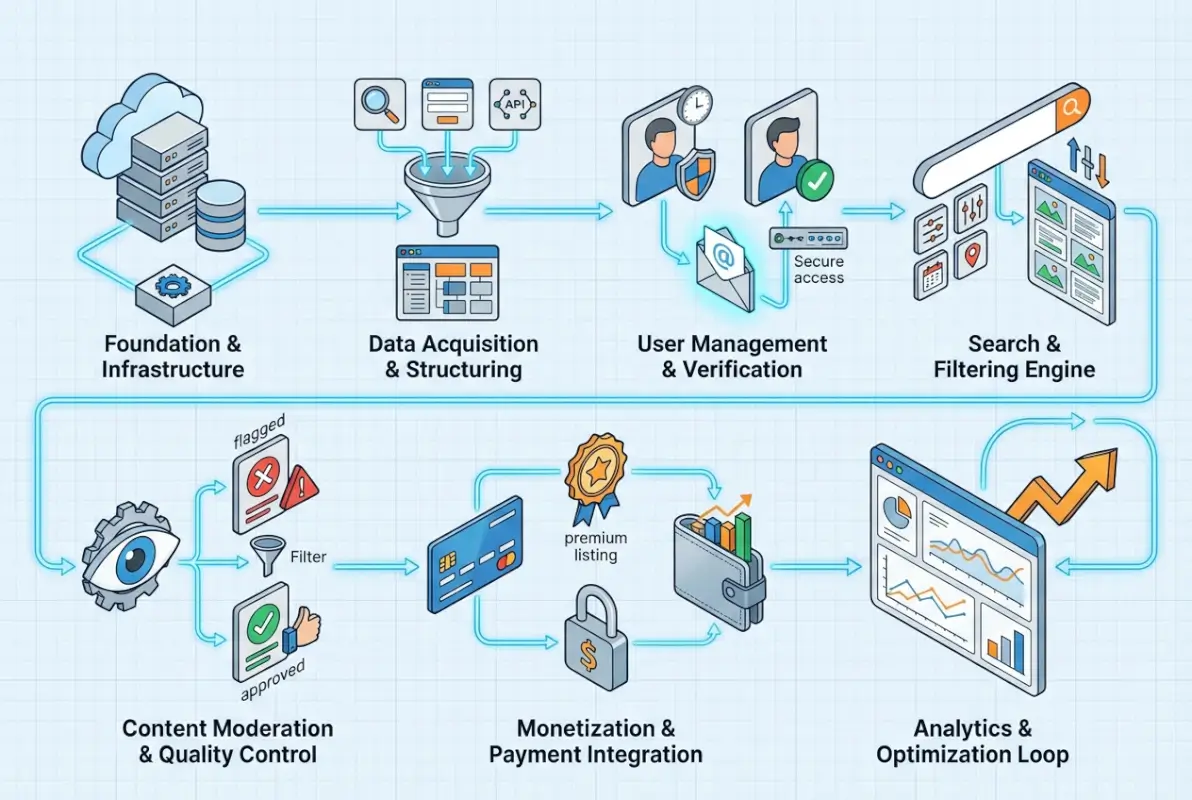
The transition from building your directory to operating it successfully requires establishing systems and governance processes that maintain quality at scale. Many directories launch with beautiful designs and solid technical foundations but fail because they haven’t thought through content moderation, data quality control, or sustainable operations workflows. These operational practices separate directories that grow sustainably from those that become spam-ridden ghosts.
Listing Governance and Moderation
Clear submission guidelines prevent the majority of spam and low-quality listings before they enter your database. Spell out exactly what information is required, what types of businesses you accept, and what constitutes a policy violation. Automated filters can catch obvious spam—submissions with no phone number, generic email addresses from disposable providers, or descriptions stuffed with keywords.
Quality control workflows should review new submissions before they go live if you have manageable volume, or use a hybrid approach where listings publish immediately but flag for review based on risk signals. Reported listings need investigation and resolution within defined timeframes. Balance protection against spam with minimizing friction for legitimate business owners who want to claim or update their information.
Review moderation requires published guidelines and consistent enforcement. Legitimate negative reviews—even harsh ones—generally stay unless they violate clear policies around profanity, personal attacks, or false factual claims. Businesses sometimes pressure directories to remove unfavorable feedback, but maintaining editorial integrity builds long-term trust even when it costs you short-term revenue.
Platform Choice and Implementation Plan
WordPress with directory plugins offers the fastest path to launch for most projects. Budget $500-2,000 for a quality theme and plugin combination plus initial customization. Plan 4-6 weeks for setup, content population with initial listings, and testing before public launch. This approach works well up to roughly 50,000 listings before you’ll need significant optimization or consideration of custom development.
SaaS platforms trade higher ongoing costs for reduced technical complexity. Monthly fees typically range from $50-500 depending on features and listing volume. Implementation timelines are shorter—often 2-3 weeks—but you’re constrained by platform capabilities and pricing models. Evaluate the total cost of ownership over 3-5 years, not just initial expenses.
Custom development makes sense when you need highly specialized features, plan to scale to hundreds of thousands of listings, or your business model requires unique functionality. Expect $15,000+ for initial development and allocate budget for ongoing maintenance and feature development. This route demands technical expertise in-house or a long-term relationship with your development team. Understanding how to set up a directory listing business helps clarify which platform approach matches your goals and resources.
Case-Study Checks and Ongoing Improvement
Launch with a minimum viable directory—comprehensive coverage in one category or location rather than thin coverage everywhere. This focused approach lets you refine your processes, understand what content and features drive engagement, and prove the concept before investing heavily in expansion.
Track the impact of every significant change you make. When you adjust your listing template, add new features, or change monetization approaches, measure how it affects your key metrics. A/B testing different layouts, call-to-action placements, or pricing structures provides data to guide decisions rather than relying on assumptions.
Scale listings strategically by adding categories or locations where you can achieve critical mass—enough listings to provide value—rather than spreading too thin. Better to be the definitive resource for craft breweries in three states than have incomplete coverage of all beverage businesses nationally.
Frequently Asked Questions
What is a directory website and how does it work?
A directory website is an organized collection of business or resource listings, categorized and searchable by location, service type, attributes, or other criteria. Users search or browse to find relevant listings, while businesses claim or submit their information to gain visibility. The directory earns revenue through featured placements, subscriptions, advertising, or lead generation while providing users with curated discovery tools.
How do I monetize a directory website effectively?
Effective monetization balances revenue with user value through several models: paid featured listings that increase business visibility, subscription tiers offering premium features, lead generation services connecting users with providers, display advertising from relevant sponsors, and affiliate partnerships for product recommendations. Choose models that align with your niche and enhance rather than degrade user experience to maintain long-term traffic growth.
How can I improve local SEO for my directory listings?
Improve local SEO by ensuring consistent NAP (Name, Address, Phone) data across all listings, implementing LocalBusiness schema markup, creating location-specific category pages with unique content, building local backlinks from community organizations, and encouraging reviews from actual customers. Location modifiers in titles, headings, and content help capture local search intent while map integration reinforces geographic relevance.
What schema markup should I use for directory listings?
Use LocalBusiness schema for physical locations, Organization schema for companies without specific addresses, Review and AggregateRating schemas to display star ratings in search results, and Product schema when listing items rather than services. Implement using JSON-LD format with complete fields including name, address, phone, hours, price range, and images. Validate markup with Google’s Rich Results Test to ensure proper implementation.
What are essential features for a modern directory site?
Modern directories require advanced search with multiple filters, frontend submission for business owners, user review and rating systems, interactive map integration, mobile-responsive design, claim/ownership verification, rich media galleries, business hours and availability display, and contact tools like click-to-call. Premium directories add analytics dashboards for listing owners, messaging systems, and comparison tools for users evaluating multiple options.
How often should I update directory listings and content?
Encourage listing owners to review their information quarterly and update immediately when details change. Add fresh content to category pages monthly through featured listings, new additions, or seasonal recommendations. Review user-generated content like reviews continuously, responding within 48 hours. Technical audits should run monthly, with immediate fixes for critical issues and quarterly improvements for optimization opportunities.
How do I measure directory performance and SEO progress?
Track organic traffic growth by category and listing, keyword rankings for target terms, listing completeness percentages, user engagement metrics like time on site and pages per session, conversion actions such as clicks to websites or calls, and revenue per listing. Use Google Analytics for traffic patterns, Google Search Console for search performance, and heat mapping tools to understand user behavior and optimize layouts accordingly.
Can a directory website compete with established platforms like Yelp?
Directories compete successfully by focusing on specific niches where general platforms provide weak coverage, offering superior content depth and curation, building trusted community relationships in defined geographies, or serving specialized B2B needs that consumer platforms ignore. Avoid competing directly on breadth; instead, own a category or location through depth, accuracy, and features tailored to your specific audience.
What’s the minimum number of listings needed to launch successfully?
Launch with enough listings to appear comprehensive in your initial focus area—typically 50-100 quality listings for a local directory in one category, or 200-500 for a broader niche directory. Users need confidence they’ll find what they’re looking for, which requires critical mass in your core offering. Better to deeply cover one segment than thinly cover many, then expand systematically as you prove value.
How do I prevent spam and maintain directory quality?
Implement automated filters catching obvious spam signals like missing contact information or keyword-stuffed content, require email verification for submissions, use CAPTCHA on submission forms, establish clear quality guidelines with examples, review flagged listings promptly, and remove obvious violations quickly. Balance protection with accessibility—overly aggressive filtering frustrates legitimate businesses and reduces your listing growth rate.
Building Your Directory for Long-Term Success
Running a successful directory website comes down to executing fundamentals consistently well: choosing a focused niche where you can establish authority, building solid technical infrastructure that search engines reward, creating genuinely valuable content that users trust, optimizing for local discovery and seamless user experience, developing monetization that aligns with user value, and establishing operational systems that maintain quality as you scale.
The directories that thrive don’t try to do everything at once. They launch lean, measure relentlessly, and improve systematically based on data rather than assumptions. They understand that search visibility and user satisfaction create a virtuous cycle—better rankings drive more users, more users generate more content and engagement, and that engagement signals further improve rankings.
Start with a pilot—one category or location where you can achieve critical mass and prove your concept works. Track what drives traffic, what converts visitors into engaged users, and what convinces businesses to pay for enhanced listings. Use those insights to refine your approach before expanding into additional categories or geographies.
Ready to Launch Your Directory?
The difference between directories that succeed and those that stagnate often comes down to starting with clear strategy and proven infrastructure. Take the insights from these seven essential areas, adapt them to your specific niche, and commit to ongoing optimization as you learn what resonates with your audience. Your directory won’t become the category leader overnight, but consistent execution of these fundamentals compounds into sustainable competitive advantage.