Free Directory Listing: How to Boost Your Online Presence (2025 Guide)

Generating summary...
Most businesses pour money into ads and social media while ignoring one of the simplest visibility multipliers available: free directory listings. These aren’t dusty digital yellow pages collecting cobwebs—they’re active search engines that millions of people use daily to find local services, and they feed crucial trust signals directly to Google. The real power isn’t in blasting your business across hundreds of random sites; it’s in strategically claiming and optimizing 5-10 high-authority profiles that actually influence where you appear when someone searches for what you offer.
What separates businesses that see results from those that waste time? Understanding that directory listings work as a system, not a checklist. I’ve watched local businesses jump from page three to the local pack in weeks—not through any secret trick, but by fixing inconsistent information across their top directories and actually completing their profiles. That’s it. No agency fees, no complicated tools, just methodical optimization of free resources most competitors ignore.
TL;DR – Quick Takeaways
- Consistency beats quantity – Identical NAP (Name, Address, Phone) across 5-7 authoritative directories outperforms 50 inconsistent listings
- Start with the big three – Google Business Profile, Bing Places, and Apple Maps form your citation foundation
- Structured data amplifies impact – Adding LocalBusiness schema to your website connects all your directory signals
- Reviews drive both rankings and clicks – Active review management increases visibility by 23% compared to passive listings
- Quarterly audits prevent drift – Regular NAP checks catch errors before they damage your local search presence
Aligning Directory Listings with Your Brand: Goals, Audits, and Core Metrics
Before you claim a single directory profile, you need a strategy. Random directory submissions create more problems than they solve—conflicting information, wasted time on irrelevant platforms, and diluted focus on what actually moves the needle. A data-driven approach starts by identifying which directories your customers actually use and which ones send the strongest trust signals to search engines.
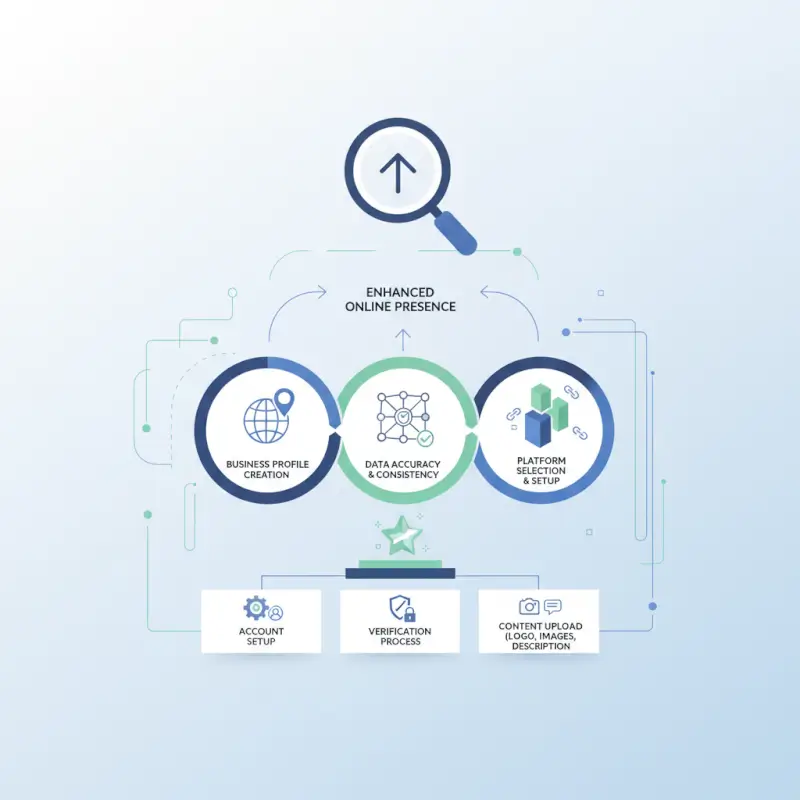
Build a Data-Driven Listing Strategy
Not all directories carry equal weight. Google My Business (now Google Business Profile) matters exponentially more than a random local directory nobody visits. The key is mapping directories to three criteria: domain authority, audience relevance, and local search impact.
Start with universal high-authority directories that benefit virtually every business: Google Business Profile, Bing Places, Apple Maps, and Facebook Business. These platforms have massive user bases and direct integration with search engines. Next, identify industry-specific directories where your target customers actually look—TripAdvisor for restaurants, Zillow for real estate agents, Healthgrades for medical practices.
According to research on local SEO citation impact, consistent citations across authoritative directories create compound trust signals that significantly improve local pack visibility. The mistake most businesses make is treating every directory equally, spreading thin across dozens of low-value platforms instead of dominating the 5-10 that actually matter for their industry.
To build your target list, search for your primary service keywords and note which directories appear on page one. If a directory ranks well for your terms, it’s worth claiming. Also check where your top competitors are listed—if they’re all on a specific platform, there’s probably a reason.
Conduct an Authoritative Audit of Current Listings
Most businesses already have directory listings they don’t even know about, often with outdated or incorrect information. Before creating new profiles, audit what already exists. Search for your business name and phone number in quotes—you’ll be surprised what shows up.
Your audit should systematically check 14 critical elements across each existing listing:
- Business name format (Inc., LLC, abbreviations)
- Complete street address with identical formatting
- Primary phone number (local, not toll-free when possible)
- Website URL (with or without www, consistently)
- Business category selections
- Operating hours, including special holiday hours
- Business description accuracy and keyword optimization
- Service area or delivery radius if applicable
- Payment methods accepted
- Photo quality and recency
- Review count and average rating
- Verification status
- Claimed vs. unclaimed status
- Schema markup alignment on your website
The official Google guidance on LocalBusiness structured data provides detailed technical requirements for ensuring your on-site schema matches your directory information. This connection matters more than most businesses realize—when Google can verify your business details across multiple authoritative sources (your website schema plus directory citations), your local entity strength increases dramatically.
Document everything in a spreadsheet. For each directory, note discrepancies in a separate column so you know exactly what needs correction. This audit typically reveals patterns—maybe your phone number changed two years ago but half your listings still show the old number, or your business name appears five different ways across platforms.
Optimizing Free Directory Listings for 2025: Practical On-Listing Improvements
Once you’ve identified your target directories and audited existing listings, the optimization phase begins. This is where most businesses either win or waste their effort. Complete, optimized listings can generate calls and directions; half-finished profiles just take up space.

Ensure NAP Consistency and Authoritative Signals
NAP consistency—keeping your Name, Address, and Phone number identical across every platform—forms the foundation of local search visibility. Even minor variations like “Street” versus “St.” or including suite numbers inconsistently can fragment your citation signals, making search engines less confident about which version is correct.
The relationship between NAP consistency and local rankings has been documented extensively in local SEO studies. When your business information matches exactly across Google Business Profile, Bing Places, Apple Maps, and industry directories, search engines interpret this as validation that your business is legitimate and your location is accurate.
Here’s the practical process: Use your master reference document to update each directory systematically. Start with the big three (Google, Bing, Apple), then move to general directories (Facebook, Yelp), then industry-specific platforms. Log into each account, edit your profile, and paste the exact NAP information from your reference document. Don’t paraphrase, don’t abbreviate differently—copy it character-for-character.
For phone numbers, use a local number if possible rather than a toll-free 800 number. Search engines give more weight to local numbers when determining geographic relevance. If you’ve moved locations, it’s critical to update every single listing immediately—old addresses create massive confusion and can tank your local rankings for months.
Enrich Each Listing with Structured Data and Category Specificity
Beyond basic NAP, complete listings include categories, attributes, descriptions, hours, photos, and services. Each element you fill out increases both your visibility within the directory and the trust signals you send to search engines.
Category selection deserves careful attention. Most directories allow a primary category and several secondary categories. Choose your primary based on what you most want to rank for, not necessarily what represents the largest portion of your business. Secondary categories can capture additional search intent. For example, a restaurant might choose “Italian Restaurant” as primary but add “Pizza Restaurant” and “Wine Bar” as secondaries to appear in more searches.
Business descriptions should be concise (150-300 words), keyword-rich without stuffing, and focused on what makes you different. Answer the question: Why should someone choose you? Include your primary services, geographic area served, and any unique selling points. Write naturally for humans first, then make sure your main keywords appear 2-3 times organically.
The LocalBusiness schema guidelines specify how to mark up your business information on your website to connect with directory signals. Adding this structured data creates a strong entity signal—search engines can verify that the business at example.com is the same entity listed on Google, Bing, and Yelp because the schema matches the directory NAP.
Photos dramatically increase engagement. Businesses with photos on their Google Business Profile receive 42% more requests for directions and 35% more clicks to their website. Upload exterior shots, interior shots, product photos, and team photos. Keep images high-resolution (at least 720px wide) and update them quarterly to signal active management.
Building Strategic Directory Authority: Which Directories Matter in 2025
The directory landscape has consolidated significantly. While thousands of directories still exist, maybe 20-30 actually influence local search rankings or drive meaningful traffic. Understanding which directories deserve your time prevents wasted effort on platforms nobody uses.

Focus on High-Impact, Credible Directories
Directory value falls into three tiers: foundational platforms everyone needs, industry-specific directories for your niche, and local directories for your geographic area. The foundational tier includes Google Business Profile (absolutely critical), Bing Places (6% of searches is still millions of people), Apple Maps (default for iPhone users), and Facebook Business Pages (broad visibility and social proof).
Industry directories vary by business type but carry weight because they’re where motivated buyers look. Restaurants benefit enormously from Yelp, TripAdvisor, and OpenTable. Home service businesses should prioritize Angi (formerly Angie’s List), HomeAdvisor, and Thumbtack. Healthcare providers need Healthgrades, Zocdoc, and Vitals. Real estate agents require Zillow, Realtor.com, and Trulia. Legal professionals benefit from Avvo, Justia, and FindLaw.
Local directories might include your chamber of commerce website, local business associations, city business directories, and regional lifestyle magazines with online directories. These often have lower traffic but higher conversion rates because they attract people specifically looking for local options.
One category worth mentioning: if you’re building your own directory website, platforms like TurnKey Directories provide WordPress-based solutions that let you create and fully control professional directory listings. This works particularly well for niche industries or geographic areas where existing directories don’t adequately serve your audience.
When evaluating a potential directory, check three things: Does it rank on page one for relevant keywords? Does it have a clean, professional interface? Can you find evidence of recent activity (recent reviews, recently added businesses)? If the answer is yes to all three, it’s probably worth the 15 minutes to claim your listing.
| Directory Type | Priority | Example Platforms | Best For |
|---|---|---|---|
| Universal | Critical | Google, Bing, Apple Maps | Every business |
| Social/Review | High | Yelp, Facebook | Consumer-facing businesses |
| Industry-Specific | High | TripAdvisor, Healthgrades, Zillow | Niche relevance |
| Local | Medium | Chamber sites, city directories | Geographic targeting |
| Data Aggregators | Medium | Neustar Localeze, Foursquare | Citation distribution |
Integrate Directory Activity with Broader Local SEO Signals
Directory listings don’t exist in isolation—they’re part of a larger local SEO ecosystem that includes your Google Business Profile, your website’s LocalBusiness schema, your local backlink profile, and your review velocity. The most effective approach integrates all these elements into a cohesive strategy.
Your Google Business Profile acts as the hub. Everything should align with it: your website schema should match your GBP information exactly, your directory listings should reinforce the same NAP, and your review acquisition efforts should focus on platforms Google can see. The official Google Business Profile guidelines provide detailed requirements for how to represent your business consistently across Google’s surfaces.
When Google encounters your business information across multiple sources—your website, your GBP, Bing Places, industry directories—and sees identical NAP information plus corroborating details like hours and categories, it builds confidence in your entity. This confidence translates to better visibility in local pack results and knowledge panels.
I’ve seen this play out repeatedly: a business cleans up NAP inconsistencies across their top 7 directories, adds matching LocalBusiness schema to their website, and within 6-8 weeks their Google Business Profile starts appearing for searches it never ranked for before. The directories themselves might only send a trickle of direct traffic, but their impact on Google’s trust in your entity drives significant indirect visibility.
Content, Reviews, and Engagement for Directory Listings
Static directory listings are a starting point, not the finish line. Active management—regularly posting updates, collecting reviews, and responding to customer questions—can triple the ROI from the same directories that do nothing for passive competitors.

Optimize Listing Content: Titles, Descriptions, Services, and FAQs
Your business description is prime real estate for keyword optimization, but it needs to read naturally. Start with what you do and where you serve, then add differentiators. For example: “Family-owned Italian restaurant serving authentic Neapolitan pizza and handmade pasta in downtown Portland since 2012. Dine-in, takeout, and catering available. Gluten-free and vegan options.”
That description hits location (downtown Portland), services (dine-in, takeout, catering), differentiators (family-owned, since 2012, authentic), and accommodations (gluten-free, vegan)—all in two sentences. It gives search engines and humans the information they need without keyword stuffing or marketing fluff.
Many directories now allow you to list specific services or products. Use this feature extensively. A plumber might list: drain cleaning, water heater repair, leak detection, pipe replacement, bathroom remodeling, emergency service. Each service listing creates another opportunity to appear in specific searches and helps customers quickly verify you offer what they need.
Some platforms, particularly Google Business Profile, support Q&A sections where customers can ask questions publicly. Don’t wait for customers to ask—seed this section with the most common questions you hear. “Do you offer emergency service?” “Are you licensed and insured?” “Do you provide free estimates?” Answer your own questions concisely. This serves two purposes: it addresses customer concerns proactively and creates additional keyword-rich content on your profile.
Leverage Reviews, Q&A, and Social Proof
Reviews directly impact both search rankings and consumer decisions. Businesses with 50+ Google reviews rank significantly higher in local pack results than those with fewer reviews, and 87% of consumers read online reviews before visiting a local business, according to BrightLocal research.
Building review velocity requires a systematic approach. The most effective method: make review requests part of your post-service workflow. After completing a job, send a follow-up email thanking the customer and including direct links to your Google, Yelp, and industry-specific directory profiles. Timing matters—ask within 24-48 hours while the experience is fresh.
For in-person businesses, train staff to ask satisfied customers directly: “If you were happy with your experience today, would you mind leaving us a quick review? Here’s a card with the link.” Simple, direct, and personal requests work far better than generic email blasts.
Responding to reviews matters as much as collecting them (perhaps more). Thank every positive reviewer by name and address their specific comments. For negative reviews, respond within 24 hours, acknowledge their concern, apologize for any shortcomings, and offer to make it right. Never argue or make excuses—45% of consumers are more likely to visit businesses that respond professionally to negative feedback.
Review diversity also matters. Having reviews on Google is critical, but reviews on Yelp, Facebook, and industry directories add credibility and create additional search visibility. When someone searches “[your business name] reviews,” you want multiple platforms to appear, not just one.
Measurement, Maintenance, and Future-Proofing Your Directory Strategy
Directory listings require ongoing maintenance, not one-time setup. Business information changes, platforms update their requirements, and competitors continuously adjust their strategies. A quarterly review cadence keeps your listings accurate and competitive.

KPIs, Dashboards, and Cadence for Ongoing Optimization
Measuring directory impact requires tracking both direct and indirect metrics. Direct metrics include clicks from directories to your website (visible in Google Analytics under Referral Traffic), phone calls from directory listings (track with call tracking numbers), and direction requests from map integrations.
Indirect metrics are equally important: local pack ranking position for your primary keywords, total citation count across the web, NAP consistency score, and knowledge panel presence. Tools like Moz Local, BrightLocal, or Whitespark can automate citation tracking and consistency monitoring, though manual quarterly audits work fine for small businesses.
Create a simple dashboard tracking:
- Total verified listings across all directories
- NAP consistency percentage (what percentage of listings have identical information)
- Review count and average rating per directory
- Monthly clicks/calls from each directory
- Local pack ranking for your top 5 keywords
Set quarterly calendar reminders to audit each directory. Log in, verify all information is still accurate, check for any platform changes (new features, new fields to complete), respond to any new reviews, and look for opportunities to enhance your listing with fresh photos or updated service descriptions.
Governance and Updates to Stay Current with Search Engine Changes
Search engines continuously refine how they evaluate local businesses. Google’s local algorithm updates, changes to how Bing weights citations, and shifts in which signals matter most all require periodic strategy adjustments.
Stay current by following official sources: the Google Business Profile Help Center announces feature changes and policy updates, and the Google Search Central structured data documentation reflects technical requirements for LocalBusiness schema.
Build an update protocol: when you hear about a local algorithm update or new directory feature, audit your top 5 directories within a week to understand if it impacts you. When Google added “product” listings to Business Profiles, early adopters saw visibility spikes—but only if they knew the feature existed and took time to add products.
Document your directory strategy in a simple playbook that includes your master NAP reference, your priority directory list, your review request process, and your quarterly maintenance checklist. This documentation ensures consistency even if the person managing directories changes, and it provides a baseline to measure improvements against.
Looking ahead, expect structured data and entity recognition to become even more important. The tighter you can connect your website schema, your directory listings, and your social profiles into a cohesive entity signal, the stronger your local visibility will be. Businesses that treat directories as isolated tactics will fall behind those who integrate them into comprehensive local entity strategies.
Frequently Asked Questions
Do free directory listings actually improve SEO?
Yes, free directory listings improve local SEO by creating citations (mentions of your business NAP) that validate your business location and legitimacy to search engines. Consistent citations across authoritative directories like Google Business Profile, Bing Places, and industry-specific platforms send trust signals that can significantly boost local pack visibility, though they work best as part of a comprehensive local SEO strategy rather than in isolation.
Which directories should I prioritize in 2025?
Start with Google Business Profile (critical for all businesses), then Bing Places and Apple Maps for broad coverage. Next, claim profiles on Facebook Business and major review platforms like Yelp. After covering these universal directories, focus on industry-specific platforms relevant to your business—TripAdvisor for restaurants, Healthgrades for medical practices, or Zillow for real estate. For businesses building their own niche directories, TurnKey Directories offers WordPress-based solutions for complete control.
How many directory listings does my business need?
Quality and consistency matter far more than quantity. Most businesses benefit from maintaining 7-15 high-quality listings across universal directories, industry-specific platforms, and relevant local directories, rather than spreading incomplete information across 50+ sites. Focus on platforms with high domain authority, active user bases, and relevance to your audience. Consistent, complete listings on fewer directories outperform inconsistent presence across many low-value platforms.
How can I measure the impact of my directory listings?
Track both direct metrics (referral traffic from directories in Google Analytics, phone calls via tracking numbers, direction requests) and indirect metrics (local pack ranking for target keywords, total citation count, NAP consistency percentage). Create a simple dashboard monitoring total verified listings, review counts per directory, monthly clicks from each platform, and local search visibility. Quarterly audits help identify which directories drive actual business value versus those consuming effort without returns.
Should I add structured data to my website alongside directory listings?
Absolutely. Adding LocalBusiness schema to your website creates a strong connection between your on-site entity signals and your directory citations. When search engines can verify that your website, Google Business Profile, and directory listings all reference the same business with identical NAP information, it significantly strengthens your local entity recognition and can improve visibility in knowledge panels and local pack results. The structured data should exactly match your directory information.
How often should I update my directory listings?
Conduct comprehensive quarterly audits to verify NAP accuracy, respond to new reviews, and update business information as needed. Additionally, update all directories immediately whenever your phone number changes, business hours shift, you relocate, or you add/remove major services. Many platforms like Google Business Profile also benefit from weekly posts or updates, which signal active management and can boost visibility during high-competition periods.
What’s the biggest mistake businesses make with directory listings?
The most damaging mistake is creating listings with inconsistent NAP information across platforms, or worse, never verifying their listings. Unverified listings have limited functionality and visibility, while NAP inconsistencies confuse search engines and dilute your citation power. The second common error is treating directory listings as “set and forget” rather than actively managing them with regular updates, review responses, and fresh content that signals ongoing business activity.
Can directory listings help with non-local businesses?
While directory listings provide the strongest impact for local businesses competing in specific geographic areas, online-only businesses still benefit from profiles on industry-specific directories and review platforms. These build domain authority through backlinks, provide social proof through reviews, and create entity signals that help search engines understand your business category and credibility. Focus on directories relevant to your industry rather than location-based platforms.
Taking Action on Your Directory Strategy
Free directory listings represent one of the most underutilized local SEO opportunities available. While competitors pour budgets into ads and complex marketing campaigns, you can build substantial visibility by simply claiming, optimizing, and maintaining profiles on 7-15 high-authority directories that actually matter for your business.
The key differentiator isn’t how many directories you’re on—it’s the consistency and completeness of your information across the directories that influence your target customers and search engines. Identical NAP data on Google Business Profile, Bing Places, Apple Maps, and your top industry directories creates compound trust signals that elevate your local entity strength far beyond what any single listing could achieve.
Start with the foundational audit: document your exact NAP in a master reference file, then systematically check your existing listings for discrepancies. Claim and verify your profiles on the big three (Google, Bing, Apple), complete every field thoroughly, and add high-quality photos. Then expand to industry-specific directories where your customers actually look for businesses like yours.
Your Directory Listing Action Plan
Week 1: Create your master NAP reference document and audit existing listings for inconsistencies.
Week 2: Claim and fully optimize Google Business Profile, Bing Places, and Apple Maps with complete information and photos.
Week 3: Identify and claim 3-5 industry-specific directories relevant to your business; add LocalBusiness schema to your website.
Week 4: Implement a review request process and respond to all existing reviews on your top directories.
Ongoing: Set quarterly calendar reminders to audit all listings for accuracy and respond to new reviews within 48 hours.
Remember that directory optimization isn’t a one-time project but an ongoing process. Business information changes, platforms introduce new features, and competitors continuously adjust their strategies. The businesses that win are those that treat directory management as a consistent practice, not a box to check once and forget.
The visibility gains from properly optimized directory listings typically appear within 4-8 weeks as search engines process the citation signals and verify consistency across platforms. Some businesses see immediate jumps in calls and direction requests from individual directories; others notice gradual improvements in local pack rankings as their entity strength builds.
What’s your next move? If you haven’t claimed your Google Business Profile yet, that’s step one—do it today. If you already have GBP, audit your NAP consistency across your top five directories this week. The compound returns from directory optimization aren’t flashy or instant, but they’re reliable, cost-free, and sustainable for businesses willing to invest the time to do it right.
Was this article helpful?