Business Listing Accuracy: How to Audit and Monitor Your Local Listings

Generating summary...
When potential customers search for your business online and find a disconnected phone number, outdated hours, or the wrong address, they don’t give you a second chance—they move straight to your competitor. For local businesses, accurate listings across directories and platforms aren’t just nice to have; they’re the foundation of trust, visibility, and revenue.
The problem is most business owners have no idea how fragmented their online presence actually is. Your business listing accuracy directly impacts whether customers can find you, contact you, and trust you enough to choose your services. Research from BrightLocal’s Business Listings Trust Report shows that 73% of consumers lose trust in a brand when they encounter inaccurate online listings.
TL;DR – Quick Takeaways
- Inaccurate listings cost you customers – 73% of consumers lose trust when they find wrong information
- NAP consistency is critical – Name, Address, Phone must be identical across all platforms
- Start with the big three – Google Business Profile, Facebook, and Yelp drive 80% of local search traffic
- Audit quarterly minimum – Monthly checks for multi-location businesses or seasonal operations
- Automated tools save hours – BrightLocal, Moz Local, and Yext can monitor hundreds of directories simultaneously
- Fix duplicates immediately – Duplicate listings split your SEO authority and confuse customers
Why Accurate Business Listings Matter in 2026
Think about the last time you searched for a restaurant and found their hours were wrong. You probably didn’t call to verify—you just picked a different place. That’s exactly what happens to your business when your listings contain errors.
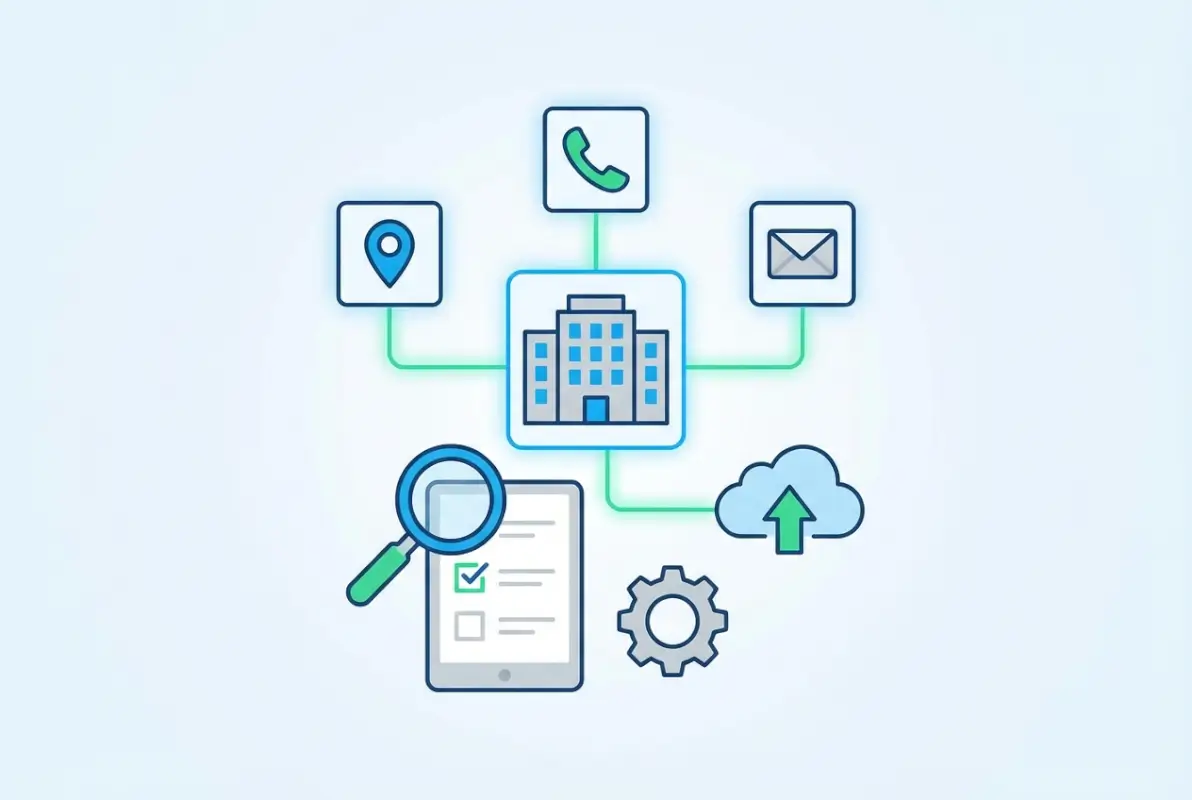
Accurate business listings serve two masters: human customers who need reliable information to contact you, and search engines that use citation consistency to determine your legitimacy and local search rankings. When both are satisfied, you show up higher in searches and convert more visitors into customers.
Local SEO Impact and Consumer Trust
Search engines like Google treat your business information as a trust signal. When your Name, Address, and Phone number (NAP) appear consistently across dozens or hundreds of directories, it tells Google’s algorithm that your business is legitimate, established, and worth showing to searchers.
According to research published by Entrepreneur, businesses with consistent NAP information across the top 50 directories rank significantly higher in local pack results—the map section that appears at the top of Google searches.
Beyond rankings, accurate listings directly impact customer behavior. When someone finds your correct phone number on Google, calls you, and reaches your business on the first try, you’ve created a frictionless experience. When they find three different phone numbers across Yelp, Facebook, and your website, they’re likely to abandon the search entirely.
Cost of Inaccuracy and Common Pain Points
Inaccurate listings don’t just cost you individual sales—they compound over time. Every wrong phone number represents dozens or hundreds of lost opportunities as frustrated customers give up and remember your business as unreliable.
The most damaging inaccuracies include wrong phone numbers (customer can’t reach you), incorrect addresses (customer shows up at the wrong location), outdated hours (customer arrives when you’re closed), and broken website URLs (customer can’t learn more about your services). Each creates immediate frustration and long-term reputation damage.
I remember working with a plumbing client who was losing approximately 15 calls per week to a disconnected phone number that appeared on older directory listings. Once we identified and corrected those listings, call volume increased 23% within six weeks—those were customers who had been trying to reach them all along.
Foundation: Mapping Your Current Listing Footprint
Before you can fix inaccuracies, you need to know where your business appears online and what information each platform displays. This mapping process reveals the full scope of your listing ecosystem and identifies your highest-priority correction targets.
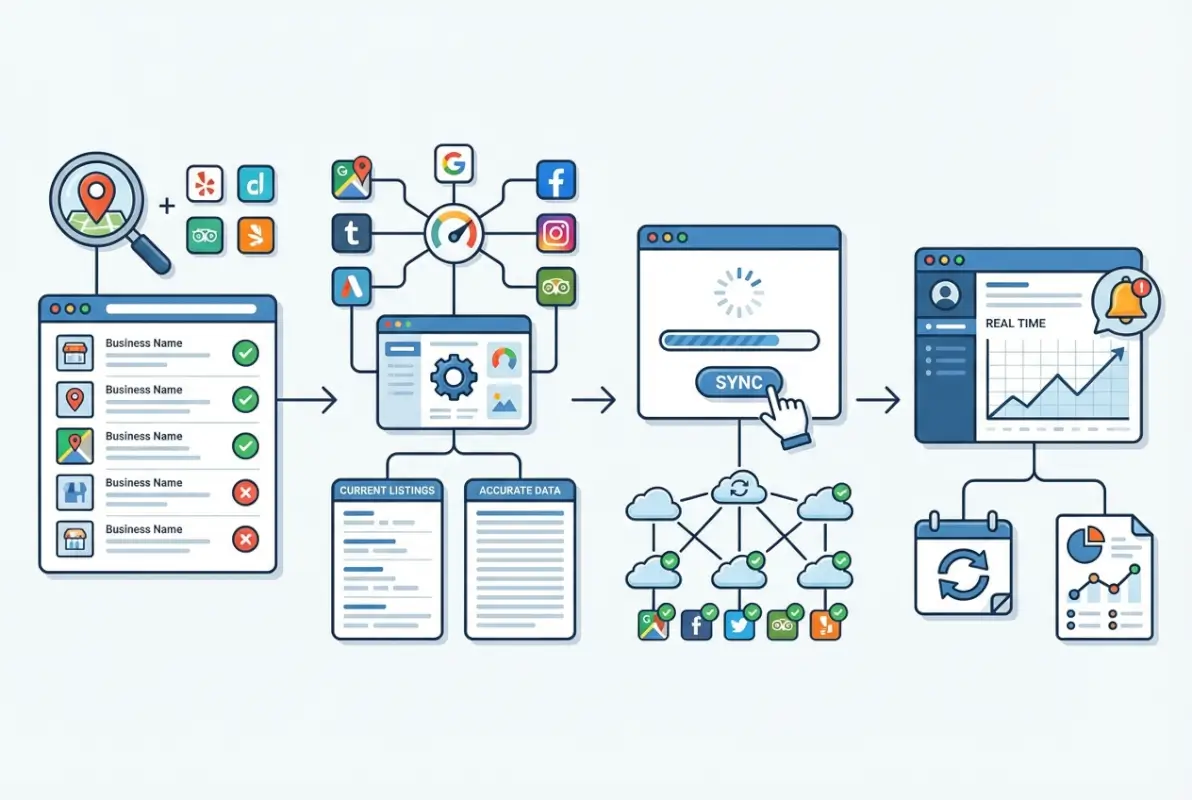
Most businesses discover they have 30-50 listings across directories they never created. Data aggregators like Neustar Localeze and Factual automatically generate listings from public records, business registrations, and other sources—often with outdated or incorrect information.
Inventory of Primary Listing Sources
Start your audit by documenting your presence on the core platforms that drive the majority of local search traffic and customer interactions:
- Google Business Profile – The single most important listing, directly controlling your Google Maps and search appearance
- Facebook Business Page – Critical for social discovery and customer communication
- Yelp for Business – Dominant in hospitality, restaurants, and service businesses
- Apple Maps – Powers Siri results and default maps on all Apple devices
- Bing Places for Business – Reaches Windows users and powers voice assistants
- Industry-specific directories – Healthgrades for medical, Avvo for legal, HomeAdvisor for contractors
For businesses in the United States, the Business Directory Listing Audit Checklist provides a comprehensive template for documenting your listing footprint systematically.
Create a spreadsheet tracking each platform, your current listing status (claimed/unclaimed), the information displayed, and any discrepancies from your official baseline. This becomes your master reference for all future updates.
Baseline Data Extraction and Verification
Establish your official business information baseline—the single source of truth that every listing should match exactly. Document these elements with precise formatting:
- Legal business name – Exactly as it appears on registration documents (including Inc., LLC, etc.)
- Doing Business As (DBA) name – If different from legal name
- Street address – Use USPS standardized format (Street vs St, Suite vs Ste)
- Primary phone number – Choose local or toll-free and use consistently
- Website URL – Include https:// and use the same format (www or non-www)
- Business category – Primary category that best describes your core offering
- Hours of operation – Standard hours plus holiday schedules
- Business description – 150-word description optimized for keywords
Once you’ve established this baseline, treat it as the authoritative reference. Every listing you control should match it character-for-character, and every update should start by updating the baseline document first.
The 6-Point Audit Framework: A Systematic Approach for 2026
A comprehensive business listings audit follows a repeatable pattern that ensures nothing gets missed. This six-point framework addresses the most common accuracy issues while staying efficient enough to complete quarterly.

The framework prioritizes high-impact platforms first, then expands to industry directories and long-tail sources. For multi-location businesses, complete this process for each location individually—listing accuracy compounds across locations.
NAP and Data Accuracy Sweep Across Top Platforms
Start by verifying your NAP consistency on the platforms that matter most. Log into each platform’s dashboard and compare the displayed information against your baseline document:
Name consistency: Your business name should be identical everywhere, including punctuation, capitalization, and legal designations. “ABC Plumbing LLC” is different from “ABC Plumbing, LLC” or “ABC Plumbing” to search engines. Pick one format and enforce it universally.
Address standardization: Use the exact same address format across all listings. If you use “123 Main Street, Suite 200″ on Google, use that exact format on Yelp, Facebook, and every other platform. Abbreviations matter—”St” versus “Street” creates citation inconsistency.
Phone number uniformity: Choose whether you’ll use your local number or toll-free number as your primary listing phone, then use that number everywhere. Don’t alternate between different numbers across platforms, as this dilutes your citation strength.
| Platform | NAP Priority | Average Update Time | Verification Method |
|---|---|---|---|
| Google Business Profile | Critical | Immediate | Phone, postcard, email |
| Facebook Business | High | Immediate | Account login |
| Yelp | High | 24-48 hours | Phone verification |
| Apple Maps | Medium | 3-5 days | Business verification |
| Bing Places | Medium | 1-3 days | Phone or postcard |
Rich Listing Optimization: Hours, URLs, Categories, and Media
Beyond basic NAP, complete listings perform significantly better in local search and customer conversions. Focus on these elements that many businesses overlook:
Business hours accuracy: Update hours for holidays, special events, and seasonal changes immediately. Enable special hours features on Google Business Profile for holidays like Thanksgiving, Christmas, and New Year’s. Wrong hours are the second most common complaint in negative reviews.
Category selection precision: Choose your primary category carefully—it determines which searches you appear in. Google Business Profile allows one primary category and multiple secondary categories. Select the most specific category that describes your core business, not the broadest.
Website URL consistency: Use the same URL format everywhere (www or non-www, http or https). Inconsistent URLs create tracking problems and dilute click-through data across analytics platforms.
Photo quality and freshness: Upload high-resolution photos (at least 720px wide) that accurately represent your current business. Businesses with photos receive 42% more requests for directions and 35% more click-throughs to their websites according to Google Business Profile optimization data.
Detecting and Fixing Duplicates, Inconsistencies, and Missing Data
Duplicate listings are one of the most damaging accuracy issues because they split your review profile, dilute your citation authority, and confuse customers about which listing is legitimate.
Finding duplicates: Search Google Maps for your business name and address. If multiple pins appear for your single location, you have duplicates. Also check Yelp, Facebook, and Apple Maps for duplicate profiles. Tools like Moz Local and BrightLocal automatically scan for duplicates across hundreds of directories.
Merging Google duplicates: In Google Business Profile, navigate to the duplicate listing and click “Report a problem” then “Duplicate listing.” Google typically processes these requests within 3-5 business days. For faster resolution, use the Google Business Profile support chat.
Claiming unclaimed listings: If you discover listings you didn’t create (common with data aggregators), claim them immediately to prevent competitors or spammers from editing your information. Use each platform’s verification process to establish ownership.
Suppressing unfixable duplicates: Some duplicates appear on data aggregator sites where you can’t directly edit or claim listings. Submit suppression requests through services like Neustar Localeze and Factual to remove these at the source, preventing them from propagating to downstream directories.
Reputation Signals and Review Hygiene
Reviews directly impact both search rankings and customer conversion rates, while also serving as an early warning system for listing accuracy problems. Customers often mention wrong information in reviews—”I tried to call but the number didn’t work” or “Showed up during posted hours but they were closed.”
Review monitoring: Check reviews weekly on your top five platforms. Respond to every review within 48 hours—responses demonstrate active management and improve customer trust. Thank positive reviewers and address concerns in negative reviews professionally.
Review attribution: Ensure reviews on different platforms all link to the same business. If duplicate listings exist, reviews may be split across them, reducing your overall rating visibility. Merging duplicates consolidates reviews into a single, stronger profile.
Rating consistency: Significant rating discrepancies between platforms (4.8 stars on Google but 3.2 on Yelp) often indicate unmanaged listings where you haven’t responded to concerns or where duplicate listings split your reviews.
Establishing a Continuous Monitoring Cadence
Listing accuracy isn’t a one-time project—it requires ongoing monitoring because information changes, platforms update, and data aggregators occasionally revert corrections.
Set up automated monitoring using tools that alert you when changes occur. BrightLocal, Moz Local, and Yext all offer monitoring dashboards that track your top 50-100 listings and send email alerts when discrepancies are detected.
For businesses managing listings without paid tools, create a monthly calendar reminder to manually check your top 10 platforms. This 15-minute check catches most critical issues before they accumulate into larger problems.
Document every correction in your master spreadsheet with the date changed and what was updated. This creates an audit trail and helps identify patterns—if the same directory keeps reverting your phone number, you may need to contact their support to understand why.
Measurement: How to Track Progress and Prove ROI
You can’t improve what you don’t measure. Tracking the right metrics shows whether your listing accuracy efforts are translating into business results and helps you prioritize which platforms deserve the most attention.

The goal isn’t just accurate listings—it’s more phone calls, more website visits, more direction requests, and ultimately more customers. Connect listing accuracy to these business outcomes to justify the time investment.
Key Metrics to Monitor
Track these performance indicators monthly to measure the impact of improved listing accuracy:
Google Business Profile insights: Monitor total searches (how many people found your listing), search queries (what keywords triggered your listing), customer actions (calls, website clicks, direction requests), and photo views. Accurate listings consistently show higher engagement across all metrics.
Listing accuracy score: Tools like Moz Local and BrightLocal provide an overall accuracy percentage across all monitored directories. A score above 95% indicates strong citation consistency. Below 80% suggests significant problems affecting your local SEO.
Phone call volume: Track calls from each listing platform using call tracking numbers or asking callers “How did you find us?” Correcting wrong phone numbers typically produces the most immediate, measurable impact—often a 20-30% increase in calls within the first month.
Direction requests: Google Business Profile tracks how many people clicked for directions to your location. This metric directly correlates with foot traffic for retail and service businesses.
Website click-through rate: Monitor how many people viewing your listing clicked through to your website. Complete listings with accurate information, photos, and hours typically see 40-60% higher click-through rates than incomplete profiles.
Local search ranking: Track your position in local pack results (the map section) for your top 5-10 keywords. Tools like BrightLocal’s Local Rank Tracker automate this monitoring. Improved listing accuracy typically improves local pack rankings within 30-60 days.
Tools and Dashboards
Centralize your listing performance data using these resources for small businesses online listing accuracy:
Google Business Profile dashboard: Your primary free tool for monitoring performance, managing reviews, and updating information. Check weekly at minimum.
Listing management platforms: BrightLocal offers comprehensive citation tracking and reporting for $29-99/month. Moz Local provides distribution management and duplicate detection for $129/year. Yext serves enterprise needs with real-time updates across 200+ platforms starting at $199/month.
Google Search Console: While not listing-specific, Search Console shows which local search queries trigger your website and how your click-through rates compare to average. Filter by queries containing “near me” or your city name to see local search performance.
Call tracking platforms: Services like CallRail or CallTrackingMetrics assign unique phone numbers to each listing platform, showing exactly which directories drive phone calls. This data helps prioritize which listings deserve the most attention.
If you’re managing directory listings at scale for multiple clients or locations, consider TurnKey Directories, a WordPress-based directory platform that helps agencies and multi-location businesses maintain consistent listings with built-in verification tools.
Implementation: Rollout Playbook and Ongoing Maintenance
Knowing what to do is only half the battle. Successful listing accuracy requires a structured rollout plan and clear ownership to ensure corrections get made and stay correct.

This implementation framework breaks the work into manageable sprints and establishes governance to prevent future drift from your accuracy baseline.
30-60-90 Day Audit Cycle Plan
Days 1-30 (Foundation Sprint):
- Week 1: Document your official NAP baseline and create your master listing spreadsheet
- Week 2: Audit and correct Google Business Profile, Facebook, and Yelp (the critical three)
- Week 3: Claim unclaimed listings on Apple Maps, Bing Places, and top industry directories
- Week 4: Document all discovered discrepancies and prioritize corrections by platform traffic
Days 31-60 (Correction Sprint):
- Week 5-6: Submit correction requests to all platforms with errors, starting with highest-priority directories
- Week 7: Follow up on pending corrections and escalate any that haven’t been processed
- Week 8: Add high-quality photos, complete business descriptions, and optimize categories on top 10 platforms
Days 61-90 (Monitoring Sprint):
- Week 9-10: Verify all corrections were applied correctly; re-submit any that were missed
- Week 11: Set up automated monitoring through BrightLocal, Moz Local, or manual monthly checks
- Week 12: Establish your ongoing quarterly audit schedule and assign ownership
Governance and Ownership
Assign clear roles to prevent listing accuracy from falling through organizational cracks:
Listing manager (primary owner): One person responsible for monitoring accuracy, making updates, and managing the quarterly audit cycle. This should be someone in marketing, operations, or customer service who understands the business impact.
Information authority: Designate who approves changes to the official baseline. When business hours change, who confirms the new hours before they’re pushed to all listings? This prevents conflicting updates from multiple team members.
Update protocol: Create a written process for handling information changes. When your business moves, changes phone numbers, or updates hours, what’s the checklist to ensure all platforms get updated within 24 hours?
Training documentation: Document your listing management process so new team members can maintain accuracy if the primary owner leaves. Include login credentials (stored securely), platform-specific quirks, and correction workflows.
For businesses with multiple locations, assign a regional or location manager as the information authority for their site, but centralize the update execution to maintain consistency across all locations.
Why is consistent NAP information important for local search rankings?
Consistent NAP (Name, Address, Phone) across directories signals to search engines that your business is legitimate and trustworthy. Search algorithms use citation consistency as a ranking factor—businesses with matching information across 50+ directories rank higher in local pack results than those with inconsistent data. Even small formatting differences confuse algorithms and dilute your local SEO authority.
How often should I audit my business listings for accuracy?
Conduct a comprehensive audit quarterly at minimum. Businesses with multiple locations, seasonal hours, or frequent promotions should audit monthly. After any permanent information change—move, phone number update, hours adjustment—verify all listings immediately to prevent customer confusion and lost revenue during the transition period.
What should I do if I find a duplicate listing?
For Google duplicates, report them through Google Business Profile by selecting the duplicate and choosing “Report a problem” then “Duplicate listing.” For other platforms, contact support requesting a merge to consolidate reviews and information. Act quickly—duplicates split your SEO authority, divide your reviews, and confuse customers about which listing is accurate.
How can I verify that my hours are correct across all platforms?
Create a master baseline document with your official hours, then manually check your top 10 platforms against it. Use listing management tools like BrightLocal or Moz Local to scan 100+ directories automatically. Set calendar reminders to update hours immediately before holidays, seasonal changes, or special events—wrong hours are a leading complaint in negative reviews.
What tools help monitor my business listings automatically?
BrightLocal offers citation tracking and accuracy monitoring starting at $29/month. Moz Local provides distribution management across major directories for $129/year. Yext serves enterprise needs with real-time updates to 200+ platforms from $199/month. For WordPress-based directory management, TurnKey Directories includes built-in verification and consistency tools for agencies and multi-location businesses.
Do reviews impact listing accuracy, and how should I respond?
Reviews don’t directly affect NAP accuracy, but customers often mention inaccurate information in reviews—wrong hours, disconnected phones, incorrect addresses. Monitor reviews weekly and respond within 48 hours to demonstrate active management. When customers report inaccurate information in reviews, thank them and immediately verify the listing to prevent others from encountering the same problem.
How do I handle discrepancies in address formatting across directories?
Choose one USPS-standardized format and enforce it everywhere. Decide whether to use “Street” or “St,” “Suite” or “Ste,” “Floor” or “Fl”—then update every listing to match exactly. Search engines treat formatting variations as different addresses, diluting your citation strength. Document your chosen format in your baseline and reference it for all future updates.
Which listings should I prioritize first for updating?
Start with Google Business Profile, Facebook, and Yelp—these three drive 80% of local search traffic. Then move to Apple Maps and Bing Places. Finally, address industry-specific directories relevant to your business. Fix critical errors (wrong phone, incorrect address) before optimizing secondary elements like photos or descriptions to maximize immediate impact on customer conversions.
Take Control of Your Business Listing Accuracy Today
Inaccurate listings are costing you customers right now—every hour you wait is another potential customer who finds wrong information, gets frustrated, and chooses your competitor instead.
Start with the foundation: document your official NAP baseline this afternoon and audit your Google Business Profile, Facebook, and Yelp listings by tomorrow. Those three platforms alone account for the majority of your local search visibility, and correcting errors there delivers immediate results.
Then expand systematically. Claim unclaimed listings within your first week. Submit correction requests within two weeks. Set up monitoring by the end of month one. This isn’t about perfection—it’s about consistent progress that compounds into better rankings, more calls, and increased revenue.
Your 30-Day Action Plan
This Week: Create your NAP baseline document and audit Google, Facebook, and Yelp
Next Week: Claim unclaimed listings on Apple Maps, Bing, and industry directories
Week Three: Submit all correction requests and document pending changes
Week Four: Set up automated monitoring or create your monthly audit calendar reminder
The businesses that dominate local search aren’t necessarily better at what they do—they’re just better at ensuring customers can find accurate information about them everywhere online. Make listing accuracy a priority, and you’ll see the impact in your phone, your foot traffic, and your bottom line within 60 days.
Was this article helpful?