How to Index a Listing in Google: 5 Essential Steps for Businesses

Getting your business discovered on Google isn’t just about having a website anymore, it’s about commanding the local search real estate that drives calls, visits, and sales. Here’s something most guides won’t tell you upfront: Google doesn’t index listings the way it indexes regular web pages. Your Google Business Profile exists in a parallel ecosystem with its own rules, signals, and timelines. While everyone obsesses over website SEO, the businesses dominating local search have cracked a different code entirely—they’ve mastered the art of making Google trust, verify, and prioritize their listing data across Search and Maps. In this guide, you’ll discover the five essential steps that separate invisible businesses from those that monopolize the local pack, backed by current data and tactics that actually move the needle in today’s algorithmic landscape.
TL;DR – Quick Takeaways
- Verification is non-negotiable – Unverified profiles get buried; verified profiles gain access to features that drive visibility and trust
- NAP consistency matters more than ever – Mismatched business data across platforms confuses Google’s trust algorithms and tanks local rankings
- Engagement signals trump static content – Posts, reviews, Q&A responses, and photos generate user interactions that feed Google’s relevance models
- Proximity and freshness now dominate local pack – Recent algorithm updates heavily weight how close you are to the searcher and how recently you’ve updated your profile
- Indexing isn’t instant – Even with recrawl requests, expect days to weeks for changes to fully propagate through Google’s systems
Step 1 — Verify and Claim Your Google Business Profile (GBP)
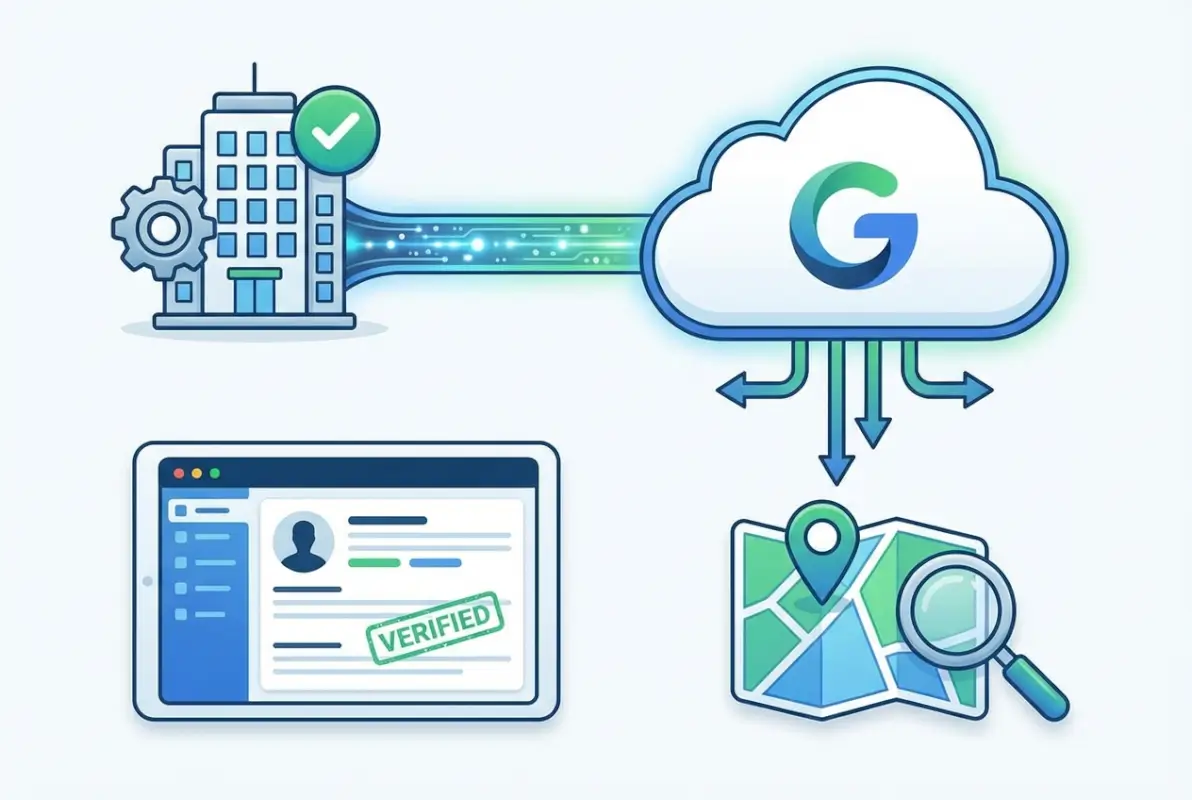
Think of your Google Business Profile as your digital storefront on the world’s busiest street. Every day, millions of high-intent searchers walk past looking for exactly what you offer, but if you haven’t verified your profile, you’re essentially operating behind frosted glass. Google treats unverified listings with skepticism for good reason: fraud, spam, and duplicate profiles have plagued Maps for years. Verification is Google’s way of confirming you’re legitimate, and it’s the gateway to every feature that actually matters for visibility.
Understand What GBP Is and Why Verification Matters
Google Business Profile serves as your business’s official presence on Google Search and Maps. It’s not a directory listing you submit to and forget, it’s a dynamic profile that Google continuously evaluates for trust, relevance, and user value. When someone searches for businesses like yours, Google doesn’t just look at your website (if you even have one). It analyzes your GBP data: category accuracy, review sentiment, photo recency, response rate to customer questions, and dozens of other signals. Verification confirms ownership and unlocks the management dashboard where you control these signals. Without it, you’re at the mercy of user-submitted edits and Google’s automated systems, which is like letting strangers redecorate your storefront.
Verification Methods and Timelines
Google offers several verification paths depending on your business type and existing digital footprint. Phone and text verification work for most businesses with publicly listed numbers. Email verification appears as an option for businesses already recognized in Google’s systems. Video verification became more common during pandemic lockdowns and requires you to film a walkthrough of your physical location. Postcard verification remains the fallback, Google mails a code to your business address that you enter in your dashboard within 30 days.
Here’s what nobody tells you about timelines: the verification process itself might take days, but indexing your verified profile can take considerably longer. I’ve seen newly verified profiles appear in Maps within 48 hours, and others take two weeks to show up in local pack results. The verification badge doesn’t automatically trigger full indexing, it just makes your listing eligible for consideration. Google’s crawl and index cycles for local data operate independently from standard web crawling, which is why you might be verified but still invisible in searches.
Practical Actions
Start by claiming your profile at google.com/business (or through the Google Maps app). If you find an existing listing for your business, claim it rather than creating a duplicate, duplicates are one of the fastest ways to torpedo your visibility. During setup, choose your primary business category with precision. This isn’t a “close enough” situation; Google uses categories as a primary relevance filter. A restaurant that selects “Diner” instead of “Italian Restaurant” won’t appear for “Italian food near me” searches, period.
Enter your exact business name as it appears on your storefront and legal documents. Add your complete address, ensuring it matches your website footer, social media profiles, and anywhere else you’re listed online. Provide a local phone number (not a call tracking number at this stage, that comes later). Set accurate business hours including special hours for holidays. This foundational data creates your listing’s identity in Google’s knowledge graph, and any inconsistency here creates friction in their trust models.
Common Pitfalls to Avoid
The most devastating mistake is creating multiple listings for the same location. Business owners sometimes create a new profile thinking their old one is lost or inaccessible, this creates a duplicate that splits your reviews, confuses Google’s systems, and can get both listings suspended. Use the “Find my business” feature to locate existing profiles before creating new ones.
Another trap: keyword stuffing your business name. Adding “Best Pizza in Brooklyn” to your official business name might seem clever, but it violates Google’s guidelines and risks suspension. Your business name should be exactly what appears on your signage, nothing more. Save the keywords for your business description and categories.
Mismatched data creates algorithmic confusion. If your GBP says “123 Main St” but your website says “123 Main Street” and your Facebook page says “123 Main St., Suite A”, Google’s confidence in your listing accuracy plummets. This NAP (Name, Address, Phone) inconsistency is like showing three different IDs at airport security, you’re going to raise flags. For more context on maintaining consistent data across platforms, check out best practices for index directory listing google seo practices.
Step 2 — Ensure Data Accuracy, Consistency, and Completeness Across the Web
Your Google Business Profile doesn’t exist in isolation, it’s part of a vast web of local citations, directory listings, and data aggregators that Google cross-references to validate your business information. Think of it like a fact-checking operation where Google is the investigative journalist and your business data is under scrutiny from multiple sources. When the story matches across all channels, Google gains confidence. When details conflict, red flags emerge and your visibility suffers. This step is less glamorous than optimization tactics, but it’s foundation work that determines whether your other efforts sink or soar.

NAP Consistency and Citations
NAP consistency sounds boring until you realize it’s the difference between ranking #1 and #11 in the local pack. Every online mention of your business name, address, and phone number is a citation, and Google uses these citations as trust signals. When your NAP appears identically across your GBP, website, Yelp, Yellow Pages, industry directories, and local chamber of commerce listings, Google interprets this consistency as verification that you’re a legitimate, stable business. When these details vary, even slightly, Google’s algorithms question which version is correct.
The consistency requirement is stricter than most people realize. “Street” vs. “St.” matters. “Suite 100” vs. “#100” matters. “(555) 123-4567” vs. “555-123-4567” matters. I’ve audited businesses with eight different phone number formats across their online presence, each variation diluting the signal strength. Pick one format for each element and enforce it everywhere. This standardization feeds into how search engines index directory listing methods website owners can leverage for better visibility.
| Data Element | Inconsistent (Bad) | Consistent (Good) |
|---|---|---|
| Address | 123 Main Street, 123 Main St, 123 Main | 123 Main St (everywhere) |
| Phone | (555) 123-4567, 555.123.4567, 5551234567 | (555) 123-4567 (everywhere) |
| Business Name | Joe’s Pizza, Joe’s Pizzeria, Joe’s Pizza NYC | Joe’s Pizza (everywhere) |
Complete Profile with Structured Data
An incomplete GBP is like a résumé with blank sections, it screams “amateur” to both users and algorithms. Google rewards profile completeness because complete profiles provide better user experiences. Fill out every applicable field: business description (750 character limit, use it), attributes (wheelchair accessible, outdoor seating, etc.), service area if relevant, appointment URL, menu or services list, and opening date.
Your business description is prime real estate for natural keyword inclusion without spam. Describe what you do, who you serve, and what makes you different. “Family-owned Italian restaurant in Brooklyn serving authentic Neapolitan pizza, fresh pasta, and regional wines since 2015” beats “Best pizza restaurant with great food and excellent service” every time. The former gives Google semantic context and users actual information; the latter is valueless fluff.
Categories deserve special attention. Your primary category determines which search queries you’re eligible for. Add secondary categories (you can select multiple) that cover your full service range. A law firm might use “Personal Injury Attorney” as primary and add “Car Accident Lawyer,” “Medical Malpractice Attorney,” and “Workers Compensation Attorney” as secondary categories. Each category expands your relevance footprint for related searches.
Leverage Local Directories and Niche Listings
Beyond your GBP, strategic directory submissions build citation strength. Focus on authoritative, established directories rather than spammy link farms. The big aggregators (Acxiom, Neustar, Factual) feed data to hundreds of smaller platforms, so getting listed there has multiplicative effects. Industry-specific directories carry extra weight, a plumber should be on HomeAdvisor and Angie’s List, a restaurant needs Yelp and OpenTable, a lawyer belongs on Avvo and FindLaw.
Don’t ignore local directories either. Your city’s chamber of commerce, local business associations, and community websites might have small audiences, but Google values these local validation signals. A link from your neighborhood association’s member directory tells Google you’re genuinely embedded in that community. Quality over quantity applies here, ten highly relevant, trustworthy citations outperform fifty low-quality directory spam listings.
Data Hygiene and Audits
Local data isn’t set-and-forget. Hours change for holidays, services evolve, phone numbers get updated, and addresses occasionally shift. Set a quarterly calendar reminder to audit your GBP and top citations. Check that hours reflect current operations (nothing frustrates customers more than driving to a business Google said was open, only to find it closed). Update temporary closures immediately, Google now surfaces this prominently in search results.
When you make changes, document them. Keep a spreadsheet of your standardized NAP and core business details. When you update your GBP, systematically update your website, major directories, and social profiles within the same week. This synchronized approach sends consistent signals to Google’s recrawl processes rather than creating a period of conflicting information as updates trickle out over months.
Step 3 — Optimize GBP Content and Features for Discovery and Engagement
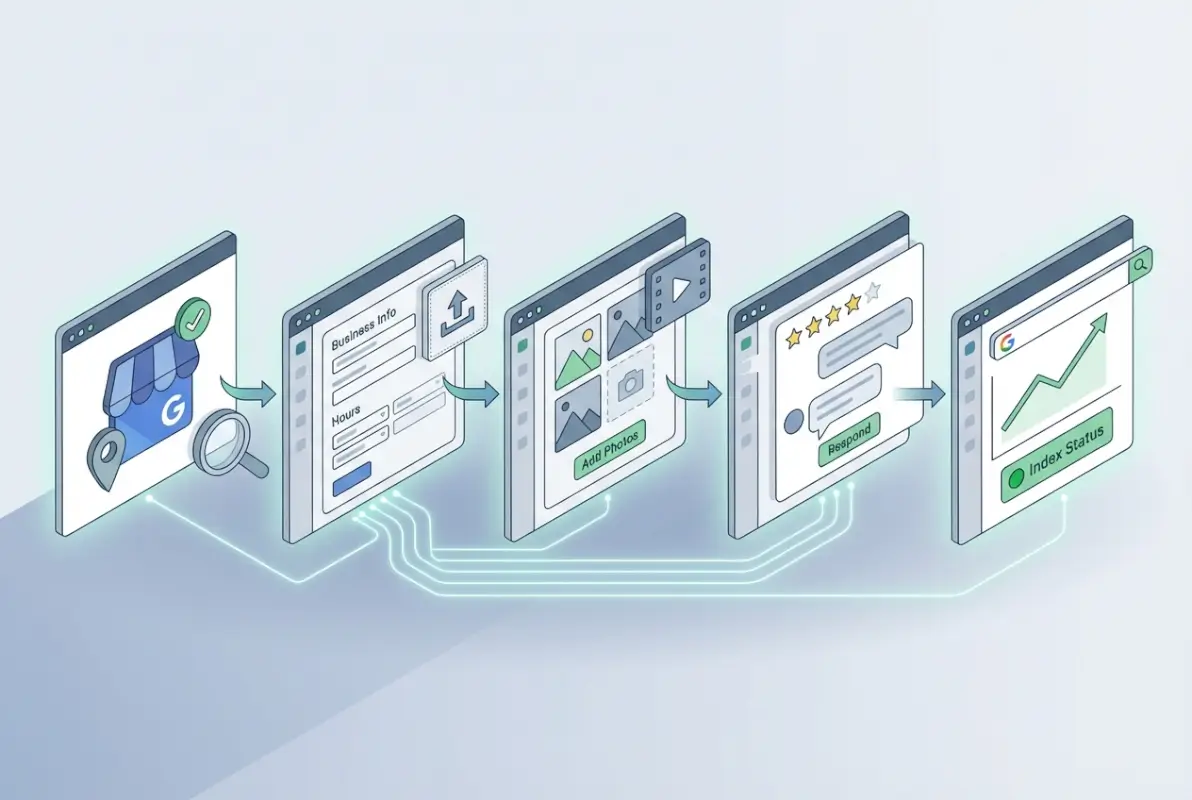
Here’s where most businesses stop too early (they claim their profile, fill in the basics, and call it done). But Google Business Profile has evolved into a content platform with features that directly impact your visibility and conversion rates. Posts, Q&A, messaging, booking buttons, product catalogs, these aren’t optional nice-to-haves, they’re engagement signals that Google measures and rewards. An active, content-rich profile tells Google your business is responsive and relevant, which translates to preferential treatment in local pack rankings and Maps prominence.
Posts, Q&A, and Messaging
Google Posts function like mini social media updates that appear directly in your knowledge panel. They’re criminally underutilized despite offering a direct channel to searchers at the moment of decision. Post about promotions, events, new products, seasonal offerings, or just helpful content related to your business. Posts remain visible for seven days (or until the event date passes), so plan a consistent posting schedule, weekly is a realistic cadence for most small businesses.
The Q&A section is a landmine if you ignore it because anyone can post a question or answer, including competitors, trolls, or misinformed customers. Monitor this section religiously and seed it with helpful FAQs you answer yourself. Preemptively answer common questions (“Do you take reservations?”, “Is parking available?”, “What payment methods do you accept?”). When real user questions appear, respond within 24 hours. Google tracks response rates and factors them into local ranking signals.
Enabling messaging allows customers to text your business directly from your GBP. Response time matters enormously here, Google displays your average response time publicly (“Typically responds within a few hours”). Fast responders build trust and convert more searchers into customers. If you enable messaging, commit to monitoring it. A messaging feature that goes unanswered for days damages your reputation more than not having it at all.
Visuals and Product/Service Details
Photos are the most overlooked ranking factor in local SEO. Businesses with more photos get more clicks, more calls, and more requests for directions than competitors with sparse imagery. Google even provides data on photo views in your insights dashboard, you can watch your photo views correlate with spikes in profile interactions. Upload high-quality images of your storefront (so customers can recognize your building), interior (so they know what to expect), products or dishes (so they can browse offerings), team members (for service businesses building trust), and your work or results (for project-based businesses).
Don’t just upload at setup and forget it. Add new photos monthly. Seasonal decorations, new menu items, finished projects, customer events, behind-the-scenes shots, variety keeps your profile fresh and gives repeat searchers new visual information. Google rewards photo freshness because it indicates an active business. Plus, user-uploaded photos appear in your profile too, monitor those and add official versions of similar content to maintain quality control over your visual presentation.
For service businesses, the Services section lets you list individual offerings with descriptions and prices. Fill this out completely. When someone searches “oil change near me,” businesses that have “Oil Change Service – $39.99” explicitly listed in their services section have a better shot at appearing than those who just mention oil changes in their description. The same principle applies across industries, explicitly catalog what you offer in structured fields rather than burying it in prose.
Structured Data and Schema
While GBP is your primary local search channel, augmenting your website with structured data reinforces the signals. LocalBusiness schema markup on your website tells Google explicitly what your business is, where it’s located, what hours you keep, and what you offer. When this schema data matches your GBP information exactly, it creates a reinforcing loop of trust signals.
Service schema is particularly valuable for service businesses. Mark up individual services with structured data that includes service type, area served, and provider details. This gives Google additional semantic context about your offerings beyond what fits in your GBP service list. For restaurants, Menu and MenuItem schema provides another layer of structured data about your offerings. While implementing schema won’t directly make your GBP appear faster, it helps Google understand and categorize your business more accurately, which influences how and when you appear for relevant queries. Learn more about technical approaches by exploring resources on how to include plugin wordpress step by step guide for schema implementation.
Mobile Readiness
Over 60% of Google searches now occur on mobile devices, and that percentage skews even higher for local searches with immediate intent (“near me” queries). Your GBP experience is inherently mobile-optimized since it’s delivered through Google’s interface, but ensure your linked website is equally mobile-friendly. When users click through from your profile to your site, a poor mobile experience kills conversions and sends negative behavioral signals back to Google.
Test your mobile click-to-call functionality. Make sure phone numbers are tappable and immediately trigger the dialer. Check that your directions link properly opens in the user’s preferred navigation app. If you’ve added a booking link or menu PDF, verify these load quickly on mobile connections. These seem like minor technical details, but they’re make-or-break moments in the customer journey from search to conversion.
Step 4 — Strengthen Local Relevance with Signals Beyond the GBP
Your Google Business Profile is the centerpiece, but Google doesn’t evaluate it in isolation. Local rankings emerge from a complex stew of signals that extend far beyond your profile: how your business is mentioned across the web, what customers say about you in reviews, how other sites link to you, even physical proximity to the searcher. Recent algorithm updates have amplified the importance of these external signals, particularly proximity and review recency. Understanding and influencing these off-profile factors separates businesses that occasionally appear in local packs from those that dominate them.

Google Local Pack and Proximity Signals
Proximity to the searcher has become increasingly dominant in local pack rankings. If someone searches “coffee shop” while standing on Main Street, Google will heavily favor coffee shops within a few blocks even if a slightly better-reviewed shop exists two miles away. This proximity bias intensified in recent algorithm updates as Google prioritizes immediate convenience for mobile searchers on the move.
You can’t change your physical location (well, you can, but that’s a bigger decision than SEO), but you can optimize around proximity. Service-area businesses should define their service areas accurately in GBP, this tells Google where you’re relevant even without a storefront. Location pages on your website help if you serve multiple areas, a plumber might create neighborhood-specific pages (“Plumbing Services in Downtown Brooklyn,” “Emergency Plumber in Park Slope”) that target proximity searches in different parts of their service region.
Freshness matters more than ever too. Profiles that are regularly updated with new posts, photos, and responses to reviews signal active businesses worth promoting. Google’s January 2025 local ranking update placed increased weight on recent profile activity, businesses that had gone months without updates saw ranking drops even with strong historical performance. Think of your GBP like a storefront, would you expect foot traffic to an obviously abandoned store? Google applies similar logic to its algorithms.
Citations and Backlinks from Local Sources
We covered NAP citations earlier, but backlinks from local sources deserve special attention. A link from your city’s newspaper website, a local blogger’s “best restaurants” roundup, a regional business journal article, or a partnership page on another local business’s site carries disproportionate local SEO value. These aren’t just backlinks for domain authority, they’re geographic trust signals that tell Google you’re genuinely embedded in and valued by your local community.
Earn these links through actual community involvement rather than trying to buy or manipulate them. Sponsor local events (which often includes a link from the event website). Host charity drives or participate in community initiatives (which get covered by local news). Partner with complementary local businesses for cross-promotion. Join local business associations and chambers of commerce that maintain member directories. The links are valuable, but the real-world relationships and reputation building matter even more.
Quality beats quantity by a mile here. One link from a trusted local newspaper carries more weight than 50 links from random directory sites. Google’s algorithms have become sophisticated at identifying and weighting locally relevant link sources versus generic SEO link building. Focus your outreach energy on sources that would actually matter to a human evaluating your local credibility.
Reviews and Reputation Management
Reviews are the most visible and impactful external signal, and Google’s approach to them continues evolving. The platform recently rolled out aggressive fake review detection globally, displaying warnings when it suspects review manipulation. Authentic reviews from real customers now matter more than ever, while shortcuts like buying reviews or incentivizing positive feedback carry serious risks of profile suspension.
Volume matters, but recency and response rate matter more. A business with 150 reviews averaging 4.2 stars but nothing in the past six months will often rank below a competitor with 75 reviews averaging 4.0 stars but 20 recent reviews in the past two months. Google interprets recent review activity as a signal of current business health and customer satisfaction. This creates a maintenance requirement, consistently delivering good service that generates organic reviews over time.
Responding to reviews (both positive and negative) demonstrably improves both user perception and algorithmic performance. Thank customers for positive reviews with personalized responses (not templated copy-paste). Address negative reviews professionally, acknowledge the issue, offer to make it right. These responses appear publicly and influence future customers’ decisions while also signaling to Google that you’re an engaged, responsive business owner. For strategies on managing online presence across platforms, including reviews, consider best practices for increase views airbnb listing optimization strategies.
Behavioral Signals
Google observes how users interact with your profile and uses these behavioral signals as ranking inputs. Click-through rate from search results to your profile, clicks to your website, requests for directions, phone calls, message initiations, photo views, all of these actions tell Google that users find your listing relevant and valuable for their search query. High engagement for a particular search term reinforces your relevance for that term in future rankings.
This creates a virtuous cycle: better visibility leads to more interactions, which signals relevance, which improves visibility further. It also means that optimizing for conversions isn’t separate from optimizing for rankings, they’re interconnected. A compelling business description that drives clicks improves your CTR, which becomes a ranking signal. High-quality photos that users actually view and click signal engagement, which feeds back into rankings.
Conversely, negative signals hurt you. If users frequently see your listing but never click, or click but immediately bounce back to results, Google interprets this as your listing being irrelevant for that query. This is why accurate categorization and truthful business information matters, attracting the wrong audience might juice short-term metrics but tanks your relevance signals when those users don’t convert.
Step 5 — Monitor, Test, and Adapt with Recrawls and Indexing Tools
Optimizing your profile once isn’t a strategy, it’s a starting point. The local search landscape shifts constantly with algorithm updates, competitive moves, seasonal demand changes, and Google’s evolving feature set. Successful local businesses treat their GBP as a living asset requiring ongoing monitoring, testing, and refinement. Google provides tools to track performance and request re-evaluation of your content, using them strategically accelerates your visibility improvements and helps you spot issues before they become ranking disasters.
Request Recrawls and Indexing When You Update GBP or Site Content
When you make significant changes to your GBP or website, Google doesn’t instantly recognize and reflect those updates. The search engine operates on crawl schedules that might revisit your content days or weeks later. Waiting passively for organic recrawls wastes time when you have tools to request immediate attention. Google Search Console’s URL Inspection tool lets you request indexing of specific URLs (your homepage, contact page, location pages). For your GBP, updates propagate through Google’s local data systems on their own schedule, but creating new posts or adding photos can trigger profile refreshes.
Sitemap submissions help Google discover and recrawl multiple pages efficiently. If you add new service pages or location content to your website, update your XML sitemap and resubmit it through Search Console. This tells Google “hey, there’s new content here, come check it out” rather than waiting for their crawler to stumble upon changes organically. That said, requesting recrawls doesn’t guarantee immediate indexing or ranking improvements, it just accelerates Google’s awareness of your updates.
Timing matters for recrawl requests. Don’t spam Google with requests after every minor tweak, that wastes your request quota and accomplishes nothing. Save recrawl requests for meaningful updates: major content additions, address changes, significant service expansions, anything that materially changes what your business offers or where you’re located. For routine updates like new photos or minor text edits, let organic crawling handle it.
Use Data to Guide Updates
GBP Insights provides valuable data about how users find and interact with your profile. Track which search queries drive impressions (how often you appear) versus actions (clicks, calls, direction requests). If you’re appearing for irrelevant queries, your categories or content might be misleading. If you’re appearing but not getting clicks, your photos or description aren’t compelling enough. If you’re getting clicks but few conversions, your business information might be inaccurate or your offer unclear.
Compare your performance to direct competitors. Where do they rank for key local searches? What categories do they use? How many reviews do they have? What content do they publish? Competitive analysis reveals opportunities and gaps, maybe they’re dominating a keyword you haven’t targeted, or maybe you’ve got strengths (review volume, photo quality) you aren’t fully leveraging. For broader visibility strategies, explore techniques like increase google business listing visibility local seo tips.
Track your local pack rankings for your core search terms. There are tools (both free and paid) that monitor local rankings from different geographic points. If you’re a service-area business, check your rankings from various parts of your territory. Proximity bias means you might rank #1 in your immediate neighborhood but #10 three miles away. Understanding these geographic variations helps you identify areas where additional signals (citations, reviews mentioning that area, content targeting that neighborhood) could improve visibility.
Stay Current with Policy and Feature Changes
Google Business Profile isn’t static, features get added, policies get updated, and functionality changes regularly. The “What’s Happening” section for restaurants, enhanced verification requirements for certain categories, changes to how Local Services ads work, these updates roll out constantly and affect optimal profile management strategies. Following official Google sources (Google Search Central blog, the GBP Help Center) and reputable industry publications keeps you ahead of changes rather than reacting after they’ve impacted your visibility.
Recent examples highlight why this matters. Google’s fake review crackdown in late 2024 meant businesses relying on dubious review tactics suddenly faced warnings or suspensions. Verification requirement changes for Local Services ads affected how certain professionals could advertise. Businesses that stayed informed adapted proactively; those who didn’t faced disruptions. Subscribe to a few trusted industry sources and spend 15 minutes monthly scanning for updates relevant to your business type.
| Metric | What It Tells You | Action to Take |
|---|---|---|
| Search Queries | How users find you | Optimize categories and content for high-volume relevant queries |
| Profile Views | Search visibility trends | Correlate with changes you made; double down on what works |
| Actions (calls, clicks, directions) | Conversion quality | If views are high but actions low, improve photos and description |
| Photo Views | Visual engagement | Add fresh photos when views plateau; test different image types |
| Review Volume & Recency | Reputation health | Implement systematic review generation process |
Practical Playbook: A Five-Step Checklist
Step-by-Step Quick-Start
Sometimes you need the executive summary version, the action plan stripped of context and explanation. Here’s your implementation checklist blending official guidance with proven best practices from current local SEO performance data:
- Claim and verify your Google Business Profile: Search for your business on Google Maps, claim the existing listing (or create one if none exists), select accurate categories, enter complete business information, and complete the verification process through your chosen method (phone, text, email, postcard, or video).
- Standardize NAP across all platforms: Create a spreadsheet documenting your canonical business name, address (with specific formatting), and phone number. Audit your website, social profiles, and top directory listings (Yelp, Yellow Pages, industry directories) to ensure they match exactly. Fix inconsistencies systematically.
- Enrich your GBP with complete information: Fill in business hours (including special hours), complete your business description with natural keyword usage, add all relevant categories (primary plus secondaries), upload high-quality photos (exterior, interior, products/services, team), list your services or menu with details, and add attributes that apply to your business.
- Activate engagement features: Publish a Google Post (announce an offer, share news, or provide helpful content), seed your Q&A section with 3-5 common questions and detailed answers, enable messaging if you can commit to responsive monitoring, and implement a process to request reviews from satisfied customers.
- Monitor and iterate monthly: Check GBP Insights for search queries, views, and actions; track your local pack rankings for core terms; respond to new reviews within 48 hours; add new photos at least monthly; update any changed information immediately; request recrawls after significant updates to your website; and scan for policy or feature changes that affect your industry.
This framework balances the essential foundational work with ongoing optimization, treating your local presence as the dynamic asset it actually is rather than a set-it-and-forget-it listing.
Special Considerations for Different Business Types
Service-Area Businesses (No Physical Storefront)
Plumbers, electricians, house cleaners, mobile pet groomers, and other service providers without a public-facing location face unique challenges. You can’t rely on foot traffic or proximity to a busy street. Your GBP can still be verified and optimized, but you’ll configure service areas instead of displaying a physical address. Be specific about the areas you serve, listing cities or zip codes increases your eligibility for local searches in those regions.
For service-area businesses, your website becomes even more critical as a trust and information source. Create dedicated pages for each major service area you cover, optimized with local keywords and content (“Emergency Plumber in [Neighborhood]”). Link these from your GBP website field. Accumulate reviews that mention specific service locations to build geographic relevance signals. Case studies or project galleries with location information help too (“Kitchen remodel in Brooklyn Heights,” “Electrical panel upgrade in Park Slope”).
Retail, Food & Hospitality, and Professionals
Retail businesses should heavily emphasize photos of products, store layout, and seasonal displays. Use the Product feature in GBP to showcase individual items with prices. Food and hospitality businesses need menu detail, interior and exterior ambiance photos, and dish photography that makes viewers hungry. Enable reservation or ordering links prominently. Hotels and vacation rentals benefit from room photos, amenity details, and integration with booking platforms.
Professional services (lawyers, doctors, accountants, consultants) need to emphasize credentials, specializations, and trust signals. Photos of professional settings, team members, and credentials work better than generic stock imagery. Detailed service descriptions help potential clients understand what you offer and whether you’re the right fit. Professional categories matter enormously here, a “Family Law Attorney” appears for very different searches than a “Criminal Defense Lawyer” even though both are lawyers.
Optional Advanced Tactics (If You Have Resources)
Schema and On-Site Optimization
Once your GBP foundation is solid, technical website optimization compounds your results. Implement LocalBusiness schema markup on your homepage and contact page, matching your GBP data exactly (NAP, hours, categories). For service businesses, mark up individual services with Service schema including service type, area served, and provider. Restaurants should implement Menu schema. Medical practices benefit from Physician schema.
This structured data doesn’t directly make your GBP rank higher, but it reinforces Google’s understanding of your business and creates consistency across your digital presence. When Google sees identical information structured on your website and in your GBP, confidence in your data accuracy increases. There are schema.org implementations for nearly every business type; find the right ones for your vertical.
Local Content Marketing and Events
Creating locally focused content attracts local backlinks and builds community relevance. A restaurant could publish blog posts about local food scene trends, ingredient sourcing from regional farms, or neighborhood history. A home services company might create neighborhood guides, local permit information, or area-specific project inspiration galleries. This content rarely drives massive traffic, but it earns links from local blogs, neighborhood websites, and community resources that strengthen your geographic signals.
Hosting or sponsoring local events creates real-world community presence that translates to online signals. A grand opening, customer appreciation event, charity drive, or educational workshop generates social mentions, potential press coverage, attendee photos (user-generated content for your GBP), and relationship building with other local businesses. The SEO value is indirect but real, you’re building the authentic local presence that Google’s algorithms try to identify and reward.
Frequently Asked Questions
How long does it take Google to index a new Google Business Profile?
Verification typically processes within 3-7 days depending on your chosen method, but initial indexing and appearance in local search results can take an additional 1-3 weeks. Google’s local data systems recrawl and re-evaluate profiles on their own schedule. Using URL Inspection for your website and adding fresh content to your profile (posts, photos) may accelerate indexing, but there’s no guarantee of immediate visibility even after verification completes.
Can I force Google to recrawl just one page or my GBP content?
For website pages, yes, use Google Search Console’s URL Inspection tool to request indexing of specific URLs. For your GBP, there’s no direct recrawl request button, but publishing new posts, adding photos, or updating business information triggers profile updates in Google’s systems. Recrawling doesn’t guarantee ranking changes or immediate visibility improvements, it just tells Google to re-evaluate your content sooner than the next scheduled crawl.
What should I include in the GBP to improve indexing and engagement?
Complete every applicable field: accurate business name, address, and phone; correct business hours including special hours; primary and secondary categories matching your services; a detailed business description using natural keywords; high-quality photos of your location, products, services, and team; regularly published posts sharing updates or offers; active management of Q&A; and professional responses to all reviews. Completeness and freshness are key ranking factors.
Are reviews important for local indexing on Google?
Absolutely. Review volume, recency, rating average, and your response rate all influence local rankings and click-through rates. Recent reviews signal an active business, while response to reviews demonstrates engagement and customer service quality. Google’s algorithms factor review signals heavily into local pack rankings, and recent updates increasingly penalize suspected fake reviews while rewarding authentic feedback patterns.
What if Google changes how it ranks local listings?
Google updates local ranking algorithms several times per year, adjusting the weight of various signals (proximity, review recency, profile completeness, engagement metrics). Stay adaptable by maintaining accurate data, publishing fresh content regularly, actively managing reviews, and monitoring your performance metrics for sudden changes. Following official Google communications and reputable industry sources helps you anticipate and respond to algorithm shifts rather than being blindsided by ranking drops.
How do I verify a service-area business (no storefront) on GBP?
GBP fully supports service-area businesses. During setup, select “I deliver goods and services to my customers” and specify your service areas by city, zip code, or region. You can hide your business address from public display while still verifying ownership. Verification methods (phone, text, postcard to your business address) work the same, you just won’t display that address publicly on Maps. Set your service radius appropriately to appear in local searches throughout your coverage area.
Where can I find official guidance on GBP and indexing?
Google Business Profile Help Center (support.google.com/business) provides official documentation on claiming, verifying, and managing your profile. Google Search Central (developers.google.com/search) covers crawling, indexing, and technical SEO topics including recrawl requests and structured data. These official sources should be your primary references for policies, features, and best practices.
Can I use the same phone number for multiple business locations?
You should avoid this when possible. Google uses unique phone numbers as part of each location’s identity, shared numbers can cause confusion in their systems or make locations harder to distinguish. If you must use a centralized phone number, ensure other NAP elements (address, business name with location identifier) clearly differentiate each location. Ideally, each physical location gets a unique local phone number for the best local search performance and customer experience.
How often should I update my Google Business Profile?
Publish new Google Posts weekly or at minimum bi-weekly to maintain freshness signals. Add new photos at least monthly, more often if you have seasonal changes or new products. Respond to reviews within 24-48 hours. Update business information immediately when anything changes (hours, services, contact info). Check and answer new Q&A questions within 24 hours. This consistent activity level signals an engaged business owner and keeps your profile fresh in Google’s evaluation cycles.
Do I need a website if I have a Google Business Profile?
Technically no, GBP can function independently and even generates a basic free website for you. Practically, yes, you should have a real website. Your website provides space for detailed service explanations, customer education, blog content, case studies, and conversion optimization that a GBP alone can’t deliver. It’s also an asset you control completely, whereas GBP exists on Google’s platform under their terms. The two work synergistically, your website and GBP should reinforce each other with consistent information and strategic interlinking.
Getting your business indexed and ranking on Google isn’t magic, it’s methodical work across multiple interconnected systems. Verification establishes legitimacy, data consistency builds trust, content richness drives engagement, external signals reinforce relevance, and ongoing monitoring catches problems while amplifying successes. The businesses dominating local search aren’t smarter or luckier, they’re simply more systematic and persistent about managing these elements. Start with the five core steps outlined here, verifying ownership, standardizing data, optimizing content, building local signals, and monitoring performance. Then iterate based on your results, your insights dashboard and customer feedback will reveal where your next optimization efforts should focus. The local search landscape will keep evolving, but these fundamentals of authenticity, completeness, engagement, and technical correctness remain constant. Take action on at least one step this week, your future customers are searching right now, and they’ll find whoever shows up most credibly in that moment of intent.