How to List a Business on a Directory: 6 Essential Steps

Most businesses dump their information into a directory and wonder why nothing happens. Here’s the truth nobody talks about: listing your business on a directory isn’t just about filling out forms—it’s about building a digital footprint that feeds your local SEO, drives qualified traffic, and creates trust signals Google actually cares about. The difference between a listing that converts and one that dies in obscurity comes down to six specific, repeatable steps that most business owners completely miss.

Think of business directories as the digital equivalent of word-of-mouth referrals, except they work 24/7 and reach people actively searching for what you offer. When done right, they become passive lead generation machines. When done wrong (inconsistent information, incomplete profiles, scattered presence), they actually hurt your rankings and confuse potential customers. I’ve seen businesses triple their local search visibility just by cleaning up their directory mess and applying a systematic approach.
TL;DR – Quick Takeaways
- Directory listings are ongoing SEO assets – not one-time tasks, they require consistent NAP data and regular updates
- Start with 5-7 core directories – Google Business Profile, Yelp, Bing Places before expanding to niche platforms
- NAP consistency is non-negotiable – every mismatch dilutes your local search authority
- Verification and optimization matter equally – claiming a listing is step one, filling it with rich content is where results happen
- Measure everything – track referral traffic, call volume, and conversion rates from each directory to justify your time investment
Step 1: Research and Select the Right Directories
The biggest mistake I see businesses make is trying to be everywhere at once. They blast their information across 50+ directories, half of which have zero traffic and questionable moderation. This scattergun approach wastes time and creates data inconsistencies that confuse search engines. Instead, you need a strategic selection process that prioritizes quality over quantity.

Start by building your directory target list in three tiers. Tier one includes the non-negotiables: Google Business Profile, Yelp, Bing Places for Business, and Apple Maps. These platforms drive the majority of local search traffic and feed directly into map packs and voice search results. According to recent data, over 60% of local searches now happen on mobile devices, and these four directories dominate mobile discovery.
Evaluate Directory Quality Before Committing
Not all directories deserve your attention. Before adding a platform to your list, run it through this filter: check its domain authority using tools like Moz or Ahrefs (aim for DA 40+), verify it has active user engagement (recent reviews, updated listings), and confirm it enforces moderation policies to prevent spam. A high-quality directory will have clear submission guidelines, responsive support, and visible traffic statistics.
For your tier two, add 5-8 industry-specific directories that your target customers actually use. If you’re a restaurant, platforms like OpenTable and TripAdvisor matter more than generic business directories. B2B companies should prioritize Clutch, G2, and industry trade association directories. Local service businesses benefit from Angie’s List, HomeAdvisor, or Thumbtack depending on their niche.
Align Your Strategy with Current Platform Trends
Directory ecosystems shift constantly. Platforms that drove massive traffic in previous years sometimes fade while new players emerge. Recent analysis shows that directories with integrated review systems and mobile-first interfaces consistently outperform legacy platforms with outdated user experiences. When you’re building a directory strategy from scratch, prioritize platforms that show upward traffic trends and active feature development.
Monitor how your competitors distribute their listings. If three of your top five competitors appear on a specific directory and rank well locally, that’s a signal worth following. Use this competitive intelligence to justify adding platforms to your tier three experimental list—directories you’ll test for 90 days before fully committing resources to maintain them.
Common Selection Pitfalls to Avoid
Resist the urge to pay for “instant submission to 100+ directories” services. These often include low-quality sites that generate duplicate listings and inconsistent data, two factors that actively harm your local SEO. Duplicate listings split citation credit and confuse Google about which information is authoritative. I remember working with a client who had 17 different versions of their business address scattered across automated submissions—it took three months to clean up and their local rankings suffered the entire time.
| Directory Type | Primary Benefit | Best For |
|---|---|---|
| Major Platforms (Google, Yelp) | High traffic volume, map pack visibility | All business types |
| Industry-Specific | Qualified leads, niche authority | Specialized services, B2B |
| Local/Regional | Hyperlocal visibility, community trust | Brick-and-mortar, service areas |
| Review Aggregators | Reputation management, social proof | Consumer-facing businesses |
Step 2: Prepare and Standardize Your NAP and Business Details
Before you touch a single directory submission form, you need a master document that becomes your single source of truth. This isn’t optional busy work, it’s the foundation that prevents the citation inconsistencies that tank local rankings. Every variation in how you present your business name, address, or phone number creates friction in Google’s entity understanding and dilutes your ranking signals.

Create a spreadsheet or document with these exact fields: legal business name (exactly as registered), doing-business-as name if different, full street address with suite/unit numbers, city, state, ZIP code, primary phone number, website URL, business category (primary and 2-3 secondary), hours of operation for each day, service areas or delivery zones, accepted payment methods, and your core business description. Format your phone number consistently—pick (555) 555-5555 or 555-555-5555 and never deviate.
Write a Master Description That Works Everywhere
Your business description needs to work across platforms with different character limits while maintaining consistent messaging. Start with a compelling 1-2 sentence value proposition that answers “What problem do you solve and for whom?” This becomes your short description. Then expand to 3-5 bullet points highlighting specific services, your unique advantages, and a clear call-to-action. Keep the long version under 250 words—most directories cap descriptions between 200-500 characters anyway.
Gather your brand assets before you start submissions. You’ll need your logo in PNG format with transparent background (minimum 500×500 pixels), 5-10 high-quality photos of your location, products, or team (1200×800 or larger), and any promotional images or videos you want to feature. Inconsistent or low-quality images across directories hurt perceived professionalism and reduce conversion rates. When someone finds you on three different platforms and sees three different logos, it raises trust questions.
Document Hours, Exceptions, and Service Details
Get specific about your hours of operation, including holiday exceptions. Most directories let you set special hours for holidays or seasonal changes, but only if you proactively update them. Outdated hours are one of the top customer complaints and a fast way to generate negative reviews. If you offer services outside standard business hours (emergency services, 24/7 support), make sure that’s clearly documented and consistently stated across all platforms.
For service-based businesses without a physical location customers visit, decide how you’ll handle the address field. Google Business Profile now offers service area businesses the option to hide their address and just show service zones. Whatever approach you choose, apply it uniformly. Showing an address on Yelp but hiding it on Google creates the exact inconsistency you’re trying to avoid. When you’re working to optimize your directory listings like a professional, these details separate amateur submissions from ones that actually drive results.
Step 3: Create or Claim Listings on Core Directories
Now comes the execution phase where your preparation pays off. The goal isn’t just to exist on directories, it’s to claim ownership, verify your authority, and optimize every available field. Unclaimed listings often already exist (Google and other platforms create them from public data), and leaving them unclaimed means competitors or random users can suggest edits that mess up your information.
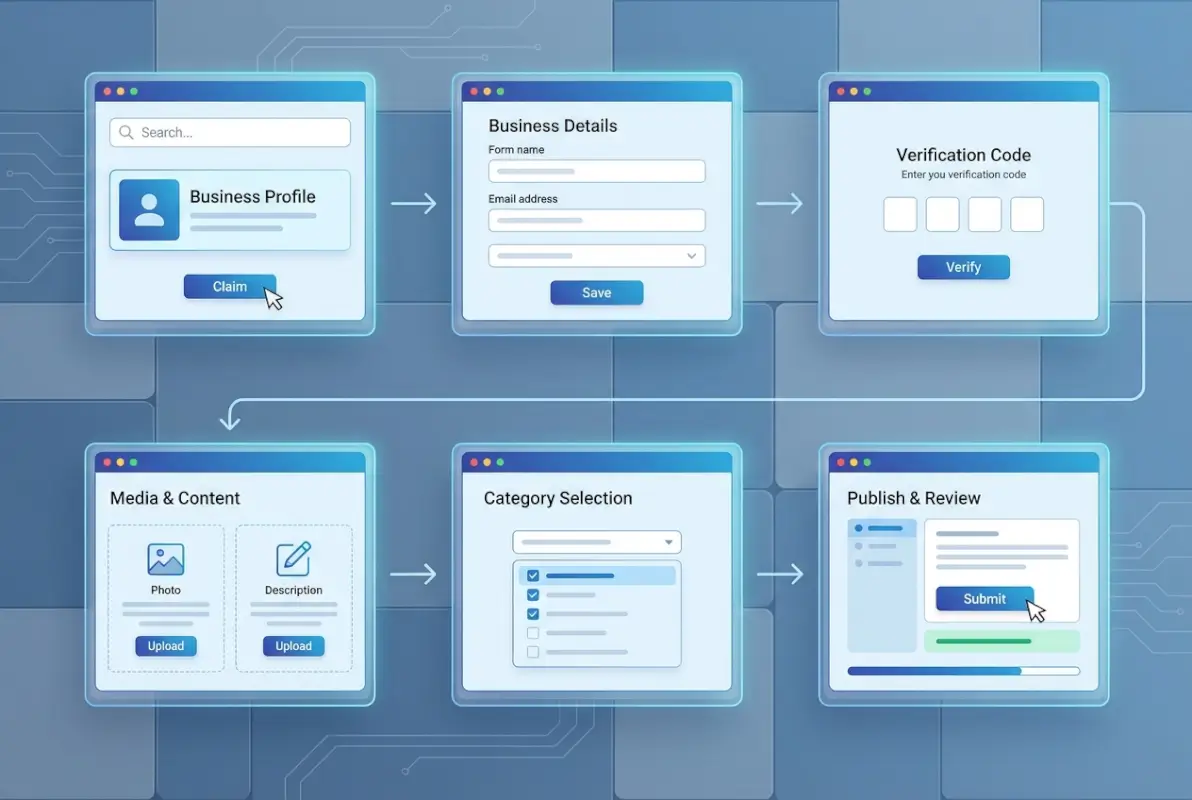
Start with Google Business Profile since it feeds Google Maps, local pack results, and Knowledge Graph panels. Search for your business name and location—if a listing exists, click “Claim this business” and follow the verification process. Google typically offers phone, email, or postcard verification. Phone is fastest but not always available. Postcard takes 5-7 days but works for any business. Some established businesses can verify instantly through Search Console or other Google services.
Follow Platform-Specific Requirements Precisely
Each directory has slightly different field requirements and validation rules. Yelp is strict about business categories and won’t let you submit until you choose an appropriate primary category. Bing Places integrates with Microsoft services and pulls data from other sources, so verify everything matches. Apple Maps requires verification through Apple Business Connect and has specific photo dimension requirements. Don’t rush through forms—careless submissions create the data inconsistencies you spent time standardizing to avoid.
Copy your NAP data exactly from your master sheet for every single submission. It’s tempting to abbreviate (using “St” instead of “Street”) or reformat phone numbers, but this is where most businesses introduce tiny variations that accumulate into ranking problems. If your master sheet says “123 Main Street, Suite 4B” then every directory should show exactly that, not “123 Main St #4B” or “123 Main Street, Ste 4B”.
Complete Verification Steps Without Delay
After submission, most platforms require verification before your listing goes fully live. Check your email immediately for verification links—they often expire within 72 hours. For postcard verification, watch your mail and enter the code as soon as it arrives. Delayed verification means your listing sits in limbo, invisible to searchers, for weeks longer than necessary. I’ve watched businesses lose momentum because they submitted to 10 directories but only verified two, wondering why results were disappointing.
Once verified, confirm your profile visibility settings match your business type. If you’re a service area business, verify the address is hidden and service areas are correctly defined. If you have a physical location, confirm the map pin appears in the right spot. Test your listing by searching for your business name and category—if it doesn’t appear, there’s a visibility or category issue to resolve immediately.
Optimize Each Profile with Platform-Specific Features
Generic submissions get generic results. After the basics are in place, leverage each directory’s unique features. Google Business Profile lets you add posts, Q&A, product catalogs, and booking links—use them. Yelp highlights photos heavily, so upload 10+ high-quality images. Bing Places integrates with Microsoft Advertising, so if you run paid search, connect the accounts for better attribution. The goal is to create a complete, rich profile that outclasses competitor listings when customers compare options side-by-side.
Your business description should stay consistent in message but can be tailored slightly for each platform’s audience. A Yelp description might emphasize customer experience and atmosphere since Yelp users care about reviews and ambiance. A LinkedIn business page should highlight professional credentials and B2B services. The core NAP and brand message stay identical, but the emphasis shifts to match how people use that specific directory. Understanding how directories integrate with your website helps you create a cohesive cross-platform presence.
Strategic Link Placement Across Directories
Most directories let you include your website URL and sometimes additional links to specific pages. Always include your homepage URL in the primary website field using the exact format from your master sheet (https://www.yourdomain.com or https://yourdomain.com—pick one and stay consistent). Some platforms offer additional link fields for menus, booking pages, or product catalogs. Use these strategically to drive traffic to high-conversion pages, not just your homepage.
Avoid the temptation to stuff every possible link into your profile or use spammy anchor text. Keep links editorial and relevant. If a directory allows social media links, include your primary platforms (Facebook, Instagram, LinkedIn) but only if you actively maintain them. Dead or rarely updated social profiles hurt credibility more than help it. Understanding the reasons to get listed in quality directories helps prioritize which ones deserve your ongoing maintenance effort.
Step 4: Optimize for Local SEO and Brand Consistency
Claiming and filling out profiles is table stakes, optimization is where you pull ahead of competitors. Local SEO depends heavily on citation consistency—how often your NAP appears identically across the web. Search engines use these citations to verify your business legitimacy and determine your geographic relevance. Even small variations (like showing “Street” in some places and “St.” in others) dilute citation value and create entity disambiguation problems.

Conduct a comprehensive NAP audit across all your live listings. Use your master sheet as the reference and check every directory for exact matches. Create a simple tracking spreadsheet with columns for directory name, NAP status (match/mismatch), last verified date, and notes. This becomes your ongoing maintenance checklist. When you find discrepancies, log into that directory immediately and correct them. Speed matters because search engines crawl these sites regularly, and every day a mismatch exists is a day your local rankings suffer.
Maintain Visual and Messaging Consistency
Beyond NAP, your brand presentation should feel cohesive across platforms. Use the same logo, color schemes, and core messaging everywhere. When customers see your listing on Yelp, then find you on Google, then check a industry directory, the experience should feel seamless. Inconsistent branding raises questions about legitimacy and professionalism. Upload the same high-quality photos to multiple directories (tailored to each platform’s recommended dimensions) rather than using completely different images everywhere.
Your business description tone and keywords should align across directories while respecting character limits. Extract shorter versions from your master description rather than writing entirely new copy for each platform. This ensures consistent keyword usage and message, which helps search engines understand what you do and reinforces brand recall with potential customers who might encounter you on multiple platforms before deciding to engage.
Build a Review Solicitation and Response System
Reviews are social proof and ranking signals combined. Directories with active, recent reviews outrank identical listings with old or no reviews. Develop a simple system to request reviews from satisfied customers—email follow-ups after transactions, text message requests, or in-person asks with a QR code that links directly to your review page. Make it as easy as possible by providing direct links to specific platforms rather than just saying “please review us online.”
Respond to every review, positive and negative, within 48 hours. Thank customers for positive reviews with specific mentions of what they praised (“Thanks for highlighting our fast turnaround time, Alex!”). For negative reviews, acknowledge the issue, apologize if appropriate, and offer to resolve it offline. Potential customers read your responses as much as the reviews themselves. Consistent, professional responses signal that you care about customer experience and actively manage your reputation.
Monitor Performance and Iterate
Set up tracking to measure how each directory contributes to your business goals. Google Business Profile includes built-in analytics showing search impressions, map views, website clicks, and phone calls. For other directories, use UTM parameters on your links to track traffic in Google Analytics (add ?utm_source=yelp&utm_medium=listing to your URLs). Track which directories drive the most visits, which generate phone calls, and which result in actual conversions or sales.
This data informs where you invest ongoing optimization effort. If Yelp drives significant traffic but low conversion, maybe your profile needs better photos or a clearer call-to-action. If a niche directory shows high conversion rates despite low traffic, invest more time optimizing that profile and explore paid options if available. Update listings seasonally or whenever your business changes—new services, expanded hours, additional locations—keeping information fresh signals active management to both search engines and customers.
Step 5: Maintain Data Quality and Ongoing Submission Cadence
Directory management isn’t a launch-and-forget project, it’s an ongoing operational task like email or social media. Business information changes, directories update their platforms and requirements, and competitors constantly optimize their own listings. The businesses that maintain consistent visibility are the ones that treat directory management as a recurring calendar item rather than a one-time project.

Schedule monthly or quarterly audits depending on how frequently your business information changes. Monthly makes sense if you run promotions, adjust hours seasonally, or frequently update service offerings. Quarterly works for stable businesses with consistent operations. During each audit, verify NAP accuracy, check for broken links, confirm hours are current including upcoming holidays, update photos if you’ve refreshed branding or locations, and review any customer-submitted edits or questions that need responses.
Expand Your Directory Footprint Strategically
As your business grows or your strategy evolves, add new directories to your portfolio. Opened a second location? Submit to local directories in that area. Expanding service offerings? Look for industry directories relevant to the new services. Tracking shows a competitor directory drives them significant traffic? Add it to your list. But expand systematically—adding one or two new directories per quarter—rather than in big batches that create maintenance overwhelm.
Conversely, prune directories that deliver no value. If you’ve had a listing on a platform for 12+ months with zero referral traffic, negligible views, and no customer engagement, consider whether maintaining it is worth the time. Inactive directories don’t hurt you directly, but they dilute your maintenance focus. Better to have 15 well-optimized, actively managed listings than 50 neglected ones. When exploring ways to monetize directory presence, focus your energy on platforms that actually drive business results.
Stay Compliant with Platform Policies
Each directory has terms of use and content policies that evolve over time. Platforms crack down on spam, fake reviews, keyword-stuffed descriptions, and prohibited business types. Regularly review the guidelines for your core directories—especially Google Business Profile, which frequently updates its quality guidelines and enforcement. Violations can result in listing suspension or permanent removal, erasing months of optimization work and damaging your local search visibility overnight.
Respect privacy and data handling standards, especially if you operate in regulated industries. Healthcare, finance, and legal services have specific rules about how you can market and what information you can display. Make sure your directory listings comply with industry regulations like HIPAA, FINRA, or state bar association rules. Non-compliance issues surface during routine audits or competitor reports, and fixing them retroactively is far harder than getting it right initially.
| Maintenance Task | Frequency | Time Required |
|---|---|---|
| NAP accuracy audit | Quarterly | 30-45 minutes |
| Photo and content refresh | Bi-annually | 1-2 hours |
| Review responses | Weekly | 15-30 minutes |
| Hours/holiday updates | As needed | 10-15 minutes |
| New directory research | Quarterly | 45-60 minutes |
Step 6: Measure Impact and Iterate
Data separates guesswork from strategy. You need concrete metrics to understand which directories justify ongoing investment and which should be deprioritized or dropped. Without measurement, you’re optimizing blind, potentially spending time on platforms that generate zero business value while neglecting hidden gems that drive qualified leads.
Define Your Success Metrics Up Front
Start by identifying what success looks like for your business. For local service companies, phone call volume from directories might be the primary metric. E-commerce businesses care more about referral traffic and on-site conversion rates. Professional services firms track consultation requests and form submissions. Define 3-5 KPIs that tie directory performance to actual revenue or qualified leads, not just vanity metrics like profile views.
Set up tracking infrastructure to capture this data. Use call tracking numbers specific to top directories (Google Voice numbers are free and track call duration and frequency). Add UTM parameters to all directory links so Google Analytics can attribute traffic sources accurately. Enable conversion tracking in Analytics to measure which referral sources actually complete purchases, fill out contact forms, or book appointments. Directory impressions and clicks matter, but conversions pay the bills.
Benchmark Against Competitors and Industry Standards
Your performance exists in context—what matters is whether you’re ahead of or behind competitors in directory visibility and engagement. Research your top 5 competitors’ directory presence. Which platforms do they appear on? How complete are their profiles? What’s their review count and average rating? How frequently do they update content? This competitive intelligence reveals opportunities (directories they’re neglecting) and threats (platforms where they dominate and you’re absent).
Use industry benchmarks to set realistic goals. Average click-through rates from directory listings vary by industry—local service businesses might see 10-15% CTR from Google Business Profile views, while retail might see 5-8%. Understanding these baselines helps you identify when performance is genuinely strong versus when you’re celebrating mediocre results because you lack context.
Iterate Based on Performance Data
Review your directory analytics monthly and make data-driven adjustments. If one directory consistently drives traffic but has a high bounce rate, the issue might be profile-to-website messaging mismatch—visitors aren’t finding what your profile promised. Test different descriptions or calls-to-action to improve alignment. If a directory shows high impressions but low clicks, your photos or business description might need optimization to stand out from competitors in search results.
Run small experiments to improve performance. Try posting updates or offers to Google Business Profile twice weekly for a month and measure if engagement increases. Upload new photos to Yelp and track if profile views rise. Adjust your business categories and see if different category selections improve visibility for relevant searches. Treat directory optimization like any other marketing channel—test, measure, refine, repeat.
Quick-Start Checklist for Immediate Results
If you need to move fast, here’s the condensed version that covers the essentials without overwhelming detail. This checklist gets you 80% of the results with 20% of the effort, ideal for businesses that want immediate visibility while building toward comprehensive optimization later.
Week 1: Create your master NAP sheet with standardized business information. Claim and verify your Google Business Profile and Bing Places listings. Upload at least 5 high-quality photos and fill out every available field completely. Set your business hours accurately.
Week 2: Submit to Yelp, Apple Maps, and 2-3 industry-specific directories relevant to your business. Use identical NAP information from your master sheet. Add the same photos you uploaded to Google. Write your business description using the template from your master sheet.
Week 3: Set up Google Analytics UTM tracking for each directory link. Request reviews from 5-10 recent satisfied customers, providing direct links to your Google and Yelp profiles. Respond to any existing reviews on your newly claimed profiles.
Week 4: Audit all live listings for NAP consistency. Fix any discrepancies immediately. Set calendar reminders for monthly review response checks and quarterly full audits. Review your Analytics to see which directories are already driving traffic.
Ongoing: Respond to new reviews within 48 hours. Update hours before major holidays. Add new photos every quarter. Research one new directory per month for potential addition to your portfolio. Check top competitor listings quarterly to identify gaps or opportunities.
Frequently Asked Questions
What is the best way to choose which directories to list my business on?
Prioritize directories based on three factors: traffic volume (measured by domain authority and platform usage statistics), audience relevance (whether your target customers actually use that directory), and competitive presence (where your top competitors maintain active listings). Start with the big four—Google Business Profile, Yelp, Bing Places, and Apple Maps—then add 3-5 industry-specific directories where your niche actively searches for services. Avoid low-quality directories with minimal moderation or sparse user activity.
How important is NAP consistency across directories for local SEO?
NAP consistency is critical for local SEO because search engines use citation matching to verify business legitimacy and determine local ranking authority. Even minor variations like “Street” versus “St.” or different phone number formatting create entity disambiguation problems that dilute ranking signals. Consistent citations across directories act as trust signals, while inconsistent information confuses search algorithms and can split citation credit across what the algorithm perceives as different entities, directly harming your local visibility.
Should I pay for directory listings or start with free options?
Start with free listings on major directories to establish your baseline presence and NAP consistency. Only consider paid directory options after you’ve maxed out free listings and can demonstrate that a specific directory drives meaningful traffic or leads. Evaluate paid directories based on their traffic quality, not just their pitch—request case studies or trial periods when possible. Many paid directories offer minimal advantage over free profiles unless they provide premium placement, enhanced features, or access to a highly targeted niche audience you can’t reach elsewhere.
How often should I update directory listings to stay accurate?
Audit your top 5-7 directory listings quarterly to verify accuracy and make updates whenever business information changes. At minimum, review listings before major holidays to update hours, at the start of each season if you have seasonal offerings, and immediately when core details like phone numbers or addresses change. Active listings with recent updates and fresh content signal engagement to both users and search algorithms, potentially improving visibility and ranking within directory search results.
What content should I include in a directory listing description?
Include a clear value proposition answering what problem you solve and for whom, 3-5 specific services or product categories with relevant keywords, what makes you unique or different from competitors, your target geographic area or service zones, and a direct call-to-action telling readers the next step. Keep descriptions between 150-250 words to fit most directory limits. Avoid generic statements and keyword stuffing—focus on clarity and customer benefits while naturally incorporating terms people search for.
How can I measure the impact of directory listings on my business?
Track referral traffic in Google Analytics using UTM parameters on directory links, monitor phone call volume using directory-specific tracking numbers or call tracking software, measure conversion rates for directory referral traffic versus other sources, and track local search visibility changes using rank tracking tools for geo-specific searches. Most major directories like Google Business Profile also provide native analytics showing impressions, clicks, direction requests, and call clicks. Compare these metrics month-over-month and against competitors to assess true impact.
How do I handle duplicate listings or conflicting information?
First, claim ownership of all duplicate listings where possible through the directory’s business claiming process. Request removal or merger of true duplicates (identical business, identical location) through the platform’s support channels—most directories have processes for consolidating duplicates once you verify ownership. For listings you can’t claim, report them as duplicates with documentation proving your authority. Fix information conflicts immediately by updating to match your master NAP sheet. If competitors or others created incorrect listings, claim them and correct rather than letting misinformation persist.
Can directory listings help my business if I’m already ranking well organically?
Yes, because directory listings serve different user intents and discovery paths than organic search results. Many customers browse directories directly when comparing options—they’re not just using Google. Directory profiles also capture map searches, voice searches, and mobile “near me” queries that bypass traditional organic results. Strong directory presence builds brand credibility through multiple touchpoints and customer reviews, creates additional backlinks supporting your overall SEO, and captures traffic from directory-specific features like promoted listings or category browsing that organic rankings don’t address.
What should I do if a competitor has fake reviews or violates directory policies?
Report violations through the directory’s official reporting mechanism with specific evidence—screenshots, timestamps, suspicious patterns like multiple reviews from the same IP or accounts. Most platforms take policy violations seriously but require documentation. Focus your energy on building legitimate positive reviews and superior content rather than obsessing over competitor shortcuts. If a competitor’s fake reviews are egregious and the platform isn’t responding, consider escalating through the directory’s business support or legal channels. However, spending excessive time on competitor policing usually generates less ROI than investing that time in improving your own listings and customer experience.
Are niche industry directories worth the effort compared to major platforms?
Niche directories can deliver highly qualified leads despite lower traffic volumes because they attract users specifically looking for your type of service. A specialized legal directory might drive 50 visitors monthly compared to Google’s 5,000, but if those 50 are all potential clients actively seeking legal services in your specialty, the conversion rate and lead quality often exceed generic directory traffic. Evaluate niche directories by lead quality and conversion metrics, not absolute traffic numbers. If a niche directory consistently converts at 10% while Yelp converts at 2%, it deserves proportional optimization investment despite lower volume.
Moving Forward with Your Directory Strategy
You now have a systematic, repeatable framework for building and maintaining a directory presence that actually drives business results. The businesses that succeed with directories aren’t the ones that blast information everywhere and forget about it—they’re the ones that treat directory listings as strategic assets requiring the same attention they give their website, social media, or paid advertising.
Start with the fundamentals: perfect your NAP consistency, claim and optimize your profiles on the five core directories, and establish a measurement framework so you know what’s working. Then expand strategically based on data, not assumptions. Add directories that serve your specific audience and prune those that deliver no value. The goal isn’t to be everywhere, it’s to be everywhere that matters with listings that outclass your competition in completeness, accuracy, and engagement.
Your action plan for the next 30 days:
Block two hours this week to create your master NAP sheet and audit your current directory presence. You’ll probably find inconsistencies and unclaimed listings costing you visibility right now. Claim and optimize your Google Business Profile completely—it’s non-negotiable. Set up tracking so you can measure results from day one. Request reviews from recent customers while their positive experience is fresh.
Then commit to 30 minutes weekly for ongoing management: respond to reviews, monitor analytics, and make small optimizations based on what the data tells you. Directory success isn’t about one big push, it’s about consistent incremental improvements that compound over time into significant competitive advantage.
The directory landscape evolves constantly—platforms change features, algorithms adjust ranking factors, and consumer behavior shifts—but the core principles remain constant. Accurate, consistent information presented professionally across relevant platforms builds trust with both search engines and customers. Reviews and engagement signal active businesses worth ranking higher. Measurement and iteration separate winners from businesses that wonder why their directory listings don’t work.
If you walked away from this article and only did three things, make them these: perfect your NAP consistency everywhere, claim and fully optimize Google Business Profile with photos and regular posts, and set up conversion tracking so you know which directories actually generate revenue. Those three actions alone will put you ahead of 70% of local businesses that treat directory listings as an afterthought. Everything else builds on that foundation, but the foundation is what matters most.