How to Optimize Your Business Directory Listing: Complete Guide for Local & Mid-Sized Companies

Generating summary...
Most business owners treat directory listings like digital paperwork—fill it out once, forget about it forever. That’s a costly mistake. I’ve watched competitors dominate local search results not because they had better products or services, but because they understood something fundamental: directory listing optimization is the leverage point that amplifies everything else you do online.
Here’s what most guides won’t tell you: the businesses crushing it in local search aren’t just “consistent” with their listings—they’re strategic. They know which directories actually move the needle, how to structure their information for both humans and algorithms, and most importantly, they treat their directory presence as a living, breathing sales channel rather than a static yellow pages entry.
Whether you’re running a single-location service business or managing listings for a mid-sized company with multiple branches, the principles of effective directory listing optimization remain remarkably consistent. The difference lies in execution, scale, and knowing exactly where to focus your limited time for maximum impact.
TL;DR – Quick Takeaways
- NAP consistency is non-negotiable – Even minor variations kill your local SEO momentum
- Quality beats quantity – 10 optimized listings outperform 50 mediocre ones
- Google Business Profile is your foundation – Master it before spreading to other directories
- Reviews drive visibility and conversions – They’re not vanity metrics, they’re ranking factors
- Fresh content signals active business – Regular updates tell search engines you’re operational
- Analytics reveal your best performers – Track which directories actually send customers
Why Directory Listings Actually Matter for Your Bottom Line
Let’s cut through the SEO jargon for a moment. Business directories matter because they sit at the intersection of three critical elements: credibility, discoverability, and conversion intent. When someone searches for “plumber near me” or “best accounting firm in Chicago,” they’re not browsing—they’re buying. Directory listings put you in front of people with their wallets already open.
The numbers tell a compelling story. According to Statista’s research on local business discovery, consumers use online directories at multiple stages of their purchase journey, with the majority checking multiple sources before making contact. Your presence—or absence—in these directories directly influences whether you’re even considered.

But here’s where it gets interesting. Directory listings don’t just help customers find you; they actively improve how search engines perceive your business. Each consistent citation acts as a vote of confidence, telling Google that your business is legitimate, established, and relevant. Think of citations as the digital equivalent of community reputation—the more quality sources mention you consistently, the more trustworthy you appear.
The Citation-to-Ranking Pipeline
Most business owners understand that backlinks help SEO, but they underestimate how directory citations specifically boost local rankings. Research from Moz’s local ranking factors study consistently shows that citation signals account for approximately 13% of how businesses rank in the local pack—those coveted map results at the top of search pages.
That percentage might sound small until you realize that local pack visibility can drive 30-40% of your total organic traffic. For a service business pulling in $500K annually, that 13% citation factor could represent $65,000 in revenue—hardly insignificant.
Beyond SEO: The Trust Factor
Here’s something I learned working with a regional HVAC company: their most valuable directory listing wasn’t on a high-authority platform—it was on their local Better Business Bureau directory. Why? Because when customers were comparing three HVAC providers, that BBB accreditation badge became the tiebreaker. The listing itself drove minimal traffic, but it closed deals.
This illustrates a crucial point about how to optimize a local business directory listing: you’re not just optimizing for traffic, you’re optimizing for trust at every stage of the customer journey.
Strategic Directory Selection: Where to Actually Invest Your Time
If you tried to claim and optimize every directory that accepts business listings, you’d still be at it next year. The harsh reality is that most directories provide negligible value. Your success depends on ruthlessly prioritizing the platforms that actually matter for your specific business context.
I use a three-tier framework when advising clients on directory selection: Foundation platforms (non-negotiable), Industry amplifiers (high-value niche), and Local connectors (geography-specific). This structure ensures you’re not spreading effort too thin while still capturing the directories that move your specific needles.

Foundation Platforms: Your Non-Negotiables
Every business needs to master these core directories before looking elsewhere:
- Google Business Profile – Drives the majority of local discovery and powers Google Maps results
- Bing Places – Often overlooked but captures a meaningful segment of searchers
- Facebook Business – Increasingly important for local discovery and review aggregation
- Apple Maps – Critical for iOS users navigating to businesses
- Yelp – Particularly vital for restaurants, home services, and B2C businesses
According to Google’s official Business Profile guidance, businesses with complete and accurate GBP listings receive 7x more clicks than those with incomplete information. That multiplier effect makes foundation platforms your absolute priority.
Industry Amplifiers: Niche Directories That Convert
This is where understanding how to optimize mid-sized companies’ directory listings becomes strategic. Industry-specific directories often deliver lower volume but significantly higher conversion rates because they attract users with precise intent.
For a medical practice, Healthgrades and Zocdoc matter infinitely more than generic directories. For contractors, Houzz and Angi (formerly Angie’s List) drive qualified leads. For B2B service providers, industry association directories and trade organization listings carry more weight than consumer platforms.
The listedin business directory key benefits for your business become particularly evident in these niche contexts—you’re reaching people already in your buying ecosystem rather than cold audiences.
| Industry | Top Niche Directories | Why They Matter |
|---|---|---|
| Healthcare | Healthgrades, Zocdoc, Vitals | Patient decision-making platforms |
| Home Services | Houzz, Thumbtack, Porch | Project-based lead generation |
| Legal | Avvo, FindLaw, Justia | Attorney research and comparison |
| Hospitality | TripAdvisor, OpenTable | Booking intent and reviews |
| B2B Services | Clutch, G2, Capterra | Enterprise buying decisions |
Local Connectors: Geographic Relevance
Don’t sleep on local directories. I’ve seen small businesses get more qualified leads from their chamber of commerce directory than from Yelp, simply because those leads were hyper-targeted to their service area.
Local directories to consider:
- Chamber of Commerce listings
- Downtown or business improvement district directories
- Regional news site business sections
- City-specific apps and platforms
- Neighborhood association directories
These platforms may have lower domain authority, but they provide context-specific relevance that broader directories can’t match. Plus, they often come with networking opportunities and community visibility beyond pure SEO value.
Profile Optimization: Making Your Listings Actually Work
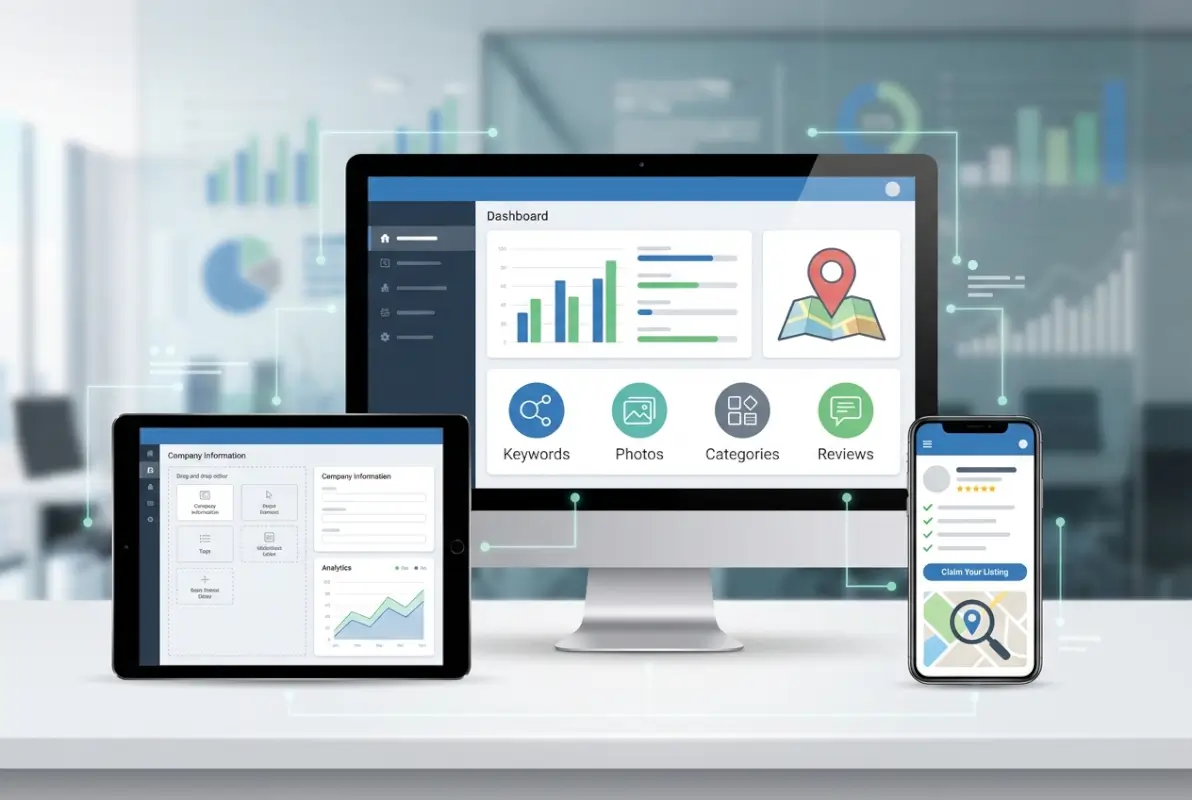
Claiming your listing is step one. Making it convert is where the actual work begins. Most businesses treat directory profiles like digital business cards—minimal information, outdated photos, generic descriptions. That’s leaving money on the table.
Effective directory listing optimization requires thinking like both a search algorithm and a skeptical customer. You need to satisfy the technical requirements that boost visibility while crafting compelling content that drives action once people find you.
The NAP Consistency Obsession
NAP stands for Name, Address, Phone—and consistency across every platform is the single most important technical factor in local SEO. Even tiny variations confuse search engines and dilute your citation power.
Common NAP mistakes that hurt rankings:
- Using “Street” on some platforms and “St.” on others
- Including suite numbers inconsistently
- Different phone number formatting (parentheses vs. dashes vs. spaces)
- Business name variations (“Bob’s Plumbing” vs. “Bob’s Plumbing LLC”)
- Mixing www and non-www website URLs
Create a master NAP document with your exact formatting and reference it religiously. This isn’t about preference—it’s about algorithmic clarity. Search engines need to see identical information to confidently group all citations as referring to the same business.
Descriptions That Convert and Rank
Your business description serves two masters: search algorithms looking for keyword relevance and humans looking for reasons to choose you over competitors. The best descriptions seamlessly serve both.
Effective description formula:
- Lead with value – Address the customer’s primary pain point or desire in the first sentence
- Differentiate clearly – State 2-3 specific elements that make you different (not just “quality service”)
- Incorporate keywords naturally – Weave in search terms without awkward stuffing
- Include proof elements – Years in business, credentials, guarantees
- Close with a clear action – Tell them exactly what to do next
Here’s a before-and-after example from a client in commercial cleaning:
Before: “We provide commercial cleaning services for offices and buildings in the Chicago area. Professional, reliable service you can count on.”
After: “Keep your Chicago workspace spotless with our certified green cleaning services—trusted by 200+ office buildings since 2008. Our night-shift crews ensure your team arrives to pristine environments without workflow disruption. Bonded, insured, and backed by our 100% satisfaction guarantee. Request a free facility assessment today.”
The optimized version incorporates location keywords (Chicago), service keywords (green cleaning, office buildings), differentiators (night-shift, certified), proof elements (200+ buildings, since 2008), and a clear call-to-action—all in a natural, readable format.
Visual Elements That Drive Engagement
Listings with high-quality photos receive dramatically more engagement. According to industry research, Google Business Profile listings with photos get 42% more requests for directions and 35% more click-throughs to websites.
Essential photos for every listing:
- Exterior storefront (helps with recognition and navigation)
- Interior workspace or showroom (builds familiarity)
- Team members in action (humanizes your business)
- Products or completed work (demonstrates capabilities)
- Your logo as profile photo (brand consistency)
Photo optimization details matter more than most realize. Before uploading:
- Rename files descriptively (not “IMG_1234.jpg” but “chicago-plumbing-team.jpg”)
- Compress for fast loading without quality loss (under 200KB when possible)
- Ensure proper orientation and lighting
- Update seasonally to show your business is active
Category Selection Strategy
Business categories are more strategic than they appear. Your primary category heavily influences which searches trigger your listing, so precision matters more than breadth.
Choose your primary category based on your most important service—what drives the majority of your revenue. Then add secondary categories to capture adjacent search intent without diluting your core positioning.
A common mistake: trying to be everything to everyone. A restaurant that selects “Restaurant” as primary, then adds “Bar,” “Event Venue,” “Catering,” and “Banquet Hall” dilutes their relevance for core searches. Better to dominate one category than rank poorly in five.
The Review Engine: Generating and Managing Customer Feedback
Reviews aren’t just social proof—they’re ranking factors, conversion drivers, and competitive moats all rolled into one. Research from Pew Research Center studies on online reviews shows that the vast majority of consumers read reviews before making local purchasing decisions, with many reading 7-10 reviews before feeling confident.
But here’s what most guides miss: review velocity matters as much as review volume. A business with 50 reviews from the last three months outperforms one with 200 reviews mostly from two years ago. Fresh reviews signal active operations and current customer satisfaction.

Building a Systematic Review Generation Process
Hoping customers leave reviews doesn’t work. You need a system that makes review generation a routine part of your customer experience.
Effective review generation tactics:
- Timing is everything – Request reviews immediately after successful service delivery, not days later
- Make it frictionless – Send direct links to your review page, not instructions to find it
- Use multiple touchpoints – Email follow-up, SMS reminder, in-person request at checkout
- Train your team – Incentivize staff for review requests, not for positive reviews specifically
- Respond to every review – This encourages future reviewers and shows you value feedback
One technique that consistently performs: the two-step approach. First, send a private feedback request asking how their experience was. Happy customers get directed to public review platforms; unhappy customers get routed to private resolution channels. This filters your public reviews toward positive experiences while giving you opportunities to fix problems before they become public complaints.
Responding to Reviews Strategically
Your responses to reviews might be more valuable than the reviews themselves. Potential customers read your responses to gauge how you handle feedback, resolve issues, and interact with customers. A thoughtful response to a negative review can actually build more trust than a positive review without response.
Response framework for positive reviews:
- Thank the reviewer by name (personalization matters)
- Reference a specific detail from their review (shows you actually read it)
- Reinforce your value proposition briefly
- Invite them back or suggest a related service
Response framework for negative reviews:
- Respond within 24-48 hours (speed signals you care)
- Thank them for the feedback (even if it stings)
- Acknowledge their experience without making excuses
- Take the conversation offline with contact information
- Briefly explain any changes you’re implementing
I watched a dental practice transform a scathing one-star review into a loyal patient. The reviewer complained about wait times and feeling rushed. The practice owner responded publicly, apologized genuinely, explained they were implementing a new scheduling system specifically to address this issue, and invited the patient back for a complimentary appointment. The patient updated their review to four stars and became a vocal advocate. That’s the power of strategic response.
Maintenance and Measurement: The Ongoing Optimization Cycle
Directory optimization isn’t a project—it’s a practice. The businesses dominating local search results treat their listings as living assets that require regular attention, updates, and refinement based on performance data.
Most businesses set up their listings and forget them. That’s like installing a security system and never checking if it’s still working. Business information changes, platform features evolve, and competitor landscapes shift. Static listings slowly lose effectiveness.

Establishing Your Audit Cadence
Create a calendar-based system for directory maintenance. I recommend three audit tiers:
Monthly quick checks:
- Verify hours are accurate (especially around holidays)
- Check for and respond to new reviews
- Update any temporary changes (seasonal hours, special offerings)
- Add fresh photos if you have them
Quarterly comprehensive audits:
- Verify NAP consistency across all platforms
- Update business descriptions with seasonal or new service information
- Review and optimize category selections
- Check all website links are functional
- Analyze performance metrics to identify trends
Annual deep optimization:
- Complete profile refresh with new photos and updated descriptions
- Evaluate which directories are delivering ROI vs. which to abandon
- Research new directory opportunities in your industry
- Competitive analysis of how your listings compare
The business directory website complete guide emphasizes that consistent maintenance separates successful listings from abandoned ones—whether you’re managing your own presence or operating a directory platform.
Directory Management Tools Worth Considering
For businesses with presence on 10+ directories, manual management becomes unsustainable. Directory management platforms provide centralized control and automation that saves hours while improving accuracy.
Leading directory management solutions include Yext, BrightLocal, Moz Local, and Semrush Listing Management. These platforms typically offer:
- Centralized dashboard for updating all listings simultaneously
- Automated duplicate detection and suppression
- Review monitoring and response management across platforms
- Performance analytics and reporting
- Listing accuracy scores and error alerts
While these services represent additional monthly costs ($30-300+ depending on features and location count), they typically deliver ROI through time savings alone. For multi-location businesses, they’re practically essential for maintaining consistency at scale.
Metrics That Actually Matter
You can’t optimize what you don’t measure. The most successful businesses track specific metrics for each directory and adjust their strategy based on performance data.
Essential metrics to monitor:
| Metric | What It Reveals | Tracking Frequency |
|---|---|---|
| Search Impressions | How often your listing appears in search results | Monthly |
| Click-Through Rate | Effectiveness of your profile content at driving action | Monthly |
| Direction Requests | Intent to visit your physical location | Weekly |
| Phone Calls | Direct conversion opportunities from your listing | Weekly |
| Website Clicks | Traffic driven to your site for deeper engagement | Monthly |
| Review Velocity | Rate of new reviews (signals active business) | Monthly |
Google Business Profile provides most of these metrics through its Insights dashboard. For other directories, you’ll need to check individual platforms or use a management tool that aggregates data.
The key is identifying patterns. If one directory drives 60% of your calls while another drives none, you know where to focus optimization efforts. If your CTR drops month-over-month, it signals your listing content needs refreshing or competitors are outperforming you.
Advanced Tactics for Competitive Markets
In crowded markets, basic optimization isn’t enough. You need advanced tactics that create separation from competitors who are also optimizing their listings. These strategies require more effort but deliver disproportionate results.
The Content Freshness Signal
Most directories allow you to post updates, offers, events, or news. Few businesses actually use these features consistently. That’s your opportunity.
Google Business Profile, for example, lets you publish posts that appear directly in your profile. Businesses that post weekly see measurably higher engagement than those that never post. These posts don’t need to be elaborate—service highlights, seasonal tips, team introductions, or customer success stories all work.
The freshness signal tells both algorithms and humans that your business is actively managed and operational. It’s the digital equivalent of a well-maintained storefront versus one with dusty windows and faded signage.
Q&A Section Management
Many directory platforms include Q&A sections where potential customers can ask questions. Here’s the problem: if you don’t proactively populate these sections, anyone can ask anything—including competitors posing as customers asking unflattering questions.
Smart operators preemptively seed their Q&A sections with common customer questions and provide helpful answers. This accomplishes three things: you control the narrative, you provide valuable information that aids purchase decisions, and you incorporate additional keywords into your profile.
Example questions to self-populate:
- “Do you offer emergency/same-day service?” (Answer emphasizing availability)
- “What areas do you serve?” (Answer reinforcing your service locations)
- “Are you licensed and insured?” (Answer highlighting credentials)
- “What payment methods do you accept?” (Answer removing a potential barrier)
Structured Data and Schema Markup
For businesses with their own websites, implementing LocalBusiness schema markup creates consistency between your site and directory listings while providing search engines with structured data about your business.
This technical SEO element, while beyond basic directory optimization, creates reinforcement loops that boost visibility across all platforms. When your website, Google Business Profile, and other directories all provide consistent structured data, search engines develop extremely high confidence in your business information.
Technical guidance from Google’s structured data documentation provides implementation details for those comfortable with basic HTML.
Frequently Asked Questions
How long does directory listing optimization take to show results?
Initial visibility improvements typically appear within 2-4 weeks for Google Business Profile and other major directories. However, meaningful ranking improvements and traffic increases usually take 2-3 months of consistent optimization and fresh review generation. Local SEO is cumulative—each optimized listing, consistent citation, and new review compounds over time rather than delivering instant results.
Should I pay for premium directory listings or stick with free options?
Start with thoroughly optimizing free listings on major platforms before investing in paid placements. Once you’ve maxed out free options and can measure their performance, consider paid placements on your highest-converting directories. Premium features like enhanced profiles or priority placement can deliver ROI, but only after you’ve proven the directory actually sends qualified traffic to your business.
How do I handle incorrect information on directories I can’t control?
Most directories allow you to claim and edit your listing even if someone else created it initially. Search for your business on the platform, look for “Claim this business” or similar options, and complete their verification process. For data aggregators like Neustar Localeze or Factual, correcting information at the source updates dozens of downstream directories simultaneously, making them high-priority targets for correction.
What’s the ideal number of directories for a local business?
Quality beats quantity, but most local businesses should aim for 15-25 well-maintained listings: 5-7 major platforms (Google, Bing, Facebook, Apple, Yelp, etc.), 5-10 industry-specific directories relevant to your business type, and 5-8 local or regional directories specific to your geography. More than 40-50 listings becomes difficult to maintain without automation tools and often provides diminishing returns.
How do I optimize directory listings for multiple locations?
Create location-specific listings for each physical location with unique NAP information, local phone numbers, and location-specific descriptions mentioning neighborhood or city names. Use a consistent naming convention (e.g., “Business Name – City” or “Business Name City Location”). Avoid creating multiple listings for a single location, which confuses search engines and can result in all listings being suppressed.
Can directory listings hurt my SEO if done incorrectly?
Yes—inconsistent NAP information across directories confuses search engines and dilutes your citation power, potentially lowering local rankings. Duplicate listings for the same location can cause search engines to suppress all versions. Low-quality or spammy directory links can sometimes harm overall domain authority. Focus on reputable directories and absolute consistency to avoid these pitfalls.
How important are business hours accuracy in directory listings?
Extremely important—incorrect hours damage customer trust and waste everyone’s time when someone drives to a closed business. Search engines also monitor user behavior signals; if people frequently get directions to your business during your listed hours but you’re actually closed, this negative engagement signal can hurt rankings. Update hours immediately for holidays, seasonal changes, or permanent schedule modifications across all platforms simultaneously.
Should I respond to every review or just negative ones?
Respond to every review, both positive and negative. Responses to positive reviews show appreciation and encourage future reviewers. Responses to negative reviews demonstrate your commitment to customer satisfaction and can actually build trust with potential customers who read them. Businesses that respond to all reviews typically see higher review volume overall because customers know their feedback will be acknowledged.
How do business categories affect directory visibility?
Categories are primary ranking factors—search engines use them to determine which searches should trigger your listing. Your primary category has the most significant impact, so choose the most specific, revenue-relevant option available. Adding too many secondary categories can dilute your relevance for your core category. Most businesses should select one primary and 2-4 highly relevant secondary categories rather than claiming every remotely related option.
What’s the difference between directories and citations?
Directories are platforms where businesses can create detailed profiles with descriptions, photos, hours, and reviews (like Yelp or Google Business Profile). Citations are simple mentions of your business NAP information, which might appear in directories but also on websites, blogs, news articles, or other online sources. All directory listings create citations, but not all citations come from directories. Both contribute to local SEO authority.
Your Seven-Day Directory Optimization Sprint
Reading about optimization is useful, implementing it is transformative. Here’s your practical roadmap to dramatically improve your directory presence in just one week—even if you’re starting from scratch or fixing years of neglect.
Day 1: Foundation Audit
Claim and verify your Google Business Profile if you haven’t already (this alone is priority number one). Document your exact NAP information in a master document. Search for your business across major directories and note which listings exist and whether the information is accurate.
Day 2: NAP Consistency Fix
Update every existing listing to match your master NAP document exactly. This is tedious but critical—even small variations hurt your rankings. Focus on the foundation platforms first (Google, Bing, Facebook, Apple Maps, Yelp).
Day 3: Description and Category Optimization
Rewrite your business description using the formula outlined earlier. Update your primary category to the most specific, relevant option. Add 2-4 strategic secondary categories. Apply this optimized description across all platforms, adjusting length to fit character limits while maintaining core messaging.
Day 4: Visual Optimization
Gather or create 8-10 high-quality photos covering exteriors, interiors, team, products/services, and your logo. Optimize file names and sizes. Upload across all major platforms. Set your best storefront image as your profile photo and your logo as your cover image.
Day 5: Review Generation Setup
Create review request templates for email and SMS. Set up direct review links for your top 3-4 platforms. Train your team on when and how to request reviews. Respond to all existing reviews you haven’t addressed yet—yes, even the old ones.
Day 6: Content and Engagement
Populate your Q&A section with 5-7 common customer questions. Create your first Google Business Profile post (service highlight, special offer, or helpful tip). Verify all contact information is correct including website URLs and phone numbers.
Day 7: Tracking and Expansion Planning
Set up Google Analytics goals for directory traffic if you haven’t already. Enable insights/analytics on all platforms that offer them. Research 5-10 industry-specific or local directories you should claim next. Create a monthly maintenance calendar with reminders for audits and updates.
Start with your Google Business Profile today. Fully optimize that one listing before spreading to others. Master the fundamentals before chasing advanced tactics. And remember—this isn’t a one-time project. The businesses winning long-term treat their directory presence as an ongoing asset that deserves regular attention, measurement, and refinement.
Your next customer is searching right now. The question is whether they’ll find a carefully optimized listing that compels them to choose you, or whether they’ll scroll past your generic profile to a competitor who understood that visibility without optimization is just noise. The strategies in this guide give you everything you need to be the business they choose. Now it’s just about implementation.
Was this article helpful?