6 Proven Strategies to Grow an Online Directory & Attract More Listings

Most online directory owners obsess over the wrong thing. They pour energy into building sleek interfaces and perfecting category taxonomies, yet their platforms remain ghost towns. Here’s what the top 1% of directories understand that others miss: growth isn’t about the platform itself—it’s about orchestrating a precise acquisition engine that treats every listing as a node in a network effect. The difference between stagnant directories and those scaling to thousands of listings comes down to treating listing acquisition like enterprise sales, not passive collection. In the online directory space, your competitive moat isn’t your technology stack; it’s the density and quality of your listings combined with the systematic processes that keep them flowing in. Let’s deconstruct exactly how successful directories engineer growth from the ground up.

TL;DR – Quick Takeaways
- Listing quality trumps quantity – NAP consistency and verification processes build credibility that attracts more listings organically
- Multi-channel outreach is non-negotiable – Relying solely on SEO leaves growth on the table; email, partnerships, and direct outreach compound results
- Monetization enables scale – Premium listings fund growth initiatives and signal value to prospects
- Data hygiene automation prevents decay – Regular audits and automated checks maintain directory integrity at scale
- Mobile-first architecture is foundational – 76% of directory searches happen on mobile; responsive design isn’t optional
Market & Competitive Intelligence: What Top Directories Actually Do
Before you can grow your directory, you need to understand the competitive landscape with surgical precision. The directories dominating their niches aren’t just lucky—they’ve reverse-engineered specific playbooks that work. Start by analyzing the top five directories in your space (or adjacent spaces if you’re pioneering a new niche). Look beyond surface features and examine their listing acquisition workflows, pricing structures, trust signals, and how they handle onboarding friction.

What you’ll discover is that leading directories share common patterns: they make the value proposition immediately clear to prospective listers, they’ve minimized onboarding steps to essential data only, and they’ve built partner ecosystems that feed listings automatically. For example, successful local business directories often integrate with chamber of commerce databases or industry associations to bootstrap their initial listing inventory. This isn’t about copying competitors—it’s about identifying leverage points that actually move the needle.
Current Data & Trends Shaping Directory Growth
The directory landscape has shifted dramatically in recent years. Mobile-first discovery now dominates how users find and interact with listings. According to recent industry analysis, over three-quarters of directory-based business searches now originate from mobile devices. This fundamentally changes UX requirements: if your directory doesn’t load in under three seconds on mobile or requires horizontal scrolling, you’re bleeding potential listings because prospective listers test your platform before committing.
Data quality has emerged as the primary differentiator between mediocre and exceptional directories. NAP consistency (Name, Address, Phone) isn’t just an SEO consideration—it’s a trust signal that influences whether businesses choose to list with you. When prospective listers see sloppy, outdated entries on competing directories, they question whether listing will actually deliver value. Regular audits and data validation have become standard practice among directories that maintain high listing renewal rates.
Common Pitfalls That Kill Directory Growth
I’ve watched countless directory projects fail despite solid initial concepts, and the causes are remarkably predictable. Over-reliance on a single acquisition channel creates fragility—if that channel dries up or algorithm changes occur, growth stalls completely. Inconsistent data standards create a cascading quality problem where bad listings drive away both users and potential new listers. Abandoned or outdated listings signal neglect, which prospective listers interpret as “this platform won’t help my business.” And perhaps most insidious, weak onboarding experiences cause friction that kills conversion even when you’ve successfully attracted prospects.
The Core Growth Playbook: Six Strategies That Actually Work
Now let’s get tactical. The directories scaling from dozens to thousands of listings implement specific, repeatable strategies. These aren’t theoretical frameworks—they’re battle-tested approaches with measurable impact. Each strategy below builds on the others, creating compound effects when implemented systematically.

Strategy 1: Optimize Listing Acquisition & Onboarding
Your onboarding flow is either a conversion machine or a leak in your bucket. The best directories treat onboarding with the same rigor that SaaS companies apply to user activation. Start by crystallizing your value proposition: what specific outcome will listing on your directory deliver? “Increased visibility” is vague; “75 qualified leads per quarter” or “first-page Google ranking for [specific keyword]” is concrete.
Design your intake form to collect only essential information upfront. Every additional field reduces conversion rates, I’ve seen completion rates drop 15-20% when adding non-critical fields. You can always collect supplementary information later through progressive profiling. Implement automated welcome sequences that guide new listers through optimization: video tutorials showing how to enhance their listing, email sequences highlighting features they haven’t utilized, and templates that help them craft compelling descriptions.
Strategy 2: Elevate Listing Quality & Build Trust
Quality listings attract more quality listings through demonstration effect. When prospects evaluate your directory, they scrutinize existing entries to gauge whether listing will be worthwhile. Enforce robust data standards from day one: complete NAP information, appropriate categorization, minimum photo requirements, and description length guidelines. Don’t just set requirements—provide scaffolding that helps listers meet them.
Develop templates and prompts specific to your niche. If you run a restaurant directory, provide description frameworks like “Describe your signature dish” or “What makes your atmosphere unique?” These prompts generate richer content than generic “Tell us about your business” fields. Implement verification processes that signal credibility: email verification at minimum, phone verification for premium listings, and document verification for regulated industries.
Strategy 3: Deploy SEO-Driven Content Architecture
Directories have a structural SEO advantage—each listing is a potential landing page, and category/location pages naturally target high-value keywords. Exploit this systematically by building niche-focused category pages that target “[category] directory” and “[category] near me” queries. Create city or region landing pages that aggregate relevant listings while providing contextual content about that location’s market.
Long-tail optimization multiplies your organic reach. A single “best plumbers directory” page competes against massive authority sites; 50 pages targeting “emergency plumber [specific neighborhood]” queries capture searchers with higher intent. Implement structured data (schema.org markup) for every listing—this enables rich snippets in search results and improves click-through rates. For those looking to start a digital online directory from scratch, proper schema implementation should be part of your technical foundation from launch.
| Content Type | SEO Value | Listing Growth Impact |
|---|---|---|
| Category Pages | High – targets commercial intent keywords | Medium – attracts users who then become listers |
| Location Landing Pages | High – captures geo-specific searches | High – local businesses discover directory |
| How-To Guides | Medium – builds topical authority | Medium – establishes expertise |
| Case Studies | Low – limited search volume | Very High – proves ROI to prospects |
Strategy 4: Execute Multi-Channel Outreach & Partnerships
Passive directories grow slowly; active directories scale exponentially. Build an outreach engine that systematically contacts prospective listers across multiple channels. Start with email—segment your target businesses by category and craft personalized value propositions for each segment. A generic “list your business with us” message converts poorly; “we’ve already driven 500+ customers to [competitor name] and want to feature your business in our [specific category] section” converts significantly better.
LinkedIn outreach works surprisingly well for B2B directories. Decision-makers are accessible, and personalized messages referencing specific aspects of their business cut through inbox noise. Local business groups—both online communities and physical chambers of commerce—provide warm introduction opportunities. Partner with complementary platforms to create listing pipelines: if you run a contractor directory, partner with building supply companies who can introduce you to their contractor customers.
Co-marketing amplifies reach without proportional effort increases. Approach industry associations about featuring your directory as a member benefit. Offer them co-branded landing pages that serve their members while populating your directory. Many associations struggle with member engagement; positioning your directory as a value-add solves their problem while solving yours.
Strategy 5: Design Monetization That Drives Growth
Free listings alone rarely build sustainable directories. Premium listing options create multiple benefits: they fund your growth initiatives, they filter for serious businesses that will maintain their listings, and paradoxically they make free listings more valuable by creating contrast. The key is aligning pricing with demonstrable ROI. If you can show that premium listings generate 10x more inquiries than free listings, a premium price becomes justifiable.
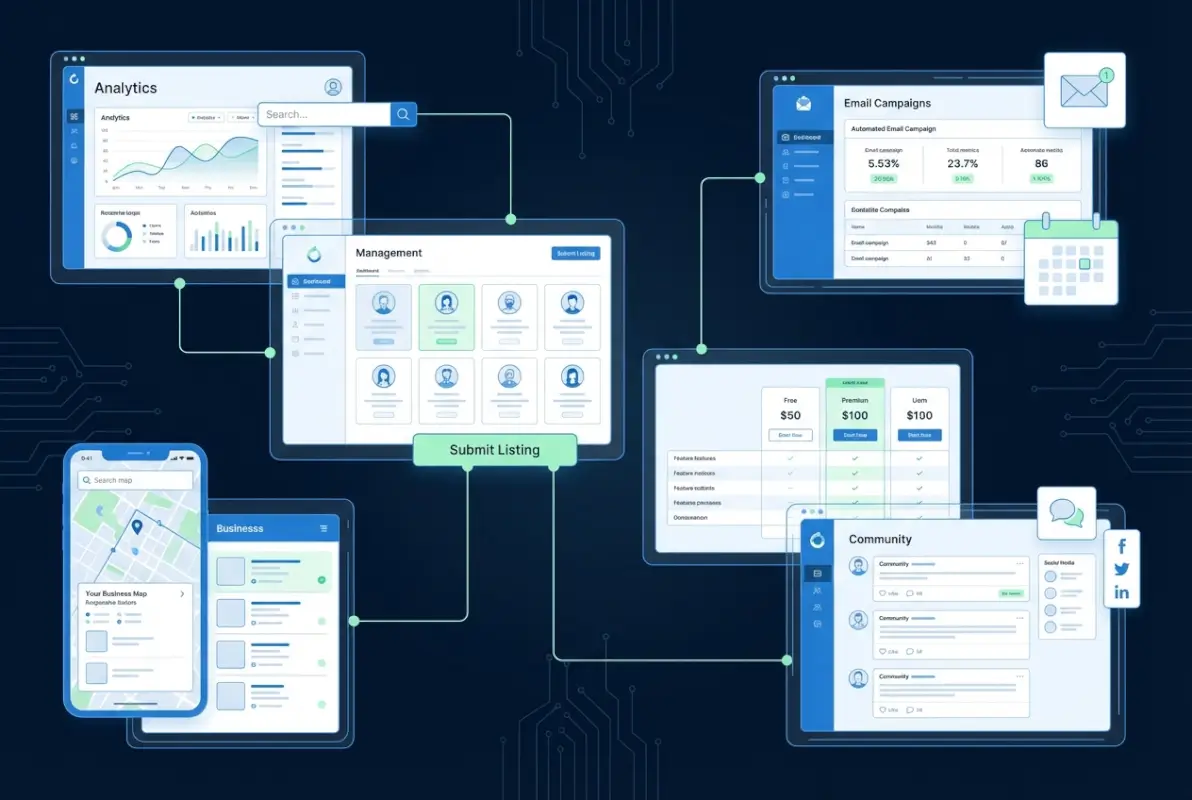
Bundle premium placements with tangible add-ons: featured spots in email newsletters, social media promotion, enhanced analytics showing exactly how many users viewed their listing and clicked through to their website. Create tiered pricing that segments by value delivered—basic listings for visibility, premium for priority placement, enterprise for full promotional packages. Test pricing aggressively; most directory owners underprice significantly and leave revenue on the table.
Strategy 6: Automate Data Quality & Implement Audit Cadence
Directory decay is inevitable without systematic maintenance. Businesses move, phone numbers change, websites go offline. Implement automated data checks that flag potential issues: duplicate entries, incomplete information, broken website links, and NAP inconsistencies across your directory and external sources. Set up quarterly comprehensive audits where you manually review a sample of listings and systematically clean obvious problems.
Offer self-serve tools that help listers maintain their own data. Send automated reminders prompting them to review and update their information, provide dashboards showing their listing’s completeness score, and gamify data quality with badges or trust indicators that reward listings meeting high standards. For directories exploring open-source business directory software, prioritize platforms with built-in data validation capabilities.
Operational Framework: Process, People & Tools
Strategy without execution infrastructure remains theoretical. Growing directories require operational systems that handle increasing volume without proportional human effort increases. Let’s break down the essential components of a scalable directory operation.

Listing Intake to Approval Workflow
Your listing workflow should minimize manual intervention while maintaining quality standards. Design intake forms with validation rules that prevent common errors: phone number formatting, required field enforcement, character minimums for descriptions. Route submissions through an automated review queue that flags potential issues—duplicate entries, incomplete information, inappropriate content—while auto-approving entries that meet all criteria.
Implement a moderation dashboard that presents flagged submissions efficiently. Show moderators exactly what triggered the flag, provide side-by-side comparison tools for duplicate detection, and enable bulk actions for common decisions. Track moderation time-per-listing as a KPI; as this metric decreases, your workflow efficiency improves.
Essential Roles & Responsibilities
Even bootstrapped directories need role clarity, even if one person wears multiple hats initially. A Growth Lead owns listing acquisition targets and orchestrates outreach campaigns. An SEO/Content Lead manages category pages, editorial content, and technical optimization. A Partnerships Manager develops and nurtures relationships with complementary platforms and associations. A Data Quality Analyst monitors accuracy metrics and coordinates cleanup initiatives. A Technical Owner maintains platform performance and implements automation.
In early stages, the founder often fills all roles, but mapping these functions explicitly helps prioritize time and identifies the first hires as you scale. Which role, if filled by a dedicated person, would unlock the most growth? That’s your first hire.
Technology Stack Essentials
Your tech stack should enable flexibility without requiring constant developer intervention. Choose a CMS or business directory website template with flexible schema that accommodates custom fields per category. Implement schema.org markup for listings to enable rich snippets. Deploy marketing automation tools for email sequences, outreach campaigns, and behavioral triggers.
| Function | Tool Category | Key Capability |
|---|---|---|
| Directory Platform | CMS or specialized software | Flexible listing schema, custom fields |
| Data Validation | Automation tools | Duplicate detection, NAP standardization |
| Outreach & Email | Marketing automation | Sequences, segmentation, tracking |
| Analytics | Dashboard platform | Listing performance, acquisition attribution |
Data hygiene automation catches issues before they compound: dedupe tools that identify potential duplicates based on fuzzy matching, standardization scripts that format phone numbers and addresses consistently, and link checkers that flag broken website URLs. Analytics dashboards should surface the metrics that matter—listings added per week, NAP consistency rate, listing quality scores, and conversion rates from prospect to active listing.
Content & SEO Playbook for Directory Growth
Content strategy for directories differs fundamentally from traditional blogs. Your core content—the listings themselves—already exists; your challenge is wrapping contextual content around listings that captures search traffic and demonstrates value to prospective listers. This requires thinking architecturally about content hierarchy and internal linking patterns.

On-Site Content Architecture
Structure your content in pillar-cluster patterns. Create comprehensive pillar pages for each major niche or category you serve—these pages target high-volume head terms and provide overview content. From each pillar page, link to cluster content: specific subcategories, location-based variations, and how-to guides. Every cluster page links back to its pillar and cross-links to related clusters. This internal linking architecture distributes authority and helps search engines understand topical relationships.
Location-based pages multiply your addressable search market. A single “find contractors” page competes in a crowded space; 100 “find contractors in [city]” pages each capture less competitive long-tail searches. Generate location pages systematically for every geography where you have meaningful listing density. Include contextual information about each location—market characteristics, local considerations—not just filtered listing results.
Content Formats That Drive Listing Acquisition
Buyer guides position your directory as an authoritative resource while naturally showcasing listings. “How to choose a [category]” guides walk users through selection criteria while linking to relevant listings that meet those criteria. Case studies and success stories from listed businesses serve dual purposes: they provide social proof to prospective listers and create engaging content for users.
How-to tutorials that help businesses optimize their listings attract prospects who are already considering listing somewhere. “How to write a compelling directory listing” or “Optimizing your business profile for local search” content ranks well and captures prospects in research mode. When they’re ready to list, your directory is top-of-mind.
Technical SEO Foundations
Technical excellence prevents you from sabotaging your content efforts. Implement structured data markup for every listing using LocalBusiness schema (or the most specific applicable schema type). Set canonical URLs to prevent duplicate content issues when listings appear on multiple category or location pages. If you serve multiple languages or regions, implement hreflang tags to help search engines serve the appropriate version.
Site speed disproportionately impacts directory success because users evaluate multiple listings in a single session. Slow load times create compound friction. Optimize images aggressively, implement lazy loading for below-fold content, minimize render-blocking resources, and consider a CDN for static assets. Mobile performance deserves special attention given that three-quarters of directory searches originate from mobile devices.
Acquisition & Growth Tactics: Outreach, Promotions & Incentives
Passive growth strategies—build and hope—fail for directories. Active acquisition through systematic outreach, strategic partnerships, and carefully designed incentives separates stagnant directories from those scaling rapidly. Let’s examine tactics that produce measurable listing growth.
Outreach Playbook & Scripts
Effective outreach balances personalization with scalability. Create templates segmented by industry vertical, business size, and listing type (free vs premium). Each template should include personalized elements you can customize quickly—business name, specific service they offer, and why they’re a fit for your directory. Generic “list your business” messages get ignored; “I noticed you specialize in [specific niche] and we’re featuring the top 20 [niche] businesses in [location]” captures attention.
Multi-touch sequences outperform single outreach attempts. Design 3-5 touch sequences across email, LinkedIn, and phone: initial introduction, value-add follow-up (share a relevant case study or statistic), social proof follow-up (mention similar businesses already listed), urgency follow-up (limited featured slots available), and final follow-up (ask if they’d like to be removed from consideration). Timing intervals matter—space touches 3-5 days apart to stay present without being annoying.
Partnerships & Integration Opportunities
Strategic partnerships create listing pipelines that fill your directory without proportional effort increases. Identify platforms that serve overlapping audiences but don’t compete directly. If you operate a restaurant directory, partner with reservation systems, POS providers, or food supplier directories. Offer co-branded landing pages, integration APIs, or white-label versions of your directory that partners can offer their customers.
Association partnerships provide warm introductions to pre-qualified prospects. Industry associations, chambers of commerce, and professional organizations constantly seek member benefits. Position your directory as a value-add—free or discounted listings for members, featured placement in association communications, co-branded directories showcasing members. You get access to their member base, they get additional member value, everyone wins. Understanding how to remove old business directory listings helps maintain partnership value by keeping data current.
Campaigns & Launch Incentives
Time-bound promotions create urgency that accelerates listing decisions. “First 100 businesses list free” or “Premium features free for early adopters” reduce friction for prospects hesitant to commit. Launch campaigns for new categories or locations with exclusive benefits for early participants. Referral programs turn existing listers into acquisition channels—offer premium upgrades or service credits for successful referrals.
Discounted premium listings during initial signup convert free prospects to paying customers. Offering “first 3 months at 50% off” or “annual plans at monthly pricing for first year” reduces perceived risk. Once businesses experience value from premium placement, renewal rates stay high even at full pricing.
Metrics, Dashboards & Continuous Improvement
What gets measured gets managed. Growing directories track specific metrics that signal health and identify optimization opportunities. Your dashboard should surface leading indicators—metrics that predict future growth—not just lagging indicators that report past results.
Essential Metrics to Track
Listings growth rate measures your acquisition engine’s output. Track weekly and monthly additions, segment by source (SEO, outreach, partnerships, paid), and monitor conversion rates at each funnel stage. Listing quality score quantifies the completeness and accuracy of entries—weight components like NAP consistency, photo inclusion, description length, and verification status.
NAP accuracy rate audits data integrity. Sample listings periodically and verify information against external sources. Inbound inquiries per listing measures value delivered to listers—this metric justifies premium pricing and drives retention. Churn and retention rates identify whether listers renew or abandon their listings, signaling satisfaction and value realization.
Traffic per listing page indicates SEO effectiveness and user engagement. Segment by listing tier to demonstrate premium value. Track these metrics in aggregate and by cohort—compare retention rates for listings acquired through different channels, quality scores by acquisition source, and inquiry rates by listing tier.
Dashboard Structure & Reporting Cadence
Build dashboards that match decision-making timeframes. Weekly health checks surface urgent issues: acquisition pace, data quality flags, and technical performance. Monthly growth reports track trends: listings added by source, conversion rate changes, revenue from premium listings. Quarterly audits examine strategic questions: which acquisition channels deliver highest-quality listings, what listing attributes correlate with inquiry generation, and where should resources be reallocated.
Automate reporting wherever possible. Manual data compilation wastes time and introduces errors. Modern analytics platforms can generate and distribute reports automatically, freeing your team to analyze insights rather than compile data.
Experimentation Framework
Systematic testing accelerates improvement. Run controlled experiments on high-impact variables: onboarding flow variations, pricing structures, premium feature bundles, outreach message templates, and landing page designs. Document hypotheses, success criteria, and learnings—failed experiments teach as much as successful ones when you understand why they failed.
Prioritize experiments by expected impact and implementation cost. Quick-win experiments with high potential impact and low implementation effort should run constantly. Bank learning velocity as a competitive advantage; directories that test systematically compound improvements faster than competitors relying on intuition.
Practical Implementation Roadmap
Theory means nothing without execution plans. Here’s a phased roadmap that sequences priorities for maximum momentum while building sustainable infrastructure. This roadmap assumes you have a functional directory platform and initial listings.
Days 1-30: Foundation & Quick Wins
Audit your current listings for data quality issues. Fix obvious problems: incomplete information, broken links, inconsistent formatting. Establish data standards and document them clearly. Implement basic automated validation rules in your intake form. Set up foundational analytics: track listings added, sources, and completion rates.
Optimize your listing onboarding flow. Remove unnecessary fields, clarify value proposition, add preview functionality. Create automated welcome email sequence with optimization tips. Launch first outreach campaign targeting 100 prospects in your strongest category. The goal this month is to establish baseline metrics and remove obvious friction.
Days 31-90: Scale Acquisition Channels
Build category and location pillar pages for your top 5-10 targets. Implement structured data markup across all listings. Launch systematic outreach program targeting 200-300 prospects monthly. Secure first 2-3 partnership agreements with complementary platforms or associations. For those using business directory templates to kickstart their platform, this phase focuses on customization and content expansion.
Introduce basic paid listing option—test pricing with early adopters. Create case study or success story from one of your best-performing listings. Implement quarterly audit schedule and data quality dashboard. By end of month three, you should have multiple acquisition channels operational and initial monetization framework in place.
Days 91-180: Optimization & Expansion
Scale partnership program to 5-10 active relationships. Expand category coverage to secondary niches. Launch location expansion to adjacent geographies. Run A/B tests on onboarding flow, premium listing features, and pricing structures. Develop referral program to turn existing listers into advocates.
Create comprehensive content library: 10-15 how-to guides, 3-5 case studies, buyer guides for major categories. Implement advanced SEO tactics: long-tail keyword expansion, schema enhancement, internal linking optimization. By six months, your directory should have diversified traffic sources, proven monetization model, and systematic growth infrastructure.
Stage-Specific KPIs
Success looks different at each growth stage. Early-stage directories (0-3 months) should track listings added weekly, NAP consistency rate achieving 90%+, listing quality score improving month-over-month, site speed under 3 seconds, and mobile usability passing Core Web Vitals.
Growth-stage directories (3-6 months) focus on inbound inquiries per listing exceeding baseline, paid listing adoption rate reaching 10-15%, active partnership agreements generating referrals, and organic traffic to category pages growing 20%+ monthly. Maturity-stage directories (6-12 months) measure revenue from listings, retention/renewal rates above 80%, average listing value increasing through upsells, and domain authority growth signaling SEO momentum.
Frequently Asked Questions
How long does it take to start gaining listings after launching a new directory?
With active outreach, you can secure 20-50 initial listings within the first month. Passive strategies take 3-6 months to gain traction through SEO. The key is not waiting for organic discovery—successful directories proactively recruit early listings to demonstrate value and credibility that attracts subsequent listings organically.
What makes a listing high quality for directory search visibility?
High-quality listings contain complete NAP information, multiple high-resolution photos, keyword-rich descriptions between 150-300 words, appropriate category assignments, verified contact details, and regular updates. Structured data markup and user reviews further enhance search visibility. Completeness matters more than any single element.
How can I convince businesses to pay for premium listings?
Demonstrate concrete ROI through data. Show premium listers get 3-5x more profile views, higher placement in search results, and measurable inquiry increases. Offer trial periods or performance guarantees for first-time premium customers. Bundle tangible add-ons like email newsletter features and social promotion that extend value beyond directory placement.
What SEO practices deliver the best ROI for directory sites?
Structured data implementation, location-specific landing pages, and category pillar content generate outsized returns. Technical optimization (site speed, mobile responsiveness) prevents losses. Long-tail keyword targeting through specific subcategories and location variations captures high-intent traffic with less competition than head terms. Internal linking between listings and content pages distributes authority effectively.
How often should I audit and clean up directory data?
Run automated checks weekly to flag obvious issues like broken links or incomplete information. Conduct manual audits quarterly, sampling 5-10% of listings to verify accuracy against external sources. Annual comprehensive reviews ensure category structures and location coverage remain aligned with user search behavior and business landscape changes.
What channels drive the most listings: SEO, outreach, partnerships, or ads?
Outreach generates the fastest initial results and highest quality listings because you control targeting and messaging. Partnerships provide scalable volume once established but require upfront relationship building. SEO delivers compounding returns but takes 3-6 months to mature. Paid ads work for competitive niches but have ongoing costs. The optimal mix combines all channels, with emphasis shifting as you scale.
How do I measure listing engagement and ROI?
Track profile views, click-throughs to business websites, phone call initiations, and inquiry form submissions per listing. Calculate cost-per-acquisition for each listing source. Survey listers about lead generation and business impact. Premium listers should receive detailed monthly reports showing their listing performance, demonstrating value and justifying renewal.
Should I allow user reviews on listings?
Reviews increase credibility and user engagement but require moderation resources. Start without reviews to minimize operational complexity, then add review functionality once you have sustainable listing volume and can handle moderation. Reviews significantly improve SEO performance through fresh content and longer page dwell times.
How do I handle duplicate or competing listings in the same category?
Implement automated duplicate detection during intake using name and address matching. For competing businesses in the same category, allow all legitimate entries—users benefit from choice. For actual duplicates, merge entries and contact the listing owner to update. Clear policies prevent disputes and maintain data integrity.
What’s the ideal balance between free and paid listings?
Offer free basic listings to build directory density and attract initial participants. Premium paid options should deliver clear incremental value: featured placement, enhanced profiles, analytics access, and promotional bundles. A healthy ratio is 70-80% free listings with 20-30% converting to premium over time as value is demonstrated.
Taking Action: Your Next Steps
Everything we’ve covered collapses into a simple truth: directory growth is systematically engineered, not passively hoped for. The directories dominating their niches aren’t lucky—they’ve implemented the playbook we’ve dissected here. They treat listing acquisition like enterprise sales, they obsess over data quality, they build multi-channel acquisition engines, and they ruthlessly optimize based on metrics.
Your immediate action plan should start with diagnosis. Audit your current state: how many listings do you have, what’s their quality score, what acquisition channels are active, and what metrics are you tracking? Identify your biggest constraint—is it listing volume, listing quality, traffic to your directory, or conversion from prospect to listing? Address that constraint first with focused experiments.
If you’re starting from scratch, resist the temptation to build perfect infrastructure before recruiting listings. Launch with basic data standards, secure 50-100 initial listings through direct outreach, then iteratively improve based on what you learn. The market will teach you what matters faster than any amount of planning.
Remember that listing acquisition creates network effects. Each quality listing makes your directory more valuable to users, which increases traffic, which attracts more listings. Your job is engineering that flywheel, then maintaining the infrastructure that keeps it spinning. Start today—audit your data, launch your first outreach campaign, secure your first partnership. Growth compounds, and the best time to start was yesterday; the second-best time is right now.
“`