6 Proven Ways to Monetize Your Business Directory Startup in 2025

Most business directory startups fail not because they lack traffic or listings, but because they never figure out how to convert their platform’s value into actual revenue. I’ve watched countless directory owners build impressive platforms with thousands of listings, only to shut down within 18 months because they couldn’t sustain operations financially.

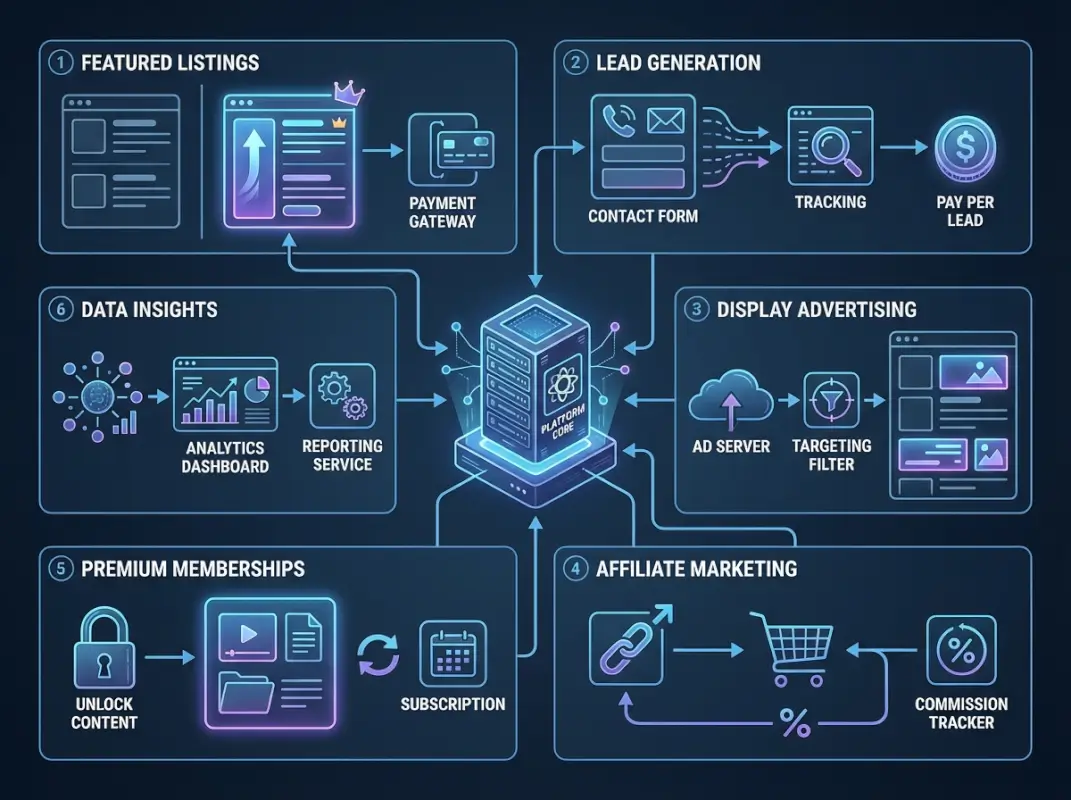
The truth? Monetization isn’t something you add later—it’s a strategic framework you build into your directory from day one. The most successful directories don’t just list businesses; they create ecosystems where businesses willingly pay for visibility, leads, and competitive advantages while users continue to receive genuine value.
What separates profitable directories from those that fade away is understanding that monetization works best as a hybrid model. Relying on a single revenue stream leaves you vulnerable to market shifts, platform changes, or competitive pressures. The directories generating six and seven figures annually typically combine 3-4 complementary monetization strategies that reinforce each other.
TL;DR – Quick Takeaways
- Hybrid models win – Successful directories combine premium listings, lead generation, advertising, and affiliate revenue rather than relying on one stream
- Timing matters – Start with freemium to build traffic, introduce premium listings around month 6-9, add advertising at 25,000+ monthly visitors
- Trust drives conversion – Verification features, user reviews, and transparency significantly increase what businesses will pay for listings
- Data-driven pricing – Use your actual traffic metrics (impressions, clicks, conversions) to set listing prices that businesses perceive as valuable
- Lead quality beats quantity – Well-qualified leads at $75-200 each outperform high-volume, low-quality leads at $10-20
Here’s what most guides won’t tell you: the businesses most eager to pay for premium placement are often those struggling to rank organically. Your job isn’t just to take their money—it’s to deliver measurable results that justify renewal rates. When 70% of your premium listings renew month after month, you’ve built something sustainable.
Premium Listings and Tiered Membership Models
Premium listings represent the most straightforward path to directory revenue because the value proposition is crystal clear: better visibility equals more customers. Businesses understand this instinctively, which is why properly structured premium listings can convert 20-35% of your total listings to paid tiers within the first year.
The psychology behind premium listings is fascinating. When a restaurant owner searches for “best Italian restaurants downtown” and sees three competitors with enhanced profiles, photo galleries, and verified badges above their basic listing, they immediately understand the competitive disadvantage. This visibility gap creates natural demand for upgrades without aggressive sales tactics.

However, the mistake many directory owners make is creating arbitrary feature differences between tiers. “Gold members get 10 photos instead of 5!” sounds logical but doesn’t necessarily translate to revenue. The most effective tiering structures focus on outcomes rather than features—positioning in search results, visibility in high-traffic categories, and access to analytics that prove ROI.
Structuring Tier Levels That Convert
After working with dozens of directory startups, I’ve noticed a consistent pattern: four-tier systems (Free, Basic Paid, Premium, Enterprise) outperform both three-tier and five-tier structures. The free tier builds your listing volume and traffic, the basic paid tier captures price-sensitive businesses, the premium tier attracts serious competitors, and the enterprise tier serves larger organizations willing to pay for exclusivity.
| Feature | Free | Basic ($49/mo) | Premium ($149/mo) | Enterprise ($399/mo) |
|---|---|---|---|---|
| Search Position | Standard | Top 10 | Top 3 | #1 Guaranteed |
| Media Gallery | 3 photos | 10 photos | 30 photos + video | Unlimited |
| Analytics Dashboard | None | Monthly summary | Real-time data | API access |
| Trust Features | Basic listing | Verified badge | Featured badge | Custom branding |
| Lead Access | Profile views only | Contact form | Direct messaging | Priority routing |
One counterintuitive insight: pricing your premium tier too low actually hurts conversion. When a business sees a $29/month premium listing option, they question whether it’s worth anything at all. But at $149/month, the price point suggests genuine value and attracts businesses serious about growing their customer base. Your pricing signals quality and effectiveness.
Category-Based Pricing Strategies
Not all directory categories have equal value, and your pricing should reflect this reality. A premium listing for a personal injury attorney might command $299/month because a single client generates $10,000+ in revenue, while a coffee shop listing might be priced at $79/month where customer lifetime value is considerably lower.
I once consulted for a home services directory that charged uniform pricing across all categories. Plumbers and electricians were happy to pay $149/month, but house cleaners and landscapers balked at anything over $49. After implementing category-specific pricing based on average job values, their conversion rate jumped 43% and revenue increased despite lower prices in some segments. Volume in affordable categories compensated for the price reduction.
Lead Generation as a Premium Revenue Stream
Lead generation transforms your directory from a passive information resource into an active business development tool. Rather than simply connecting users with business profiles, you facilitate actual transactions—and get paid for each qualified connection you create.
The key word is “qualified.” Sending a flood of low-intent inquiries to businesses might generate short-term volume, but it destroys trust and kills renewal rates. The directories making serious money from leads focus obsessively on quality control—pre-qualifying prospects, capturing detailed project information, and only routing leads to genuinely relevant providers.
Lead generation works particularly well for high-consideration purchases where buyers actively seek multiple quotes: home remodeling, legal services, B2B software, financial advisory, and professional services. In these categories, businesses understand that acquiring customers costs money, and they’re willing to pay premium rates for pre-qualified prospects.
Lead Pricing Models That Work
You have several options for monetizing leads, each with distinct advantages. Pay-per-lead charges businesses a fixed rate ($25-$250) for each qualified inquiry, regardless of whether they convert. This model provides predictable revenue and businesses understand it intuitively, but some complain about paying for leads that don’t convert.
Success-based fees charge a percentage (typically 10-20%) of completed transactions, aligning your interests with business outcomes. This builds tremendous trust because businesses only pay when they make money, but it requires robust tracking systems and participation from listed businesses in reporting conversions.
Subscription access charges businesses monthly fees ($99-$499) for unlimited lead access within their service area. This works well for directories generating high lead volumes but requires careful territory management to prevent businesses from competing for the same prospects. Category exclusivity allows one business to pay premium rates ($500-$2,000/month) for being the sole provider receiving leads in their category and location.
Building Effective Lead Qualification Systems
The difference between a $15 lead and a $150 lead is qualification depth. Low-value leads capture minimal information—name, email, phone, and generic inquiry. High-value leads collect detailed project specifications, timeline, budget range, decision-making authority, and competitive context.
Your qualification process should feel helpful to users, not invasive. Frame questions as tools that help them get better matches: “To connect you with the right contractors, tell us about your project timeline” feels collaborative rather than interrogative. Progressive disclosure works well—start with basic questions, then adapt subsequent questions based on earlier responses.
One home improvement directory I worked with implemented a three-stage qualification process: initial project type selection, detailed specification form with budget and timeline, and confirmation screen showing which contractors would receive their information. Businesses reported 60% higher conversion rates on these qualified leads compared to their previous low-detail inquiries, allowing the directory to increase lead prices from $35 to $95 without resistance.
Strategic Advertising and Sponsored Placements
Advertising represents one of the most scalable monetization channels because it doesn’t require convincing every listed business to upgrade—you need just a few advertisers willing to pay for access to your audience. However, the challenge lies in maintaining user experience while integrating ads that actually perform well enough to justify advertiser renewal.
The directories that excel at advertising revenue understand that their users aren’t browsing casually—they’re actively searching for specific solutions. This high-intent context makes directory traffic incredibly valuable to advertisers, justifying premium CPM rates (cost per thousand impressions) that often exceed standard display advertising by 3-5x.

Let me be direct about something most monetization guides gloss over: generic banner ads from networks like Google AdSense rarely generate substantial revenue for directories. The real money comes from direct advertising relationships with businesses in your niche who understand your audience and are willing to pay premium rates for targeted visibility.
High-Performance Ad Formats for Directories
Category sponsorships allow businesses to “own” visibility within entire category pages—their logo, messaging, and offer appear prominently whenever users browse that category. This works exceptionally well for categories with 50+ listings where sponsored placement provides clear differentiation. Pricing typically ranges from $500-$2,500 monthly depending on traffic volume and category competitiveness.
Sponsored search results place paid listings at the top of search results (clearly marked as sponsored for transparency). Users understand this model from Google search, making it familiar and generally acceptable. These placements typically command $1-$5 per click in service categories, or $200-$800 monthly for guaranteed placement regardless of clicks.
| Ad Format | Best For | Typical Pricing | User Impact |
|---|---|---|---|
| Category Sponsorship | Market leaders | $500-2,500/mo | Low friction |
| Sponsored Results | Competitive categories | $200-800/mo or PPC | Medium friction |
| Native Content | Educational topics | $1,000-5,000/piece | Low friction |
| Banner Display | Brand awareness | $5-25 CPM | High friction |
Native advertising and sponsored content can be particularly effective because it provides genuine value to users while promoting advertisers. A contractor directory might feature “10 Questions to Ask Before Hiring a Roofer” sponsored by a premium roofing company. The content helps users make better decisions while positioning the sponsor as an authority—creating value for both parties.
The Direct Sales Advantage
Once you reach 50,000+ monthly visitors, direct advertising relationships typically generate 3-5x more revenue than programmatic ad networks. The math is straightforward: ad networks take 30-50% margins, whereas direct relationships capture the full advertiser budget while allowing you to charge premium rates for targeted placement.
I remember working with a regional business directory that was generating about $800/month from AdSense with 75,000 monthly visitors. After implementing a direct sales program targeting local service franchises and regional businesses, their advertising revenue jumped to $4,200/month within five months—with the same traffic levels. The difference was capturing the full advertiser budget and charging premium rates for category exclusivity.
Affiliate Marketing and Strategic Partnership Revenue
Affiliate marketing allows you to monetize your directory’s traffic by recommending relevant products and services, earning commissions on resulting sales without building or delivering those products yourself. When implemented thoughtfully, affiliate relationships feel like helpful recommendations rather than intrusive advertising.
The key to successful affiliate monetization is relevance and trust. A restaurant directory promoting reservation software or point-of-sale systems makes perfect sense. A contractor directory recommending project management tools or equipment suppliers feels natural. But aggressive promotion of barely-relevant products destroys user trust and ultimately kills conversion rates.

What makes affiliate marketing particularly attractive for directories is the asymmetric upside: you’re paid based on actual conversions rather than impressions or clicks. A single high-value conversion can generate $50-$500 in affiliate commissions, and since you’re recommending products that genuinely help your audience, the ethical concerns that plague some affiliate models are largely resolved.
High-Value Affiliate Opportunities for Directories
Software and SaaS products typically offer the best commission structures for directory owners—15-30% recurring commissions on subscription products, or $50-$500 one-time payments for business software. If your directory serves business owners, promoting CRM systems, accounting software, marketing tools, or industry-specific platforms can generate substantial revenue.
According to research from major affiliate networks, SaaS affiliates in the B2B space earn average commissions of $58 per conversion, with top performers exceeding $200 per conversion by focusing on high-value enterprise products. The recurring nature of SaaS subscriptions means a single referral can generate income for months or years.
Service provider partnerships work well for directories focused on consumer needs. A home services directory might partner with home warranty companies, insurance providers, or financing services—earning commissions when users purchase these complementary services. Local directories can establish relationships with business services like web design, SEO agencies, or bookkeeping firms that serve listed businesses.
Building Custom Partnership Programs
Beyond standard affiliate networks, the most lucrative opportunities often come from custom partnership arrangements with companies specifically aligned with your directory’s niche. These relationships might include revenue sharing (you get 20-30% of sales generated from your referrals), co-branded offerings (joint products or services that benefit both audiences), or exclusive discounts (your users get special rates, you earn commissions on conversions).
One B2B service directory I advised established a partnership with a popular project management platform. Rather than standard affiliate links, they negotiated a custom integration where directory users could start projects directly from business profiles. The directory earned $125 per activated account—4x the standard affiliate commission—because they were driving highly qualified, pre-engaged users rather than cold traffic.
Disclosure and Trust Considerations
Federal Trade Commission guidelines and similar regulations globally require clear disclosure of affiliate relationships. Beyond legal compliance, transparency builds trust. Users who understand you earn commissions on recommendations are generally fine with it—as long as those recommendations provide genuine value.
The directories that maintain strong affiliate revenue over time follow clear principles: only recommend products they’ve vetted and believe provide value, clearly disclose affiliate relationships near recommendation links, prioritize user benefit over commission rates when choosing what to promote, and regularly review affiliate partners to ensure quality remains high.
Membership Subscriptions for Recurring Revenue
Subscription models create the most predictable, sustainable revenue because they transform one-time transactions into ongoing relationships. Instead of constantly acquiring new paying customers, you build a base of subscribers who pay monthly or annually—creating compounding revenue that scales with your member count.
However, subscriptions only work when you offer ongoing value that justifies recurring payments. Users won’t pay month after month for static information they could access once and screenshot. Successful subscription directories provide continuously updated content, exclusive tools, community access, or other benefits that require ongoing platform engagement.

The psychological shift is significant: instead of selling access to information, you’re selling membership in a valuable ecosystem. The most successful subscription directories foster this sense of belonging and exclusive access, making the subscription feel like joining a club rather than paying for data.
Designing Subscription Tiers That Convert
Effective subscription structures typically offer 2-3 tiers for consumer users or professionals utilizing the directory for research and decision-making. A free tier maintains traffic volume and serves as a conversion funnel for paid subscriptions. Basic paid subscriptions ($19-$49/month) remove ads and add convenience features like saved searches, favorites, and basic analytics. Premium subscriptions ($79-$149/month) provide advanced tools, exclusive content, or priority access.
The value ladder should feel logical—each tier solves progressively more sophisticated needs. Free users can browse and search basic information. Paid subscribers get enhanced research tools and ad-free experience. Premium subscribers access proprietary data, advanced comparison tools, or direct connection features that free users don’t see.
Retention Strategies That Work
Acquiring subscribers is just the beginning, retaining them is where profitability lives. Research from subscription business analysts shows that increasing customer retention by just 5% can increase profits by 25-95% because you eliminate the constant need for new customer acquisition.
Effective retention tactics include strong onboarding that demonstrates value in the first 7 days, regular engagement through personalized emails highlighting features subscribers haven’t used, continuous feature improvements based on subscriber feedback, community elements like forums or networking events that increase switching costs, and usage prompts for under-engaged subscribers before they churn.
I’ve noticed that subscription directories with the lowest churn rates (under 5% monthly) share a common characteristic: they track feature engagement religiously and intervene when subscribers show declining usage patterns. A simple email saying “We noticed you haven’t used [feature] yet—here’s how it can help with [specific use case]” often re-engages subscribers on the verge of canceling.
Data Analytics and Insights as Premium Products
Your directory accumulates valuable data as users search, browse, and interact with listings—data that businesses would pay handsomely to access. Search trends, user behavior patterns, competitive insights, and market demand signals all represent potential monetization opportunities when aggregated and anonymized appropriately.
This monetization approach works particularly well for established directories with substantial traffic because the data becomes more valuable at scale. A directory with 5,000 monthly users might generate interesting insights, but one with 100,000+ monthly users produces statistically significant data that businesses can use for strategic planning.
Packaging Data as Revenue Products
Industry reports and trend analysis can be sold as downloadable reports ($99-$500) or subscription access to regularly updated dashboards. Businesses in your niche want to understand market trends, competitive positioning, and consumer behavior—all insights your directory data can reveal when properly analyzed and packaged.
White-label analytics for premium listings allow businesses to see detailed metrics about how users engage with their profiles: view counts, search queries that surfaced their listing, competitor comparison data, and conversion funnel insights. This service typically commands $49-$149 monthly as an add-on to premium listings.
API access for larger businesses or researchers provides programmatic access to directory data, enabling them to build custom tools or integrate your data into their systems. This typically works as an enterprise-level offering priced at $500-$5,000+ monthly depending on usage limits and data scope.
Building Data Products Users Actually Want
The mistake many directories make is creating data products they think are interesting rather than solving actual business problems. Before investing in data analytics capabilities, validate demand by surveying listed businesses about what insights would help them make better decisions.
One local service directory discovered that contractors cared most about seasonal demand patterns and geographic expansion opportunities. Rather than building complex competitive analysis tools, they focused on simple heat maps showing search volume by service type and neighborhood across different seasons. Contractors paid $79/month for this focused insight—generating over $18,000 monthly from just 230 subscribers.
Frequently Asked Questions
What is the most profitable monetization model for business directories?
Hybrid models combining premium listings with lead generation typically generate the highest revenue for established directories. Premium listings provide stable recurring revenue ($49-$299 monthly per listing) while lead generation adds transaction-based income ($25-$200 per qualified lead). Directories using both models often see 60-80% of revenue from these two sources, with advertising and affiliate income providing supplementary streams.
How much traffic do I need before monetizing my directory?
You can introduce premium listings at any traffic level, but advertising and lead generation monetization become viable around 15,000-25,000 monthly visitors. Start with a freemium model immediately to build listing volume, introduce basic paid listings around month 6-9 regardless of traffic, then add advertising and more sophisticated monetization as traffic scales beyond 25,000 monthly users.
Should I charge businesses or consumers for directory access?
Most successful directories monetize primarily through business-side payments (premium listings, leads, advertising) while keeping consumer access free to maximize traffic. However, premium consumer subscriptions work well for specialized directories offering proprietary data, advanced tools, or exclusive content that casual users don’t need. Consider offering basic free access with premium consumer tiers for power users.
How do I determine pricing for premium listings?
Calculate average customer lifetime value for businesses in your categories, then price premium listings at 1-3% of monthly customer value. For example, if a contractor typically earns $5,000 from new customers, a $99-$149 monthly listing fee represents 2-3% cost of acquisition. Validate pricing through A/B testing, starting conservatively and increasing prices as you demonstrate ROI through analytics.
Can I monetize a directory without annoying users with ads?
Yes—focus on native monetization that enhances rather than interrupts user experience. Premium listings provide better search results, lead generation helps users connect with businesses, sponsored content offers educational value, and affiliate recommendations solve user problems. Reserve traditional display advertising for non-intrusive placements or consider eliminating it entirely in favor of these integrated approaches.
What conversion rate should I expect for premium listing upgrades?
Healthy directories typically convert 15-30% of free listings to paid tiers within the first 12-18 months. Conversion depends on competitive intensity (more competition drives upgrades), clear value demonstration (show traffic and lead data), and appropriate pricing. If conversion rates fall below 10%, review your value proposition, pricing structure, or target audience fit.
How do affiliate partnerships work for directory monetization?
You recommend relevant products or services to your audience through tracked links, earning commissions (typically 5-30%) when users make purchases. Focus on products that genuinely help your audience—business software, professional services, or category-specific tools. According to industry standards, B2B SaaS affiliates earn $50-$200 per conversion, while consumer product commissions average $15-$50 per sale.
Should I build custom features or use existing directory platforms?
For most startups, using established directory platforms like WordPress with directory plugins allows faster launch and lower costs. Custom development makes sense only when your monetization model requires unique features that existing platforms can’t support. Platform choice matters less than your ability to execute marketing, sales, and ongoing optimization—spend resources there first.
How long until a directory startup becomes profitable?
Most directories begin generating revenue within 6-12 months but typically require 18-24 months to reach profitability after covering operating costs and initial investment. Timeline depends on niche competition, marketing effectiveness, and monetization model. Directories reaching 50,000+ monthly visitors with 20%+ premium listing conversion often achieve profitability within 18 months.
What metrics should I track to optimize monetization?
Focus on revenue per listing (total revenue divided by paid listings), conversion rate from free to paid tiers, monthly recurring revenue and growth rate, customer lifetime value and churn rate, lead quality metrics (if applicable), and traffic-to-revenue ratio. These metrics reveal which monetization strategies work and where optimization opportunities exist. Prioritize improving conversion rates before aggressively pursuing traffic growth.
Ready to Build Your Profitable Directory?
Monetizing a business directory successfully requires strategic thinking about value creation, not just revenue extraction. The directories that thrive long-term focus first on solving genuine problems for both businesses and users, then implement monetization models that enhance rather than diminish that value.
Start by choosing 1-2 primary monetization strategies aligned with your niche and audience, then layer in additional revenue streams as you validate what works. Premium listings provide the most accessible starting point for most directories, with lead generation and advertising added as traffic scales.
Most importantly, obsess over demonstrating ROI to paying customers. When businesses see clear evidence that your premium listings generate customers, they’ll renew month after month and become advocates who refer other businesses. That virtuous cycle—where value delivery drives retention drives referrals—is the foundation of sustainable directory profitability.
The directories making six and seven figures annually didn’t get there by implementing every monetization tactic simultaneously. They started with one or two approaches, executed them exceptionally well, measured results rigorously, and gradually expanded their revenue mix based on what the data revealed about their specific market.
Your path to directory profitability starts with understanding that monetization isn’t something you bolt onto an existing platform—it’s a strategic framework you build into your directory’s DNA from inception. Choose models aligned with your niche, validate pricing through testing, demonstrate clear value to paying customers, and continuously optimize based on actual performance data rather than assumptions.
The opportunity in directory monetization remains substantial because businesses constantly need visibility and customers, and users constantly need reliable ways to discover and evaluate options. Position yourself as the trusted intermediary connecting both sides, implement monetization that enhances that connection, and you’ll build not just a directory but a sustainable, profitable business.