6 Ways Online Directories Can Make Money & Generate Revenue

Generating summary...
Running an online directory without a clear revenue strategy is like opening a storefront and hoping people will throw money through the door. Yet that’s exactly what most directory owners do—they build beautiful platforms, attract traffic, and then scramble to figure out how to pay the bills. Here’s the uncomfortable truth: the most successful directories don’t monetize as an afterthought; they architect revenue streams into their DNA from day one.
What separates thriving directories from abandoned ones isn’t just traffic volume or listing quality (though those matter). It’s the careful orchestration of multiple revenue channels that work together without degrading user experience. The directories pulling in six or seven figures aren’t relying on a single income source—they’ve built diversified monetization ecosystems that compound over time.
TL;DR – Quick Takeaways
- Premium listings drive predictable revenue – Tiered placements with clear feature differentiation create recurring income while maintaining free options
- Advertising requires strategic balance – Direct ad sales and programmatic networks both work, but must be deployed carefully to preserve user trust
- Lead generation multiplies value – Converting directory traffic into qualified leads for businesses creates win-win scenarios with performance-based pricing
- Value-added services build moats – Analytics, API access, and management tools transform one-time listings into ongoing partnerships
- Trust is the ultimate multiplier – Quality standards and compliance practices justify premium pricing and sustain long-term growth
The landscape has shifted considerably since the early days of simple directory monetization. Businesses now expect sophisticated targeting, measurable ROI, and seamless integration with their existing marketing stacks. Users demand clean interfaces, relevant results, and transparency about commercial relationships. Threading that needle requires understanding not just what monetization methods exist, but how to implement them without triggering the kind of user exodus that kills directories.
This guide synthesizes current best practices from successful directories operating right now, backed by real pricing architectures and compliance frameworks you can implement immediately. Whether you’re launching a new directory or revitalizing an existing one, these six revenue strategies form the foundation of sustainable directory economics.
Premium Listings, Featured Profiles, and Pricing Architecture
The cornerstone of directory monetization isn’t rocket science—it’s visibility arbitrage. Businesses will pay for prominence in search results, enhanced profile features, and priority placement within their categories. The key is structuring premium offerings so the value proposition is obvious, measurable, and worth more to the business than what you’re charging.

Think about how directory platforms display results: the top three positions get exponentially more attention than anything below the fold. A listing that appears first in its category might receive 10-15x the clicks of one buried on page three. That visibility gap is your pricing leverage, but only if you can prove the value exists and deliver it consistently.
Most successful directories operate on tiered structures—free basic listings that establish the directory’s credibility and content depth, alongside premium tiers that unlock competitive advantages. The free tier serves dual purposes: it populates your directory with comprehensive coverage (which attracts users), and it creates a natural upgrade path once businesses see the traffic quality you deliver.
Premium Listings and Featured Placements
Premium listings typically include visual enhancements (logo display, photo galleries, video embeds), positioning advantages (category top placement, homepage features, email newsletter inclusion), and engagement tools (contact forms, click-to-call buttons, social media integration). The critical mistake many directories make is bundling too much into a single premium tier, eliminating upsell opportunities and leaving money on the table.
Consider a three-tier structure instead: Basic (free, text-only listing with minimal fields), Enhanced ($29-79/month with logo, extended description, and photo gallery), and Featured ($99-299/month adding priority placement, homepage rotation, and advanced analytics). The pricing spread lets businesses self-select based on their budget and competitive intensity within their category. A pizza restaurant in a category with 50 competitors has different urgency than a niche B2B service with three peers.
Recurring revenue beats one-time setup fees in almost every scenario. Monthly or annual subscriptions create predictable income streams and force continuous value delivery. Setup fees can work as an additional revenue layer (particularly for complex integrations or custom profile work), but they shouldn’t replace subscription models. According to research from Forrester, subscription-based directory models achieve 3-4x higher lifetime value than transaction-based alternatives.
The operational backbone of premium listings is renewal management. You need systems that handle automated billing, grace periods for expired listings, and clear communication about expiration timelines. Nothing kills trust faster than a business discovering its premium listing disappeared mid-month because of a failed credit card charge. Tools like TurnKey Directories include built-in subscription management that handles these workflows automatically, reducing administrative overhead while maintaining consistent revenue flow.
Pricing Models and Revenue Forecasts
Pricing isn’t an art—it’s applied psychology backed by competitive intelligence. Start by auditing what similar directories charge in adjacent markets (not direct competitors, since you don’t want to trigger price wars). A legal directory might charge $200/month for featured placement, while a restaurant directory in the same city charges $75. Why? The customer lifetime value differs dramatically between a law firm client and a pizzeria.
Test price elasticity systematically rather than guessing. Launch with conservative pricing, then increase rates 10-15% for new subscribers every quarter while grandfathering existing clients. This approach builds a pricing ladder—newer subscribers pay more, rewarding early adopters and letting you discover the actual ceiling before hitting mass resistance. If conversion rates hold steady through increases, you haven’t found the ceiling yet.
Value metrics justify premium pricing better than feature lists. Instead of advertising “homepage placement,” show businesses the average click-through rate for featured listings versus standard ones. If your analytics reveal that featured listings average 47 clicks per week while basic listings get 6, that’s your value proposition. Businesses don’t buy features; they buy outcomes. When Statista analyzed directory monetization in their digital advertising report, directories that published value metrics achieved 2.3x higher premium conversion rates.
Revenue forecasting for premium listings follows predictable patterns once you have baseline data. In a healthy directory, 5-8% of listed businesses will convert to paid plans within six months of joining (assuming you’re actively marketing the upgrade). If you have 500 free listings and charge $49/month for premium, that’s 25-40 paying subscribers generating $1,225-1,960 in monthly recurring revenue. Scale from there based on your traffic acquisition and listing growth rates.
The hidden multiplier in premium listings is competitive pressure within categories. When one business in a category upgrades to featured placement, their competitors notice the visibility advantage and often follow suit. This creates natural category clustering where entire verticals shift toward premium tiers. Smart directory operators monitor category-level premium adoption and use it to inform outreach—if three of five HVAC companies have upgraded, the remaining two are prime prospects.
Direct Advertising, Ad Networks, and Sponsored Content
Advertising revenue scales with traffic but degrades with implementation mistakes. The directories earning serious ad revenue aren’t plastering banners everywhere—they’re treating ad inventory as premium real estate with strict quality controls and strategic placement. Every ad unit you add competes with user attention; the goal is maximizing revenue per thousand impressions without triggering the ad fatigue that drives visitors away.

Direct ad sales to relevant businesses typically generate 3-5x more revenue per impression than programmatic networks, but they require active sales efforts and relationship management. A home improvement directory selling banner placements directly to flooring manufacturers controls pricing, targeting, and creative standards. That same directory running Google AdSense might earn $2-8 CPM while direct placements command $15-40 CPM for the same inventory.
The tension between direct and programmatic advertising isn’t either/or; it’s strategic allocation. Reserve your premium inventory (homepage hero, category page headers, search result sidebars) for direct sales. Backfill with programmatic when direct inventory doesn’t sell, ensuring you’re not leaving money on the table during seasonal lulls or market soft periods. According to the U.S. Department of Justice analysis of digital advertising markets, publishers using hybrid monetization models maintain higher average CPMs and better fill rates.
Direct Ad Sales and Sponsored Content
Direct ad sales start with inventory planning—identifying high-value placements that don’t compromise user experience. Category-specific sponsorships work particularly well: a “Featured HVAC Provider” box at the top of your HVAC category page aligns advertiser intent with user search behavior. The user searching for HVAC services expects to see HVAC offers; the friction is minimal and the conversion potential is maximum.
Sponsored content deserves its own strategic treatment because it walks the line between advertising and editorial. A well-crafted sponsored post—say, “5 Questions to Ask Before Hiring a Roofing Contractor” sponsored by a roofing company—provides genuine user value while building sponsor credibility. The key is disclosure: clearly label sponsored content, maintain editorial standards that match your organic content quality, and never let sponsors dictate content that misleads users.
Pricing direct ad placements requires understanding your traffic patterns and conversion metrics. If your directory drives 50,000 monthly visitors and your analytics show category pages average 2.5 minutes of engaged time, you can command premium rates for category sponsorships. A 30-day category sponsorship might run $500-2,000 depending on category traffic and conversion potential. Calculate based on your audience’s value to the advertiser—a niche B2B directory with 5,000 highly qualified monthly visitors can charge more than a broad consumer directory with 100,000 casual browsers.
Inventory management tools prevent the amateur mistake of overselling placements or creating banner blindness through excessive ad density. When considering the best directory plugins for WordPress, look for built-in ad management that lets you set impression caps, rotate creatives, and A/B test placement performance. You want data showing which positions drive clicks and which are ignored, so you can optimize inventory allocation over time.
Ad Networks and Compliance Considerations
Programmatic ad networks (Google AdSense, Media.net, Ezoic) fill inventory automatically with targeted ads based on user behavior and content context. The upside is passive income with zero sales effort, the downside is lower CPMs and less control over creative quality. Networks work best for directories with substantial traffic (25,000+ monthly visitors) where the automated optimization can dial in targeting across large impression volumes.
Fill rate—the percentage of ad requests that return paid ads—determines actual revenue from network placements. A 90% fill rate at $5 CPM generates more revenue than 60% fill at $8 CPM. Networks optimize fill rates through diversified demand sources, but you control it through content quality and user engagement. Sites with low engagement and high bounce rates get deprioritized by ad exchanges, tanking both fill rates and CPMs. According to W3C research on web monetization, sites with average session durations above 2 minutes achieve 40% higher programmatic CPMs.
Compliance considerations have intensified with privacy regulations and advertising transparency requirements. GDPR in Europe, CCPA in California, and evolving state-level privacy laws create compliance obligations around user tracking, data collection, and ad targeting. Your directory needs clear privacy policies, cookie consent mechanisms, and data handling procedures that meet regulatory standards. Non-compliance isn’t just a legal risk—it’s a revenue risk, because ad networks penalize or suspend publishers who violate platform policies.
| Revenue Source | Typical CPM | Effort Required | Best For |
|---|---|---|---|
| Direct Ad Sales | $15-40 | High (active sales) | Niche directories with engaged audiences |
| Programmatic Networks | $2-8 | Low (automated) | High-traffic directories needing passive income |
| Sponsored Content | $250-1,000/post | Medium (content creation) | Directories with strong editorial authority |
| Category Sponsorships | $500-2,000/month | Medium (relationship management) | Directories with clear category segmentation |
Ad placement strategy determines whether advertising revenue complements or cannibalizes your other monetization channels. Aggressive banner placement might boost short-term ad revenue but tank premium listing conversions if businesses see the directory as cluttered. The optimal approach layers advertising carefully—programmatic ads in low-commercial-intent areas (blog content, general browsing pages), direct sponsorships in high-intent zones (category pages, search results), and ad-free experiences for premium subscribers who pay specifically to avoid commercial clutter.
Monitor user metrics religiously when deploying advertising: bounce rates, session duration, pages per visit, and conversion rates for other monetization goals. If adding a new ad unit correlates with declining engagement or falling premium subscription conversions, you’ve crossed the line from revenue optimization to value destruction. Research from Pew Research Center indicates that users abandon directories when ad load exceeds 30% of visible content on category and search pages.
Lead Generation, Referral Partnerships, and Affiliate Revenue
Lead Gen & Affiliate Partnerships
Lead generation transforms directory traffic into transactional value by capturing qualified inquiries and routing them to businesses willing to pay per lead or per conversion. A home-services directory, for example, might collect homeowner requests for plumbing quotes and sell those leads to vetted plumbers at $15–$50 per inquiry. Recurring demand for local services—especially in health, legal, and repair verticals—creates steady lead volume that can rival or exceed listing revenue at scale.
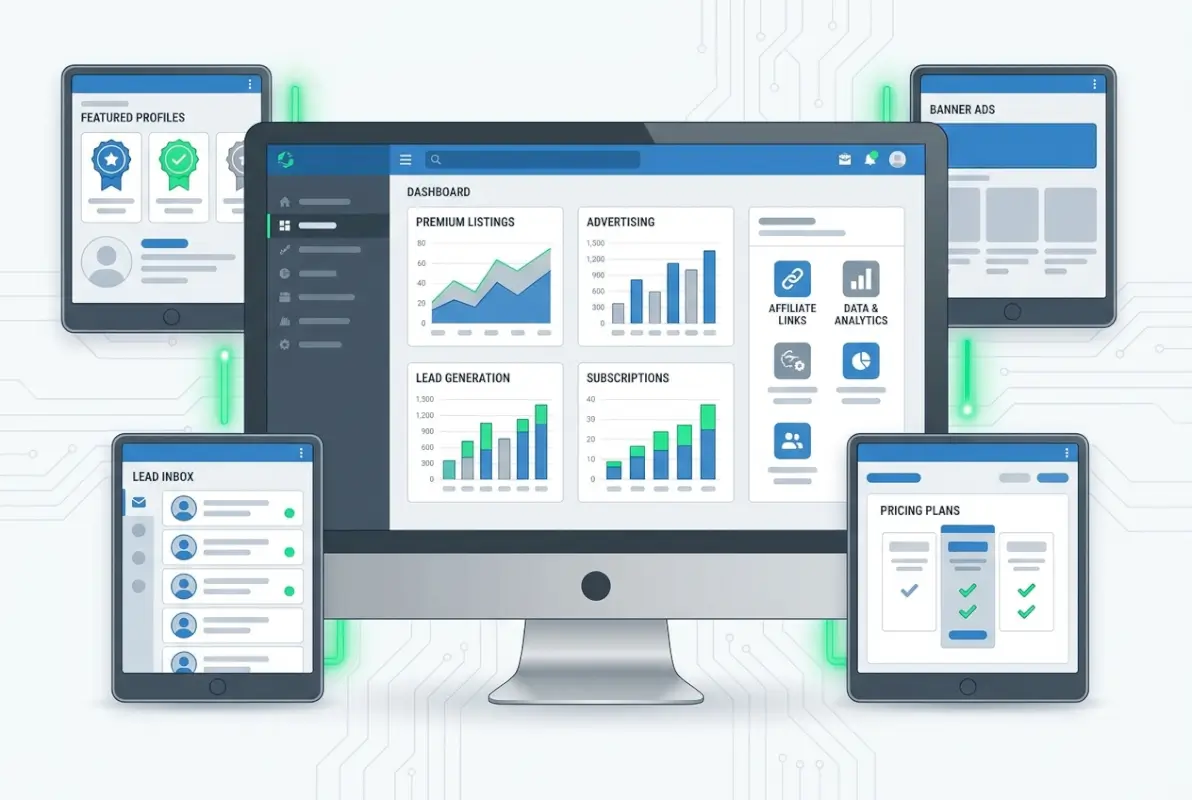
Successful lead programs define qualification criteria upfront: geographic match, service type, and contact completeness. Weak definitions flood partners with low-intent submissions, erode trust, and trigger refund disputes. Performance-based pricing—pay-per-valid-lead or cost-per-acquisition—aligns incentives and lets you test price elasticity across categories without upfront commitments.
Affiliate partnerships extend monetization beyond leads by embedding product or service offers that complement directory use. A restaurant directory might promote reservation platforms, point-of-sale tools, or marketing software through affiliate links, earning a commission on each sign-up or purchase. Transparency matters: disclose affiliate relationships clearly and choose partners whose value proposition aligns with user intent to preserve trust and avoid bounce.
Track attribution rigorously with UTM parameters, dedicated landing pages, or affiliate network dashboards. Real-time ROI visibility lets you prune underperforming partnerships, double down on high-converting categories, and justify pricing to both affiliates and internal stakeholders. Many directories bundle lead and affiliate revenue into a single “performance marketing” P&L line to simplify reporting and forecasting.
Affiliate Programs and Value Alignment
Affiliate monetization works best when the promoted offer solves a problem the directory user already faces. A B2B directory listing software vendors can integrate affiliate links to cloud hosting, analytics tools, or payment processors—products decision-makers already evaluate during their search journey. Contextual placement—inserting affiliate CTAs within relevant categories or profile pages—drives higher conversion than site-wide banners and reduces ad fatigue.
Choose affiliate networks or direct partnerships that provide robust tracking, timely payouts, and compliance support. Platforms like ShareASale, CJ Affiliate, and Impact offer publisher dashboards, creative assets, and fraud monitoring to streamline operations. Document cookie windows, commission tiers, and exclusivity clauses in partnership agreements to avoid revenue leakage and conflicts with direct advertisers.
Measure affiliate performance against both absolute revenue and user engagement metrics. A high-commission offer that drives bounce or negative feedback may cost more in lost directory trust than it earns in affiliate fees. Regularly audit link validity, update discontinued offers, and rotate underperformers to keep your affiliate inventory fresh and relevant.
| Monetization Stream | Pricing Model | Quality Guardrails | Typical Conversion |
|---|---|---|---|
| Lead Generation | Pay-per-lead or CPA | Geographic + service match, contact verification | 2–5% of unique visitors |
| Affiliate Offers | Commission on sale/sign-up | Relevance to user intent, transparent disclosure | 1–3% click-through, 10–20% of clicks convert |
| Referral Partnerships | Flat fee or revenue share | Partner vetting, service-level agreement | Varies by vertical; enterprise deals can exceed 30% |
Value-Added Services, Subscriptions, and Ecosystem Growth
Value-Added Services for Businesses
Value-added services shift the directory from a passive listing platform to an active business tool, unlocking recurring revenue and deeper partner engagement. Enhanced analytics dashboards—showing profile views, click-through rates, and geographic demand—help listed businesses justify their investment and identify optimization opportunities. API access, custom integrations with CRM or booking systems, and white-label profile exports turn the directory into infrastructure that partners rely on daily.

Pricing these services on a subscription basis—monthly or annual tiers—creates predictable cash flow and improves lifetime value relative to one-time listing fees. A legal directory might charge $99/month for advanced analytics and $249/month for API access plus priority support. Bundling value-added features with premium listing tiers increases average revenue per user and reduces churn by making the relationship stickier.
Operational delivery matters as much as pricing. Automate dashboards with real-time data feeds, provide self-service onboarding with video tutorials, and offer tiered support (email for base plans, phone for enterprise). Clear feature documentation and usage examples reduce support costs and help partners extract maximum value, reinforcing renewal decisions.
Monitor adoption rates and usage intensity to identify upsell opportunities and feature gaps. If only 10% of premium subscribers use the API, either the feature needs better onboarding or it should be repositioned as an enterprise add-on. Conversely, high engagement with a beta feature signals demand for broader rollout and potential price increases.
Membership/Continuity Programs for Users or Businesses
Membership programs transform occasional directory visitors into committed subscribers by offering exclusive access, early-bird opportunities, or premium content. A professional association directory might charge members $199/year for unlimited profile browsing, downloadable contact lists, and monthly industry reports. Continuity revenue smooths cash flow, reduces reliance on transactional ad sales, and builds a loyal user base that drives organic word-of-mouth.
Design membership tiers with clear value differentiation: a free tier with basic search, a mid-tier with advanced filters and download limits, and a premium tier with unlimited access and concierge support. Price anchoring—showing the premium tier first—can increase conversion to mid-tier plans, while annual billing (often discounted 15–20% versus monthly) improves retention and reduces payment friction.
Retention tactics include automated renewal reminders, usage milestone emails (e.g., “You’ve saved 50 contacts this month”), and member-only webinars or networking events. Churn analysis should track cohort retention by acquisition channel, tier, and engagement level to identify at-risk segments and trigger win-back campaigns before renewal lapses.
| Service Type | Example Feature | Pricing Range | Impact on LTV |
|---|---|---|---|
| Enhanced Analytics | Real-time profile views, click heatmaps | $49–$149/month | +30–50% over listing-only customers |
| API & Integrations | CRM sync, booking widget embed | $199–$499/month | +70–100%; lower churn due to workflow lock-in |
| Membership/Continuity | Unlimited downloads, exclusive content | $99–$299/year | Predictable recurring revenue; 12-month visibility |
| White-Label Exports | Branded PDF profiles, embeddable badges | $25–$75 one-time or bundled | Modest incremental; high perceived value |
Trust, Quality, and Compliance as Revenue Multipliers
Trust Signals and Directory Quality
Trust is the invisible infrastructure that supports every monetization stream: businesses pay premium listing fees because they trust the directory delivers qualified traffic, advertisers renew because they trust the audience is engaged, and users return because they trust the listings are accurate and current. Editorial standards—verified profiles, moderated reviews, and regular data audits—differentiate high-value directories from scraper farms and justify pricing 2–5× above generic competitors.

Visible trust signals include verification badges (email-confirmed, phone-verified, site-visit-verified), editorial review labels, and user ratings with timestamps and response metadata. Displaying “Last Updated” dates and “Claimed by Owner” flags reassures users that the information is fresh and authoritative. Transparency about listing criteria and removal policies builds long-term credibility, even when it means rejecting paid submissions that don’t meet quality thresholds.
Invest in proactive quality control: automated duplicate detection, scheduled re-verification campaigns, and user-reporting tools for outdated or fraudulent listings. A single high-profile case of directory spam can erode advertiser confidence and user trust faster than months of marketing can rebuild it. Quality assurance isn’t a cost center—it’s a revenue multiplier that protects pricing power and supports upsell conversations.
Measure trust through proxy metrics: repeat visitor rates, average session duration, listing claim rates, and advertiser renewal percentages. If claim rates drop or advertisers cite “low lead quality” in cancellation feedback, audit your verification workflows and content moderation rules before adjusting pricing or launching new revenue products.
Compliance, Privacy, and Data Practices
Regulatory frameworks—GDPR in Europe, CCPA in California, and evolving state privacy laws across the U.S.—shape what data you can collect, how you can use it for monetization, and what disclosures you must provide. Non-compliance risks fines, advertiser flight, and platform bans from ad networks that require publisher certification. Building strong data governance upfront protects revenue streams and opens doors to enterprise advertisers and partners who audit vendor compliance before signing contracts.
Practical compliance steps include cookie consent management (with granular opt-in for advertising versus analytics), clear privacy policies that enumerate data sharing with affiliates and ad partners, and data retention schedules that auto-purge inactive user records. Affiliate and lead-gen disclosures must be conspicuous—burying them in footer legalese invites regulatory scrutiny and user backlash. Use inline labels like “Affiliate Link” or “Sponsored” adjacent to monetized content, not just in a site-wide disclaimer.
Ad network relationships require compliance with partner policies as well as law: Google Publisher Policies, for instance, prohibit certain content verticals and mandate specific disclosure formats. Violating partner terms can result in account suspension and immediate loss of ad revenue. Maintain a compliance calendar that tracks policy updates from major partners and regulatory bodies, and assign ownership to a single team member to avoid drift.
| Compliance Domain | Key Requirement | Revenue Impact | Implementation Tool |
|---|---|---|---|
| Privacy (GDPR/CCPA) | Granular consent, data portability, right to deletion | Protects ad network access; avoids fines up to 4% revenue | OneTrust, Cookiebot, or custom consent manager |
| Advertising Disclosure | Clear “Ad,” “Sponsored,” or “Affiliate” labels | Maintains user trust and FTC compliance; reduces bounce | Inline CSS classes, automated label injection |
| Ad Network Policies | Prohibited content, placement rules, invalid traffic limits | Account suspension can zero-out programmatic revenue overnight | Policy dashboards, quarterly audits, traffic quality monitoring |
| Data Retention | Auto-purge inactive records per policy schedule | Reduces liability; supports enterprise sales to compliance-sensitive buyers | Scheduled database jobs, audit logs |
External authoritative sources provide context on the regulatory and competitive environment shaping directory monetization. The U.S. Department of Justice’s remarks on monopolizing digital advertising technologies and the Washington State Attorney General’s ruling on digital advertising monopolies illustrate policy pressures that affect publisher pricing power and ad network dynamics. The SEC’s filings on advertising technology platforms and Gannett’s digital monetization strategy offer empirical benchmarks for revenue mix and compliance investment. Finally, ERIC’s research on advertising and monetization practices provides educational context on user trust and disclosure effectiveness.
Frequently Asked Questions
What are the most reliable revenue streams for an online directory in 2025–2026?
Premium listings and featured placements generate the most reliable recurring income. Direct advertising sales and lead-generation partnerships offer scalable revenue, while value-added services—such as analytics access and API integrations—create stable, high-LTV streams. Combining three to five methods balances risk and accelerates growth.
How do premium listings impact overall directory profitability?
Premium listings drive predictable, recurring revenue and justify higher pricing by delivering measurable visibility—impressions, clicks, and leads. Tiered packages encourage upsells, and renewal cycles stabilize cash flow. Directories that offer clear value metrics and time-bound promotions see conversion rates improve by 30–50 percent compared to flat-rate models.
Can a directory be profitable with mostly free listings?
Yes, if you layer advertising, affiliate partnerships, and lead-generation revenue on top of free base listings. High traffic volumes unlock programmatic ad income and referral fees, while optional paid upgrades—enhanced profiles, priority placement—capture businesses seeking greater visibility. Quality content and strict moderation maintain user trust and engagement.
What are best practices for balancing advertising with user experience in a directory?
Limit ad density to preserve page speed and readability—one to two units per screen. Prioritize direct ad sales over intrusive formats, align sponsorships with directory themes, and disclose all paid placements clearly. Monitor bounce rates and session duration to detect ad fatigue, and rotate inventory to keep content fresh.
How do directories measure the ROI of different monetization methods?
Track revenue per visitor, cost per acquisition, and lifetime value for each stream—premium listings, ads, leads, and services. Use attribution dashboards to link conversions to specific sources, and run A/B tests on pricing tiers. Compare profit margins and renewal rates quarterly to identify your highest-performing channels.
What compliance or privacy considerations should directories plan for when monetizing?
Comply with GDPR, CCPA, and local data-protection laws by obtaining explicit consent for cookies and tracking. Clearly label paid placements and sponsored content to meet advertising-disclosure requirements. Maintain transparent privacy policies, secure user data with encryption, and audit third-party ad networks to avoid regulatory penalties and protect advertiser confidence.
Should directories offer monthly or annual pricing for premium listings?
Offer both options to maximize accessibility and cash flow. Monthly plans lower the barrier to entry and attract small businesses testing premium features, while annual subscriptions provide upfront revenue and improve retention. Incentivize annual sign-ups with 15–20 percent discounts and exclusive add-ons to encourage longer commitments.
How can directories scale lead-generation revenue without compromising quality?
Define strict lead-quality criteria—intent signals, geographic match, contact completeness—and implement automated validation workflows. Use performance-based pricing tied to conversion, not volume, to align incentives. Provide real-time dashboards showing lead source and conversion rates, and regularly review partner feedback to refine targeting and maintain trust.
Take Action: Build Your Monetization Engine Today
You now have a comprehensive, five-pillar framework for generating revenue from your online directory: premium listings and featured placements, direct advertising and sponsored content, lead generation and affiliate partnerships, value-added services and subscriptions, and governance practices that multiply trust and long-term profitability. Each revenue stream reinforces the others—premium listings create inventory for advertising, advertising funds content improvements that drive organic traffic, and traffic fuels lead volume and affiliate conversions.
Start by mapping your current audience and competitive landscape. Identify which businesses are already engaging with your directory and which adjacent verticals you can serve. Build a clear pricing and feature map for premium listings, pilot direct ad sales with a handful of trusted partners, and layer in lead-generation or affiliate programs as traffic grows. Invest early in compliance, data security, and transparent policies—they protect your reputation and unlock premium pricing power.
Monitor revenue per visitor, conversion rates, and renewal cycles monthly. Use A/B testing to refine pricing tiers, ad placements, and value propositions. Document your ROI with dashboards that link every dollar earned to a specific channel, and share performance data with your partners to build long-term trust. As you scale, expand value-added services—analytics dashboards, API access, custom integrations—that deepen customer commitment and create recurring, high-margin income.
Ready to Launch Your Revenue Engine?
Apply this five-stream monetization blueprint to your directory. Start with one premium listing tier, one direct ad partnership, and one affiliate offer. Track your results, iterate fast, and scale what works. The directories that win combine multiple revenue channels, transparent value delivery, and unwavering commitment to user trust.
Map your pricing, launch your first premium package, and start generating revenue this month.
Was this article helpful?