5 Steps to Create an Online Directory Like Manta for Your Niche

Generating summary...
Building an online directory for your niche isn’t just about copying what Manta does—it’s about creating something better, more focused, and more valuable for a specific audience. Most entrepreneurs make the mistake of thinking bigger is better, when in reality, a laser-focused directory that serves one niche exceptionally well will outperform a generic directory every single time. The difference between success and failure often comes down to how well you understand your market’s specific pain points and how effectively you can solve them through structured, verified data.
What most people don’t realize is that we’re in the middle of a massive shift in how businesses and consumers discover services. Generic search is becoming less effective while specialized, curated directories are gaining trust because they offer pre-vetted options. According to BrightLocal’s research, consumer reliance on directory listings and reviews has intensified, with verification badges and data accuracy becoming critical trust signals. This creates an unprecedented opportunity for niche directory operators who get the fundamentals right.
TL;DR – Quick Takeaways
- Niche focus beats broad coverage – A specialized directory for one vertical will outcompete generic directories in that space
- Data quality is your moat – Verification workflows and accuracy create trust and differentiation
- Monetization requires value alignment – Premium tiers must deliver measurable ROI to listed businesses
- Compliance isn’t optional – FTC rules on reviews and endorsements protect your directory from legal issues
- Mobile-first design matters – Directory searches happen predominantly on mobile devices
- Build for scale from day one – Your data model and architecture should support thousands of listings
Define Your Niche, Goals, and Success Metrics
The first step most people get wrong is choosing too broad a niche or picking one without validating demand. I’ve seen countless directory projects fail because someone built “a directory for restaurants” when they should have built “a directory for farm-to-table restaurants in the Pacific Northwest.” The specificity isn’t limiting—it’s your competitive advantage.

Niche Selection Criteria
Your niche needs to pass several tests before you invest significant time and money. First, calculate addressable market size—you need at least 500-1,000 potential listings to make the economics work, but not so many that you can’t reasonably verify and maintain quality. Second, identify a clear target audience with specific pain points. Are they struggling to find verified suppliers? Do they need hyper-local options that national directories miss?
Competition gaps reveal opportunities. When I researched sustainable product directories, I found that existing options either covered too much ground (losing trust) or focused only on major brands (excluding innovative startups). That gap represented a buildable position. Look for similar openings in your chosen sector where established players have blind spots.
Goals and Success Metrics
Primary metrics should focus on engagement quality, not just volume. Track qualified leads generated per listing, submission completion rates, and user return frequency. These indicate whether your directory actually helps people find what they need. Secondary metrics like revenue per listing and traffic growth follow once you’ve proven core utility.
One metric that’s particularly revealing is the ratio of searches to contact actions. If users search but don’t click through to businesses, your data quality or relevance is insufficient. Conversely, a high action rate validates that you’re solving a real discovery problem, which is crucial before exploring business directory strategies.
Competitive Landscape Snapshot
According to industry analysis from Jasmine Directory, successful directories in recent years emphasize three things: pristine data quality, transparent verification processes, and monetization models that align with user value. They’re moving away from low-quality link farming toward genuine utility.
| Success Factor | Established Directories | Niche Opportunity |
|---|---|---|
| Data Coverage | Broad but shallow | Narrow but deep |
| Verification | Automated only | Human + automated |
| Specialization | Generic categories | Expert taxonomy |
| User Trust | Brand recognition | Curation quality |
Competitive Analysis of Directory Creation Strategies
Understanding what works in existing directory guides helps you avoid common pitfalls and adopt proven strategies. After analyzing top-ranking articles about building directories like Manta, clear patterns emerge around what successful operators prioritize versus what beginners overlook.

What Top-Ranking Articles Emphasize
The best directory-building content consistently highlights data model planning as the foundation. You can’t retrofit a poor database structure later without enormous cost. They also stress verification workflows—distinguishing your directory from low-quality spam repositories—and local search integration, since much directory traffic comes from location-based queries.
Monetization appears in every serious guide, typically structured as freemium models where basic listings are free but premium placements, enhanced features, or verification badges require payment. Launch planning receives attention too, with emphasis on seed data quality over quantity. It’s better to launch with 200 verified, complete listings than 2,000 partial or outdated ones.
Gaps to Exploit
What’s missing from most guides is actionable, niche-specific customization advice. Generic templates don’t account for the unique taxonomy needs of, say, a veterinary directory versus a sustainable goods directory. Few articles provide actual data schemas, moderation checklists, or API integration guides you can implement immediately.
Another gap is ROI-focused case studies. Everyone talks about revenue models in theory, but specific examples of customer acquisition cost (CAC), lifetime value (LTV), and break-even timelines are rare. When you’re considering whether to create a business directory on platforms like Wix or build custom, these economics determine your path.
Recent Data Points to Reference
Directory usage trends from industry sources indicate continued growth in mobile-first discovery, with users expecting instant, accurate results and transparent business information. The rising importance of verified data stems from increasing consumer skepticism about fake reviews and outdated information. Directories that prominently display verification status and last-updated timestamps build trust faster.
Planning, Architecture, and Data Governance
This is where most directory projects either set themselves up for success or guarantee future headaches. Your data architecture decisions made today will either enable or prevent scaling to thousands of listings, adding new features, and maintaining quality over time.

Taxonomy and Data Model
A robust data model includes several core entities. Listings are your primary object, containing business information. Categories organize listings into browsable groups—make these hierarchical (parent/child relationships) to support both broad and narrow searches. Regions enable location-based filtering, crucial if your niche has geographic relevance. Businesses represent the actual entities (separate from listings to handle cases where one business has multiple locations).
Reviews, media (photos/videos), tags, and owner accounts complete the model. Key attributes for each listing must include name, full address, phone, website, operating hours, categories, search keywords, verification status, and last_updated timestamp. The last_updated field is particularly important—it drives your data freshness workflows and builds user trust.
Data Acquisition Sources and Verification
Primary data sources typically include public business registrations, industry association directories, partner data feeds, and user submissions. Each source requires different verification approaches. Public records might be reliable for existence but often have outdated contact information. User submissions need moderation but can provide the most current details.
Verification workflows should combine automated checks (does the phone number format correctly? does the website resolve?) with human review for completeness and appropriateness. Trust signals like citation consistency across multiple sources, review authenticity, and response rate to user inquiries all contribute to a listing’s credibility score.
UI/UX and Accessibility
Directory search needs to be fast and flexible. Users should be able to filter by category, location, verification status, rating, and niche-specific attributes (for veterinary directories, maybe “emergency services available” or “exotic animal specialists”). Map integration is essential—most users think geographically when searching for services.
Listing detail pages must load quickly on mobile and present information hierarchically: business name, verification badge, rating, address/phone, hours, description, reviews, photos. Accessibility compliance isn’t just ethical, it’s practical—screen reader compatibility and keyboard navigation expand your audience and improve SEO. Many local business directories in the USA overlook these elements and lose both users and search visibility.
Information Accuracy and Update Cadence
Define clear service level agreements (SLAs) for data freshness. A reasonable starting point might be automated verification checks every 30 days for basic listings and 90-day comprehensive reviews for verified listings. Critical fields like hours and contact information warrant more frequent validation, especially for businesses where outdated info creates immediate problems (think emergency services or time-sensitive offerings).
Implement user-reported corrections with a streamlined workflow: user submits correction → automated verification where possible → human review → update listing → notify business owner. This process typically takes 24-48 hours for priority corrections.
Data Acquisition, Quality, and Freshness
The quality of your data determines everything else—user trust, SEO performance, monetization potential, and competitive differentiation. Poor data quality creates a death spiral: users get bad results, stop using your directory, businesses see no value, and revenue dries up.
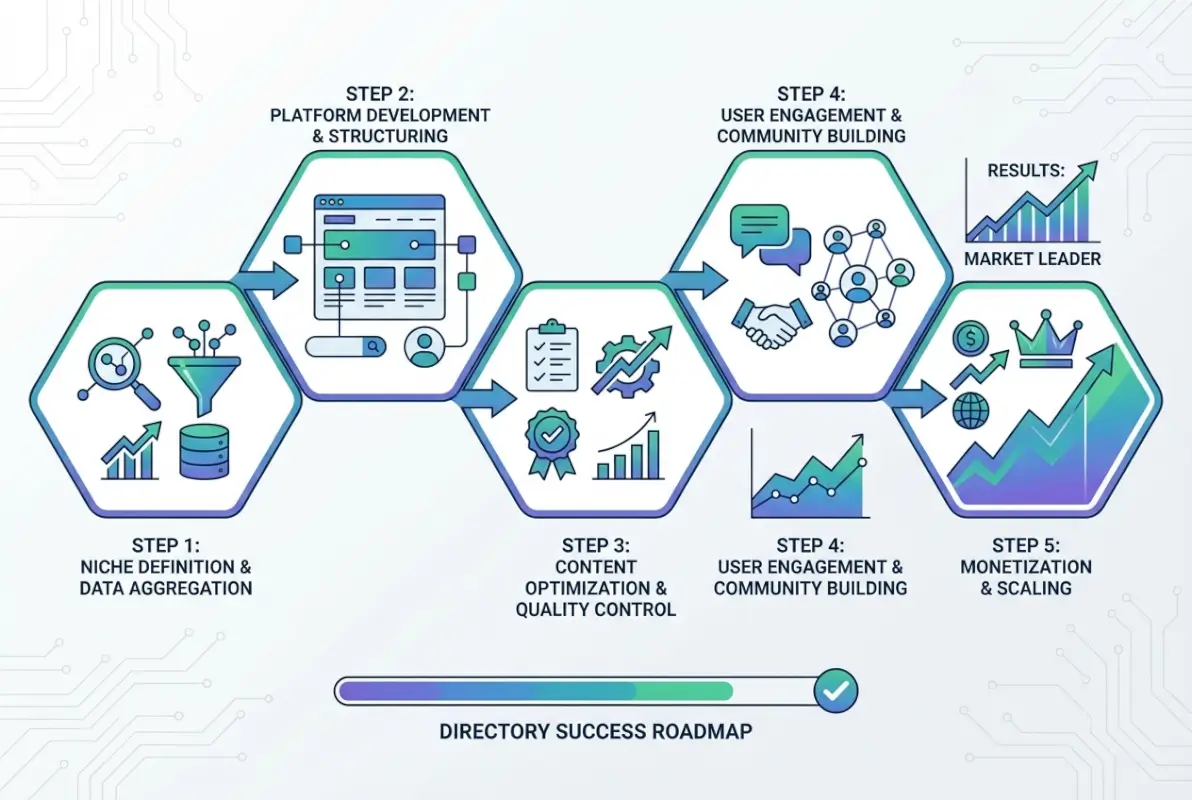
Data Freshness Strategy
Regular ingestion pipelines should run automated checks on listing validity. For phone numbers, you can use validation APIs that check if numbers are still active (though this gets expensive at scale). For websites, simple HTTP checks verify the domain still resolves. Address validation against postal databases catches obvious errors.
Change detection triggers re-verification when automated systems notice discrepancies. If your automated check finds a phone number disconnected or a website down, flag that listing for immediate human review. For high-value verified listings, consider quarterly manual outreach to confirm details haven’t changed.
Verification and Moderation Workflow
Establish clear roles and thresholds. Automated systems handle obvious spam (duplicate submissions, malformed data, blacklisted domains). Moderators review everything that passes automated filters, checking for completeness, appropriateness, and accuracy. Senior moderators or administrators handle escalations like disputed information or businesses claiming incorrect listings.
For user-generated content like reviews, implement a multi-stage process. New reviews from unverified users get held for moderation. Reviews from verified users (confirmed customers or established community members) publish immediately but get retroactively spot-checked. This balances trust-building with operational efficiency.
Data Quality Controls and KPIs
Track completeness (percentage of listings with all core fields populated), consistency (Name-Address-Phone data matching across sources), duplication rate (should be under 2%), and accuracy (verified through sampling and user feedback). Set targets like 95% completeness for verified listings and 85% for free listings.
| Quality Metric | Target (Verified) | Target (Free) |
|---|---|---|
| Completeness | 95%+ | 85%+ |
| NAP Consistency | 98%+ | 90%+ |
| Duplication Rate | <1% | <3% |
| Update Frequency | 30 days | 90 days |
Legal and Compliance Implications
Review integrity rules from the FTC’s consumer reviews guidance are non-negotiable. You cannot allow fake reviews, incentivized reviews without disclosure, or suppression of negative reviews. These practices not only violate federal rules but destroy the trust your directory depends on.
Truth-in-advertising considerations apply to how you present listings. If a business pays for “verified” status, that verification must be real and meaningful—not just a paid badge. Premium placements must be clearly labeled as sponsored or featured to avoid deceiving users about organic rankings.
Monetization, Pricing, and Business Model
A directory without a sustainable revenue model is a hobby, not a business. The key is aligning what you charge for with genuine value delivered to both listed businesses and end users.

Revenue Streams to Consider
Listing subscriptions form the foundation for most directories. Free basic listings get businesses in the door; paid tiers offer enhanced features like priority placement, additional photos, detailed descriptions, or analytics on how many users view their listing. This freemium model works because it aligns incentives—businesses that get value from free listings will pay to get more value.
Featured or priority placements let businesses appear at the top of category pages or search results, clearly marked as sponsored. Advertising can work in niches where users are actively researching purchases (banner ads for related products or services). API access charges developers or data consumers who want to integrate your directory data into their applications. Premium data services might package aggregated insights about the industry you cover.
Partnerships with complementary services create additional revenue. A veterinary directory might partner with pet insurance providers or specialty food suppliers, earning referral fees for introductions. Similar approaches work when you’re learning to create a business directory that drives traffic and converts visitors.
Pricing Approaches and Benchmarks
Tiered pricing typically starts with free (basic listing with limited features), moves to a middle tier ($15-50/month for enhanced listings), and tops out with premium ($75-200/month for maximum visibility and features). Annual billing with a discount (typically 15-20% off monthly rates) improves cash flow and reduces churn.
Volume discounts make sense for businesses with multiple locations—they pay less per listing when they list all locations. This approach particularly benefits you in targeting businesses looking for free directory sites to grow reach, then upselling them to paid tiers.
Value Proposition Alignment with Pricing
Your pricing must correlate with measurable value. If an enhanced listing costs $40/month, businesses need to see that it generates more than $40 in value—either through direct leads, brand visibility, or competitive positioning. Provide analytics showing views, clicks, contact requests, and direction requests so businesses can calculate ROI.
Premium verification badges work when they genuinely signal trust to users. Background checks, license verification, insurance validation, or customer reference checks justify charging for verified status because they require real work and deliver real value to end users making decisions.
Operational Costs vs Expected Revenue
Initial costs include development (custom build $15-40K, template-based $2-8K), data acquisition and cleanup, hosting, and your time. Ongoing costs cover hosting/infrastructure, moderation labor, marketing, and support. A small niche directory might spend $1,500-3,000/month on operations once established.
Revenue projections depend on conversion rates and market size. With 1,000 listings and a 5% conversion rate to paid tiers averaging $35/month, you’d generate $1,750/month. At 3,000 listings with 7% conversion, that jumps to $7,350/month. Break-even typically occurs at 12-18 months for directories that execute well on both data quality and marketing.
SEO, Directory Signals, and Trust-Building
Directory SEO differs from typical website optimization because you’re optimizing both the directory platform itself and individual listing pages. Getting this right creates compounding returns as more listings mean more indexed pages mean more traffic.
Core SEO Pillars for a Niche Directory
On-page optimization starts with listing pages using clean URLs (yoursite.com/veterinarians/seattle/clinic-name rather than yoursite.com/listing?id=12345). Each listing page needs unique title tags and meta descriptions that include the business name, category, and location. The description should be genuinely useful, not keyword-stuffed boilerplate.
Clean taxonomy with logical category hierarchies helps both users and search engines understand your structure. Schema markup is crucial—use LocalBusiness schema with all available properties (address, phone, hours, price range, accepted payments). This structured data helps search engines display rich results and can earn you coveted positions in local packs.
User-generated content signals through reviews provide fresh content and keyword diversity. A plumber’s listing with 20 reviews mentioning “emergency repairs,” “water heater replacement,” and “reasonable prices” will rank for those terms organically.
Directory-Specific Trust Signals
Data freshness displays build confidence. Show last verification date prominently on listing pages. Verification badges should explain what they mean—clicking the badge reveals your verification process so users understand the value. Consistent NAP (Name-Address-Phone) data across your directory and other platforms reinforces local SEO signals.
User reviews handled according to FTC fake review rules demonstrate integrity. Display both positive and negative reviews transparently, respond to feedback professionally, and never suppress negative reviews or allow fake positive ones.
Local Search and Discovery Mechanics
Listings appear in map packs when they have accurate location data and strong local signals. Citations (mentions of the business’s NAP across the web) contribute to local ranking. Your directory becomes one of those citation sources, but only if your data is accurate and consistent.
According to research on local consumer behavior, users increasingly rely on directory information to validate businesses found through other channels. They might discover a plumber through a friend’s recommendation, then check directory listings and reviews to confirm that plumber’s credibility before calling.
Risk Management for Reviews and Endorsements
The FTC consumer reviews rule prohibits several practices: buying positive reviews, compensating reviewers without disclosure, suppressing negative reviews, using reviews from non-customers without disclosure, and creating fake reviews. Violations can result in significant fines.
Legitimate review practices include soliciting reviews from verified customers, displaying all reviews (positive and negative), disclosing any relationship between your directory and reviewed businesses, and implementing good-faith efforts to prevent fake reviews through verification and moderation.
Technology Stack, MVP Plan, and Launch Roadmap
Technology choices determine your development speed, operational costs, and ability to scale. The right stack for a 500-listing directory differs from what you need for 50,000 listings.
MVP Feature Set
Start with core functionality: listing ingestion (manual submission form plus bulk import), basic search (keyword, category, location), filters (distance, rating, verification status, category), map view showing listing locations, detailed listing pages, user account creation, and simple moderation queue for submitted listings.
What you can skip in v1: advanced analytics, API access, review replies, photo galleries beyond basic images, and complex subscription management. Add these based on user feedback and actual demand rather than assumptions.
Tech Stack Decision Factors
Choose a scalable database that handles both structured data (business details) and flexible attributes (niche-specific fields). PostgreSQL works well for most directory applications. Search indexing deserves special attention—Elasticsearch or Algolia provide fast, relevant search with filtering capabilities that basic SQL queries can’t match.
Mapping and geocoding require either Google Maps API (reliable but expensive at scale) or open alternatives like Mapbox (more affordable for high-volume usage). Front-end frameworks like React or Vue enable responsive, app-like experiences without constant page reloads.
| Component | Budget Option | Premium Option |
|---|---|---|
| Database | MySQL/PostgreSQL | Managed PostgreSQL |
| Search | Database queries | Elasticsearch/Algolia |
| Maps | Mapbox/Leaflet | Google Maps |
| Hosting | Shared/VPS | AWS/Azure/GCP |
Launch Milestones
A realistic timeline runs 3-6 months from start to public launch. Month 1: finalize niche, taxonomy, and data model; design wireframes; set up development environment. Month 2-3: build core features; begin seed data collection. Month 4: beta testing with friendly users; iterate based on feedback. Month 5: polish UI/UX; implement analytics; prepare marketing materials. Month 6: soft launch to niche communities; monitor performance; address issues; scale up promotion.
Growth and Iteration
Post-launch analytics should track listing submission sources (where do they come from?), search behavior (what are users looking for?), conversion events (contact clicks, website visits, direction requests), and churn indicators for paid listings. Use this data to prioritize features—if analytics show users frequently search by specific attributes, add filters for those attributes.
Feature prioritization should balance user requests, business value, and development effort. A feature that 10% of users desperately want might be more valuable than one that 50% would mildly appreciate.
Risk, Governance, and Regulatory Considerations
Operating a directory comes with legal and ethical responsibilities, particularly around user-generated content and business information accuracy. Ignoring these creates existential risk.
FTC and Advertising Guidelines
The FTC’s rules around consumer reviews and endorsements aren’t suggestions. The recent crackdown on fake reviews reflects growing consumer harm from misleading practices. Your directory must implement systems to detect and prevent fake reviews, clearly disclose paid placements or sponsored content, and avoid suppressing negative feedback.
If your directory accepts payment for enhanced listings or verification badges, make sure those features deliver real value. Selling a “verified” badge that doesn’t involve actual verification constitutes deceptive advertising.
Data Privacy and Security
Collect only necessary data from users and businesses. Implement secure password storage (hashed and salted), encrypt sensitive data in transit and at rest, and provide clear privacy policies explaining what data you collect and how you use it. If you operate in California or serve California residents, CCPA compliance matters. European users trigger GDPR requirements.
User consent for submissions should be explicit, particularly for reviews and photos. Terms of service should clarify that submitted content may be displayed publicly and grant your directory license to use it.
Content Governance and Moderation Policy
Publish clear community guidelines defining acceptable content. Prohibited content typically includes false information, hate speech, harassment, spam, and anything illegal. Moderation response times should be defined—how quickly will you address reported violations?
Transparency about moderation decisions builds trust. When you remove a review or reject a listing, explain why (without revealing private information). This accountability prevents perceptions of arbitrary or biased moderation.
Launch Plan and Early Traction Tactics
The best directory in the world won’t succeed if nobody knows it exists. Launch strategy balances building awareness with maintaining quality as you scale.
Seed Listings and Partnerships
Start with quality over quantity. Identify 100-200 exemplary businesses in your niche and manually create high-quality listings for them (using publicly available information plus verification). Then reach out explaining that you’ve created a free listing and invite them to claim and enhance it. This approach converts 20-30% of contacted businesses into engaged users.
Partner with industry associations, local chambers of commerce, or complementary businesses. They’ll promote your directory to members in exchange for visibility or partnership recognition. These partnerships provide both listings and credibility.
Marketing and Growth Channels
Content marketing targeting your niche builds SEO authority and demonstrates expertise. A veterinary directory might publish articles on choosing a vet, understanding common treatments, or preparing for pet emergencies. This content attracts pet owners who then use your directory to find local vets.
Niche-focused PR means reaching out to industry publications, blogs, podcasts, and influencers with your story. “New directory makes it easier to find [niche businesses]” appeals to journalists covering your industry. Local SEO tactics like creating location pages, building citations, and optimizing for local keywords drive geographically targeted traffic.
Social proof and referral programs incentivize sharing. Offer businesses a discount on paid listings if they refer other businesses who sign up. Display metrics like “X businesses listed” and “Y searches this month” to demonstrate traction.
Metrics and Iteration
Define success metrics before launch so you can objectively evaluate performance. Initial benchmarks might target 250 listings in 90 days, 100 user signups, 10% listing claim rate, 1,000 monthly searches, and 5% conversion to paid tiers within 120 days.
Iterate based on data, not assumptions. If analytics show users bouncing after searching, improve result relevance. If businesses claim listings but don’t upgrade, survey them to understand why. If certain categories get disproportionate searches but few listings, recruit businesses in those categories.
Frequently Asked Questions
What makes a niche directory successful in the current market?
Success comes from deep specialization with high-quality verified listings, strong data governance ensuring accuracy, mobile-optimized design, and monetization strategies that align paid features with genuine value delivery. Trust signals like verification badges and current data are increasingly critical as users become more skeptical of outdated or fake information.
How often should directory listings be refreshed to maintain quality?
Implement a tiered approach: automated checks every 30 days for basic validation, quarterly comprehensive reviews for verified listings, and immediate re-verification when change detection flags issues. Critical fields like contact information and hours should be validated more frequently, especially in niches where outdated info causes user problems.
Can I monetize a niche directory and how quickly can profitability happen?
Yes, through listing subscriptions, featured placements, advertising, and data services. Profitability timing depends on listing quality, traffic generation, conversion rates, and pricing strategy. Well-executed directories typically reach break-even at 12-18 months when they balance quality with growth and optimize customer acquisition costs against lifetime value.
What about user-generated content like reviews on a directory site?
Allow reviews with proper moderation, follow FTC guidelines prohibiting fake or undisclosed incentivized reviews, and never suppress legitimate negative feedback. Transparent review policies and authentic user feedback build trust with visitors and improve SEO through fresh user-generated content that includes natural keyword variations.
What data sources should I use for initial directory listings?
Start with credible public business registrations, industry association member lists, partner data feeds, and user-submitted listings with verification. Ensure consistent formatting of Name-Address-Phone (NAP) data across all sources since consistency is a critical local SEO and trust signal.
How important is mobile usability for directory websites?
Extremely important—the majority of directory searches now happen on mobile devices. Mobile-friendly experiences with fast loading, touch-optimized interfaces, clear call-to-action buttons, and readable text without zooming directly impact engagement, conversions, and search rankings. Google prioritizes mobile-first indexing.
What regulatory guidance should I follow for reviews and endorsements?
Follow FTC Endorsement Guides and Consumer Reviews Rule guidance ensuring truthful, non-deceptive review practices. Prohibit fake reviews, require disclosure for incentivized content, allow negative reviews, verify reviewer authenticity, and clearly mark paid placements. Violations can result in significant fines.
How do I handle duplicate listings or conflicting information?
Implement automated duplicate detection during submission, merge confirmed duplicates while preserving valuable information from both, and establish clear resolution processes for conflicting data. When businesses dispute information, require verification documentation and make updates quickly. Display last-verified dates to indicate data confidence.
What’s the best way to get businesses to claim their listings?
Create high-quality initial listings from public data, then contact businesses explaining you’ve created a free listing and inviting them to claim and enhance it. Show the value: analytics on views, ability to respond to reviews, upload photos, and upgrade for more visibility. Personal outreach converts better than generic emails.
Should I build custom or use an existing directory platform?
Custom development ($15-40K) provides maximum flexibility and unique features but takes longer and requires ongoing technical expertise. Existing platforms ($2-8K setup) launch faster with proven features but limit customization. Choose based on your technical skills, budget, differentiation requirements, and timeline. Most successful niche directories eventually need custom development for competitive advantage.
Your Next Steps: Building a Directory That Matters
Creating a successful niche directory requires more than technical execution—it demands genuine understanding of your market’s needs and unwavering commitment to data quality. The directories that fail are the ones that treat it as a passive SEO play or quick revenue grab. The ones that succeed become indispensable resources that users trust and businesses depend on.
Start by validating your niche choice with real market research, not assumptions. Talk to potential users and businesses before writing a single line of code. Build your data model with scalability in mind, even if you’re starting small. Establish quality processes from day one because retrofitting quality into a low-quality foundation never works.
Most importantly, remember that you’re building a business, not a website. Revenue, user satisfaction, and sustainable growth matter more than vanity metrics like total listings or traffic. A small directory with 300 highly engaged users and 50 paying businesses beats a massive directory with 10,000 outdated listings and no engagement.
Ready to move forward? Create a detailed project plan mapping out your taxonomy, wireframe key pages, draft your data schema, and outline a phased launch roadmap. Engage with potential early users and partners to seed your directory and validate the business model before full-scale development. The opportunity exists for those willing to execute with excellence.
Was this article helpful?