7 Steps to Build an Online Directory Website That Attracts Visitors

Generating summary...
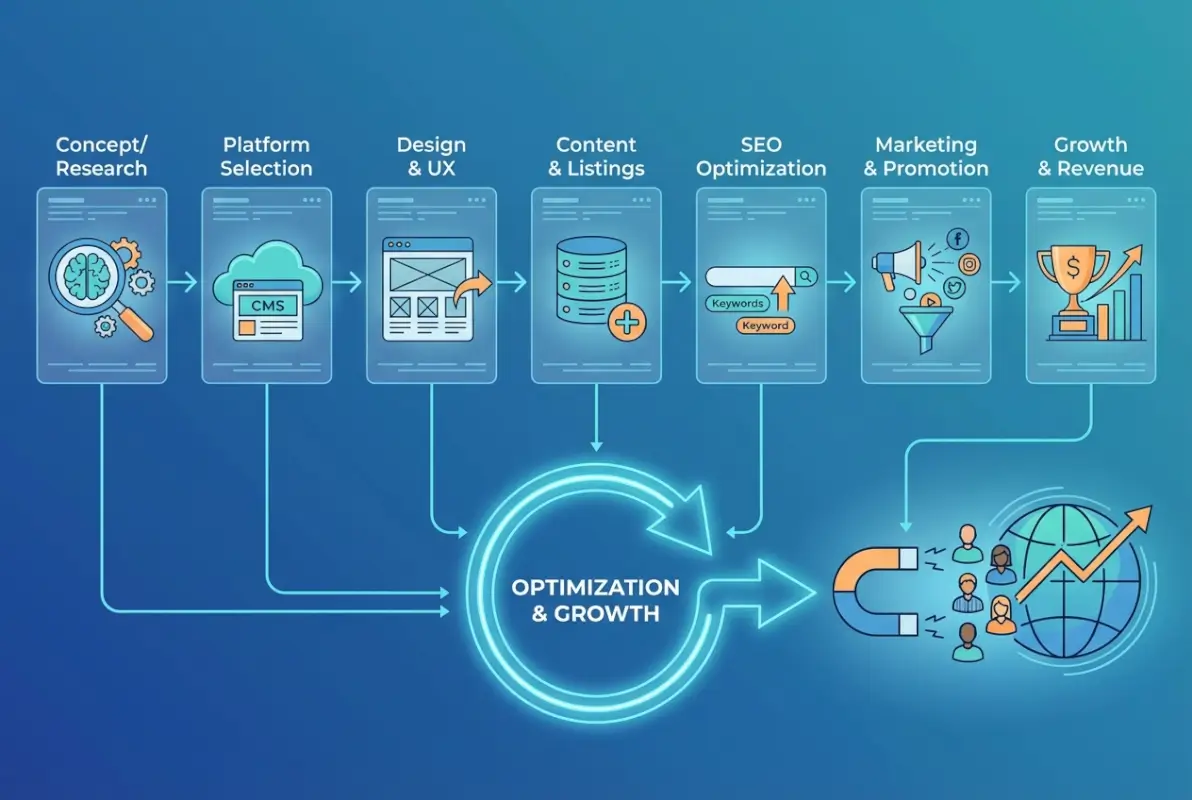
Building an online directory website isn’t just about creating a list of businesses or services—it’s about becoming the trusted hub where people turn first when they’re looking for solutions. In my experience working with directory sites, I’ve seen how the right structure can transform a simple listing platform into a revenue-generating asset that grows organically. The difference between directories that fade into obscurity and those that dominate search results comes down to seven strategic steps that prioritize data quality, user experience, and smart SEO. If you’re ready to build a directory that actually attracts visitors (and keeps them coming back), you’re about to learn a framework that balances human curation with scalable automation.
TL;DR – Quick Takeaways
- Narrow your niche – Focused directories outrank generalist ones because they signal expertise and relevance
- Structure matters – Clean information architecture with schema markup dramatically improves visibility
- Quality over quantity – Verified, curated listings build trust faster than thousands of unvetted entries
- Local SEO wins – Location-based pages and NAP consistency remain core ranking factors
- Content drives traffic – Editorial guides and FAQ content capture long-tail searches competitors miss
- Measure everything – Track listing activation, organic traffic, and retention to identify what actually works
Step 1 — Define Your Niche, Value Proposition, and Monetization Model
The biggest mistake I see with new directory builders is trying to be everything to everyone. Generic directories compete with established giants like Yelp and Yellow Pages, and you simply won’t win that battle. Instead, you need to carve out a specific niche where you can become the authoritative source.

Narrow the Focus to Ensure Signal-to-Noise Ratio
Think about who you’re serving and what problem you’re solving. Are you creating a directory of sustainable businesses in the Pacific Northwest? A curated list of freelance graphic designers specializing in healthcare branding? The more specific you get, the easier it becomes to define editorial standards and attract both quality listings and targeted visitors.
Consider these questions when narrowing your niche: What industries or professions have fragmented information? Where do people struggle to find vetted providers? What geographic area or specialty lacks a trusted directory? Your sweet spot sits at the intersection of market demand and competitive gaps.
Identify Buyer Personas
You’re actually serving three distinct groups, and understanding each one shapes your entire strategy. First, there are the businesses or professionals who want to be listed—they need clear value propositions and pricing transparency. Second, the searchers looking for services need intuitive filtering and trust signals. Third, if you’re selling premium listings or ads, you need to understand who’s willing to pay and why.
Value Proposition and Differentiation
What makes your directory worth visiting instead of doing a Google search? This is where editorial standards become your competitive advantage. Curated listings with verification badges, detailed profiles with rich media, editor picks, and quality ratings all signal that you’re not just scraping data—you’re providing vetted recommendations.
The format of your listings matters too. Will you include pricing information? Customer reviews? Portfolio samples? Video introductions? The more structured and comprehensive your listing fields, the more valuable your directory becomes. Just don’t overwhelm users with too many fields that remain empty.
Monetization Model
You need to know how you’ll make money before you build, not after. Common models include flat listing fees (one-time or annual), tiered subscription plans with premium features, display advertising, featured placements, or partnership commissions. Many successful directories use a freemium model—basic listings are free (which helps build volume), while premium features like enhanced profiles, top placement, or analytics require payment.
Budget for both acquisition (getting your first 100-500 listings) and retention (keeping them updated and paying). Your monetization model should align with the value you’re providing, if premium listings don’t offer measurable benefits, businesses won’t renew.
Success Metrics for Step 1
At this planning stage, define what success looks like. How many listings do you want to acquire in month one? Month three? What’s an acceptable activation rate (percentage of businesses that complete their profile after starting)? What does early retention look like—are businesses renewing their annual listings at 60%, 70%, or higher?
Step 2 — Build a Scalable Information Architecture and Listing Schema
Information architecture sounds technical, but it’s really just the organizational skeleton of your directory. Get this right, and everything else—SEO, user experience, scalability—becomes exponentially easier. Get it wrong, and you’ll be fighting uphill battles with confusing navigation and poor search rankings.

IA Design for Directory Clarity
Your category taxonomy needs to be logical, comprehensive, and not too deep. Most directories work best with 2-3 levels of categorization—for example, “Home Services > Plumbing > Emergency Plumbers” or “Health > Dentistry > Cosmetic Dentistry.” Beyond three levels, you risk confusing users and diluting link equity.
Location pages deserve equal attention. If you’re building a directory with geographic scope, each city or region should have its own page. This isn’t just for user convenience—it’s a cornerstone of local SEO strategy. URL structure should be clean and predictable, like yourdirectory.com/category/city or yourdirectory.com/city/category, whichever makes more logical sense for your niche.
Consistent naming conventions matter more than you might think. If you refer to categories as “categories” in one place and “services” in another, or if location slugs use different formatting, you’re creating friction that hurts both users and search engines.
Listing Schema and Metadata
Every listing should capture core fields that provide both user value and SEO signals. At minimum, you need NAP data (Name, Address, Phone), contact details, category assignments, operating hours, and space for descriptions. Beyond that, consider fields for website URLs, social profiles, pricing indicators, certifications, and media galleries.
Rich structured data using schema.org markup (specifically LocalBusiness or ProfessionalService schemas) tells search engines exactly what each listing represents. Implement this as JSON-LD in your template, and you’ll see enhanced search results with star ratings, hours, and other rich snippets that improve click-through rates.
Content Types Beyond Listings
The best directories aren’t just databases—they’re content destinations. Create editorial guides that help users understand how to choose providers in your niche. Write “how to use this directory” articles that explain your rating system or how to evaluate different options. This content serves dual purposes: it helps users make better decisions, and it captures long-tail search traffic that pure listings can’t.
User-generated contributions like reviews and submission forms add freshness and social proof, but they require moderation. Set clear guidelines, implement spam filters, and have a human review process for new submissions. The qualities of great online directories consistently include robust moderation systems that maintain quality standards.
Step 3 — Create a Listing Acquisition and Verification Process
You can build the most beautiful directory website in the world, but without listings, you have nothing. The challenge is acquiring quality listings at scale while maintaining editorial standards. This step requires both strategic thinking and operational discipline.

Data Acquisition Strategy
You have several options for populating your directory, each with tradeoffs. Manual curation gives you maximum quality control but doesn’t scale well—you might personally research and add your first 50-100 listings to establish credibility. Self-service submission forms scale better but require robust validation and moderation workflows to prevent spam.
Some directories start with licensed data from industry associations or business databases, which provides volume quickly but often lacks the detailed information that makes listings truly valuable. A hybrid approach often works best: seed your directory with foundational data, then enhance it through verification calls and encourage businesses to claim and complete their profiles.
Verification and Quality Control
This is where many directories fail. A verification workflow ensures every listing meets your standards before going live. This might include checking that phone numbers work, websites are active, addresses are valid, and business information is current. For professional directories, you might verify licenses or certifications.
Anti-spam measures are non-negotiable. Implement CAPTCHA on submission forms, use email verification, and watch for duplicate submissions or suspicious patterns. Set up automated flags for listings with missing critical fields or placeholder content, then route them through manual review before publication.
Partnerships and Data Licensing
Partnering with niche associations, industry bodies, or regional business groups can accelerate your listing acquisition dramatically. These organizations often have member directories that they’re willing to share or cross-promote. In exchange, you might offer their members discounted premium listings or co-branding opportunities.
Data licensing agreements can give you access to verified business information, but read the terms carefully—some providers restrict how you can display or monetize their data. Make sure any partnership aligns with your monetization model and doesn’t compromise your editorial independence.
Onboarding for New Listings
When a business submits a listing or you add one on their behalf, the onboarding experience sets the tone for the relationship. Send a welcome email that explains the benefits of a complete profile, outlines your verification process, and provides clear next steps. If you offer premium tiers, this is your opportunity to upsell by demonstrating the value of enhanced placement or additional features.
Clear pricing communication prevents surprises that lead to disputes or chargebacks later. If you’re offering a free trial of premium features, make the terms explicit. The smoother your onboarding funnel, the higher your activation rate will be.
Step 4 — Build a Conversion-Focused Website and UX
Your directory’s design needs to serve two masters: human visitors who want to find information quickly, and search engines that need clear signals about your content. The good news is that these goals align more than they conflict—fast, accessible, well-structured sites perform better on both dimensions.
Core Pages and UX Principles
Your homepage should immediately communicate what your directory offers and guide visitors toward either searching or browsing. Location pages and category pages form the backbone of your internal linking structure—each should have unique, descriptive content (not just a list of results) that provides context and helps with SEO.
Individual listing pages need to balance comprehensive information with scanability. Use clear headings, bullet points for key details, and prominent calls-to-action (contact, visit website, get directions). Internal linking between related listings, relevant categories, and location pages distributes authority and helps visitors discover more content.
Mobile-friendly design isn’t optional anymore—the majority of directory searches happen on phones. Test your design on actual devices, not just browser simulators. Click targets need to be large enough for thumbs, text needs to be readable without zooming, and forms need to be simple enough to complete on a small screen.
Search, Filters, and Ranking Signals
Your search functionality should support both keyword queries and location-based searches. “Find plumbers near me” and “emergency plumbing in Austin” should both return relevant results. Filters let users narrow by category, rating, price range, distance, or any other structured field you collect.
Be transparent about how you rank listings. If you’re mixing organic results with paid placements, label them clearly. Default sort orders might prioritize verified listings, then ratings, then completeness of profile—whatever combination serves user intent. Allow users to re-sort by different criteria if they prefer.
| Ranking Factor | User Value | SEO Impact |
|---|---|---|
| Profile Completeness | More information helps decision-making | Rich content provides indexable text |
| Verification Status | Trust signal reduces risk | Quality indicator for algorithms |
| User Reviews | Social proof influences choice | Fresh content and keyword diversity |
| Recency | Recently updated likely still operating | Freshness factor in search rankings |
Performance optimization directly impacts both user experience and SEO. Target page load times under three seconds. Optimize images, minify CSS and JavaScript, leverage browser caching, and consider a content delivery network (CDN) if you’re serving a geographically distributed audience. Google’s Core Web Vitals—specifically Largest Contentful Paint, First Input Delay, and Cumulative Layout Shift—are ranking factors you can’t ignore.
Trust, Reviews, and Social Proof
User reviews are powerful trust signals, but they require active management. Implement a review system that allows verified users to rate and comment on listings. Respond to reviews (both positive and negative) to show that you’re engaged. Editor picks or featured listings add another layer of curation that helps users navigate choices.
Case studies or success stories from businesses that benefited from your directory create social proof that encourages more listings and premium upgrades. Testimonials from users who found great services through your directory reinforce value for searchers.
Accessibility and Compliance
Accessibility isn’t just ethical—it’s legally required in many jurisdictions and expands your potential audience. Follow WCAG guidelines: use semantic HTML, provide alt text for images, ensure sufficient color contrast, make navigation keyboard-accessible, and test with screen readers. These practices also improve SEO, since they create clearer structure and content hierarchy.
Privacy and data protection requirements vary by location, but at minimum, you need a clear privacy policy, secure handling of user data, and compliance with regulations like GDPR or CCPA if applicable. If you’re collecting payment information, use established payment processors that handle PCI compliance rather than building it yourself.
Step 5 — Implement a Content and SEO Strategy That Attracts Organic Traffic
This is where the magic happens. A well-executed content and SEO strategy transforms your directory from a static database into an organic traffic magnet. The key is understanding that you’re not just optimizing listing pages—you’re creating an ecosystem of content that captures intent at every stage of the user journey.

Keyword and Topic Strategy
Start with core keywords that describe your directory’s focus—these are typically category + location combinations like “Portland wedding photographers” or “emergency plumbers Seattle.” But the real opportunity lies in long-tail keywords that indicate specific intent: “how to choose a wedding photographer,” “questions to ask a plumber before hiring,” or “average cost of emergency plumbing.”
Place-intent pages targeting “near me” searches and specific neighborhoods capture high-intent local traffic. If you’re building a directory for a major metro area, create pages for each neighborhood or district, not just the city level. These hyperlocal pages often face less competition than broader city-level terms.
“People Also Ask” boxes in search results are gold mines for content ideas. Look at what questions appear for your core keywords, then create comprehensive FAQ content that directly answers those queries. This positions you for featured snippets—those answer boxes at the top of search results that drive significant traffic.
On-Page SEO for Directory Pages
Every page type—homepage, category pages, location pages, individual listings—needs optimized title tags and meta descriptions that include relevant keywords while remaining compelling to human readers. Header structure (H1, H2, H3) should create clear content hierarchy and include keyword variations naturally.
Image SEO often gets overlooked in directories, but it’s crucial. Use descriptive file names, include alt text with relevant keywords, compress images for fast loading, and consider implementing image sitemaps. If your listings include photos, encourage businesses to provide high-quality images with descriptive captions.
Internal linking strategy deserves dedicated attention. Link from category pages to relevant location pages and vice versa. Link from blog content to relevant listings or categories. Use descriptive anchor text that includes keywords naturally. This web of internal links helps search engines understand your site structure and distributes authority to important pages.
Content Marketing and Link Acquisition
Editorial content—guides, how-to articles, industry insights—serves multiple purposes. It attracts organic traffic from informational queries, establishes your authority, provides link targets for external sites, and keeps visitors engaged beyond just browsing listings. Think about creating ultimate guides, comparison articles, local area profiles, and industry trend analysis.
Link building for directories should focus on ethical, sustainable approaches. Reach out to local business associations, chamber of commerce sites, industry publications, and complementary directories for partnership opportunities. Guest posting on relevant industry blogs, creating linkable assets like research reports or infographics, and participating in local community initiatives all build legitimate backlinks.
Avoid buying links, participating in link schemes, or using automated link-building tools—these tactics can result in penalties that tank your rankings. Quality over quantity applies to link building just as much as to listing acquisition. Understanding active directory business use cases can inform your outreach strategy by identifying organizations that might value partnering with your directory.
Local and Localized Content
City and region pages shouldn’t just list businesses—they should provide context. Include information about the local market, neighborhood characteristics, or regional considerations that affect the category you cover. For example, a home services directory in coastal areas might discuss salt air corrosion issues; a professional directory in a tech hub might reference industry-specific expertise.
Local signals extend beyond content to technical factors. Ensure your Google Business Profile (if applicable) is complete and consistent with your directory’s information. Encourage businesses listed in your directory to maintain NAP consistency across all platforms. Build citations in other local directories and business listing sites, since citation consistency reinforces local authority.
Ongoing Content Cadence
Search engines reward sites that publish fresh, relevant content regularly. Develop an editorial calendar that balances different content types: new or updated listings, blog posts, seasonal guides, industry news, and user-generated content. Even publishing 2-4 new pieces per month signals to search algorithms that your site is active and maintained.
Content audits should happen quarterly or semi-annually. Review existing pages for accuracy, update outdated information, identify underperforming content that could be improved or consolidated, and look for keyword cannibalization where multiple pages compete for the same terms.
Step 6 — Acquisition, Engagement, and Retention Strategies
Building traffic is only half the equation. You also need to convert visitors into engaged users and keep them coming back. This step focuses on the full funnel—from first visit to repeat user to potential advocate who recommends your directory to others.
Traffic Acquisition Channels
Organic search should be your primary long-term channel, but diversification reduces risk. Email marketing works well for directories—send curated newsletters featuring new listings, seasonal guides, or category spotlights. Segment your list between businesses (listing owners) and consumers (searchers) since they have different interests.
Social media effectiveness varies by niche. Professional directories might find LinkedIn valuable, while local service directories might do better on Facebook community groups or neighborhood-focused platforms. Don’t spread yourself too thin—focus on one or two platforms where your audience actually spends time.
Partnerships and cross-promotion with complementary businesses or organizations can drive targeted traffic. If you run a wedding vendor directory, partner with wedding venues or planners. If you run a professional directory, partner with industry associations or certification bodies.
Engagement Tactics
Subscription features turn casual visitors into regular users. Offer saved searches, favorites lists, or personalized recommendations based on browsing history. Premium listings might include enhanced features like priority placement, analytics dashboards, or lead capture forms that justify the upgrade cost.
Email alerts for new listings in categories or locations users care about keep your directory top-of-mind. Curated newsletters that showcase high-quality listings or provide genuinely useful content (not just promotional emails) maintain engagement without being spammy.
Interactive features like comparison tools, cost calculators, or “request quotes from multiple providers” functionality increase time on site and provide value that pure listing browsing doesn’t offer. Just make sure any features you add genuinely serve user needs rather than just adding complexity.
Retention and Validation
For listing businesses, retention means renewals. Regular data update requests keep information current and give you a reason to stay in touch. Send quarterly or semi-annual emails asking businesses to verify their information, update photos, or add new services. This ongoing communication reinforces value and increases renewal rates when subscription periods end.
Feedback loops help you improve. Survey businesses about their experience with your directory—did they receive inquiries? What features would they value? Survey users about their search experience—did they find what they needed? What would make the directory more useful? This data informs your roadmap and helps prioritize improvements.
Community and Network Effects
The best directories create network effects where more listings attract more searchers, which attracts more listings, in a virtuous cycle. Reviews and user-generated content accelerate this—every review adds value for future visitors and creates activity that boosts SEO.
For businesses, knowing that potential customers actually use your directory motivates them to maintain quality listings. Share success metrics (anonymized if necessary) that demonstrate traffic and engagement. Highlight businesses that receive positive reviews or high engagement as case studies that encourage others to invest in premium features.
Step 7 — Measurement, Iteration, and Scale
What gets measured gets managed. The final step in building a successful directory is establishing metrics, running experiments, and scaling what works while pruning what doesn’t. This isn’t a one-time activity—it’s an ongoing discipline that separates hobby projects from sustainable businesses.
Key Metrics to Track
Organic traffic is your primary health indicator for SEO effectiveness. Track overall sessions, but also segment by page type (category pages, location pages, individual listings, blog content) to understand what’s driving visits. Look at landing pages to see which content successfully attracts new visitors.
Unique listings and listing growth rate show whether your acquisition strategy is working. But don’t just count quantity—track activation rate (percentage of submitted listings that get completed and published) and average profile completeness score. A hundred incomplete listings provide less value than fifty detailed, verified profiles.
Churn rate for paid listings tells you whether businesses see value in maintaining their presence. If churn is high, investigate why—is the pricing wrong? Are businesses not receiving inquiries? Is the interface confusing? Revenue per listing and customer lifetime value inform how much you can afford to spend on acquisition and what features justify premium pricing.
| Metric | What It Measures | Why It Matters |
|---|---|---|
| Organic Traffic | SEO effectiveness | Primary sustainable growth channel |
| Activation Rate | Listing quality and completion | Incomplete profiles provide little value |
| User Engagement | Time on site, pages per visit | Indicates usefulness and relevance |
| Conversion Rate | Visitor to action (contact, visit) | Demonstrates directory delivers value |
| Churn Rate | Paid listing renewals | Indicates business ROI perception |
Experimentation and A/B Testing
Don’t guess—test. Run experiments on critical elements like homepage layout, default search sort order, pricing page structure, or call-to-action button copy. Even small changes can have significant impacts on conversion rates or user behavior.
A/B testing pricing models or feature packages helps you optimize revenue without alienating customers. You might test whether monthly versus annual pricing generates higher lifetime value, or whether three tiers versus two tiers improves upgrade rates. Document your hypotheses, run tests with sufficient sample sizes, and implement winners while learning from losers.
UI and UX changes should be data-driven. Use heatmaps and session recordings to understand how users actually interact with your site. Where do they click? Where do they drop off? What elements never get used? This behavioral data often reveals opportunities that analytics numbers alone miss.
Tooling and Automation
Analytics platforms like Google Analytics, Plausible, or Fathom provide essential traffic and behavior data. Set up goal tracking for key conversions (listing submission, contact clicks, premium upgrades). Create custom dashboards that surface your most important metrics at a glance.
SEO tooling from platforms like Ahrefs, SEMrush, or Moz helps you track keyword rankings, monitor backlinks, identify technical issues, and analyze competitors. These tools aren’t free, but they pay for themselves by revealing opportunities and problems you wouldn’t catch manually.
Data validation automation reduces manual work as you scale. Build or integrate tools that periodically check phone numbers, verify website URLs are still active, flag duplicate listings, or identify incomplete profiles. The more you can automate quality control, the more time you can spend on strategic improvements.
Scaling with Integrations
As your directory grows, integrations become critical for efficiency. CRM systems help manage relationships with listing businesses, track communication history, and automate renewal reminders. Payment gateways handle subscriptions, invoicing, and financial reporting without custom development.
API-based listing ingestion allows businesses or partners to push data directly into your directory, reducing manual entry and keeping information current. If you’re working with industry-specific data providers, API integration might be the only scalable way to maintain freshness across thousands of listings.
Marketing automation platforms can segment your email lists, trigger behavioral emails (like follow-ups after listing submission), and run drip campaigns that nurture free users toward premium upgrades. These tools scale personalized communication that would be impossible to handle manually.
Optional Core Add-Ons for Scale and Monetization
Once your core directory is stable and growing, these advanced features can accelerate scale and open new revenue streams.
Internationalization and Localization
If your niche has international potential, consider multi-language support and region-specific versions. This isn’t just translating content—it involves currency localization, local payment methods, region-appropriate imagery, and potentially different category structures that reflect local market characteristics.
API Access for Partners
Offering API access to your directory data creates partnership opportunities and potential licensing revenue. Other platforms might want to display your curated listings, driving referral traffic and creating additional touchpoints. Set clear usage terms, implement rate limiting, and consider tiered API pricing based on call volume.
Premium Features and Upsells
Advanced features like appointment scheduling, lead capture forms, analytics dashboards, or priority customer support justify premium pricing tiers. Bundle features strategically—you want clear differentiation between tiers without making the basic tier feel crippled.
Compliance, Data Governance, and Security
As you scale, invest in robust security practices: regular backups, SSL certificates, secure authentication, data encryption, and regular security audits. Data governance policies define how you collect, use, store, and delete user information, ensuring compliance with evolving privacy regulations. If you’re working with business directories, exploring how to add business to phone directory systems properly can inform your data management approach.
Implementation Roadmap
Theory is great, but execution requires a practical timeline. Here’s a realistic roadmap for bringing your directory from concept to sustainable operation.
0–30 Days: Planning, IA, and Initial Listings
Finalize your niche definition, complete competitive research, and document your value proposition. Build your information architecture and category taxonomy. Select and set up your platform (custom build, WordPress with directory plugin, or dedicated directory software). Create templates for key page types and implement basic SEO structure. Manually curate and add your first 20-50 verified listings to establish credibility. Set up analytics and tracking.
31–90 Days: Content, SEO Groundwork, and Early Traffic
Launch self-service listing submissions with moderation workflows. Create 5-10 pieces of editorial content targeting informational keywords. Build location and category landing pages with unique content. Start basic link-building outreach to local organizations and industry groups. Implement schema markup across all page types. Reach 100-200 total listings through a mix of curation and submissions. Begin email list building for both businesses and users.
3–6 Months: Growth Experiments and Monetization Tests
Launch premium listing tiers if you haven’t already, and run pricing experiments. Scale listing acquisition through partnerships or bulk data imports (with verification). Expand content calendar to weekly or bi-weekly publishing. Implement user reviews and ratings. Run your first A/B tests on key conversion points. Analyze traffic patterns and double down on highest-performing content types. Reach 500+ listings and establish consistent organic traffic growth.
6–12 Months: Scale, Partnerships, and Global Direction
Automate repetitive tasks through integrations and tooling. Develop strategic partnerships that drive both listings and traffic. Consider expansion to adjacent categories or geographic areas. Implement advanced features based on user feedback and data. Achieve profitability or demonstrate clear path to profitability with unit economics. Set vision for year two based on what’s proven to work.
Frequently Asked Questions
What is an online directory website, and why build one in the current market?
An online directory website is a curated database of businesses, services, or professionals organized by category and location, helping users find and compare options. Building one makes sense when you can provide better curation, verification, or niche focus than existing generalist directories, creating value for both searchers and listed businesses while generating revenue through listings, ads, or partnerships.
How do I acquire listings quickly without sacrificing quality?
Use a hybrid approach: manually curate your first 50-100 listings to establish standards, then open self-service submissions with robust verification workflows including email confirmation, phone validation, and editorial review. Partner with industry associations for bulk member data, but always verify and enhance before publishing. Automation should flag issues, while humans make final quality decisions.
What is the best way to structure category pages for SEO?
Category pages should include unique descriptive content (150-300 words minimum) explaining what the category covers, why it matters, and what to look for, followed by well-organized listings. Use clear H1 headers with target keywords, implement breadcrumb navigation, include relevant internal links to location pages and related categories, and add schema markup. Avoid thin content that’s just a list of results.
How can I ensure listing data remains accurate over time?
Implement quarterly validation emails asking businesses to confirm their information, automate checks for broken website links and disconnected phone numbers, encourage users to flag outdated information through reporting features, and make it easy for businesses to update their own listings. Consider annual renewal requirements for paid listings that force data review. Set up automated alerts for listings that haven’t been updated in 12+ months.
What are effective monetization strategies for a directory site?
The freemium model works well: offer basic free listings to build volume, then charge for premium features like enhanced profiles, top placement, analytics, or priority support. Subscription tiers ($20-200/month depending on niche) often outperform one-time fees. Display advertising and affiliate partnerships provide supplementary revenue. Featured placements or sponsored categories work for high-value niches. Match your model to the value you provide and your audience’s ability to pay.
How important are reviews and ratings for directory trust?
Extremely important—reviews provide social proof that helps users make confident decisions and signals to search engines that your directory provides genuine value. Implement verified review systems where possible, moderate to prevent spam while allowing authentic negative feedback, respond to reviews to show engagement, and make ratings visible in search results and listings. Directories with robust review systems consistently see higher engagement and trust metrics.
Which on-page SEO signals matter most for directory pages?
Structured data (schema.org LocalBusiness or ProfessionalService markup) is critical for rich results. Unique, descriptive content on category and location pages prevents thin content issues. Optimized title tags and meta descriptions with target keywords improve click-through rates. Clean URL structure and internal linking distribute authority effectively. Page speed and mobile-friendliness affect both rankings and user experience. NAP consistency across all listings supports local SEO signals. For professional directories, understanding how lawyers directory structures work can provide helpful examples of effective on-page optimization.
How long does it take to see SEO results for a directory site?
Expect 3-6 months before seeing meaningful organic traffic if you’re starting from scratch, with continued growth accelerating in months 6-12 as your content library and backlink profile mature. Quick wins might come sooner from low-competition long-tail keywords or local searches. Building domain authority takes time, directories benefit from compound effects where each new quality listing and piece of content strengthens overall performance.
How do I drive local traffic to location pages?
Create unique content for each city or region highlighting local market characteristics, not just listings. Build local citations by submitting to regional directories and business listing sites. Develop partnerships with local organizations, chambers of commerce, or community groups. Create hyperlocal content targeting neighborhood-level keywords. Encourage listed businesses in each area to link back to their directory profiles. Leverage local backlinks from community websites, news sites, or regional blogs.
What are common mistakes to avoid when launching a directory?
Launching with too few listings (aim for at least 50 quality listings in your core niche), trying to cover too broad a market without establishing authority first, neglecting mobile optimization, allowing thin or duplicate content on category pages, failing to implement proper schema markup, using automated scraping without verification (creating quality issues), not having clear monetization from the start, and underestimating the ongoing work required for content creation and data maintenance. When thinking about structure, reviewing business phone menu directory options can help you avoid common navigation mistakes.
Building Your Directory Success Story
The seven steps we’ve covered form a repeatable framework that balances strategic planning with tactical execution. From defining your niche and value proposition through building scalable information architecture, acquiring and verifying listings, creating conversion-focused UX, implementing content-driven SEO, engaging and retaining users, to measuring and iterating for growth—each step builds on the previous one.
The directories that succeed long-term aren’t necessarily the biggest or the flashiest. They’re the ones that provide genuine value through curated listings, maintain data accuracy through ongoing validation, establish trust through editorial standards and reviews, and attract organic traffic through thoughtful content strategy. They balance human judgment with automation to scale quality, not just quantity.
Your next 30 days should focus on three priorities: finalize your information architecture and category structure, manually curate your first 20-50 verified listings that exemplify the quality you’re aiming for, and set up your base SEO infrastructure including schema markup, analytics, and a content plan. These foundations determine whether the rest of your effort builds something sustainable or just creates another directory that fades into obscurity.
The opportunity in online directories hasn’t disappeared, it’s just evolved. Users still need trusted sources to find services and businesses. Search engines still reward well-structured, authoritative content. The difference between success and failure comes down to execution—are you willing to do the work that most directory builders skip? If you follow this framework with discipline and patience, you’ll build more than just a website; you’ll build a genuine resource that attracts visitors, serves their needs, and generates sustainable revenue.
Was this article helpful?