Citing an Online Directory in APA Format: A Step-by-Step Guide

Generating summary...
Ever stared at an online directory entry wondering, “How on earth do I cite this in APA format?” You’re not alone. While most APA guides walk you through books, journal articles, and even tweets, they often leave directory citations in the dust. Yet directories—from professional registries to government databases—are treasure troves of credible information that deserve proper credit in your academic work.
Here’s what most guides won’t tell you: citing an online directory isn’t just about plugging information into a template. It’s about understanding what you’re citing (the entry? the whole directory? the hosting organization?) and why that distinction matters. Get it wrong, and you risk misattributing authorship, confusing your readers, or worse—undermining your credibility. But get it right, and you’ll stand out as someone who truly understands the nuances of APA 7th edition.
TL;DR – Quick Takeaways
- Online directories require special attention – You’re often citing a corporate author (organization) rather than an individual, and dates may be missing or dynamic.
- Structure matters – Follow Author/Organization, Year, Entry Title, Directory Title (if distinct), and URL; use (n.d.) when no date is available.
- Distinguish your source level – Are you citing a specific entry, a directory page, or the entire directory? Each requires slightly different treatment.
- Retrieval dates aren’t always required – Include them only when content is likely to change frequently; stable entries can omit this detail.
- Use ready-made templates – We provide copy-paste formats for government, professional, and corporate directory citations below.
Understanding What Counts as an Online Directory in APA
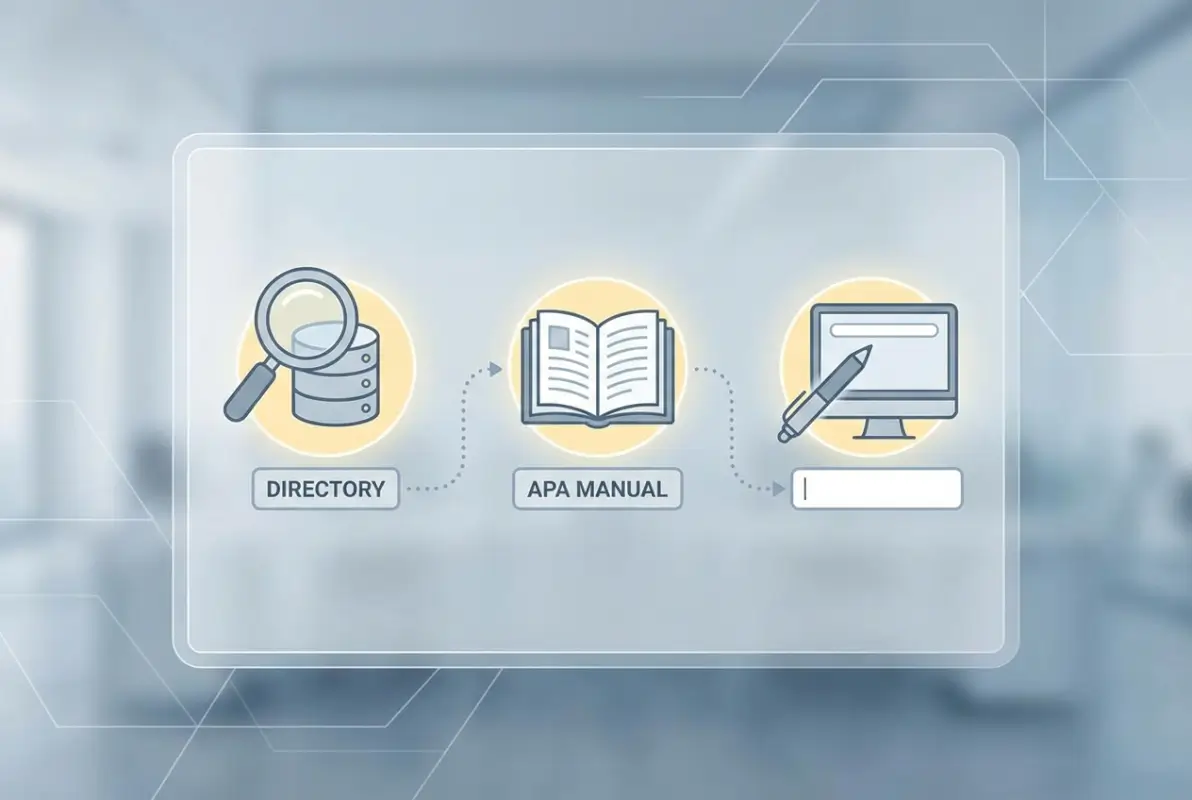
Let’s start with the basics, because not every list on the internet qualifies as a “directory” in the citation sense. An online directory is a curated, organized collection of entries—think professional registries (like state bar associations), business listings (Chamber of Commerce directories), scholarly directories (faculty databases), or government/education directories (agency employee listings). These aren’t random blog posts or Wikipedia pages; they’re structured databases maintained by credible organizations.
Definition and Scope
What separates a true directory from a regular webpage? Authority and structure. A directory is typically maintained by a recognized organization, updated regularly, and follows a consistent format for each entry. Examples include the American Psychological Association’s member directory, the U.S. Government’s federal employee directory, or a university’s faculty listing. If you’re pulling data from one of these, you’re dealing with a directory.
When to Cite an Online Directory in APA vs. the Directory’s Hosting Site
Here’s where things get tricky. Are you citing information from a specific entry (like Dr. Smith’s profile in a medical directory), or are you referencing the directory itself as a resource (like mentioning that the directory exists and contains 5,000 physicians)? The former requires citing the entry; the latter means citing the directory page or homepage. Confusing these leads to muddy references that leave readers guessing where to look.
Author, Year, and Organizational Responsibility
Most directories don’t have individual authors for each entry. Instead, the organization maintaining the directory becomes the author. For instance, if you’re citing an entry from the National Association of Realtors directory, the association is your author. This is called corporate authorship, and APA loves it (seriously, it simplifies things). Just make sure you can identify who’s responsible for maintaining the directory—if it’s unclear, that’s a red flag about the source’s credibility.
Retrieval Details and Stability of URLs
Not all URLs are created equal. Some directories archive entries permanently; others update them daily or even hourly. If the content you’re citing is likely to change (like a “current employees” directory that gets updated every week), include a retrieval date in your citation. But if you’re citing an archived or stable entry—say, a historical professional directory from a university library—you can usually skip the retrieval date. Check with your instructor or institution’s guidelines if you’re unsure, because practices vary slightly.
According to Virginia Peninsula Community College’s APA guide, retrieval dates are most important when “the content is designed to change over time and is not archived.” That’s your litmus test.
Core APA Reference Structure for Online Directories (7th Edition)
Now that you understand what you’re citing, let’s talk how. APA 7th edition has streamlined online citations, but directories still trip people up because they blur the line between webpages and database entries. The good news? Once you nail the basic structure, you can adapt it to almost any directory type.
Basic Reference Format for a Directory Entry
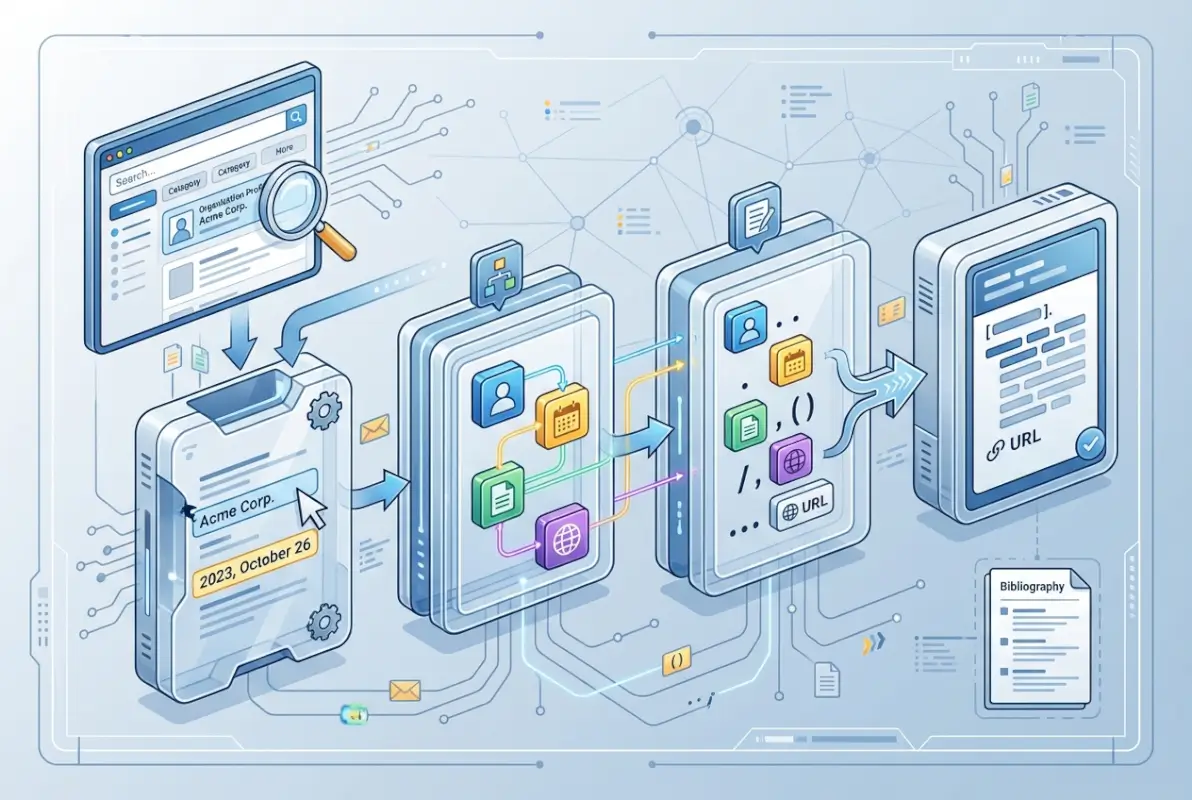
Here’s the skeleton you’ll use most often:
Author/Organization. (Year). Title of entry. Title of directory (if distinct from site). URL
For example:
American Dental Association. (n.d.). Dr. Jane Doe, DDS. ADA Member Directory. https://www.ada.org/memberdirectory/doe-jane
Notice a few things: the organization is the author, we used “(n.d.)” because no publication date was listed, the entry title is italicized (since it’s a standalone piece of content), and the directory title is included to clarify where this entry lives. If the entry title and directory title are identical or the directory name is obvious from the URL, you can simplify—but when in doubt, include both for clarity.
Basic Reference Format for a Directory Page (If No Specific Author)
Sometimes you’re citing the directory page itself, not an individual entry. Maybe you’re referencing the directory’s introduction or its search functionality. In that case:
Organization. (Year, Month Day). Title of page. Title of directory (if distinct). URL
Example:
U.S. Department of Education. (2023, August 15). Federal student aid office directory. https://studentaid.gov/offices
Here, the organization is still the author, but we included a full date because government pages often timestamp updates. If you can’t find a date, use (n.d.) and consider adding “Retrieved [date]” if the content is dynamic.
Handling Missing Publication Dates (n.d.) and Corporate Authors
Let’s be real: most directories don’t plaster publication dates on every entry. When you can’t find one, use “(n.d.)” (no date). Your reference looks like this:
National Council of State Boards of Nursing. (n.d.). Nurse licensure verification. NCSBN Nursys. https://www.nursys.com
For corporate authors, treat the organization as a single entity. Don’t break it into pieces or try to identify individual staff members unless they’re explicitly credited as authors. If the directory is maintained by a subcommittee or division (like “Office of Student Affairs, Harvard University”), list it as Harvard University for simplicity, unless the subcommittee is well-known enough to stand alone.
In-text Citations
In-text citations follow your reference-list format. If you cited the American Dental Association with no date, your in-text citation is (American Dental Association, n.d.). If you have a year, it’s (American Dental Association, 2022). Simple as that. For subsequent mentions in the same paragraph, you can drop the year, but keep it for new paragraphs to maintain clarity.
One quirk: if the organization name is long (like “International Association of Certified Home Inspectors”), you can abbreviate it in later citations (IACHI, 2022) as long as you introduce the abbreviation in the first citation: (International Association of Certified Home Inspectors [IACHI], 2022).
Step-by-Step Example Walkthroughs
Theory is great, but examples are where the rubber meets the road. Let’s walk through four real-world scenarios you’re likely to encounter when citing online directories. These aren’t hypothetical—these are the kinds of directories students and researchers cite every day.
Example 1 — Citing a Government/Education Directory Entry
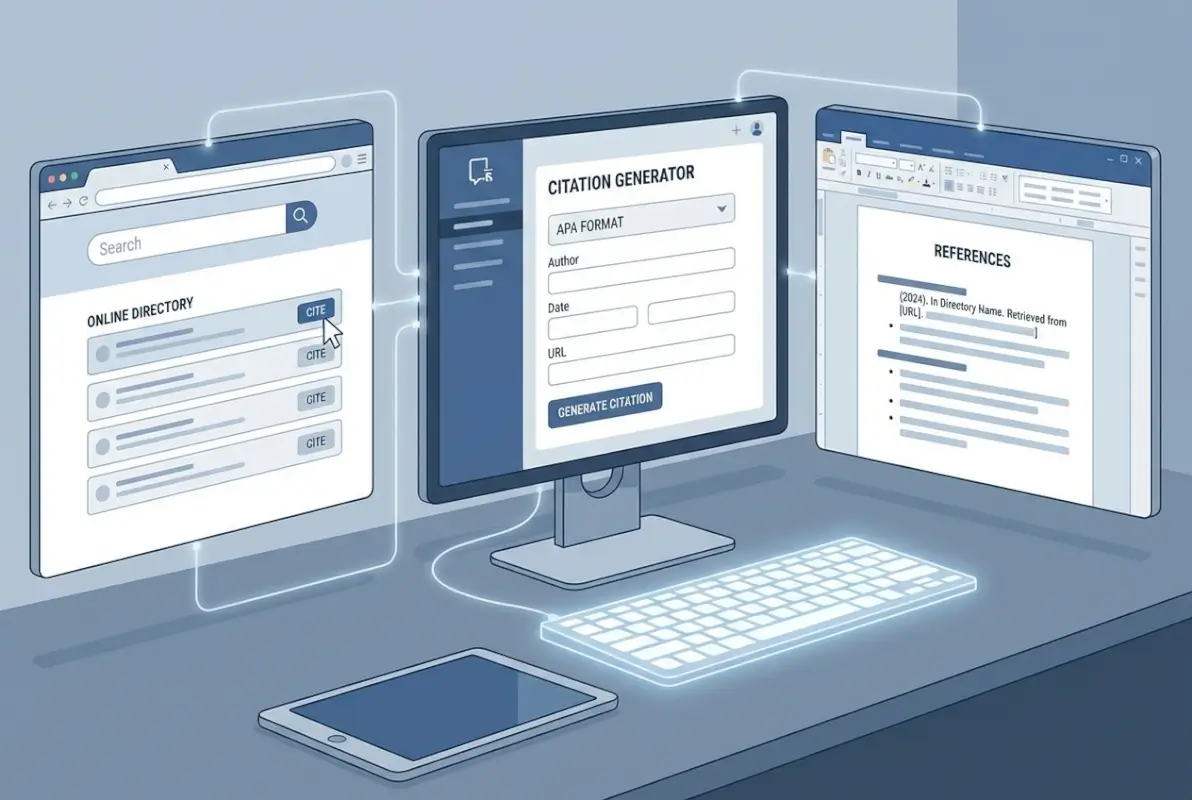
Imagine you’re writing a paper on public health infrastructure and you need to cite the contact information for a specific CDC division from their online staff directory. Here’s how to handle it:
Reference List:
Centers for Disease Control and Prevention. (n.d.). Division of HIV/AIDS Prevention. CDC Staff Directory. https://www.cdc.gov/nchhstp/dhap/
In-text Citation:
According to the CDC’s directory entry, the Division of HIV/AIDS Prevention coordinates national efforts to reduce HIV transmission (Centers for Disease Control and Prevention, n.d.).
Notice we treated the CDC as the author (corporate authorship), used (n.d.) because no date was listed, italicized the division name (since it’s the “entry title”), and included the directory name for context. For government directories, this structure works beautifully because agencies are almost always the responsible party.
Example 2 — Citing a Professional/Industry Directory
Now let’s say you’re citing a lawyer’s profile from a state bar association directory for a legal research project:
Reference List:
California State Bar. (2023). Attorney profile: John A. Smith. Attorney Search. https://apps.calbar.ca.gov/attorney/12345
In-text Citation:
Smith’s professional standing was verified through the state bar directory (California State Bar, 2023).
This one includes a year because the bar association timestamps profile updates. The entry title combines “Attorney profile” with the individual’s name to make it clear and searchable. If you were referencing multiple attorneys from the same directory, you’d differentiate by name in the entry title.
Example 3 — Citing a Directory Entry with Multiple Authors or a Corporate Author
Some directories list multiple people responsible for an entry—think a research team’s profile in a university directory. Here’s the approach:
Reference List:
Massachusetts Institute of Technology. (2022). Computer Science and Artificial Intelligence Laboratory (CSAIL) faculty directory. MIT Directory. https://www.csail.mit.edu/people
In-text Citation:
The CSAIL faculty directory highlights MIT’s interdisciplinary approach to AI research (Massachusetts Institute of Technology, 2022).
Even though this directory contains multiple faculty members, we’re citing the directory page itself (not an individual entry), so MIT remains the sole author. If you were citing a specific faculty member’s entry, you’d adjust the title to “Dr. Jane Doe” and keep MIT as the author (since they maintain the directory, not the faculty member).
Example 4 — Directory Page with No Individual Entry Author
What if you’re citing a directory’s homepage or overview page, not a specific entry? This happens when you’re discussing the directory as a resource:
Reference List:
American Medical Association. (n.d.). DoctorFinder. https://doctorfinder.ama-assn.org/
In-text Citation:
The AMA’s DoctorFinder tool provides patients with verified physician credentials (American Medical Association, n.d.).
Here, “DoctorFinder” is both the entry title and the directory name, so we didn’t repeat it. The AMA is the author, and since the page doesn’t list a publication date, we used (n.d.). This format works for any directory landing page where you’re citing the directory itself, not a specific entry within it.
For more examples of creating structured directories, explore how organizations maintain these resources.
Common Pitfalls and How to Avoid Them
Even seasoned researchers stumble when citing online directories. Why? Because directories occupy a weird space between databases, webpages, and organizational documents. Let’s address the four biggest mistakes I’ve seen—and how to sidestep them entirely.
Overlooking Publication/Last-Updated Dates
You land on a directory entry, scan for information, and… no date in sight. Your first instinct might be to skip the date field entirely, but APA requires some date indicator. If you truly can’t find a publication or update date, use (n.d.). But before you do, check the page footer, the “About” section, or the URL for timestamps (some sites embed dates in the URL slug, like “/2023/directory/”). Many directories list “last updated” dates in fine print—don’t overlook them.
Citing the Directory Host vs. the Specific Entry
This is the number-one pitfall I see students make. They cite “Google” or “LinkedIn” when they mean to cite a specific profile within a professional directory. Remember: if you’re using information from Jane Doe’s LinkedIn profile (a directory entry), cite LinkedIn as the organizational author and Jane Doe’s profile as the entry title. Don’t just cite “LinkedIn.com” generically. The same goes for university directories—cite the university as the author, then specify the entry (like a faculty member’s page) in the title. This distinction ensures readers can locate your exact source.
Using Long or Unstable URLs Without a Retrieval Note
Some directories generate ridiculously long URLs with session IDs, tracking parameters, or temporary tokens (like “?sessionid=abc123xyz”). These URLs break over time, leaving your readers (and your professor) unable to verify your source. Whenever possible, trim the URL to its shortest stable form. If the directory warns that content changes frequently—or if you’re citing a “current employees” page—add a retrieval date: “Retrieved January 10, 2024, from [URL].” This signals to readers that the information was accurate at that moment, even if it changes later.
According to Mass General Hospital’s APA guide, you should “include a retrieval date when the source material may change over time (for example, Wikis).” Apply the same logic to dynamic directories.
Missing Author Information or Misattributing Authorship
Who’s responsible for maintaining this directory? If you can’t answer that question confidently, you have an authorship problem. Some directories bury their “About Us” page or fail to credit the maintaining organization anywhere visible. In those cases, you have two options: dig deeper (check the site’s footer, domain registration, or parent organization), or—if you still can’t identify a credible author—reconsider whether the source is reliable enough for academic use. APA style assumes your sources are credible; if authorship is murky, that’s a red flag. Don’t invent an author or default to “Anonymous” unless absolutely necessary (and even then, your instructor may push back).
For insights on building credible directory websites, see what features establish authority.
Current Statistics and Trends Related to Online Information Behavior
Why should you care about internet usage trends when you’re just trying to cite a directory? Because understanding how people access and trust online information in 2024 and beyond helps you evaluate the credibility and stability of the directories you’re citing. Let’s look at the data.

Global Internet Usage and Frequency of Online Activity
As of recent reports, billions of people worldwide are online daily, and that number keeps climbing. According to Pew Research Center, internet usage among American adults has plateaued near saturation, with the vast majority (around 90% or more) going online at least occasionally. More importantly for our purposes, people increasingly rely on online directories—whether for finding local services, verifying professional credentials, or researching organizations. This shift means directories are no longer niche resources; they’re mainstream reference tools that deserve careful citation.
Pew’s research also shows that younger demographics (teens and young adults) engage with online directories differently than older generations—they’re more likely to cross-reference multiple directories and check for real-time updates. This behavior underscores the importance of including retrieval dates when citing dynamic directories, because users expect current information.
Implications for Citing Online Directories
With online content proliferating at breakneck speed, not all directories are created equal. Some are meticulously maintained by credible organizations; others are cobbled together by fly-by-night operators with no oversight. When you cite a directory, you’re vouching for its credibility, so choose wisely. The same Pew data that shows rising internet use also highlights growing concerns about misinformation and source verification. In academic contexts, that means your citations need to demonstrate why a directory is trustworthy—clear authorship, stable URLs, and transparent update practices all signal credibility.
2024–2026 Snapshot Notes
Looking ahead, experts predict continued growth in specialized directories (like field-specific professional registries) and increased use of AI-powered directory tools. However, this also means more directories will be algorithmically generated or auto-updated, raising questions about authorship and stability. For citation purposes, stick to directories with clear organizational ownership and transparent maintenance practices. If a directory can’t tell you who runs it or when it was last updated, it’s probably not citation-worthy—no matter how slick it looks.
Interestingly, global digital adoption reports show that mobile devices now account for the majority of directory lookups, which means directory developers are optimizing for on-the-go users. For researchers, this translates to shorter, mobile-friendly URLs and faster-loading pages—good news for citation stability, since shorter URLs tend to be more permanent.
Explore directory management features to see how organizations maintain accurate, up-to-date listings.
Best Practices for Citing Online Directories in Academic Work
Knowing the rules is one thing; applying them smartly is another. These best practices will help you navigate edge cases and ensure your directory citations hold up under scrutiny—whether you’re submitting to a professor, a journal, or a thesis committee.
When to Include Retrieval Dates
We’ve touched on this, but it’s worth repeating: include a retrieval date if the directory content is likely to change and isn’t archived. Examples include employee directories that update weekly, real-time business listings, or “current members” pages. If the directory archives old versions (like some university libraries do), you may not need a retrieval date—but double-check your institution’s preferences. When in doubt, including a retrieval date never hurts; it just adds precision.
How to Handle Archived or Captured Directory Entries
What if you’re citing a directory entry that’s been archived via the Wayback Machine or a similar service? Treat the archive as the “publisher” and include both the original URL and the archive URL. For example:
American Library Association. (2015). Library directory: Springfield Public Library. Retrieved from https://web.archive.org/web/20150601120000/http://www.ala.org/directory/springfield
This shows readers that the content existed at a specific point in time, even if the original URL is now broken. Archived directory entries are gold for historical research, but they require careful citation to avoid confusion.
Cross-Checking Directory Accuracy and Authority
Before you cite any directory, ask yourself: Is this source authoritative? Check for accreditation, professional affiliations, or endorsements from recognized organizations. For instance, a medical directory maintained by a state licensing board is far more credible than a random “find a doctor” site with no clear oversight. If you can’t verify the directory’s authority, consider finding an alternative source. Your citations reflect on your credibility as a researcher, so choose wisely.
Accessibility and Link Rot Considerations
Link rot—the phenomenon where URLs break over time—is a real problem for online citations. To minimize this risk, favor directories with stable, clean URLs (no weird session tokens or query parameters). If you’re citing a directory hosted by a major organization (like a government agency or professional association), the URL is more likely to remain functional. For smaller directories, consider archiving the page yourself via the Wayback Machine and including that link as a backup. Accessibility also matters: ensure the directory you’re citing is publicly accessible (not behind a paywall) so readers can verify your source.
Learn more about directory listing management to understand how organizations maintain stable, accessible entries.
Practical, Standalone Reference Templates (APA 7th Ed.)
Ready for some plug-and-play formats? Copy these templates and adapt them to your specific directory citation needs. I’ve included four common scenarios to cover most situations you’ll encounter.
Template A — Directory Entry with Author/Organization
Format:
Organization Name. (Year). Title of specific entry. Directory Name (if different from organization). URL
Example:
National Association of Realtors. (2023). Agent profile: Sarah Johnson. Realtor Directory. https://www.nar.realtor/directory/johnson-sarah
In-text: (National Association of Realtors, 2023)
Template B — Directory Page with Organization as Author (No Entry Author)
Format:
Organization Name. (Year, Month Day). Title of page. URL
Example:
U.S. Small Business Administration. (2023, July 10). Local resource partner directory. https://www.sba.gov/local-assistance
In-text: (U.S. Small Business Administration, 2023)
Template C — Entry with No Date (n.d.)
Format:
Organization Name. (n.d.). Title of entry or page. Directory Name (if applicable). URL
Example:
Institute of Electrical and Electronics Engineers. (n.d.). Member directory: Dr. Alan Turing. IEEE Member Directory. https://www.ieee.org/membership/directory/turing
In-text: (Institute of Electrical and Electronics Engineers, n.d.)
Template D — Retrieved from an Online Directory with No Stable URL
Format:
Organization Name. (n.d.). Title of entry. Directory Name. Retrieved Month Day, Year, from URL
Example:
Texas Education Agency. (n.d.). School district directory: Austin ISD. TEA School Directory. Retrieved January 15, 2024, from https://tea.texas.gov/directory/austin
In-text: (Texas Education Agency, n.d.)
| Template Type | Use When | Key Feature |
|---|---|---|
| Template A | Citing a specific entry with a known author/org and date | Includes year in parentheses |
| Template B | Citing a directory page (not an individual entry) | Full date if available |
| Template C | No publication date available | Uses (n.d.) |
| Template D | Unstable URL or frequently changing content | Includes retrieval date |
Accessibility, Diversity, and Inclusivity Considerations
APA isn’t just about commas and italics—it’s also about respect and accessibility. When citing online directories, keep these ethical and practical considerations in mind to ensure your work is inclusive and accessible to all readers.
Ensuring Accessible Citations for Readers with Disabilities
Your citations should be readable by screen readers and other assistive technologies. That means avoiding image-only references (like screenshots of directory entries without alt text) and ensuring your URLs are functional and descriptive. If you’re citing a directory with accessibility features (like text alternatives for images), mention that in your paper when relevant—it signals awareness of inclusive practices.
Language and Naming Conventions in Directory Entries
Some directories include entries with non-English names, titles, or credentials. Preserve original spelling and diacritical marks (like accents or tildes) in your citations. Don’t anglicize names or translate titles unless the directory itself does so. This respect for linguistic diversity aligns with APA’s emphasis on cultural sensitivity and accuracy.
Ethical Considerations for Directories with Sensitive Data
Some directories contain sensitive information—think medical practitioner directories with personal details or directories of abuse survivors. Before citing such a directory, ask yourself: Is this information publicly intended for academic citation, or could my citation expose individuals to risk? If the directory is password-protected or marked “confidential,” it’s not appropriate to cite publicly. Always prioritize privacy and ethical use of information, especially when human subjects are involved.
External Resources and Further Reading (APA Guidance)
No single guide can cover every edge case, so here are authoritative external resources to deepen your APA citation knowledge, especially for online directories and electronic sources.
University-Level APA Reference Guides
University library guides are gold mines for practical APA examples. Check out Virginia Peninsula Community College’s APA online sources guide for clear explanations of retrieval dates and authorship. Davenport University’s APA references guide offers side-by-side examples of web-based sources, including directories. These guides are maintained by professional librarians and updated regularly, so they’re reliable starting points.
Official APA Style Resources for Electronic References
For the ultimate authority, consult the American Psychological Association’s official website. Their style blog includes posts on citing webpages, databases, and organizational websites—all relevant to directory citations. While the APA Manual itself doesn’t call out “directories” as a distinct category, the principles for citing organizational webpages and database entries apply directly.
Directory-Specific Citation Examples from Library Guides
Some libraries publish guides specifically for field-specific directories. For example, Green River College’s online sources APA guide includes examples for government and educational directories. Murdoch University’s APA internet guide covers international directories and non-U.S. sources, which is helpful if you’re citing directories outside the United States.
Frequently Asked Questions
How do I cite an online directory entry in APA 7th edition?
Start with the organization maintaining the directory as the author, followed by the year in parentheses (or “n.d.” if no date). Italicize the title of the specific entry, include the directory name if distinct, and end with the URL. In-text citations use (Author/Organization, Year) or (Organization, n.d.). For example: American Dental Association. (n.d.). Dr. Jane Doe, DDS. ADA Member Directory. https://www.ada.org/memberdirectory/doe-jane
Should I include the retrieval date for directory entries?
Include a retrieval date only if the directory content is likely to change frequently and isn’t archived. For stable, permanent entries (like archived university directories), you can omit the retrieval date. If the directory updates daily or weekly, use “Retrieved Month Day, Year, from URL” at the end of your reference. Always check your institution’s specific guidelines for retrieval date requirements.
What if the directory has no clear author?
Use the organization responsible for maintaining the directory as the corporate author. For example, if a state bar association runs a directory, cite the association as the author. If you cannot identify any responsible organization, reconsider whether the source is credible enough for academic use. Avoid using “Anonymous” unless absolutely necessary, and consult your instructor if authorship is unclear.
How do I handle entries with multiple authors or editors?
List up to 20 authors according to APA 7th edition guidelines, using commas and an ampersand (&) before the final author. However, most directory entries use corporate authorship (the organization), so individual authors are rare. If individual contributors are clearly identified (like editors of a directory page), list them as you would for a multi-author article, but keep the organization as the primary author if applicable.
Can I cite a directory the same way I cite a webpage?
Yes, with modifications. Treat the directory as you would an organizational webpage, but tailor the reference to include the entry title (italicized), the directory name if distinct from the site, and the organization as the corporate author. The basic APA structure for webpages applies, but you’ll need to specify whether you’re citing a specific entry or the directory page itself to avoid confusion.
Are there recommended templates I can copy?
Yes—most university APA guides provide ready-to-use templates for online sources, including directories. See the “Practical, Standalone Reference Templates” section above for four common scenarios: directory entry with author, directory page with organization as author, entry with no date, and entry with no stable URL. Copy these templates and adapt the details to your specific directory citation.
What if the directory URL is very long or contains session tokens?
Trim the URL to its shortest stable form by removing session IDs, tracking parameters, and temporary tokens. If the URL changes every time you visit the page, include a retrieval date in your reference: “Retrieved Month Day, Year, from [clean URL].” This ensures readers understand the link was valid at a specific time, even if it breaks later. Avoid copying URLs directly from your browser’s address bar without cleaning them first.
How do I cite an archived directory entry from the Wayback Machine?
Include both the original URL and the Wayback Machine archive URL in your reference. Start with the organization and year (or n.d.), italicize the entry title, and format the URL as: “Retrieved from https://web.archive.org/web/[timestamp]/[original URL].” This shows readers that the content was captured at a specific point in time and provides a stable link to the archived version.
Do I need to cite the entire directory or just the specific entry I used?
Cite the specific entry if you’re referencing information from it (like contact details or credentials). Cite the directory page or homepage if you’re discussing the directory itself as a resource (like its purpose, scope, or number of entries). The distinction matters for accuracy and helps readers locate your exact source. When in doubt, ask yourself: What information am I actually using in my paper?
Can I abbreviate long organization names in my in-text citations?
Yes, introduce the abbreviation in your first in-text citation, then use the abbreviation in subsequent citations. For example: (International Association of Certified Home Inspectors [IACHI], 2022) on first mention, then (IACHI, 2022) afterward. Make sure the abbreviation is widely recognized or clearly defined to avoid confusing readers. Don’t abbreviate organization names that are short or already well-known (like “CDC” or “NASA”).
Conclusion
Citing an online directory in APA format doesn’t have to be a guessing game. Once you understand the core principles—corporate authorship, clear entry titles, stable URLs, and appropriate use of retrieval dates—you can adapt these rules to any directory type you encounter. Whether you’re referencing a government employee database, a professional association’s member registry, or a university’s faculty directory, the templates and examples we’ve covered give you a solid foundation to build on.
Remember, your citations are more than just bureaucratic hoops to jump through; they’re a signal of your credibility and respect for intellectual property. By taking the time to cite directories accurately, you’re demonstrating that you understand the nuances of APA style and that you value precision in academic work. That’s the kind of attention to detail that professors notice—and that sets you apart from peers who treat citations as an afterthought.
So here’s your action plan: bookmark this guide, copy the templates that fit your needs, and double-check every directory citation against the examples we’ve provided. When you encounter an edge case (and you will), consult the external resources listed above or reach out to your institution’s writing center. Don’t let directory citations slow you down or trip you up, because now you’ve got the tools to handle them like a pro.
One last thing: APA style evolves, and so do online directories. Stay current by checking official APA updates and reputable university library guides at least once a year. The fundamentals we’ve covered here will remain relevant, but minor formatting tweaks happen—staying informed means you’ll never be caught off guard by a style change. Now go forth and cite with confidence!
Was this article helpful?