Directory Website SEO: 7 Proven Strategies to Rank Higher in 2026

Generating summary...
Most directory websites fail at SEO because they treat thousands of listings like an afterthought—dumping data onto pages without structure, schema, or strategy. Here’s the truth nobody talks about: your directory isn’t just competing with other directories anymore. You’re fighting against AI-generated overviews, featured snippets, and local pack results that answer users’ questions before they ever click through. The good news? Directory websites have unique advantages that, when properly optimized, can dominate local search, capture answer-engine traffic, and build genuine topical authority that scales across thousands of pages.
If you’ve been wondering why your business directory gets buried on page three while competitors with fewer listings rank higher, the problem likely isn’t your data—it’s how search engines crawl, interpret, and trust that data. Directory website SEO in the modern landscape requires fundamentally different tactics than blog SEO or e-commerce optimization. You’re managing entity relationships, local signals, user-generated content, and massive site architecture all at once.
TL;DR – Quick Takeaways
- Technical foundation comes first – Fix crawlability, pagination, and Core Web Vitals before anything else or you’re optimizing invisible pages
- Data quality beats data quantity – Accurate NAP, complete business attributes, and fresh listings outperform massive databases of stale information
- Answer-engine optimization is non-negotiable – PAA blocks, structured FAQ content, and snippet-friendly formatting capture visibility in AI-driven search
- Schema markup is your competitive edge – LocalBusiness and Organization schema turn generic listings into rich results that earn clicks
- Quality backlinks scale your authority – One editorial link from a city guide beats 100 directory submissions
1. Build a Rock-Solid Technical Foundation for Directory SEO
Most directory owners obsess over content and backlinks while their site’s technical foundation quietly sabotages every optimization effort. When you’re managing hundreds or thousands of listing pages, technical SEO stops being a nice-to-have and becomes the difference between comprehensive indexing and having 70% of your valuable pages invisible to search engines. Google won’t rank pages it can’t crawl efficiently, and users won’t engage with pages that take seven seconds to load.
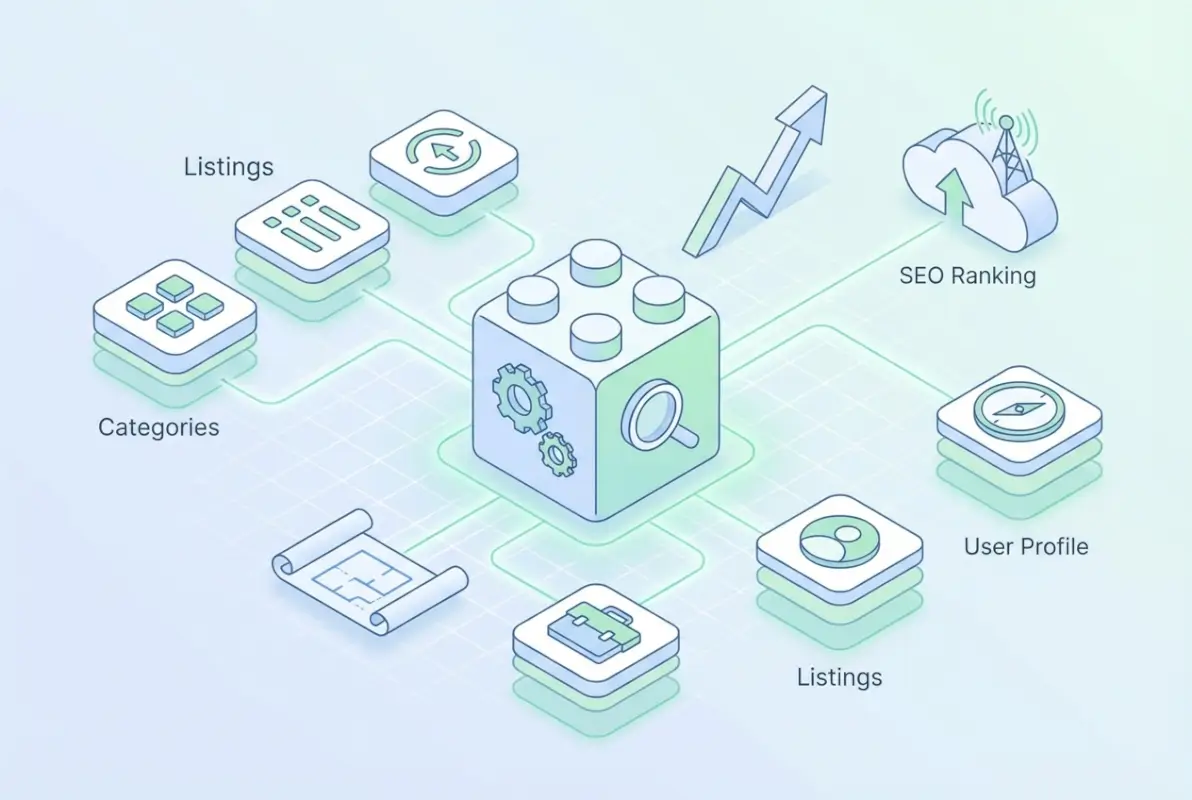
The reality is harsh: directory sites are technical nightmares by default. You’ve got duplicate content across location variations, pagination that confuses crawlers, and listing pages that balloon with unoptimized images and slow-loading review widgets. Before you write another category description or chase another backlink, you need to verify that search engines can actually access, understand, and prioritize your most important pages. This isn’t glamorous work, but it’s foundational—without it, everything else you do delivers half the results it should.
Ensure Crawlability and Indexability
Start with your XML sitemap architecture. For directories, a single massive sitemap is a mistake—you need segmented sitemaps organized by content type (categories, locations, individual listings) with priority signals that guide crawlers to your most valuable pages first. Your robots.txt file should explicitly allow access to all public-facing listing and category pages while blocking search result pages, filter combinations, and user account sections that waste crawl budget. According to Google’s sitemap documentation, well-structured sitemaps help search engines discover and prioritize URLs more efficiently.
Pagination is where most directories implicitly create duplicate content disasters. If you’re displaying 20 listings per page across 50 pages of results, you need proper rel=”next” and rel=”prev” tags (or view-all canonicalization if appropriate) so Google understands the relationship between paginated pages. Canonical tags on category pages should point to the main category URL, not individual filtered or sorted variations. I’ve seen directories lose 60% of their indexed pages overnight because they canonicalized every listing page to the homepage—don’t make that mistake.
Crawl path optimization matters more for directories than almost any other site type. Every listing should be accessible within three clicks from your homepage through logical category hierarchies. Orphaned listings (pages with no internal links pointing to them) are essentially invisible. Run regular crawls with tools like Screaming Frog to identify orphaned pages, broken internal links, and redirect chains that slow down crawler progress. Clean crawl paths mean search engines spend their limited crawl budget on your best content instead of getting lost in architectural dead ends.
Performance, Schema, and Structured Data
Core Web Vitals are non-negotiable ranking factors, and directory sites struggle with them more than leaner site types. Your Largest Contentful Paint (LCP) likely suffers from slow-loading hero images or unoptimized maps on listing pages. Fix this by lazy-loading non-critical images, using next-gen formats like WebP, and ensuring your featured images are sized appropriately for viewport dimensions. Cumulative Layout Shift (CLS) problems typically come from ads, review widgets, or maps that load after initial page render—reserve space for these elements in your CSS so the page doesn’t jump around as content loads.
First Input Delay (now evolving into Interaction to Next Paint) measures how quickly your directory responds to user actions. Heavy JavaScript from third-party review platforms, social sharing widgets, and tracking scripts kills this metric. Audit every third-party script—if it’s not directly generating revenue or critical functionality, remove it. For building an online directory with strong technical foundations, consider platforms that prioritize performance from the start rather than bolting optimizations onto bloated themes later.
Schema markup is where directories gain a massive advantage over competitors who skip structured data. LocalBusiness schema on every listing page tells search engines the business name, address, phone, hours, price range, and review ratings in a format they can parse reliably. Organization schema on your homepage establishes your directory as an authoritative entity. If you’re aggregating products or services, Product schema can earn rich results with pricing and availability. The U.S. Chamber of Commerce research on local SEO benefits shows that complete, structured business data significantly improves local search visibility.
Don’t implement schema incorrectly—Google will ignore it or penalize you. Use Google’s Rich Results Test to validate every schema implementation, especially on template pages that repeat across thousands of listings. Common mistakes include putting the directory’s address in LocalBusiness schema for every listing (it should be the listed business’s address) or using aggregate ratings before you have genuine user reviews. When done right, schema transforms your listings from plain blue links into rich results with star ratings, business hours, and click-worthy visual elements.
2. Create Topical Authority with Thorough, Intent-Driven Directory Content
Most directory owners make a fatal assumption: they believe comprehensive listings alone establish topical authority. They don’t. Search engines evaluate topical authority through content depth, internal linking patterns, update frequency, and how well your content satisfies the full spectrum of user intent around a topic. If your directory lists 500 restaurants but publishes zero helpful content about choosing restaurants, understanding cuisine types, or navigating dining options in specific neighborhoods, you’re leaving massive authority and traffic on the table.
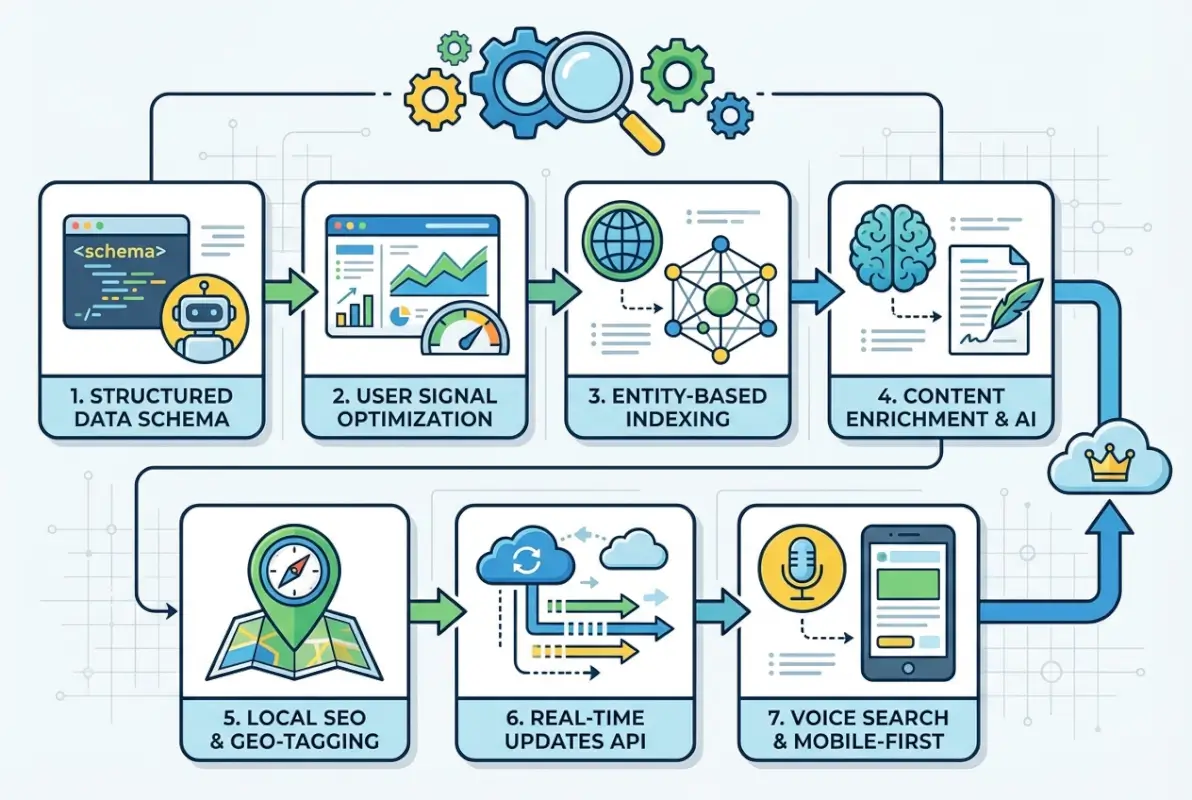
The shift toward AI-generated overviews and answer engines makes topical authority even more critical. When someone searches “best Italian restaurants in Austin,” they’re not just looking for a list—they want neighborhood recommendations, price range guidance, parking information, and insider tips. If your directory provides bare-bones listings while a competitor publishes comprehensive neighborhood dining guides with those contextual details, you lose. Topical authority isn’t built through keyword density, it’s earned by covering a topic so thoroughly that search engines recognize you as the definitive source.
Topic Clustering and Pillar Content
Topic clusters transform scattered directory content into an organized knowledge hub. Your pillar page might be “Complete Guide to Austin Restaurants”—a comprehensive 3,000-word resource covering neighborhoods, cuisine types, price ranges, and dining trends. That pillar links to cluster content: individual neighborhood guides (“Best Restaurants in East Austin”), cuisine-specific roundups (“Top 10 BBQ Joints in Austin”), and practical how-to content (“How to Make Reservations at Austin’s Most Popular Restaurants”). Every cluster page links back to the pillar and to related clusters, creating a topical web that signals authority.
For directories, your individual listings function as micro-clusters. Each restaurant listing should link to its neighborhood page, cuisine category page, and relevant pillar content. This internal linking architecture tells search engines these pages are related entities within your authoritative coverage of Austin dining. The mistake most directories make is treating listings as isolated pages—they should be integrated nodes in your topical network. When setting up directory design principles, plan your information architecture around these cluster relationships from day one.
Freshness signals matter enormously for directory authority. A pillar page published two years ago and never updated sends weak authority signals compared to one that’s regularly updated with new listings, seasonal recommendations, and current trends. Schedule quarterly reviews of your top pillar content to add new data, remove outdated information, and expand sections that users engage with most. Even minor updates (adding three new listings to a “Top 20” roundup, updating hours for holiday seasons) signal to search engines that this content remains current and valuable.
Unified On-Page Signals for Directory Categories
On-page optimization for directories requires ruthless consistency across templates. Your category pages need predictable H1/H2 hierarchy: H1 for the category name (“Plumbers in Seattle”), H2s for key sections (“Top-Rated Plumbers,” “Emergency Plumbing Services,” “How to Choose a Plumber”). This consistency helps search engines understand your content structure and makes it easier to scale optimization across thousands of pages. According to Moz’s on-page SEO research, clear heading hierarchy remains a foundational ranking factor even as algorithms evolve.
Every category and listing needs a unique, compelling title tag and meta description. Yes, this is tedious at scale—but it’s non-negotiable for competitive directory SEO. Template-driven titles like “Business Name | Your Directory” are wasted opportunities. Better: “Joe’s Plumbing – 24/7 Emergency Service in Seattle | 50+ 5-Star Reviews.” Your meta description should answer why this listing or category deserves a click: “Seattle’s highest-rated emergency plumber. Same-day service, licensed & bonded, free estimates. Compare verified reviews from 200+ local customers.”
Keyword intent alignment prevents the common trap of optimizing for the wrong search intent. Someone searching “plumbers near me” wants a quick list of nearby options with phone numbers and hours (transactional intent). Someone searching “how to find a reliable plumber” wants educational content about vetting contractors, checking licenses, and comparing quotes (informational intent). Your category pages should satisfy transactional intent with clear listings and contact information, while your pillar and cluster content satisfies informational intent with guides and advice. Mixing these on the same page confuses users and dilutes relevance signals.
Internal anchor text matters more than most directory owners realize. When linking from your homepage to “Plumbers in Seattle,” use that exact phrase as anchor text—not “click here” or “view listings.” When a plumber’s individual listing links to the category page, the anchor might be “see all Seattle plumbers” or “more plumbing services in Seattle.” Varied but descriptive anchor text helps search engines understand page relationships and distributes ranking power effectively throughout your directory structure. For business directory websites and platforms, consistent internal linking can make the difference between page-three obscurity and page-one visibility.
3. Optimize Listings Data Quality, Freshness, and Local Signals
Directory SEO lives or dies on the quality of its listing data. Search engines prioritize directories that provide accurate, complete, and up-to-date information because users rely on these details to make decisions. Every incomplete phone number, outdated business hour, or inconsistent address erodes trust with both visitors and crawlers.

For directories managing hundreds or thousands of listings, data quality becomes a systems problem, not just a content problem. You need standardized fields, validation rules, and regular audits to maintain consistency across every page. Without these guardrails, even a small percentage of inaccurate listings can drag down the perceived authority of your entire site.
Accurate, complete listing data
Start with a rock-solid data schema that enforces Name, Address, and Phone (NAP) consistency across every listing. Search engines cross-reference NAP data with other directories and local signals; mismatches flag your directory as less reliable. Build validation into your submission forms and flag any listing that deviates from standard formats (abbreviations, missing suite numbers, inconsistent phone formatting).
Beyond NAP, enrich each listing with attributes that users actually search for: business hours, services offered, accepted payment methods, accessibility features, and categories. Automated enrichment tools can pull missing data from public APIs or third-party sources, but always layer in human review for edge cases—AI tools still struggle with nuance. The goal is to answer every common question a searcher might have without forcing them to leave your directory or click through to a third-party site.
| Data Field | Impact on SEO | Validation Method |
|---|---|---|
| NAP (Name, Address, Phone) | Critical for local ranking and trust signals | Format checks, third-party API verification |
| Business Hours | High – users filter/sort by availability | Regular prompts for business owners to update |
| Services/Categories | Moderate – improves keyword relevance | Controlled taxonomy with multi-select options |
| Images & Media | Moderate – boosts engagement, CTR, dwell time | Minimum resolution/size checks, alt-text required |
Local signals and user-generated content
User reviews are one of the strongest signals you can offer for both local SEO and overall directory authority. They provide fresh, unique content at scale—exactly what search engines want to see on listing pages. Encourage every visitor to leave a review by surfacing simple, low-friction forms directly on listing pages and sending follow-up emails to past users.
Moderate and respond to reviews quickly to show that your directory is actively maintained and that business owners are engaged. Responding to reviews (both positive and negative) signals human oversight and builds trust with new visitors. On the schema side, implement Review and AggregateRating markup so rich snippets can display star ratings directly in search results, which drives higher click-through rates.
For geography-heavy directories, create dedicated city and region landing pages that aggregate listings by location. Each city page should include localized content—not just a list of businesses, but a brief introduction to the area, common services in that region, and links to sub-neighborhoods or categories. Pair these pages with Place or LocalBusiness schema to reinforce local relevance and help crawlers understand your geographic coverage.
4. Earn High-Quality References and Backlinks Without Spammy Tactics
Backlinks remain a top-three ranking factor for directory sites, but the rules have changed. Low-quality link schemes—mass directory submissions, paid placements on sketchy link farms—carry real risk in 2026. Google’s algorithms are better than ever at detecting manipulative patterns, and a single penalty can erase months of SEO work.

The antidote is value-driven link building: create content that industry bloggers, local news sites, and niche publishers actually want to reference. For directories, this means publishing unique data sets, city-specific guides, and curated lists that solve real problems for your target audience. When you provide insights no one else has, editorial links follow naturally.
Strategic link-building for directory ecosystems
Start by identifying the blogs, city guides, and industry publications that already link to your competitors. Tools like Ahrefs or Semrush can surface these opportunities in minutes. Reach out with a clear value proposition: “We just published the most comprehensive guide to [category] in [city], complete with verified hours and user ratings. Thought it might be useful for your readers.”
Contextual links from high-authority, topically relevant sites carry far more weight than hundreds of generic directory listings. Prioritize quality over volume: one link from a respected city blog or chamber of commerce page is worth more than a dozen links from low-traffic, low-trust directories. Avoid reciprocal link exchanges and three-way link schemes; search engines are adept at spotting these patterns.
For directories with unique data, create shareable resources like annual reports, trend analyses, or “State of [Industry] in [Region]” posts. Journalists and bloggers love citing original research, and data-backed content is one of the easiest ways to earn natural backlinks. Host these resources on dedicated pillar pages and promote them through email outreach, social channels, and industry newsletters.
| Link Source Type | Value | Acquisition Method |
|---|---|---|
| Local news & city blogs | High – topically relevant, trusted domain | Pitch unique local data or curated guides |
| Industry association sites | High – authoritative, niche-specific | Sponsor events, contribute guest posts |
| Partner directories (selective) | Moderate – if high-quality and non-reciprocal | Strategic partnerships, co-marketing |
| Mass directory submissions | Low to None – high spam risk | Avoid entirely |
Directory-specific credibility and trust signals
Beyond external links, build credibility signals directly into your directory’s content and design. Editor-curated badges (“Editor’s Pick,” “Top Rated”) encourage business owners to promote their listings on social media and their own sites, which can generate natural inbound links. Highlight any media mentions or industry awards your directory has received; these trust markers signal to both users and search engines that your site is a credible authority.
Avoid the temptation to submit your directory to every free listing site you can find. Low-quality directory placements dilute your link profile and can trigger spam filters. Instead, focus on a curated list of high-authority directories in your niche—think chamber of commerce sites, .edu resources, or government-run business registries. A handful of strong placements will outperform hundreds of weak ones.
5. Harness AI, PAA, and the Answer-Engine Era for Directory Content
Search is evolving from a list of blue links to a direct-answer interface powered by AI and featured snippets. People Also Ask (PAA) boxes, AI Overviews, and zero-click results now dominate high-intent queries. For directories, this shift means you need to structure content not just for ranking, but for extraction—making it easy for search engines to pull your content into these prominent answer positions.

The good news: directories are naturally suited to answer common questions about local businesses, services, and categories. By embedding FAQ-style content directly into your listing and category pages, you can capture PAA real estate and increase your visibility in AI-generated results. The format matters as much as the content; search engines prefer concise, structured answers that can be parsed and served without additional context.
Optimize for People Also Ask (PAA) and related questions
Start by researching the PAA questions that appear for your core keywords. Search for “[category] in [city]” or “best [service] near me” and note the questions Google surfaces. Tools like AlsoAsked or AnswerThePublic can map out entire question clusters. Use these insights to build FAQ blocks on your category pages, city landing pages, and even individual listings.
Each FAQ answer should be 40–60 words—long enough to provide value, short enough to fit in a featured snippet. Use clear, direct language: “How do I find the best [category] in [city]? Browse our verified listings, filter by user ratings and hours, and read real customer reviews to make an informed choice.” Avoid marketing fluff; PAA answers reward clarity and utility.
Integrate these micro-answers directly into your page structure using proper heading tags (<h3> for the question, followed by a <p> for the answer). Implement FAQPage schema to explicitly mark up question-answer pairs, increasing your chances of appearing in rich results. Even if you don’t win the featured snippet, well-structured FAQ content improves dwell time and reduces bounce rates—both positive user signals.
Content formats that align with AI-driven results
AI engines and featured snippets favor content that’s easy to parse: bullet lists, numbered steps, comparison tables, and short paragraphs. Rewrite your category introductions and listing descriptions to frontload key information in scannable formats. Instead of long prose blocks, use bulleted lists of services, tables comparing top options, or step-by-step guides (“How to use this directory”).
Tables are especially powerful for directories because they present data in a structured, machine-readable format. Create comparison tables that highlight the top 5 or 10 listings in a category, showing ratings, price range, services, and contact info side by side. Search engines can extract individual cells from tables and serve them as direct answers, giving you multiple entry points into zero-click results.
Keep an eye on how AI Overviews cite sources. In 2026, search engines increasingly credit sites that provide concise, authoritative answers with minimal fluff. Trim every unnecessary word from your introductions and summaries; aim for information density, not word count. The more directly you answer a user’s question, the more likely an AI engine will surface your content as the best source.
| Content Format | AI/PAA Suitability | Best Use Case |
|---|---|---|
| Bullet lists | High – easy to extract and display | Services offered, key features, quick tips |
| Comparison tables | Very High – structured, scannable data | Top 5/10 listings, feature comparisons |
| FAQ blocks (Q&A pairs) | Very High – matches PAA format exactly | Common user questions, how-to guidance |
| Long-form paragraphs | Low – harder to parse and extract | Deep-dive guides (use sparingly) |
Frequently Asked Questions
What is a directory website SEO, and why is it different from standard website SEO?
Directory website SEO focuses on optimizing large-scale listing platforms with hundreds or thousands of pages. Unlike standard sites, directories must manage crawl budget efficiently, standardize listing data quality, implement location-specific schema, and avoid duplicate content across categories while maintaining fresh, comprehensive information on every entry.
How can I optimize thousands of directory listings without slowing my site?
Use lazy loading for images and content below the fold, implement server-side caching, minify CSS and JavaScript, leverage CDNs for static assets, and optimize database queries. Prioritize Core Web Vitals by ensuring fast server response times and reducing layout shifts with fixed dimensions for listing elements.
What schema should I use for directory listings and city or category pages?
Use LocalBusiness schema for individual business listings, including NAP data, opening hours, and review aggregates. Apply ItemList schema for category and city pages to structure collections. Organization schema works for the directory site itself, while Product schema fits marketplaces or e-commerce directories with transactional listings.
How important are user reviews for directory SEO?
User reviews are critical. They generate fresh user-generated content, improve engagement metrics, provide social proof that increases click-through rates, and supply structured review data for rich snippets. Reviews also signal trust to search engines and users, directly influencing local pack rankings and conversion rates on listing pages.
How do I handle duplicate content and pagination on directory categories?
Use canonical tags pointing to the main category page from paginated pages, or implement rel=”prev” and rel=”next” if you want all pages indexed. Add unique introductory text to each category page, use noindex on filter and sort variants, and ensure URL parameters are properly configured in Google Search Console.
What role do People Also Ask blocks play for directory sites?
PAA blocks present opportunities to capture featured snippet positions by answering common directory-use questions directly on category and listing pages. Structure FAQ sections with concise answers, use question-format H3 headings, and implement FAQ schema to increase visibility in PAA carousels and voice search results.
Which types of backlinks are most effective for directory sites in 2026?
Editorial links from local news sites, city guides, and industry blogs carry the most weight. Data-driven content like “Top 10” lists with unique research attracts natural links. Partner placements from chambers of commerce, tourism boards, and authoritative niche sites build topical relevance better than mass directory submissions.
How often should I refresh directory data and listings?
Refresh high-traffic listings weekly and the full database at least monthly. Automate data feeds where possible and implement user-submitted updates with moderation. Seasonal or event-based listings need immediate updates. Regular refreshes signal content freshness to search engines and improve user trust and engagement metrics.
Your Directory SEO Roadmap Starts Now
You now have a complete blueprint for directory website SEO success in 2026. The five strategies outlined in this guide—building a rock-solid technical foundation, creating topical authority, optimizing listing data quality, earning high-quality backlinks, and harnessing AI and PAA opportunities—work together as an integrated system. Each component reinforces the others, creating a compounding effect that elevates your directory above competitors still relying on outdated tactics.
The directories that win in search results share common traits: they respect search engine crawl budgets, deliver lightning-fast user experiences, maintain impeccable data accuracy, and answer user questions before they’re even asked. They understand that every listing page is both a standalone destination and part of a larger topical ecosystem. They invest in structured data that makes their content machine-readable while keeping it human-friendly.
Start with your technical foundation. Audit your current site architecture, review your XML sitemaps, and verify that Core Web Vitals meet Google’s thresholds across your most important pages. Next, map out your content clusters—identify your pillar pages and the supporting content that will establish topical authority in your niche. Then tackle data quality: standardize your NAP information, enrich your listing attributes, and activate review collection systems that generate fresh user signals.
Don’t try to implement everything at once. Prioritize the strategies that address your biggest gaps. If your site suffers from poor performance metrics, focus on technical optimization first. If you have solid infrastructure but thin content, invest in pillar-cluster development. If your data is stale or inconsistent, make freshness and accuracy your primary objectives. If you lack authoritative backlinks, begin targeted outreach campaigns that provide real value to potential link partners.
Ready to Dominate Directory Search Rankings?
Apply these seven proven strategies today and watch your directory climb to the top of search results. The competitive advantage belongs to those who act first.
Begin with a comprehensive technical audit, then build out your content strategy layer by layer. Consistency beats perfection—start small, measure results, and scale what works.
The directory landscape in 2026 rewards sites that blend technical excellence with genuine user value. Search engines have become sophisticated enough to distinguish between thin aggregators and authoritative resources that truly serve searcher intent. Your competitive edge lies in being the latter—a directory that users trust, search engines reward, and other sites naturally reference.
Track your progress with clear metrics: organic traffic growth to category and listing pages, improvements in Core Web Vitals scores, increases in featured snippet captures, growth in referring domains from quality sources, and rising engagement metrics like time on page and review submission rates. Set quarterly goals for each of the five strategy areas and review your wins and gaps regularly.
The directories that succeed long-term treat SEO not as a one-time project but as an ongoing commitment to excellence. They continuously refine their technical infrastructure, expand their content depth, improve their data quality, build relationships that generate natural backlinks, and adapt their content formats to emerging search behaviors. They understand that ranking higher isn’t about gaming algorithms—it’s about becoming genuinely better than the alternatives.
Your next step is clear: choose one strategy from this guide and implement it this week. Whether you start by fixing canonical tags, writing your first pillar page, standardizing listing data fields, reaching out to a potential link partner, or adding structured FAQ sections to your top categories, forward motion matters more than perfection. The directories dominating search results in 2026 didn’t get there by waiting—they got there by taking consistent, strategic action.
Was this article helpful?