7 Business Directory Advertising Options to Monetize Your Site

Generating summary...
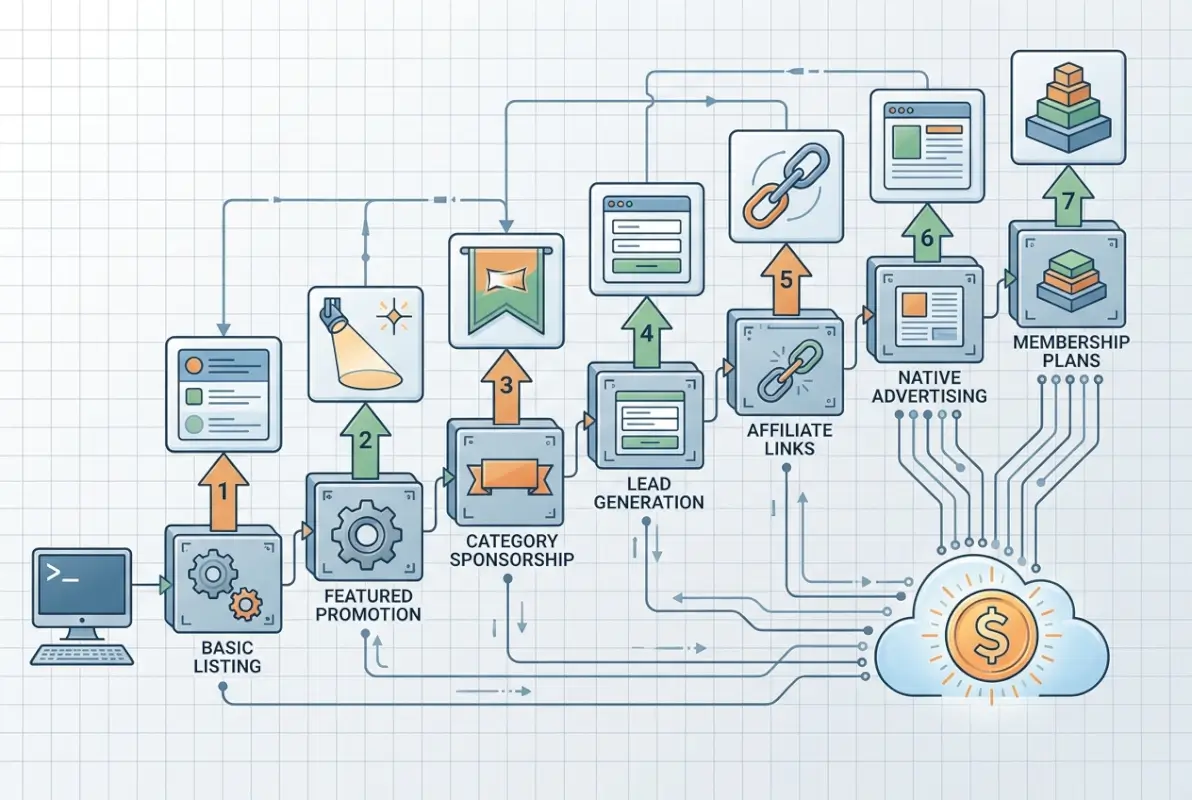
Running a business directory website without a clear monetization strategy is like owning prime real estate and never collecting rent. You’ve built the traffic, curated the listings, and created genuine value for your users—now it’s time to capture some of that value back. But here’s where most directory owners stumble: they either wait too long to monetize (bleeding resources while their audience plateaus) or they slam ads and premium listings everywhere, turning a useful resource into a cluttered billboard. The sweet spot? A deliberate, multi-stream approach that layers revenue channels without sacrificing the core experience that brought users to your directory in the first place.
What’s rarely discussed is that the best-performing directories treat monetization as a product design challenge, not just a revenue switch to flip. The directories pulling six figures annually aren’t simply “adding ads”—they’re architecting entire ecosystems where paid features genuinely enhance what businesses get from the listing, where sponsored placements feel native, and where every revenue stream reinforces (rather than undermines) the directory’s authority. If you’ve been wondering whether your directory website can generate meaningful income without alienating your audience, you’re asking exactly the right question.
TL;DR – Quick Takeaways
- Tiered listings – Offering basic free and premium paid options is the foundation; 60–70% of directory revenue typically comes from listing upgrades
- Display and sponsorships – Combining ad networks with direct category sponsorships diversifies income and keeps fill rates high
- Pay-per-lead models – Charging for qualified inquiries (not just clicks) can yield 3–5× higher ARPU than traditional display ads
- Affiliate partnerships – Contextual tool referrals and SaaS bundles monetize traffic without disrupting the directory experience
- Value-added services – Premium content, events, and listing enhancements create recurring revenue beyond basic placements
Paid Listings and Tiered Listing Schemes
The paid listing model is the bedrock of directory monetization for a simple reason: it aligns incentives perfectly. Businesses that benefit most from visibility are willing to pay for it, while casual or bootstrap listings can still participate for free (or at a minimal tier). This isn’t about locking everyone out—it’s about creating a ladder where each rung delivers incremental value. When you structure tiers correctly, businesses self-select into the plan that matches their growth stage and budget, and you avoid the awkward “all or nothing” dynamic that kills conversion.

Start with three core tiers: Basic (free or very low cost), Standard (mid-tier paid), and Premium (your flagship offering). Basic listings should include the essentials—business name, category, location, contact info, maybe a short description—but no frills. Standard adds featured placement in search results, a logo, extended descriptions, and perhaps a few images. Premium goes all-in: priority positioning across the directory, video embeds, social media integration, lead capture forms, and analytics dashboards. Pricing varies by niche, but a common range is $0 for Basic, $25–$75/month for Standard, and $100–$300/month for Premium in B2B or professional service directories. For a detailed breakdown of how directories generate revenue, look at what competitors in your vertical charge and start 10–15% below their Premium tier to ease initial adoption.
Basic, Standard, and Premium Listings—What to Offer and Price Points
The feature delta between tiers matters more than the absolute price. Your Standard plan should feel like a meaningful upgrade—not just “Basic plus a badge.” Think about what actually moves the needle for a business listing: higher search visibility, richer media, credibility signals (like verified badges), and direct inquiry channels. If your directory uses WordPress directory themes, most modern themes and plugins (including TurnKey Directories at turnkeydirectories.com) offer built-in tier management with custom fields, so you can gate features without custom development.
Premium tiers should include at least one exclusive benefit that Standard can’t touch—often that’s homepage or category-top placement, dedicated account support, or advanced lead routing. According to Statista research, directories with clearly differentiated premium tiers see conversion rates 40–50% higher than those with vague “featured listing” add-ons. Price transparency also matters, publish your tier comparison table prominently (we’ll show you how to format one later) so businesses can self-serve and upgrade without a sales call.
Time-Bound Promos and Trials to Accelerate Upgrades
Free trials are conversion rocket fuel for directory listings. Offer new businesses a 14- or 30-day Premium trial (no credit card required) so they can see exactly what enhanced visibility delivers—more profile views, more inquiries, better placement. Most directory platforms track these metrics out of the box, and when a business owner logs in to see “Your listing was viewed 247 times this month” versus their competitors’ basic submissions getting 12 views, the value proposition sells itself.
Limited-time promotions work even better when tied to external events: “Get 3 months of Premium for the price of 2 if you upgrade before the holiday season” or “Featured placement during [local event week] for 50% off.” The urgency creates a decision forcing-function, but make sure the promotion delivers real ROI—if businesses upgrade, get no results, and churn immediately, you’ve just torched future trust. Track upgrade-to-renewal rates religiously; a healthy directory sees 60–70% of trial users convert to at least one paid billing cycle, according to data from Forbes analyses of SaaS and directory business models.
Advertising and Display Revenue (Ad Networks and Direct Deals)
Display advertising gets a bad rap in directory circles because it’s often implemented badly—pop-ups that obscure content, auto-play videos that tank page speed, or banner farms that scream “low-quality site.” Done right, though, display ads and sponsorships can add 20–35% to your total revenue without harming user experience. The trick is treating ad inventory like premium real estate: limited supply, strategic placement, and a clear hierarchy that keeps your directory’s core content front and center.
Start with a trusted ad network like Google AdSense, which handles targeting, bidding, and payments automatically. AdSense works well for directories with 10,000+ monthly visitors; below that threshold, CPMs are too low to justify the layout trade-offs. Place ads in natural break points—between listing results, in the sidebar, or at the end of category pages—never inline within a single listing’s detail page (that destroys trust). According to AdSense best practices, directories typically see $2–$6 CPMs depending on niche; professional services and B2B directories skew higher, local lifestyle directories lower.
Display Ads via Trusted Networks and Direct Ad Deals
Once you hit 50,000+ monthly visitors, layer in direct sponsorships alongside network ads. Direct deals let you charge a flat monthly or quarterly fee for ad placement in specific sections, and they typically yield 3–5× the revenue of programmatic fill in the same slot. Reach out to businesses that already list in your directory (especially Premium tier clients) or relevant service providers in your niche—accounting software for a business directory, booking platforms for a restaurant directory, etc. Offer them a fixed-price package: “Your banner in the Finance category homepage for $500/month, guaranteed 50,000 impressions.”
Structure direct deals with clear deliverables and reporting. Use a simple one-pager that specifies ad dimensions, placement (with screenshots), expected impressions, and reporting frequency. Most directory owners use WordPress directory plugins like TurnKey Directories or dedicated ad management plugins to rotate and track direct inventory. If you’re managing both network and direct ads, set rules so direct sponsors always get priority fill—network ads serve only when direct inventory is unsold. This keeps your direct partners happy and your fill rate near 100%.
Sponsored Sections and Category-Level Sponsorships
Category sponsorships are the native ad format of directories, they blend value for users (curated “top picks” or expert partners) with clear revenue for you. Instead of scattering generic banner ads, let a single sponsor own an entire category or content section. For example, a home services directory might offer “Sponsored: Top Plumbers in [City]” where one plumbing company pays $1,000/month to be featured at the top of that category with a distinct badge and extended profile. Users still see organic listings below, but the sponsor gets premium real estate and implied endorsement.
Sponsored sections work because they mirror how users already browse—by category and location. Research from the Pew Research Center on online search behavior shows that users tolerate sponsored content as long as it’s clearly labeled and relevant to their intent. Make sponsorship labels unmissable (“Sponsored,” “Featured Partner,” or “Promoted Listing”), use a subtle background tint or border to visually distinguish sponsored entries, and limit sponsored slots to 1–2 per category page so they don’t overwhelm organic results. If you’ve got 20 categories and sell even half of them at $500–$1,000/month each, that’s $5,000–$10,000 in predictable monthly revenue on top of listing fees.
Lead Generation and Pay-Per-Lead Models
Pay-per-lead (PPL) represents a performance-based alternative to flat listing fees, charging businesses only when your directory delivers a qualified inquiry—typically a form submission, phone call, or message from a ready-to-buy user. Because advertisers pay for outcomes rather than impressions, PPL can command higher unit economics than display ads or basic listings, especially in service verticals such as home improvement, legal, and healthcare. Directory operators who implement lead tracking and quality filters often see average revenue per user (ARPU) climb 30–50% compared to flat-fee plans.
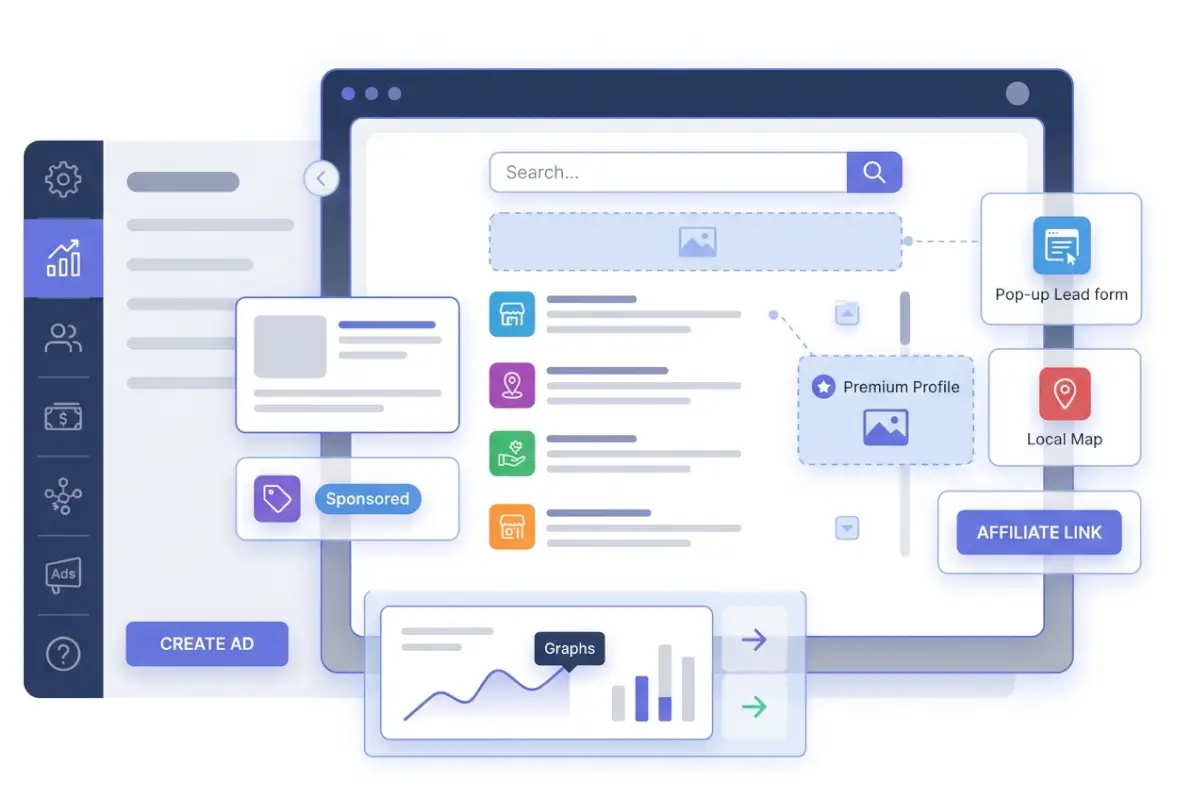
The shift from pay-per-listing to pay-per-lead also aligns incentives: your revenue grows as listing performance improves, motivating you to send higher-intent traffic to each business. Modern directories use tags, UTM parameters, and call-tracking pixels to attribute every lead to its source category or listing, ensuring transparency and building trust with advertisers. When businesses can measure ROI directly—”I paid $X and received Y qualified inquiries”—they are more likely to renew and scale their spend on your platform.
Pay-per-lead for high-intent inquiries
High-intent inquiries are leads that signal immediate purchase interest: a user who fills out a “Request Quote” form, clicks “Call Now,” or submits specific project details is far more valuable than a casual browser. To monetize these interactions, directories charge a fixed or bid-based fee per lead, often tiered by vertical (legal leads may sell for $50–150, while retail service leads may be $5–20). Implementing lead scoring—assigning points for completeness, urgency keywords, and user behavior—helps you route only the top-quality prospects to advertisers, reducing disputes and increasing repeat business.
Transparently define what constitutes a “qualified lead” in your terms of service: minimum form fields, geographic match, contact verification, or even a duplicate-detection window to prevent double-billing. Clear qualification criteria protect both your reputation and advertiser budgets. Many directories offer a short dispute window (24–48 hours) and automatic credit for flagged duplicates, balancing speed with accountability and maintaining trust at scale.
Lead routing and value-added services (verification, CRM integration)
Beyond basic lead delivery, value-added services amplify PPL revenue by increasing lead quality and advertiser convenience. Real-time lead verification—using CAPTCHA challenges, phone number validation, or email confirmation—filters out bots and low-effort submissions, ensuring that each charged lead meets a quality threshold. Directories that embed verification see dispute rates drop by 40–60%, freeing staff time and improving advertiser satisfaction.
CRM integrations take monetization further by pushing leads directly into advertisers’ sales pipelines via Zapier, Salesforce, or HubSpot connectors. When a plumber receives an instant notification with lead details and project photos in his CRM, he perceives your directory as mission-critical infrastructure rather than a marketing expense. Charging a premium for “verified + CRM-ready” leads—typically 20–30% above standard PPL rates—creates a recurring, high-margin revenue stream while reducing churn among power users.
| Lead Generation Feature | Revenue Impact | Implementation Complexity |
|---|---|---|
| Basic form submission | Baseline PPL ($5–20/lead) | Low |
| Call-tracking (phone leads) | +30–50% per lead | Medium |
| Real-time verification | Reduces disputes 40–60% | Medium |
| CRM integration (Zapier/Salesforce) | +20–30% premium tier | Medium–High |
| Lead scoring & routing | Higher renewals, lower churn | High |
Partnerships, Affiliates, and Commission-Based Partnerships
Affiliate and partnership revenue diversifies your directory’s income without requiring additional inventory or user-generated content. By embedding contextually relevant product links, tool referrals, or service integrations—such as payment processors for listed businesses or booking platforms for service providers—you earn commissions on transactions that flow from your audience. Affiliate programs from established networks (Amazon Associates, ShareASale, CJ Affiliate) typically offer 3–10% commissions, while SaaS referral partnerships can yield $50–500 per qualified signup.

The key to sustainable affiliate revenue is relevance: recommend tools and services your listings already need—accounting software for small businesses, booking widgets for consultants, or insurance comparison tools for contractors. When affiliate placements solve real problems for your users, click-through and conversion rates rise, and your editorial integrity remains intact. Avoid scattershot banner farms; instead, integrate affiliate links within category guides, “Getting Started” resources, or comparison tables that add genuine value to the directory experience.
Affiliate partnerships with relevant services (e.g., tools your listings rely on)
Directory audiences often arrive with specific intent: researching vendors, comparing services, or seeking advice on hiring decisions. This intent creates natural opportunities to recommend complementary tools—CRM platforms, email marketing suites, review-management software, or payment gateways—that help listed businesses succeed. By curating an “Essential Tools for [Your Niche]” resource page and embedding affiliate links, you monetize the research phase without interrupting the core directory search flow.
Transparency is critical: clearly label affiliate links with disclosures like “We may earn a commission if you sign up through this link, at no extra cost to you.” Most users accept affiliate arrangements when recommendations are honest and useful. Track performance by partner using UTM tags or dedicated affiliate dashboards, then double down on high-converting partnerships and prune underperformers. Over time, a handful of strategic affiliate relationships can contribute 10–20% of total directory revenue with minimal ongoing effort.
SaaS/tool partnerships (co-branded offerings, bundled services)
Co-branded partnerships elevate affiliate revenue by bundling directory listings with discounted access to essential SaaS tools, creating a more compelling value proposition for both parties. For example, a legal directory might partner with a practice-management platform to offer “Premium Listing + 3 Months Free CRM” packages, splitting the subscription revenue or earning a flat referral bounty. These bundles increase perceived value, justify higher listing fees, and deepen user lock-in because businesses adopt interconnected tools that depend on your directory data.
Negotiate revenue-share or tiered-commission agreements with SaaS partners: a flat $100 per signup for basic referrals, or recurring 15–20% lifetime commissions for enterprise deals. Co-marketing agreements—where the SaaS vendor promotes your directory to their user base in exchange for featured placement—further amplify reach and create a virtuous cycle of cross-promotion. Document terms in a simple partnership agreement covering attribution windows, payout schedules, and branding guidelines to avoid disputes and ensure smooth collaboration.
Content, Events, and Value-Added Services
High-quality editorial content—industry guides, “Top 10” roundups, how-to articles, and expert interviews—drives organic search traffic, establishes your directory as an authority, and creates new surfaces for monetization. Sponsored content and native advertising allow brands to pay for visibility within these editorial experiences, typically commanding $500–5,000 per placement depending on traffic volume and audience quality. Because content lives permanently on your site and ranks in search engines, a single sponsored guide can deliver ROI for months or years, making it attractive to both publishers and advertisers.

Events and value-added services extend monetization beyond digital placements. Virtual webinars, in-person meetups, or annual awards ceremonies create premium sponsorship opportunities and ticket revenue while deepening community engagement. Offering paid add-ons—SEO audits for listed businesses, verified-badge programs, or social media training—transforms your directory from a static catalog into a full-service growth platform. These services command higher margins than ad impressions and build lasting relationships with power users who view your directory as essential infrastructure.
Editorial opportunities, guides, and sponsored content
Editorial content serves dual purposes: attracting new visitors through search and social channels, and providing inventory for native sponsorships that feel less intrusive than banner ads. A well-researched “Ultimate Guide to Hiring a [Service]” article can rank for hundreds of long-tail keywords, drive qualified traffic to your directory, and include tasteful sponsor callouts or affiliate links to relevant tools. Publish consistently—at least two to four authoritative pieces per month—to build domain authority and maintain a steady pipeline of monetizable content assets.
Sponsored content works best when it mirrors your editorial voice and delivers genuine value: a plumbing-supply company sponsoring a “How to Prevent Winter Pipe Damage” guide feels natural, while a generic banner would be ignored. Charge based on traffic (CPM), engagement (time on page), or flat project fees, and always label sponsored pieces with “Sponsored by [Brand]” or “Partner Content” to maintain reader trust. Over time, a library of evergreen sponsored guides becomes a compounding asset that generates passive revenue and SEO equity long after publication.
Premium add-ons (SEO audits, listing verification, training, or events)
Premium add-ons monetize your expertise and infrastructure by offering services that help listed businesses succeed. SEO audits—analyzing a business’s listing completeness, keyword optimization, and backlink profile—can sell for $200–1,000 per engagement and position your directory as a growth partner rather than a passive listing platform. Verified-badge programs, where businesses pay an annual fee ($50–300) for identity verification and a trust icon, boost credibility and create recurring revenue with minimal marginal cost once the verification workflow is automated.
Training and events unlock community monetization: host quarterly webinars on “Maximizing Your Directory Listing” or “Local SEO Best Practices,” charging $50–200 per seat or offering free access as a premium-tier perk. In-person or hybrid events—annual awards, industry conferences, or regional meetups—generate sponsorship revenue, ticket sales, and networking opportunities that strengthen loyalty among your most engaged users. These high-touch offerings also provide qualitative feedback and case studies that inform product roadmap decisions and marketing narratives.
| Value-Added Service | Typical Price Point | Best For |
|---|---|---|
| Sponsored content / native article | $500–5,000 per piece | Established directories with >10k monthly visits |
| SEO audit for listed business | $200–1,000 per audit | Service-focused niches (local, B2B) |
| Verified badge / trust seal | $50–300/year recurring | Directories emphasizing trust & safety |
| Webinar / training session | $50–200 per seat | Engaged communities, B2B audiences |
| Annual awards / event sponsorship | $1,000–10,000+ per sponsor tier | Mature directories with strong brand |
FAQ: Frequently Asked Questions
How many monetization streams should a directory site pursue?
Start with two complementary streams—typically paid listings plus display advertising or lead generation. Monitor performance for 60–90 days before adding a third. Too many streams early on dilute focus and complicate user experience. Mature directories often balance three to four streams once they’ve refined pricing and user flows.
What is the difference between paid listings and sponsored listings?
Paid listings grant a business permanent or recurring placement at a tier (basic, premium) with defined features. Sponsored listings are typically time-bound promotional placements that appear in prime positions or dedicated sections, often sold separately as ad inventory. Both generate revenue, but sponsored listings function more like traditional advertising.
Can I combine pay-per-lead with display advertising effectively?
Yes, but design carefully. Display ads work best on content and category pages, while pay-per-lead forms should appear on business detail pages or dedicated inquiry flows. Keep lead forms clean and uncluttered by ads to maximize conversion. Track click-through and lead submission rates separately to avoid cannibalization between streams.
How do I set pricing for premium listings without scaring away users?
Anchor pricing to clear value: extra photos, priority placement, review widgets, or lead routing. Offer a free or low-cost basic tier so users see the directory as accessible. Test an introductory discount or 30-day trial on premium tiers. Survey early adopters to validate willingness to pay, then iterate pricing based on conversion and retention data.
What metrics should I track to optimize directory monetization?
Focus on average revenue per listing, conversion rate from free to paid, lead-to-close rate (if offering pay-per-lead), and ad viewability or click-through rate. Monitor churn for recurring plans and time-to-upgrade for trial users. Segment by category or geography to identify high-value niches and adjust pricing or ad placements accordingly.
Are there risks to directory UX when adding too many ads or promoted listings?
Absolutely. Excessive ads or overly prominent sponsored placements erode trust, slow page speed, and hurt organic search rankings. Limit display ads to sidebars or between-content slots. Cap sponsored listings to 10–20% of visible results per page. Regularly test user behavior (bounce rate, session duration) to ensure monetization doesn’t degrade core directory utility.
How long does it typically take to see revenue from paid listings?
Most directories begin seeing paid listing conversions within 30–60 days of launch if they have an existing audience or traffic source. Cold-start directories may take 90–120 days to build critical mass. Accelerate uptake with limited-time discounts, outreach to high-value categories, and clear ROI messaging to early prospects.
Should I hire an agency or use plugins to manage monetization?
Start with plugins or platform-native tools (e.g., WordPress directory themes, SpreadSimple) to validate your model and control costs. Once revenue exceeds $5,000–$10,000 per month, consider an agency for advanced ad operations, sponsored content strategy, or custom development. Plugins handle basics well; agencies add strategic scale and optimization.
Conclusion: Turn Your Directory Into a Revenue Engine
You now have a structured, five-part framework to monetize your business directory without compromising the user experience or diluting your brand. Paid listings deliver predictable recurring revenue. Display ads and sponsorships tap passive traffic. Pay-per-lead models align your success with your customers’ outcomes. Affiliate partnerships and value-added services round out a diversified income portfolio that scales as your audience grows.
The key is to start focused. Choose two streams that fit your niche and audience size, set up tracking for the metrics that matter, and commit to a 60–90 day test cycle. Measure conversions, gather feedback from early paying customers, and iterate on pricing and placement. Resist the temptation to bolt on every revenue option at once. Sustainable directory monetization is built on trust, transparency, and continuous refinement.
Ready to Monetize Smarter?
Map your current traffic and audience demographics to the five monetization paths. Identify the two highest-leverage opportunities for your directory. Set clear 90-day revenue and conversion targets, launch your pilot, and let data guide your next move. The tools and strategies are proven—now it’s your turn to execute.
Start small. Test fast. Scale what works.
Was this article helpful?