Directory Monetization Strategies: 7 Ways to Generate Revenue from Your Platform

Generating summary...
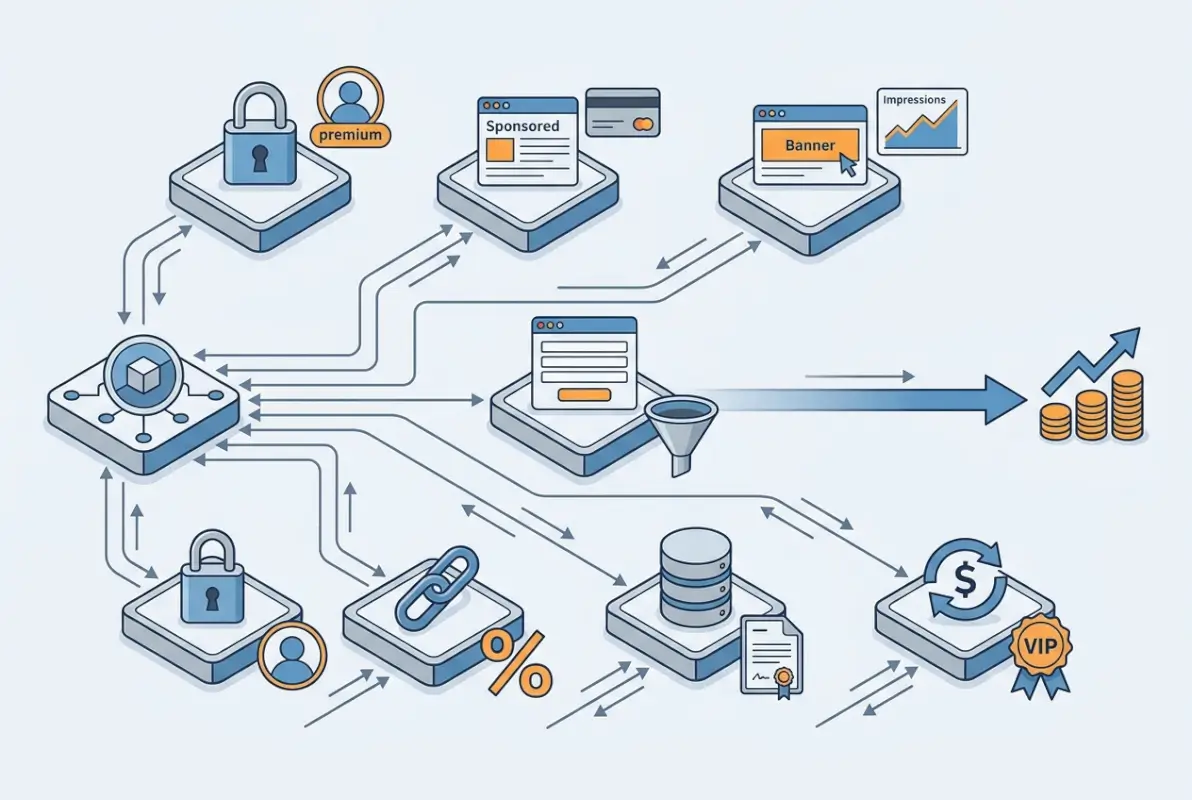
If you’ve built a directory platform—whether it’s a local B2B hub, a niche vertical marketplace, or a B2C recommendation engine—you already know that traffic alone doesn’t pay the bills. The real challenge isn’t just attracting eyeballs; it’s converting those visits into sustainable, diversified revenue streams without eroding user trust or cluttering the experience. What most directory operators miss is that monetization isn’t a single switch you flip—it’s an ecosystem of interdependent value exchanges. You’re not just selling ad space or charging for listings; you’re orchestrating a multi-sided platform where every dollar earned should amplify the value for both listed businesses and end users. In my experience working with directory owners, the operators who thrive are those who resist the temptation to bolt on every revenue tactic at once and instead layer complementary models that reinforce credibility, data quality, and actionable insights. This article walks you through seven battle-tested directory monetization strategies, grounded in current research on directory advertising strategies and platform economics, so you can build a revenue engine that scales with your audience.
TL;DR – Quick Takeaways
- Premium Listings – Tiered plans and featured placements generate predictable subscription revenue while delivering measurable ROI to businesses
- Lead & Transaction Fees – Pay-per-lead and commission models align your revenue with tangible outcomes for listed businesses
- Advertising & Sponsorships – Display ads and sponsored content scale with traffic, but require careful targeting to preserve user experience
- Data Services – Analytics dashboards, market insights, and API access unlock high-margin revenue from aggregated platform intelligence
- Freemium Hybrid – A free baseline drives acquisition; bundling premium features (analytics, API, priority support) monetizes engaged segments without friction
Multi-sided platforms thrive when they balance competing interests—businesses want visibility and leads, users want relevant results, and you need cash flow to maintain quality and infrastructure. According to research published by MDPI on platform monetization, consumer expectations around privacy, ad relevance, and transparency now shape which revenue tactics actually work at scale. That same research underscores that platforms with diversified revenue streams exhibit greater resilience during traffic fluctuations and regulatory shifts. Regulatory considerations matter too, when you sell data or run programmatic ads, you’re on the hook for GDPR compliance, cookie consent flows, and user opt-outs. The takeaway? Every revenue lever you pull needs to pass the trust test—does this make the directory more valuable for everyone, or does it extract short-term cash at the expense of long-term engagement?
In the sections that follow, we’ll unpack five core monetization pillars: premium listings and placements, lead generation and transaction fees, advertising and sponsorships, data-driven services, and freemium hybrid models. Each section includes concrete tactics, real-world considerations, and guardrails to help you avoid common pitfalls (like ad fatigue or opaque pricing). Whether you’re launching a new directory on TurnKey Directories, a custom WordPress build, or a SaaS platform, these strategies apply—just tailor the mix to your niche, audience maturity, and competitive landscape.
Premium Listings and Placement That Drive Value
Premium listing models work because they solve a real problem for businesses: standing out in a crowded directory. When you offer tiered plans—free, basic, premium—you create a clear value ladder that aligns pricing with visibility, feature richness, and analytics access. A free tier maximizes listing count and directory depth (which benefits SEO and user choice), while paid tiers deliver priority placement, enhanced profile fields, image galleries, social proof badges, and performance dashboards. This approach mirrors the pricing playbooks of established marketplaces like Yelp, Angi, and industry-specific directories, where the majority of listings sit in the free tier but a meaningful minority pay for premium features that demonstrably increase inbound leads.

The economics are straightforward: if a business generates $500/month in qualified leads from a premium listing and you charge $99/month, the ROI is crystal clear. The friction comes when businesses can’t see that ROI—either because your directory lacks traffic, your analytics don’t surface lead attribution, or your premium features don’t materially improve visibility. That’s why successful directories invest in transparent performance metrics: impression counts, click-through rates, and conversion funnels that show businesses exactly what they’re buying. When you’re finding directory listings to benchmark against, look at how top players structure their dashboards and what proof points they surface to justify premium pricing.
Tiered plans also allow you to test pricing elasticity without alienating your base. You might launch with three tiers—free (basic contact info, no images), $49/month (photos, extended hours, social links), and $149/month (top-category placement, badge, lead analytics). Over time, you track conversion rates from free to paid, churn by tier, and lifetime value (LTV) relative to customer acquisition cost (CAC). If premium subscribers stick for 18 months on average, your LTV is $2,682—making a CAC of $300-$500 (via ads or sales outreach) entirely sustainable. This data-driven iteration is what separates sustainable directory businesses from those that guess at pricing and wonder why revenue stalls.
Tiered Listing Plans (Free, Basic, Premium)
Designing your tier structure requires balancing value perception with operational costs. A free tier should include enough functionality that businesses see immediate value (name, address, phone, category, basic description), but withhold features that drive differentiation and conversions. Basic paid tiers unlock richer content—photos, custom fields (certifications, service areas, payment methods), and maybe limited analytics. Premium tiers add priority placement (top of category pages, search results), badges (Verified, Featured, Top Rated), and full-funnel analytics (impressions, clicks, form submissions, phone taps).
The key is making premium benefits visible to end users, not just listed businesses. If a premium badge or top placement doesn’t influence user clicks, businesses won’t renew. That’s why directories like city directories often surface premium listings first in search results and add subtle visual cues (border highlights, star icons) that signal credibility without feeling like paid ads. You’re not deceiving users; you’re curating the best options for them while rewarding businesses that invest in their profiles. Transparency matters here—some directories label premium placements as “Sponsored” or “Featured,” while others rely on organic ranking signals plus a premium boost. Test both approaches and measure click-through rate and user satisfaction to find the sweet spot.
From a technical standpoint, WordPress directory platforms like TurnKey Directories make it easy to define custom fields per tier, automate badge assignment, and restrict dashboard features based on subscription level. If you’re building on a custom stack, you’ll need user role management, payment gateway integration (Stripe, PayPal), and a recurring billing engine. Don’t forget email workflows—welcome sequences for new free listings, upgrade prompts for engaged users, and renewal reminders 7-14 days before expiration. Automation here reduces churn and improves cash flow predictability.
Featured Listings and Categories
Featured listings take premium placement a step further by offering time-boxed, top-of-page visibility. Think of it as the difference between a premium subscription (ongoing) and a limited-time boost (short-term campaign). A business might pay $200 for 30 days at the top of the “Plumbers in Austin” category page, capturing inbound traffic during peak season (say, winter freeze emergencies). This model works especially well in high-intent, transactional niches where visibility directly correlates with lead volume—home services, legal, medical, and event vendors.
The challenge is maintaining fairness and user trust. If every slot is sold to the highest bidder with no regard for quality, users start ignoring featured placements or, worse, abandon the directory for competitors with better curation. The solution is a hybrid approach: allow businesses to purchase featured slots, but reserve the right to deny listings with poor reviews, incomplete profiles, or unverified credentials. You’re not just selling placement; you’re vouching for quality. Some directories cap the number of featured slots per category (e.g., max three per page) to preserve scarcity and value. Others use auction-style bidding where businesses set a daily budget and compete for impressions, similar to Google Ads. Both models work, but auctions require more sophistication (bid management UI, real-time reporting) and can intimidate small businesses unfamiliar with performance marketing.
From a revenue perspective, featured listings generate lumpy, high-value transactions rather than smooth monthly recurring revenue (MRR). That variability can stress cash flow if you’re early-stage, so many directories bundle featured placements into annual premium plans or offer them as add-ons (e.g., “Add a 30-day category boost for $150”). Another tactic is seasonal campaigns—promote featured slots ahead of Black Friday, wedding season, or tax deadlines when demand peaks. When planning how to find listing agents or other high-value verticals, featured placements can deliver outsized ROI because the customer lifetime value for those businesses is high, justifying aggressive upfront spend.
Lead Generation Fees and Transaction Revenue
Lead generation fees shift your directory from a passive listing service to an active participant in your customers’ sales funnels. Instead of charging a flat monthly subscription, you charge per inbound inquiry, quote request, or booking generated through your platform. This performance-based model aligns your revenue with tangible business outcomes—if a contractor receives 20 qualified leads and converts four into $10k projects, paying you $50 per lead feels like a bargain. The upside for you is that high-traffic directories can generate hundreds or thousands of leads per month, creating a scalable revenue stream that grows with your audience.
The operational complexity here is real. You need lead tracking infrastructure—forms with unique identifiers, call tracking numbers, or booking widgets—that attribute each inquiry to a specific listing. You also need quality controls to prevent fraud or low-intent spam (bot submissions, duplicate leads sold to multiple businesses). Many directories implement lead verification steps: CAPTCHA, email confirmation, or manual review before a lead is billed. Some offer a dispute resolution process where businesses can flag invalid leads for refunds or credits. According to data from Statista, lead generation marketplaces in home services and professional services see average lead costs ranging from $15 to $150, depending on vertical and lead quality—use that as a benchmark when setting your own pricing.
One often-overlooked advantage of lead-based monetization is that it naturally incentivizes directory quality. If your SEO and user experience improve, you generate more leads, and revenue rises without increasing your listed business count. Conversely, if your traffic drops or your forms break, revenue falls immediately—giving you tight feedback loops to diagnose and fix issues. This is different from subscription models, where churn lags performance problems by weeks or months. For directories targeting find listing by license plate or other data lookup use cases, lead fees can be structured as pay-per-query or pay-per-result, charging users or businesses each time a search returns actionable information.
Pay-Per-Lead or Pay-Per-Transaction Fees
Pay-per-lead pricing works best when leads are discrete, trackable events: a quote request, a consultation booking, a phone call, or a form submission. You charge a fixed fee per lead—say, $25 for a home cleaning inquiry or $100 for a legal consultation request. Businesses only pay when they receive a lead, so there’s no upfront subscription barrier, which lowers friction for new listings and accelerates marketplace liquidity. The trade-off is that you need robust lead routing logic (round-robin, tiered by subscription level, geographic proximity) and real-time notifications so businesses can respond fast—speed-to-lead is the single biggest predictor of conversion in service verticals.
Pay-per-transaction models take this further by charging a percentage or flat fee on completed transactions facilitated through your platform. If your directory includes booking or payment flows—think Airbnb for local services, or a marketplace for freelance professionals—you can take 5-15% of each transaction in exchange for payment processing, dispute mediation, and trust infrastructure (reviews, identity verification). This model scales beautifully because your revenue grows in direct proportion to gross merchandise value (GMV), but it requires you to build or integrate booking, invoicing, and escrow systems—a non-trivial engineering lift.
Hybrid models are common: charge a small monthly subscription ($29) plus a per-lead fee ($15-$50) or a lower commission rate (5% instead of 15%). This gives you predictable base revenue while capturing upside from high-volume users. When evaluating whether to go pure pay-per-lead or hybrid, model your unit economics: if average LTV per business is $1,200/year on subscriptions but $2,800/year on lead fees, and your CAC is $400, lead fees win. If lead volume is inconsistent or seasonal, subscriptions provide cash flow stability. Many directories start with subscriptions to validate product-market fit, then layer in lead fees once they hit critical mass and can guarantee lead volume.
Commission on Bookings/Transactions
Commission-based revenue shines in verticals where transactions happen online and you can insert yourself into the payment flow. Examples include event bookings (photographers, venues), professional services (consultants, coaches), and e-commerce marketplaces (artisan goods, local products). You enable one-click bookings or checkout, handle payment processing (often via Stripe Connect or PayPal for Marketplaces), and remit the net amount to the service provider after deducting your commission. This model creates strong platform lock-in because once businesses rely on your payment infrastructure, switching costs are high.
The user experience benefit is enormous: buyers get a seamless checkout with dispute protection and order tracking, sellers get automated invoicing and payout schedules, and you capture rich transaction data (average order value, repeat purchase rate, seasonal trends) that informs pricing and marketing. According to Harvard Business Review, platform businesses that control payments see 30-50% higher LTV compared to those that rely on off-platform transactions, because they reduce friction and build trust through escrow and refund guarantees.
Dynamic pricing is another lever: you might charge 10% commission on transactions under $500 but drop to 7% for transactions over $2,000, rewarding high-value listings and encouraging larger bookings. Some platforms implement seller-funded discounts or promotional fees—businesses pay an extra 2-3% to appear in “Deal of the Day” slots or seasonal campaigns. Escrow and dispute resolution are table stakes here; without them, buyers won’t trust the platform, and sellers will route transactions off-platform to avoid fees. Build simple arbitration workflows (photo evidence, messaging logs, partial refunds) and set clear terms of service so everyone knows the rules before a dispute arises.
Advertising, Sponsorships, and Content Partnerships
Advertising remains one of the most straightforward monetization levers for directories with consistent traffic, but success hinges on relevance and restraint. Display ads, programmatic networks, and private sponsorship deals can unlock recurring revenue without demanding deep product changes. At the same time, poorly targeted or excessive ad placements erode user trust and engagement, driving visitors away before they complete a conversion.

The key is to align advertising inventory with user intent and directory context. If your platform connects local contractors, ads for project-management tools or building-material suppliers add value rather than distraction. Contextual targeting and first-party audience segments allow you to serve ads that feel like useful recommendations, increasing click-through rates and advertiser ROI while preserving the clean browsing experience that keeps users coming back.
Sponsorships and content partnerships offer a higher-margin, lower-volume complement to programmatic ads. A tier-one sponsor can pay for exclusive category placement, branded buyer’s guides, or sponsored search results in exchange for guaranteed impressions and leads. These arrangements work best when they’re clearly disclosed, aligned with your editorial standards, and limited in number so that sponsorships retain their premium cachet and don’t dilute the organic experience.
Display Advertising and Programmatic Partners
Programmatic ad networks—Google AdSense, MediaVine, or niche-specific exchanges—provide plug-and-play revenue for directories that generate steady page views. Once you hit minimum traffic thresholds, you can serve contextual banners, in-feed units, and sidebar placements without building a direct sales team. The trade-off is lower per-impression rates and limited control over creative quality, so you’ll need to monitor ad density, load times, and relevance to prevent a poor user experience.
Private marketplace deals or direct sponsorships typically command higher CPMs because you can package audience segments, guarantee placements, and offer richer formats like takeovers or video. Building a one-page media kit—monthly uniques, top categories, user demographics—simplifies outreach to brands that want to reach your niche. Set floor prices and cap the number of ad slots per page to maintain scarcity and preserve the directory’s editorial integrity.
| Ad Format | Revenue Model | Best For |
|---|---|---|
| Programmatic Display | CPM, revenue-share | High-traffic directories seeking passive income |
| Private Sponsorships | Fixed monthly/quarterly fee | Niche directories with engaged, vertical audiences |
| Native In-Feed Ads | CPC or CPM hybrid | Directories with strong organic search traffic |
Sponsored Content and Buyer’s Guides
Sponsored blog posts, case studies, and category buyer’s guides allow advertisers to tell a deeper story while you collect a premium placement fee. Unlike banner ads, sponsored content can educate users, compare solutions, and drive qualified leads—outcomes that justify higher pricing and longer-term partnerships. Label each piece clearly as “Sponsored” or “Partner Content” to comply with disclosure norms and maintain editorial credibility.
Buyer’s guides work especially well for directories in complex verticals—software, professional services, home improvement—where users need help evaluating multiple vendors. You can charge participating vendors a flat rate or tiered sponsorship to be featured in the guide, then promote it via email, social, and SEO. The guide becomes evergreen content that attracts organic traffic, generates backlinks, and positions your directory as a trusted authority rather than a passive listing repository.
Data-Driven Services and Value-Added Offerings
Every search, click, and listing view generates data that—when aggregated and anonymized—holds market intelligence value for vendors, investors, and partners. Data-driven monetization transforms your directory from a passive marketplace into a research platform that quantifies trends, benchmarks pricing, and predicts demand shifts. The revenue potential is significant, but execution requires careful attention to privacy regulations, data quality, and transparent licensing terms.

Analytics dashboards, API access, and market-intelligence reports let you package insights at multiple price points. A basic dashboard might show a vendor how many profile views and leads they received each month. A premium tier could include competitive benchmarks, geographic heat maps, and cohort analysis.
At the enterprise level, you can sell API access or custom data feeds to aggregators, research firms, or SaaS platforms that want to enrich their own products. Each tier addresses a different willingness to pay and use case, allowing you to capture value from small businesses all the way up to institutional buyers.
Analytics, Insights, and API Access
Offering vendors a real-time analytics dashboard—profile impressions, click-through rates, lead sources—turns a static listing into a performance-marketing channel they can optimize. Charge a monthly SaaS fee or bundle analytics with premium listing tiers, then upsell advanced features like A/B testing, keyword tracking, or conversion funnels. The more vendors depend on your data to drive ROI, the stickier your platform becomes and the higher your customer lifetime value.
API access opens a B2B revenue stream by letting partners pull listing data, search results, or trend reports programmatically. Price API tiers by call volume, data freshness, or feature set—basic lookups, enriched metadata, real-time webhooks. Ensure your API documentation, rate limits, and SLAs meet enterprise standards, and require compliance with your terms of service to protect data integrity and prevent misuse.
| Data Product | Target Buyer | Typical Pricing |
|---|---|---|
| Vendor Analytics Dashboard | Small/mid-size businesses | $29–$99/month bundled with listing |
| Market Intelligence Report | Investors, analysts, agencies | $500–$5,000 one-time or subscription |
| API Access | SaaS platforms, aggregators | $200–$2,000/month by call volume |
Affiliate and Content-Driven Revenue
Affiliate marketing layers commission-based revenue on top of your existing content and listings without requiring new products or services. When a user clicks through to a vendor and completes a purchase, you earn a percentage or flat fee. Affiliate links work especially well in buyer’s guides, comparison tables, and editorial roundups where you’re already recommending specific products or services in a trusted, editorial context.
Transparency is critical: disclose affiliate relationships clearly, only recommend solutions you would genuinely endorse, and avoid letting commissions distort your editorial judgment. Most directories integrate affiliate programs from Amazon Associates, ShareASale, or CJ Affiliate for broad product coverage, then negotiate direct partnerships with high-value vendors for better rates and exclusive deals. Track affiliate performance separately so you can optimize placements, retire underperforming links, and reinvest in content that drives the highest revenue per visitor.
Freemium and Hybrid Models to Scale Growth
Freemium models lower the barrier to entry, letting you amass a large user base while converting a small percentage to paid tiers that unlock premium features. This approach is particularly effective for directories in competitive niches where initial trust and network effects determine long-term success. By offering a robust free tier—basic listings, standard search, limited analytics—you attract vendors who might otherwise skip your platform, then upsell them as they see measurable value and outgrow the baseline offering.

Hybrid monetization blends freemium subscriptions with advertising, lead fees, sponsorships, and data services to diversify revenue and reduce reliance on any single stream. A hybrid model smooths cash flow, balances user experience with monetization, and lets you experiment with pricing and packaging without overhauling your core product. The trade-off is operational complexity—you’ll need clear analytics to track contribution margins, churn, and customer acquisition cost across multiple revenue lines—but the upside is resilience and the ability to optimize each stream independently.
Freemium Core with Paid Upgrades
A successful freemium strategy starts with a free tier generous enough to deliver real value—verified listings, basic contact forms, category tags—so users experience immediate benefit and trust your platform. The paid tiers then add features that matter to growth-focused vendors: priority placement, rich media uploads, lead analytics, API integrations, and dedicated support. Pricing should reflect clear capability jumps; for example, a $49/month tier might add analytics and top-three category placement, while a $199/month tier unlocks unlimited media, advanced reporting, and custom CTAs.
Conversion rates from free to paid typically range from 2–10 percent, so you need significant free traffic to generate meaningful subscription revenue. Use in-app prompts, email nurture sequences, and usage-triggered offers—”You’ve received 20 leads this month; upgrade for full analytics”—to drive conversions at moments when the value of premium is most obvious. Monitor cohort retention and expansion revenue to identify which features drive stickiness and justify future development investment.
Hybrid Monetization Strategy
A hybrid approach combines subscription revenue, transactional fees, advertising, sponsorships, and data products into a single, diversified P&L. For instance, free users might see programmatic ads and generate CPM revenue, basic-tier subscribers pay a monthly fee and see no ads, premium subscribers pay higher fees for lead-gen features and analytics, and enterprise partners pay for API access or custom data feeds. Each segment contributes margin in a different way, balancing predictable recurring revenue with variable, usage-based income.
The challenge is managing complexity without confusing users or creating perverse incentives. Build a simple pricing page that presents two or three clear subscription tiers, then layer additional monetization—ads for free users, optional lead fees, sponsorships—behind the scenes. Use cohort analysis and contribution-margin dashboards to track which revenue streams are growing, which are cannibalizing others, and where to invest product development. Test pricing changes incrementally—grandfather existing customers, A/B test new tiers—and iterate based on conversion, churn, and net revenue retention data.
| Monetization Layer | Primary Metric | Typical Contribution |
|---|---|---|
| Freemium Subscriptions | Monthly recurring revenue (MRR) | 40–60% of total revenue |
| Lead/Transaction Fees | Revenue per lead, conversion rate | 15–30% |
| Advertising & Sponsorships | CPM, fill rate, viewability | 10–25% |
| Data & API Access | API call volume, data-product ARR | 5–15% |
Frequently Asked Questions
What is the most effective way to monetize a directory website in 2025?
A layered approach combining premium placements, pay-per-lead fees, and targeted sponsorships typically delivers the strongest, most scalable revenue. Adapt your mix to your niche and traffic levels while maintaining user trust and transparent value delivery throughout every interaction.
How do premium listings justify their cost to businesses?
Premium listings offer measurable visibility through top placements, verification badges, enhanced profiles, and often complementary analytics dashboards. Real-world ROI should be tracked through inbound leads, conversion rates, and customer acquisition cost comparisons to demonstrate clear value over free alternatives.
Should a directory rely on ads or subscriptions for monetization?
Most successful platforms use a hybrid mix to balance revenue stability with user experience. Ad revenue scales with traffic volume, while subscriptions grow with perceived value. Combining both models diversifies risk and optimizes lifecycle value across different user segments and market conditions.
Can data and API access be monetized in a directory?
Yes, aggregated data insights and API access can unlock tiered pricing for partners seeking market intelligence or integration capabilities. Ensure robust data quality, clear licensing terms, and strict privacy compliance to maintain trust while creating value-added revenue streams beyond basic listings.
How do you prevent audience fatigue from ads in a directory?
Use contextually targeted, relevant ads that match user intent. Limit ad density and placement frequency. Prioritize value-first formats like sponsored buyer’s guides that genuinely benefit users, and always maintain transparent disclosure to preserve credibility and trust in your platform.
What is a freemium model for directory websites?
A freemium model offers a free baseline service to maximize traffic and user acquisition, while bundling premium features such as analytics dashboards, priority placement, API access, or advanced filters for paid upgrades. This approach balances growth with monetization potential across different user tiers.
How do commission-based fees work on directory platforms?
Commission-based fees charge a percentage or flat rate per completed transaction, booking, or lead conversion facilitated through your directory. Implement secure payment processing, clear terms for disputes, and transparent pricing structures to build trust while capturing transaction value at scale.
What are sponsored content opportunities for directories?
Sponsored content includes curated buyer’s guides, category-specific spotlights, and partner case studies that offer genuine value to users. Ensure clear disclosure, maintain editorial standards, and align sponsor messages with user needs to preserve credibility while creating high-margin revenue streams.
Build Your Revenue Blueprint Today
Monetizing a directory platform successfully requires more than choosing a single revenue stream. The most resilient, high-performing platforms layer complementary models to diversify risk, match user expectations, and capture value at multiple touchpoints. Whether you prioritize premium listings for immediate cash flow, lead-generation fees for performance alignment, or data-enabled services for strategic partnerships, the key is to start with clarity and iterate based on real user behavior.
Begin by selecting one or two primary models that align with your niche, audience size, and platform maturity. Measure lifetime value against acquisition cost, track conversion funnels, and remain transparent with both users and business clients about what they’re paying for and why. As traffic grows and trust deepens, you can progressively layer additional streams—ads, sponsorships, affiliate revenue, or API access—to unlock new growth without compromising the user experience that brought you this far.
Platform monetization is not static. Regulatory shifts around data privacy, evolving consumer expectations, and competitive pressure will continue to shape what works. Stay agile, invest in analytics, and keep user value at the center of every pricing decision. Your directory is more than a collection of listings; it’s a marketplace of trust, discovery, and action. Monetize it with intention, and you’ll build a sustainable business that serves all sides of your platform ecosystem.
Ready to Implement Your Monetization Strategy?
Start with a single revenue model that fits your current traffic and trust levels. Test pricing, track conversions, and layer additional streams as you scale. The best time to diversify your revenue is before you need to—build resilience into your platform today.
Choose one model from this guide and launch a pilot within the next 30 days.
Was this article helpful?