Directory Advertising: 7 Strategies to Monetize Your Platform & Drive Revenue

Generating summary...
Most directory owners leave serious money on the table. They’ll charge a flat listing fee or slap a few banner ads on their site and call it a day. Meanwhile, platforms like Yelp, Zillow, and Angi have built billion-dollar businesses by layering multiple revenue streams—subscriptions, lead generation, data licensing, premium placements, and value-added services—all working in concert. The real opportunity in directory advertising isn’t choosing between ads or listings; it’s orchestrating a portfolio of complementary monetization tactics that grow with your platform while preserving the core value that keeps users coming back. Here’s the counterintuitive truth: aggressive early monetization usually kills directories, but waiting too long to diversify revenue streams leaves you vulnerable to market shifts and competition.
TL;DR – Quick Takeaways
- Multi-stream monetization – Successful directories combine 4-6 revenue models rather than relying on a single source
- Network effects first, pricing second – Subsidize one side of your marketplace early to build critical mass, then monetize aggressively
- Premium placements outperform flat fees – Tiered visibility options generate 3-5x more revenue per listing than single-price models
- Data and services compound value – Licensing directory data and offering value-added services create sustainable competitive moats
- Trust preservation is non-negotiable – Every monetization tactic must pass the “does this make the directory more useful?” test
Monetization Foundations for Directory Platforms
Before you can effectively monetize directory advertising, you need to understand the economic structure beneath your platform. Directories operate as two-sided marketplaces (sometimes called multi-sided platforms), where you’re simultaneously serving searchers looking for businesses and businesses seeking visibility. The pricing strategy that works for a traditional product company will fail spectacularly here, because you’re not just selling a product—you’re orchestrating a network where value increases as both sides grow.

The Harvard Business School research on marketplace scalability demonstrates that successful platforms carefully manage the subsidy-to-monetization transition. Early on, you might offer completely free listings to build critical mass on the supply side while investing heavily in SEO and user acquisition to drive search traffic. Once you’ve established product-market fit and traffic patterns stabilize, you can begin extracting value from the businesses who benefit most from your platform. I’ve watched directory owners make the mistake of charging premiums when they had 50 listings and zero traffic—businesses paid once, got no leads, and never renewed.
According to research from the Pew Research Center, digital advertising revenue has shifted dramatically toward targeted, performance-based models over the past decade. This trend directly informs how you should structure directory monetization: businesses now expect to pay based on results (leads, clicks, conversions) rather than simple exposure. If you want to find directory listings that actually convert, understanding this value alignment is crucial.
Core Revenue Models for Directories (Pricing, Tiers, and Listings)
Your primary monetization lever is the listing itself. Most mature directories offer four distinct listing tiers: free basic listings (to build inventory and SEO value), paid standard listings with enhanced features, premium placements with visibility guarantees, and enterprise packages with custom features and dedicated support. The free tier isn’t charity—it’s a strategic investment in marketplace density and search engine authority. When someone tries to find city directory online resources, comprehensive coverage beats exclusive coverage every time.
Value-based pricing means charging businesses based on the tangible value they receive from your platform, not arbitrary price anchors. A law firm in a major metro searching for clients might happily pay $500/month for a featured placement if you’re delivering qualified leads at a $50 cost-per-lead. That same $500 would be absurd for a coffee shop in a small town. Smart directories segment pricing by geography, category competitiveness, and demonstrated ROI rather than one-size-fits-all tiers.
Subscription models create predictable recurring revenue and align incentives better than one-time listing fees. When businesses pay monthly or annually, they expect ongoing value—which forces you to continually improve traffic quality, enhance listing features, and prove ROI. One-time fees often attract low-quality listings from businesses testing the waters with no commitment to maintaining accurate information. The WordPress ecosystem has proven that subscription models, when executed properly, can scale into eight-figure businesses.
Pricing Strategy and Network Effects
Network effects in directories work differently than social networks. Your platform becomes more valuable to searchers as you add more comprehensive, high-quality listings. It simultaneously becomes more valuable to listers as you add more searchers generating leads. The trick is determining which side to subsidize and when to flip the monetization switch (Harvard Business School’s platform strategy research emphasizes this timing as the most critical decision multi-sided marketplace operators make).
Most successful directories follow a predictable pattern: subsidize listings completely in year one to build comprehensive coverage, introduce premium placement options in year two once traffic reaches meaningful levels, then layer in lead generation and data monetization in years three and beyond. Trying to skip straight to aggressive monetization before you’ve achieved sufficient network density typically results in a sparse, low-traffic directory that provides value to neither side. I learned this the hard way—my first directory project charged $99 listing fees from day one and attracted exactly seven paying customers in six months.
Cross-subsidization between user groups creates strategic flexibility. Enterprise SaaS companies discovered years ago that free individual accounts drive paid team accounts; Slack and similar platforms built billion-dollar businesses on this model. Directories can apply the same logic: free listings in low-competition categories subsidize the platform while you extract premium revenue from high-value, competitive categories where visibility directly translates to customer acquisition. When businesses try to find business directory reliable sources, they’re specifically looking for platforms with this kind of comprehensive coverage.
The most sophisticated directory operators adjust pricing dynamically based on category competition and geographic market density. A “plumber” listing in Manhattan should cost substantially more than the same category in rural Nebraska—not because you’re gouging, but because the lead value and competition justify different price points. This approach requires analytics infrastructure to measure and communicate value, but it prevents the common mistake of underpricing high-value categories while overpricing low-value ones.
Direct Listing Monetization and Advertising Placements
Once your directory achieves meaningful traffic and listing density, direct monetization of listing placements becomes your most reliable revenue engine. Unlike advertising revenue that fluctuates with market conditions, listing fees—especially subscription-based ones—provide predictable cash flow you can model and scale. The key is structuring placement options that feel like value upgrades rather than ransom payments.
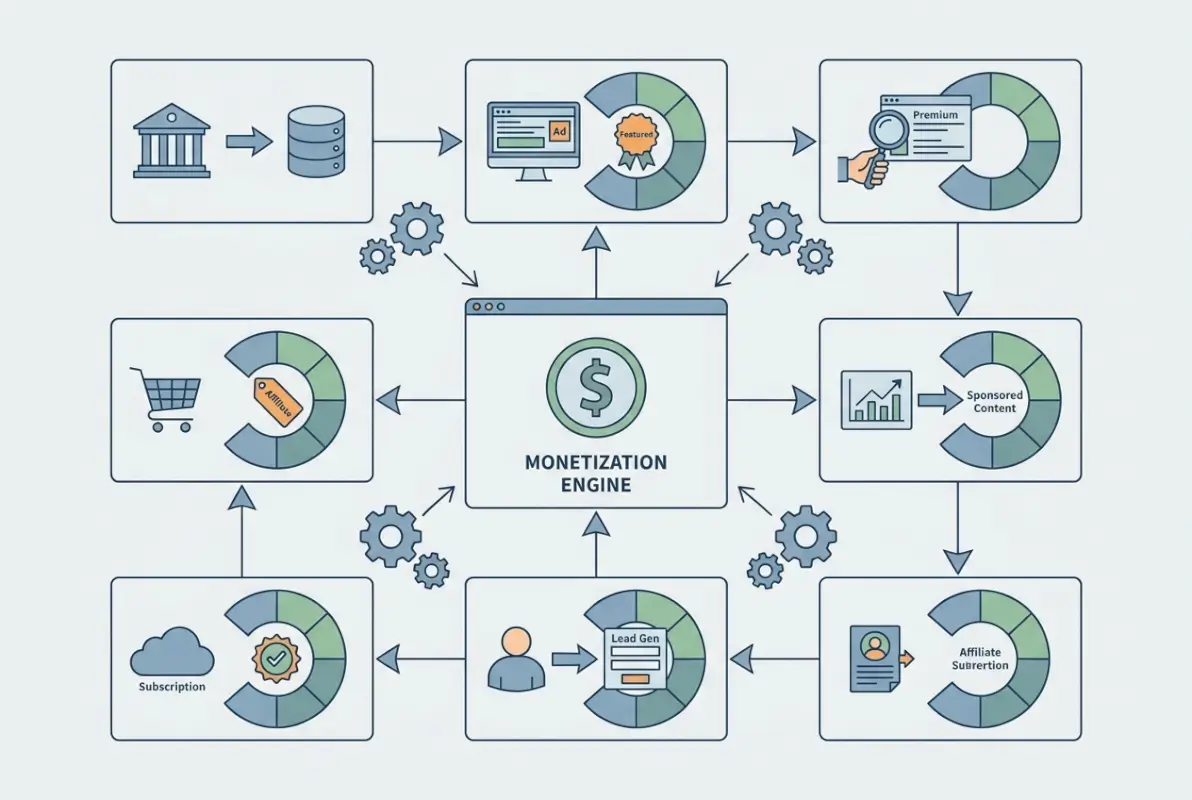
Premium placement and sponsored visibility options work because they solve a genuine problem for businesses: standing out in crowded categories. When someone searches “divorce attorney” in a major city and sees 50 results, the businesses appearing in the top three positions capture the majority of clicks and leads. Charging for that visibility isn’t exploitative; it’s offering a solution to a real competitive challenge. Research from Statista shows that top-three search results capture 75% of user clicks across most industries, a pattern that holds true in directory listings as well.
The TurnKey Directories plugin offers built-in monetization features specifically designed for WordPress-based directory platforms, including tiered listing packages, featured placement options, and subscription management. This type of infrastructure lets you focus on driving traffic and providing value rather than wrestling with payment processing and access control. If you’re exploring how to criss cross directory online cost pricing models, having flexible technical infrastructure is foundational.
Direct Listing Monetization (Fees, Badges, and Curation)
Listing fees should correlate directly with visibility and features, not arbitrary tier names. Your basic paid listing might include a logo, photos, business description, contact details, and category placement. Mid-tier adds priority ranking within category results, a verified badge, and enhanced analytics showing listing views and click-through rates. Top-tier guarantees above-the-fold placement in relevant searches, removes all competing ads from the listing page, and includes promotional features like coupons or special offers.
Verification badges and trust signals create a premium tier that businesses will pay for even beyond placement benefits. A “verified” or “background-checked” badge provides value to both searchers (reduced risk) and businesses (differentiation and credibility). Some directories charge for verification as a standalone service, others bundle it into premium tiers. The important thing is actually delivering on the verification promise—fake badges destroy trust faster than any other monetization mistake.
Curation and editorial selection represent a third monetization path that works particularly well for niche directories. Instead of accepting all listings and charging for visibility, you maintain exclusivity by only featuring businesses that meet specific quality standards, then charge premium fees for the privilege of inclusion. This model works best when you have strong editorial authority and your target audience values curation over comprehensiveness (think Michelin Guide rather than Yelp).
Display Advertising, Sponsorships, and Partner Programs
Display advertising and sponsorships provide supplementary revenue that scales with traffic rather than listing inventory. The advantage is that you’re monetizing the attention you’ve built without requiring businesses to commit to long-term listing fees. The disadvantage is that ad revenue fluctuates with market conditions and your traffic quality, while potentially degrading user experience if implemented poorly.
Programmatic display ads (Google AdSense, Mediavine, etc.) offer the easiest implementation but typically generate the lowest revenue per impression and give you zero control over ad quality or relevance. Direct sponsorships with businesses complementary to your directory audience generate substantially higher revenue but require sales effort. A local services directory might sell monthly homepage sponsorships to insurance companies, banks, or software tools that serve the same small business audience.
The critical metric for advertising monetization is revenue per thousand impressions (RPM) balanced against user experience degradation. Adding a single well-placed, relevant banner ad might generate $5-15 RPM with minimal UX impact. Plastering your directory with pop-ups, interstitials, and auto-play video ads might briefly spike RPM to $50+ before users abandon your platform entirely. Most directories find that 2-3 thoughtfully placed ad units generate optimal revenue without destroying the core product. When users try to find Airbnb listing tips for travelers or similar specific information, intrusive ads torpedo the user experience.
Email newsletter sponsorships and partner programs can generate premium advertising revenue if you’ve built an engaged email list. A weekly roundup email sent to 10,000 subscribers might command $500-2,000 per sponsor mention, far exceeding what those impressions would generate through display advertising. The key is maintaining strict relevance standards—your subscribers will tolerate (even appreciate) sponsor messages for legitimately useful products or services, but they’ll unsubscribe instantly if you’re shilling irrelevant junk.
Traffic-Driven Monetization Strategies
Lead generation and pay-per-lead / pay-per-click models
Lead generation transforms directory traffic into predictable revenue by charging advertisers only when users take specific actions—submitting a contact form, clicking a phone number, or requesting a quote. Unlike flat listing fees, pay-per-lead (PPL) and pay-per-click (PPC) models align advertiser costs directly with performance, making them attractive to businesses that want measurable ROI. This approach works especially well for high-value service categories like legal, home improvement, or B2B software, where a single qualified lead can justify significant acquisition costs. Directory platforms typically implement lead-gen through gated contact forms, click-to-call tracking, or redirect URLs that log every interaction.
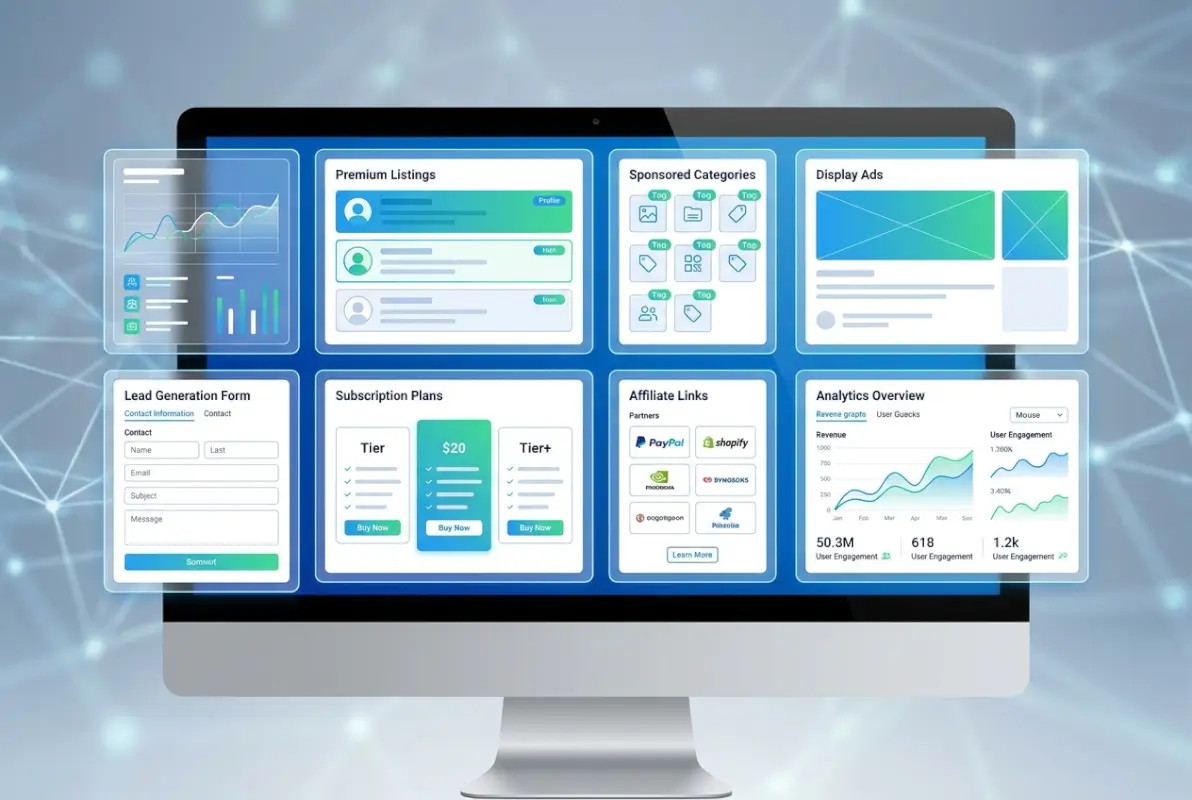
The key operational challenge is maintaining lead quality while scaling volume. Advertisers will quickly abandon a directory if leads are unqualified, duplicated, or fraudulent, so robust filtering and validation are essential. Implement real-time lead scoring that evaluates user behavior (time on site, pages viewed, form completeness) and apply deduplication rules to prevent the same inquiry from generating multiple charges. Set clear expectations with advertisers about lead exclusivity, response-time windows, and dispute resolution processes.
Pricing for lead-gen typically follows one of three models: fixed price per lead (common in local services), bid-based auctions (used by platforms like Google Local Services Ads), or tiered pricing by lead quality or geography. Start with conservative pricing based on industry benchmarks—$15–$50 for local service leads, $100–$500 for professional services, and $200–$1,000+ for enterprise B2B inquiries—then adjust based on conversion data and advertiser feedback. Monitor lead acceptance rates and advertiser LTV closely; if acceptance rates fall below 60%, your lead quality or targeting needs improvement.
Transparency is critical to sustaining a lead-gen model. Provide advertisers with detailed lead reports showing submission timestamps, user context (search query, referral source), and disposition outcomes. Build a self-service dashboard where advertisers can pause campaigns, adjust budgets, and dispute invalid leads with one-click workflows. On the user side, clearly disclose that submitting a form will share their information with third parties and offer opt-in choices for follow-up marketing, ensuring compliance with privacy regulations like GDPR and CCPA.
Affiliate partnerships and referral revenue
Affiliate monetization leverages your directory’s audience and trust to generate commissions from relevant third-party products and services. Rather than charging your own listings directly, you earn a percentage when users click through to a partner merchant and complete a purchase or sign-up. This model works best when affiliate offers align naturally with user intent—for example, a SaaS directory might promote productivity tools, or a travel directory might link to booking platforms. The key advantage is minimal operational overhead: no billing infrastructure, no customer support for transactions, and no inventory risk.
Choose affiliate programs strategically by evaluating commission rates, cookie windows, and brand reputation. High-ticket items (enterprise software, premium subscriptions) often pay 20–30% recurring commissions, while commodity products (hosting, travel bookings) may offer only 5–10% one-time payouts. Prioritize programs with 30–90 day cookie windows to capture delayed conversions and ensure partners provide real-time reporting APIs so you can attribute revenue accurately. Avoid low-quality networks or merchants with aggressive upselling tactics that could damage your directory’s credibility.
Integrate affiliate links thoughtfully to preserve user experience. Contextual placements—such as “Recommended Tools” sections within relevant category pages or curated buying guides—perform better than banner ads and feel more editorial. Use disclosure language like “We may earn a commission if you purchase through this link” to maintain transparency and comply with FTC guidelines. Track click-through and conversion rates by placement type and affiliate partner, then double down on top performers while pruning underperforming programs quarterly.
Hybrid models that combine affiliate revenue with owned listings can amplify earnings. For example, offer free directory listings to attract a broad base of businesses, then monetize the resulting traffic through affiliate partnerships for complementary tools (payment processors, marketing platforms, analytics services). This approach subsidizes the directory side with affiliate income, accelerating network effects without directly charging small businesses. Monitor cannibalization carefully—if affiliate offers compete directly with paid listings, you risk undermining your primary revenue stream.
Data, Services, and Value-Added Offerings
Data licensing, insights, and data-as-a-service
Your directory’s structured data—business profiles, user reviews, search trends, and geographic coverage—is a valuable asset that can be monetized through licensing and analytics products. Enterprises, researchers, and adjacent platforms often pay premium rates for clean, verified datasets that would take months to compile independently. Data-as-a-service (DaaS) models deliver this information via API access, bulk exports, or customized reports, creating recurring revenue streams with high margins and low incremental costs once the infrastructure is built.

Start by auditing your data inventory for commercial viability. High-demand datasets include business contact information (emails, phone numbers, addresses), category taxonomies, review sentiment scores, and trend analytics (search volume by industry or region). Anonymize and aggregate user behavior data to protect privacy while surfacing insights like “top-growing categories in the Southeast” or “average review sentiment by business size.” Package these outputs into tiered API plans—basic (read-only access, rate-limited), professional (bulk exports, higher quotas), and enterprise (custom integrations, dedicated support).
Pricing for data products typically follows usage-based or subscription models. API access might charge $0.01–$0.10 per record retrieved, with volume discounts at scale, while flat-rate subscriptions ($500–$5,000/month) work well for unlimited access within defined use cases. Enterprise contracts for custom data feeds or white-label integrations can command $50,000–$500,000+ annually, especially if your directory covers a niche vertical (healthcare providers, financial advisors, construction firms) where proprietary data is scarce. Use metered billing and real-time dashboards to help customers monitor usage and avoid surprise overages.
Data governance and compliance are non-negotiable. Ensure all licensed data complies with privacy regulations (GDPR, CCPA) and terms of service with your listing businesses—most directories prohibit bulk scraping or resale without explicit consent. Implement robust access controls, audit logs, and encryption for data transfers. Draft clear licensing agreements that specify permitted use cases (e.g., market research only, no telemarketing) and enforce violations aggressively to protect your reputation and avoid legal exposure.
Value-added services for listings (SEO, audits, design, coupons)
Beyond basic directory placement, businesses will pay for services that amplify their visibility and conversion rates. Value-added offerings like SEO optimization, listing audits, enhanced page design, and promotional tools (coupons, featured badges) create upsell opportunities while increasing platform stickiness. These services are especially attractive to small businesses that lack in-house marketing expertise and view your directory as a growth partner, not just a listing database. Bundling services with tiered subscription plans drives higher average revenue per user (ARPU) and reduces churn.
SEO audits and optimization services help listing businesses improve their organic search rankings both within your directory and on external search engines. Offer automated audits that flag missing or weak elements—incomplete business descriptions, low keyword density, missing images, or broken links—then provide one-click fixes or premium manual optimization for a fee ($50–$500 per listing). Emphasize tangible outcomes like “improved search ranking” or “3× more profile views” backed by before-and-after analytics. This service works especially well for directories with high domain authority, where optimized listings rank prominently in Google local packs.
Enhanced listing design and customization options let businesses differentiate themselves from free or basic listings. Offer premium templates with custom color schemes, video embeds, photo galleries, and rich-text bios. Provide drag-and-drop editors or done-for-you design services ($200–$2,000 depending on complexity) that turn a generic profile into a branded landing page. Track engagement metrics (time on page, click-through to website/contact) for premium vs. standard listings and share case studies demonstrating conversion lifts of 30–50% to justify the investment.
Promotional tools like digital coupons, limited-time offers, and “verified” or “top-rated” badges create urgency and trust signals that drive user action. Charge businesses $25–$100/month to feature a coupon on their listing or $50–$200 for a verified badge that signals you’ve confirmed their credentials. Time-limited promotions (e.g., “20% off for new customers this week”) can be paired with email or social campaigns that drive traffic back to the directory, creating a flywheel effect. Measure redemption rates and ROI for advertisers to refine pricing and prove value, ensuring these tools become sticky, recurring revenue streams rather than one-off experiments.
| Value-Added Service | Typical Pricing | Key Benefit | Best For |
|---|---|---|---|
| SEO Audit & Optimization | $50–$500/listing | Higher organic rankings, more profile views | High-authority directories, competitive verticals |
| Enhanced Design/Templates | $200–$2,000 | Branded, conversion-optimized listing pages | Premium/enterprise listings, B2B directories |
| Verified/Top-Rated Badge | $50–$200/month | Trust signal, higher click-through rates | Consumer directories, trust-sensitive categories |
| Digital Coupons/Promotions | $25–$100/month | Drive immediate conversions, track redemptions | Local service directories, e-commerce |
Operational Considerations, Governance, and Measurement
User experience, trust, and compliance
Sustainable monetization depends on preserving the core value proposition that attracted users to your directory in the first place—fast, relevant search results and trustworthy business information. Overly aggressive advertising, hidden fees, or low-quality listings erode trust and drive users to competitors, undercutting long-term revenue. Design every monetization feature with a “user-first” filter: does this improve or degrade the search experience, and would I personally tolerate this level of commercial messaging? If the answer is no, find a lighter-touch alternative or test incrementally before full rollout.

Transparency in pricing and sponsorship disclosure builds trust and ensures regulatory compliance. Clearly label paid placements as “Sponsored” or “Featured” and separate them visually from organic results using background shading or border styling. Provide a dedicated pricing page that outlines all listing tiers, advertising options, and value-added services with no hidden charges or surprise auto-renewals. Implement GDPR-compliant consent flows for data collection and offer easy opt-out mechanisms for marketing communications. These practices not only satisfy legal requirements but also signal professionalism and respect for users, differentiating your platform from spammy competitors.
Quality controls and anti-spam measures protect your directory’s integrity as monetization scales. Establish clear listing guidelines (no duplicate entries, accurate contact info, real business addresses) and enforce them through manual review, automated checks, and user reporting tools. Revoke paid listings that violate terms, even if it means short-term revenue loss—allowing bad actors undermines the entire marketplace. Implement rate limiting and CAPTCHA on listing submissions to block bulk spam, and use domain reputation scoring to flag suspicious sign-ups before they go live.
Privacy and data security are especially critical when monetizing through lead generation or data licensing. Encrypt all user submissions and business data both in transit and at rest, and conduct regular penetration testing to identify vulnerabilities. Draft clear terms of service and privacy policies that explain how data is collected, used, and shared, with conspicuous links on every form. Obtain explicit opt-in consent before sharing contact information with third parties and honor deletion requests within regulatory windows (typically 30 days). Proactive compliance reduces legal risk and positions your directory as a trusted steward of sensitive information.
Analytics, testing, and sustainable growth
Data-driven optimization is the engine of effective monetization. Instrument every revenue touchpoint—listing upgrades, ad clicks, lead submissions, affiliate conversions—with detailed tracking so you can measure performance by channel, cohort, and timeframe. Use a modern analytics stack (Google Analytics 4, Mixpanel, or Amplitude) to build conversion funnels that reveal drop-off points and identify high-value user segments. Set up real-time dashboards for key metrics like monthly recurring revenue (MRR), average revenue per user (ARPU), customer acquisition cost (CAC), and lifetime value (LTV) to monitor financial health at a glance.
A/B testing should be continuous and hypothesis-driven. Test pricing variations (does $49/month convert better than $59/month?), feature packaging (is a three-tier model clearer than five?), and creative elements (which CTA button color drives more upgrades?). Run experiments with statistical rigor—aim for at least 100 conversions per variant and a 95% confidence threshold before declaring a winner. Document all tests in a shared repository (Notion, Airtable, or a dedicated experimentation platform) so your team can learn from past results and avoid repeating failed approaches.
Churn analysis and retention initiatives are as important as acquisition. Track cohort retention curves to see how many paying listings renew month-over-month and identify inflection points where drop-off accelerates. Conduct exit surveys or interviews with churned customers to uncover common pain points (too expensive, didn’t see ROI, poor support) and address them systematically. Implement win-back campaigns offering limited-time discounts or new features to re-engage lapsed users, and measure reactivation rates to assess effectiveness.
Balance short-term revenue goals with long-term platform health by monitoring engagement and satisfaction metrics alongside financial KPIs. Track organic search rankings, domain authority, and backlink growth to ensure monetization tactics aren’t harming SEO. Survey users quarterly on Net Promoter Score (NPS) and perceived value, and compare scores across free vs. paid cohorts to detect dissatisfaction early. If NPS drops below 30 or organic traffic declines for two consecutive quarters, audit recent monetization changes and roll back aggressive experiments. Sustainable growth comes from compounding user trust and network effects, not maximizing short-term extraction at the expense of the ecosystem.
| Metric | What It Measures | Healthy Benchmark | Red Flag |
|---|---|---|---|
| MRR Growth Rate | Month-over-month recurring revenue increase | 10–20%/month (early stage), 5–10% (mature) | Flat or negative for 2+ months |
| ARPU (Average Revenue Per User) | Total revenue ÷ paying listings | $50–$200/month (depends on vertical) | Declining trend over 3+ months |
| LTV:CAC Ratio | Lifetime value vs. acquisition cost | 3:1 or higher | Below 2:1 |
| Monthly Churn Rate | % of paying listings that cancel each month | 3–5% (monthly), <10% (annual) | Above 10% monthly |
| Net Promoter Score | User willingness to recommend directory | 40+ (good), 60+ (excellent) | Below 20 or declining trend |
Frequently Asked Questions
What are the most common monetization models for online directories?
The most common models include paid listings, tiered subscription plans, featured placements, display advertising, lead generation fees, and affiliate partnerships. Many successful directories combine multiple streams—such as free basic listings with premium upgrades and targeted ads—to balance user growth with predictable revenue while maintaining quality and trust.
How much can a directory site realistically earn from listings and ads?
Revenue varies widely based on niche, traffic, and monetization strategy. Small local directories might earn a few hundred dollars monthly, while established niche platforms with thousands of active listings and robust traffic can generate $5,000 to $50,000+ per month through subscriptions, featured placements, and advertising combined.
Should a directory charge for listings or offer free listings with paid upgrades?
A freemium model—free basic listings with paid premium tiers—typically accelerates growth and network effects early on. Once you’ve built critical mass and proven value, introduce paid features like enhanced visibility, verification badges, or analytics. This approach maximizes both supply-side participation and willingness to pay for differentiation.
How do you balance user experience with monetization on a directory?
Prioritize transparency, relevance, and performance. Clearly label sponsored content, limit ad density to preserve page speed and readability, and ensure ads align with user intent. Regularly test conversions and engagement metrics; if monetization features degrade core search quality or trust, they’ll erode the platform value that drives revenue.
Do directories benefit from data licensing or offering value-added services?
Yes. Directories with high-quality, structured data can license insights or API access to businesses, researchers, or partners. Value-added services—SEO audits, enhanced profiles, coupon distribution, or onboarding support—increase stickiness, differentiate premium tiers, and unlock incremental revenue while strengthening relationships with listed businesses.
How important is trust and verification in a monetized directory?
Trust is foundational. Verified badges, quality controls, and anti-spam measures protect user experience and justify premium pricing. Users and advertisers pay more when they trust the directory’s accuracy and relevance. Implement transparent listing policies, moderation, and privacy compliance to sustain long-term credibility and conversion rates.
What metrics indicate a healthy monetization strategy for a directory?
Track activation rate, conversion by tier, average revenue per listing, customer lifetime value, churn, and lead quality. Healthy directories show growing premium adoption, stable or rising LTV-to-CAC ratios, low churn, and strong engagement metrics. Regularly A/B test pricing and features, and iterate based on cohort performance data.
How should I prioritize monetization initiatives for a new directory?
Start with growth and network effects: offer free or low-cost listings to build supply and traffic. Once you have traction, introduce featured placements and premium tiers. Layer in advertising, lead generation, or data services only after core value is proven and user trust is established, ensuring each step reinforces platform quality.
Conclusion: Build a Sustainable Revenue Engine for Your Directory
Directory platforms sit at the intersection of curation, community, and commerce. The strategies outlined here—from foundational pricing and network effects through direct listing monetization, traffic-driven models, data services, and rigorous governance—give you a comprehensive playbook to turn your platform into a thriving revenue engine. Success hinges on one core principle: monetization should amplify value, not extract it.
Start by understanding your two-sided market. Know when to subsidize searchers to build critical mass and when to lean into premium tiers and advertising as your network scales. Layer in complementary revenue streams—lead generation, affiliates, data licensing, value-added services—only when they enhance the core experience and deepen trust. Every pricing decision, every ad placement, and every badge or feature you introduce sends a signal about what you value and who you serve.
Measurement matters as much as model. Track the metrics that reveal whether your monetization is healthy: activation rates, tier conversion, lifetime value, churn, and lead quality. Test relentlessly, iterate based on cohort data, and remain disciplined about user experience. The directories that scale sustainably are those that balance short-term revenue with long-term platform health.
Take Action Today
Choose one monetization initiative from this guide—whether it’s introducing a premium tier, launching featured placements, or piloting a lead-gen model—and commit to testing it within the next 30 days. Set clear success metrics, gather data, and refine your approach. Sustainable directory revenue is built one disciplined experiment at a time.
Your platform has value. Now it’s time to unlock it strategically, transparently, and profitably.
The best directory monetization strategies are invisible to users who find what they need and indispensable to businesses that gain visibility and leads. When you get that balance right, you create a flywheel: more quality listings attract more searchers, more searchers justify premium pricing and advertising, and better revenue funds the curation and features that reinforce trust. That’s the path to a directory platform that doesn’t just survive—it thrives.
Was this article helpful?