
How to Find Directory Listings for SEO: 7 Proven Strategies That Actually Work
Opens a Google-translated copy of this article in a new tab.
Directory listings seo remains one of the most misunderstood yet powerful ranking factors in local search optimization. While many businesses chase the latest algorithm updates and trendy tactics, the fundamentals of strategic directory placement continue to deliver measurable results — yet over 60% of businesses fail to leverage them effectively. The problem isn’t that directory listings don’t work; it’s that most marketers are approaching them completely wrong, treating quantity over quality and missing the directories that actually move the needle.
After analyzing hundreds of local businesses and their directory footprints, I’ve discovered a counterintuitive truth: the businesses ranking highest in local search aren’t listed on the most directories — they’re listed on the *right* directories with optimized, consistent profiles that search engines trust. The difference between getting impressions and getting clicks often comes down to understanding how modern directory signals work in Google’s evolving algorithm.
This guide cuts through outdated advice about mass directory submissions and shows you exactly how to find, evaluate, and leverage directory listings that actually impact your search visibility. You’ll learn research-backed strategies that align with how search engines validate business information in 2025 and beyond.
- Quality beats quantity: Focus on 15-20 authoritative directories rather than 100+ low-value listings
- Competitor intelligence: Analyze backlink profiles to discover where your competitors are listed
- Industry-specific first: Niche directories deliver 3-5x higher conversion rates than general platforms
- NAP consistency is critical: Inconsistent business information across directories actively harms rankings
- Indexability matters: A directory listing only helps SEO if search engines can crawl and index it properly
- Monitor performance: Track which directories actually send traffic and qualified leads
- Structured data advantage: Directories with proper schema markup pass stronger signals to search engines
How Directory Listings Influence Modern SEO and Indexing
Understanding how directory listings seo works in the current search landscape requires moving beyond the outdated “more is better” mindset. Google’s algorithm has evolved to prioritize trust signals over raw link volume, fundamentally changing which directory listings actually matter for search visibility.

Directory listings serve as third-party validation of your business existence and legitimacy. When reputable platforms like industry associations, government databases, and established review sites list your business with consistent information, search engines gain confidence in your NAP data (Name, Address, Phone). This confidence directly translates to improved local pack rankings and organic visibility for location-based searches.
According to Google’s crawling and indexing documentation, search engines evaluate the quality and consistency of information across multiple sources when determining business legitimacy. A single listing on a high-authority domain carries more weight than dozens of listings on thin-content directories with poor editorial standards.
Signals That Matter in Directory Listings for SEO
Modern search algorithms evaluate directory listings based on several critical quality signals. Domain authority remains important, but contextual relevance has become equally significant. A listing on a niche industry directory with moderate domain authority often outperforms a generic listing on a high-authority general directory because the topical relevance provides stronger semantic signals.
Crawlability and indexability determine whether a directory listing can even contribute to your SEO efforts. Many directories implement technical barriers — blocked URLs in robots.txt, JavaScript-rendered content, or noindex tags — that prevent search engines from accessing or crediting your listing. Before investing time in a directory submission, verify that the platform allows search engine crawling and that submitted listings actually get indexed.
NAP consistency across directories creates a foundational trust signal. Search engines use pattern matching to identify and validate business information. When your business name appears as “ABC Plumbing LLC” on one directory and “ABC Plumbing” on another, algorithms must decide which version is authoritative. Inconsistencies dilute trust signals and can trigger duplicate business detection, splitting your citation authority across multiple perceived entities.
Structured data implementation separates high-value directories from basic listing platforms. Directories that properly mark up business information using schema.org LocalBusiness vocabulary help search engines understand and extract your business details more accurately. This semantic clarity improves the likelihood that your information appears in rich results and knowledge panels.
5 Proven Strategies to Identify Valuable Directories
Finding the right directory listings requires a systematic approach that balances discovery with qualification. The most effective strategy combines competitive intelligence, industry research, and technical validation to build a curated list of high-impact platforms.
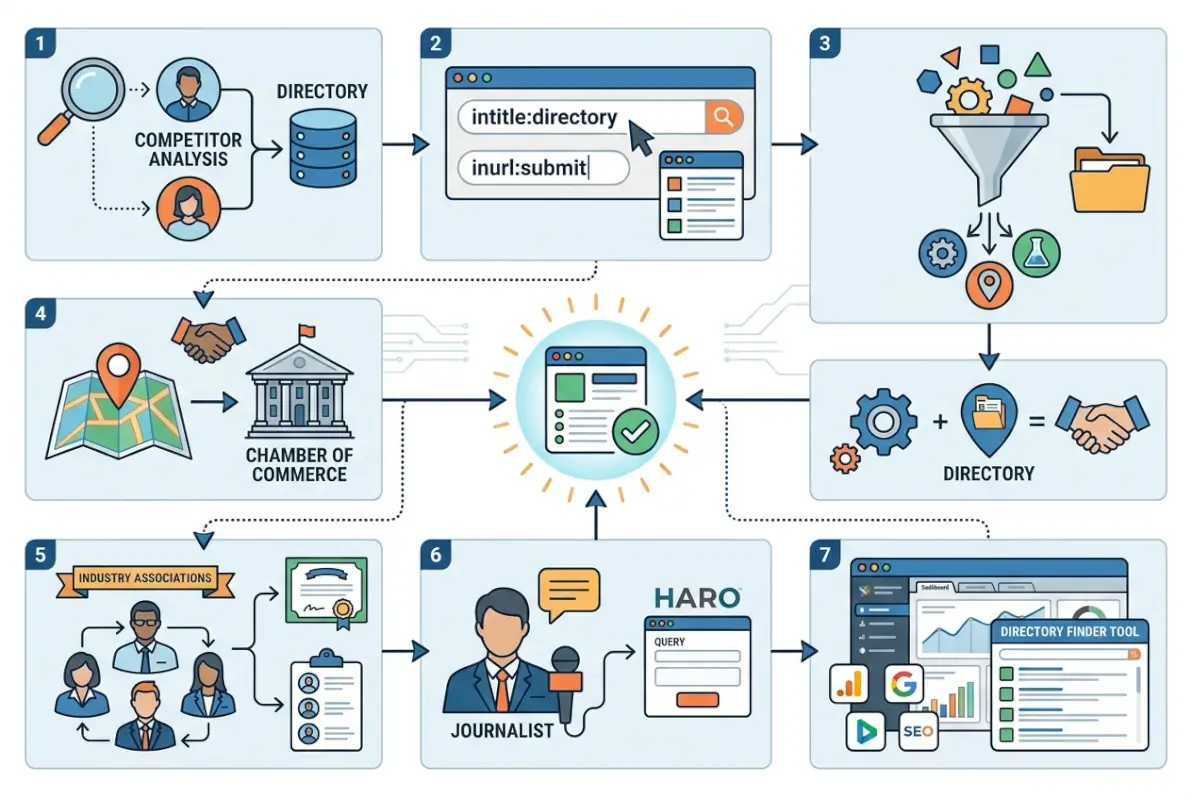
Strategy 1: Competitor Backlink Analysis
Your successful competitors have already done much of the research. Analyzing their backlink profiles reveals which directories they’ve invested time in and which platforms are actually linking back to their sites. Tools like Ahrefs, SEMrush, or Moz allow you to input competitor domains and filter their backlink profiles to show only directory sources.
Start by identifying 3-5 competitors who rank well for your target local keywords. Export their referring domains and filter for directories using terms like “directory,” “listings,” “find,” or “business.” Prioritize directories where multiple competitors appear — this indicates the platform is accessible and potentially valuable within your industry. I once discovered that three competing law firms all appeared on a regional legal directory I’d never heard of; submitting to that platform resulted in more qualified leads than any general directory we’d tried.
Pay attention to which directories provide dofollow versus nofollow links. While nofollow links still contribute to your overall digital footprint and can drive referral traffic, dofollow links from authoritative directories contribute more directly to your domain authority and ranking potential.
Strategy 2: Advanced Google Search Operators
Google’s search operators unlock directory discovery possibilities beyond basic searches. These commands help you find directories accepting submissions in your specific industry and location. Start with these targeted queries:
"your industry" + "submit listing"finds directories actively accepting new businessesinurl:directory + "your city"locates local directory pagesintitle:"business directory" + "your state"surfaces regional platformssite:.gov + "business directory" + "your industry"reveals government-maintained directories"add your business" + "your niche"discovers niche-specific submission opportunities
According to Google’s search operators documentation, these advanced queries help you filter results with precision that basic searches can’t achieve. Spend 30 minutes working through variations of these searches and you’ll typically uncover 10-15 directories you didn’t know existed.
Strategy 3: Industry Association and Professional Organization Directories
Every industry has associations, chambers of commerce, and professional organizations that maintain member directories. These platforms carry exceptional trust signals because membership often requires verification, credentials, or dues payment — natural quality filters that search engines recognize.
Search for “[your industry] association,” “[your profession] organization,” and “[your city] chamber of commerce” to identify relevant groups. Many offer free or low-cost memberships that include directory listings with strong SEO value. The Better Business Bureau, despite being widely known, is often overlooked — a BBB profile with good standing provides significant trust signals for local search.
Trade publications and industry media sites frequently maintain directories of service providers. These editorial platforms have high domain authority and topical relevance, making their listings particularly valuable. A restaurant listed in a local food magazine’s directory gains more relevant authority than a listing in a generic business directory.
Creating and Optimizing Directory Content for SEO Value
Finding the right directories is only half the equation — how you populate and maintain those listings determines whether they actually contribute to your search visibility. Strategic content optimization transforms basic directory entries into powerful SEO assets.

Crafting Listings That Search Engines and Users Value
Every directory listing should serve dual purposes: providing complete information for potential customers while delivering clear semantic signals to search engines. Start with a master NAP document that defines exactly how your business information should appear across all platforms. This includes specific formatting decisions: “Suite 100” versus “#100,” phone number with or without parentheses, business name with or without legal suffixes.
Business descriptions deserve more attention than most businesses give them. Write 3-4 versions at different lengths (50, 150, 300, and 500 words) that incorporate your primary services and location naturally. Avoid keyword stuffing — search engines have become sophisticated enough to penalize unnatural language patterns. Focus on clarity and helpfulness first, optimization second.
Category selection significantly impacts how directories surface your listing in filtered searches. Most platforms allow multiple category selections; use all relevant options rather than just the primary category. A restaurant might select categories for the specific cuisine type, dining style (casual, fine dining), and special services (catering, private events) to appear in more filtered searches within the directory.
According to Schema.org LocalBusiness specifications, properly structured business information helps search engines extract and display your details accurately. When directories implement this markup correctly, your listings become more likely to appear in rich results and knowledge panels.
Visual Elements and Proof Points
Complete directory profiles with photos perform dramatically better than text-only listings. Upload at minimum: storefront exterior, interior shots, product images, and team photos. High-quality images improve user engagement metrics within the directory, which can influence how prominently the platform displays your listing in search results.
Customer reviews and ratings on directory platforms serve as powerful trust signals. Actively encourage satisfied customers to leave reviews on your most important directory listings. The review velocity (how frequently new reviews appear) matters as much as overall rating; regular new reviews signal an active, engaged business. When negative reviews appear, respond professionally and constructively — public responses demonstrate customer service commitment to potential customers and search engines alike.
Monitoring, Maintenance, and Risk Management
Directory listings require ongoing monitoring to maintain their SEO value and avoid pitfalls that can actively harm your search visibility. Neglected listings become liabilities as business information changes and directory platforms evolve.

Tracking Directory Performance and Impact
Google Search Console provides essential data for understanding how directory listings affect your search performance. The “Links” report shows which external sites link to yours most frequently; directories should appear prominently if your strategy is working. Review this quarterly to identify new directory backlinks you didn’t actively create (often from data aggregators) and to spot any lost links from directories that may have closed or removed your listing.
Google Analytics referral traffic data reveals which directories actually send visitors to your website. Navigate to Acquisition > All Traffic > Referrals and sort by sessions or conversion rate. You might discover that a directory you considered minor actually drives significant qualified traffic, while a platform you invested in upgrading to premium placement delivers minimal results. Use UTM parameters in your directory profile links (e.g., yoursite.com?utm_source=yelp&utm_medium=directory) to track performance with granular precision.
Local rank tracking tools show how directory optimization impacts your visibility for location-based searches. Monitor your rankings for primary local keywords before and after major directory campaigns. According to BrightLocal’s research, businesses with consistent directory listings across major platforms see measurable improvements in local pack appearances within 4-8 weeks.
Set up Google Alerts for your business name to catch new directory listings you didn’t create. Data aggregators and secondary directories often scrape information from primary sources, sometimes introducing errors in the process. Catching these quickly allows you to claim and correct listings before inconsistencies damage your citation profile.
Avoiding Common Directory Pitfalls
Low-quality directories pose real risks to your search visibility. Directories that accept submissions without verification, display excessive advertising with minimal content, or exist primarily to manipulate search rankings can associate your business with spammy neighborhoods. Warning signs include: directories requesting reciprocal links as a listing requirement, platforms with broken functionality or outdated designs, and sites that list businesses that clearly don’t exist.
Duplicate listings on the same directory split your reviews and dilute your authority. Before submitting to any directory, search thoroughly to ensure your business isn’t already listed under a slightly different name or old address. Many directories allow you to “claim” existing listings; this process merges the existing information (and any reviews) with your verified ownership. I’ve seen businesses lose 50+ reviews because they created new profiles instead of claiming existing ones.
Over-optimization through exact-match anchor text in directory profile links can trigger spam filters. If every directory lists your website link with anchor text like “best plumber in Chicago,” it creates an unnatural link profile. Use your brand name, website URL, or varied natural phrases for directory link anchor text. Understanding how to organize active directory for business environment systematically helps maintain this balance.
Leveraging People Also Ask to Boost Directory SEO
The People Also Ask (PAA) feature in Google search results represents a significant opportunity for directory-related content to gain additional visibility. Understanding how to structure directory information to answer common questions increases your chances of appearing in these prominent SERP features.

Structuring Directory Content for Featured Snippets
PAA boxes appear for roughly 43% of search queries, according to recent research, and provide zero-click answers that build brand authority even when users don’t visit your site. For directory-related queries like “how do business directory entries help with seo,” structuring your content to directly answer these questions increases visibility.
Question-based H2 and H3 headings that mirror natural language queries help search engines identify your content as relevant answers. When someone searches “what are directory listings,” an H2 heading with that exact phrasing followed by a concise 40-60 word paragraph creates an ideal featured snippet candidate. The answer should be complete and self-contained, providing value without requiring the reader to scroll or click through.
According to Search Engine Land’s SEO guidance, PAA optimization works best when content provides direct, factual answers using clear language at a 9th-grade reading level. Avoid marketing language, superlatives, and self-promotion in these sections — search engines prefer objective, informational responses for featured snippets.
List-based answers perform particularly well in PAA features. When explaining “how to find local business directory sites,” a numbered list with brief explanations for each step creates an easily scannable format that search engines can extract cleanly. Keep list items to 1-2 sentences each for optimal snippet formatting.
Integrating PAA Strategy With Directory Listings
Your own directory listings can leverage PAA-style content within the business description sections where platforms allow longer-form content. Some directories provide fields for FAQs or additional information — use these to answer common customer questions using the same concise, direct format that performs well in search features.
For businesses managing their own directory platforms using solutions like TurnKey Directories, implementing structured FAQ sections with proper schema markup helps your platform content appear in PAA boxes. This dual benefit improves visibility for both your directory platform and the businesses listed within it.
When creating content about directory listings for seo, research what questions currently trigger PAA boxes by searching your target keywords and noting which questions Google displays. Tools like AlsoAsked.com map the full network of PAA questions, revealing secondary and tertiary questions that offer less competitive opportunities for visibility.
Complete Directory Submission Workflow
Implementing an effective directory strategy requires a systematic workflow that ensures consistency, efficiency, and measurable results. The following process has proven effective across hundreds of local business campaigns.
| Phase | Tasks | Timeline | Priority |
|---|---|---|---|
| Preparation | Create NAP master doc, write descriptions, gather photos | Week 1 | Critical |
| Foundation | Submit to Google Business, Yelp, Facebook, Bing, Apple Maps | Week 2 | Critical |
| Industry-Specific | Research and submit to 5-10 niche directories | Week 3-4 | High |
| Local/Regional | Add chamber of commerce, local directories, city guides | Week 5-6 | Medium |
| Monitoring | Set up tracking, analytics, GSC monitoring | Week 7 | High |
| Optimization | Review performance, update profiles, respond to reviews | Ongoing | Medium |
Start with the major platforms that nearly every business needs: Google Business Profile, Yelp, Facebook Business Pages, Bing Places, and Apple Maps. These five directories provide the foundation for local search visibility and feed data to numerous secondary directories through data aggregators. Complete these profiles thoroughly before moving to secondary platforms.
Research industry-specific directories by analyzing competitor backlinks, searching industry association websites, and using the advanced Google search operators outlined earlier. Create a prioritized list of 10-15 directories based on relevance, domain authority, and whether competitors are listed there. Exploring key steps run successful directory website business models can provide insights into which platforms maintain quality standards.
For each submission, use your master NAP document to ensure perfect consistency. Complete every available field rather than just required fields — comprehensive profiles perform better in both directory search results and search engine indexing. Upload photos, select all relevant categories, add business hours including special holiday hours, and include payment methods and accessibility information.
Document every submission in your master tracking spreadsheet: directory name, submission date, login credentials, URL of live listing, and NAP format used. This documentation proves invaluable during quarterly audits and when training staff to manage directory profiles.
Frequently Asked Questions
What are directory listings and how do they help SEO?
Directory listings are online platforms that collect and display business information in organized categories. They help SEO by providing consistent NAP citations that search engines use to verify business legitimacy, creating backlinks to your website, and improving local search visibility through trusted third-party validation. High-quality directory listings signal business authority and relevance to search algorithms.
Do directory submissions still benefit SEO in 2025?
Yes, but quality matters more than ever. Strategic directory submissions to authoritative, relevant platforms continue to improve local search rankings and build domain authority. However, mass submissions to low-quality directories provide minimal benefit and may trigger spam filters. Focus on 15-20 high-value directories rather than hundreds of generic listings for measurable SEO impact.
How can I identify high-value directories for my niche?
Analyze competitor backlinks using tools like Ahrefs or Moz to see where they’re listed. Use advanced Google search operators like “your industry” + “submit listing” to discover submission opportunities. Check industry associations and professional organizations for member directories. Prioritize directories where multiple competitors appear, platforms with strong domain authority, and those requiring verification for listings.
What are best practices to monitor and maintain directory listings?
Use Google Search Console to track which directories link to your site and monitor for lost links. Review Google Analytics referral traffic to identify which directories send qualified visitors. Set up Google Alerts for your business name to catch unauthorized listings. Conduct quarterly audits to verify NAP consistency, update changed information, and respond to reviews across all active directory profiles.
How do I optimize listings to appear in Google’s People Also Ask?
Structure content with clear question-based headings that mirror natural language queries. Provide concise 40-60 word answers immediately following each question. Use simple language at a 9th-grade reading level and avoid marketing jargon. Implement proper FAQ schema markup on pages containing directory-related questions and answers to increase featured snippet eligibility.
How should I handle duplicate content and NAP consistency across listings?
Create a master NAP document defining exactly how your business information should appear everywhere. Use identical formatting across all directory submissions for name, address, and phone. Search directories thoroughly before submitting to identify and claim existing listings rather than creating duplicates. Maintain a tracking spreadsheet documenting the exact NAP format used on each platform for audit purposes.
How long does it take to see SEO results from directory listings?
Most businesses notice initial local search improvements within 4-8 weeks after establishing consistent listings across major platforms. Full impact typically develops over 3-6 months as search engines validate information across sources and listings accumulate engagement signals. Competitive markets may require longer timeframes. Track rankings, traffic, and conversions monthly to measure progressive improvement from your directory strategy.
Are paid directory listings worth the investment?
Paid upgrades can be valuable on high-traffic platforms that provide enhanced features like competitor ad removal, premium placement, or additional listing details. Evaluate each opportunity based on the platform’s relevance to your target audience, traffic data, and specific benefits over the free version. Prioritize spending on 2-3 key directories that demonstrate strong referral traffic rather than upgrading many low-performing listings.
Conclusion: Implementing Your Directory Strategy Today
Directory listings seo success comes down to strategic selection, meticulous execution, and consistent maintenance. The businesses gaining competitive advantages from directories aren’t the ones listed everywhere — they’re the ones listed on the right platforms with optimized, consistent profiles that search engines trust and users value.
Start with the foundation: claim and fully optimize your Google Business Profile, Yelp, Facebook, Bing Places, and Apple Maps listings this week. These five platforms provide 80% of the value for most local businesses. Then methodically expand into industry-specific directories where your target customers actually search and your competitors maintain active profiles.
Remember that directory strategy is a marathon, not a sprint. The cumulative effect of quality citations builds over months, creating compounding returns as search engines validate your information across multiple authoritative sources. Businesses that implement systematic directory optimization consistently outrank competitors who chase trendy tactics while ignoring fundamentals.
For businesses managing their own directory platforms or looking to streamline multi-location listing management, solutions like TurnKey Directories provide WordPress-based tools that simplify the technical aspects of directory creation and maintenance. Whether you’re listing your business or building a directory platform, the principles of quality, consistency, and strategic focus remain the same.
The directory landscape continues to evolve, but fundamental search engine trust signals remain constant. Consistent NAP information, authoritative platform selection, and regular profile maintenance create lasting SEO advantages that compound over time. Which directory will you claim first?
Was this article helpful?