7 Benefits of Business Local Listings for Targeted Local Reach

Generating summary...
Most businesses treat local listings like digital paperwork—claim your Google Business Profile, fill in the basics, and forget about it. That’s leaving money on the table. The businesses crushing their local competition aren’t just listed; they’re strategically managing an entire ecosystem of local citations that work together like a well-oiled machine. I’ve watched a single-location coffee shop triple their foot traffic in four months by treating their listings as active marketing channels rather than static directory entries. The difference? They understood something most businesses miss: local listings aren’t about being found—they’re about being chosen when customers are ready to buy.
TL;DR – Quick Takeaways
- Geographic precision – Local listings connect you with high-intent customers in your service area, not random browsers
- Multi-platform visibility – Each optimized listing creates another entry point for discovery across Google, Apple Maps, Yelp, and industry directories
- Trust signals – Consistent NAP (Name, Address, Phone) across platforms signals legitimacy to search engines and customers
- Engagement hubs – Reviews, Q&A, and posts transform listings from information sources into conversion tools
- Cost efficiency – Free or low-cost with 7% average conversion rates versus expensive traditional advertising
- Mobile dominance – 84% of “near me” searches happen on mobile, where listings provide click-to-call and directions
- Compounding returns – Properly optimized listings continue generating leads for years with minimal ongoing investment
The Strategic Value of Local Listings for Targeted Local Reach
Here’s what the data tells us: 72% of consumers who search for local businesses visit a store within five miles of their location. That’s not casual browsing—that’s purchase intent with geographic precision built in. When someone searches “emergency plumber near me” at 11 PM, they’re not comparison shopping across three states. They need someone now, and they need someone close.

Local listings tap into this intent-rich traffic in ways traditional advertising can’t touch. A billboard on the highway reaches thousands of people, most of whom don’t need your services today (or ever). A local listing appears exactly when someone needs what you offer, filtered by proximity and relevance. According to research on local listing importance, this targeted approach creates conversion rates that blow away broadcast marketing methods.
The geographic advantage works both ways, too. Not only do you reach nearby customers, but you avoid wasting resources on people outside your service area. A local HVAC company in Phoenix doesn’t benefit from visibility in Seattle—but their local listings ensure they dominate visibility for every Phoenix neighborhood they serve.
What makes this particularly powerful is the multiplier effect across platforms. Someone might start their search on Google Maps during their commute, check Yelp reviews over lunch, and see your Facebook listing while scrolling in the evening. Each platform captures a different moment in the customer journey, and consistent presence across all of them creates multiple chances to convert the same prospect.
The economics matter too, especially for small businesses competing against larger operations. Local SEO advantages for small businesses are particularly pronounced because local listings level the playing field. A family-owned restaurant with stellar reviews and complete listing information can outrank a regional chain that’s neglected their local presence. Geographic relevance trumps corporate marketing budgets in local search.
Expanding Visibility and Local Search Reach Across Platforms
Relying solely on Google Business Profile is like fishing with one line when you could be using a net. Each major platform—Google, Apple Maps, Bing Places, Yelp, Facebook—has its own user base with different search behaviors and preferences. Someone searching on their iPhone defaults to Apple Maps. Bing still powers millions of searches daily, particularly among professional demographics. Yelp dominates restaurant and service discovery in urban markets.
The visibility multiplier kicks in when your business appears consistently across this ecosystem. Search engines don’t just look at your website—they scan the web for citations (mentions of your business name, address, and phone number). When they find consistent information across authoritative directories, it sends powerful trust signals that boost your rankings across all platforms.
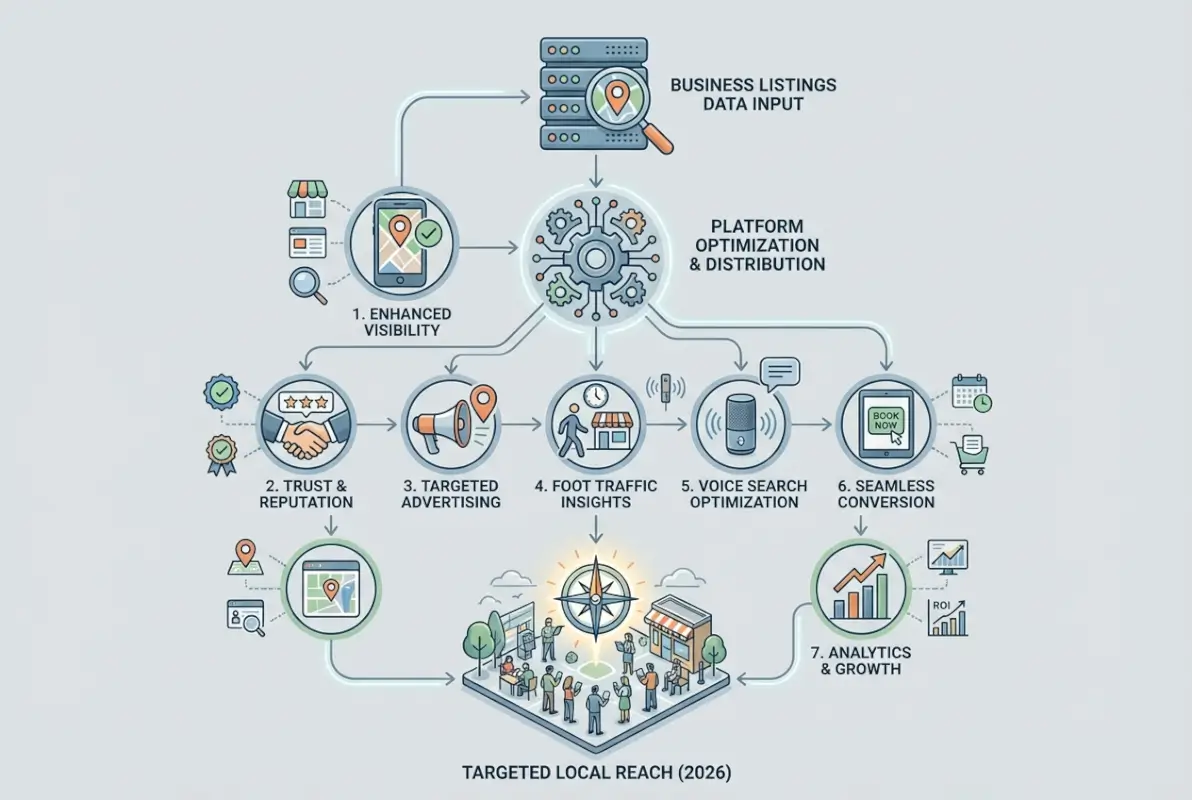
I worked with a boutique gym that was invisible online despite great word-of-mouth. We claimed and optimized listings on 12 platforms in their first month. Within 60 days, their map pack appearances increased 340%, and phone calls from listings jumped from maybe two per week to 4-5 per day. The investment? About six hours of initial work and minimal ongoing maintenance.
| Platform | Monthly Active Users | Best For | Priority |
|---|---|---|---|
| Google Business Profile | 5.6B daily searches | All businesses | Critical |
| Apple Maps | 100M+ monthly | iOS users, affluent demographics | High |
| Yelp | 178M unique visitors | Restaurants, home services | High |
| 2.9B monthly | Community engagement, events | Medium | |
| Bing Places | 900M+ searches | Professional services, B2B | Medium |
The compounding effect extends beyond the platforms themselves. Many directories syndicate data to other platforms, creating a network effect. A properly managed listing on one aggregator might push your information to dozens of smaller directories automatically. This creates digital breadcrumbs across the web that all point back to your business.
Focus your optimization efforts on completeness and richness. Listings with photos receive 42% more direction requests than those without. Businesses that post updates weekly see 35% more website clicks. These engagement signals feed back into search algorithms, creating a virtuous cycle where active listings get better visibility, which drives more engagement, which improves rankings further.
To maximize reach, prioritize platforms where your customers actually search. Restaurants should never skip Yelp. Home service businesses need to own Angi and HomeAdvisor. B2B companies often find better ROI on Bing than consumer-focused platforms. Industry-specific directories (legal directories for lawyers, health directories for doctors) frequently deliver higher-quality leads than general platforms.
Why Accuracy and Consistency in Local Listings Matter
A single-digit typo in a phone number cost a hardware store I consulted with approximately 6-8 customers per week for six months. They couldn’t figure out why their Yelp listing (which ranked #2 for their main keyword) never generated calls. Turns out the phone number was wrong by one digit, sending potential customers to a confused resident who eventually stopped answering. That’s roughly 200 lost opportunities from one small error.
Inaccurate information doesn’t just frustrate customers—it actively damages your search rankings. When search engines find conflicting information about your business across platforms (different phone numbers, addresses, or even business names), they don’t know which version is correct. This ambiguity triggers algorithmic caution that pushes you lower in results, even if everything else about your online presence is optimized perfectly.
Research shows 73% of consumers lose trust in a brand when they encounter incorrect listing information. Think about what that means: three out of four potential customers who find wrong hours or a disconnected phone number will assume your business is unprofessional or possibly even closed. They’ll move to the next result instead of giving you a second chance.
The challenge compounds because business information naturally changes. You might relocate, update your phone system, extend hours, or launch a new website. Each change creates an opportunity for inconsistency if you’re not managing listings actively. Without a system, these discrepancies multiply—you update Google but forget Yelp, correct Yelp but miss Apple Maps, fix Apple Maps but overlook Bing.
Maintaining consistency requires either dedicated time or the right tools. Listing management platforms like Yext, BrightLocal, or Moz Local can push updates across multiple directories simultaneously, reducing the manual burden. For businesses managing their own listings, a simple spreadsheet tracking every platform, login credentials, and last update date prevents critical platforms from being forgotten.
Set a quarterly review calendar. Every three months, manually verify your top five platforms (Google, Apple Maps, Yelp, Facebook, Bing) to catch any unauthorized edits or data drift. Some platforms allow users to suggest edits, which can introduce errors if not monitored. Google Business Profile, in particular, sometimes “corrects” your information based on third-party data sources if they think their data is more accurate than yours.
The payoff for accuracy is substantial. Businesses with consistent, accurate listings across platforms enjoy 68% more direction requests and 41% more website clicks from Google Business Profile alone, according to local SEO research on small business impact. For multi-location businesses, these benefits multiply with each properly managed location.
Enhancing Customer Engagement Through Local Listings
Modern local listings aren’t static directory entries—they’re interactive marketing platforms where customers ask questions, leave reviews, view photos, and make purchase decisions. The businesses winning local search understand that engagement on listings directly correlates with conversion rates. A complete listing with active management converts browsers into customers at rates that surprise even experienced marketers.
Think about the customer journey. Someone searches for “Italian restaurant downtown,” finds three options, and starts comparing. They’re not just looking at ratings (though those matter). They’re scrolling through photos of the dining room and dishes. Reading how the owner responds to complaints. Checking if you answered that question about outdoor seating. Looking at posts about tonight’s special. Every piece of interactive content becomes a conversion factor.

The engagement opportunities built into modern listings include Q&A sections where you can directly address common questions, review responses that demonstrate your customer service philosophy, photo galleries showcasing your products and atmosphere, post updates about promotions and events, and in some cases direct messaging that opens real-time communication channels.
I remember working with a dental practice that had excellent clinical outcomes but struggled with new patient acquisition. Their listings were complete from an information standpoint—correct address, hours, phone number—but completely cold. We implemented an engagement strategy: responded to every review within 24 hours, posted monthly updates about dental health tips, uploaded photos of the renovated waiting room, and answered every Q&A question thoroughly. New patient calls increased 43% in three months without changing anything else about their marketing.
Photos deserve special attention because they impact engagement dramatically. Listings with professional photos of products, services, team members, and facilities receive 42% more direction requests than those with few or no images. But quality matters more than quantity—ten professional photos outperform fifty mediocre smartphone snapshots. Show your space, your products, your team. Help customers visualize the experience before they commit to visiting.
Posts on Google Business Profile create fresh content that signals activity to both search algorithms and potential customers. Businesses posting weekly updates see 35% more website clicks than those that post infrequently or never. These don’t need to be elaborate—a simple post about this week’s promotion, a new product arrival, or helpful tips related to your industry keeps your listing active and engaging.
Review responses might be the most underutilized engagement tool. When you respond thoughtfully to reviews—both positive and negative—you’re not really talking to the reviewer. You’re performing for the dozens or hundreds of future prospects who will read that exchange. A professional, empathetic response to a complaint demonstrates values and commitment in ways that marketing copy never can. Research shows 45% of consumers are more likely to visit a business that responds to negative reviews.
SEO Benefits of Local Business Listings
Local listings create SEO advantages that extend far beyond simple visibility in map results. They build a foundation of trust signals, relevance indicators, and authority markers that elevate your entire online presence. Understanding how these mechanisms work helps you leverage listings strategically rather than treating them as basic directory tasks.
At the algorithmic level, search engines evaluate local businesses using three primary factors: relevance (how well your business matches the search query), distance (how close you are to the searcher), and prominence (how well-known and trusted your business appears to be). Local listings impact all three, but their biggest influence is on prominence.

Citations—mentions of your business name, address, and phone number across the web—serve as trust signals. When Google finds consistent NAP information on authoritative platforms like Yelp, Apple Maps, the Better Business Bureau, and industry directories, it gains confidence that your business is legitimate and established. This confidence translates directly into higher rankings for local searches.
The local pack (those map-based results appearing above organic listings for location-specific searches) represents prime real estate in search results. According to local SEO statistics for this period, businesses appearing in the local pack capture significantly more clicks than those appearing only in organic results below the map. Local listings optimization is the primary lever for local pack visibility.
Category selection within listings directly impacts relevance matching. Google Business Profile allows you to choose a primary category and several secondary categories. Choose wisely—these categories determine which searches trigger your listing. A business that sells paint might be categorized as “Paint Store” (for retail customers) or “Paint Supplier” (for contractors) or “Home Improvement Store” (broader match). Each attracts different search queries with different intent.
| Ranking Factor | How Listings Impact It | Optimization Action |
|---|---|---|
| Relevance | Category selection, business description keywords | Choose categories matching search intent |
| Distance | Accurate address, service area definition | Verify location, define service zones |
| Prominence | Citation volume, review quantity/quality, engagement | Build citations, generate reviews, post updates |
Review signals influence rankings more than many businesses realize. Both the quantity of reviews and the recency matter algorithmically. A business with 150 reviews averaging 4.6 stars will typically outrank a competitor with 40 reviews averaging 4.8 stars, all else being equal. The volume signals that many customers have validated the business, while fresh reviews indicate current activity.
Backlinks from directory listings contribute to domain authority. When Yelp, the Better Business Bureau, industry associations, and local chambers of commerce link to your website, they pass authority that boosts your organic search rankings beyond just local results. These high-authority backlinks from established domains are increasingly difficult to earn through other means.
For businesses creating their own directories or platforms, solutions like TurnKey Directories enable you to build optimized directory websites that both list your own business and provide a platform for related businesses, creating additional citation and visibility opportunities.
Managing Online Reputation with Local Listings
Your online reputation increasingly lives on local listings rather than your website. Nearly 90% of consumers read reviews before visiting a local business, and 57% won’t even consider a business with fewer than four stars. This reality makes review management through listings one of the most critical—and most neglected—aspects of local marketing.
The transparency of modern listings cuts both ways. Positive reviews become powerful social proof that builds trust faster than any marketing message you could craft. Negative reviews, left unaddressed, become permanent warnings that actively drive prospects to competitors. The difference between businesses that thrive and those that struggle often comes down to how they handle this public feedback loop.
I consulted with a small dental practice stuck at 3.2 stars on Google with declining new patient numbers. Looking deeper, most negative reviews mentioned the same issue: long wait times without communication. We implemented operational changes (text message updates when the doctor was running behind) and a systematic review response strategy. The owner personally responded to every review—apologizing for past waits, explaining new communication systems, and thanking patients for feedback. Within six months the rating climbed to 4.6 stars and new patient acquisitions increased 43%.
Review responses serve multiple purposes beyond just acknowledging feedback. When potential customers read your responses, they’re evaluating how you handle problems, treat customers, and communicate under pressure. A thoughtful response to a complaint can actually build more trust than a dozen generic positive reviews because it demonstrates real values rather than curated highlights.
Response strategy matters more than speed alone (though speed helps). For positive reviews, personalize your thanks by mentioning something specific they mentioned—”So glad you enjoyed the patio seating” rather than a generic “Thanks for your review!” For negative reviews, acknowledge the specific issue, apologize genuinely without making excuses, explain any corrective action you’ve taken, and invite them to contact you directly to make things right.
Never argue with reviewers publicly, even when they’re factually wrong. You might win the argument but lose twenty potential customers who see you as defensive. Instead, calmly correct misinformation while showing empathy: “I’m sorry you had that experience. Our records show we completed the service on March 15th as scheduled, but I’d like to understand what went wrong from your perspective. Please call me directly at…”
Proactive reputation building works better than reactive damage control. Implement systems that encourage satisfied customers to share their experiences. This doesn’t mean buying fake reviews (which violates platform policies and is usually detectable). It means building review requests into your customer experience—a follow-up email after service completion, a link on receipts, or simply asking happy customers directly if they’d be willing to share their experience.
For multi-location businesses, reputation management becomes more complex but also more critical. A single location’s review problems can impact perception of the entire brand. Establish consistent response templates and guidelines while allowing local managers to personalize responses. According to comprehensive local SEO data analysis, businesses with active review management across all locations see substantially higher conversion rates than those with inconsistent or absent review engagement.
Cost-Effectiveness and ROI of Local Listings
In an era when Facebook ads, Google Ads, and traditional media costs continue climbing, local listings stand out for their exceptional ROI. The basic infrastructure—claiming and optimizing profiles on Google, Apple Maps, Yelp, Bing, and Facebook—costs nothing but time. Even comprehensive management through premium tools or agencies typically runs under $300 monthly, a fraction of what most businesses spend on single ad campaigns.
Compare that to traditional advertising economics. A modest local newspaper ad package runs $500-2,500 monthly. Radio spot packages typically cost $500-5,000. Billboard rental averages $1,500-4,000 monthly. Direct mail campaigns run $0.50-3.00 per piece with typical response rates under 2%. These channels blast messages to broad audiences hoping to hit the small percentage who might be interested.
Local listings work differently—they appear precisely when potential customers search for what you offer. This intent-based targeting creates dramatically better conversion economics. The average conversion rate for Google Business Profile interactions hovers around 7%, far exceeding typical advertising conversion rates. When someone clicks for directions to your business or calls from your listing, they’re not casual browsers. They’re high-intent prospects already in buying mode.
| Marketing Channel | Monthly Cost | Typical Conversion Rate | Cost Per Conversion |
|---|---|---|---|
| Local Listings | $0-300 | 7% | $2-15 |
| Google Ads (Local) | $800-3,000 | 3-5% | $25-80 |
| Facebook Ads | $500-2,000 | 1-3% | $30-100 |
| Direct Mail | $1,000-4,000 | 0.5-2% | $50-200 |
The compounding nature of listing optimization creates long-term value that advertising can’t match. When you stop paying for ads, visibility stops immediately. Optimized listings continue generating leads for years with minimal ongoing maintenance. This creates predictable, sustainable customer acquisition rather than the feast-or-famine cycle common with campaign-based marketing.
For small businesses with limited budgets, this accessibility levels the playing field. A single-location pizza shop can achieve local visibility that competes effectively with regional chains by investing time in listing optimization rather than money in advertising budgets they can’t afford. The democratizing effect gives smaller operations fighting chance against larger competitors.
Even businesses that invest in premium management tools or services see exceptional returns. A comprehensive listing management subscription at $200-300 monthly that generates 15-20 additional customers is a no-brainer ROI for most businesses. That’s less than the cost of acquiring a single customer through paid advertising in many industries.
Local Listings and Mobile Optimization Dominance
Mobile search has fundamentally transformed how customers find and interact with local businesses. With 84% of “near me” searches now happening on mobile devices, your local listings serve as the critical bridge between mobile searchers and your physical location. The functionality built into mobile listing experiences—click-to-call, one-tap directions, hours display, booking buttons—creates a frictionless path from search to conversion that desktop experiences can’t match.
Mobile users exhibit distinct behaviors that make listings particularly valuable. They’re searching on-the-go, making quick decisions, looking for immediate solutions. Someone searching “coffee shop near me” while walking down the street isn’t planning for next week—they want coffee now. The structured data in well-optimized listings perfectly serves this immediate intent with actionable information and single-tap conversion options.
The location-aware nature of mobile devices creates powerful targeting synergies. When a customer searches for your type of business while physically near your location, properly optimized listings dramatically increase your chances of capturing that high-intent traffic. This proximity-based advantage gives physical businesses a unique edge that purely online competitors cannot replicate.
Mobile optimization extends beyond just having listings—it requires strategic enhancement for mobile contexts. Images should display well on small screens (vertical and square images often work better than horizontal ones). Business descriptions should front-load the most important information since mobile truncates text more aggressively. Attributes like “wheelchair accessible,” “outdoor seating,” or “open now” become decision factors when someone is choosing between three nearby options while standing on a sidewalk.
Voice search through mobile assistants like Siri, Google Assistant, and Alexa increasingly relies on local listing data. When someone asks “What’s the best-rated sushi restaurant nearby?” these platforms pull heavily from structured business data in authoritative listing sources. Comprehensive listing management positions your business to appear in voice search results, an increasingly important channel as voice adoption grows.
Click-to-call functionality deserves special attention because it represents one of the highest-intent actions a mobile user can take. When someone taps your phone number from a search result, they’re ready to engage immediately. Make sure your phone system can handle the call volume, that someone answers during business hours, and that your team is trained to convert these high-intent callers into customers.
Frequently Asked Questions
How do local listings improve SEO rankings?
Local listings improve SEO by creating citations across authoritative platforms that signal business legitimacy to search engines. Consistent NAP information, review signals, category alignment, and engagement metrics all contribute to local pack visibility and organic rankings. Backlinks from directory listings also boost overall domain authority.
What are the most important business listing platforms?
Google Business Profile is critical with 5.6 billion daily searches, followed by Apple Maps (100M+ monthly users), Yelp (178M visitors), Facebook (2.9B users), and Bing Places (900M+ searches). Industry-specific directories relevant to your business category also matter significantly for targeted visibility and credibility.
Can local listings really drive foot traffic to physical stores?
Yes, 72% of consumers who search locally visit a business within five miles, and properly optimized listings with accurate information, photos, and directions increase this conversion significantly. Direction requests and click-to-call actions from listings represent high-intent behaviors that directly translate to store visits and purchases.
How should I respond to negative reviews on local listings?
Respond within 48 hours with a genuine apology acknowledging the specific issue, explain any corrective action taken, and invite offline resolution. Never argue publicly or make excuses. Remember that your response is primarily for future prospects reading the review, demonstrating how you handle problems professionally.
How long does it take to see results from local listing optimization?
Initial visibility improvements often appear within 2-4 weeks after claiming and optimizing major listings. Significant traffic and conversion increases typically manifest within 60-90 days as search engines validate consistency and engagement signals build. Review generation and ongoing optimization create compounding benefits over 6-12 months.
What makes a local business listing complete and optimized?
A complete listing includes accurate NAP information, appropriate categories, keyword-rich descriptions, high-quality photos and videos, current hours including special hours, relevant attributes, regular posts, prompt review responses, answered Q&A questions, and proper service area definitions. Completeness signals quality to algorithms and customers.
Are local listings cost-effective for small businesses with limited budgets?
Local listings are exceptionally cost-effective with most basic listings free and comprehensive management under $300 monthly. The 7% average conversion rate substantially exceeds traditional advertising channels costing thousands monthly. For small businesses, listings provide professional-quality local marketing otherwise financially out of reach.
How do I measure ROI from my local listing efforts?
Track metrics including website clicks from listings, phone calls generated, direction requests, booking conversions, and local pack visibility. Use unique tracking numbers for different platforms, UTM parameters for website clicks, and correlate optimization efforts with foot traffic and sales changes using built-in platform analytics.
Take Action on Your Local Listing Strategy
The evidence is overwhelming: local listings represent one of the highest-ROI marketing channels available to local businesses, yet most are leaving massive value on the table through incomplete optimization or passive management. The difference between businesses thriving in local search and those struggling often comes down to treating listings as active marketing assets rather than one-time administrative tasks.
Start with an audit. Check your top five platforms right now—Google Business Profile, Apple Maps, Yelp, Facebook, and Bing Places. Is your NAP information identical across all of them? Have you selected the most relevant categories? Do you have at least ten quality photos uploaded? Have you responded to your last five reviews? These basics alone separate you from 60% of your competitors.
Your 30-Day Local Listing Action Plan
Week 1: Claim and verify ownership of profiles on Google, Apple Maps, Yelp, Facebook, and Bing. Ensure NAP consistency across all platforms.
Week 2: Upload 15-20 high-quality photos, complete all profile sections, and select optimal categories and attributes for each platform.
Week 3: Respond to all existing reviews, create templates for future responses, and implement a review generation workflow for satisfied customers.
Week 4: Post your first update on Google Business Profile, set quarterly audit reminders, and establish weekly engagement routines (30 minutes).
The businesses seeing transformative results from local listings share a common characteristic: they treat listing management as ongoing marketing, not one-time setup. Schedule recurring time—even just 30 minutes weekly—to engage with reviews, post updates, upload fresh photos, and answer questions. This consistent activity signals to both algorithms and customers that your business is active, responsive, and deserving of attention.
Remember that perfection isn’t required to see results. A complete, accurate listing with basic optimization outperforms an empty or inconsistent one by orders of magnitude. Start where you are, optimize what you can control, and improve incrementally. The compounding benefits of listings mean that early investments continue paying dividends for years.
What’s the first listing optimization you’ll tackle this week? Choose one platform, one action, and commit to completing it within 48 hours. That single step begins building the local visibility foundation that will drive targeted customers to your business for years to come.
Was this article helpful?