How to Find Key Decision Makers in B2B: Modern Buying Group Strategies

Generating summary...
The old playbook for finding decision makers is dead. I learned this the hard way after spending three months building what I thought was a perfect relationship with a “decision maker,” only to discover they were one voice in a committee of fourteen people I’d never even heard of. Sound familiar?
Here’s what’s changed: B2B buying groups have exploded from an average of 6.8 participants just a few years ago to between 11 and 22+ stakeholders today, according to research from Attainment Labs. You’re no longer selling to a single decision maker—you’re navigating an ecosystem of influencers, technical buyers, economic approvers, and gatekeepers, each with veto power over your deal.
The companies winning deals in 2025 aren’t just finding “the decision maker”—they’re mapping entire buying groups, understanding the dynamics between stakeholders, and orchestrating multi-threaded engagement strategies. This guide shows you exactly how to do that, with frameworks grounded in current research and tactics that work when buying committees span departments, geographies, and organizational levels.
- Buying groups now average 11-22 participants across multiple departments, not single decision makers
- Six core roles exist in every committee: Decider, Economic Buyer, Technical Buyer, Influencer, Gatekeeper, and End User
- Speed matters: Target 2-week sprints to identify buying group members and 4-6 weeks for first meaningful engagement
- Validation is king: Modern buyers demand trials, proof-of-concept, and peer validation before decisions
- Multi-channel orchestration beats single-thread outreach by 65% in connection rates
- External stakeholders increasingly influence purchases, including consultants and industry peers
Understand the Modern B2B Buying Group and Who Counts as a Decision Maker
The term “decision maker” is misleading in today’s B2B environment. What you’re actually facing is a buying group—a cross-functional team where purchasing authority is distributed, not concentrated. According to Forrester’s research on buying group dynamics, even small purchases now involve multiple stakeholders with different concerns, timelines, and approval thresholds.
This expansion isn’t random. Organizations have become more risk-averse, compliance requirements have multiplied, and the cost of bad purchasing decisions has increased. The result? More people need to sign off before anyone says “yes.”
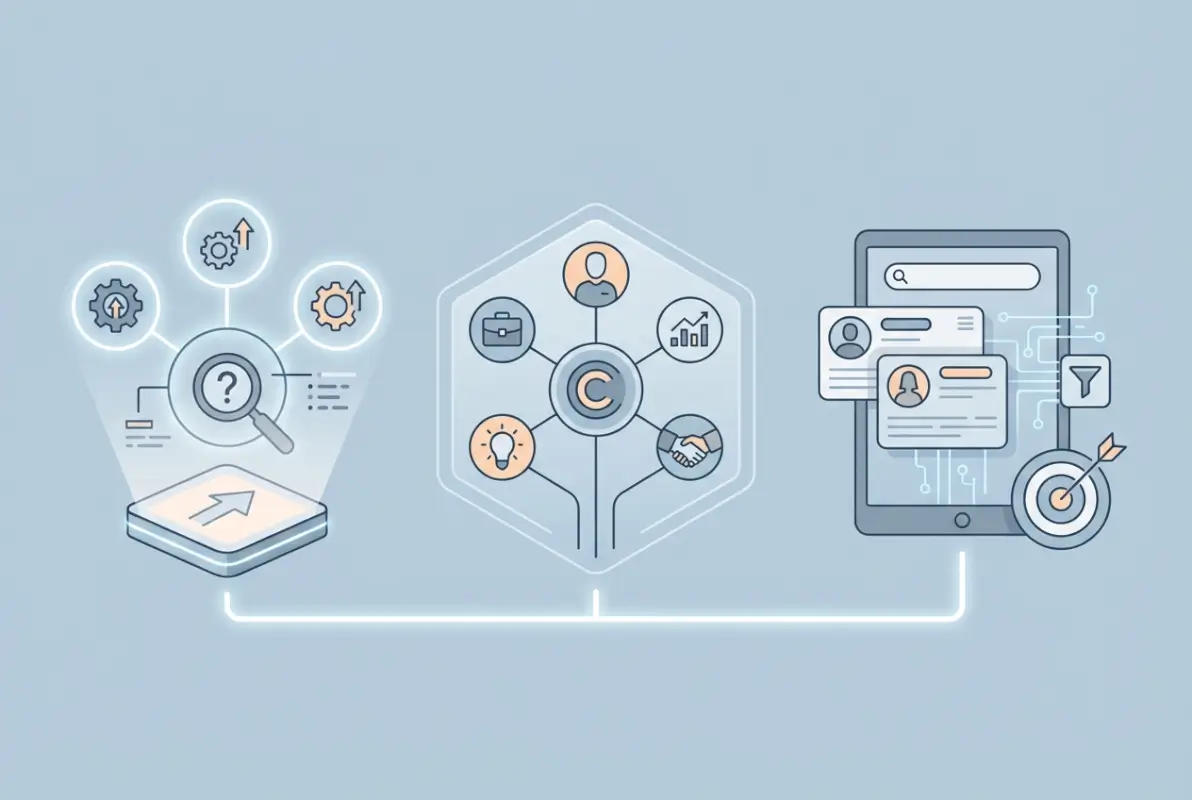
Understanding who sits in these buying groups—and what role each person plays—is the foundation of modern B2B prospecting. Miss a key influencer, and your champion’s internal pitch fails. Ignore the technical buyer, and your solution gets disqualified on criteria you never knew existed. Bypass the economic buyer, and budget constraints kill your deal at the eleventh hour.
The Anatomy of the Buying Group: Six Core Roles You Must Map
Every buying group, regardless of industry or company size, includes six fundamental roles. These aren’t necessarily six different people (in smaller companies, one person may wear multiple hats), but these six perspectives will always exist in the decision process:
The Decider (Final Approver) holds ultimate authority to approve or reject the purchase. In enterprises, this is typically a C-suite executive or senior VP. In mid-market companies, it might be a department head or director. Their primary concern is strategic alignment—does this purchase support organizational objectives and justify the investment of capital and attention?
The Economic Buyer (Budget Owner) controls the purse strings and evaluates ROI. Often the CFO or finance director, but can be a department head with budget authority. They care about cost-benefit analysis, payment terms, total cost of ownership, and how the purchase impacts financial targets. They’re asking: “Can we afford this, and will it pay for itself?”
The Technical Buyer (Validator) assesses whether your solution actually works as advertised and integrates with existing systems. This might be a CTO, IT director, or technical architect. They’re concerned with specifications, compatibility, security, scalability, and implementation complexity. Their job is to validate claims and identify technical risks that could derail the project.
The Influencer (Internal Champion or Critic) shapes opinions within the buying group through expertise, credibility, or political capital. This could be a respected long-tenured employee, a department expert, or someone who successfully led similar initiatives. Influencers don’t have formal authority but their recommendations carry weight. Identifying your champion (positive influencer) and neutralizing critics (negative influencers) often determines deal outcomes.
The Gatekeeper (Access Controller) manages information flow and access to other buying group members. Executive assistants, procurement specialists, and department managers often play this role. While they rarely make final decisions, they control your ability to reach decision makers and can filter you out before you ever get a hearing. Respecting and building rapport with gatekeepers is essential, not optional.
The End User (Day-to-Day Operator) will actually use your product or service daily. Their input on usability, workflow impact, and practical functionality matters more than many salespeople realize. If end users hate your solution, implementation fails—and decision makers learn to involve users earlier in future purchases. Smart buying groups conduct user testing and pilots before committing.
Research from Forrester on capturing buying group dynamics emphasizes that these roles interact in complex ways, with shifting influence at different stages of the buying process. Your job is to map who fills each role at your target accounts and understand the relationships between them.
How Many Decision Makers Are Typical Today (Size and Composition)
The size of buying groups varies dramatically based on deal size, industry, and company size, but the trend is unmistakable—they’re getting larger. Small purchases (under $50K) might involve 5-8 people. Mid-market deals ($50K-$250K) typically include 8-15 stakeholders. Enterprise purchases above $250K can involve 15-25+ participants across multiple departments and geographies.
Here’s what makes this even more complex: buying groups now regularly include external stakeholders. Industry consultants, implementation partners, existing vendors whose systems must integrate, and even peers from other companies providing informal advice all influence the decision. According to Forrester’s State of Business Buying report, external influencers participate in over 40% of B2B purchases today.
The composition also varies by purchase type. Software purchases might heavily weight technical and end-user input. Professional services deals elevate the importance of relationship fit and track record. Capital equipment purchases emphasize financial analysis and operational impact. Understanding your specific buying group composition requires research into how your target companies make decisions in your category.
One critical insight: larger buying groups don’t necessarily mean longer sales cycles if you engage them effectively. The companies that struggle are those still trying to sell to a single contact. The companies that excel map the entire buying group early, engage multiple stakeholders in parallel, and orchestrate a coordinated value narrative that addresses each role’s concerns.
Research-Backed Tactics to Locate Key Decision Makers Fast
Once you understand buying group structure, the question becomes: how do you quickly identify who fills each role at a specific target account? Traditional approaches—calling the main number and asking who handles X, searching LinkedIn for job titles, sending exploratory emails—are too slow and unreliable when you’re competing against vendors who’ve already mapped the entire committee.
The answer lies in structured prospecting workflows that combine multiple intelligence sources, verify through cross-referencing, and prioritize speed without sacrificing accuracy. The goal is a two-week sprint from “we’re targeting this account” to “we’ve identified and validated the six key buying group members.”
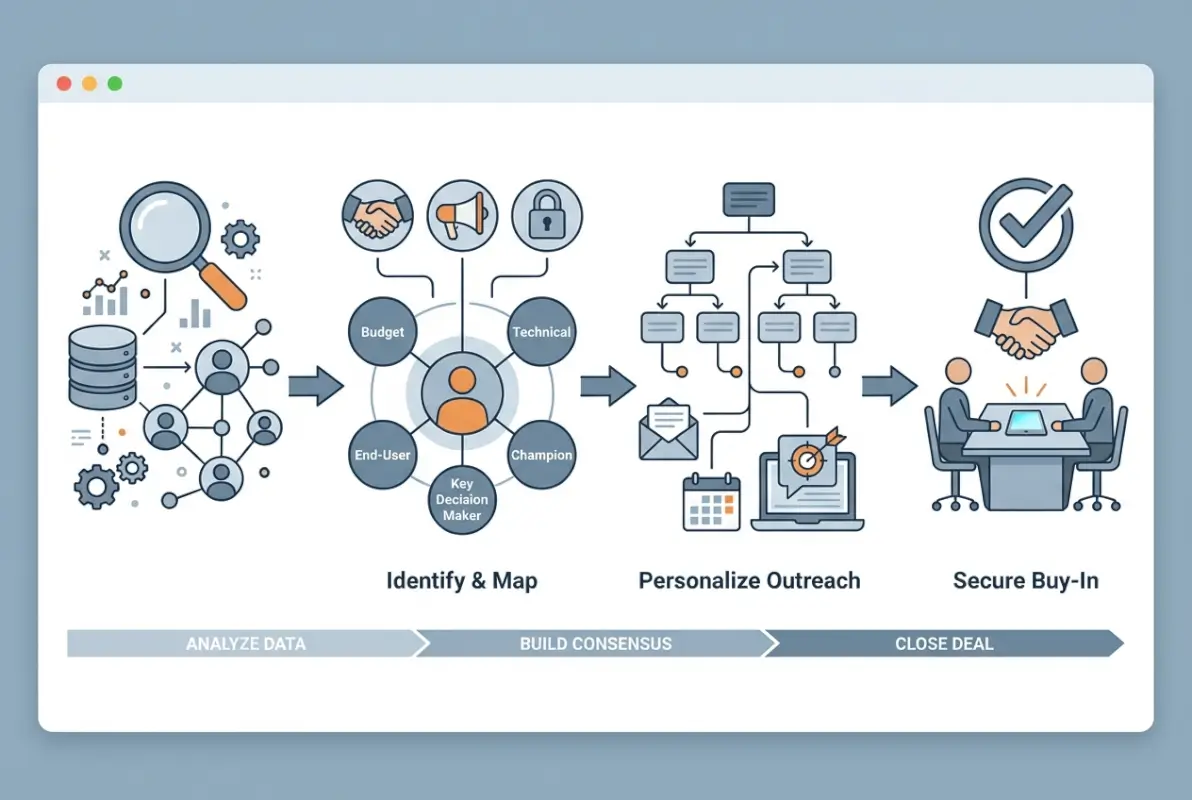
Structured Prospecting to Identify Decision-Makers and Influencers Quickly
Start with organizational chart mapping using business intelligence platforms. Tools like ZoomInfo, Apollo.io, and LinkedIn Sales Navigator provide org chart functionality showing reporting structures, department hierarchies, and team sizes. For a business owners directory or membership organization, TurnKey Directories offers customizable solutions that can organize and surface this type of relationship data effectively.
Begin at the top. Identify the C-suite or executive leadership team from the company website, press releases, or SEC filings (for public companies). This gives you potential Deciders and Economic Buyers. Then work downward into relevant departments—if you’re selling marketing software, map the marketing department; if it’s manufacturing equipment, map operations and production.
Use role-based targeting, not just titles. Titles vary wildly across companies (one company’s “Director” equals another’s “VP”). Instead, search for functions and responsibilities. Look for language like “leads procurement,” “oversees implementation,” “manages vendor relationships,” or “owns budget” in LinkedIn profiles and company bios.
Cross-reference multiple sources to improve accuracy. If ZoomInfo shows Person A as the CTO but the company website lists Person B, check LinkedIn to see who’s current. Look for recent announcements—”pleased to announce Person C has joined as…” often indicates a recent change not yet reflected in databases.
Leverage social and professional network cues. Check who publishes content on behalf of the company, who speaks at industry events, and whose posts get engagement from colleagues. These signals often identify influencers who aren’t necessarily the most senior people but carry internal credibility.
Map external relationships. Review the company’s partner ecosystem, technology stack (via BuiltWith or similar tools), and recently published case studies or press releases mentioning consultants or advisors. These external players often have a seat at the table during buying decisions.
For companies building directories of businesses or professionals, understanding how to organize active directory for business environment can provide foundational knowledge for structuring contact databases effectively.
Vetting and Validating Decision-Makers at Speed
Identification is only half the process—validation prevents wasted effort on outdated or inaccurate information. Research from business intelligence providers shows that contact data decays at roughly 30% annually. That means nearly one-third of the “decision maker” contacts in any database are wrong or outdated at any given time.
Validate titles and current employment through LinkedIn direct profile checks. LinkedIn profiles are usually current (professionals keep them updated for career opportunities), making them more reliable than third-party databases. Cross-check the person’s headline, current company, and recent activity to confirm they’re still in the role your data shows.
Confirm actual authority by examining their network and engagement patterns. A CFO who regularly discusses procurement strategy and vendor evaluation in their posts likely has budget authority. A VP of Marketing who never mentions vendor selection might not be as influential in buying decisions as their title suggests.
Use company signals to triangulate authority. Review recent press releases for mentions of who led initiatives, who announced partnerships, or who spoke to media about strategic decisions. Check procurement patterns through government databases (if they’re a public sector entity) or industry disclosure requirements.
Verify through gentle outreach. A well-crafted initial message to a potential gatekeeper (“I’m researching who leads [function] at [Company]—can you point me in the right direction?”) often yields accurate information faster than database digging. Gatekeepers appreciate being treated respectfully and often help when you’re transparent about seeking the right contact.
Monitor job change alerts and company announcements continuously. Set up Google Alerts for your target accounts with terms like “[Company name] announces,” “[Company name] appoints,” or “[Company name] new hire.” Most intelligence platforms also offer trigger alerts when key personnel change roles—these transitions create windows of opportunity as new decision makers reassess existing vendors.
Data-Driven Outreach: Timing, Messaging, and Channels for Decision Makers
You’ve identified the buying group and validated the key players. Now comes the moment where most B2B efforts fail—first contact. The challenge isn’t just reaching busy executives (though that’s hard enough). The real challenge is breaking through with a message that immediately communicates relevance and value when they’re in the right mindset to engage.
According to Forrester’s State of Business Buying research, modern B2B buyers increasingly demand validation before sales conversations—they want trials, proof-of-concept opportunities, and peer references before they’ll invest time in vendor discussions. Your outreach strategy must acknowledge this shift from “convince me” to “prove it.”
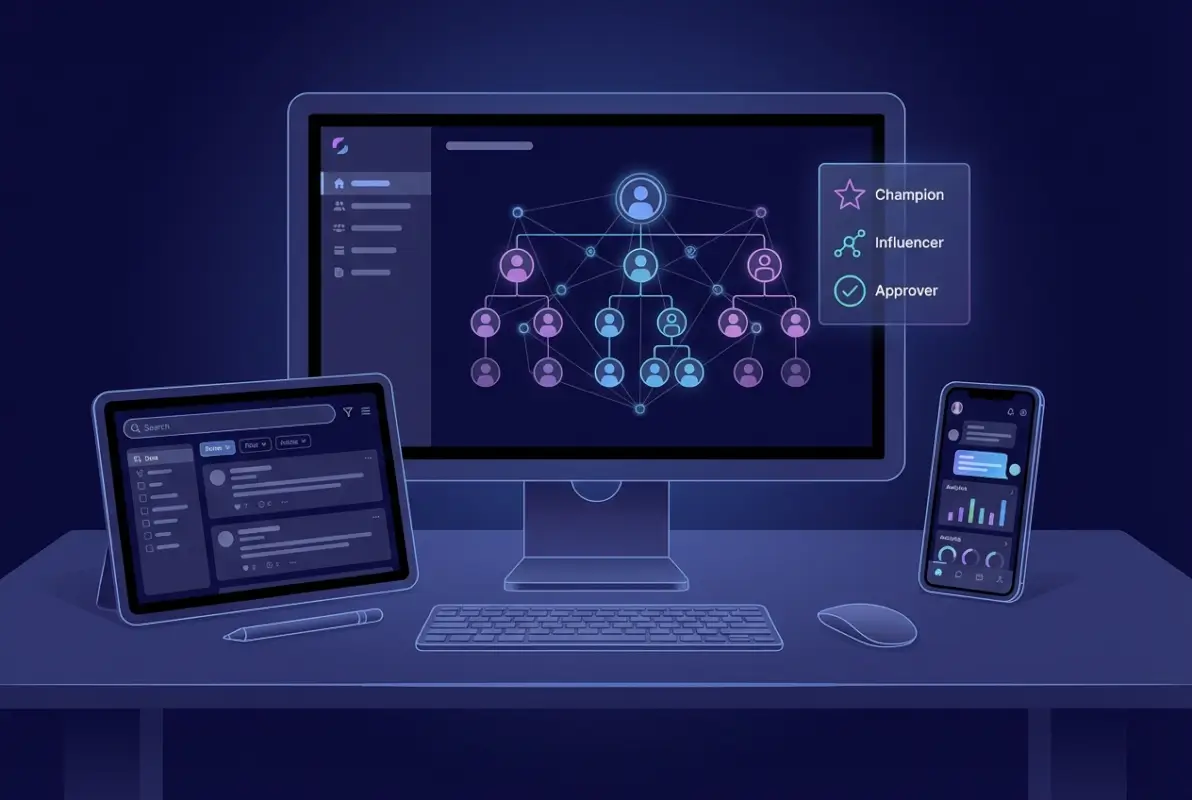
Timing and Messaging That Resonate with Decision Makers
Timing matters more than most sales professionals realize. The same message sent Tuesday at 10 AM versus Friday at 4 PM can see response rate differences of 40% or more. But timing isn’t just about time-of-day—it’s about business cycles, fiscal calendars, and organizational readiness.
Target organizational trigger events that create openness to change. New executive hires (especially in relevant departments), funding announcements, mergers or acquisitions, new product launches, office expansions, or publicized challenges all signal potential receptivity. Companies in transition are actively seeking solutions; companies in steady-state operation are defending the status quo.
Align outreach with fiscal cycles. Most B2B companies do strategic planning and budget allocation quarterly. Reaching decision makers 6-8 weeks before their next fiscal quarter gives them time to include your solution in upcoming budget discussions. Reaching them 2 weeks into a new quarter means waiting 3 months for the next budget window.
Frame messages around value validation, not product features. Modern buying groups respond to outcomes, proof, and risk reduction. Instead of “I’d like to show you our platform’s capabilities,” try “Companies similar to [Target Company] typically see [specific outcome] within [timeframe]—would a 2-week pilot to validate those results for your environment make sense?”
Emphasize ROI in language specific to each buying group role. Economic Buyers care about cost-benefit ratios and payback periods. Technical Buyers want proof of integration success and security validation. Deciders need strategic alignment confirmation. End Users need usability evidence. One-size-fits-all messaging fails because it doesn’t address role-specific concerns.
Offer low-friction validation opportunities. “Let’s schedule a demo” is higher friction than “Here’s a 3-minute recorded walkthrough showing how [Company X] solved [Challenge]—I can set up a pilot if it looks relevant.” You’re giving them value before asking for their time, which respects the modern buyer’s research-first approach.
Include social proof relevant to their industry and company size. Generic testimonials don’t carry weight; specific outcomes from comparable companies do. “Mid-market SaaS companies in our portfolio typically see [metric]” is more credible than “Our clients love us.” If you’ve helped similar organizations navigate buying committees successfully, mention that—it shows you understand their environment.
Channel Strategy: Where Decision Makers Spend Time (and How to Reach Them Ethically)
Multi-channel orchestration has become non-negotiable. Research consistently shows that prospects need 6-8 touches across multiple channels before responding. But “multi-channel” doesn’t mean spam—it means coordinated, value-added touches that build credibility and familiarity over time.
Email remains the foundation for B2B outreach but requires sophisticated personalization. Generic templates get 2-3% response rates; deeply personalized messages referencing specific company initiatives, challenges, or achievements can see 20-30% response rates. Use the first line to prove you’ve done research (“I saw [Company] recently [specific achievement]…”) before transitioning to value.
LinkedIn has evolved from networking platform to prospecting powerhouse. But the approach matters—immediate connection requests with sales pitches get ignored or rejected. The better path: engage with their content authentically (thoughtful comments on posts), connect without a pitch, then message after the connection is established. Sales Navigator’s InMail feature can work for reaching highly targeted prospects when personalized properly.
Phone outreach still works but requires precision. Calling without email context gets screened. Calling after sending valuable email content and saying “I sent you a note about [specific topic]—caught you at a bad time or worth 3 minutes?” respects their time and references your prior touch. Leave voicemails that offer value, not sales pitches: “I have three specific ideas for [solving Challenge] at [Company]—call me back at [number] if relevant, no hard feelings if not.”
Direct mail (yes, physical mail) has made a comeback for high-value prospects because so few people do it anymore. A personalized, dimensional package with genuinely useful content—a relevant book, industry research, or creative demonstration of your value—cuts through digital noise. But it must offer value, not just branded swag no one wants.
Industry events and conferences create the highest-quality touchpoints when used strategically. Don’t just attend—identify which target account decision makers will be there (check speaker lists and attendee databases), schedule meetings in advance, and prepare personalized value propositions for each conversation. Post-event follow-up within 24 hours while you’re still top-of-mind dramatically improves conversion.
Coordinate channel timing strategically. A sample sequence: Day 1 (personalized email), Day 3 (LinkedIn profile view and content engagement), Day 6 (phone call referencing email), Day 9 (second email with additional insight), Day 13 (LinkedIn connection request), Day 16 (phone call), Day 20 (final email with “breaking up” approach). Each touch adds value and uses different channels to increase visibility.
For professionals exploring directory-based approaches to organizing business contacts and decision maker information, learning about ways to access business park directory information can provide foundational context for regional prospecting strategies.
Practical Tools and Best Practices for a Faster Find-and-Connect Process
Strategy without execution tools is just theory. The most successful teams combine strong frameworks with technology that accelerates research, improves data quality, and enables scale without sacrificing personalization. But tool selection matters—the wrong platforms waste budget and create more problems than they solve.
The directory and intelligence landscape has consolidated around a few category leaders, with specialized tools serving niche needs. Your choice depends on deal size, target market, and internal resources. Enterprise sales teams with $100K+ average deal sizes can justify premium platforms; SMB-focused teams need cost-effective solutions that still deliver accuracy.
Directory and Data Hygiene Practices
Data quality determines everything downstream. If your contact information is 30% inaccurate (industry average), roughly one-third of your outreach effort is wasted before you start. Worse, incorrect information damages credibility—nothing says “I didn’t do my research” like addressing someone by their old title or emailing them at a company they left two years ago.
Establish data verification workflows before outreach begins. Create a checklist: (1) Verified on LinkedIn within 30 days? (2) Cross-referenced with company website? (3) Email address passed validation tool? (4) Phone number format correct for region? (5) Title and responsibilities confirmed through recent activity? Only contacts passing all checks enter your active prospecting queue.
Implement refresh cadences based on contact tier. A-tier prospects (highest priority) get monthly verification. B-tier contacts get quarterly checks. C-tier prospects get semi-annual updates. Use automation for initial verification (email validation tools, LinkedIn profile scrapers) but human review for high-value contacts—the ROI justifies the time investment.
Choose data sources based on coverage and accuracy in your target market. ZoomInfo excels at North American enterprise data but has gaps in European mid-market coverage. Apollo.io offers strong SMB coverage at lower price points. D&B Hoovers provides unmatched firmographic data but can lag on recent personnel changes. Consider building a multi-source strategy where you validate against 2-3 databases for critical accounts.
For organizations building directories themselves, exploring white label business directory software solutions provides customizable platforms tailored to specific industry needs with built-in data management capabilities.
Monitor data decay patterns to optimize refresh timing. Track “bounce rate” (percentage of emails that fail), “wrong number” rate, and “no longer in role” frequency. If you’re seeing 15% bounce rates, your data is too stale and refresh cycles need to accelerate. If bounce rates stay under 5%, you can potentially extend verification cycles slightly to improve efficiency.
Build feedback loops from your sales team into data quality processes. When reps discover inaccurate information, they should flag it in your CRM with the correct data and source. This crowdsourced validation continuously improves database accuracy while respecting your team’s time—they’re correcting data they’re already interacting with anyway.
| Platform | Best For | Data Strength | Price Range |
|---|---|---|---|
| ZoomInfo | Enterprise sales teams | Org charts, direct dials | $15K-$40K/year |
| Apollo.io | SMB prospecting | Email sequences, affordable scale | $49-$149/month |
| LinkedIn Sales Nav | Social selling | Network insights, InMail | $80-$150/month |
| D&B Hoovers | Account research | Firmographics, predictive analytics | $5K-$25K/year |
| TurnKey Directories | Custom directory builds | WordPress integration, customizable | Flexible |
Compliance and Trust Considerations in Outreach
Data regulations have fundamentally changed what’s legally permissible in B2B prospecting. GDPR in Europe, CCPA in California, CAN-SPAM federally, and various state-level privacy laws create a complex compliance landscape. Violations carry significant penalties—GDPR fines can reach 4% of global revenue—but beyond legal risk, non-compliant outreach damages brand reputation and buyer trust.
Understand legitimate interest versus consent requirements. B2B outreach to corporate email addresses generally falls under “legitimate interest” in most jurisdictions, but you must still provide clear opt-out mechanisms, honor opt-out requests immediately, and maintain records of consent and withdrawal. Personal email addresses (Gmail, Yahoo, etc.) require explicit consent in GDPR jurisdictions before marketing outreach.
Implement proper opt-out infrastructure in every channel. Email must include functioning unsubscribe links that process requests within 10 business days (CAN-SPAM requirement, though best practice is immediate). Phone calling must respect Do Not Call registries and time-of-day restrictions. LinkedIn outreach should cease if someone declines your connection or asks you to stop messaging.
Maintain documentation of data sources and processing activities. GDPR requires you to demonstrate where personal data came from and how it’s being used. Keep records showing: (1) Source of each contact (purchased database, public website, conference attendance, etc.), (2) Date acquired, (3) Legal basis for processing (legitimate interest, consent, etc.), (4) Retention schedule, and (5) Security measures protecting the data.
Train teams on privacy-respecting outreach practices. Your sales reps are your compliance front line—they need to understand what’s permissible and what creates liability. Regular training on updated regulations, escalation procedures for data subject requests, and cultural emphasis on respecting privacy preferences creates organizational discipline that protects the company.
Build trust through transparency about data usage. When prospects ask “How did you get my information?” have a clear, honest answer. “We identified you through [Source] as someone who leads [Function] at companies we serve” is transparent and professional. Vague non-answers or defensive responses damage trust and fuel the perception of unethical data practices.
Case Studies and Benchmark Metrics to Track Progress
Theory and tactics mean nothing without measurement. The best sales organizations obsessively track metrics that indicate whether their decision-maker identification and outreach processes are improving or degrading. These metrics provide early warning of problems and validate what’s working before results show up in closed revenue.
Modern buying committee complexity makes traditional sales metrics insufficient. “Qualified leads generated” doesn’t tell you if you’ve identified the full buying group. “Meetings scheduled” doesn’t indicate whether you’re meeting with actual decision makers or lower-level contacts who can’t advance deals. You need metrics that specifically measure buying group engagement effectiveness.

Short-Case Benchmarks: Speed-to-First-Contact and Speed-to-Yes
Velocity metrics reveal process efficiency and competitive positioning. In competitive markets, the first vendor to engage buying groups meaningfully often has 40-60% higher win rates simply due to anchoring bias and relationship momentum. Speed matters—but only when combined with accuracy (engaging the right people) and quality (providing value in first interactions).
Speed-to-identification benchmark: From target account selection to validated buying group map should take 2 weeks maximum for mid-market accounts, 3-4 weeks for complex enterprises. If you’re consistently taking longer, your research workflow has inefficiency bottlenecks—likely insufficient tool investment, lack of process documentation, or inadequate training.
Speed-to-first-meaningful-contact benchmark: From buying group identification to first substantive conversation with a buying group member should target 4-6 weeks. This includes outreach sequences, follow-ups, and coordination across multiple stakeholders. Faster is better, but don’t sacrifice message quality for speed—a rushed, generic pitch wastes the opportunity.
Buying-group-coverage ratio: Track what percentage of the full buying group you’ve identified and engaged before moving to formal proposal. Best-in-class sales teams engage 60%+ of buying group members before proposing; struggling teams often engage just 1-2 contacts and wonder why deals stall in “evaluation” stage. Aim for contact with at least one person in four of the six key roles (Decider, Economic Buyer, Technical Buyer, and primary Influencer at minimum).
Speed-to-close benchmark: From first contact to signed contract varies dramatically by industry and deal size, but has general ranges. Small deals ($10K-$50K) should close in 4-8 weeks. Mid-market ($50K-$250K) typically need 8-16 weeks. Enterprise ($250K+) often require 16-32 weeks. Track your actual cycles and compare to industry benchmarks—significant variance indicates process problems or poor qualification.
Real example (anonymized): A mid-market SaaS company selling HR software reduced their average sales cycle from 14 weeks to 9 weeks by implementing buying-group mapping early in their process. They identified that they were consistently missing the CFO (Economic Buyer) and HRIS Manager (Technical Buyer) in initial conversations, leading to late-stage objections about cost and integration. By engaging all six buying group roles within the first 3 weeks, they addressed concerns earlier when solutions were easier to implement.
Metrics to Monitor for Ongoing Optimization
Establish a metrics dashboard tracking both leading indicators (predict future outcomes) and lagging indicators (confirm what happened). Review weekly for tactical adjustments, monthly for strategic pattern recognition, and quarterly for major process changes.
Contact accuracy rate: Percentage of contacts where initial outreach succeeded (email delivered, phone connected, LinkedIn profile current). Target 85%+ accuracy. Below 80% indicates stale data requiring immediate refresh. Track separately by source to identify which databases maintain quality.
Response rate by channel: Track response percentages for email (target 15-25% for highly personalized outreach), phone (target 5-10% connection rate to decision makers), LinkedIn (target 30-40% connection acceptance, 10-15% message response). Significant deviation from targets indicates message quality issues or list quality problems.
Buying group identification rate: Percentage of target accounts where you successfully map all six buying group roles within your target timeframe. Should exceed 70% for accounts you’ve actively researched. Below 50% suggests insufficient tool investment, poor research processes, or targeting companies where information is legitimately scarce (closely-held private companies, for example).
Multi-threading score: Average number of buying group members engaged per opportunity. Best practice is 3-5 active contacts per deal. Single-threaded deals (only one contact) have 60-70% higher risk of stalling or losing to “no decision.” Track this as early warning—deals dropping to single-threaded status need immediate intervention.
Time-to-response: How quickly buying group members respond to initial outreach. Faster response (within 24-48 hours) indicates strong message relevance and good timing. Slow response (5+ days) or multiple follow-ups needed suggests weak value proposition or poor timing. Use this to A/B test messaging approaches.
Content engagement metrics: If you’re sending valuable content (case studies, research, tools) as part of outreach, track open rates, time spent, and click-through on next steps. High engagement with low conversion suggests your content attracts attention but doesn’t drive action—adjust your calls-to-action. Low engagement suggests content doesn’t resonate or isn’t reaching the right people.
Pipeline velocity: Measures how quickly opportunities move through your pipeline stages. Calculate as: (Number of deals × Average deal size × Win rate) / Sales cycle length. Improvements in pipeline velocity indicate your buying-group approach is working—deals move faster and close more predictably. Declining velocity signals qualification problems or poor buying group engagement.
Win rate by engagement model: Compare win rates for deals where you engaged the full buying group versus deals with limited contact coverage. The delta quantifies the value of thorough buying-group mapping. If you’re not seeing 40%+ win rate improvement with full buying group engagement, your message isn’t addressing stakeholder concerns effectively.
Frequently Asked Questions
Who counts as a decision maker in a B2B company today?
Decision makers today are actually buying groups with six core roles: Decider (final approver), Economic Buyer (budget owner), Technical Buyer (solution validator), Influencer (internal champion or critic), Gatekeeper (access controller), and End User (daily operator). Modern B2B purchases involve 11-22 participants on average, with authority distributed across multiple stakeholders rather than concentrated in one person.
How many people are typically on a B2B buying group?
B2B buying groups now average 11-22 participants depending on deal size and complexity, according to Forrester research. Small purchases under $50K involve 5-8 people, mid-market deals ($50K-$250K) include 8-15 stakeholders, and enterprise purchases above $250K can involve 15-25+ people across departments. This represents a doubling from just a few years ago when buying groups averaged 6-8 participants.
What signals indicate someone is an influencer versus a decision maker?
Influencers often lack formal approval authority but shape buying group opinions through expertise, tenure, or credibility. Look for employees who publish company content, speak at industry events, receive internal recognition, or whose opinions colleagues reference in discussions. Decision makers typically hold C-suite or VP titles, control budgets, appear in executive leadership documentation, and make final approval signatures. Both roles matter—influencers can kill deals even without formal authority.
What are the best channels to reach senior decision makers quickly?
Multi-channel orchestration combining personalized email, strategic LinkedIn engagement, and well-timed phone calls achieves 65% higher connection rates than single-channel approaches. Lead with email offering specific value, follow with LinkedIn profile views and thoughtful content engagement, then phone calls referencing previous touches. Industry events provide the highest-quality touchpoints when you identify target decision makers attending and schedule meetings in advance. Direct mail has resurged for high-value prospects due to reduced digital competition.
How can I validate a target’s authority before reaching out?
Cross-reference contact information across three independent sources: business intelligence platforms (ZoomInfo, Apollo), LinkedIn profiles for current role verification, and company websites for official leadership confirmation. Review press releases mentioning who led initiatives or announced partnerships. Examine the person’s network and content engagement patterns—active discussion of procurement and vendor evaluation indicates real authority. Use email verification tools to confirm address validity before outreach to avoid bounce rates damaging sender reputation.
What tools are best for finding decision makers in buying groups?
ZoomInfo excels for enterprise org charts and direct dial numbers but costs $15K-$40K annually. Apollo.io provides strong SMB coverage with email sequencing at $49-$149 monthly. LinkedIn Sales Navigator ($80-$150/month) enables social selling with network insights and InMail. TurnKey Directories offers customizable WordPress-integrated solutions for organizations building their own business directories. Choose based on your target market, deal size, and budget—enterprise teams need premium platforms while SMB-focused sellers can succeed with mid-range tools.
How long should it take to identify a complete buying group?
Target a 2-week sprint for mid-market accounts and 3-4 weeks for complex enterprises from target selection to validated buying group map. This includes identifying all six core roles (Decider, Economic Buyer, Technical Buyer, Influencer, Gatekeeper, End User), cross-referencing contact information, and confirming current employment. Longer timeframes suggest workflow inefficiencies, insufficient tool investment, or poor research processes. Speed matters because first vendors engaging buying groups meaningfully often achieve 40-60% higher win rates.
What metrics indicate successful buying group engagement?
Track buying group coverage rate (percentage of six core roles engaged before proposal—target 60%+), multi-threading score (average contacts per deal—target 3-5), response rate by channel (email 15-25%, LinkedIn 10-15%, phone 5-10%), and pipeline velocity (how quickly deals progress through stages). The highest-value metric is win rate comparison between full buying group engagement versus limited contact coverage—expect 40%+ improvement with thorough buying group mapping. Monitor speed-to-first-contact and contact accuracy rate as leading indicators.
Start Mapping Your Buying Groups Today
The shift from single decision makers to complex buying groups isn’t a temporary trend—it’s the new permanent reality of B2B sales. Organizations have learned that distributed decision-making reduces risk, improves outcomes, and prevents expensive mistakes. That’s not changing, which means your approach must evolve or you’ll consistently lose to competitors who’ve already adapted.
The good news? Most of your competition is still trying to find “the decision maker” while you can be mapping entire buying groups, understanding stakeholder dynamics, and orchestrating multi-threaded engagement that addresses each role’s specific concerns. This approach takes more upfront work but dramatically improves close rates, shortens sales cycles, and builds relationships that extend beyond single transactions into long-term partnerships.
Start with one target account this week. Don’t try to overhaul your entire process immediately—that’s overwhelming and rarely sticks. Instead, pick a high-value prospect and methodically work through the framework in this guide. Identify the six core roles. Validate contact information through three sources. Design role-specific outreach that offers validation opportunities rather than demanding meetings. Track what works and what doesn’t. Then apply those lessons to the next account, and the next, until buying group mapping becomes your default approach rather than an occasional experiment.
The tools exist, the frameworks work, and the ROI is proven. What separates successful teams from struggling ones isn’t access to information—it’s disciplined execution of systematic processes that consistently identify, validate, and engage buying groups effectively. You now have that process. The question is whether you’ll implement it before your competition does, or whether you’ll keep chasing single contacts while they build relationships with entire committees.
Your Two-Week Buying Group Sprint
Week 1: Select your priority account, research org structure, identify six core buying group roles, and cross-validate contact information across three sources.
Week 2: Design role-specific outreach sequences, launch multi-channel engagement, track response patterns, and document what you learn for the next account.
Success metric: Achieve contact with buying group members in at least four of the six roles within 14 days—this becomes your repeatable process baseline.
Was this article helpful?