How to Improve Your Airbnb Listing: 10 Optimization Tips for Hosts

Generating summary...
If you’ve ever wondered why some Airbnb listings consistently fill their calendars while yours sees sporadic bookings, you’re not alone. The short-term rental landscape has shifted dramatically—what worked a few years ago barely moves the needle today. With listing supply rising across most markets and guests expecting more for less, optimizing your Airbnb listing isn’t just a nice-to-have anymore, it’s the difference between profitable occupancy and watching your calendar sit empty while competitors thrive.
Here’s the reality: most hosts still approach their listings like static billboards, uploading a few photos and hoping for the best. Meanwhile, the hosts who treat their listings as dynamic, data-informed storefronts are capturing the lion’s share of bookings. This guide will walk you through ten concrete optimization strategies grounded in current market data, competitive analysis, and guest psychology—the same tactics that have helped operators boost both occupancy and rates by measurable margins even as markets tighten.
TL;DR – Quick Takeaways
- Market positioning matters first – Audit 5-10 comparable listings to identify gaps and differentiation opportunities before making changes
- Professional photography is non-negotiable – High-quality images are the single biggest driver of booking decisions and search visibility
- Dynamic pricing beats static rates – Automated pricing tools align with demand fluctuations and can improve occupancy by 15-30%
- Instant Book increases visibility – Listings with Instant Book enabled often rank higher in search results
- Guest experience drives reviews – Ratings and responsiveness directly influence your listing’s search ranking and conversion rate
- Multi-channel sync prevents disasters – Calendar synchronization across platforms eliminates double bookings and maintains guest trust
- Operational excellence scales revenue – Data-driven iteration on pricing, amenities, and communication separates top performers from the rest
Understand the Market and Your Position
Before you change a single word in your listing description or adjust your pricing by even a dollar, you need to understand where you stand in your local market. Too many hosts optimize in a vacuum, making changes based on generic advice without considering what their direct competitors are doing or what guests in their specific area actually want.

Analyze competition in your market
Start with a quick competitive audit. Search Airbnb as if you were a guest looking for accommodations in your area—use your actual location, typical guest arrival dates, and party sizes that match your property. Identify 5-10 listings that would compete directly with yours: similar size, price range, location, and amenities.
Now comes the important part. Create a simple spreadsheet (I’ve found that even a basic Google Sheet works perfectly) and compare these listings across key dimensions: nightly pricing, number of photos, quality of the cover photo, unique amenities, review count and rating, response rate, and whether they offer Instant Book. You’re looking for patterns—what do the most-booked properties in your market have in common? Where do they all fall short?
The goal isn’t to copy your competition blindly, it’s to establish a baseline and then identify your unique value proposition. Are you the only listing with dedicated workspace? Do you have parking in a neighborhood where it’s scarce? Is your place genuinely closer to a major attraction? These standout amenities become the foundation of your optimization strategy, similar to how businesses need to differentiate their business listings to rank competitively.
Define measurable targets
Vague goals like “get more bookings” won’t cut it. You need specific, measurable targets that you can track month over month. Start by calculating your current baseline metrics:
- Bookings per month – How many separate reservations are you currently landing?
- Occupancy rate – What percentage of available nights are actually booked?
- Average Daily Rate (ADR) – What’s your average nightly rate across all bookings (not your listed price, but what guests actually pay)?
- Guest rating – What’s your current overall rating and how many reviews do you have?
Once you have these numbers, set realistic targets. If you’re currently at 60% occupancy, aiming for 75% over the next quarter is reasonable; jumping to 95% probably isn’t unless you drastically drop prices. The same goes for ADR—you might target a 10-15% increase through strategic pricing, but doubling your rate overnight will tank your bookings.
Current market context
The short-term rental market has entered a more mature, competitive phase. Recent data shows rising supply in many regions, which creates pricing pressure and makes differentiation even more critical. In some markets, like Hawaii, vacation rental demand has softened noticeably, while major event-driven markets like Paris during the Olympics experienced temporary oversupply that pushed prices down unexpectedly.
Guest expectations have also evolved. Cleanliness has moved from a nice-to-have to an absolute baseline expectation. Flexibility around check-in, clear communication, and accurate listings (no surprises) are now table stakes. Understanding these shifts helps you prioritize which optimizations will have the biggest impact on your specific market.
Create a Compelling, Policy-Supportive Listing
Your listing is your storefront, your sales pitch, and your first impression all rolled into one. Get this wrong and none of your other optimizations matter because guests will scroll right past you. Get it right and you’ll convert browsers into bookers at a much higher rate.
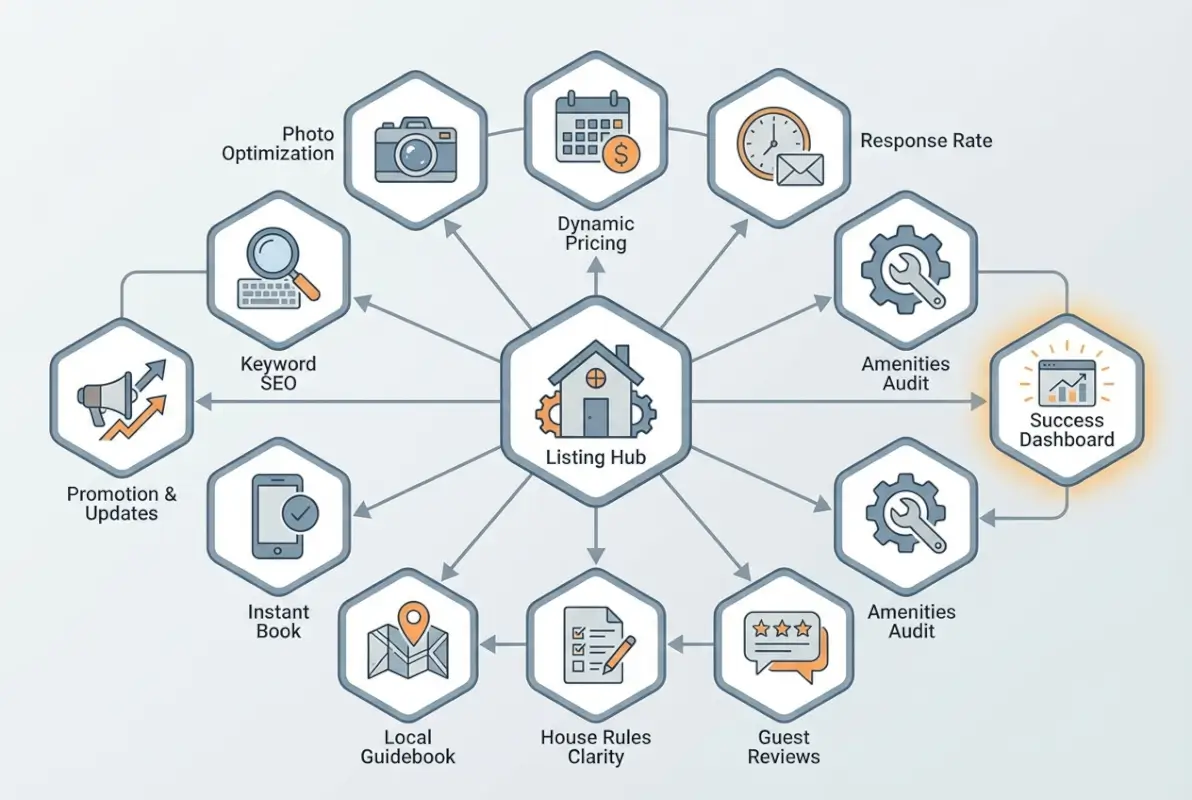
Title, cover photo, and first impression
Your listing title has one job: make someone want to click. The best titles balance descriptiveness with appeal—they tell guests what makes your place special while including location-specific keywords that help with search visibility. Instead of “Cozy Downtown Apartment,” try “Bright 2BR Loft with Balcony – Walk to Pike Place Market.” See the difference? The second version paints a picture and includes a landmark that guests might search for.
The cover photo is even more critical, honestly. It’s the single most important visual element in your entire listing. This image should be your absolute best shot—well-lit, professionally composed, and representative of your space’s best feature. If you have an incredible view, that’s your cover. If you have a stunning living area, that’s the one. Avoid exterior shots unless your building is architecturally remarkable; guests want to see where they’ll actually spend their time.
Professional photography and visual storytelling
Let me be blunt: smartphone photos almost never cut it anymore. The quality gap between professional photography and amateur shots is immediately obvious to guests, and it affects both your click-through rate and your booking conversion. Professional photographers understand lighting, composition, and how to make spaces look inviting rather than flat or cramped.
Aim for 25-35 high-quality photos that tell a complete story of the guest experience. Include wide-angle shots of each primary room (living area, bedrooms, kitchen, bathrooms), but also detail shots that highlight nice touches—the coffee station, the reading nook, the workspace setup. If your property supports it, add a floor plan or 3D tour. These tools help guests understand the layout and feel more confident about booking.
Optimized description and amenities
Your description should be scannable—most guests skim rather than read carefully. Start with a strong hook that captures your unique value proposition in the first sentence. Then organize information into clear sections: the space, the neighborhood, guest access, and any special notes.
Use short paragraphs (2-3 sentences maximum), bullet points for amenities, and bold text to highlight key features. Don’t bury important information like parking details or stair access in paragraph five; put it upfront. And be honest about limitations—if you’re on a busy street or there’s no elevator, say so clearly. Surprises kill reviews, transparency builds trust.
When it comes to amenities, accuracy matters more than quantity. Don’t check boxes for things you don’t actually offer. Guests expect Wi-Fi, fresh linens, basic toiletries, and a clean space as baseline. The amenities that actually differentiate you are things like dedicated workspace (huge for digital nomads), parking (in urban areas where it’s scarce), or unique features like a hot tub or fire pit.
Calibrated house rules and safety disclosures
House rules can make or break a booking, and they’re a delicate balance. Too strict and you scare away perfectly good guests; too loose and you invite problems. Set clear, reasonable expectations around check-in/check-out times, quiet hours (if applicable), and any specific property rules like no smoking or no pets.
Safety disclosures aren’t just about liability—they’re about building trust. If you have security cameras in common areas (like a front door camera), disclose it clearly. Mention any potential safety considerations like stairs, a pool, or proximity to water. The more transparent you are upfront, the fewer problems you’ll face later.
Local context and experiences
One of the most underutilized sections of an Airbnb listing is the neighborhood description. Guests don’t just book a bed, they book an experience in a location. Help them imagine their stay by highlighting what’s nearby: “Two blocks from the subway, ten-minute walk to the historic district, and our favorite neighborhood coffee shop is right downstairs.”
Include specific distances and travel times to major attractions, transit options, and parking information. If there are unique neighborhood features—a weekend farmers market, a popular running trail, a hidden gem restaurant—mention them. This context not only helps with conversions but also improves guest satisfaction because they arrive with realistic expectations, much like how detailed information helps businesses stand out in directory listings.
Pricing, Availability, and Booking Experience
Pricing is where most hosts leave serious money on the table. Either they price too high and watch their calendar stay empty, or they price too low and leave revenue on the table even when they’re fully booked. The sweet spot is dynamic pricing that adjusts to demand, seasonality, and local events in real time.
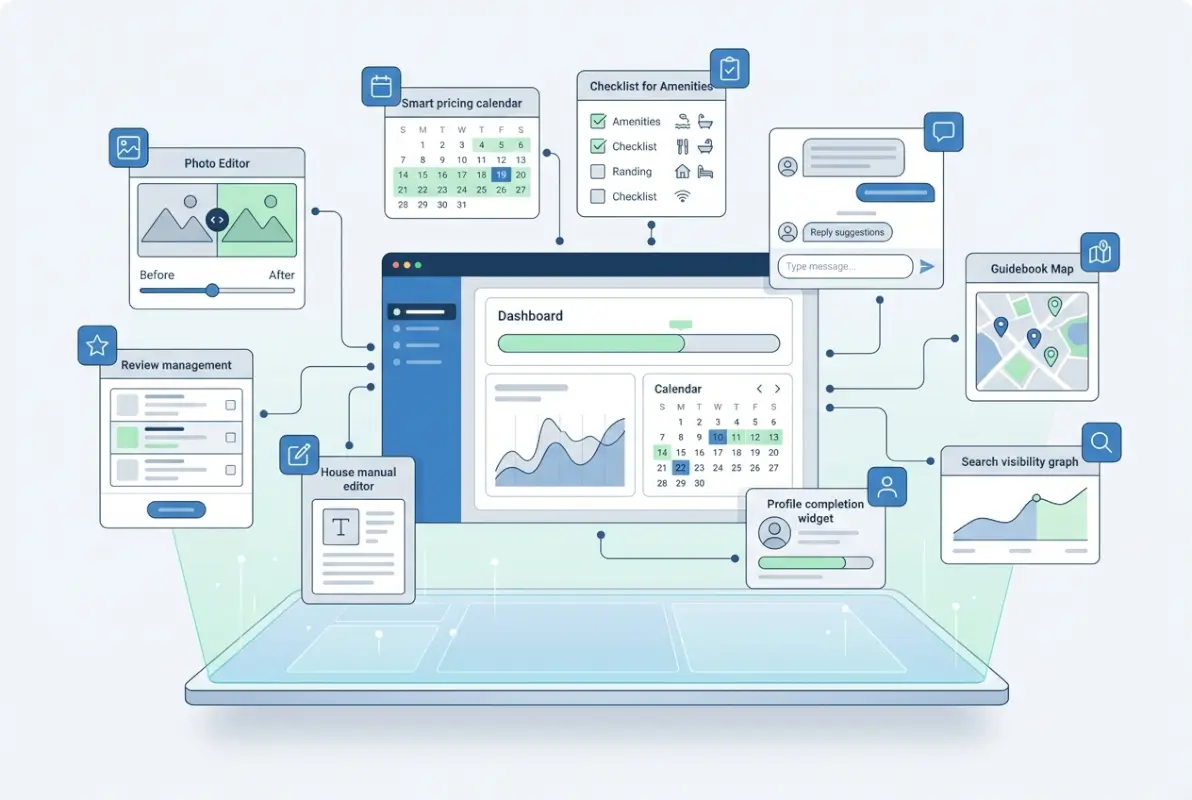
Dynamic pricing and smart pricing strategies
Static pricing—setting one rate and leaving it unchanged—is essentially leaving money on the table during high-demand periods while struggling to fill low-demand dates. Dynamic pricing tools analyze market conditions, local events, seasonality, and competitor rates to suggest optimal pricing for each night.
Tools like PriceLabs, Beyond Pricing, or Airbnb’s own Smart Pricing can automate this process. The key is setting appropriate floor and ceiling rates so the algorithm doesn’t race to the bottom or price you out of the market entirely. Most successful hosts set their floor at the absolute minimum they’ll accept (covering costs plus a small margin) and their ceiling at 150-200% of their base rate for peak demand periods.
| Pricing Strategy | Best For | Typical Impact |
|---|---|---|
| Static Pricing | Highly stable markets, minimal seasonality | Lower revenue potential |
| Manual Dynamic | Hosts with time to monitor daily | Moderate improvement (10-15%) |
| Automated Dynamic | Most markets, busy hosts | Strong improvement (15-30%) |
| Hybrid (Auto + Manual) | Experienced hosts, event-driven markets | Best performance (20-40%) |
Remember to monitor your pricing tool’s performance, not just set it and forget it. During major local events, you might need to manually adjust because algorithms sometimes lag behind real-time demand spikes. I’ve seen hosts double or triple their normal rate during big conferences or sporting events when they stay attentive.
Calendar discipline and minimum/maximum stay rules
An updated calendar signals to both Airbnb’s algorithm and potential guests that you’re an active, responsive host. Block out dates you’re genuinely unavailable immediately, and unblock them as soon as plans change. Orphan nights (single-night gaps between bookings) hurt your revenue because they’re hard to fill—consider offering discounts for guests who’ll fill those gaps or adjusting your minimum stay requirements strategically.
Speaking of minimum stays: they’re a powerful tool when used correctly. During peak seasons, a 2-3 night minimum can improve your revenue per booking and reduce turnover costs. During slow periods, dropping to a one-night minimum can help fill your calendar. The key is flexibility—adjust these rules based on demand patterns rather than setting them once and never touching them.
Instant Book and guest screening
Instant Book is one of those features that makes hosts nervous, but the data is pretty clear: listings with Instant Book enabled typically receive better search placement and higher booking rates. The reason is simple—guests love the convenience of booking immediately without waiting for host approval, and Airbnb rewards hosts who offer that convenience.
If you’re worried about quality control, use Airbnb’s screening tools. You can require guests to have positive reviews from other hosts, verify their identity, and agree to your house rules before they can instant-book. You also maintain the ability to decline or cancel penalty-free if a guest raises red flags. The sweet spot is enabling Instant Book with reasonable screening criteria—you’ll capture more bookings without sacrificing safety.
Length-of-stay incentives and promotions
Weekly and monthly discounts serve two purposes: they attract longer stays (which means less turnover and cleaning costs), and they improve your booking conversion rate. A 15-20% weekly discount and 25-35% monthly discount are standard in most markets. These percentages sound steep, but remember—a week-long booking at 20% off usually nets more revenue than piecing together individual nights, especially when you factor in cleaning costs and calendar gaps.
Shoulder season promotions can also boost occupancy during traditionally slow periods. Consider offering early-bird discounts for bookings made far in advance, or last-minute deals for gaps within two weeks. These tactics help smooth out your revenue curve rather than feast-or-famine occupancy.
Maximize Visibility through Listings SEO and Platform Features
Airbnb’s search algorithm is a black box, but years of host observations and platform behavior have revealed some clear patterns. Visibility in search results directly correlates with bookings, so understanding how to optimize for Airbnb’s algorithm is crucial for consistent occupancy.

Keywords in title and description
Airbnb’s search function looks for matches between what guests type and the text in your listing. This means your title and description should naturally include terms guests actually search for. Location-based keywords are crucial: neighborhood names, nearby landmarks, major attractions. Instead of “Beautiful Home,” think “Craftsman Home Near Downtown Austin – Walk to 6th Street.”
Feature-driven keywords matter too: “private entrance,” “king bed,” “full kitchen,” “dedicated workspace,” “mountain view.” These terms help your listing surface when guests filter for specific amenities. Just make sure every keyword you use accurately reflects what you offer—keyword stuffing or misleading terms will hurt your reviews, which ultimately hurts your ranking more than any short-term search boost.
The approach is similar to how you’d optimize any online presence for search visibility, whether it’s learning to get your directory on the first page of Google or improving product listings on other platforms.
Photo indexing, order, and captions
The order of your photos matters more than you’d think. Your cover photo gets the most visibility, obviously, but guests who click through typically look at the first 5-10 photos most carefully. Arrange your photos to showcase your property’s best features first: stunning living spaces, beautiful bedrooms, well-appointed kitchens, then bathrooms and exterior shots.
Photo captions are often overlooked, but they serve two purposes: helping guests understand what they’re looking at and potentially adding to your searchable text. A caption like “Spacious living room with 65-inch smart TV and city views” is more useful than “Living room” and might even help with search matching.
Reviews and responsiveness
Your review count, rating, and response rate are among the strongest signals in Airbnb’s ranking algorithm. Properties with more positive reviews rank higher, all else being equal. This creates a virtuous cycle—better rankings lead to more bookings, which lead to more reviews, which improve your ranking further.
Response rate and response time also factor into your search placement. Airbnb tracks how quickly and how often you respond to inquiries and booking requests. Hosts who respond within an hour and maintain a 90%+ response rate typically see better search placement. This doesn’t mean you need to be glued to your phone, but it does mean you should enable notifications and respond promptly when opportunities arise.
Multi-channel management (if applicable)
Many hosts list on multiple platforms—Airbnb, Vrbo, Booking.com—to maximize exposure. This strategy can work brilliantly, but only if you have airtight calendar synchronization. Double bookings are catastrophic for your reputation and your stress levels, and they’re surprisingly easy to create if your calendars aren’t syncing properly.
Property management systems or channel managers solve this problem by automatically updating availability across all platforms when you receive a booking on any one platform. The investment in these tools pays for itself quickly if you’re managing multiple listings or listing on multiple platforms. Just like businesses need systems to manage their presence across directories, hosts need technology-enabled operations to scale without creating chaos.
Optimize for Guest Experience and Trust
All the SEO optimization and pricing strategies in the world won’t help if guests have bad experiences and leave negative reviews. The hosts who consistently maintain high occupancy and premium rates are the ones who’ve mastered the guest experience from booking through checkout.

Cleaning standards and safety
Post-pandemic cleanliness expectations have permanently shifted. What used to be “clean enough” is now unacceptable. Guests expect hospital-grade cleaning, and they’re vocal about it in reviews when they don’t get it. This means investing in quality cleaning—either hiring professionals or dedicating serious time and attention to detailed cleaning protocols between guests.
Communicate your cleaning standards clearly in your listing. Some hosts post photos of their cleaning checklist or mention specific protocols (sanitizing high-touch surfaces, washing linens at high temperatures, etc.). Third-party cleanliness certifications can also build trust, though they’re not necessary if your reviews consistently mention cleanliness.
Safety goes hand-in-hand with cleanliness. Ensure your smoke detectors work, your carbon monoxide detectors are installed and functional, and your fire extinguisher is accessible and charged. These aren’t just liability issues—they’re trust builders that show guests you care about their wellbeing.
Hospitality touches and amenity quality
The difference between a good review and a great review often comes down to small touches that exceed expectations. I’m not talking about expensive upgrades—I’m talking about thoughtful details that show you care. A welcome note, a basket with local snacks, high-quality coffee and tea, detailed recommendations for nearby restaurants, extra phone chargers, quality linens that are actually soft.
Amenity quality matters more than amenity quantity. One excellent coffee maker beats three mediocre ones. Premium toilet paper and nice hand soap cost a few extra dollars but generate outsized goodwill. Fast, reliable Wi-Fi is non-negotiable in the current market—if your internet is spotty, that’s often the first complaint in reviews.
Clear communication and responsiveness
Great host communication starts before booking and continues through checkout. Respond promptly to inquiries, even if it’s just to say “Let me check my calendar and get back to you within the hour.” Send clear check-in instructions well before arrival, not the day-of. Be available during the stay to address issues quickly, but not so intrusive that guests feel monitored.
Set clear expectations upfront and then meet or exceed them. If you say check-in is at 3 PM, don’t make guests wait until 4 PM. If you promise a quiet neighborhood, make sure it actually is. Mismatched expectations are the single biggest driver of negative reviews, and they’re entirely preventable through honest communication and accurate listing descriptions.
Operational Excellence and Scale
If you manage multiple properties or plan to grow beyond a single listing, operational excellence becomes your competitive advantage. The hosts who scale successfully are the ones who build systems, use technology effectively, and make data-informed decisions rather than flying by the seat of their pants.
Channel management and calendar hygiene
We touched on multi-channel management earlier, but it deserves deeper emphasis for hosts managing multiple properties. Calendar synchronization prevents double bookings, but it’s also about maintaining accurate availability across all platforms in real time. Manual calendar management becomes impossible once you’re beyond 2-3 properties or listing on more than two platforms.
Quality channel management software keeps everything synchronized automatically and provides centralized management of bookings, guest communications, and pricing across all your listings and platforms. The time savings alone justify the cost, but the real value is in eliminating the costly errors that come with manual management—similar to how sellers need systems to manage their listings across multiple marketplaces.
Maintenance and guest support
Proactive maintenance prevents guest issues before they become review-killers. Regular inspections, prompt repairs, and preventive upkeep keep your property in top condition. One broken appliance or one maintenance issue mentioned in a review can cost you bookings for months, the math on prevention is pretty straightforward.
Guest support during stays is where responsiveness really shines. When a guest reports an issue—the Wi-Fi drops, the coffee maker breaks, they can’t figure out the TV—your speed of response and effectiveness in solving the problem directly impacts their review. Have backup solutions ready (know where the router is and how to reset it, keep spare appliances on hand) and empower whoever manages your properties to solve problems immediately rather than waiting for your approval.
Data-informed iteration
The most successful hosts I know treat their properties like small businesses and make decisions based on data, not gut feel. Track your key metrics monthly: occupancy rate, ADR, revenue per available night, booking lead time, cancellation rate, and review scores. Look for patterns—do certain months always underperform? Does your ADR spike during specific events? Are bookings trending up or down?
Use this data to inform optimization decisions. If occupancy drops during a specific season, experiment with pricing adjustments or promotions. If reviews consistently mention a specific issue, fix it. If a particular amenity gets called out in positive reviews repeatedly, highlight it more prominently in your listing. This iterative, data-informed approach compounds over time into significant competitive advantage.
Regional Trends and Case Context
Understanding macro trends in your specific market helps you set realistic expectations and make smarter strategic decisions. The short-term rental market isn’t monolithic—what’s happening in Austin is different from New York, which is different from rural Vermont.
Market signals
Recent reporting across multiple markets shows some consistent patterns worth noting. First, listing supply has grown faster than demand in many regions, creating increased competition for bookings. This is particularly acute in markets that saw an explosion of new listings during pandemic-era remote work trends. Second, regulatory pressure is intensifying in some cities as local governments respond to housing concerns and neighborhood complaints.
Price dynamics vary widely by market. Some event-driven markets experience dramatic swings—Paris saw unexpected oversupply and falling prices during anticipated peak periods, while other markets maintain stable or growing rates. The lesson isn’t that prices are universally falling or rising—it’s that you need to understand your specific market’s dynamics rather than assuming national trends apply locally.
Guest behavior is also evolving. Data shows increasing average length of stay in some markets, driven partly by digital nomads and remote workers, while other markets see the opposite trend toward shorter trips. Understanding which pattern your market follows helps you optimize minimum stay requirements and pricing strategies appropriately.
Practical 10-Point Action Plan for Hosts
Theory is great, but execution is what drives results. Here’s a concrete four-week action plan for implementing these optimization strategies, broken down into manageable weekly sprints.
Action steps by week 1–4
Week 1: Audit and Baseline
- Complete competitive audit (5-10 comparable listings)
- Document current metrics: occupancy rate, ADR, review count and score, response rate
- Review all listing photos critically—do they meet professional standards?
- Read through your listing description as if you were a guest—is it clear, scannable, and compelling?
- Check calendar for accuracy and identify any orphan dates
Week 2: Pricing and Booking Settings
- Research and select a dynamic pricing tool (or refine existing settings)
- Set appropriate floor and ceiling rates based on your cost structure and market research
- Review and optimize minimum/maximum stay requirements by season
- Configure length-of-stay discounts (weekly, monthly)
- Enable Instant Book with appropriate guest screening requirements
- Ensure calendar is updated and synchronized across all platforms
Week 3: Guest Experience Infrastructure
- Create or refine guest communication templates (booking confirmation, check-in instructions, checkout reminder)
- Document and communicate cleaning protocols clearly in your listing
- Develop or update your in-property welcome guide (Wi-Fi, instructions, recommendations)
- Conduct a safety and maintenance check (smoke detectors, CO detectors, fire extinguisher, appliances)
- Identify 2-3 hospitality touches you can add without major investment
Week 4: Listing Content and Launch
- Rewrite listing title with location and feature keywords
- Optimize description for scannability (short paragraphs, bullet points, bold text)
- Review and reorder photos (best shots first)
- Add or improve photo captions
- Update amenities list for accuracy
- Add neighborhood context and local recommendations
- Launch optimized listing and monitor performance
Ongoing optimization cadence
Optimization isn’t a one-time project—it’s an ongoing practice. Establish a rhythm for reviewing and refining your listing performance:
Monthly reviews: Check your key metrics (occupancy, ADR, revenue), read new reviews for patterns or issues, verify calendar accuracy, and make minor pricing or description adjustments based on what you’re seeing.
Quarterly strategic tweaks: Deeper analysis of market trends, competitive positioning, and major optimization opportunities. This is when you’d consider bigger changes like amenity upgrades, major pricing strategy shifts, or expansion to new platforms.
Annual strategic planning: Big-picture assessment of whether your property is meeting your financial goals, whether the market has shifted enough to require repositioning, and whether you want to scale or exit the market.
This cadence keeps you responsive to market changes without getting caught up in constant tinkering that rarely moves the needle. Just like real estate agents need to regularly update their featured listings, short-term rental hosts need consistent attention to stay competitive.
Frequently Asked Questions
What are the fastest ways to improve Airbnb search ranking?
Enable Instant Book, respond to all inquiries within one hour, maintain a 90%+ response rate, and keep your calendar updated daily. These factors signal to Airbnb that you’re an active, reliable host. Additionally, high-quality professional photos and competitive pricing improve your click-through and booking rates, which indirectly boost search placement through engagement metrics.
How many photos should I include in my listing?
Include 25-35 high-quality photos that tell a complete story of your property. Cover all primary spaces with wide-angle shots, include detail shots of special features or amenities, and showcase the neighborhood or views if applicable. More photos generally correlate with higher bookings, but only if they’re high quality—ten great photos beat thirty mediocre ones.
Should I use Instant Book, and how does it affect bookings?
Yes, most hosts should enable Instant Book. Listings with Instant Book typically receive better search visibility and convert browsers to bookers at higher rates because guests appreciate immediate confirmation. You can still screen guests by requiring verified ID and positive reviews, and you maintain the ability to decline or cancel if genuine concerns arise.
How should I price my Airbnb listing for peak vs. off-peak seasons?
Use dynamic pricing tools to adjust rates based on demand automatically. During peak seasons, you can typically charge 50-100% above your base rate, while off-peak periods might require 15-30% discounts to maintain occupancy. Monitor local events and adjust manually when algorithms lag behind demand spikes. The goal is optimizing revenue, not maximizing price—sometimes a lower rate that fills your calendar earns more than a high rate with gaps.
What cleaning standards do guests expect post-pandemic?
Guests expect professional-level cleanliness as baseline: spotless bathrooms and kitchens, fresh linens, sanitized high-touch surfaces, and no visible dust or debris. Many appreciate visible cleaning protocols mentioned in listings. Consider professional cleaning services if you can’t maintain hospital-grade standards yourself, as cleanliness is now the most frequently mentioned review category, both positive and negative.
How can I increase my occupancy without lowering the price?
Improve your listing’s appeal through better photos, enhanced descriptions, and additional amenities that justify your current pricing. Enable Instant Book to improve search visibility. Adjust minimum stay requirements to capture more booking opportunities. Enhance guest communication and responsiveness to improve conversion rates. Focus on generating positive reviews, which improve both search ranking and booking likelihood without price changes.
How important are guest reviews, and how can I reliably get better ones?
Reviews are critical—they directly influence search ranking and booking conversion rates. Get better reviews by exceeding guest expectations with cleanliness, clear communication, thoughtful amenities, and prompt issue resolution. Send clear check-in instructions before arrival, be responsive during stays, and follow up after checkout. The secret isn’t asking for reviews, it’s creating experiences worth reviewing positively.
Which amenities most influence bookings currently?
Fast Wi-Fi remains the most important amenity across almost all markets. Dedicated workspace has surged in importance with remote work trends. Parking matters significantly in urban areas where it’s scarce. Climate control (AC or heating depending on season) is essential. High-quality coffee setup, smart TVs with streaming services, and quality linens are relatively inexpensive amenities that guests consistently mention in positive reviews.
How can I prevent double bookings when listing on multiple platforms?
Use channel management software that automatically synchronizes calendars across all platforms in real time. When a booking comes through on Airbnb, the software immediately blocks those dates on Vrbo, Booking.com, and any other platforms you use. Manual calendar synchronization becomes unreliable once you’re managing multiple properties or platforms—the small monthly cost for automation prevents expensive double booking disasters.
Was this article helpful?