
Blog
Google Maps SEO Services: 5 Top Providers to Boost Local Visibility
In the bustling digital marketplace, local visibility can make or break your business. While everyone talks about general SEO strategies,…
Starting one, filling it, getting it ranked and making it pay — written while building the WordPress plugin that runs them. Search it, or pick a topic below.
The library is one long archive, which is fine for Google and useless for a person. These eight groups are how the articles actually cluster — pick the one that matches the problem in front of you.
Groups overlap on purpose — an article about monetising a real-estate directory belongs in three of them, and it appears in all three.
Almost everyone arrives asking one of these. Each path is three articles from across that cluster — not the three newest, so you get the range rather than the last thing published.
Directory SEO: pages that rank, links that stick, indexing that finishes. 22 articles.
In the bustling digital marketplace, local visibility can make or break your business. While everyone talks about general SEO strategies,…

If you’ve been around the SEO world for a while, you probably remember the golden days when submitting your website…

In the ever-shifting landscape of search engine optimization, backlinks remain one of the most powerful ranking signals. But here’s what…

Remember the early 2000s, when submitting your website to as many online directories as possible was considered SEO gold? Back…

Article directories have a reputation problem. Mention them in any SEO forum, and you’ll hear they’re dead, ineffective, or worse—dangerous…
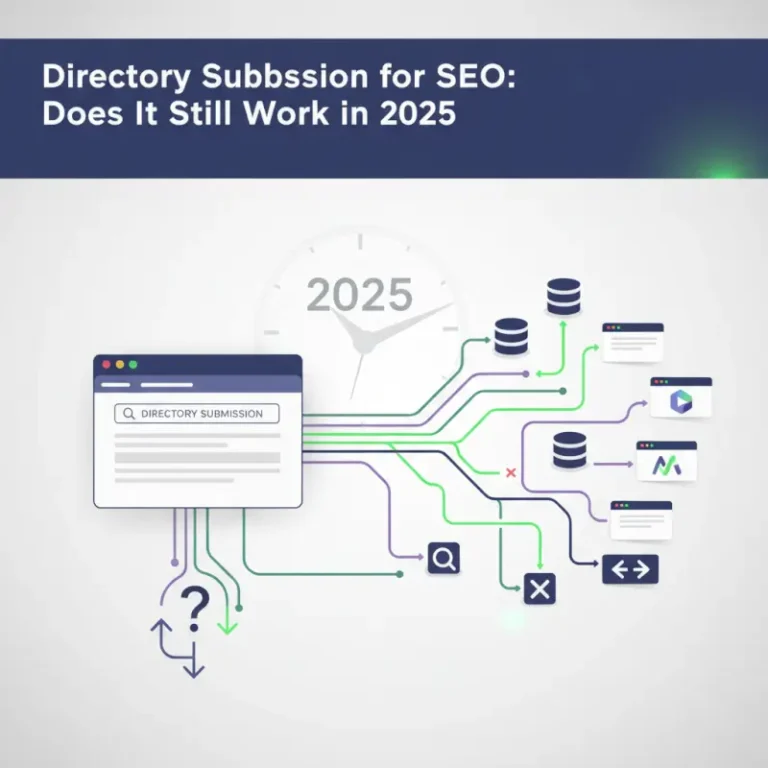
Search engine optimization directory submission was once the gold standard for building backlinks and boosting visibility. Fast forward to today,…

Quick Reality Check: Article directories aren’t dead—they’ve just evolved. While thousands of low-quality submission sites deservedly disappeared after Google’s Panda…

Online directories aren’t dead—but most businesses are using them completely wrong. While competitors waste time submitting to hundreds of low-quality…

Your business exists online in dozens of places right now—whether you know it or not. The question isn’t whether you…

Most business owners know they need a website, but here’s what catches them off guard: local listing sites USA drive…

Looking to get found by local customers without burning through your marketing budget? The harsh truth is that most small…

If your business is getting thousands of impressions in local search but zero clicks, you’re experiencing what I call the…
This isn't a content-marketing programme with a lead magnet at the end of it. It's the working notes from building a directory plugin, published because the answers were hard to find the first time.
Import formats, schema, sitemaps, local ranking, billing the businesses you list — every one of those was a problem in the plugin before it was an article here. The research had to happen either way.
When a guide says a directory can hold 50,000 listings and still load fast, there's a public 50,000-listing demo you can open and run through PageSpeed yourself. No screenshots, no case-study PDF.
No email wall, no "download the full guide", no account. The article you land on is the entire article, and the plugin the articles are about is free on WordPress.org.
A 4,000-word guide on directory monetisation is worth exactly nothing until something is live. Whichever article brought you here, one of these is the next step.
Work the three questions in Start here in order — get one live, fill it, make it pay. That sequence is the whole business, and most of the mistakes people write in about come from doing them out of order: buying data before deciding the niche, or building a pricing page before there is anything to charge for.
No. The guides are about directories — niche selection, data quality, local SEO, pricing, the mechanics of getting business listings to rank — and almost none of it is specific to one piece of software. Where an article does get concrete about implementation it usually names WordPress, because that is what we build on and what most readers already run.
Use the search box at the top of this page. It matches article titles and slugs rather than full text, so single words work best — airbnb, citation, schema, monetize — and two words narrow it further, because both have to appear. If a search comes back empty, the eight topic groups above are the wider net.
Because that is the only thing we build. TurnKey Directories is a WordPress plugin that turns a site into a business directory, and this library is the research behind it — how listings get found, what data sources are worth paying for, which revenue models businesses actually accept. The live demos are the same subject matter with the reading removed.
Yes — the standard RSS feed is at https://turnkeydirectories.com/feed/, and it works in any reader. There is no newsletter and no signup form on this site, so the feed is the way to follow it.
The free plugin gives you dynamic location pages, LocalBusiness schema and both sitemaps on any WordPress theme, with no listing cap. Start there and read the rest when you hit something.