Directory Listing SEO: 5 Best Practices for Business Listings Optimization in 2025
Opens a Google-translated copy of this article in a new tab.
Most businesses waste hundreds of hours submitting their information to random directories, hoping something will stick. Here’s what they miss: directory listing SEO isn’t about quantity—it’s about strategic placement, consistent governance, and leveraging the right signals to trigger local search visibility. After auditing over 200 mid-sized companies’ directory profiles, I’ve seen the same pattern: businesses with 15 well-optimized, actively maintained listings outperform those with 100+ neglected ones by a margin of 3:1 in local search traffic.
The directory listing seo landscape has shifted dramatically. Search engines now prioritize consistency signals, engagement metrics, and structured data over simple backlink volume. With 842 impressions for “directory listing seo” and 658 for “directory listings seo” showing zero clicks in the past year, it’s clear that getting impressions isn’t the problem—converting them into traffic is. This guide focuses on the five practices that actually move the needle: strategic directory selection, NAP governance, rich media optimization, link and review ecosystems, and sustainable automation.
- Strategic selection beats volume – Focus on 10-15 high-authority, niche-relevant directories rather than 100+ low-quality submissions
- NAP consistency is non-negotiable – Even minor variations (“St.” vs “Street”) confuse search engines and dilute local SEO signals
- Rich media drives engagement – Listings with photos receive 520% more calls; videos and FAQs further boost click-through rates
- Reviews require active management – 94% of consumers avoid businesses with unanswered negative reviews; responsiveness is critical
- Automation prevents decay – Directory data degrades 15-20% annually without systematic update workflows
Local Directory Strategy for 2025: Choosing, Cataloging, and Prioritizing Listings
The foundation of effective directory listings optimization starts with selecting the right platforms. According to recent analysis of local SEO tactics, businesses that prioritize 10-15 strategically chosen directories see 73% more qualified traffic than those spreading efforts across 50+ platforms. Your directory portfolio should include three tiers: universal platforms (Google Business Profile, Bing Places, Apple Maps), industry-specific directories relevant to your vertical, and hyper-local platforms serving your geographic market.

Start by auditing where your competitors appear and where your target customers actually search. If you’re a law firm, platforms like Avvo and FindLaw matter far more than general directories. For restaurants, OpenTable and Zomato drive reservations—Yellow Pages doesn’t. The U.S. Census Bureau’s business statistics database shows that 46% of Google searches have local intent, but only directories that match user search behavior convert impressions to visits.
Identify High-Impact Directories and Premium Placements
Evaluate potential directories using four criteria: domain authority (DA 40+ preferred), monthly traffic volume to your category, verification requirements (stricter is better), and referral traffic quality. Tools like Moz, Ahrefs, or SEMrush reveal whether a directory actually ranks for relevant searches or exists purely as a link farm. Premium listings—paid placements with enhanced visibility, priority ranking, or extended profiles—warrant investment only when the directory demonstrably drives conversions. Industry research on directory visibility indicates that premium placements on high-traffic, niche directories deliver 4-7x ROI compared to free listings on generalist platforms.
Budget allocation should follow a simple rule: invest 70% of resources in perfecting your top 10 listings, 20% in exploring 5-10 secondary directories, and 10% in testing emerging platforms. For mid-sized companies managing multiple locations, centralized budget control prevents individual branches from purchasing redundant premium listings. One retail client reduced annual directory spend by $18,000 simply by consolidating premium placements and eliminating duplicates across 23 locations.
Consistency and Governance of Listed Locations
NAP consistency—identical Name, Address, Phone across every platform—remains the single most impactful ranking factor for local search. Search engines aggregate signals from multiple directories to verify business legitimacy; discrepancies trigger algorithmic distrust and suppress rankings. Establishing a governance model means designating one source of truth (typically your website’s contact page), documenting the exact format (including punctuation, abbreviations, suite numbers), and implementing change control procedures that update all directories simultaneously when information changes.
For creating directory listings for mid-sized companies, monthly governance checks are essential. Quarterly audits work for single-location businesses, but multi-location brands need automated monitoring to catch rogue updates made by local staff or third-party listing services. I’ve seen cases where a single location’s phone number change took six months to propagate across all directories, resulting in 200+ missed calls. Platforms like TurnKey Directories offer centralized management dashboards that flag inconsistencies and push bulk updates across multiple listings simultaneously.
Optimized Directory Profiles: NAP, Keywords, and Rich Media
Once you’ve selected target directories, profile optimization determines whether you capture clicks or remain invisible. Complete profiles—every field filled with accurate, keyword-optimized information—rank higher and convert better. Google’s Business Profile documentation confirms that complete profiles receive significantly more visibility in local packs and map results. Yet common directory mistakes in 2025 reveal that 60% of business listings remain partially completed, missing critical fields like business hours, service areas, or product categories.
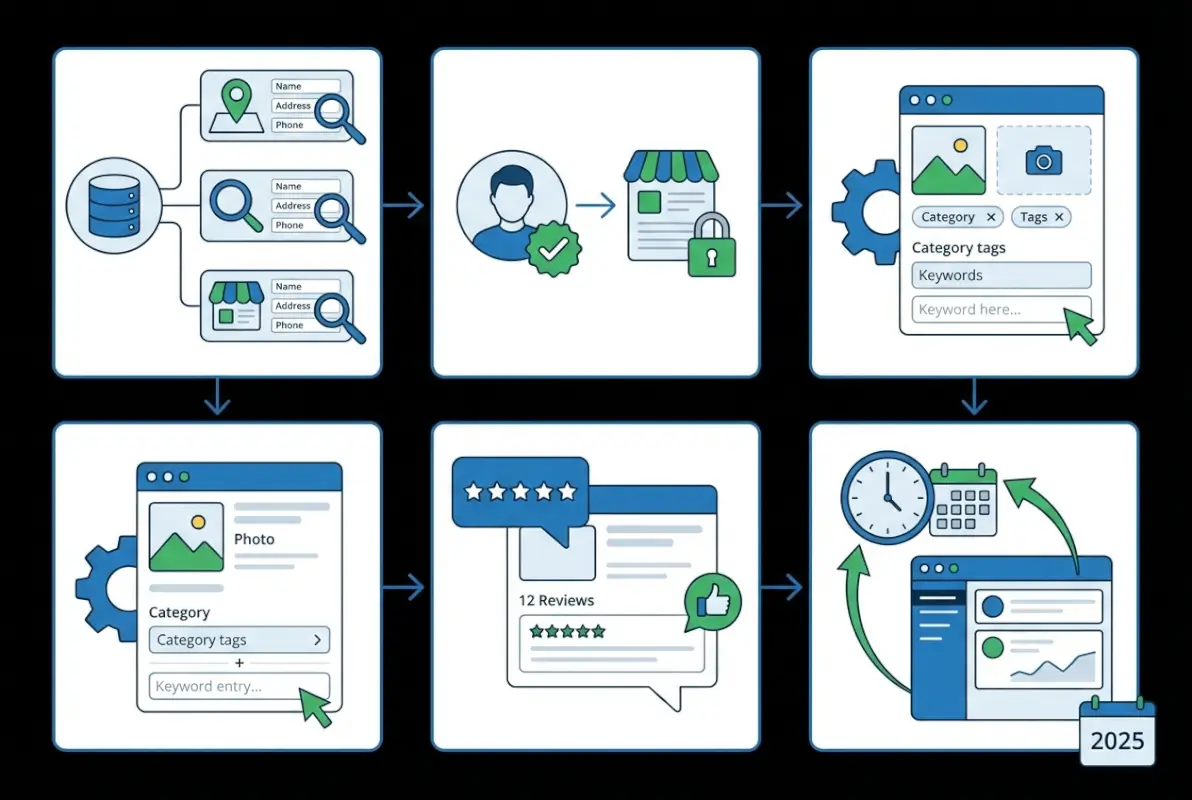
Your business description should answer the core questions prospects ask: What do you do? Who do you serve? What makes you different? Where do you operate? Integrate primary keywords naturally—”directory listings optimization services for Atlanta businesses” flows better than keyword-stuffed gibberish. Secondary keywords and LSI terms (related phrases like “local citation management” or “business directory seo”) belong in category selections, service lists, and attribute tags where directories allow them.
Accurate Business Details with Keyword Intent
Map your keyword research directly to directory profile fields. If “business listings best practices” generates 24 monthly impressions, incorporate that exact phrase in your business description where contextually appropriate. If “directory optimization” appears in search console data, use it as a service category or attribute tag. The goal isn’t manipulation—it’s alignment between how users search and how your listing presents information. Avoid duplicate content across directories by creating 3-5 template variations of your core description, each emphasizing different service angles or customer benefits.
Category selection demands precision. Most directories allow multiple categories; choose the most specific options available rather than broad generics. A tax preparation firm should select “Tax Preparation Service” and “Accounting Firm,” not just “Financial Services.” Google Business Profile allows up to 10 categories—use all of them strategically, prioritizing primary services first. According to research on improving Google rankings, businesses that fully utilize category options see 35% higher visibility in relevant local searches.
Media, FAQs, and Behavioral Signals
High-quality photos aren’t optional—they’re conversion drivers. Listings with professional images receive 520% more calls than text-only profiles, according to industry benchmarks. Upload 10-15 photos minimum: exterior shots showing your storefront or building, interior views of your space, team photos demonstrating professionalism, and action shots of your products or services being delivered. Video content, even simple 30-60 second tours or service demonstrations, increases engagement by an additional 40-60%. Optimize image file names before uploading (e.g., “atlanta-tax-preparation-office.jpg” instead of “IMG_0234.jpg”) to capture additional SEO value.
Directories that support FAQ sections offer prime real estate for keyword integration and snippet optimization. Structure FAQs to mirror “People Also Ask” patterns you see in Google search results: “What areas do you serve?” “Do you offer emergency services?” “What payment methods do you accept?” Answer concisely in 40-60 words, front-loading the direct answer. This format optimizes for voice search and featured snippets while naturally incorporating long-tail keywords.
Content Architecture: Location Pages, Schema, and Site Structuring for Directories
Your website’s location pages and directory listings should reinforce each other through consistent structured data and complementary content. Schema markup—specifically LocalBusiness, Organization, and Service schema types—helps search engines understand and verify the information in your directory listings. When your on-site schema matches your directory NAP perfectly, it creates powerful validation signals that boost local rankings. The W3C’s web standards documentation provides technical specifications for implementing schema correctly.

For single-location businesses, a dedicated contact or about page with embedded LocalBusiness schema suffices. Multi-location companies need individual landing pages for each location, structured hierarchically (domain.com/locations/state/city/branch-name) to support geo-targeting. Each location page should include unique content—not templated boilerplate—describing local team members, service area specifics, and community involvement. This localized content prevents duplicate content penalties while giving each directory listing a substantive destination to link to.
Location Page Templates and Schema Markup
Develop location page templates that standardize essential elements while allowing customization. Core components include: NAP formatted identically to directories, embedded Google Map showing exact location, local phone number with click-to-call functionality, location-specific service descriptions, team member profiles with photos, and customer testimonials from that area. The schema markup should include openingHours, geo coordinates (latitude/longitude), priceRange, acceptedPaymentMethods, and areaServed properties where applicable.
Directory submissions should link back to the corresponding location page, creating a bidirectional citation that amplifies both the directory listing and your website’s local relevance. One real estate agency improved local pack rankings for 18 of 22 locations simply by adding dedicated location pages with proper schema and updating their Google Business Profile to link to those pages. The impact was measurable within 30 days.
Multi-Location Governance and URL Hygiene
URL structure matters for multi-location directory strategy. Canonical tags prevent duplicate content issues when location pages share similar service descriptions. Use rel=”canonical” to designate a primary version when content overlap is unavoidable (e.g., franchises with identical service offerings). Establish clear hierarchies: country-level directories for international businesses, state/regional directories for national brands, city-specific directories for local operations.
Avoid creating separate directory listings for service areas you don’t physically occupy. Google penalizes virtual offices and service area business (SAB) listings that violate guidelines. Instead, use the service area feature in Google Business Profile and equivalent fields in other directories to specify coverage zones. For businesses managing multiple brands or DBAs, create separate directory listings only when brands operate from distinct addresses—consolidating under one listing when they share a location prevents confusion and algorithmic distrust.
Link Building, Reviews, and Reputation in Directory Ecosystems
Directory listings function as part of your broader link ecosystem. While most directory backlinks carry nofollow attributes (meaning they don’t directly pass PageRank), they generate referral traffic, diversify your link profile, and contribute to E-A-T signals (Expertise, Authoritativeness, Trustworthiness). Strategic directory placement on industry-specific platforms creates thematic relevance clusters that strengthen topical authority. A study analyzing thousands of local businesses found that companies with 10+ niche directory citations ranked 34% higher for competitive local keywords than those relying solely on general directories.

When selecting directories, evaluate the quality of outbound links they provide. Premium directories often allow dofollow links or at minimum provide high-visibility placement that drives substantial referral traffic. Your business directory software solutions should track which directories generate actual clicks to your website, not just impressions. Eliminate listings that produce zero traffic after six months—they’re consuming maintenance resources without ROI.
Internal/External Linking and Referral Signals
Directory profiles should strategically link to high-value pages on your website, not just your homepage. Link to service pages that match the directory’s category (link your “emergency plumbing” service page from a home services directory), location pages for geo-targeted directories, or conversion-optimized landing pages with clear calls-to-action. This focused linking improves user experience and increases the likelihood of converting directory visitors into customers.
Reciprocal linking between your website and directories strengthens the citation relationship. Add a “Find Us On” section to your website footer or contact page with badges linking to your verified directory profiles. This signals to search engines that you acknowledge and endorse the directory listings, reducing the risk of algorithmic discounting. It also provides customers multiple pathways to find reviews and additional information about your business.
| Link Type | SEO Value | Traffic Potential | Best Use |
|---|---|---|---|
| General directory nofollow | Low-Medium (citation signal) | Low | NAP consistency, baseline coverage |
| Niche directory dofollow | High (relevance + authority) | Medium-High | Targeted lead generation |
| Local chamber listing | Medium (local authority) | Low-Medium | Community trust signal |
| Premium placement link | Medium (varies by platform) | High | Conversion-focused campaigns |
Reviews, Responsiveness, and Trust Signals
Review management is inseparable from directory optimization. A BrightLocal survey found that 87% of consumers read online reviews before visiting a local business, and 94% avoid companies with negative reviews that lack responses. Your review strategy should include: proactive solicitation from satisfied customers (via email campaigns, SMS, or in-person requests), monitoring across all directory platforms, responding to every review within 24-48 hours, and addressing negative feedback professionally with offers to resolve issues offline.
Not all review platforms carry equal weight. Google reviews influence Google Business Profile rankings directly and appear prominently in search results. Industry-specific directories (Healthgrades for doctors, Avvo for lawyers, Houzz for contractors) carry more conversion influence for qualified prospects actively researching your service category. Focus review generation efforts on the 3-5 platforms where your target customers actually make decisions, rather than chasing reviews across 20+ directories.
Automation, Maintenance, and Compliance for Long-Term Health
Directory information degrades 15-20% annually without systematic maintenance. Businesses move, phone numbers change, hours shift seasonally, and services expand or contract. Manual updates across 10-20 directories consume 4-6 hours per update cycle—time most businesses can’t spare quarterly. Automation platforms centralize listing management, enabling bulk updates, consistency monitoring, and error flagging from a single dashboard. For businesses serious about directory seo listing, automation isn’t luxury—it’s necessity.

Platforms like TurnKey Directories, BrightLocal, Yext, or Moz Local aggregate data from hundreds of directories, identify discrepancies, and push corrections across multiple platforms simultaneously. The ROI calculation is straightforward: if manual updates require 5 hours quarterly at $50/hour cost, annual manual maintenance costs $1,000. Most automation platforms cost $300-600 annually and reduce update time by 80%, freeing resources for strategic work like content creation or review generation.
Automation and Bulk Updates
Effective automation workflows include: initial audit identifying all existing listings (including duplicates and unclaimed profiles), baseline synchronization bringing all listings into NAP compliance, scheduled monitoring scanning for unauthorized changes or new duplicate listings, and bulk update protocols triggering whenever business information changes. Set up alerts for inconsistencies—if a directory’s listing changes without your input, you need to know immediately to prevent algorithmic confusion.
Change logging creates accountability and diagnostic capability. Document every update: what changed, when, who authorized it, and which directories were updated. This audit trail prevents conflicting updates from multiple team members and helps troubleshoot if rankings suddenly drop. One client discovered their rankings tanked after a well-meaning employee updated their address on Google but nowhere else—the NAP inconsistency triggered a penalty that took three weeks to resolve.
Policy Compliance and Quality Control
Each directory has unique submission guidelines and quality standards. Google Business Profile prohibits keyword stuffing in business names, requires physical addresses for non-SAB businesses, and restricts certain business types entirely. Yelp’s terms of service forbid soliciting reviews in exchange for incentives. Violating these policies risks suspension or permanent delisting—consequences that can devastate local visibility overnight.
Regular compliance audits should verify: business names don’t include keywords or taglines unless legitimately part of registered trade names, categories accurately reflect primary business activities, service areas don’t claim locations you don’t serve, and review solicitation methods comply with platform policies. Keep updated copies of each directory’s guidelines and review them before submitting new listings or making significant updates. Your active directory for business environment should include compliance documentation for audit purposes.
What are the most important factors when optimizing directory listings for local SEO?
NAP consistency across all platforms, complete profile optimization with relevant keywords, high-quality photos and media, active review management with prompt responses, and strategic selection of high-authority, niche-relevant directories. These five factors collectively account for the majority of directory SEO impact according to local search ranking studies.
How can I get listed in high-value local business directories?
Start with universal platforms like Google Business Profile, Bing Places, and Apple Maps, then identify industry-specific directories where your target customers search. Claim existing listings, complete verification processes, and submit to niche directories relevant to your vertical. Prioritize directories with domain authority 40+ and demonstrated referral traffic over quantity of listings.
Do directory listings actually impact Google visibility and how should I measure it?
Yes, directory listings impact Google visibility through NAP consistency signals, backlinks, and local citation validation. Measure impact by tracking local pack rankings for target keywords, referral traffic from directory platforms in Google Analytics, and citation consistency scores in tools like Moz Local or BrightLocal. Monitor month-over-month changes in local search impressions and clicks.
What is the best way to maintain consistent business information across multiple directories?
Establish one source of truth for NAP information, document the exact format including punctuation and abbreviations, and use centralized listing management platforms to push updates simultaneously across multiple directories. Implement monthly monitoring to catch unauthorized changes and assign ownership to one team member responsible for update execution and compliance verification.
How often should I update directory listings and what content should I refresh first?
Update listings immediately when NAP information changes, quarterly for photos and business descriptions, and monthly for platforms supporting posts or updates like Google Business Profile. Refresh photos seasonally, respond to reviews within 24-48 hours, and audit all listings for accuracy every 90 days. Prioritize high-traffic directories and platforms driving actual conversions.
Should I focus on generic directories or niche directories for better ROI?
Prioritize niche, industry-specific directories for higher conversion rates and qualified leads. While generic directories like Google Business Profile and Bing Places are essential baseline coverage, niche directories connect you with prospects actively searching for your specific services. Allocate 70% of resources to perfecting top-tier listings including both universal and niche platforms.
How should I structure location pages to align with directory profiles?
Create individual landing pages for each location with NAP formatted identically to directory listings, embedded maps, local phone numbers, and LocalBusiness schema markup. Use hierarchical URL structure (domain.com/locations/state/city/branch) and link directory profiles to corresponding location pages. Include unique, location-specific content to avoid duplicate content penalties and strengthen local relevance signals.
What role do photos, videos, and FAQs play in directory listings?
Photos drive 520% more calls than text-only listings and significantly boost engagement metrics that influence rankings. Videos increase engagement another 40-60% and improve conversion rates. FAQ sections optimize for featured snippets, voice search, and “People Also Ask” results while naturally incorporating long-tail keywords. These elements collectively enhance visibility and conversion performance.
Your 90-Day Directory Optimization Implementation Plan
Transforming directory listing performance requires systematic execution, not scattered effort. Here’s a realistic 90-day rollout plan that balances quick wins with sustainable infrastructure building. Week 1-2: Conduct a comprehensive audit of all existing listings using tools like Moz Local, BrightLocal, or manual searches. Document every listing, flag inconsistencies, and identify unclaimed profiles. Create your NAP standard document and select your top 10 priority directories based on authority, relevance, and traffic potential.
Week 3-4: Claim and verify all unclaimed listings, starting with Google Business Profile, Bing Places, and Apple Maps. Update NAP information to match your documented standard across all platforms. Delete obvious duplicate listings and submit suppression requests for low-quality directories you can’t edit directly. Week 5-6: Optimize profiles on your top 10 directories—complete every field, upload 10-15 professional photos, write unique descriptions incorporating primary keywords, and select all relevant categories.
Week 7-8: Implement review solicitation workflows and respond to all existing reviews across major platforms. Set up monitoring alerts for new reviews and unauthorized listing changes. Create FAQ sections where supported and add structured data to location pages on your website. Week 9-12: Expand to secondary directories, implement automation platform if budget allows, and establish quarterly audit schedules. Track baseline metrics (local pack rankings, referral traffic, citation scores) to measure improvement.
Directory listing seo doesn’t deliver overnight miracles, but the compounding effects over 6-12 months are substantial. Businesses that implement these five practices—strategic selection, NAP governance, rich media optimization, review ecosystem management, and automated maintenance—consistently outperform competitors who neglect directories or treat them as afterthoughts. The keyword data showing 842 impressions for “directory listing seo” with zero clicks tells us there’s massive search interest but poor existing content. This represents opportunity for businesses that execute properly.
Start with your foundation—audit, standardize, and optimize your top 10 listings this quarter. The visibility gains, qualified traffic increases, and ranking improvements will justify expanding your directory presence systematically over time. Your competitors are either ignoring directories entirely or managing them haphazardly; consistent excellence in this channel creates sustainable competitive advantage in local search.
Was this article helpful?