5 Steps to Create an Online Directory Like Manta for Your Niche

Building a niche online directory isn’t just another tech project—it’s about owning a slice of discovery in your chosen market. While giants like Manta cast wide nets across millions of businesses, the real opportunity lies in going deep rather than broad. Think about it: would you rather compete with established players for generic business listings, or become the authoritative source for, say, sustainable wedding vendors in the Pacific Northwest? The answer seems obvious, yet most people still try to build another “everything directory” and wonder why they can’t gain traction.

Here’s what most guides won’t tell you upfront: the businesses you list care far more about qualified leads than vanity metrics. A directory with 500 highly relevant, verified listings in a tight niche will outperform a database of 50,000 generic entries every single time. I’ve watched directory projects fail not because of poor technology choices, but because founders never truly understood their value proposition beyond “we list businesses.” The winners? They solve specific discovery problems that general search engines handle poorly.
TL;DR – Quick Takeaways
- Niche focus beats broad coverage – A tightly defined category with 500 quality listings generates more revenue than 50,000 generic entries
- Platform choice matters less than execution – WordPress plugins, no-code builders, or custom builds can all succeed; your data quality and monetization strategy determine outcomes
- Monetization requires trust first – Premium listings and lead generation only work after you’ve proven discovery value to both users and businesses
- Expect 3-6 months to meaningful traction – MVPs launch in weeks, but building authority and converting free to paid listings takes sustained effort
- Data sourcing is your moat – Public records get you started, but proprietary verification, reviews, and enrichment create defensible value
Market Research and Positioning
Before writing a single line of code or choosing a platform, you need to understand the directory landscape you’re entering. The top-performing guides on building online directories reveal consistent patterns: successful projects start with obsessive market research, not technology decisions. When you analyze content from sources like Directory Profits, a clear framework emerges around niche selection, platform evaluation, data strategy, and monetization models.

The most valuable insight from studying successful directory builders? They all emphasize starting narrow and going deep. General business directories face brutal competition from established players and search engines that aggregate business information automatically. Your competitive advantage lies in specialized knowledge, unique data enrichment, and community trust within a specific vertical.
Analyzing Competing Content and Common Themes
Popular guides consistently cover several core themes. First, niche focus over generic breadth appears in virtually every successful case study. Second, platform choices receive extensive discussion because there’s no single “best” answer—WordPress with directory plugins like GeoDirectory works for some projects, no-code builders like Softr or Bubble serve others, and custom development makes sense for complex data models.
Third, data sourcing strategies separate successful directories from abandoned projects. You’ll find discussion of public records, publisher feeds, partner submissions, and (carefully considered) scraping approaches. The ethical and legal boundaries around data collection matter more than most founders initially realize. Finally, monetization models span premium listings, featured placements, advertising, lead generation fees, and subscription tiers—often implemented in combination rather than choosing just one.
Current Statistics and Market Data
The online directory market shows interesting dynamics. While exact numbers vary by niche, industry analyses suggest that well-executed niche directories achieve conversion rates of 2-5% from free to premium listings once they establish marketplace authority. That’s significantly higher than many other online business models, but it requires building genuine value first.
Customer acquisition costs vary wildly based on niche and competition. Content-driven directories often achieve CAC of $50-200 per premium listing through organic search and partnerships, while paid advertising approaches can push this to $300-500 or higher. The key metric becomes lifetime value: how long do premium listings renew, and what’s the total revenue per business relationship?
Platform costs provide another data point. No-code solutions typically run $30-100 monthly for starter plans, WordPress hosting with quality directory plugins costs $20-80 monthly initially, and custom development starts around $5,000-15,000 for a basic MVP. These numbers help frame realistic budget expectations, though the real investment often becomes content creation, data curation, and marketing rather than pure technology.
Competitive Landscape Snapshot
Manta and similar broad directories operate with massive scale but limited depth in any single vertical. They monetize through premium placements, advertising, and data licensing. Their strength lies in comprehensive coverage and domain authority; their weakness is shallow information and limited vertical expertise. For specialized niches, local business directories often provide better targeted visibility than national generalists.
Your opportunity exists in the gaps these large players can’t economically fill. A directory focused exclusively on certified green building contractors, for example, can offer specialized filters (LEED certification levels, specific sustainable materials expertise, project portfolio by building type) that generic directories would never justify building. This specialization creates value for both searchers and listed businesses.
Key Positioning Takeaway
Select a tightly scoped niche where you can become the definitive source, not just another listing site. Look for markets with clear category boundaries, businesses willing to pay for qualified leads, and gaps in existing discovery tools. Your defensible advantage comes from proprietary data enrichment, community trust, and vertical expertise—not from trying to out-scale established players.
Define Your Niche, Value Proposition, and Success Metrics
Choosing your niche determines everything else about your directory project. The best niches share several characteristics: clear category definitions that businesses and users both understand, existing demand evidenced by search volume or community discussion, and current gaps in discovery tools that frustrate both sides of the marketplace.
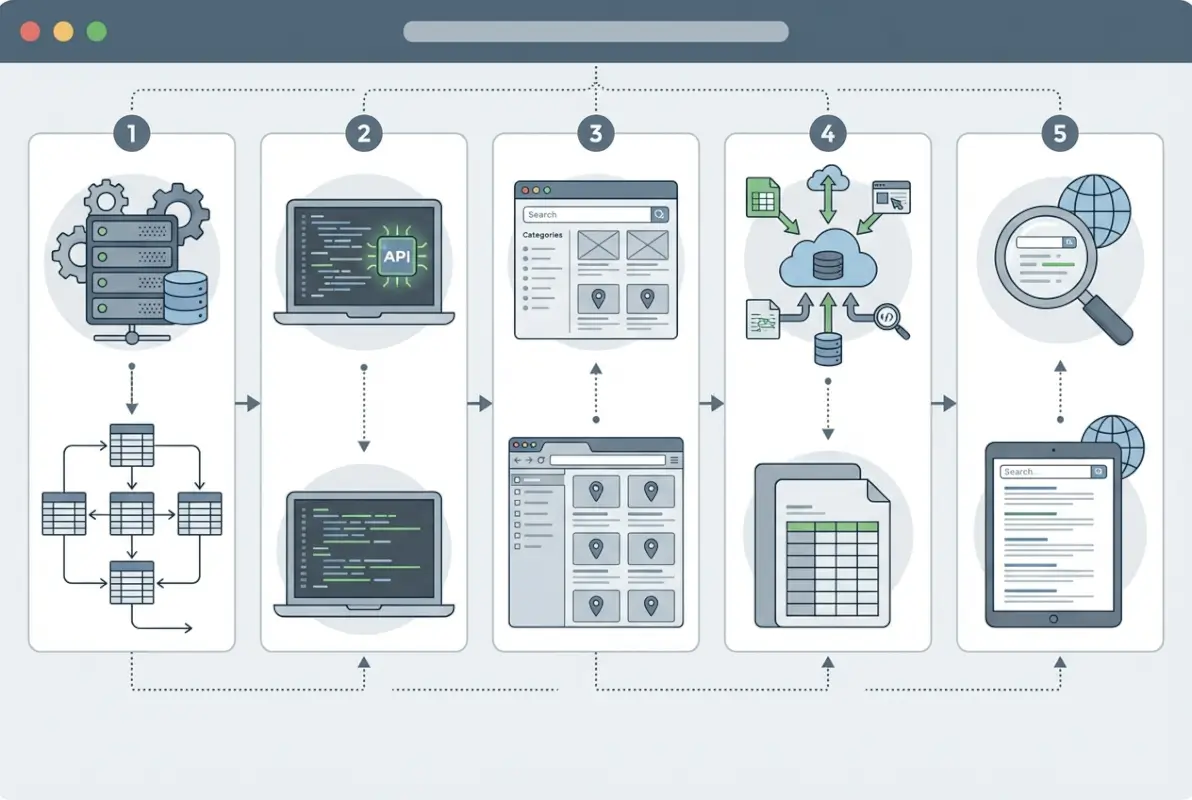
Niche Selection Criteria
Start by evaluating market demand through keyword research and community engagement. Are people actively searching for this type of business? Do existing forums, Facebook groups, or Reddit communities discuss how hard it is to find qualified providers? Strong demand signals include consistent search volume, active community discussion, and complaints about current discovery options.
Category clarity matters more than most founders expect. “Sustainable businesses” is too vague; “LEED-certified commercial contractors in the Southeast” gives you clear boundaries. You need to be able to explain in one sentence who gets listed and who doesn’t. Ambiguous categories create confusion for users and dilute your value proposition.
Willingness to pay represents the crucial economic test. Some niches have businesses desperate for qualified leads who’ll happily pay $50-200 monthly for premium exposure. Others involve businesses with thin margins or low customer lifetime value who won’t justify any directory spend. Research what businesses in your niche currently pay for leads or advertising as a proxy for directory pricing potential.
| Niche Characteristic | Strong Signal | Weak Signal |
|---|---|---|
| Search Demand | Consistent monthly searches, specific long-tail queries | Sporadic interest, only broad generic terms |
| Category Clarity | Clear inclusion/exclusion criteria | Fuzzy boundaries, constant edge cases |
| Payment Willingness | High lead value, active advertising spend | Low margins, no current marketing budget |
| Competition Gaps | No dominant specialized directory | Multiple established players with authority |
Value Proposition for Both Sides
Your directory serves two distinct audiences with different needs. For listed businesses, you provide exposure to qualified prospects actively searching for their specific services. Premium features might include enhanced profiles with rich media, priority placement in category searches, lead contact forms, review management, and performance analytics. The value proposition centers on qualified lead generation at a predictable cost.
For users searching your directory, you solve discovery problems that general search engines handle poorly. This might mean verified credentials, specialized filtering (certifications, service areas, project types), comparative information, authentic reviews, and up-to-date availability. You’re not just listing businesses—you’re curating and enriching information to make better decisions possible. Creating a website business directory that delivers genuine value requires understanding both perspectives.
Success Metrics and KPIs
Track metrics that actually predict business success, not vanity numbers. Listings added per week shows growth momentum, but profile completeness indicates business engagement and listing quality. A directory with 100 complete, verified profiles outperforms 500 sparse entries with minimal information.
User metrics should focus on search behavior and repeat engagement. Unique searchers, searches per user, and return visit rates tell you whether you’re solving discovery problems. Low repeat usage suggests you’re not differentiated enough from general search engines.
Monetization metrics include listing upgrade rate, average revenue per listing, customer acquisition cost, lifetime value, and churn rate. These determine whether you have a sustainable business or an expensive hobby. Calculate unit economics early and often—if CAC exceeds LTV, you need to fix fundamental value delivery before scaling.
Platform Strategy and Tech Stack
Platform choice sparks endless debate in directory builder communities, but the truth is less exciting than people want to hear: multiple approaches can work, and your success depends more on execution than technology decisions. That said, different platforms suit different situations, and understanding tradeoffs helps you choose wisely.

Build vs. No-Code vs. Custom Development
No-code platforms like Softr, Bubble, or Glide let you launch an MVP in days rather than months. They excel for testing market fit quickly and iterating based on real user feedback. Limitations appear as you scale or need custom data models, but for validating whether your niche actually wants a directory, no-code removes excuses about technology barriers. Monthly costs typically run $30-100 for starter plans.
WordPress with directory plugins represents the middle ground—more flexible than no-code, less expensive than custom development. Plugins like GeoDirectory, Business Directory Plugin, or Connections provide robust directory functionality while letting you customize with themes and additional plugins. Hosting costs $20-80 monthly, plugins range from free to $200 one-time or $100-300 annual licenses. This approach suits most directory projects that don’t require highly specialized data models. If you’re exploring this route, learning how to create a business directory on platforms can accelerate your launch.
Custom development makes sense when your data model is complex, you need specific integrations, or you’re building with significant funding and timeline flexibility. Starting costs around $5,000-15,000 for a basic MVP, with ongoing development and maintenance adding $1,000-5,000 monthly. The advantage is complete control; the disadvantage is time and capital requirements that delay market validation.
| Approach | Time to MVP | Initial Cost | Best For |
|---|---|---|---|
| No-Code | 1-2 weeks | $30-100/mo | Fast validation, simple data models |
| WordPress + Plugins | 2-4 weeks | $200-500 + $20-80/mo hosting | Flexibility, proven directory needs |
| Custom Build | 2-4 months | $5,000-15,000+ | Complex data, unique requirements, funding available |
Data Architecture and Listing Schema
Your data model determines what filtering, search, and comparison features you can offer. Core entities typically include Business (the listed entity), Listing (the directory entry with its status and features), Category (hierarchical taxonomy), Location (geographic data for filtering and maps), Tags (flexible metadata), Reviews (user feedback), and Media (photos, videos, documents).
Plan for extensibility from the start. Custom fields let you capture niche-specific data without rebuilding your entire schema. A contractor directory might track license numbers, bonding status, and specialty certifications; a restaurant directory needs cuisine types, price ranges, and dietary options. Generic “description” fields limit your filtering value, specialized structured data creates it.
Data Sourcing Approaches
Starting with public records and business registrations provides a foundation, though data quality varies significantly. Chamber of commerce listings, professional association directories, and government registries offer verified starting points for many niches. Partner with industry associations when possible—they often provide member directories in exchange for exposure or technology access.
Business owner submissions should complement but not replace curated data. Offer easy claim and update processes, but verify critical information before displaying it. Automated scraping carries legal and ethical risks—respect robots.txt, terms of service, and data ownership. Focus instead on creating proprietary value through verification, enrichment, and community reviews that competitors can’t easily replicate.
Monetization Models to Consider
The freemium model works well for directories: free basic listings with paid upgrades for enhanced features. This builds directory comprehensiveness while creating clear upgrade paths. Premium features might include profile photos and media galleries, priority placement in search results, contact forms and lead routing, review response capabilities, and performance analytics.
Featured listings and sponsored placements generate revenue from businesses wanting maximum visibility. Lead generation fees—charging per inquiry or connection—align your incentives with business results but require sophisticated tracking and attribution. Advertising to your audience provides additional revenue but can degrade user experience if overused.
Subscription tiers for different business sizes work in some niches. Sole practitioners might pay $30-50 monthly, small firms $75-150, and larger organizations $200-500 for enterprise features. The key is demonstrating ROI—if premium placement generates even one qualified customer monthly, it’s easily justified for most service businesses.
Data Acquisition, Validation, and Curation
Data quality separates valuable directories from abandoned bookmark folders. Users and businesses both judge you on accuracy, completeness, and freshness. This means treating data curation as an ongoing operational commitment, not a one-time launch task.

Data Quality Framework
Establish verification processes appropriate to your niche. License verification might mean checking state registrar databases; certification verification requires contacting issuing organizations. Document your verification methodology and display verification badges on listings to build trust. Users need to know why your directory is more reliable than generic search results.
Profile completeness thresholds determine listing visibility and ranking. Require minimum information—business name, category, location, contact method, and description—before publishing any listing. Incentivize completeness through better placement for profiles with photos, detailed service descriptions, business hours, and other enriching data.
Ongoing update workflows matter because business information changes constantly. Phone numbers disconnect, locations move, services evolve. Build processes to verify and refresh listings quarterly at minimum, monthly for premium listings. Automate where possible—flag listings with disconnected phones, broken websites, or returned emails for manual review.
Listing Population Plan
Your initial seed strategy determines launch credibility. A directory with 20 listings looks abandoned; 200+ suggests comprehensiveness. Start by identifying and manually curating the obvious established businesses in your niche. These form your quality baseline and demonstrate value to early users.
Partnerships with industry associations, certification bodies, or related directories can accelerate population. Offer them free featured placement or co-marketing in exchange for member lists or data feeds. Many associations struggle with outdated directories and welcome modern alternatives that reduce their administrative burden.
Community-driven contributions scale your effort but require moderation. Make business claiming and profile updates easy, but review all submissions before publishing. Spam, competitors posting negative information as “updates,” and simple errors all occur. Human review costs time but protects quality—the very reason users choose your directory over search engines. Exploring various free business directory sites can provide ideas for sourcing and organizing listings.
Compliance and Trust Signals
Privacy policies and terms of use aren’t just legal requirements, they’re trust signals. Clearly explain what data you collect, how you verify it, who can access it, and how businesses can update or remove listings. Transparency builds confidence with both users and listed businesses.
Display your update cadence and verification standards prominently. “All listings manually verified within the last 90 days” or “License status checked monthly against state databases” tells users your information is reliable. These commitments also force you to actually maintain quality, since making promises you don’t keep erodes trust faster than having no directory at all.
Site Design, UX, and SEO for Discovery
A directory succeeds or fails based on whether users can quickly find what they need and businesses can showcase their value. This means treating information architecture, search functionality, and listing presentation as core product features, not afterthoughts.

Information Architecture and Navigation
Category hierarchies should match how users think about your niche, not how you happen to organize things internally. Test your taxonomy with real users—do they find the category structure intuitive or confusing? Can they navigate from broad categories to specific subcategories in two or three clicks?
Robust search functionality is non-negotiable. Users should be able to search by keyword, location, category, specific attributes, and combinations thereof. Filters must be fast and responsive—if clicking a filter takes more than a second to update results, users abandon the search. Consider faceted search that shows how many results match each filter option before applying it.
The mobile experience determines success for most directories since users often search on-the-go for local services. Responsive design isn’t enough—you need thumb-friendly tap targets, simplified navigation, and fast loading on cellular connections. Test your directory on actual mobile devices, not just browser dev tools.
Listing Pages That Convert
Individual listing pages serve as landing pages from search engines and internal directory searches. They need to inform, build trust, and drive action—all without overwhelming users with cluttered layouts. Lead with the most important information: business name, category, location, contact options, and brief description in the initial viewport.
Rich media significantly improves engagement and conversion. Photos of work, team, or location help users evaluate fit before contacting a business. Videos provide even stronger connection but require more production effort. Document uploads (certifications, insurance certificates, case studies) build credibility, particularly in professional service niches.
Clear calls-to-action appropriate to your niche drive conversions. Phone numbers with click-to-call on mobile, contact forms that capture inquiry details, “save for later” bookmarking, and comparison tools all serve different user needs. Test what actually drives desired actions rather than assuming.
SEO Essentials
Category pages represent your primary SEO opportunity. Each category should have unique, valuable content beyond just listings—explain what this type of business does, what to look for when hiring, typical costs, and common questions. This content helps you rank for informational searches that lead to commercial intent.
Local optimization matters for location-based directories. Create dedicated pages for each geography you serve with local context, statistics, and listings. “Certified Solar Installers in Portland, Oregon” targets more specific intent than generic “Solar Installers” and faces less competition.
Technical SEO fundamentals apply to directories as much as any site. Clean, keyword-rich URLs (not auto-generated ID numbers), fast page load times, mobile optimization, XML sitemaps, and internal linking structure all influence rankings. Link from category pages to relevant subcategories and top listings; link from listings back to their categories. This distributes authority throughout your site.
Schema markup for directories, businesses, and reviews helps search engines understand and display your content. Implement LocalBusiness schema on listing pages, BreadcrumbList for navigation, and AggregateRating for reviews. Rich snippets increase click-through rates from search results, driving more traffic without ranking improvements.
Growth, Marketing, and Community
Building the directory is only half the challenge, getting users and listings is the other half. Growth requires systematic effort across content, partnerships, outreach, and community building. There’s no single growth hack that bypasses this work, despite what clickbait headlines promise.
Early Growth Tactics
Content marketing drives initial discovery better than paid advertising for most directories. Create guides, comparison articles, and educational content around the problems your niche solves. “How to Choose a Certified Green Building Contractor” attracts users actively considering hiring, who then discover your directory as the solution to finding qualified contractors. This approach to creating business directories that drive traffic focuses on solving user problems first.
Email capture should happen early and often. Offer valuable resources (comparison checklists, hiring guides, niche-specific templates) in exchange for email addresses. Build segmented lists of users interested in specific categories or locations so you can send relevant updates about new listings or content.
Partnerships with complementary services accelerate growth. If you run a contractor directory, partner with building material suppliers, home design blogs, or real estate agents. They send referral traffic, you provide value to their audience—everyone wins. Look for non-competitive businesses serving the same target market.
Content Strategy to Support Authority
Beyond initial growth content, ongoing publishing establishes your directory as an authority source. Regular niche news, trend analysis, expert interviews, and how-to guides keep users returning and position you as more than just a listing site. This content also generates natural backlinks from industry blogs and publications.
Profile optimization guides help listed businesses get more value from your platform, which increases renewal rates and referrals. Teach them how to write compelling descriptions, what photos to include, how to respond to reviews, and what premium features drive the best results. Their success is your success.
Outreach and Link-Building Considerations
Link-building for directories requires particular care. Spammy tactics damage your reputation with both search engines and your niche community. Focus instead on genuine relationship-building with industry publications, associations, and complementary services. Offer to contribute expert content, not just request links.
Resource pages and industry directories of directories (yes, they exist) provide natural link opportunities. Find “resources for [your niche]” pages on association sites, government portals, and educational institutions. Reach out with personalized pitches explaining why your directory serves their audience better than existing links.
Monetization Ramp Plan
Don’t launch with premium features on day one. Build user trust and listing traffic first. A typical ramp might introduce premium listings at 3-6 months once you’re driving meaningful traffic, add featured placement options at 6-9 months, implement lead generation fees at 9-12 months, and explore advertising or sponsorships beyond 12 months.
Pricing starts low and increases as value becomes evident. Early adopter discounts encourage initial paid listings while you’re still building traffic. As your directory drives more leads and visibility, gradually increase pricing for new customers while honoring existing commitments. This rewards early supporters and reflects growing value delivery.
Launch Plan and Milestones
Structured timelines keep directory projects on track and prevent endless “just one more feature” delays. Reality check: most directory projects that succeed launch quickly and iterate based on real user feedback, while projects that fail typically spend months building features nobody asked for.
0-90 Day MVP Plan
Week 1-2: Finalize niche selection, competitive research, and value proposition. Choose your platform based on budget, timeline, and technical requirements. Set up basic infrastructure (hosting, domain, platform).
Week 3-4: Configure directory structure, categories, listing schema, and submission forms. Build initial design and information architecture. This isn’t final polish—it’s functional MVP.
Week 5-8: Populate seed listings manually for your core categories. Aim for 100-200 quality listings that demonstrate directory value. Write initial content for top category pages and about/contact pages.
Week 9-10: Private beta with 20-30 users from your network. Collect detailed feedback on usability, value proposition, and gaps. Fix critical issues and confusion points.
Week 11-12: Public launch with initial marketing push—announcement to your email list, social media, relevant communities, and personal network. Monitor user behavior and listing claims closely.
3-6 Month Growth Plan
Expand listing coverage to fill obvious gaps users identify. If searches for specific subcategories or locations return zero results repeatedly, prioritize adding those listings. Optimize your top-performing pages based on analytics—which categories drive the most traffic? Which listings get the most views and contacts?
Implement basic monetization carefully. Start with simple premium listings or featured placement rather than complex pricing tiers. Test willingness to pay with a small segment before broad rollout. Use feedback to refine your value proposition and pricing.
Scale content production around high-value topics that drive organic traffic. Double down on content that’s ranking and attracting users. Kill or improve content that’s not performing. Build email nurture sequences for different user segments.
12+ Month Scalability Plan
Data governance becomes critical at scale. Who owns updating listings? How do you verify ongoing accuracy? What processes handle disputes or spam? Systematize what you’ve been doing manually or growth will overwhelm you.
API access can create partner ecosystems—let related services integrate your directory data, display listings on their sites, or contribute enriched information. This extends your reach and creates defensibility through network effects.
Consider adjacent niche expansion only after you’ve thoroughly dominated your initial focus. A directory for solar installers might expand to energy efficiency auditors or battery storage specialists—related but distinct categories that serve similar user needs.
Risk, Compliance, and Ethical Considerations
Running a directory carries responsibilities around data accuracy, privacy, and fair representation. Addressing these proactively prevents problems and builds trust with users and listed businesses.
Data Privacy and Accuracy
Compliance with data source terms matters legally and ethically. If you’re using public records, business registrations, or third-party feeds, understand and follow their terms of use. Display disclaimers about data freshness and verification status so users make informed decisions.
User consent and business claiming rights prevent disputes. Listed businesses should be able to claim, update, and remove their listings easily. Users should understand what data you collect and how you use it. Privacy policies and terms of service protect you legally while demonstrating respect for data subjects.
Competitive and Market Risks
Search engine algorithm changes can dramatically impact directory traffic. Don’t depend entirely on organic search—build direct traffic through email lists, partnerships, and brand awareness. Diversified traffic sources provide stability when algorithms shift.
Shifts in discovery habits represent longer-term risks. Voice search, AI assistants, and changing user behavior might reduce directory usage in some niches. Monitor how your target users actually discover businesses and be ready to adapt your value proposition.
Platform dependency creates risk if you build on third-party no-code tools. Pricing changes, feature removals, or platform shutdowns can disrupt your business. Mitigate this by owning your data, maintaining export capabilities, and building direct user relationships that transcend any single platform.
Frequently Asked Questions
What is an online directory, and how does it work?
An online directory is a curated database of businesses or services organized by category, location, or specialty. Users search or browse to find providers matching their needs, while listed businesses gain exposure to potential customers. Directories create value through verification, organization, and enriched information beyond generic search engines.
How do you build a niche directory quickly (no-code vs. custom)?
No-code platforms like Softr, Bubble, or Airtable-based tools let you launch in 1-2 weeks with zero coding. WordPress with directory plugins takes 2-4 weeks but offers more customization. Custom development requires 2-4 months and significant budget but provides complete control. Choose based on your timeline, budget, and technical complexity needs.
What platform should I use to start a directory?
WordPress with plugins like GeoDirectory offers the best balance of flexibility, cost, and features for most projects. No-code builders work well for simple MVPs and fast validation. Custom development makes sense only for complex data models, significant funding, or unique requirements that existing platforms can’t support.
How can I source and verify listings for quality?
Start with public records, business registrations, and industry association directories for baseline data. Partner with certification bodies or professional associations for verified member lists. Implement manual verification for critical claims like licenses or certifications. Regular update cycles ensure ongoing accuracy as business information changes.
How do online directories make money, and what pricing models work best?
Successful directories combine multiple revenue streams: freemium models with premium listing upgrades, featured placement fees, lead generation charges per inquiry, subscription tiers for different business sizes, and targeted advertising to niche audiences. The freemium approach typically works best for building comprehensive coverage while monetizing engaged businesses.
How long does it take to build a directory from scratch?
An MVP can launch in 4-8 weeks using existing platforms. Meaningful traction typically requires 3-6 months of sustained effort building listings, content, and audience. Profitability often takes 12-18 months as you optimize conversion from free to premium listings and build enough traffic to justify business investment in featured placement.
What SEO strategies help a directory rank well in search?
Focus on category page optimization with unique, helpful content beyond just listings. Create location-specific landing pages for geographic niches. Implement schema markup for rich snippets in search results. Build high-quality backlinks through partnerships and content marketing. Ensure fast load times, mobile optimization, and clean URL structures throughout.
How can I encourage businesses to list themselves or upgrade listings?
Demonstrate ROI through case studies and testimonials from early premium users. Make claiming and profile completion easy with clear step-by-step guidance. Offer limited-time early adopter discounts to reduce friction. Show businesses their listing performance metrics so they see actual inquiry and view numbers that justify upgrades.
What are the legal considerations when aggregating business data?
Respect data source terms of service and copyright restrictions. Provide clear processes for businesses to claim, update, or remove listings. Implement privacy policies compliant with regulations in your jurisdiction. Verify critical information rather than republishing potentially inaccurate data. Display disclaimers about data freshness and verification status.
What metrics should I track to measure directory success?
Track listings added weekly and profile completeness rates for growth. Monitor unique users, searches per user, and return visit rates for engagement. Measure conversion from free to premium listings as your core monetization metric. Calculate customer acquisition cost versus lifetime value to ensure sustainable unit economics. Watch listing churn rates to identify value delivery gaps.
Conclusion
Building a niche directory requires clear thinking about market opportunity, relentless focus on data quality, and systematic execution through launch and growth phases. The opportunities exist in specialized niches where general search engines and broad directories provide shallow, generic information. Your competitive advantage comes from depth, verification, and community trust—not from trying to out-scale established players.
The path forward starts with choosing a tightly scoped niche where you can become the definitive source, selecting a platform appropriate to your timeline and budget, and launching quickly with a functional MVP. Resist perfectionism in favor of real user feedback. Build data quality and verification processes from day one, because these create the defensible value that justifies premium pricing and drives user loyalty.
- Identify three potential niches and evaluate them against the selection criteria outlined above
- Research existing competition and identify specific gaps your directory could fill
- Choose a platform and set a 90-day launch deadline to maintain momentum
- Manually curate 100-200 seed listings to demonstrate initial value
- Launch publicly and iterate based on actual user behavior, not assumptions
The directories that succeed aren’t necessarily the most technically sophisticated or the best funded. They’re the ones that solve real discovery problems for a specific audience, deliver genuine value to both users and businesses, and execute consistently through the messy middle phase between launch and profitability. Start lean, stay focused on your niche, and build trust through data quality and helpful content. The market rewards directories that make discovery genuinely better, not just different.