Business Listing Backlinks 2026: Quality Over Quantity Wins

Generating summary...
Here’s something most SEO professionals won’t admit: they’re still using the same business listing strategies from 2018. While algorithms have evolved, user behaviors have shifted, and AI has fundamentally changed how search engines evaluate trust signals, many businesses are still submitting their information to every directory that’ll accept them. The result? Wasted effort, diluted authority signals, and sometimes outright penalties.
The reality in 2026 is both simpler and more complex than the old approach. Business listing backlinks absolutely still matter—but the game has changed so dramatically that what worked even two years ago might actively hurt your rankings today. The shift isn’t about abandoning directory citations; it’s about understanding that modern search algorithms evaluate these signals with unprecedented sophistication, weighing contextual relevance, user engagement patterns, and data consistency across platforms.
What’s particularly fascinating is how the relationship between business listing backlinks and local visibility has deepened rather than weakened. While low-quality mass submissions have lost nearly all value, strategic placements on authoritative, niche-relevant directories now carry more weight than ever before. This creates both opportunity and risk—done right, a focused listing strategy can dramatically improve local search visibility; done poorly, it can trigger spam filters and waste resources on placements that contribute nothing.
- Quality beats quantity: 15-20 highly relevant listings outperform 200+ generic submissions
- NAP consistency across authoritative platforms is now a critical local ranking factor
- AI-driven algorithms evaluate contextual relevance and user engagement, not just link volume
- Google Business Profile integration with strategic citations creates powerful local visibility
- Industry-specific and verified listings carry significantly more weight than general directories
- Regular audits to remove low-quality listings are now essential for maintaining authority
The 2026 Reality: Business Listing Backlinks in an AI-Driven Search Landscape
The transformation of business listing value over the past 18 months has been nothing short of remarkable. Where once quantity ruled and mass directory submissions could move the needle, today’s algorithms evaluate listings with the scrutiny previously reserved for editorial backlinks. This shift reflects broader changes in how search engines—particularly Google—understand and rank local businesses.
Modern search algorithms don’t just count citations; they analyze the relationship between your business and the platforms listing it. A plumbing company appearing on home services directories, local chamber websites, and industry association platforms creates a logical, coherent pattern. The same business listed on random, unrelated directories triggers pattern recognition systems designed to identify manipulation. This contextual evaluation means that relevance has become the primary value driver, with authority and consistency following close behind.

What makes 2026 different is the integration of user behavior signals into listing evaluation. Directories that generate genuine engagement—users clicking through to your website, calling your business, or interacting with your listing—pass substantially more value than static citations. Search engines can now track these engagement patterns, effectively measuring whether a listing serves actual users or exists purely for SEO purposes.
The rise of entity-based search has fundamentally changed how business listings function within your overall digital presence. Google no longer sees your business as just a website with backlinks; instead, it understands your business as an entity with specific attributes, relationships, and signals across multiple platforms. Citations serve as entity validation—confirming your business exists, operates in specific locations, offers particular services, and maintains consistent information. This makes accurate, consistent listings more valuable for establishing legitimacy than ever before.
I remember working with a regional HVAC company last year that had accumulated hundreds of directory listings over the previous decade. Their local visibility was stagnant despite strong on-site SEO and an optimized Google Business Profile. When we audited their citation profile, we discovered that 73% of their listings contained inconsistent NAP information, outdated service areas, or appeared on low-quality directories flagged for spam. After six weeks of cleanup—removing low-value listings, correcting inconsistencies, and adding strategic placements on industry-specific platforms—their local pack visibility increased 41% and they started ranking for competitive service-area keywords where they’d been invisible.
How AI and Machine Learning Changed Directory Evaluation
The integration of machine learning into search algorithms has created new evaluation criteria that didn’t exist in previous years. Modern systems can assess the semantic relationship between a directory’s content and your business category, understanding whether the connection makes logical sense. They can identify patterns in how users interact with your listings, measuring dwell time, click-through rates, and conversion behaviors that indicate genuine value versus empty citations.
Natural language processing now analyzes the content surrounding your listings—business descriptions, category placements, and user reviews—to determine contextual relevance. This means that even identical NAP information can carry different weight depending on how it’s presented and what supporting content accompanies it. Listings with detailed, unique descriptions and rich category information signal higher quality than bare-bones citations with minimal detail.
Perhaps most significantly, AI systems can now detect manipulation attempts with remarkable accuracy. Unnatural patterns in listing acquisition—such as dozens of citations appearing simultaneously, identical descriptions across multiple platforms, or placements on directories with suspicious link profiles—trigger quality filters that can neutralize or penalize the entire citation strategy. This makes organic, strategic growth essential rather than optional.
Strategic Selection: Which Business Listing Backlinks Actually Matter
The fundamental shift in business listing strategy for 2026 centers on selective, strategic placements rather than comprehensive coverage. Where previous approaches emphasized claiming every available listing, modern best practices focus on identifying the 15-25 platforms that deliver the highest combination of SEO value, referral traffic, and target audience reach.
High-value directories share specific characteristics that make them worth pursuing. Domain authority remains relevant, but it’s no longer the primary criterion. More important factors include the directory’s relevance to your industry or service area, verification processes that ensure listing quality, active user engagement that generates actual traffic, and integration with major search platforms and data aggregators. A niche industry directory with moderate domain authority but high user engagement and strict verification often provides more value than a high-DA general directory with minimal quality controls.
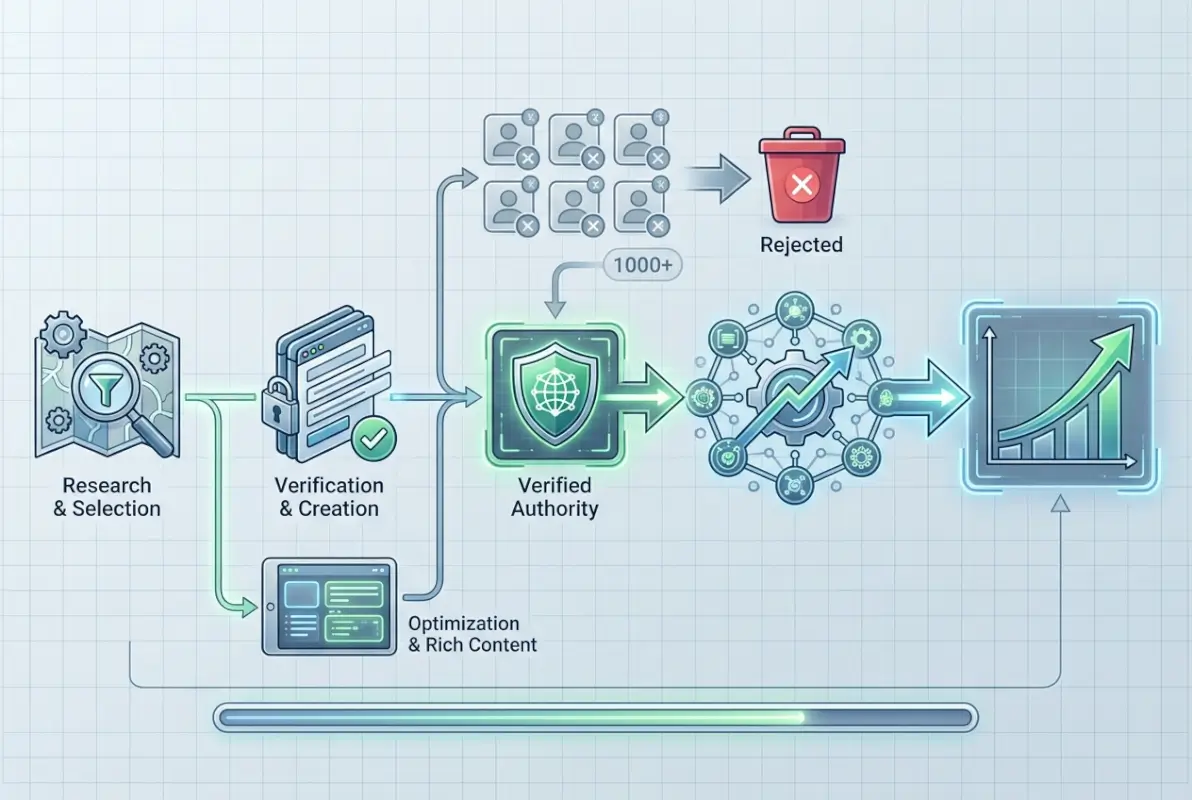
Local-specific platforms deserve particular attention for businesses serving defined geographic areas. Chamber of commerce websites, local business associations, regional news sites with business directories, and neighborhood-specific platforms send powerful geographic relevance signals that directly influence local pack rankings. These placements often provide the dual benefit of community credibility and search visibility, making them particularly valuable for service-area businesses.
| Directory Type | SEO Value | Best For | Priority Level |
|---|---|---|---|
| Google Business Profile | Critical | All local businesses | Essential |
| Industry Associations | Very High | B2B and professional services | High |
| Local Chambers | High | Community-focused businesses | High |
| Niche Directories | High | Specialized services | Medium-High |
| Major Aggregators | Medium-High | Broad visibility | Medium |
| Generic Directories | Low-Medium | Supporting signals only | Low |
Industry-specific platforms have gained tremendous value as algorithms become better at understanding topical authority and contextual relevance. A law firm listed on legal directories, bar association sites, and legal news platforms develops a coherent authority profile that reinforces expertise signals. The same principle applies across industries—restaurants benefit from food-focused platforms, contractors from home services directories, and healthcare providers from medical directories.
Data aggregators deserve special attention in your citation strategy. Platforms like Neustar Localeze, Factual, and Foursquare serve as data sources for dozens of other directories and platforms. A single accurate listing on a major aggregator can cascade to multiple downstream citations, making these placements particularly efficient for building consistent presence across the web.
Building Your Strategic Citation Profile: The 2026 Playbook
Creating an effective business listing strategy starts with audit and cleanup rather than new submissions. Most established businesses already have dozens of existing citations—some accurate, some outdated, and some on platforms that now carry more risk than reward. Beginning with a comprehensive audit reveals the current state of your citation profile and identifies immediate optimization opportunities.
The audit process should inventory all existing listings, document NAP variations and inconsistencies, identify low-quality or potentially harmful placements, note incomplete or outdated information, and assess which high-value platforms are missing from your profile. Tools like TurnKey Directories can facilitate this process for directory operators, while businesses can use citation auditing services or manual searches combined with backlink analysis.

Once you’ve completed your audit, prioritize corrections and additions based on impact potential. Start with your Google Business Profile—ensuring it’s fully optimized, verified, and actively managed—since this single listing influences local visibility more than any other. Next, address NAP inconsistencies across existing high-value listings, correcting any variations in business name formatting, address presentation, or phone numbers.
When creating new listings or updating existing ones, completeness matters enormously. Modern algorithms can measure the richness and depth of your business information, using it as a quality signal. Comprehensive listings should include exact, consistent NAP information matching your Google Business Profile; primary and secondary business categories reflecting your services; detailed business descriptions (150-300 words) with natural keyword integration; complete service area or location information; accurate operating hours including special schedules; high-quality images showing your location, products, or services; and verification through available processes (phone, postcard, documentation).
The Critical Importance of NAP Consistency
NAP (Name, Address, Phone) consistency isn’t just a best practice—it’s a fundamental requirement for citation value in 2026. Even minor variations can create confusion for both search algorithms and potential customers, potentially diluting the authority signal your citations should provide. The key is establishing a single, canonical format for your business information and using it identically across every platform.
Common NAP variations that create problems include abbreviating “Street” as “St.” on some platforms but spelling it out on others, including or omitting suite numbers inconsistently, using different phone number formats ((555) 123-4567 versus 555-123-4567), varying business name presentation (adding or removing “LLC,” “Inc.,” etc.), and presenting address information in different orders or formats. While these might seem like minor details, modern algorithms track these variations as data quality signals.
For businesses with multiple locations, NAP consistency becomes even more critical. Each location requires its own consistent citation profile with location-specific NAP information. Mixing locations within a single listing or using inconsistent formatting across location pages can severely dilute local search visibility for all locations.
Optimizing Business Listings for Maximum Impact
Creating a listing is just the beginning; optimization determines whether it delivers value or languishes as another static citation. The most impactful listings serve dual purposes—providing SEO signals while also converting users who discover your business through the directory itself. This dual-purpose approach requires attention to both search engine signals and user experience elements.
Business descriptions deserve particular attention since they represent your primary opportunity to differentiate your listing from competitors and integrate relevant keywords naturally. Generic descriptions copied across multiple platforms not only risk duplicate content issues but also miss opportunities to optimize for platform-specific audiences. Instead, create unique descriptions for your primary listings (Google Business Profile, industry directories, major aggregators) while maintaining core NAP consistency.

Effective business descriptions in 2026 should tell a story rather than just list services. They need to include your primary service keywords naturally within context, highlight what makes your business unique or valuable, speak directly to customer needs and pain points, incorporate location-specific terms for local relevance, and maintain a conversational tone that engages readers. Aim for 150-300 words on platforms that allow longer descriptions, providing enough detail to be valuable without becoming overwhelming.
Visual elements significantly impact both user engagement and perceived legitimacy. Listings with professional photos receive substantially more clicks and conversions than those without images. When platforms allow photo uploads, include exterior shots of your location for recognizability; interior images showing your space or environment; product or service photos demonstrating what you offer; team photos adding a personal, trustworthy element; and completed project images showcasing your work quality.
Categories and attributes represent structured data opportunities that directly influence when and how your listing appears in relevant searches. Most platforms offer primary and secondary category selections—use all available slots with accurate, specific categories that match your services. Avoid the temptation to select irrelevant categories hoping to appear in more searches; modern algorithms can identify category stuffing and may penalize listings that appear to manipulate categorization.
Managing and Maintaining Your Citation Profile
The biggest mistake businesses make with citations isn’t poor initial strategy—it’s neglecting ongoing management and maintenance. Business information changes over time (new phone systems, address changes, expanded service areas), directory platforms evolve or change ownership, and previously high-quality directories can deteriorate in value. Without regular maintenance, even perfectly executed initial strategies decay in effectiveness.
Implement a structured maintenance schedule based on your business changes and resource availability. At minimum, conduct quarterly comprehensive audits checking all major listings for accuracy, updating any changed information across all platforms, identifying and claiming new listings that appeared on auto-generated directories, and reviewing how to organize active directory for business environment or citation profiles. For businesses in competitive markets or those experiencing rapid growth, monthly spot-checks on top-tier listings can catch problems before they impact visibility.
Review management has become increasingly important as listings evolve into interactive platforms. Responding to reviews—both positive and negative—signals active management and customer engagement, factors that modern algorithms consider when evaluating listing quality. Prompt, professional responses demonstrate legitimacy and customer service commitment while providing opportunities to naturally incorporate keywords and service details in your replies.
The Google Business Profile Foundation
No discussion of business listing strategy would be complete without emphasizing Google Business Profile (GBP) as the foundation of all local SEO efforts. While technically just one citation among many, GBP exerts disproportionate influence on local search visibility and serves as the canonical source Google uses to verify information from other citations.
The relationship between GBP and other business listings is symbiotic but not equal. GBP performance improves when supported by consistent, high-quality citations across authoritative platforms—these external citations serve as validation for the information in your GBP listing. However, inconsistencies between GBP and other citations create uncertainty, potentially diluting the strength of signals from both sources.

Modern GBP optimization extends far beyond basic NAP completion. To maximize the platform’s value, ensure you’ve verified your listing through available methods; selected the most specific primary category available; added all relevant secondary categories (Google allows multiple); uploaded high-quality photos regularly (Google favors recently updated profiles); posted updates, offers, and news through GBP Posts; encouraged and responded to customer reviews; completed all available attributes (wheelchair accessible, Wi-Fi, parking, etc.); and added detailed service or product information through available features.
The integration between GBP and external citations works through data validation processes. When Google encounters consistent information about your business across multiple authoritative sources, it gains confidence in displaying that information in search results. Conversely, conflicting data creates uncertainty—if your GBP lists one phone number while three directory citations show different numbers, Google must decide which to trust or whether to reduce confidence in all sources.
Avoiding Common Pitfalls and Penalties
The business listing landscape contains numerous traps that can waste resources or actively harm your SEO performance. Understanding these common mistakes helps you avoid unnecessary setbacks and focus efforts on high-value activities that actually move the needle.
Mass directory submissions rank among the most persistent bad practices still used by businesses and inexperienced SEO providers. Services offering to submit your business to “500+ directories” or similar promises almost always deliver more harm than benefit. These mass submissions typically place your business on low-quality directories with minimal user traffic, create listings with minimal customization or unique descriptions, ignore industry or geographic relevance, and generate unnatural citation acquisition patterns that trigger spam filters.
| Common Mistake | Why It Backfires | Better Approach |
|---|---|---|
| Identical descriptions everywhere | Duplicate content signals, missed optimization | Unique descriptions for major platforms |
| Keyword-stuffed business names | Violates platform policies, risks suspension | Use actual business name, optimize description |
| Creating listings too quickly | Unnatural velocity triggers spam detection | Stagger submissions over weeks/months |
| Ignoring low-quality listings | Association with spam networks | Regular audits, remove harmful citations |
| Setting up and forgetting | Information becomes outdated and inconsistent | Quarterly maintenance schedule |
Another common mistake involves optimizing business names by stuffing keywords into the business name field. While “Joe’s Plumbing – Emergency Plumber Seattle” might seem like smart optimization, most platforms (including Google) explicitly prohibit this practice. Violations risk listing suspension, loss of verification status, and potential penalties affecting broader search visibility. Your business name should match your legal, registered business name or the name displayed on your physical signage—nothing more.
Failing to monitor for duplicate listings creates another set of problems. Many directories allow multiple submissions for the same business, either intentionally or through poor quality controls. Duplicate listings split your review ratings, confuse customers with potentially different information, dilute citation authority signals, and create management headaches when business information changes. Regular audits should identify duplicates so you can request mergers or deletions, consolidating signals into single, authoritative listings.
Frequently Asked Questions About Business Listing Backlinks
Do business listing backlinks still help SEO in 2026?
Yes, but their value has evolved significantly. High-quality, relevant business listings on authoritative platforms continue to provide valuable local SEO signals, particularly for NAP consistency and entity validation. However, mass directory submissions and low-quality citations now provide minimal benefit and can potentially trigger spam filters. Focus on 15-25 strategic placements rather than hundreds of generic listings.
How many business directory listings should my company have?
Quality matters far more than quantity. Most businesses achieve optimal results with 15-25 carefully selected listings on platforms relevant to their industry, location, and target audience. This should include Google Business Profile, major data aggregators, industry-specific directories, local chambers or associations, and relevant niche platforms. More listings don’t necessarily mean better results if they lack relevance or quality.
What’s the difference between a business listing and a backlink?
A business listing is a directory entry containing your company information (NAP, description, categories), while a backlink is simply a link from another site to yours. Business listings often include backlinks to your website, but their primary SEO value comes from citation consistency and entity validation rather than traditional link equity. Modern algorithms evaluate listings holistically, considering accuracy, completeness, and engagement alongside link signals.
How do I check if my business listings have NAP inconsistencies?
Conduct manual searches for your business name across major search engines and review the results for variations in name, address, or phone formatting. Citation auditing tools like Moz Local, BrightLocal, or Whitespark can automate this process. Create a spreadsheet documenting all discovered listings with their NAP information, then compare against your canonical format to identify inconsistencies requiring correction.
Should I remove low-quality business directory listings?
Generally yes, especially if they contain incorrect information, appear on spammy platforms, or create confusion with duplicate listings. Request removal directly from directory operators when possible. For listings you can’t remove, consider using Google’s disavow tool if they appear to be harming your backlink profile, though this should be reserved for clear spam situations rather than simply low-value citations.
How often should I update my business directory listings?
Conduct comprehensive audits quarterly to ensure information accuracy across all platforms. Update listings immediately whenever your business information changes (phone number, address, hours, services). For platforms with engagement features like posts or offers, update weekly or monthly to signal active management. Regular photo additions and review responses also indicate ongoing maintenance to both users and algorithms.
Are nofollow links from business directories still valuable?
Yes, nofollow links from authoritative, relevant directories still provide value through referral traffic, brand visibility, and entity validation signals. While they don’t pass traditional “link juice,” they contribute to your overall digital footprint and can influence local search rankings through consistent NAP information and user engagement signals. Focus on listing quality and relevance rather than follow/nofollow status.
What makes a business directory “high-quality” in 2026?
High-quality directories demonstrate strong domain authority, implement verification processes for listings, show active user engagement and traffic, maintain relevance to your industry or location, regularly update their platform and remove spam, integrate with major search engines and data aggregators, and provide comprehensive listing features beyond basic NAP. User reviews, editorial oversight, and mobile optimization also indicate quality.
How do business listings affect Google Map Pack rankings?
Business listings influence Map Pack rankings primarily through NAP consistency validation and entity confidence signals. When Google sees consistent business information across authoritative external sources, it gains confidence in displaying your GBP listing for relevant searches. Quality citations also contribute to overall domain authority and local relevance signals that factor into Map Pack placement algorithms.
Can I use the same business description on all directory listings?
While maintaining consistent core information is essential, using identical descriptions across all platforms can trigger duplicate content concerns and miss optimization opportunities. Create unique descriptions for your most important listings (Google Business Profile, industry directories, major aggregators) while maintaining consistent NAP information. For minor directories, similar descriptions are acceptable but try to vary language naturally.
Final Takeaway: Strategic Focus Wins in 2026
The business listing landscape has matured from a quantity game to a strategic quality play. Success no longer comes from claiming every available citation but from carefully curating a focused profile of authoritative, relevant listings that support your local SEO goals while providing genuine value to potential customers.
Start with a comprehensive audit of your existing citations, eliminate inconsistencies and low-quality placements, and strategically add high-value listings on platforms your customers actually use. Remember that active directory business use cases extend beyond SEO—the most valuable listings drive direct customer acquisition while simultaneously strengthening your search visibility. Invest your effort where it counts, maintain what you build, and watch your local visibility grow organically over time.
Was this article helpful?