Free vs. Paid Directory Listings: 6 Pros & Cons to Help You Decide

When you’re hunting for local customers online, you’ve probably asked yourself: should I bother with free directory listings, or is it worth paying for premium placement? Here’s the truth most marketing guides won’t tell you—both can waste your time and money if you don’t know which directories actually move the needle for your business. The real competitive edge isn’t about choosing free versus paid; it’s about understanding exactly when each approach earns its keep, and how to build a citation strategy that multiplies your visibility without bleeding your budget dry. Most small business owners scatter their efforts across dozens of random directories (I’ve seen companies with profiles on 40+ platforms they’ve never even logged into), while their competitors dominate local search with just 8-10 carefully chosen listings that actually deliver calls and foot traffic.
TL;DR – Quick Takeaways
- Free listings build your foundation – They establish baseline NAP consistency and help Google verify your business exists, but offer limited visibility and control
- Paid listings amplify high-intent traffic – Premium placements can drive 3-5x more clicks in competitive categories, but only if you choose directories where your customers actually search
- Data quality trumps quantity – Ten accurate, complete listings outperform 50 inconsistent ones; Google penalizes conflicting business information across the web
- ROI requires ruthless measurement – Track which directories send calls, form fills, and directions requests; cut platforms that don’t convert within 90 days
- Hybrid strategies win for most businesses – Maintain 5-7 core free listings (Google Business Profile, Bing Places, industry-specific platforms), then test 1-2 paid placements in your highest-revenue categories
What Free Directory Listings Actually Deliver (And What They Don’t)
Free business directory listings serve one critical purpose: they put your business on the digital map without requiring upfront investment. When you boost your online presence with business website listing platforms, you’re essentially planting flags across the internet that tell search engines “yes, this business exists at this address.” Google’s local ranking algorithm relies heavily on citation signals—mentions of your business name, address, and phone number across trusted directories. The more consistent these citations appear, the more confident Google feels showing your business in local search results and map packs.

But here’s where most businesses go wrong. They claim every free listing they can find, then abandon them. A BrightLocal survey found that 80% of consumers lose trust in local businesses when they encounter incorrect or inconsistent information across directories. Free listings typically offer bare-bones profiles—basic contact details, maybe a category selection, and little else. You can’t add multiple photos, showcase customer reviews prominently, or get priority placement when someone searches your category. Your plumbing business sits on page three alongside 40 competitors, all looking identical because the free tier doesn’t let you stand out.
The hidden cost of free listings is ongoing maintenance. Business hours change, phone numbers port to new carriers, you add a second location—now you need to update 15-20 directories manually (or pay for a citation management tool, which defeats the “free” benefit). I’ve watched local service businesses lose thousands in revenue because their Google Business Profile showed correct holiday hours, but four other directories showed they were open, sending frustrated customers to locked doors. Free doesn’t mean zero cost, it means you pay in time and lost opportunities instead of dollars.
There’s also the spam problem. Free directories attract low-quality submissions because there’s no vetting barrier. According to research from Google Business Profile guidance, duplicate listings and fake businesses dilute search relevance. When you appear in directories packed with fake reviews and dead links, users question whether you’re legitimate. Some free platforms even inject ads into your listing page, so potential customers see your competitor’s banner ad while reading about your services.
Why Businesses Pay for Directory Placement (And When It Backfires)
Paid directory listings promise what free versions can’t deliver: visibility that actually interrupts the customer’s search journey. When you explore business website directory benefits for online visibility, premium placements typically include featured positioning at the top of category pages, enhanced profiles with unlimited photos and videos, verified badges that signal legitimacy, and detailed analytics showing exactly how many people viewed your listing versus clicked through to your website. In competitive niches like legal services or home remodeling, these advantages can mean the difference between three quote requests per month and thirty.
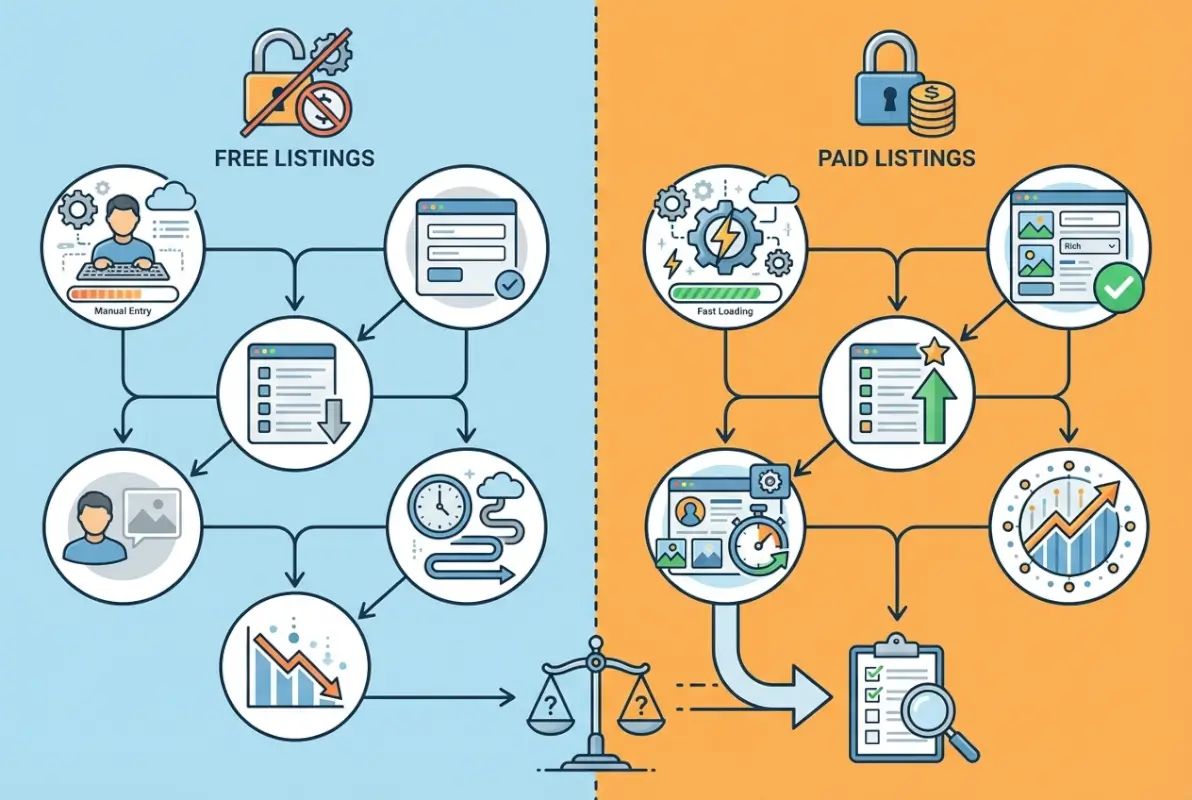
The ROI math on paid listings hinges on one brutal question: does this directory send customers who actually convert? I’ve seen attorneys spend $3,000 yearly on niche legal directories that generate 50 profile views but zero consultations, while a $300 annual investment in a regional chamber directory delivered six five-figure clients. The Statista research on local search behavior shows that 76% of people who search for something nearby visit a business within 24 hours, but that only applies when they find you in directories they trust and use regularly.
Paid platforms earn their fees by offering features that compress the decision timeline. Verified badges reduce hesitation (customers spend less time wondering if you’re real). Direct booking buttons eliminate friction (they don’t need to visit your site to schedule). Prominent review displays leverage social proof (seeing 47 five-star ratings makes your premium pricing feel justified). When you evaluate directory website essential features to look for in a platform, these conversion-focused tools should top your checklist—because driving traffic means nothing if visitors bounce without taking action.
The risk with paid listings is overpaying for reach that doesn’t match your market. National directories charge premiums for exposure across all 50 states when you only serve a 25-mile radius. Industry-specific platforms promise qualified leads but define “qualified” so broadly that you get tire-kickers instead of buyers. According to guidance from Search Engine Land on local business visibility, even Google doesn’t guarantee that paying for ads will improve your organic local ranking—paid and organic are separate systems. You need to track which directories generate phone calls, form submissions, and actual revenue, then ruthlessly cut the underperformers after a 90-day trial.
There’s also a hidden trap in multi-year contracts. Some premium directories lock you into annual renewals with automatic billing, betting you’ll forget to cancel even when results disappoint. Others bundle “bonus” services like social media posting or email marketing that you never use, inflating the cost without delivering proportional value. When you consider business web directory reasons to get listed today, focus on platforms offering month-to-month terms until you’ve validated ROI through your own data.
Impact on Local SEO and User Behavior
Local search algorithms prioritize data quality, consistency, and trust signals across all citation sources when determining map pack rankings and local organic results. Google Business Profile remains the cornerstone of local visibility, but structured citations from third-party directories reinforce your business’s legitimacy and geographic relevance. When your NAP (name, address, phone) appears consistently across multiple authoritative directories, search engines gain higher confidence in your location data and are more likely to surface your profile for relevant queries.

Free listings contribute to this citation ecosystem by adding breadth—dozens of directories referencing the same business details send cumulative signals that support local pack inclusion. Paid listings, however, often carry additional trust markers such as verified badges, premium placement in category pages, and richer schema markup that search engines can parse more effectively. These enhanced signals can give your listing a competitive edge in crowded verticals where multiple businesses share similar NAP patterns and service offerings.
From a data quality perspective, paid directories typically enforce stricter verification processes and offer business owner dashboards to correct inaccuracies in real time. Free platforms may allow duplicate or outdated entries to persist, diluting the strength of your citation profile and confusing both users and crawlers. A single conflicting phone number or misspelled street name across free directories can trigger consistency warnings in local SEO tools, potentially dampening your overall ranking potential.
Local search signals and data quality
Google Business Profile guidance emphasizes that accurate, complete listings with high-quality photos, regular posts, and prompt review responses perform better in local search results. While GBP is a direct Google property, third-party directories feed aggregator networks (such as data aggregators that supply Apple Maps, Bing Places, and voice assistants) and amplify your reach beyond Google’s ecosystem. Ensuring NAP parity between your GBP and every directory listing—free or paid—reinforces the unified business identity that search engines reward.
Data aggregators like Neustar Localeze and Foursquare sync business information to hundreds of downstream platforms, so a single authoritative paid listing on an aggregator-connected directory can cascade corrections across the web. Free listings rarely offer this level of automated distribution, requiring manual updates on each platform. For multi-location businesses or franchises, centralized paid listing management tools streamline bulk edits and reduce the risk of drift between locations.
Engagement metrics and consumer trust
According to BrightLocal’s Local SEO Statistics, nearly all consumers (98%) read online reviews for local businesses, and 76% trust online reviews as much as personal recommendations. High-quality directory profiles—especially those with verified status, recent photos, and active review streams—signal credibility and prompt higher click-through rates from search results. Paid listings often feature review widgets, trust seals, and customer testimonials more prominently than free counterparts, directly influencing conversion intent.
Engagement metrics such as clicks-to-call, directions requests, and website visits are tracked more comprehensively in paid directory dashboards, giving you visibility into which platforms drive qualified leads. Free listings may lack analytics entirely or provide only aggregate views, making it difficult to attribute conversions to specific directories. By monitoring these metrics, you can identify top-performing paid directories and reallocate budget away from underperforming free listings that generate impressions but no tangible actions.
User behavior studies show that searchers often cross-reference multiple sources before contacting a business; seeing consistent information and rich media across both free and paid directories builds cumulative trust. If a prospect encounters conflicting hours on a free listing and accurate details on a paid directory, the paid listing’s verified badge may tip the decision in your favor. This halo effect underscores the importance of maintaining high standards across all listings, regardless of cost.
Practical Decision Framework: When to Choose Free vs. Paid
Choosing between free and paid directory listings hinges on four primary factors: budget constraints, competitive intensity in your category, the geographic footprint you serve, and the incremental value of premium features relative to your lead acquisition cost. A solo consultant in a low-competition niche may achieve ample visibility through free general-purpose directories and a well-optimized Google Business Profile, while a multi-location retailer competing against national chains will likely require paid placements to break through the noise and capture top-of-page real estate.

Evaluate the competitiveness of your primary keywords and service area by searching your target terms and noting how many directory listings appear on page one. If paid directory results dominate the first page for queries like “best [service] near me,” that signals strong ROI potential for premium placements in those same directories. Conversely, if organic business websites and Google’s local pack fill the top results, investing heavily in paid directories may yield diminishing returns compared to on-site SEO and content marketing.
Budget allocation should reflect the lifetime value of a customer and your conversion funnel metrics. If a single new client generates $5,000 in revenue and your paid directory listing costs $200 annually, you need only one qualified lead per year to break even—an achievable threshold in most service industries. Track lead source in your CRM or call tracking software to attribute conversions accurately, then scale investment in directories that consistently deliver high-intent prospects.
Factors to evaluate
| Factor | Free Listing Advantage | Paid Listing Advantage |
|---|---|---|
| Budget | Zero upfront cost; ideal for startups and bootstrapped ventures | Predictable ROI when customer LTV justifies annual fee |
| Competition | Sufficient in low-saturation niches with minimal directory contention | Necessary to outrank competitors in high-density categories |
| Feature Set | Basic NAP, description, and single image | Photo galleries, videos, trust badges, analytics, and priority placement |
| Geographic Reach | Broad coverage across multiple directories at no cost | Targeted visibility in specific metros or categories where volume matters |
Consider the marginal benefit of premium features such as click-to-call buttons, embedded booking widgets, and customer review syndication. If your conversion rate doubles when prospects can book appointments directly from a directory listing, the incremental revenue from that feature alone may exceed the cost of a paid upgrade. Test these enhancements on a single high-traffic directory before rolling out across multiple platforms.
Hybrid strategies that leverage both
Most successful local businesses adopt a tiered approach: claim and optimize every relevant free listing to establish baseline NAP consistency and citation volume, then invest in paid placements on the top three to five directories that drive the majority of qualified traffic. This hybrid model captures the breadth of free directories while concentrating budget on platforms where engagement metrics and conversion data prove ROI. Monitor performance quarterly and shift paid spend toward directories that consistently outperform on cost-per-lead benchmarks.
Use free listings to test new markets or service lines with minimal financial risk; if a particular directory category generates meaningful inquiries, upgrade to a paid plan to maximize visibility in that segment. Conversely, downgrade or cancel paid listings that underperform after six months, reallocating those funds to higher-converting platforms or other marketing channels. This dynamic budgeting approach ensures your directory strategy evolves alongside market conditions and competitive dynamics.
Leverage aggregator relationships by securing one or two paid listings on platforms that syndicate data widely—such as Yelp or industry-specific directories with API partnerships—so corrections and updates propagate automatically to downstream sites. Pair these with a curated set of niche-specific free directories that attract highly targeted audiences, such as trade association portals or regional chamber listings. The combination of broad aggregator reach and deep niche relevance delivers both volume and quality in your lead pipeline.
Best Practices to Maximize Either Approach
Whether you rely on free listings, paid placements, or a hybrid model, consistent execution of foundational best practices will amplify your results and protect your investment. Start by conducting a comprehensive citation audit using tools like Moz Local, BrightLocal, or Whitespark to identify every existing mention of your business online. Flag discrepancies in name spelling, address format, phone number, and business category, then systematically correct or claim each listing to ensure uniformity across the ecosystem.

Establish a single source of truth for your business data—typically your Google Business Profile—and use that as the canonical reference for all other directories. Document your official NAP format, business description, service list, hours of operation, and category selections in a shared spreadsheet or local SEO platform. Every time you update information (such as holiday hours or a new phone line), propagate those changes to all active listings within 24 hours to prevent drift and maintain search engine confidence in your data.
Invest time in enriching each listing with high-quality visual content, even on free platforms. Upload at least five professional photos showcasing your storefront, team, products, or completed projects, and refresh images seasonally to signal active management. Add detailed business descriptions that incorporate relevant keywords naturally, highlight unique value propositions, and include clear calls-to-action. Many free directories allow these enhancements at no cost, yet most businesses leave fields blank—capturing this low-hanging fruit differentiates your profile and improves click-through rates.
Data hygiene and consistency
Set a recurring monthly calendar reminder to review your top ten directory listings for accuracy, checking that hours, services, and contact details remain current. Assign ownership of this task to a specific team member or agency partner to ensure accountability, and document each update in your local SEO tracking sheet. Automated monitoring tools can alert you to unauthorized edits or duplicate listings created by third parties, enabling rapid responses that prevent citation decay.
When expanding to new locations or rebranding, preemptively update all directory listings before announcing changes publicly. This synchronizes your online presence with offline reality and avoids customer confusion or lost leads due to outdated information. For multi-location businesses, use location-specific landing pages and unique phone numbers (tracked via call analytics) to attribute directory-driven calls accurately and identify which directories perform best in each market.
Measurement and optimization
Track key performance indicators for each directory listing: profile views, search appearances, clicks-to-call, direction requests, website clicks, and message inquiries. Google Business Profile offers these metrics natively in its Insights dashboard; paid directories typically provide similar analytics. Aggregate these data points monthly and calculate cost-per-action for paid listings to determine which platforms justify continued investment versus those that should be downgraded to free tiers.
Monitor online reviews across all directories and respond promptly to both positive and negative feedback, as review velocity and response rate are ranking signals in local search algorithms. Encourage satisfied customers to leave reviews on your highest-traffic directories by sending post-purchase follow-up emails with direct review links. A steady stream of fresh, authentic reviews boosts credibility, improves conversion rates, and signals active engagement to search engines.
Conduct quarterly competitive benchmarking by searching your target keywords and analyzing which directories your top competitors occupy and whether they use free or paid placements. If a rival consistently appears in a directory’s featured section, test a paid upgrade on that platform to reclaim visibility. Conversely, if no competitors invest in a particular directory, that may indicate low ROI potential—deprioritize it in favor of directories with proven traffic and engagement in your category.
Frequently Asked Questions
What is the main advantage of free directory listings?
Free directory listings provide essential online presence without upfront cost, ensuring your business is discoverable across multiple platforms. They establish baseline NAP consistency, contribute to local SEO signals, and offer immediate visibility for businesses with limited marketing budgets. This foundational presence is critical for building credibility and search engine trust.
Do paid listings actually improve local rankings or just visibility?
Paid listings primarily improve visibility through premium placement and enhanced features rather than directly boosting search engine rankings. While they don’t guarantee higher organic positions, increased clicks, engagement, and traffic from paid listings can indirectly signal relevance to search engines, potentially improving overall local SEO performance over time through behavioral metrics.
How many listings should a small business maintain across directories?
Most small businesses benefit from maintaining listings on 10-15 high-authority directories, starting with Google Business Profile, Bing Places, and industry-specific platforms. Focus on quality over quantity, ensuring each listing is complete, accurate, and regularly updated. Adding too many low-quality directories can dilute your efforts and introduce citation inconsistencies.
Are there risks associated with free listings?
Free listings can expose your business to risks including spam associations, duplicate NAP entries, outdated information, and placement alongside low-quality businesses. Without active management, incorrect data can spread across aggregators, creating citation conflicts that confuse search engines and erode consumer trust. Regular audits are essential to mitigate these risks.
How can I measure ROI from directory listings effectively?
Track directory ROI by monitoring clicks, calls, direction requests, and conversions through platform analytics and UTM parameters. Compare the cost of paid listings against qualified leads generated, customer acquisition costs, and lifetime value. Review engagement metrics quarterly and reallocate budget toward directories delivering measurable business results and higher-intent traffic.
Should I invest in paid listings if my Google Business Profile is optimized?
Even with an optimized Google Business Profile, paid listings on niche or high-traffic directories can capture additional audience segments and competitive categories. Paid placements offer enhanced features like priority positioning, rich media, and trust badges that differentiate your business. Test selectively in directories where your target customers actively search.
What features make paid directory listings worth the investment?
Paid listings justify investment through priority search placement, expanded photo galleries, video integration, customer review prominence, verified badges, and detailed service descriptions. These features increase click-through rates, signal credibility, and allow businesses to stand out in competitive local markets. ROI improves when paid features align with customer decision-making behavior.
Can free listings negatively impact my business credibility?
Free listings themselves don’t harm credibility, but poorly maintained or incomplete profiles on low-quality directories can. If your listing appears alongside spam, contains outdated information, or lacks professional presentation, it may reduce consumer trust. Prioritize reputable directories and keep all free listings current to maintain a professional image.
Taking Action: Build Your Directory Strategy Today
The decision between free and paid directory listings isn’t binary—it’s strategic. Most successful local businesses adopt a layered approach that combines the broad reach of quality free listings with the targeted visibility of selective paid placements. Your optimal mix depends on budget constraints, competitive intensity in your market, and how effectively you can measure incremental returns.
Start by securing your foundational presence across authoritative free directories, ensuring every NAP detail is accurate and consistent. Then evaluate paid opportunities based on where your ideal customers actively search and which platforms deliver measurable engagement. Track performance rigorously, comparing cost per lead across channels, and be prepared to shift resources toward listings that demonstrate clear ROI.
The competitive advantage doesn’t come from choosing one approach over the other—it comes from executing both with discipline, maintaining data integrity across all touchpoints, and continuously optimizing based on real performance data. Businesses that treat directory management as an ongoing strategic initiative rather than a one-time setup task consistently outperform competitors in local search visibility and customer acquisition.
Ready to Optimize Your Directory Presence?
Audit your current listings, identify gaps in high-value directories, and create a 90-day action plan that balances free foundational presence with strategic paid investments. Monitor your analytics, test different platforms, and refine your approach based on what drives real business results in your market.
Your next customer is searching right now—make sure they find you first.