6 Ways to Make Money from an Online Directory (Earn $10K/Month)

Building an online directory isn’t just about collecting listings—it’s about engineering a sustainable revenue machine. Most directory owners leave thousands of dollars on the table because they rely on a single monetization method (usually basic listing fees) and wonder why growth plateaus. Here’s the truth: the directories consistently hitting five figures monthly aren’t necessarily the biggest or oldest; they’re the ones layering multiple revenue streams, obsessing over their niche’s specific pain points, and treating every listing like a potential partnership rather than a transaction.

What if I told you that the sweet spot for directory monetization isn’t chasing massive traffic first? Counterintuitively, starting hyper-focused on a profitable vertical with strong intent signals (think contractors desperate for qualified leads, not casual browsers) can generate meaningful revenue with just a few hundred engaged users. The $10K/month milestone becomes achievable when you combine smart pricing architecture with trust-building mechanisms and multiple monetization layers working in concert.
TL;DR – Quick Takeaways
- Multi-model approach wins – Successful directories combine 3-4 revenue streams (subscriptions, premium placements, leads, advertising) rather than relying on one
- Niche beats broad – High-intent verticals command 3-5x higher ARPU than generic directories
- Trust signals justify premium pricing – Verification badges and quality reviews reduce friction and allow higher pricing tiers
- Traffic quality matters more than volume – 500 targeted users convert better than 5,000 casual browsers
- Retention drives sustainability – Monthly churn reduction of 5% compounds to major revenue gains over 12 months
Core Revenue Models for Online Directories
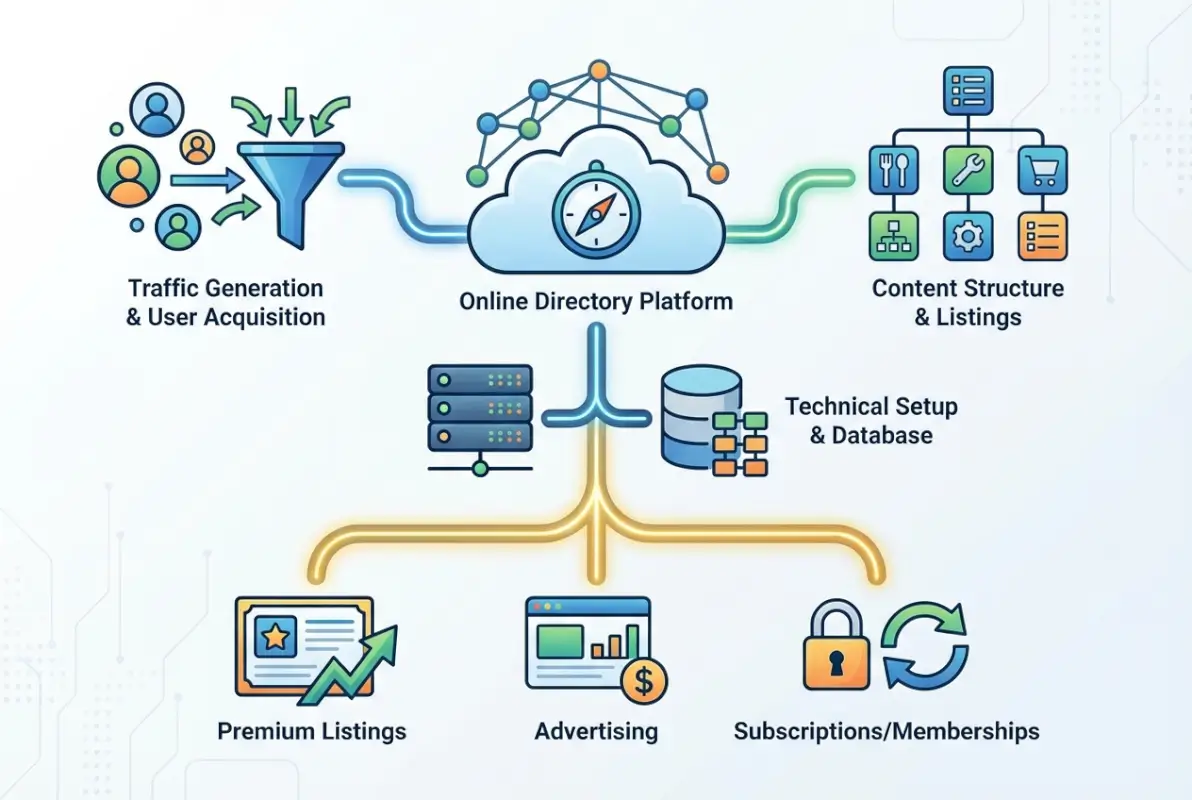
The foundation of any profitable directory starts with understanding your revenue architecture. Think of it like building a financial ecosystem where each component reinforces the others. I’ve seen directory owners try to bolt on monetization as an afterthought, and it shows in their conversion rates (typically under 2%). The successful approach involves designing your monetization from day one, even if you only activate certain streams later.
Free vs. Paid Listings and Tiered Subscriptions
The freemium model remains powerful for directories, but with a critical caveat: your free tier must provide enough value to build trust while creating obvious limitations that make upgrades compelling. I recommend starting with free basic listings (name, category, location, single link) and reserving everything else for paid tiers. This gives you SEO juice from comprehensive coverage while converting serious businesses who want more visibility.
Your subscription tiers should follow a clear value ladder. A typical structure might include Basic ($29-49/month) with enhanced profile and contact forms, Professional ($99-149/month) adding featured placement and analytics, and Enterprise ($299-499/month) including priority support and API access. The key is making each tier feel like a no-brainer for its target segment, businesses looking to leverage active directory features often see the most value in mid-tier plans.
Premium Placements and Featured Listings
Here’s where quick wins happen. Premium placements (top-of-category, homepage features, search result pins) typically convert 3-4x better than standard listings because the ROI is immediately visible to businesses. You can charge $50-200/month for featured status depending on your niche and traffic volume, and because placement inventory is naturally limited, scarcity works in your favor.
The smartest operators create multiple placement types: category features, geographic pins, search result highlights, and homepage rotations. Each represents a separate upsell opportunity. I’ve watched directories add $2K-5K monthly revenue just by introducing a well-designed featured listing program to their existing base, the conversion rate on offering this to current free users often hits 8-12%.
Lead Generation and Pay-Per-Lead Models
Pay-per-lead (PPL) arrangements flip the script entirely. Instead of charging for visibility, you charge for results. This works exceptionally well in high-value service verticals (legal, medical, home services, B2B) where a single converted lead might be worth $500-5,000 to the business. Your directory captures inquiry forms and routes qualified leads to appropriate businesses for a fee ($10-100 per lead depending on vertical).
The challenge with PPL is lead quality validation. You’ll need systems to verify contact information, filter spam, and potentially score leads based on intent signals. But once dialed in, PPL can become your highest-margin revenue stream because it scales with traffic without requiring manual sales effort, businesses pay gladly when they see direct ROI.
Advertising Revenue Streams
Display advertising through networks like Google AdSense provides passive income once you hit meaningful traffic (typically 10K+ monthly visitors for worthwhile returns). The CPM (cost per thousand impressions) for directory sites typically ranges $2-8 depending on niche, which translates to roughly $200-800 monthly at 100K pageviews. Not enough to build a business on alone, but solid supplemental income.
Native advertising and sponsored content perform better, especially in B2B directories. Allowing relevant businesses to publish thought leadership articles or case studies (clearly labeled as sponsored) can command $500-2,000 per placement. The key is maintaining editorial standards so your audience still trusts your content recommendations.
Affiliate Programs and Referral Partnerships
Affiliate commissions create win-win scenarios. If your directory serves a niche where users frequently need complementary services (booking software for restaurants, CRM for consultants, payment processing for retailers), you can earn 10-30% recurring commissions by recommending quality tools. A directory with 5,000 active listings might generate $1,500-3,000 monthly from strategic affiliate partnerships alone.
The sophistication here lies in integration depth. Rather than banner ads, embed affiliate tools directly into your listing management dashboard. When a restaurant updates their directory profile, offer integrated reservation systems right there. The conversion rate on contextual recommendations is 5-10x higher than sidebar ads, and you’re genuinely adding value rather than just monetizing attention.
API Access and Data Licensing
This B2B play works when you’ve built comprehensive, structured data that other platforms need. Companies building apps, research firms, marketing platforms—they’ll pay $200-2,000 monthly for API access to your verified business data. If your directory has unique data enrichment (operating hours verified monthly, service menus, pricing ranges), the value multiplies.
Data licensing requires careful legal groundwork and privacy compliance, but the margins are exceptional. One directory operator I know generates $8K monthly from just three API clients who integrate his local business data into their SaaS platforms. This revenue stream tends to be extremely sticky once integrated.
Targeted Niche Strategy to Increase Average Revenue Per User
Here’s where most directory projects go wrong: they try to be everything to everyone. A “business directory for all industries” sounds ambitious but murders your monetization potential. The math is brutal—generic directories might achieve 0.5-1% conversion to paid listings with $30-50 average revenue per user (ARPU). Focused verticals routinely hit 3-7% conversion with $120-300 ARPU. That’s a 10-20x difference in revenue per visitor.
Selecting High-Intent Verticals
The ideal directory niche combines three factors: high transaction values (services costing $500+), strong local intent (people searching need solutions nearby now), and fragmented competition (no single dominant directory). Home services (contractors, plumbers, electricians), professional services (lawyers, accountants, consultants), and healthcare (dentists, chiropractors, specialists) check all three boxes.
I’ve watched a directory focused exclusively on commercial real estate brokers achieve $12K monthly revenue with just 180 paid listings because each listing represented businesses doing million-dollar deals. Meanwhile, a generic “find local businesses” directory with 5,000 free listings struggled to convert anyone because the value proposition wasn’t clear to any specific audience. Specificity isn’t limiting; it’s liberating for monetization, similar to how businesses can set up KSL directory listing operations with focused verticals.
| Vertical | Avg ARPU | Conversion Rate | Revenue Multiple |
|---|---|---|---|
| Generic Business | $35 | 0.8% | 1x (baseline) |
| Home Services | $125 | 4.2% | 18.7x |
| Professional Services | $215 | 5.8% | 44.6x |
| Healthcare | $180 | 3.5% | 22.5x |
Building Trust Signals That Justify Premium Pricing
Trust signals aren’t just nice-to-have features, they’re revenue multipliers. Verification badges (confirming license numbers, insurance, business registration) let you charge 40-60% more than unverified directories because you’re solving the buyer’s core fear: getting scammed or hiring an incompetent provider. The verification process itself becomes a filter that attracts serious businesses while keeping out low-quality operators.
Reviews and ratings drive this further. Directories with robust review systems (verified customer feedback, response mechanisms, aggregate scoring) see conversion rates 2-3x higher than those without. Interestingly, perfect 5-star ratings actually decrease trust—people smell manipulation. A listing with 4.7 stars from 23 verified reviews converts better than one with 5.0 stars from 3 reviews.
Data Enrichment as a Pricing Lever
Rich listings justify higher prices because they deliver better results. Basic listings might include name and phone number, but premium tiers should offer photo galleries (8-15 images), detailed service catalogs, pricing ranges, availability calendars, team bios, certifications, and portfolio samples. Each data field you add increases perceived value and listing performance.
I remember working with a contractor directory that added real-time availability status (“accepting projects, booked 2 weeks” etc) and saw inquiry rates jump 40% because users could immediately identify available providers. That single feature justified a $50/month price increase that 78% of existing customers accepted without pushback. Data enrichment isn’t busywork; it’s monetizable differentiation.
Traffic Growth Levers That Drive Monetization
Revenue potential stays theoretical without traffic. But here’s the nuance: you need the right traffic, not just more traffic. A directory with 2,000 monthly visitors who have strong intent and match your niche will generate more revenue than one with 20,000 casual browsers. The growth strategy should obsess over user intent and local relevance rather than vanity metrics.

Local SEO and Structured Data Implementation
Local search queries (“plumber near me,” “divorce lawyer Chicago,” “best Thai restaurant Portland”) represent peak intent and convert like crazy. Optimizing your directory for local SEO means creating location-specific landing pages, implementing proper schema markup for local businesses, and building location-authority signals through local link building and citations.
Schema.org markup (specifically LocalBusiness schema) tells search engines exactly what your listings represent, which dramatically increases your chances of appearing in rich snippets, local packs, and knowledge panels. Every listing should include structured data for name, address, phone, hours, ratings, price range, and services. This isn’t optional for competitive directories—it’s table stakes, much like learning how to add your business to directory listings properly.
Content Strategy That Supports Discovery
Directories shouldn’t be passive databases; they should be content destinations. Publishing how-to guides (“How to Choose a Contractor,” “What to Ask Your Lawyer”), industry news, and provider spotlight interviews serves multiple purposes: it attracts organic traffic through informational queries, builds topical authority, and provides reasons for users to return beyond just searching listings.
The content-to-conversion path works like this: someone searches “how to find reliable electrician,” lands on your comprehensive guide, reads your quality criteria, then naturally uses your directory to find verified electricians meeting those standards. You’ve pre-sold the value of your listings through educational content. This approach typically generates 30-50% of total traffic while producing conversion rates 2x higher than direct listing searches.
User-Generated Content for Engagement
Reviews, Q&A sections, and user photos transform your directory from a static list into a living community. This user-generated content (UGC) provides fresh content signals for search engines while increasing time-on-site and repeat visits. Directories with active UGC see 60-80% longer average session durations and 40% higher return visitor rates.
The implementation requires careful moderation to prevent spam and maintain quality, but the payoff is substantial. Businesses are also more likely to pay for listings on platforms where customer interaction happens because they see direct engagement value beyond just exposure. Set up email notifications when reviews or questions appear so businesses can respond promptly, this responsiveness increases renewal rates significantly.
Strategic Partnerships for Distribution
Partner with complementary platforms to expand reach without heavy marketing spend. If you run a restaurant directory, partner with reservation systems, POS providers, or food bloggers. If you’re focused on professional services, connect with CRM platforms, scheduling tools, or industry associations. These partnerships can deliver qualified referral traffic and create integration opportunities that benefit both parties.
I’ve seen directories triple their listing acquisition rate by partnering with industry software vendors who promote the directory to their customer base as a visibility channel. The traffic quality from such partnerships is exceptional because it’s pre-qualified by industry relevance and often includes businesses already paying for related services (signaling willingness to invest in growth).
Pricing Strategy and Value Communication
Pricing is where psychology meets economics. Set prices too low and you’ll struggle to cover costs while attracting low-commitment customers; set them too high without proven value and conversion rates plummet. The sweet spot requires understanding your target customers’ alternatives, their willingness to pay, and the perceived ROI of directory visibility.

Designing Effective Price Tiers
Your tier structure should create clear upgrade paths with meaningful differentiation at each level. A common mistake is making tiers too similar—if users can’t immediately understand why Professional costs 3x more than Basic, they’ll default to the cheapest option. Each tier jump should unlock obvious benefits that certain customer segments desperately need.
Consider this structure: Free (basic listing, searchable but limited visibility), Starter ($49/month with enhanced profile and contact form), Professional ($129/month adding featured placement, photos, analytics), Enterprise ($299/month with priority support, API access, custom landing page). Notice how each tier serves a different business maturity level, from “testing the waters” to “this is a core marketing channel.”
| Tier | Monthly Price | Key Features | Target Customer |
|---|---|---|---|
| Free | $0 | Basic listing, searchable | Tire-kickers, awareness phase |
| Starter | $49 | Enhanced profile, contact form | Small businesses testing channel |
| Professional | $129 | Featured placement, gallery, analytics | Growing businesses, proven ROI |
| Enterprise | $299 | Priority support, API, custom page | Established businesses, agencies |
Incentive Structures That Increase Lifetime Value
Annual prepay discounts (typically 15-20% off monthly pricing) improve cash flow and reduce churn since customers have already committed for 12 months. A business paying $129/month or $1,290/year (17% discount) is more likely to choose annual if they’ve seen even modest results in their first month. The upfront cash lets you invest in growth while the commitment reduces your need for constant re-selling.
Free trials work but require careful implementation. A 14-day trial with full feature access converts better than a 30-day limited trial because users can evaluate true performance. However, trials increase support burden and attract freebie-seekers, so I typically recommend trials only for higher-priced tiers ($150+/month) where the LTV justifies the acquisition cost. For lower tiers, a satisfaction guarantee works better than trials.
Value Communication Through ROI Proof
Businesses don’t buy directory listings; they buy customers, visibility, and revenue growth. Your pricing page should translate features into outcomes: “Generate 15-30 qualified leads per month” hits harder than “Featured placement in search results.” Case studies showing actual results (attribution linking directory leads to closed deals) justify premium pricing like nothing else.
Build simple ROI calculators into your sales process: “If our directory generates just 3 additional customers per month worth $500 each, your $129 monthly investment returns 11.6x.” When the math is obvious, price objections evaporate. I’ve seen conversion rates double simply by adding ROI framing to pricing pages without changing the actual prices, understanding better user experience presentation helps drive this point home.
Reducing Churn Through Onboarding
The make-or-break period for retention is days 1-30. Businesses that see value quickly (leads, profile views, inquiries) renew at 80%+ rates; those who experience nothing in the first month churn at 60%+. Your onboarding should include setup assistance, optimization tips, and early performance reporting to demonstrate value before the first renewal decision.
Automated email sequences work well: Day 1 (welcome and setup checklist), Day 3 (profile optimization tips), Day 7 (first analytics report), Day 14 (case study showing success), Day 21 (invite to add premium features). Each touchpoint reinforces value and reduces the likelihood of passive churn (forgetting why they signed up).
Onboarding, Retention, and Scale
Acquiring customers is expensive; keeping them is where profitability lives. A directory with 5% monthly churn loses 46% of its customer base annually and must replace nearly half its revenue just to stand still. Reducing churn to 2% monthly (76% annual retention) transforms economics because growth compounds on a larger base each month.

Frictionless Onboarding Systems
The first 15 minutes after signup determine long-term retention. Businesses should be able to create a compelling listing in under 10 minutes with guided templates, pre-formatted sections, and helpful prompts (“Upload 5-8 photos showing your work,” “Describe your services in 2-3 sentences”). Complexity kills completion rates, I’ve watched directories improve activation (completed profile) from 40% to 78% just by simplifying the initial form.
Provide media kits and best-practice guides upfront: example photos that work, copy templates for common service descriptions, SEO tips for category selection. The faster businesses see their listing live and attractive, the more committed they become to the platform. Consider offering a “profile review” service where your team provides optimization feedback—this white-glove touch increases perceived value dramatically.
Analytics Dashboards That Prove Value
Give businesses visibility into their ROI through detailed analytics: profile views, click-throughs to website, phone calls, form submissions, message inquiries. When customers can log in and see “47 profile views, 12 website clicks, 3 phone calls this week,” renewal becomes a no-brainer. The dashboard should emphasize engagement metrics that correlate with real business outcomes.
Monthly performance emails summarizing activity work even better than expecting customers to log in regularly. “Your listing generated 38 leads last month (+23% from previous month)” creates positive reinforcement and reduces the likelihood of cancellation. Many customers will never log in to a dashboard but read every email summarizing their results.
Automated Renewal Management
Most churn is passive—credit cards expire, businesses forget to update billing, nobody actively cancels but the subscription lapses. Automated renewal reminders 7 days before billing, followed by grace periods and billing retry logic, can recapture 20-30% of would-be churn. Make renewal the path of least resistance while making cancellation require active effort (though never make it deceptively difficult, which breeds resentment).
Annual renewals should include upgrade prompts: “Renew Professional for another year, or upgrade to Enterprise at a special renewal rate.” Offering a one-time upgrade discount at renewal captures customers who’ve grown and now need more features. This is also when introducing new features or benefits since their renewal decision is top-of-mind.
Customer Success and Support Models
For lower-priced tiers (under $100/month), self-serve support through documentation, video tutorials, and chatbots keeps costs reasonable. For higher tiers ($200+/month), dedicated account management or priority support justifies the premium and dramatically improves retention. Enterprise customers especially expect white-glove treatment—quarterly business reviews, optimization consultations, and rapid technical support.
Proactive support prevents churn better than reactive support fixes it. If you notice a listing hasn’t received inquiries in 30 days, reach out proactively with optimization suggestions. If a customer hasn’t logged in to view their analytics in 45 days, send a performance summary and check in. These touches show you’re invested in their success, not just collecting fees.
Quality Control and Data Governance
Listing quality directly impacts user trust and, by extension, your ability to charge premium prices. Implement verification processes (confirm business licenses, check addresses, validate phone numbers) and moderate user submissions to prevent spam, duplicates, and low-quality entries. A directory full of defunct businesses and fake listings destroys trust and tanks conversion rates.
Automated quality checks can flag obvious issues (disconnected phone numbers, broken websites, duplicate addresses), but human review for new submissions maintains standards. The businesses paying for premium listings especially care about this, they don’t want to compete with fake competitors or scammy operators dragging down the platform’s reputation. Quality control is a moat that justifies premium pricing, learning about directory infrastructure decisions helps maintain these standards.
Operational Playbook for Building to $10K/Month
Theory is useless without execution roadmaps. The path from $0 to $10K monthly recurring revenue (MRR) follows predictable stages with specific milestones, metrics, and priorities at each phase. Understanding where you are and what matters most right now prevents wasted effort on premature optimization.
The 0-3 Month Phase: Foundation and Validation
Your first 90 days should focus on niche validation and core product-market fit, not scale. Choose your vertical based on demand data (search volume for relevant keywords), competitive gaps, and monetization potential. Build your minimum viable directory with 50-100 high-quality listings (seed manually if needed), implement basic monetization (one paid tier + featured listings), and drive your first 500-1,000 targeted visitors.
Success metrics for this phase: 5-10 paying customers, 2-3% free-to-paid conversion rate, clear feedback on what features drive upgrades. If you can’t convert 2%+ of your initial traffic to paid listings, your value proposition needs work before you scale. Revenue target: $500-1,500 MRR. This proves demand exists and validates your pricing hypothesis.
The 3-6 Month Phase: Growth Systems
Once core product-market fit is confirmed, shift to repeatable growth systems. Implement content marketing (2-4 articles weekly targeting relevant keywords), build strategic partnerships (3-5 complementary platforms or industry associations), and optimize your conversion funnel (A/B test pricing pages, trial offerings, onboarding flows). Expand to 200-300 total listings with 30-50 paid.
Success metrics: 10-20% month-over-month MRR growth, reducing CAC (customer acquisition cost) below $150, achieving 75%+ 90-day retention. Revenue target: $3,000-5,000 MRR. You’re proving that growth systems work and customers stick around when they see value.
The 6-12 Month Phase: Scale and Optimization
With validated growth systems, pour fuel on what works. Scale your content production, expand to adjacent niches or geographies, introduce additional monetization layers (advertising, affiliate programs), and implement advanced retention tactics (customer success programs, analytics dashboards, quarterly business reviews for enterprise customers). Reach 500-800 total listings with 80-120 paid.
Success metrics: Consistent 15%+ MoM growth, LTV:CAC ratio above 3:1, churn under 3% monthly. Revenue target: $10,000+ MRR. You’ve hit the milestone that validates this as a real business worth continued investment. Now the focus shifts to defensibility and margin expansion.
Tech Stack and Tool Selection
Your technology foundation should balance functionality with simplicity. For most directories, a WordPress-based setup with a directory plugin (GeoDirectory, Listify, or similar) provides 80% of needed functionality at reasonable cost. As you scale, custom development or platforms like Brilliant Directories offer more flexibility. Key integrations include payment processing (Stripe or PayPal), email automation (ConvertKit or Mailchimp), analytics (Google Analytics plus custom event tracking), and CRM for sales follow-up.
Don’t overbuild initially. I’ve watched entrepreneurs spend 6 months building “perfect” custom platforms before acquiring a single customer, only to discover their assumptions about needed features were wrong. Start with proven tools, validate demand, then customize as specific needs emerge. The best tech stack is one that doesn’t get in the way of testing your business model.
Sales Process Design
For listings under $150/month, self-serve signup with automated email follow-up works best. For $150-300/month, add a sales-assist option (schedule a demo or consultation) to answer questions and increase conversion. For enterprise/custom pricing, require a sales conversation to qualify needs and structure appropriate packages. The key is matching sales intensity to price point—high-touch sales for $49/month listings kills your margins.
Your sales emails should follow a value-first sequence: educational content about the benefits of directory listings, social proof (case studies, testimonials), scarcity or urgency (limited featured spots), and clear calls-to-action. I typically recommend a 5-7 email sequence over 14 days for warm leads, with different sequences for different segments (by industry, business size, or feature interest).
Common Pitfalls and How to Avoid Them
Every directory that fails does so for predictable reasons. I’ve consulted on dozens of struggling directories, and the patterns repeat endlessly. Understanding these failure modes upfront lets you architect around them rather than learning expensive lessons through experience.
The Single-Revenue-Stream Trap
Relying solely on listing subscriptions makes your business fragile. If competition emerges with lower prices or a new platform offers free listings in your space, your entire revenue model collapses. Successful directories layer multiple streams (subscriptions + featured listings + leads + advertising + affiliates) so weakness in one area doesn’t crater the whole business. Diversification isn’t just smart; it’s survival strategy in competitive markets.
Value Misalignment and Pricing Confusion
Charging $200/month for a listing that generates zero measurable value is a recipe for 100% churn. Your pricing must align with delivered value, ideally capturing 10-20% of the ROI you generate for customers. If businesses make $5,000 monthly profit from directory-sourced leads, a $200-500 listing fee feels reasonable. If they get nothing, even $20 feels expensive. The fix is either improving value delivery (more traffic, better targeting) or reducing price until value justifies it.
Pricing tiers that differ only in vague ways (“Standard,” “Plus,” “Premium” with unclear distinctions) confuse customers into paralysis. Make differentiation obvious: “Starter includes basic profile, Professional adds featured placement and analytics, Enterprise adds dedicated support and API access.” Clarity converts, confusion kills.
Quality Drift and Trust Erosion
As you scale, maintaining listing quality gets harder. Spam submissions, outdated information, fake reviews, and scam businesses slip through. Each quality failure chips away at user trust, which eventually cascades into lower traffic, worse conversion rates, and higher churn. The antidote is systematic quality control: verification processes, regular audits of listings, user reporting mechanisms, and active moderation.
I’ve seen directories lose 40% of their traffic over 6 months because search engines downgraded them for low-quality content and users stopped trusting the listings. The recovery took 18 months and cost far more than implementing quality controls from day one would have. Don’t let quality slip, it’s far easier to maintain standards than to rebuild lost trust.
Onboarding Neglect and Support Gaps
Customers who struggle through confusing signup, can’t figure out how to add photos, or receive no help when stuck churn fast regardless of your product’s potential value. Poor onboarding creates unnecessary friction that tanks activation rates (customers completing setup) and destroys first-impression momentum. The fix is embarrassingly simple: watch real users go through your signup, identify every point of confusion, and smooth it out.
Support gaps have similar effects. Customers paying $100+/month expect responses within 24 hours; if they wait 3-4 days or get unhelpful responses, they cancel. Support quality correlates directly with retention. You don’t need massive support teams early, but you need responsive, helpful assistance that makes customers feel valued. Automated responses acknowledging receipt and setting expectations work better than silence.
Infrastructure Failure and Technical Debt
Directories that crash under traffic, have broken payment systems, or suffer from security breaches destroy credibility instantly. Your infrastructure must scale smoothly and securely as you grow. This doesn’t mean over-engineering from day one, but it does mean choosing solid hosting (not the cheapest $5/month option), implementing basic security (SSL, regular updates, secure payment processing), and monitoring uptime.
Technical debt accumulates when you take shortcuts: hardcoded hacks instead of proper features, ignored security patches, neglected backups. Eventually this debt comes due, usually at the worst possible moment (mid-growth spurt when you can least afford downtime). Budget 10-15% of development resources for maintenance and debt reduction, not just new features. Boring infrastructure work prevents exciting disasters.
Strategic Framework: Putting It All Together
The difference between directories that hit $10K/month and those that stall at $1-2K isn’t execution quality across the board, it’s strategic prioritization. You can’t optimize everything simultaneously. The framework below maps what matters most at each growth stage, helping you focus energy where it generates maximum leverage rather than spreading thin across too many initiatives.
Early Stage (0-$2K MRR): Validation Over Scale
Priority 1: Prove product-market fit by converting 2-5% of early traffic to paid customers. If you can’t hit this baseline, your niche, value prop, or pricing needs adjustment before you invest in growth. Priority 2: Gather qualitative feedback from every early customer—what convinced them to pay, what almost stopped them, what features matter most. This intelligence guides everything that follows.
Priority 3: Establish one solid traffic channel (typically organic search through content) that can scale without linear cost increases. Paid acquisition works but often isn’t economical at low price points. Priority 4: Build retention fundamentals (onboarding, support, early value demonstration) because keeping your first 20 customers teaches you how to keep the next 200.
Growth Stage ($2K-$7K MRR): System Building
Priority 1: Scale what works. You’ve validated core product-market fit, now pour fuel on working channels. If content marketing drives most conversions, double down there. If partnerships generate high-quality leads, formalize more partnerships. Don’t diversify prematurely, scale proven winners first. Priority 2: Layer additional revenue streams (advertising, affiliate, lead generation) to increase ARPU and reduce single-stream risk.
Priority 3: Systematize operations so growth doesn’t require proportional increases in your time. Automate onboarding, templatize support responses, create self-serve resources. Growth should feel increasingly leveraged, not increasingly overwhelming. Priority 4: Optimize conversion funnels through A/B testing and analytics. A 20% improvement in free-to-paid conversion at this stage has massive compounding effects over the next 12 months.
Scale Stage ($7K-$15K+ MRR): Optimization and Defense
Priority 1: Churn reduction becomes make-or-break. At scale, small churn percentage changes equal thousands in monthly revenue. Invest in customer success, analytics dashboards, feature improvements that reduce churn. Priority 2: Market positioning and differentiation to create defensibility. You’ve proven the market, now competitors notice. Build moats through trust signals, exclusive partnerships, proprietary data, and brand strength.
Priority 3: Team building and delegation. You can’t personally manage 150+ customer relationships and execute growth initiatives. Hire or outsource strategically (support first, content second, sales third typically) to maintain quality while scaling. Priority 4: Explore higher-value segments or adjacent markets. Once you dominate your initial niche, geographic expansion or vertical adjacent moves capture new growth without starting from scratch.
Frequently Asked Questions
How do online directories make money?
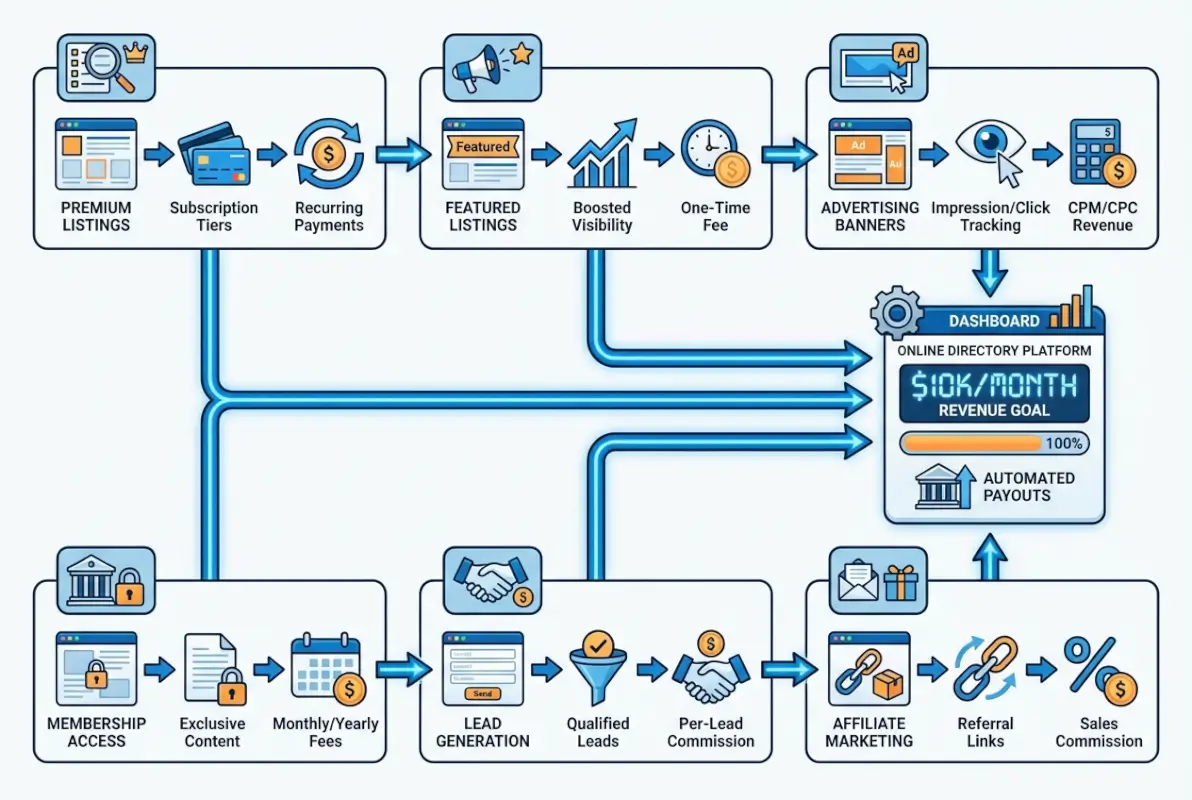
Online directories generate revenue through multiple streams including paid listing subscriptions, premium placement fees, lead generation commissions, advertising (display and native), affiliate partnerships, and data licensing. The most successful directories combine 3-4 revenue models rather than relying on a single source, creating more resilient and higher-margin businesses.
What is a typical pricing model for directory listings?
Most directories use tiered subscription models ranging from $29-49 monthly for basic enhanced listings to $99-149 for professional tiers with featured placement and analytics, up to $299-499 for enterprise packages including priority support and API access. Pricing varies significantly by vertical, with B2B and professional service directories commanding 2-3x higher prices than consumer directories.
Can a small directory make $10K a month, and how long does it take?
Yes, focused niche directories regularly achieve $10K+ monthly revenue with 80-150 paying customers at $100-150 average revenue per user. Timeline typically ranges 12-18 months from launch with consistent execution, though high-value verticals with strong product-market fit can reach this milestone in 8-10 months. Broad, unfocused directories struggle to reach $10K even with larger user bases.
What are the fastest ways to monetize a new directory?
Start with paid listing subscriptions and featured placements as your core two revenue streams since they require minimal infrastructure and convert immediately when value is clear. Avoid complex ad tech or lead generation systems initially. Focus on driving high-intent traffic to a small number of listings with clear upgrade paths. Quick wins come from manual outreach to 20-30 businesses in your niche who see immediate ROI.
Should I start with free listings or paid listings?
A freemium model (free basic listings with paid upgrades) typically works best because it builds comprehensive coverage for SEO while creating clear upgrade incentives. Starting paid-only makes initial traction harder since businesses resist paying for unproven platforms. The free tier should provide enough value to justify inclusion but have obvious limitations that serious businesses will pay to overcome.
How important are reviews and trust signals for monetization?
Trust signals directly impact both conversion rates and price ceiling. Directories with verification badges and robust review systems see 2-3x higher free-to-paid conversion rates and can charge 40-60% more than unverified competitors. Trust reduces buyer friction and makes premium pricing defensible by solving the core fear of unreliable or fraudulent providers in your vertical.
How can I increase ARPU in a niche directory?
Increase average revenue per user by adding valuable features that justify higher prices (analytics dashboards, lead capture, featured placements, verified badges), introducing higher-priced tiers for established businesses, implementing strategic add-ons (additional locations, team members, custom URLs), and layering additional revenue streams like lead generation fees or advertising. Data enrichment and trust signals also support premium pricing.
What tech stack is needed to run a profitable directory?
A typical profitable directory runs on WordPress with specialized directory plugins like GeoDirectory, payment processing through Stripe, email automation via ConvertKit or Mailchimp, analytics through Google Analytics with custom event tracking, and CRM for sales follow-up. Total monthly tech costs typically run $50-200 early stage, scaling to $300-500 at higher revenue levels. Custom development becomes worthwhile above $15K MRR.
How do I prevent fraud and maintain listing quality?
Implement verification processes (confirm business licenses, validate addresses and phone numbers), require manual approval for new listings, establish user reporting mechanisms for problems, conduct regular audits of listing accuracy, and actively moderate reviews. Automated checks can flag obvious issues like disconnected phones or broken websites, but human review for high-value listings maintains standards that justify premium pricing and user trust.
How long does it take to see ROI from directory monetization efforts?
Basic monetization (paid listings) can generate revenue within 30-60 days if you have traffic and clear value proposition. Breaking even on customer acquisition costs typically requires 3-6 months of subscription payments given average retention. Full ROI on your total investment (development, content, marketing) usually takes 12-18 months. High-value niches with strong product-market fit can see positive cash flow within 6 months.
What metrics should I track to reach $10K/month?
Focus on monthly recurring revenue (MRR) and its growth rate, customer acquisition cost (CAC), average revenue per user (ARPU), lifetime value (LTV), LTV:CAC ratio (should be 3:1+), monthly churn rate (target under 3%), free-to-paid conversion rate (target 2-5%), and listing activation rate (completed profiles). Traffic and engagement metrics matter but only as leading indicators of these core financial metrics.
Your 90-Day Action Plan
Here’s the moment where everything clicks together or falls apart: execution. You’ve absorbed the strategy, understood the pitfalls, and seen the framework. Now the work begins. I’m going to give you a concrete 90-day blueprint because vague intentions (“I’ll start a directory someday”) never become profitable businesses.
Days 1-30: Niche selection and validation. Research 3-5 potential verticals using search volume data, competitive analysis, and monetization potential. Choose one based on highest combination of demand, willingness to pay, and competitive gaps. Build your minimum viable directory with 50-100 seed listings (manually if needed), implement basic infrastructure (WordPress + directory plugin + payment processing), and create your first pricing tier. Drive initial traffic through outreach and content. Goal: 5-10 paying customers proving demand exists.
Days 31-60: Growth systems and conversion optimization. Publish 8-12 pieces of targeted content, establish 2-3 strategic partnerships, implement conversion tracking and analytics, and test pricing/positioning variations. Add featured listings as second revenue stream. Expand to 150-200 total listings with 20-30 paid. Goal: Validate that you can repeatably convert traffic to customers and identify which tactics work best for scaling.
Days 61-90: Scale what works and layer monetization. Double down on best-performing traffic channels, introduce third revenue stream (advertising or affiliate), implement retention systems (onboarding sequences, analytics dashboards, customer support), and begin systematic outreach to grow listing base. Reach 250-300 total listings with 40-60 paid. Goal: Establish clear path to $10K MRR with current trajectory and systems.
The difference between directories that succeed and those that stay in planning purgatory forever is this: successful operators ship imperfect versions, learn from real users, and iterate based on data rather than assumptions. Your first pricing structure won’t be optimal. Your initial value proposition will need refinement. Your tech stack will evolve. All of that is fine—the learning comes from market contact, not additional planning.
Take the first step this week: choose your niche, register your domain, and set up your basic infrastructure. The directories generating serious revenue didn’t wait for perfect conditions or complete knowledge. They launched, learned, adjusted, and scaled. Your turn.