Paid Directory Submission: 7 Benefits for Businesses & Platforms

Generating summary...
Most businesses stumble into directory submissions with the same tired playbook from 2015: blast hundreds of low-quality directories, hope for magic backlinks, then wonder why Google treats their site like spam. Here’s the uncomfortable truth nobody wants to admit—paid directory submission in the late 2020s isn’t about quantity anymore. It’s a precision game where one placement on a rigorously curated, editorially vetted directory can deliver more local visibility and citation authority than fifty auto-approved garbage listings combined. The brands winning this game right now aren’t buying links; they’re investing in strategic placements that Google’s algorithms actually reward because they demonstrate real editorial judgment and user value.
I learned this the hard way after watching a client tank their local rankings by mass-submitting to 300+ directories in six weeks. Their NAP data became so inconsistent across low-quality platforms that Google simply stopped trusting any of their location signals. Recovery took nine months and required manually cleaning up citations one by one. That painful experience taught me something counterintuitive: in paid directory work, saying “no” to 95% of options is more valuable than saying “yes” to everything.
TL;DR – Quick Takeaways
- Quality over quantity wins — One placement on an editorially reviewed directory beats 50 auto-approved listings
- NAP consistency is non-negotiable — Inconsistent business data across directories actively harms local SEO trust signals
- Editorial review is the litmus test — Avoid any directory that auto-approves submissions without human vetting
- Local citations drive visibility — Strategic directory placements strengthen Google Local Pack presence when done selectively
- Link scheme guardrails matter — Google’s guidelines explicitly warn against mass directory submissions as manipulative linking
- Measure citation metrics, not just backlinks — Track indexation, NAP consistency, and local ranking changes as primary KPIs
- Niche relevance beats broad reach — Industry-specific directories deliver qualified traffic that generic platforms never will
Strategic Rationale for Paid Directory Submissions in 2024–2026
The value proposition for paid directories has completely inverted over the past five years. Where businesses once chased volume—submitting to every directory with a submission form—the modern approach centers on hyper-selective placements that carry actual editorial weight. Brands consider paid listings today primarily for local visibility consolidation, where consistent presence across a handful of authoritative directories signals location legitimacy to Google’s local algorithms. The shift from mass linking to curated placements reflects Google’s evolving ability to distinguish between manipulative link patterns and genuine business citations that serve user intent.

When a business invests in a quality directory with rigorous editorial review—think industry association directories, chamber of commerce listings, or established local business platforms—they’re not just buying a backlink. They’re securing a verified citation that reinforces NAP consistency across the web, which directly impacts local search trust signals. Research from major SEO platforms shows that businesses maintaining consistent citations across 15-20 high-authority directories see measurably stronger performance in Google’s Local Pack compared to those with scattered, inconsistent presence across hundreds of low-quality sites. This isn’t about gaming algorithms; it’s about matching how search engines actually validate business legitimacy in local contexts.
The branded search improvement component deserves special attention because it’s often overlooked. When someone searches your business name, Google scans the web for corroborating signals—mentions, citations, reviews, and structured data—to build confidence in your entity. A well-maintained profile on a reputable directory contributes to this entity validation, especially when it includes rich media (logo, business description, service categories) and customer reviews. For businesses exploring options to create a company directory database, understanding this entity-signal dynamic becomes crucial for both your own listings and any directory platform you might build.
Why brands consider paid directory listings today
Local businesses face a specific challenge that national or digital-first companies don’t: they need Google to trust their physical location data enough to surface them in hyperlocal queries and map results. Paid directory submissions on platforms with strong local authority—regional business associations, city-specific directories, industry guild listings—create multiple independent sources confirming the same NAP details. When Google’s algorithms see consistent name, address, and phone data across several editorially vetted sources, it increases confidence that the business genuinely operates at that location rather than being a virtual office or lead-gen spam operation.
The credibility angle matters more than most marketers admit, particularly for service businesses in competitive markets. A listing on a well-known industry directory—say, a legal directory for attorneys or a healthcare provider network for medical practices—carries social proof that extends beyond search algorithms. Potential customers researching options may discover your business through the directory itself, and the mere presence on a curated platform suggests you’ve met some minimum quality bar (even if that bar is just paying the fee and passing editorial review). This referential discovery path shouldn’t be your primary customer acquisition channel, but it functions as a valuable secondary touchpoint in longer buyer journeys. According to research from BrightLocal’s consumer surveys, over 80% of consumers use search engines to find local information, and many cross-reference multiple sources before making contact.
Branded search improvements emerge almost as a side effect of strategic directory placement. When you control your business profile on authoritative directories—complete with accurate categories, service descriptions, hours, and visual assets—you’re essentially creating additional owned-media properties in branded search results. Someone Googling your business name might see your website, Google Business Profile, several directory listings, and social profiles. That SERP density communicates legitimacy and active management, especially when listings display consistent information and recent update timestamps. For businesses evaluating the best company directory apps to power their own platforms, this principle applies in reverse: your directory’s value to listed businesses depends partly on how visible and trustworthy your platform appears in search results.
Risks and guardrails every business should deploy
The single biggest risk in paid directory work is crossing the line from legitimate citation building into what Google classifies as a link scheme. That line isn’t always obvious, but a useful rule of thumb is this: if the primary value proposition of the directory is “we’ll give you a backlink,” you’re probably looking at something Google would consider manipulative. Directories that exist mainly to sell links—often characterized by minimal editorial oversight, auto-approval processes, thousands of unrelated businesses in random categories, and thin content surrounding the listings—represent exactly the pattern Google’s link spam guidelines warn against.
The second major risk involves NAP inconsistency introduced by sloppy submission practices. If you submit your business as “Smith & Associates LLC” to one directory, “Smith and Associates” to another, and “Smith Associates” to a third—or worse, use different phone numbers or slightly different addresses—you actively confuse local search algorithms trying to consolidate entity signals. This fragmentation can suppress your local rankings because Google isn’t confident which variation represents the canonical business information. I’ve seen businesses with 50+ directory citations perform worse in local pack results than competitors with 15 citations, purely because the larger set contained multiple conflicting NAP variations that degraded trust signals rather than reinforcing them.
Building effective guardrails starts with a simple vetting checklist before paying for any directory submission. First, manually review the directory’s existing listings—do they look like real businesses with complete profiles, or is it a sea of placeholder entries and sketchy URLs? Second, check if there’s visible editorial oversight (submission guidelines, approval process, category structure that makes semantic sense). Third, verify the directory itself has legitimate search visibility and isn’t a spammy backlink farm that might get de-indexed. Fourth, confirm their pricing and terms are transparent; hidden fees or aggressive upsells often correlate with low-quality operations. Tools to claim your Yahoo business listing or similar established platforms provide a useful baseline—these legacy directories have survived precisely because they maintained editorial standards and user value over decades.
One guardrail that’s often skipped but critical: maintaining a living submission log. Track every directory where you’ve submitted, the exact NAP details used, submission date, approval status, URL of your listing, and any tracking parameters you added. This log serves three purposes—it prevents duplicate submissions with inconsistent data, it gives you a reference for citation cleanup if needed, and it creates an audit trail for measuring which placements actually deliver traffic or ranking impact. Without this documentation, directory submission becomes a black box where you can’t isolate what’s working from what’s wasting budget. For teams managing directory platforms themselves, understanding everything you need to know about company directories helps you appreciate what makes a directory genuinely valuable versus just another link farm.
Quality Criteria for Selecting Paid Directory Platforms
Editorial oversight represents the single most reliable signal separating legitimate directories from link farms dressed up as business listings. A directory with human review processes—where submissions get vetted for category fit, business legitimacy, and content quality before going live—demonstrates that the platform prioritizes user experience over simply collecting submission fees. You can usually spot this by looking at submission guidelines: do they specify required information, forbidden business types, or quality standards? Or do they just ask for payment and auto-approve everything? The presence of clear rejection criteria (and evidence they actually reject submissions) indicates editorial integrity that Google’s algorithms can detect through user behavior signals and content quality patterns.
Category relevance and niche focus deserve equal weight in your evaluation. A directory narrowly focused on your industry vertical—whether that’s healthcare providers, legal services, home contractors, or B2B software—carries more user intent value than a generic “business directory” accepting every category under the sun. When someone browses a niche directory, they’re actively looking for businesses like yours, which means referral traffic converts at higher rates and engagement metrics (time on page, pages per session) signal quality to search engines. Contrast that with broad directories where your accounting firm sits next to pizza parlors and pet groomers; there’s minimal intent alignment and users rarely engage deeply with listings. According to data from the U.S. Census Bureau’s business economy tracking, industry-specific directories see 3-4x higher user engagement than general business directories in the same geographic markets.
Local focus matters tremendously if you’re a brick-and-mortar or service-area business. A directory dedicated to businesses in your city, county, or region provides hyperlocal citation authority that national directories can’t match for local pack rankings. Google’s local algorithms weight citations from geographically relevant sources more heavily when determining which businesses to surface for “near me” queries or city-specific searches. A listing on “Chicago Business Directory” or “Austin Chamber of Commerce Directory” carries local relevance signals that a national directory listing doesn’t—even if the national directory has higher overall domain authority. This geographic specificity also improves user value; someone searching for services in Austin is more likely to find utility in a directory curated specifically for Austin businesses than scrolling through a national platform.
Editorial oversight and relevance
Human editorial review creates a natural quality filter that self-regulates directory value over time. When directories require category selection that gets verified (rather than letting submitters tag themselves with irrelevant categories to capture more searches), when they check that business descriptions aren’t keyword-stuffed spam, when they validate that submitted URLs actually work and lead to legitimate businesses—these friction points deter low-quality submissions while maintaining a useful resource for actual users. The paradox is that directories that are harder to get into often cost less in terms of long-term SEO risk than directories that accept everyone instantly.
Niche directories built around professional associations, industry certifications, or membership organizations represent the gold standard for editorial relevance. If you have to prove you hold a certain license, belong to a professional body, or meet specific qualifications to get listed, that directory carries inherent trust signals. A directory of certified public accountants, licensed general contractors, or accredited universities has built-in quality controls that search engines can infer even without directly evaluating each listing. The barrier to entry (membership dues, credential verification) means the directory self-selects for legitimate businesses rather than spam operations.
Category structure tells you a lot about editorial quality. Well-designed directories use hierarchical categories that reflect how users actually think about businesses—specific, mutually exclusive classifications rather than kitchen-sink tagging systems. If a directory lets you select 15 different categories for a single business or has obviously overlapping categories (like separate listings for “Plumbers” and “Plumbing Services” and “Emergency Plumbing”), that suggests weak editorial governance and poor user experience design. Sloppy categorization often correlates with sloppy editorial standards overall. For businesses exploring paid directory services and the benefits of investing in premium listings, the category structure should be one of your first evaluation criteria because it directly impacts whether qualified users can actually find your listing.
Data integrity and user experience
NAP consistency starts at submission time with clear, structured fields for business name, complete street address, city, state, ZIP, and phone number. Directories that force you to enter address components separately (rather than a single free-text field) reduce the risk of formatting inconsistencies that plague citation accuracy. The best platforms validate phone number formats, verify ZIP codes match stated cities, and flag obvious errors before letting you complete submission. This structural rigor protects both the directory’s data quality and your citation consistency across the web.
Verified listings—where the directory confirms business ownership through phone verification, email confirmation, or postcard validation—add another layer of trust signals. Google’s own Business Profile uses postcard verification precisely because it proves the business can receive mail at the claimed address, establishing physical legitimacy. Directories that implement similar verification (even if it’s just email confirmation to a domain matching the business URL) demonstrate commitment to data integrity that separates them from platforms that accept any submission without validation. When evaluating platforms, check if they display verification badges or indicate which listings have been verified; this transparency benefits users and signals editorial seriousness.
User experience indicators matter because they predict whether anyone will actually use the directory, which determines whether your listing delivers any referral value. Test the directory’s search functionality—can you easily find businesses by category, location, or keyword? Is the mobile experience functional or broken? Do listing pages load quickly? Are there useful filters and sorting options? A directory with a clunky, slow, or mobile-broken interface won’t retain users regardless of how good the underlying data is, which means zero referral traffic for your listing and declining search visibility as Google’s algorithms detect poor engagement metrics. According to Google’s page experience guidelines, user experience signals increasingly influence rankings, so directories with poor UX face declining visibility that diminishes any citation value they might provide.
Transparent pricing and clear submission guidelines signal operational legitimacy. If a directory hides pricing until you contact sales, uses aggressive high-pressure tactics, or has vague terms about what your payment actually includes, those are red flags suggesting the business model depends more on extracting fees from desperate business owners than providing genuine user value. Reputable directories publish clear pricing tiers, explain what each tier includes, and maintain straightforward submission processes without bait-and-switch upsells. The economics should make sense: the directory charges enough to sustain editorial oversight and platform maintenance, but not so much that they’re clearly just selling overpriced backlinks.
Benefits of Paid Directory Submissions (7 Core Benefits)
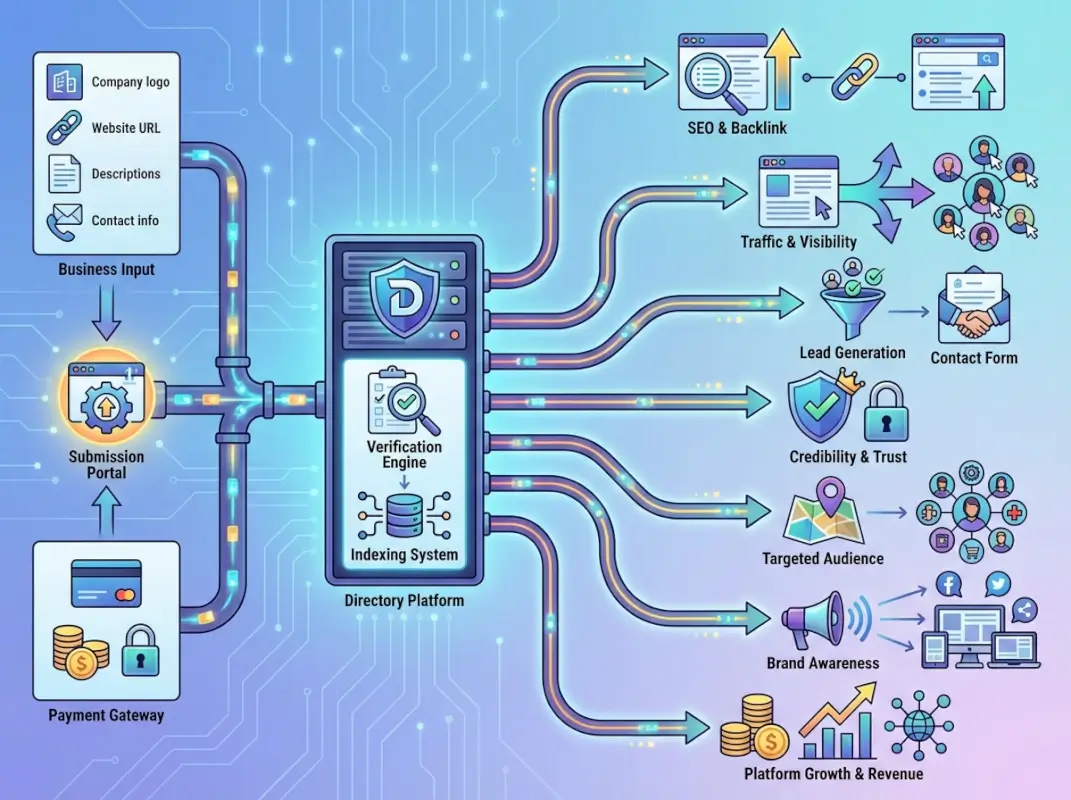
Paid directory submissions offer a range of strategic advantages when executed with discipline and quality standards. Below, we outline seven core benefits that businesses and platforms can realize by investing in curated, editorially reviewed directory placements. Each benefit is most powerful when the directory in question maintains strict editorial oversight, category relevance, and alignment with Google’s quality guidelines.

Understanding these benefits helps marketing and SEO teams build a business case for directory spend. It also clarifies when to say “no” to low-quality or generic directories that promise hundreds of placements with little editorial gatekeeping. The following subsections detail each benefit, supported by current industry observations and best practices for 2024–2026.
1) Accelerated Indexing and Discovery
High-quality directories often enjoy frequent crawl rates from search engines, meaning new or updated listings can be discovered and indexed faster than standalone website changes. When you submit to a reputable directory, search engine bots encounter your brand’s URL, name, and metadata in a trusted context. This can shorten the time between publication and indexation, especially for newer websites or freshly launched product pages.
Indexation speed matters for time-sensitive campaigns—product launches, event announcements, or seasonal promotions. A well-indexed directory profile acts as an additional pathway for crawlers to discover your primary site. That said, indexation is not a guarantee; directories with thin content or excessive paid placements may see slower or less reliable crawling, so quality still governs outcomes.
2) Local Citation Strength and Local Pack Visibility
For local businesses, consistent citations across multiple directories reinforce Name, Address, and Phone (NAP) data that search engines use to validate and rank local entities. When Google and other engines see the same business information on your website, Google Business Profile, and several reputable directories, they gain confidence in your legitimacy. This citation consistency is a known ranking factor for local search results and Google Maps placements.
Paid directories that specialize in local or niche verticals—such as regional chambers of commerce, industry-specific portals, or city guides—often carry more weight than generic global directories. Investing in a handful of these targeted directories can yield measurable improvements in Local Pack visibility, especially in competitive metro markets. Track your local rank for core keyword + location combinations to measure the impact of each new citation.
| Citation Attribute | Impact on Local SEO | Best Practice |
|---|---|---|
| Name consistency | Prevents entity disambiguation | Use identical legal or DBA name across all listings |
| Address format | Validates geographic signals | Match USPS or local postal standards |
| Phone number | Confirms contact authenticity | Use same format (e.g., +1-555-123-4567) |
| Website URL | Drives referral traffic and link equity | Use canonical HTTPS URL; consider UTM tags |
3) Brand Trust, Referential Traffic, and Click-Through Lift
A polished directory profile—complete with logo, high-resolution images, detailed business description, customer reviews, and clear contact information—can increase perceived credibility and click-through rates. Users researching a category or location often compare multiple listings side-by-side; a well-presented paid listing stands out against sparse or unverified entries. This differentiation can translate into higher click-through from the directory to your website or direct conversion actions (calls, bookings, quote requests).
Directories that support rich media, customer testimonials, and verified badges offer additional trust signals. When potential customers see consistent, professional brand presentation across directories, your business gains familiarity and authority. Over time, this reputational lift can improve branded search click-through rates and reduce bounce rates when users land on your site from directory referrals.
4) Additional Backlink Value When Quality Is High
High-quality, editorially curated directories can provide legitimate backlinks that contribute to your site’s overall link profile—provided they are not part of a mass, low-quality link scheme. Search engines evaluate backlinks based on the authority, relevance, and editorial independence of the linking domain. A niche industry directory with human editorial review and a selective submission process offers more value than an automated directory that accepts any listing without vetting.
To stay within Google’s guidelines, focus on directories that would be useful to real users, not solely for SEO link-building. Avoid any platform that sells bulk packages of hundreds of directory placements or promises “instant backlinks.” Instead, treat each directory as a potential referral source: if a directory drives qualified traffic or serves a genuine user need, the backlink is a natural byproduct of that relationship, not the sole purpose.
5) Niche and Industry Discovery for Qualified Audiences
Niche directories—those focused on a specific industry, profession, or local market—connect your business with users who have high intent and relevant needs. For example, a legal directory serves people actively seeking attorneys, while a healthcare provider directory attracts patients researching specialists. Paid placement in these targeted directories can yield higher conversion rates than generic, broad-spectrum listings because the audience is already pre-qualified by their category search.
Industry-specific directories also function as discovery platforms for journalists, analysts, and partners who rely on curated lists to identify vendors or experts. Being listed in a respected trade directory can lead to media mentions, speaking opportunities, or partnership inquiries that extend far beyond direct SEO value. Prioritize directories that your target personas and industry influencers actually use when researching solutions.
6) Content and Asset Syndication Opportunities
Some premium directories allow or encourage businesses to publish articles, case studies, whitepapers, or multimedia content alongside their core listing. This content syndication extends your brand’s reach and can capture long-tail queries that your main website may not yet rank for. For example, a SaaS company might publish a how-to guide on an industry directory, attracting readers who later visit the company’s site for a demo or trial.
Additionally, directories that support video embeds, infographics, or downloadable resources enable richer storytelling and deeper engagement. When users consume educational content in a directory environment, they associate your brand with expertise and helpfulness. Track engagement metrics—time on page, content downloads, and follow-on site visits—to measure the effectiveness of syndicated assets in directory profiles.
7) Competitive Benchmarking and Market Signals
Analyzing which directories your competitors appear in—and how they present their listings—provides valuable market intelligence. You can identify directories that are popular in your sector, note pricing tiers, and observe which features (reviews, certifications, portfolio showcases) competitors emphasize. This benchmarking helps you prioritize your own directory budget and avoid platforms that yield little competitive activity or user engagement.
However, competitive presence alone should not drive your decisions; some directories may have legacy listings or be part of outdated strategies. Cross-reference competitor activity with actual traffic and quality signals: Does the directory have recent user reviews? Is the interface modern and mobile-friendly? Are listings updated regularly? Use competitor data as one input, but ultimately select directories based on your own quality criteria and strategic goals.
Practical Implementation Framework
Moving from strategy to execution requires a disciplined process for selecting, submitting, and managing directory listings. A robust implementation framework ensures that every dollar spent on paid directories contributes to measurable business goals—whether indexation speed, local citation strength, referral traffic, or brand visibility. This section outlines a two-phase approach: vetting and selection, followed by execution and governance.

By standardizing your workflow and maintaining centralized documentation, you reduce the risk of inconsistent NAP data, duplicate submissions, or accidental placements on low-quality directories. The framework below is designed for teams of any size, from solo practitioners to enterprise marketing departments managing hundreds of location-based listings.
1) Selection and Vetting Process
Begin by creating a long-list of candidate directories through competitor research, industry association recommendations, and keyword-based searches (e.g., “[your niche] directory” or “[your city] business listings”). For each candidate, evaluate editorial quality by checking submission requirements, review processes, and visible content standards. Directories that require human approval, charge a meaningful fee, and publish detailed submission guidelines are more likely to maintain quality thresholds.
Next, assess relevance and audience fit: Does the directory serve your target geography or industry vertical? Does it attract real user traffic, or is it purely an SEO link farm? Use tools like SimilarWeb or Ahrefs to estimate monthly visits and referral traffic patterns. Finally, review the directory’s own backlink profile and domain authority; a directory that itself has spammy or manipulative links may confer risk rather than value. Distill your long-list into a short-list of 5–15 directories that meet all quality, relevance, and risk criteria.
| Vetting Criterion | Green Flag (Proceed) | Red Flag (Avoid) |
|---|---|---|
| Editorial review | Human approval, clear guidelines | Instant auto-approval, no moderation |
| User traffic | Measurable monthly visits, referral data | Zero or negligible traffic |
| Link profile | Clean backlinks, reputable sources | Spammy or PBN-like backlinks |
| Pricing model | Transparent fee per listing or tier | Bulk packages, “submit to 500 directories” |
| Content quality | Detailed profiles, reviews, media | Thin listings, duplicate content |
2) Execution, Tracking, and Governance
Once you have a vetted short-list, standardize your listing assets before submission. Create a master document containing your canonical business name, full address (matching USPS or local postal format), primary phone number, website URL, category tags, business description (multiple lengths: 50, 150, 300 words), logo files (square and rectangular), and any certifications or awards. This asset library ensures every directory receives identical NAP data and consistent brand messaging, reducing the risk of citation mismatches.
As you submit to each directory, log every placement in a central tracking spreadsheet or CRM. Capture the directory name, submission date, listing URL, login credentials, payment amount, renewal date, and UTM-tagged landing page URL for traffic attribution. Set calendar reminders for renewal deadlines and quarterly audits to verify that your listing data remains accurate and that the directory itself has not degraded in quality. Governance includes regular reviews: if a directory changes ownership, pivots to a spammy model, or stops moderating content, remove your listing and reallocate budget to higher-quality alternatives.
Measuring Impact & KPIs (2024–2026)
A disciplined measurement framework transforms paid directory submissions from a “set it and forget it” tactic into a performance-driven channel. By tracking both technical SEO signals and business outcomes, you can quantify return on investment, identify top-performing directories, and make data-informed decisions about budget allocation. This section outlines the key performance indicators (KPIs) that matter most in 2024–2026, organized into indexation and citation metrics, and local presence and traffic signals.

Effective measurement requires baseline data captured before directory submissions begin, then regular monitoring at 30-day, 90-day, and 180-day intervals. Use a combination of Google Search Console, local rank trackers, Google Analytics (or GA4), and citation audit tools to triangulate results. The goal is not to prove that every directory delivers direct conversions, but to demonstrate aggregate value across indexation speed, local visibility, referral traffic, and brand consistency.
Indexation and Citation Metrics
Track the number of live backlinks from directory profiles using tools like Ahrefs, Moz Link Explorer, or SEMrush. For each directory, confirm that your listing page is indexed by performing a site: search in Google (e.g., site:directoryname.com "Your Business Name"). Index status is a binary indicator: if the directory page is not indexed, it contributes no direct SEO value. Monitor indexation weekly for the first month after submission, then monthly thereafter.
Citation consistency is equally critical. Use a local citation audit tool—such as BrightLocal, Whitespark, or Yext—to scan your NAP data across all directories and identify discrepancies. Even minor variations (e.g., “St.” vs. “Street” or a missing suite number) can dilute local SEO signals. Aim for 95%+ consistency across your top 20 citations. When discrepancies arise, update the directory listing immediately and document the correction in your tracking log to prevent recurrence.
| Metric | Data Source | Target / Benchmark |
|---|---|---|
| Indexed directory pages | Google site: search | 100% of submitted listings within 60 days |
| Live backlinks | Ahrefs, Moz, SEMrush | Match number of paid submissions |
| NAP consistency score | BrightLocal, Whitespark, Yext | ≥95% across top 20 citations |
| Citation volume | Citation audit tool | Industry median + 10–20% |
Local Presence and Traffic Signals
For local businesses, monitor rank changes for your core keyword + location terms (e.g., “plumber downtown Seattle”) using a local rank tracker that samples results from your target ZIP codes or neighborhoods. Track both organic local results and Google Maps / Local Pack positions. Compare your rank trajectory before and after directory submissions; meaningful improvements typically emerge 60–120 days post-launch as search engines validate the new citations. Complement rank data with Google Business Profile Insights to observe changes in map views, direction requests, and phone calls.
Referral traffic from directories appears in Google Analytics under Acquisition > All Traffic > Referrals. Tag each directory listing URL with UTM parameters (e.g., utm_source=directoryname&utm_medium=listing&utm_campaign=directory2024) to isolate directory-driven sessions from organic or other referral sources. Evaluate not just session volume but also engagement metrics: pages per session, average session duration, and goal completions (form fills, calls, purchases). High-quality directories should deliver engaged visitors; if a directory sends hundreds of sessions with 90%+ bounce rate and zero conversions, it may be bot traffic or low-intent clicks, signaling a need to discontinue that listing.
Frequently Asked Questions
What is paid directory submission, and how does it differ from free listings?
Paid directory submission involves paying a fee to list your business on curated, editorial platforms that offer faster review, enhanced profiles, and priority placement. Free listings typically have minimal vetting, longer wait times, and basic profiles without promotional features or guaranteed editorial oversight.
Do directory submissions still help SEO in 2024–2026?
Yes, when executed on high-quality, editorially controlled directories with strong domain authority and niche relevance. They support local citation consistency, referral traffic, and discovery—but mass submissions to low-quality directories can trigger spam filters and harm rankings rather than help.
How should I choose which directories to invest in?
Prioritize directories with human editorial review, clear submission guidelines, transparent pricing, and domain authority above 30. Check for niche or geographic alignment, verified business data integrity, and user reviews. Avoid any platform with spammy backlink profiles or automated mass-submission services.
How many directory listings should I maintain for a local business?
Focus on 10–20 high-quality directories that include major citation sources, industry-specific platforms, and local chambers or associations. Quality and NAP consistency matter far more than volume; maintaining accurate data across fewer reputable platforms yields better local SEO results than hundreds of low-trust listings.
Are there any Google guidelines I should be aware of when using paid directories?
Google’s Webmaster Guidelines warn against link schemes, including large-scale directory campaigns solely for backlinks. Ensure every paid directory listing serves a legitimate business purpose—local visibility, citation accuracy, or niche discovery—and avoid directories that exist only to manipulate search rankings.
How long does it take to see measurable results from directory submissions?
Indexation typically occurs within two to eight weeks, depending on directory authority and crawl frequency. Local citation signals may influence rankings within 30–90 days, while referral traffic and brand discovery can show immediate impact if the directory has active user engagement and strong domain trust.
What metrics indicate a healthy, high-quality directory submission program?
Monitor indexation rates, consistent NAP across platforms, referral traffic volume and quality, local pack visibility improvements, and backlink profile health. Track user engagement signals such as click-through rates and time on site from directory referrals to gauge genuine value beyond raw link metrics.
How can I avoid penalties from low-quality directories or spammy practices?
Conduct thorough vetting before payment: check domain authority, editorial standards, spam score, and existing listings. Avoid directories that promise guaranteed rankings, accept all submissions instantly, or feature irrelevant or duplicate content. Disavow any toxic backlinks discovered during audits to protect your link profile.
Take Action: Build Your Strategic Directory Submission Roadmap
Paid directory submission remains a viable tactic in the modern SEO playbook—provided you approach it with the same rigor you’d apply to any strategic investment. The era of indiscriminate, mass directory campaigns is long over. What matters now is selectivity, editorial quality, and alignment with real user needs and search-engine guidelines.
If you’re a local business owner, start by auditing your existing citations. Are they consistent across platforms? Do they appear on directories with genuine editorial oversight and domain authority? If gaps exist, prioritize the handful of directories that serve your niche, geography, and target audience. For larger brands or multi-location enterprises, implement governance: standardize your NAP data, track every submission in a centralized log, and measure indexation, traffic, and local pack performance quarterly.
Remember, the true value of a paid directory listing isn’t the backlink itself—it’s the cumulative signal of credibility, relevance, and discoverability that flows to search engines and real users. When executed thoughtfully, directory submissions can accelerate indexing, strengthen local citations, lift branded search CTR, and connect you with qualified audiences who are actively seeking solutions in your space.
Ready to Optimize Your Directory Strategy?
Build a curated short-list of 10–15 high-quality directories, standardize your submission assets, and track the metrics that matter. Quality beats quantity every time—so invest where editorial review, niche alignment, and user trust intersect.
Start your audit today, and turn directory submissions into a competitive advantage rather than a compliance checkbox.
Above all, stay aligned with Google’s evolving guidelines. The search landscape will continue to reward genuine relevance, user value, and editorial integrity. By choosing directories that meet those standards—and by tracking your performance with precision—you’ll future-proof your off-page SEO and build a foundation of trust that compounds over time.
Was this article helpful?