7 Qualities of a Great Online Directory: Essential Elements for Success

You’ve heard it a thousand times: “Get your business listed in online directories!” But here’s what nobody tells you—most directories are graveyards of outdated information, broken links, and listings that haven’t been touched since 2015. I remember launching my first local service business and excitedly submitting to every directory I could find, only to realize six months later that half of them drove zero traffic and the other half displayed my old phone number that I’d changed three times.

The truth is, not all online directories are created equal. Some become trusted resources that drive real customer decisions, while others become digital clutter that hurts more than helps. The difference? Seven critical qualities that separate high-performing directories from the rest. These aren’t just nice-to-haves; they’re the foundational elements that determine whether a directory becomes a revenue-generating asset or just another abandoned project consuming server space.
TL;DR – Quick Takeaways
- NAP Consistency is Non-Negotiable – Accurate name, address, and phone data across all listings directly impacts local search rankings and user trust
- Rich Content Drives Engagement – Listings with photos, videos, detailed descriptions, and structured data see significantly higher click-through and conversion rates
- Trust Signals Matter More Than Ever – Verification badges, moderated reviews, and transparent data policies separate credible directories from spam farms
- Mobile Performance is Critical – Over 60% of directory searches happen on mobile devices, making responsive design and fast load times essential
- Data Governance Ensures Longevity – Regular audits, schema markup, and quality controls maintain directory relevance and search visibility
- Sustainable Monetization Requires Balance – Premium features and advertising must enhance (not degrade) the user experience to maintain trust
- Continuous Optimization is Required – Successful directories measure KPIs, iterate on feedback, and adapt to changing search behaviors
Core Qualities of a Great Online Directory
Let’s cut through the noise and focus on what actually makes a directory valuable. The foundation of any great online directory rests on seven interconnected qualities that work together to create a trustworthy, useful resource. Miss one, and the whole structure weakens; nail all seven, and you’ve built something that serves both businesses and consumers effectively.

Accuracy and Consistency of Listings
The single biggest complaint users have about online directories? Outdated information. Nothing destroys trust faster than showing up to a business that closed six months ago, or calling a disconnected phone number. NAP consistency—maintaining accurate Name, Address, and Phone data—isn’t just good practice, it’s fundamental to both user experience and search engine optimization.
Search engines like Google cross-reference business information across multiple sources to determine legitimacy and relevance. When your directory displays contact details that contradict other authoritative sources, it sends conflicting signals that can suppress both the listing’s visibility and your directory’s overall domain authority. Consistency means ensuring every field—from street address formatting to business hours—matches what appears on the business’s official website and other verified sources.
Beyond basic NAP data, accuracy extends to categories, service areas, specializations, and operating hours. A restaurant listed under “Auto Repair” or showing incorrect holiday hours creates friction that drives users away (and they rarely come back). The best directories implement multi-stage verification processes that combine automated data validation with human review for flagged entries.
Rich, Structured Listing Content
Bare-bones listings with just a name and address don’t cut it anymore. Users expect—and search engines reward—rich, comprehensive content that helps them make informed decisions without leaving your site. That means detailed business descriptions that go beyond generic boilerplate, specific service listings, photo galleries that showcase the actual business, and even video content when relevant.
Structured content serves two masters: human visitors and search engine crawlers. For users, it provides the information they need to evaluate options quickly. For search engines, properly marked-up data using schema.org vocabulary (especially LocalBusiness and related schemas) enables rich snippets, knowledge panel entries, and improved visibility in local search results.
Consider the difference between a basic restaurant listing with a name and address versus one that includes cuisine type, price range, dietary options (vegan, gluten-free, etc.), sample menu items, ambiance photos, and customer review highlights. The rich listing doesn’t just rank better; it converts better because it answers user questions before they have to click away to find answers elsewhere.
Trust Signals and Verification
In an era of fake reviews, misleading listings, and outright scams, trust signals separate legitimate directories from digital wastelands. Users have developed sophisticated BS detectors, and they’re quick to abandon directories that feel unmoderated or spammy. Verification badges, review moderation policies, clear reporting mechanisms, and transparent editorial standards all contribute to perceived trustworthiness.
The most effective trust signals are those that require effort to obtain. Email verification is table stakes; phone verification adds a layer; document verification (business license, incorporation papers) provides even stronger assurance. Some directories implement tiered verification systems where businesses can achieve “verified,” “claimed,” or “premium verified” status based on the documentation they provide.
Review management is equally critical. That doesn’t mean censoring negative reviews—users are savvy enough to distrust directories with only five-star reviews. It means moderating for spam, fake reviews, and content that violates community guidelines while maintaining transparency about your moderation criteria. Allowing business owners to respond to reviews (both positive and negative) adds another layer of authenticity and demonstrates that real humans are behind the listings.
Usability and Accessibility
A directory packed with accurate, rich content still fails if users can’t navigate it effectively. Usability encompasses everything from information architecture and navigation design to page load speeds and responsive mobile layouts. Accessibility ensures that users with disabilities can access and use your directory through assistive technologies like screen readers.
Clear navigation means users can find what they’re looking for in three clicks or less. Intuitive category hierarchies, prominent search functionality, breadcrumb trails, and consistent page layouts all reduce cognitive load. Fast load times aren’t just nice; they’re essential—directories with page load times over three seconds lose significant traffic to bounce rates.
Mobile-friendliness deserves special emphasis because a majority of local directory searches now happen on smartphones. A desktop-optimized directory that’s clunky on mobile is essentially invisible to more than half your potential audience. Responsive design, touch-friendly interface elements, click-to-call buttons, and mobile-optimized forms are non-negotiable requirements for modern directories, especially when you consider essential tips successfully run directory website optimization strategies.
Search and Discovery Design
Users arrive at directories with different search behaviors and intents. Some know exactly what they’re looking for (“Italian restaurants in downtown Seattle”); others are browsing (“fun things to do this weekend”). Great directories accommodate both directed search and exploratory discovery through thoughtful taxonomy design, robust filtering, and intelligent search relevance.
Taxonomy—your category and subcategory structure—should mirror how users actually think about and search for businesses, not how you internally organize data. That often requires user research, search query analysis, and iterative refinement. Overly broad categories (“Services”) provide no value; overly granular ones (“24-hour emergency vegan pet grooming”) fragment your listings across too many sparse pages.
Filters and faceted search let users progressively narrow results based on their criteria: location, price range, hours, amenities, ratings, and more. But here’s where many directories fail: they implement filters that return zero results because they didn’t consider how filter combinations intersect. Smart directories show filter options dynamically based on what will actually return results in the current result set.
Geolocation capabilities have become expected functionality. Users want to find businesses near their current location (or near a specified location) with distance sorting. Integration with mapping services, “near me” search optimization, and radius-based filtering all improve discovery for location-dependent searches.
Reputation Management and Engagement
Static directories where businesses can’t claim, update, or respond to their listings feel abandoned. Modern directories enable two-way engagement where business owners can take ownership of their listings, update information, respond to reviews, and showcase their strengths. This creates a virtuous cycle: engaged businesses maintain better data, which attracts more users, which drives more engagement.
The business owner dashboard should balance power with safety. Owners need the ability to update hours, upload photos, and manage contact information—but not to delete negative reviews or manipulate ratings. Approval workflows for certain changes (category reassignments, business name changes) prevent abuse while maintaining data quality.
Transparency in how you handle reputation management builds trust with both businesses and consumers. Clear policies about what reviews get removed (spam, personal attacks, fake reviews) versus what stays (honest negative experiences) demonstrate fairness. Response features that let owners address concerns publicly show potential customers how businesses handle problems—often more valuable than perfect five-star ratings.
Data Quality and Governance
Behind every great directory is a data quality system that most users never see but absolutely depend on. Data governance encompasses the standards, processes, and tools that ensure information remains accurate, complete, and useful over time. Without it, directories inevitably decay into unreliable messes.
Schema markup implementation signals to search engines exactly what each piece of data represents. LocalBusiness schema tells Google “this is a business listing with these attributes,” while AggregateRating schema communicates review data in a structured format that can appear in rich snippets. Proper schema implementation can dramatically improve visibility in search results.
Regular audits catch decay before it destroys user trust. Automated systems can flag listings that haven’t been updated in set timeframes, detect phone numbers that return disconnected signals, and identify businesses that may have closed based on web activity signals. Manual spot-checks on high-traffic listings ensure your most visible content maintains quality standards.
Data-Driven Foundations for Success
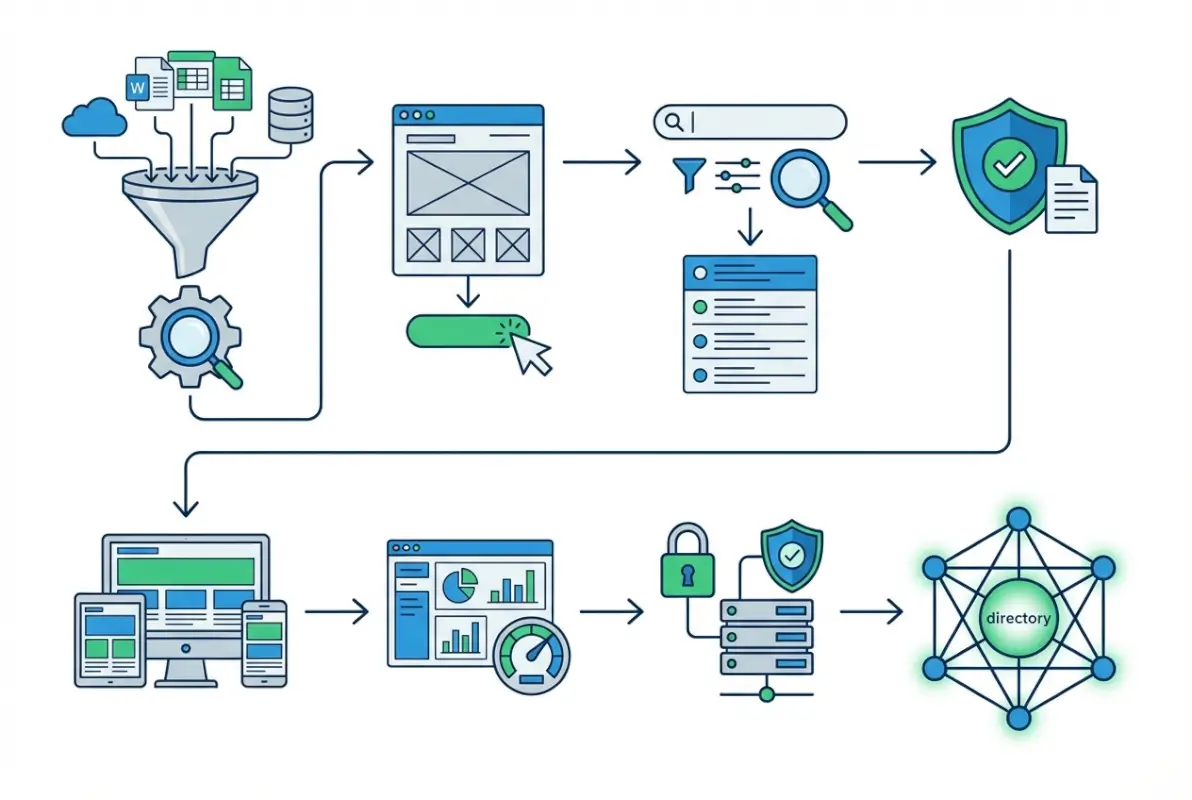
Intuition and best practices only take you so far. The directories that consistently outperform competitors are those that measure what matters, analyze user behavior, and make data-informed decisions. Understanding which metrics actually correlate with success—and which are just vanity numbers—separates sustainable directory businesses from those that plateau after initial launch excitement fades.
Performance Metrics that Matter
Not all metrics deserve equal attention. Organic traffic volume sounds impressive, but it means nothing if those visitors bounce immediately. Click-through rate from search results to your directory matters, but even more important is click-through rate from your directory to listed businesses—because that’s where value gets created for both users and business owners.
Conversion rate is your north star metric, but “conversion” needs proper definition. For some directories, it’s a phone call or directions request. For others, it’s a transaction or reservation. For lead-generation directories, it’s a contact form submission. Whatever you define as conversion, track it obsessively and break it down by listing type, category, traffic source, and device type to understand where value actually comes from.
| Metric | What It Measures | Why It Matters |
|---|---|---|
| Listing Page Views | How often individual listings are viewed | Indicates search visibility and listing appeal |
| Click-Out Rate | % of listing views that result in clicks to business | Core value delivery metric |
| Review Velocity | Rate of new reviews per listing over time | Engagement indicator and freshness signal |
| Claimed Listing % | Portion of listings actively managed by owners | Data quality and engagement proxy |
| Mobile Traffic % | Share of visits from mobile devices | Indicates need for mobile optimization |
Engagement metrics tell you whether your content resonates. Time on page, scroll depth, interaction with filters, and return visitor rate all provide insight into whether users find your directory valuable enough to stick around and return. Low engagement despite decent traffic usually signals usability problems or content that doesn’t match user intent.
Local and Directory Statistics That Shape Strategy
Understanding broader trends in how consumers use directories and local search helps contextualize your own metrics and identify opportunities. Mobile has fundamentally changed directory behavior—users now search while actively moving toward a purchase decision, not passively browsing from a desktop. That shift has massive implications for what information needs to be prominent and how quickly pages need to load.
Review influence continues to grow. Multiple studies consistently show that consumers trust online reviews nearly as much as personal recommendations, with the caveat that they’re looking for patterns across multiple reviews rather than obsessing over star ratings. A business with fifty 4-star reviews typically outperforms one with five 5-star reviews because the volume signals legitimacy and the slight imperfection signals authenticity.
The link value of directory submissions has shifted significantly. While many directories now use nofollow links (which pass little to no SEO value), the citation value—having consistent business information across authoritative directories—remains important for local search rankings. The SEO value of directory inclusion now comes more from data consistency and brand visibility than from direct link equity.
The Role of Reviews and Ratings
Reviews aren’t just nice social proof, they’re conversion drivers that can make or break a listing’s performance. Research consistently shows that the presence of reviews (even mixed reviews) outperforms no reviews, and that users actively seek out negative reviews to understand potential downsides before making decisions. This creates an interesting dynamic for directory operators: facilitating authentic reviews (including negative ones) actually builds trust more than curated exclusively-positive reviews, similar to insights found when exploring ways make money online directory earn strategies.
Star ratings provide quick filtering mechanisms, but review content provides the context that drives decisions. The most valuable reviews include specific details about the experience, describe what type of customer might be best suited for the business, and provide balanced perspectives that acknowledge both strengths and weaknesses.
Impact of Structured Data and Rich Snippets
Schema markup implementation might seem like technical minutiae, but it directly impacts visibility in search results. Directories that properly implement LocalBusiness schema, AggregateRating schema, and related structured data types enable rich snippets that make their listings more prominent and clickable in search results.
Rich snippets can display star ratings, price ranges, business hours, and other key information directly in search results. This increased visibility typically translates to higher click-through rates from search engine results pages. But there’s a catch: you only get rich snippet eligibility if your markup is correct and if your content meets quality thresholds that search engines continuously refine.
Beyond basic schema, opportunities exist for event markup (for directories featuring events), FAQ schema (for common questions about listed businesses), and breadcrumb markup (for improved site navigation display in search results). Each additional schema type implemented correctly provides another potential visibility boost.
Content and Architectural Best Practices for Top-Ranking Directories
Great content and solid information architecture don’t happen by accident. They’re the result of intentional decisions about how to structure information, how to present it visually, and how to optimize for both human visitors and search engine crawlers. The directories that consistently rank well have mastered the balance between comprehensive content and scannable presentation.

Clear, Scannable Location Pages
Location pages are often the workhorses of directory traffic, ranking for “businesses in [city]” or “[category] in [neighborhood]” queries. But too many directories treat location pages as afterthoughts—thin content pages with just a list of businesses and minimal context. The opportunity is to create genuinely useful location landing pages that serve user intent while naturally incorporating target keywords.
Effective location pages include contextual information about the area, highlighting what makes it unique or relevant for the directory’s focus. A restaurant directory’s Seattle page might mention neighborhoods known for specific cuisines, while a home services directory’s page would reference common local considerations (weather patterns that affect roof maintenance, local building code considerations, etc.).
The business listings themselves should be scannable—filterable by subcategory, sortable by rating or distance, and supplemented with quick-view information (ratings, price level, key features) that helps users narrow options without clicking through to every full listing. Pagination or infinite scroll needs careful implementation to ensure all listings remain indexable by search engines.
Category and Subcategory Taxonomy that Aligns with User Intent
Your taxonomy is your directory’s backbone, it determines how users navigate, how search engines understand your content, and how effectively you can scale to thousands of listings without creating chaos. The mistake most directory operators make is building taxonomy based on internal logic rather than user search behavior.
Start with keyword research that reveals how users actually search for businesses in your vertical. They might search for “family law attorney” rather than “divorce lawyer,” or vice versa—your job is to match their language, not impose your preferred terminology. Tools like Google’s Keyword Planner, AnswerThePublic, and analysis of competitor categories reveal user language patterns.
Balance breadth and depth carefully. Too few top-level categories force unlike businesses together; too many fragment your content across sparse pages. A three-tier structure (top-level category → mid-level subcategory → specific service/specialization) works well for most directories, allowing you to create substantial category pages while still providing specific targeting for niche queries.
Listing Publishing Workflows
The gap between submission and publication is where data quality gets enforced—or where it falls apart. Automated publishing might feel efficient, but it opens the door to spam, duplicate listings, miscategorized businesses, and low-quality content that degrades your directory’s value. Manual review of every listing scales poorly. The sweet spot is a hybrid workflow that uses automation for obvious quality checks and flags edge cases for human review.
Automated checks can validate phone numbers (format and potentially active status), verify addresses against postal databases, detect duplicate submissions based on name and location similarity, flag suspicious patterns (same email submitting many listings, obviously fake business names), and ensure minimum content requirements are met (description length, required fields completed).
Human review focuses on judgment calls: is this business appropriately categorized? Is the description substantive or just keyword-stuffed spam? Do the uploaded photos actually represent the business? Is this a legitimate business or someone trying to game your directory? Quality control at this stage determines whether your directory maintains standards or gradually degrades into a spam-filled wasteland, which connects to considerations around active directory business use cases and moderation approaches.
Visual Storytelling
Text descriptions matter, but visual content drives engagement and conversions. Listings with high-quality photos receive measurably more clicks, longer dwell times, and higher conversion rates than text-only listings. Video content (when relevant and well-produced) performs even better, providing users with a richer sense of what to expect before they commit to visiting or contacting a business.
Photo quality requirements need enforcement. Blurry smartphone snapshots, overly filtered images, and stock photos that don’t represent the actual business all undermine trust. The best directories provide photo guidelines (ideal resolution, composition tips, what to show) and moderate submissions to maintain visual standards. Allowing multiple photos—exterior shots, interior views, product/service examples, team photos—gives users comprehensive visual information.
360-degree views and virtual tours represent the cutting edge for industries where physical space matters (restaurants, hotels, retail stores, event venues). While not every business needs this level of visual content, those that invest in it see measurably better engagement. The technical implementation requires more sophisticated hosting and players, but the tools have become increasingly accessible.
Local SEO Optimization
Local SEO for directories means optimizing both your directory’s pages and the listings within them for geographic search queries. Location-specific content (city pages, neighborhood pages) should target not just “[category] in [city]” but also related long-tail queries that reveal user intent: “best [category] near [landmark],” “top-rated [category] in [neighborhood],” and question-based queries like “where to find [service] in [area].”
Citation building—ensuring your listed businesses appear consistently across multiple directories and data aggregators—improves their individual search visibility, which indirectly benefits your directory by association. While you can’t control external citations, you can ensure your directory becomes a citation source that others trust and reference.
Local link-building opportunities often get overlooked. Partnerships with local chambers of commerce, business associations, local news sites, and community organizations can provide authoritative backlinks that boost your directory’s domain authority. These relationships also provide content opportunities (spotlighting local businesses, covering local business news) that create reasons for return visits.
Accessibility and Performance Benchmarks
Web accessibility isn’t just a legal compliance issue (though it is that), it’s a usability enhancement that benefits everyone. Accessible design principles—clear visual hierarchy, sufficient color contrast, keyboard navigation, descriptive link text, properly structured semantic HTML—make your directory easier to use for all visitors, not just those using assistive technologies.
Core Web Vitals—Google’s performance metrics focused on Largest Contentful Paint, First Input Delay, and Cumulative Layout Shift—directly impact search rankings and user experience. Directories must meet performance targets across all page types: listing pages, category pages, location pages, and search results. This often requires technical optimization like image lazy-loading, code minification, efficient database queries, and content delivery network implementation.
Mobile-first indexing means Google primarily uses the mobile version of your content for ranking. If your mobile experience lags behind desktop—slower load times, hidden content, difficult navigation—your search visibility suffers. Testing on actual devices across various connection speeds (not just desktop browser simulators) reveals real-world performance issues that metrics alone might miss.
Monetization and Sustainability Without Compromising User Experience
Every directory operator eventually faces the monetization question: how do you generate revenue without degrading the user experience that made the directory valuable in the first place? It’s a genuine tension, and getting it wrong kills directories faster than almost any other mistake. Aggressive monetization alienates users and degrades content quality; insufficient monetization means you can’t invest in maintenance and growth.

Freemium vs Premium Listings
The freemium model—basic listings are free, enhanced listings cost money—has become standard because it aligns incentives reasonably well. Businesses get baseline visibility at no cost, and those who want additional prominence can pay for it. The trick is ensuring premium features provide genuine value without making free listings essentially invisible.
Premium features that work well include: priority placement in category and search results, enhanced listing pages with more photos and content, featured/highlighted placement on relevant pages, removal of competitor ads from their listing page, and analytics showing how users interact with their listing. These upgrades provide value without completely hiding free listings or degrading the user’s ability to find the best option for their needs.
| Listing Tier | Key Features | Best For |
|---|---|---|
| Free | Basic NAP, category, short description, limited photos | Testing, small businesses, baseline visibility |
| Enhanced | Unlimited photos, video, extended description, social links, basic analytics | Growing businesses ready to invest in online presence |
| Premium | Priority placement, badge/verification, competitor ad suppression, detailed analytics, featured status | Established businesses competing in crowded markets |
What doesn’t work: making free listings so limited they’re essentially useless, or selling top placement positions that aren’t clearly marked as paid. Both erode user trust and create incentive structures where deep-pocketed but mediocre businesses outrank genuinely excellent options.
Advertising and Affiliate Models
Display advertising and affiliate relationships provide alternative or supplementary revenue streams, but they require careful balance. Banner ads that push content below the fold or interrupt the user experience drive visitors away faster than they generate meaningful revenue. Affiliate relationships where you take commissions on transactions or leads can work well—if the recommendations genuinely serve user interest rather than just chasing highest payouts.
Transparency matters enormously. Clearly label paid placements, disclose affiliate relationships, and maintain editorial independence between monetization and content quality. Users have become sophisticated enough to recognize when recommendations are driven by affiliate commissions rather than genuine merit, and they’ll abandon directories that consistently push inferior options because they pay better.
Native advertising—sponsored content that matches the format of organic listings but is clearly labeled—can work if relevance is maintained. A plumber sponsoring the “emergency plumbing” search results makes sense; that same plumber appearing in “divorce attorney” results destroys trust. Relevance algorithms for ad placement should be nearly as sophisticated as your organic search relevance.
Privacy, Data Use, and Trust
Data privacy has moved from technical concern to mainstream trust issue. Users want to know what data you collect, how you use it, who you share it with, and how they can opt out. Privacy policies need to be both comprehensive and comprehensible—legalese-heavy documents that no one reads don’t build trust, even if they technically disclose everything.
Data minimization—collecting only what you actually need—reduces both privacy concerns and your own liability. Do you really need to know user demographics for every interaction, or are you collecting data just because you can? Every additional data point collected should serve a specific, justifiable purpose that benefits user experience or directory functionality.
Compliance with regulations (GDPR, CCPA, and emerging frameworks) isn’t optional, but it’s also not purely a burden. Directories that implement privacy-respecting practices as core design principles rather than grudging legal compliance often find they build stronger user relationships and differentiate themselves from competitors who treat privacy as an afterthought.
Balancing Revenue and Content Quality
The long-term sustainable approach prioritizes content quality and user experience, with monetization designed around that foundation rather than compromising it. Short-term revenue grabs—selling top placement to the highest bidder regardless of quality, accepting obviously spam listings because they pay—provide temporary cash flow while destroying the asset’s long-term value. I’ve watched more than one directory go from thriving community resource to spam farm through these short-sighted decisions, which ties into broader considerations about ways make money online directory earn without destroying user trust.
Quality controls need to apply equally to free and paid listings. Premium placement should amplify great businesses, not give bad ones cover. Review moderation should be consistent regardless of whether the reviewed business has a paid listing. Category placement and verification should follow the same standards for everyone.
Operational Playbook: Launch, Grow, and Sustain an Online Directory
Building a quality directory requires more than good intentions and solid initial design. It requires operational systems that maintain quality at scale, processes that evolve with changing user needs, and governance structures that prevent gradual degradation. The difference between directories that thrive and those that stagnate often comes down to operational excellence in these behind-the-scenes systems, similar to principles found in discussions about business phone menu directory options and structured workflows.

Standards, Onboarding, and Verification for Listings
Your submission and verification process sets the quality bar for everything that follows. A friction-free submission process that accepts anything gets you volume but not quality; an overly restrictive process that demands extensive documentation upfront prevents legitimate businesses from bothering. The sweet spot is progressive verification that gets basic information quickly while allowing businesses to enhance their listings with additional verification over time.
Initial submission should capture essentials: business name, category, location, contact information, and a basic description. Automated validation checks ensure data meets minimum standards (valid address format, phone number format, required fields completed). Businesses receive immediate confirmation that their submission is received and under review, with clear expectations about timeline and next steps.
Verification tiers let businesses prove legitimacy at various levels. Email verification (clicking a link sent to the business email) provides baseline confirmation. Phone verification (receiving a code via call or SMS) adds another layer. Document verification (uploading business license, tax ID, or incorporation documents) provides the highest assurance and can unlock premium verification badges.
Content Pipeline: Acquisition, Curation, and Community Contributions
Successful directories typically blend multiple content sources: business submissions, data partnerships and licensing, community contributions, and editorial curation. Relying on a single source creates vulnerabilities—if business submissions dry up or data partnerships end, your pipeline breaks. Diversification ensures consistent content flow even as individual sources fluctuate.
Data partnerships with business registries, chambers of commerce, industry associations, and existing databases can seed your directory with baseline listings. These partnerships typically involve licensing fees or revenue sharing, but they provide scale that would take years to build through organic submissions. The challenge is ensuring data quality and freshness, since licensed data is only as good as its source.
Community contributions—user-submitted photos, reviews, updated hours, and flagged errors—provide ongoing freshness and richness that business owners alone often don’t maintain. Incentivizing contributions (gamification, recognition, small rewards) while moderating for quality creates a virtuous cycle where engaged users continuously improve content quality.
Moderation and Quality Assurance
Moderation exists at the intersection of spam prevention, quality enforcement, and community management. Under-moderate and your directory fills with spam, fake reviews, and low-quality listings; over-moderate and you stifle legitimate participation and create resentment. Finding the right balance requires clear guidelines, consistent enforcement, and mechanisms for appeal when mistakes happen.
Automated moderation catches obvious spam: duplicate submissions, clearly fake reviews (generic text, impossible experiences, violation of basic logic), prohibited content (illegal services, adult content in family directories), and pattern-based abuse (same user creating multiple fake accounts). Machine learning models trained on your specific content can improve over time, becoming better at distinguishing legitimate edge cases from actual violations.
Human moderation focuses on judgment calls and appeals. Is this review harsh but legitimate, or does it cross into personal attack? Is this business genuinely in this category, or are they stretching to game the system? Is this photo representative of the business, or misleading stock imagery? These nuanced decisions require human judgment informed by clear policies.
Analytics and Optimization Cycle
Data-driven optimization turns a good directory into a great one. Regular analysis of user behavior, conversion funnels, search patterns, and engagement metrics reveals opportunities for improvement that intuition alone would miss. The key is establishing a regular rhythm—weekly metrics review, monthly deep-dives, quarterly strategic assessment—that keeps optimization ongoing rather than sporadic.
A/B testing specific elements (listing layout, filter options, call-to-action buttons, premium feature positioning) provides concrete evidence about what works rather than relying on opinions or assumptions. Start with high-impact pages (search results, popular category pages, high-traffic listings) where improvements deliver the most value.
KPI dashboards should track both leading indicators (new listings submitted, claimed listings, review submissions) and lagging indicators (traffic, conversions, revenue). Leading indicators give you early warning when something is trending wrong; lagging indicators confirm whether changes are working. Both matter, but for different purposes.
Governance and Compliance
Terms of use, content policies, privacy policies, and community guidelines form the governance framework that protects both your directory and its users. These aren’t just legal necessities, they’re communication tools that set expectations and provide the foundation for enforcement actions when problems arise.
Accessibility compliance (WCAG standards) ensures your directory serves users with disabilities while often improving general usability. Regular accessibility audits catch issues before they become barriers or legal problems. Automated testing tools catch many issues, but manual testing (including testing with actual assistive technologies) provides the most thorough assessment.
Data protection and security measures protect user information from breaches while meeting regulatory requirements. Regular security audits, penetration testing, and staying current with patches and updates prevent most common vulnerabilities. Clear incident response plans ensure you can act quickly if breaches occur despite precautions.
Best Practices Checklist and Quick-Start Guide
Theory is useful, but concrete action steps accelerate implementation. This checklist distills the seven core qualities into practical steps you can execute in a structured rollout. Whether you’re launching a new directory or optimizing an existing one, this framework provides a roadmap for systematic improvement.
- Define NAP data standards and validation rules
- Create category taxonomy based on keyword research
- Implement LocalBusiness schema markup
- Set up basic analytics and goal tracking
- Draft content submission guidelines
- Build listing submission and verification workflow
- Create moderation guidelines and tools
- Implement review system with spam filtering
- Design mobile-responsive listing templates
- Set up automated data validation checks
- Add search filters and sorting options
- Implement geolocation and distance search
- Create business owner dashboard for listing management
- Design premium listing tier and features
- Optimize page speed and Core Web Vitals
- Test accessibility with screen readers and WCAG validators
- Weekly: Review moderation queue and user reports
- Monthly: Audit high-traffic listings for data quality
- Monthly: Analyze KPIs and adjust strategies
- Quarterly: Test and optimize conversion funnels
- Quarterly: Review and update category taxonomy based on search data
This timeline assumes you’re starting from scratch or doing a comprehensive overhaul; adapt it based on your current state. If you already have solid infrastructure, you might compress the timeline; if you’re building everything custom, you might need additional time for development.
Frequently Asked Questions
What makes an online directory trustworthy?
Trustworthy directories combine verified business information, moderated reviews from real users, clear policies about data use and paid placements, and consistent enforcement of quality standards. Verification badges, transparent moderation practices, and mechanisms for users to report problems all contribute to perceived trustworthiness. Directories that disclose how they make money and maintain editorial independence between monetization and content quality earn higher user confidence.
How important are reviews for directory success?
Reviews significantly impact both user decision-making and search visibility. Listings with reviews see measurably higher click-through rates and conversions than those without. From an SEO perspective, fresh review content signals active engagement and listing relevance. The volume and recency of reviews matter as much as average ratings—users trust patterns across many reviews more than perfect scores from just a few reviews.
What is NAP consistency and why does it matter for directories?
NAP consistency refers to maintaining identical Name, Address, and Phone information across all online listings and citations for a business. Search engines cross-reference business data across multiple sources to determine legitimacy and relevance. Inconsistent NAP data creates conflicting signals that can suppress both individual listing visibility and your directory’s overall authority. Consistency reinforces that information is accurate and trustworthy.
Should I allow user-generated content on listings?
Yes, user-generated content like reviews, photos, and updated information significantly enhances directory value when properly moderated. It provides freshness that business owners alone often don’t maintain and offers diverse perspectives that help other users make informed decisions. The key is implementing moderation workflows that prevent spam and abuse while encouraging legitimate contributions. Clear guidelines and consistent enforcement maintain quality without stifling participation.
How can I improve listing discovery and engagement on mobile?
Prioritize fast load times (under three seconds), implement responsive design that adapts to various screen sizes, use large touch-friendly buttons and interface elements, enable click-to-call functionality, simplify forms for mobile input, and ensure filters and search work smoothly on touch devices. Location-based features (geolocation, “near me” functionality) are especially valuable for mobile users actively seeking nearby services.
What data standards or schemas should I implement?
Start with LocalBusiness schema from Schema.org, which tells search engines exactly what each piece of business information represents. Add AggregateRating schema for review data, PostalAddress for location information, and OpeningHoursSpecification for business hours. If your directory includes events, products, or FAQs, implement relevant schemas for those as well. Proper schema markup enables rich snippets that improve search visibility and click-through rates.
How should I monetize a directory without harming user experience?
Implement freemium models where basic listings are free and premium features provide genuine added value (enhanced visibility, more content space, analytics) without making free listings useless. Clearly label paid placements and sponsored content. Maintain editorial independence so payment doesn’t influence quality standards or review moderation. Ensure ads are relevant to user intent and don’t interrupt the core experience. Prioritize long-term trust over short-term revenue extraction.
How often should I refresh listings and verify data?
High-traffic listings should be spot-checked quarterly at minimum. Automated systems can flag listings that haven’t been updated in six months for review. Implement proactive outreach to business owners annually to confirm information accuracy. Reviews and user reports provide ongoing signals about potential data issues. Businesses with claimed listings should be able to update information instantly, while unclaimed listings require verification before changes publish.
What are common mistakes to avoid when building a directory?
Avoid accepting all submissions without quality control, which leads to spam proliferation. Don’t neglect mobile optimization since most directory searches happen on mobile devices. Resist making free listings essentially invisible to push paid upgrades, which drives users away. Don’t ignore data governance—directories without regular audits gradually fill with outdated information. Avoid over-complicating navigation or burying search functionality. Never compromise editorial integrity for monetization.
How do I measure directory success?
Track listing page views and click-out rates to measure value delivery to users. Monitor conversion rates for defined actions (calls, directions, website visits, reservations). Measure engagement through time on site, pages per visit, and return visitor rates. Track growth in claimed listings and review velocity as health indicators. Monitor organic traffic and ranking positions for target keywords. Calculate revenue per listing and customer acquisition costs for business sustainability metrics.
Conclusion: Building Directories That Deliver Lasting Value
Creating a great online directory isn’t a one-time project, it’s an ongoing commitment to accuracy, usability, and user value. The seven core qualities—accurate and consistent data, rich structured content, visible trust signals, thoughtful usability design, effective search and discovery, reputation management features, and rigorous data governance—work together as an integrated system. Neglect any one element and the others can’t fully compensate.
The directories that succeed long-term are those that resist short-term thinking. They invest in data quality even when it’s tedious. They moderate reviews consistently even when it’s thankless work. They maintain editorial integrity even when compromising would be more profitable in the moment. They optimize continuously based on data rather than assumptions.
Start with a comprehensive audit of your existing directory (or competitive analysis if you’re building new). Identify which of the seven core qualities need the most attention. Prioritize improvements that will have the highest impact on user experience and search visibility. Implement measurement systems before making changes so you can quantify improvement. And remember: great directories are never finished, they’re continuously evolving to serve changing user needs.
The opportunity in the directory space remains significant because most directories settle for mediocre. They accumulate listings but don’t maintain them. They implement features but don’t optimize them. They grow initially but don’t sustain quality. By committing to the principles outlined here—and executing them systematically—you can build a directory that becomes a genuinely useful resource that users trust and return to. That’s not just good for your business metrics; it’s the foundation of a sustainable competitive advantage in an increasingly crowded market.
Now take what you’ve learned here and put it into practice, one quality improvement at a time.